
Okay, I can’t really say “ever” since I’ve never watched the Superbowl before. But seriously, who is Mark Sanchez!
MORE BEAUTIES
So, toward the end of last week I saw two more casts of Sleeping Beauty in New York City Ballet’s production. Above are the beautiful Kathryn Morgan as Aurora and Tyler Angle as her Prince Desire (Paul Kolnik is the photographer). Below are some photos of the other couple I saw, Tiler Peck (both she and Kathryn were making their Aurora debuts), with Gonzalo Garcia, albeit not from this ballet.
(in Four Bagatelles, photo by Paul Kolnik)
(and in the Christopher Wheeldon / Martha Wainwright collaboration over the summer, photo from NYTimes by Andrea Mohin; I like this photo because I think it shows each of their personalities well).
And then last week, I saw Ashley Bouder and Andrew Veyette.
I’ve been thinking about who I thought was best in what role but it’s actually really hard to do that. I honestly ended up liking everyone, though there were definite differences.
I do have a lot to say about Gonzalo Garcia though. I LOVED him as Prince Desire — he really melted me, he really completely stole the show that night and I feel like I’m not ever going to like anyone quite as well in that role now. I mean, you just have to see him in a classical ballet, as the romantic lead, and you realize why San Francisco audiences were so upset when he left SFB for NYCB a couple years ago. Some of those SFBallet fans were really devastated when he left. And I think it’s been such a puzzle to those fans that New Yorkers haven’t really fallen for him the same way. And I think it’s because he hasn’t had the chance to shine because NYCB is so Balanchine-heavy. He needs roles where he can act and become a character. He’s such the quintessential romantic prince.
You can really tell how differently he’s trained than the other NYCB dancers, who’ve nearly all come from SAB and been trained on Balanchine’s non-actable abstract ballets. I felt like with Gonzalo I was seeing someone from ABT — mainly Angel Corella (in terms of the body type, dramatic style and boyishly handsome face). The way he’d hold onto the music, draw it out while it crescendos, by for example in the vision scene holding out a finger to the princess and then leaning back, then looking out to the audience — not AT the audience but in the audience’s direction — to show how enthralled he is, how much he wants to catch her, all before then turning and running toward her. The other two — Tyler and Andrew — they didn’t do all that. They just kind of looked toward her standing more and more toward the tips of the toes, ready to run toward her when the music told them to. Gonzalo’s way was so much more Petipa and Tchaikovsky and Bolshoi and Romantic Russian and all that, and it might all seem overly melodramatic to audiences who aren’t used to that. But that’s what I’m used to with ABT — and that kind of stuff makes me swoon!– so that’s why I think I loved him so much. But I’m wondering what others who saw this cast thought?
And Gonzalo just knows what’s expected of him, as the prince. Later, when he went to do that crazy series of jetes, he was rested up and ready and he nailed them like I’ve never seen him nail anything. I’ve never seen his legs straighter, in perfect splits, and the whole way around the perimeter of the stage, without tiring. And it’s like he knew that was a very important part, and he had to do them perfectly because that’s just what the romantic hero does — that’s the way he shows his love for the princess, and that he’s worthy of her. The other two obviously took them seriously (because they’re crazy hard, you have to take them seriously), but it just was more of a difficult feat, instead of having the same meaning. You know what I mean? Like he looked out all across the stage wistfully, and then he just took off flying around it. It gave it a different meaning than just flying around.
It makes me wonder though if contemporary audiences understand that, or appreciate it. Or whether they prefer for the emotion to look more “natural”? I’m not saying Gonzalo was better than the other two, just different.
I wonder what Joaquin De Luz was like, since he’s not SAB trained either. Did anyone see him?
As far as partnerships, Kathryn and Tyler were my favorites. Tyler had a few flubs on some of his solo variations (but I still love him!), but he was always the perfect partner, he was always solid when supporting her. And the series of fish dives in the wedding pas de deux were some of the most breathtaking I’ve ever seen. Her legs were pointing completely up toward the ceiling! Magnificent! And the final hands-free fish dive was picture perfect.
I liked all of the Aurora interpretations, but they were different too. Kathryn was the most princess-like, the most regal, though that may just be the way she looks. She just kind of looks like royalty! Ashley and Tiler seemed more “real girlish” – all smiles and sweetness and awe at the world and their cute suitors.
The rose adagios were all near perfect. (ABT’s Sarah Lane is still the queen of the balances to me — it seems like she could hold them for hours.) Kathryn had the most absolutely gorgeous extensions. Do I have to giggle every time Robert Fairchild comes out leading the cavalcade of suitors? I loved Craig Hall as the “African prince,” – I don’t know what exactly stood out about him but something did. And even though it wasn’t a dancing role, I loved Henry Seth as the King; he acted it really well. Chase Finlay was lovely as Gold in the wedding scene – -he’s a really beautiful dancer with exquisite lines. Everyone’s talking about him being the next romantic lead. I loved tiny Erica Pereira as the fairy of eloquence and Ana Sophia Scheller as the fairy of courage, thought Faye Arthurs and Adrian Danchig-Waring were brilliant as The White Cat and Puss in Boots, and Daniel Ulbricht is the quintessential gymnastic court jester.
And there’s NEVER been a better Carabosse than Georgina Pazcoguin! Nor has there ever been (or, perhaps, could there be) a better Lilac Fairy than Sara Mearns. I love how she arches her back so luxuriously and opens up her chest. And the rich, full-out port de bras. Such beautiful expansiveness, that, with her beatific face, makes her perfect for this angelic role. She reminds me of Veronika Part.
Okay, that’s all I can think of, for now!
This week begins the Swan Lakes. I’ve never seen Peter Martins’ version, so I’m really excited. In particular, I’ve heard wonderful things about Maria Kowroski as Odette and I’m psyched for Stephen Hanna’s debut as Prince Siegfried!
BARYSHNIKOV INTERVIEW SERIES FROM THE DAILY TELEGRAPH
In honor of his 62nd birthday (which occurred last week), the British website The Arts Desk is posting a two-part series of interviews that Daily Telegraph writer Ismene Brown conducted with Mikhail Baryshnikov over the years, covering everything from his youth and Kirov training, to his defection, to his relationship with Nureyev and some of his ballerina partners (including Gelsey Kirkland).
Here is the first part. They’ve got a couple of old videos there too — do check it out!
Above photo taken from the article.
BRITISH SO YOU THINK YOU CAN DANCE
The esteemed Guardian critic Judith Mackrell tackles the British version of SYTYCD. And damn, their show looks so much better than ours!:
“Who knew we’d be seeing choreography by Henri Oguike, Rafael Bonachela and Mark Baldwin on prime-time Saturday TV, or hearing serious discussion of brisés volés? So You Think You Can Dance may have some of the naffest production values on the box, but it’s actually done the job of getting dance – other than ballroom – into the mainstream. And so far, I’m hooked.”
BURN THE FLOOR GOES TO TORONTO
Where it will star Pasha and Anya! Photo (and story) taken from here. Dancers will also include SYTYCD alum Karen Hauer and Artem Chigvintsev. The show will stop briefly in Vancouver, from April 13-18, then head to Toronto from April 22-May 1, before traveling on to Europe.
ALVIN AILEY BEGINS THEIR 20 CITY TOUR IN DC AND VP HOSTS A CELEBRATION IN THEIR HONOR
The luckiest dancers in the world, I swear, are those in Alvin Ailey. That company seems to tour more cities in more countries every year than any other performing arts troupe. It’s like, become a dancer and see the world! Anyway, they began their current U.S.-wide tour last night in Washington DC, where the Vice President and Dr. Biden hosted a celebration in their honor. Vice Pres Biden apparently admitted he was never a fan of ballet until he and his wife witnessed Mikhail Baryshnikov years ago. Read more at Sister to Sister Magazine. And go here for AAADT’s tour schedule.
Photo of Judith Jamison’s Divining by Nan Melville.
NEW YORK CITY BALLET’S SLEEPING BEAUTY IS THOROUGHLY CAPTIVATING FROM START TO FINISH
This past week, New York City Ballet began its two-week run of Sleeping Beauties. I saw the opening night performance, with Ashley Bouder (above with Damian Woetzel, in Paul Kolnik photo) in the lead. She danced opposite Andrew Veyette, as Prince Desire. Both did really, a near-perfect job (just because nothing’s ever completely perfect!). Really, I don’t know what more you could ask for, although I’m waiting to write my full review on the production until later this week, after I’ve seen two more casts: Kathryn Morgan as Aurora and Tyler Angle as PD (with Janie Taylor as the Lilac Fairy!), and then Tiler Peck and Gonzalo Garcia as the leads.
I love NYCB’s production — a lot more than ABT’s — and I can’t really figure out why. In NYCB’s there’s really never a dull moment — there’s no boring court dancing, just all the wondrous ballet, the very intricate and complicately awe-inducing variations for the various faeries (Sara Mearns was gorgeous as Lilac Fairy — in photo below by Paul Kolnik, as were Amanda Hankes, Lauren King, Rebecca Krohn, Erica Pereira, and especially Ana Sophia Scheller as Fairies of Tenderness, Vivacity, Generosity, Eloquence, and Courage respectively), the fun “wedding scene” with all the cute virtuosity-driven duets for the fairy tale characters (once again, loved Sean Suozzi last week — here as Puss in Boots, and Stephanie Zungre as his partner the White Cat; loved Tiler Peck and Daniel Ulbricht as Bluebird and Princess Florine, loved Henry Seth as the Wolf but not sure why they had a little girl dance Little Red Riding Hood…), the “jewels” starring Stephen Hanna :), and of course the beatific Grand Wedding Pas De Deux between Bouder and Veyette.
I don’t know, there’s just never a dull moment: you go from the Rose Adagio with all the virtuosic balances for Aurora (and the handsome cavaliers), to the richly choreographed fairy variations (that seemed to me more Balanchine than Petipa), to the drama of Carabosse’s arrival with her creepy minions and the frightening spell she casts, to the sweet Vision scene, to the quick Awakening (nothing in this production is long and drawn out; each scene gets right to the point), to the Wedding with the entertaining guests, and ending with the beautiful pas de deux between Beauty and the Prince.
I can’t figure out what exactly is different between this version and the others I’ve seen before, but honestly, this hasn’t been one of my favorite story ballets. So I was just really floored by how captivating NYCB’s production was. I can’t wait to see a few more this week. NYCB is good at story ballets! If you’re in NY and you can make it sometime this week, do go!
GYOR NATIONAL BALLET FROM HUNGARY AT THE JOYCE
Photo by Bela Szabo, of Gyor National Ballet’s Rite of Spring, from here.

Reviewed by Christopher Atamian.
Györ National Ballet (at The Joyce January 26-31)
From the land of Bartók and Kodály, strudel and palascinka, comes Hungary’s Györ National Ballet, a vibrant dance company that everyone should have the pleasure of seeing at least once during their next New York appearance. It takes considerable originality and artistic vision to re-interpret Petrushka and Rite of Spring with the verve and sometimes breathtaking visual appeal that Györ brought to the Joyce on January 26. The company was founded in 1979 by two graduates of the National Ballet Institute. Led by Janós Kiss since 1991, it has since won accolades worldwide: all twelve members that performed here are talented, vibrant and passionate dancers with evident balletic training behind them.
The presentation at the Joyce, titled “A Stravinsky Evening” was dedicated to the twentieth anniversary of the fall of the Iron Curtain. The original Petrushka ballet was of course choreographed by Mikhail Fokin but this version, credited to Dmitrij Simkin and James Sutherland presents a fresh look at the well-worn story. Here Petrushka (Bálint Sebestyén) is transformed into a free thinker who resists communist indoctrination, while the sorcerer (Balázs Pátkai) is a party leader in uniform who tracks him down, interrogates and tortures him. Both Sebestyén and Pátkai dance their roles beautifully. Pátkai is appropriately rigid and authoritarian (but sinuous and sinister as well) while Sebestyén is equally adept at performing different tempos and phrasings—at one point he dances torso nu to a particularly sensitive segment of Stravinsky’s music with rare, almost spellbinding sensuality, as if he were actually in a trance: his body quivers all over as he moves arms and legs into languorous serpentine positions. The other dancers are also attuned to soft almost ethereal body movements; as a whole they executed beautifully but their strength was surely the seemingly effortless synchronicity that they achieved with the Stravinsky score. The piece ends as it begins with a fast-paced pop-inspired communist scout march—a lovely bookend to the Stravinsky. The dancers again perform as communist scouts, mainly running in place and repeating a few movements in synchronicity—illustrating with deft alacrity that complete oxymoron known as “happy totalitarianism.”
This Petrushka presents the type of work that European companies often still perform best: intelligent, classically-based work updated for contemporary audiences—based in literature or myth, the stories told seem fresh and relevant. In the program notes, Simkin avers: “I present here, not dolls with human feelings…as in Fokin’s work, but humans who act like puppets in a society controlled by propaganda where misleading the masses and brainwashing controls the whole society.” Simkin and Sutherland introduce current themes and update ballet’s sometimes archaic fairy tale themes, while presenting innovative movement not slavishly hampered by traditional technique and point work. The scenery and costumes, also by Dmitrij Simkin were arresting: a large shining red star hung over a stage; a large head of Lenin lay in the background. The piece sometimes lacked subtlety—Stravinsky is already domineering enough as it is without being hit over the head with an overt political message; and when the Lenin head was rolled around and literally knocked everyone to the ground, you sort of just sighed at the obviousness of it all. But that is small criticism surely when compared to its overall depth and beauty.
Attila Kun’s Rite of Spring was sheer delight. Here the set changes to minimalist and ultra-modern: a white rectangle surrounded on the edges by a black border, all of it glinting like marble under the stage lights. The eleven dancers of both sexes, all equally beautiful physically, wear only white—the men in long pants, bare-chested in cotton frocks, the women in culottes and asymmetrical tops that made them look as if they had just come down an Hervé Leger catwalk. At one point the dancers sit down facing each other two-by-two to apply ceremonial paint, remaining stoic in light of what is about to take place. The clean lines and unencumbered choreography create the illusion that perhaps we are not about to witness something terrible. And the lithe Lilla M. Horváth is simply astounding as “The Chosen One,” both as an actress and dancer, even as she futilely fights for her life and gasps her last breath. The other dancers—all assistants and too numerous here to mention—defy time and place, something almost Egyptian or ageless in their presentation as if they had walked off an episode of Stargate, noble in demeanor, sporting long limbs and almost extraterrestrial in bearing! As the piece comes to a close, the dancers have not only presented a pagan sacrifice, but also the idea of renewal and hope, much like modern Hungary emerged from communist rule, proud and independent.
BOOK BREAK
Just FYI, I’ve finally managed to reduce my novel’s Amazon price from $17.99 to $14.99. That’s the print price; the Kindle is $9.99. The endlessly wonderful James Wolcott has given me yet another shout-out — thank you Mr. Wolcott! And how sweet is this, and this!
I haven’t participated in a meme for a long time and so thought I’d take the one posted by Laurel-Rain in her Seasons blog (the last link above). The rules are to find the book nearest you, turn to page 56 and write the 5th sentence (and maybe a sentence or two after that for context, if you like). For me, that book is
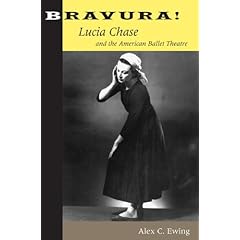
Bravura! Lucia Chase and the American Ballet Theatre by Alex C. Ewing (Chase’s son), which I received for review purposes. I’m about a quarter of the way through; so review coming soon. Here’s the passage:
“Lucia would have had to be blind not to see that Mordkin was being pushed out of the picture. Yet she was most decidedly not the author of the early plans for Ballet Theatre, nor was she calling the critical shots. Other than providing the seed money for Pleasant to proceed with his grand design, Lucia had made a strict and unequivocal effort to stay out of management.”
So far, my favorite parts have been more about Lucia’s personal life than the details of setting up the company — such as her relationship with her husband, who died tragically young, when the couple’s two children were still babies. For years after his death, she would write him notes, telling him what she was doing, thinking, about her life. A way of keeping him around, I guess. So heartbreaking. Right now I’m reading about her love / hate relationship with Agnes de Mille — delicious fun!

That’s nonfiction. Here is a novel, Picking Bones From Ash, that was just about the same distance away from me. It’s by my friend, Marie Mutsuki Mockett, and I recently finished it and wrote a review of it on Goodreads. I absolutely loved it; I learned so much — about Japanese culture, European culture, Japan itself, Buddhism, classical music, historical artifacts, how to discern the period in which a piece of art was made — just read it, it’s filled with such beautiful detail and the story is so suspenseful you really won’t be able to put it down after a certain point. Anyway, here is page 56’s fifth sentence:
“We continued to spend time together on the weekends and during the holidays when I was home in Hachinohe. In the middle of my second year of college, however, Masayoshi began to act a little bit strange again. It all started when his father had a small stroke around the same time that I was caught up in preparing for the annual Messiah concert.”
One other book I just received in the mail and am currently reading is this:

Anatolia and Other Stories is a collection of short stories by Anis Shivani, whose work I became familiar with in the literary journal Boulevard. According to a quote by award-winning novelist Laila Halaby on the inside cover, the collection “takes us around the globe in stories that juxtapose old and new, east and west, with characters that do their best to navigate the generational / religious / cultural / socioeconomic tensions inherent in our global economy. Shivani’s observations are dead-on, especially when dealing with themes of loss, family dynamics, and subtleties of power.”
Finally, here’s another book related to dance that I didn’t have time to review, but that is getting good reviews.

The Sugarless Plum, by Zippora Karz, details the New York City Ballet dancer’s struggles coping with the dangerous and life-altering Type 1 Diabetes, which she was diagnosed with at age 21, while still a corps member in the company. Despite the disease she nevertheless managed to rise through the ranks and enjoy a solid, 16-year ballet career.
If anyone wants to participate in the meme, just link back to this post on your blog, or, if you don’t have a blog, you can write the book’s passage in a comment here.
SAMANTHA HARRIS IS LEAVING DANCING WITH THE STARS
MSNBC (via People.com) reports that Samantha Harris is leaving her position as Dancing With the Stars co-host in order to focus on her work on The Insider and Entertainment Tonight. She calls DWTS a “dream job” and says she’s sad to leave. Host Tom Bergeron is reportedly hoping to have her on sometime as a contestant (which could be fun). Season 10 begins March 22nd.
Photo: Kelsey McNeil / ABC
HENNING RUBSAM’S "IMPENDING VISIT"
I’ve been such a bad blogger (and bad friend) lately! Back in November, my friend Henning Rubsam, who founded, directs and choreographs for SenseDance, premiered his latest dance, Impending Visit, at the Jacqueline Kennedy Onassis Theater in midtown. I’d meant to write about it but lost track of time. So here are some pictures, all by JAN LA SALLE. Dancers are Erin Ginn, Heidi Green, Maria Phegan, Victor Gonzalez, Dartanion Reed, and Ramon Thielen.
It wasn’t the world premiere of the work, but the New York premiere. The world premiere took place in October at a festival — the Fiesta Iberoamericana de las Artes, in Old San Juan, Puerto Rico, at which Henning was honored for his longtime commitment to using contemporary music in his ballets. He collaborated on this piece with Puerto Rican composer Rafael Aponte-Ledee.
The music was very abstract, very modern and at times light and mellifluous, at times discordant with an air of mystery, which well suited the dance, a combination of ballet and modern with some Puerto Rican social dance — rumba basics, salsa, and some swing — thrown in. Dancers moved in pairs, trios and in ensemble. The partnering moved from sweet and flirty (the social duets), to more daring (the balletic), with complex lifts and balances. The stage was made up, as you can see above, to resemble an industrial landscape, like the action took place in the interior of some kind of skyscraper perhaps. Lighting was by Philip Trevino. I’m not sure what it all meant, since it was very abstract, but it made me think of the way cultures can initially collide but through mutual exploration can eventually harmonize and breed something new.
Also showing were several other of Henning’s dances – I think there were eleven in all! What I love about going to a SenseDance show is that there is such variety. He gets straight to the point, his dances are never too long, and he presents a variety — ballet, modern, jazzy. My favorites are still Caves and Amaranthine, both danced with his most stand-out dancers (imo): Maria Phegan and Dartonian Reed. Caves in particular reminds me a bit of Balanchine’s Prodigal Son — with the innocent young man and the seductive siren, except here it’s more like human / ethereal creature resembling a spider who veers from companionable and intriguing to potentially ensnaring. Phegan has limbs that just go on and on and her poses are always so striking. And Reed is the perfect foil / partner for her.
(photo from Treehugger).

Here is a video clip of a composite of the performed dances:
BARYSHNIKOV AND ANNIE LIEBOVITZ IN LOUIS VUITTON AD
Annie Liebovitz’s latest Louis Vuitton ad features the photog herself along with her longtime friend, Mikhail Baryshnikov. I love how his pants legs are rolled up and his well-worked feet are visible — I love how he’s not really making a dancerly pose, yet you can still tell. And I love how young he looks!
Visit the NYTimes blog to see an early video of their working together (a fuller one will apparently be available February 11th).