HELP!


Okay, just one more post before I settle down for the weekend.

Next week is going to be pure insanity. Practically every single Giselle cast at ABT is a must-see. Retiring ballerina Nina Ananiashvili is dancing her last two Giselles Monday (with Marcelo Gomes) and Friday (with Jose Carreno); Tuesday Diana Vishneva dances the lead (whom many critics consider best in the role); Wednesday matinee David Hallberg and Maria Riccetto make their debuts; Wednesday night Veronika Part dances the Queen of the Wilis with Irina Dvorovenko in the lead; Thursday night La Scala superstar Roberto Bolle makes his debut as the newest company principal; Saturday matinee Herman Cornejo dances Albrecht; and Saturday night is visiting Bolshoi ballerina Natalia Osipova in the lead. (By the way, Saturday night casting has recently been changed to David Hallberg as Albrecht, dancing in place of the apparently still-injured Ethan Stiefel.)

Across the plaza at New York City Ballet, the newish ballet Lifecasting by Douglas Lee (which is your only chance to see Ashley Bouder dance this season) shows on Wednesday night, Friday night, and the Sunday matinee along with the critically acclaimed Christopher Wheeldon ballet, Mercurial Manoeuvres (one of my personal favorites of his). And their always fun Dancers’ Choice program is on Sunday night. (Visit Oberon for more deets on that).

I had also wanted to see Jennifer Muller’s The Works 35th Anniversary program at the Joyce in Chelsea but just don’t know if I’m going to be able to pull it off.


Also, the following week, on Tuesday, June 16 from 5:30-7 pm, Roberto Bolle (photo from here) will be at Rizzoli Bookstore (on 57th Street between 5-6th Avenues) signing copies of his book (of photos of him dancing at La Scala).

Happy weekend, everyone!

LIEBESLIEDER WALZER


I’m pooped! After a week of writing about scent operas, ABT, new ballets, and SYTYCD dramas, I really need to spend the rest of the weekend working on my novel. I’ve spent the latter part of this week at New York City Ballet and promise to write about those performances soon. In the meantime, please enjoy this Paul Kolnik photo of my favorites, Janie Taylor and Sebastien Marcovici in Balanchine’s Liebeslieder Walzer (which I enjoyed much more than Vienna Waltzes although the latter was far more popular in its day and the former was in fact taken out of the NYCB rep for some time! More on that later…)

WHY ARE THE WORLD’S GREATEST DANCERS SO PATHETICALLY UNDERVALUED?


I was originally going to title this post “WHOSE PUBLICITY STUNT WAS THIS?” because I couldn’t imagine how someone who was just promoted to principal at one of the most prestigious dance companies in the U.S., helmed by one of the most famous names in dance, could possibly want to jeopardize his career by doing something so publicly that is explicitly forbidden by his contract and then admitting on national TV that he wasn’t fulfilled at his job and wanted more — like the chance to dance ballroom and hip hop. And then I did a Google Image search of Alex Wong for this post and found two pictures of him dancing, and that was after I had to narrow it down substantially to exclude all the many other Alex Wongs in the universe. Even given all I said at the top of the post, he hardly has an internet presence.

For those who didn’t watch tonight’s SYTYCD, it was the last day of Vegas-round auditions, when the judges called each contestant onstage and told him / her whether they’d made the top 20. Of course everyone in the ballet world was ecstatic over Alex being on the show — it would be just like Danny Tidwell; we’d actually have someone brilliant to watch. When Alex was called up, the judges all confirmed how brilliant he was. Then Nigel told him that, given that he was under contract with “Miami Ballet,” he’d spoken with Edward Villella to see if the artistic director would allow Wong out of his contract for the time necessary to be on the show. Villella said no, we need him. Nigel said he didn’t blame Villella. Nigel, completely blowing me away here with actual wisdom, looked at Wong like he was completely off his nut and told Wong he was currently enjoying the opportunity to work with one of the greatest dancers  in the history of dance. Enjoy that time, learn everything you can, he said, and then maybe in the future if you still want, you can be on the show. Nigel actually shrugged at those last words. Like he knew how it sounded to anyone who knew the least bit about dance. Good for Nigel, for once. Seriously, I have a completely newfound respect for the man.

Wong cried — as if he didn’t know this was coming — and said he was so limited in his company; here he’d seen so many people enjoying so many different kinds of dance, he’d been exposed to so much here. His tears looked real.

So, my first thoughts were – –just like Count Albrecht — WHAT THE F— WAS WONG THINKING???? Did he not talk to Villella beforehand? Did he not read his contract? Was he never asked these questions when he auditioned for the show? Did he talk to Villella about, you know, having just a little time off? There are the auditions, the several months of the show, and then, if you go far, the whole year-plus-long tour. Was none of this really considered? So, I thought — and am still wondering — was this a publicity stunt? And if so whose? Villella’s to get Miami City Ballet on the map (even though that backfired a bit by Nigel’s failure to say the name of the company correctly), the show’s producers’ to get fans of serious dance interested in the show, Wong’s to get famous?

But then, considering how horrendously, ridiculously, unjustly little known ballet dancers are these days, maybe I can understand Wong’s desperation. Maybe he really didn’t think. Or maybe it was a publicity stunt — I half expect it to be announced on the show next week, that, yay, Villella came through!

All I know is that I really don’t want to watch the show now. Does anyone else?

AMERICAN BALLET THEATER’S PROKOFIEV PROGRAM


On the Dnieper grew on me after seeing it the second time on Tuesday night, with the new cast, although I still generally preferred the first cast. If you missed my earlier post on Ratmansky’s new ballet, it’s here. Second cast was: Jose Carreno as Sergei the returning soldier; Hee Seo as Natalia, his betrothed; Diana Vishneva as Olga, the flirt who steals his heart; and Alexandre Hammoudi as Olga’s volatile fiance.

I absolutely loved Diana as Olga. She and Hee Seo, who was excellent as well, really drove home the ballet’s pathos and heartbreak. A BalletTalk poster said that with Diana, Olga became the central character and I think they’re right. Diana’s Olga was the most dynamic character in the whole thing; she really underwent a change in those mere 40 minutes. And it was believable. She starts out this carefree and careless flirtatious girl, frolicking around, teasing Sergei, teasing her boyfriend. And when her flirtatiousness with Sergei sets the whole disastrous string of events in motion — Sergei falls for her and she for him, her fiance has an emotional breakdown and beats Sergei, her parents are distraught, and she realizes what she and Sergei have done to poor Natalia — she really grows up, overnight, becomes a totally different person, takes responsibility for her actions. When she and Sergei bow to Natalia at the end in a prayer for forgiveness, before running off to their new life together, you feel equal heartbreak for both women.

Hee Seo and Veronika Part were equally compelling, although Seo seemed a little younger and more naive up front and I didn’t notice the holding out of the arms and the resting of the head on the shoulder like I did with Veronika. Jose, who’s generally ABT’s best actor I think (he never overdoes it; everything is authentic), was good as Sergei, but different from Marcelo. Jose seemed to be searching for something at the beginning, trying to rediscover his hometown with those short, staccato steps in each direction. His movements at the beginning were more modern than ballet, sharp and staccato at points, like he was unnerved that he didn’t recognize things or that things were different. (That kind of movement is more visible on a smaller body though.) Marcelo didn’t seem as sad or desperate up front. But then when torn between the two women, with Jose I  didn’t notice the back and forth of the jumps, this way and that, as I did with Marcelo. The jumps first to one woman, then the other, are my favorite Sergei movement trait, along with the throwing himself to the ground in anguish, almost like a half push-up.

Alexandre Hammoudi was a very different fiance from David Hallberg. Alexandre was quieter, especially up front, not seeming to realize the potential dangers of Olga’s flirtatiousness. He underwent a character change, like Diana’s Olga, then, becoming aggrieved and angry when he realized what had happened. David was more volatile up front, as if that was fundamentally part of the fiance’s character. Those extremely fast-paced steps during his anger scene were not as pronounced with Alexandre as with David. It looked more like he was kicking up leaves (which they had strewn on the ground); with David he was using those feet like daggers. David made such an impression with that character, and specifically that going nuts scene — I’m never going to forget it; I’m never going to forget that insane, almost terrifying, tap dance.

Okay, can I stop talking about this ballet now and focus on the other Prokofiev pieces?!

I generally wasn’t in love with Desir (photo at top of post) by James Kudelka, at least not as it was danced here. The movement is lovely and much of it original and the dancers are excellent but something was just lacking and I can’t figure out exactly what. It’s a ballet about several different couples, and I think my problem is that all the couples are basically the same, at least the way it’s being danced by ABT. With someone like Tharp or Robbins, different couples have different issues — there’s a romantic couple, a sexed-up couple, a fighting couple, etc. Here, the first two couples on first, dressed in fiery red — the women in long, flowing dresses that really whirl when they turn, the men in brown pants and long-sleeved colored tops —  both seem passionate and in love, all but Gillian Murphy from the first night’s cast, wearing bright smiles. But I don’t know if the happy smiles are supposed to be there. Some of the movement is rather chaotic. The woman seems to want to go one way and the man keeps turning her the other, mid-air. Gillian was the only one who made this dramatic, as if there was something not quite right going on between the characters. Apollinaire Scherr noticed that as well; read her very insightful comments on the whole program here (scroll down).

Then we move to a set of four couples, all dancing at once. My favorite part of the whole ballet is the men of these couples. At one point, men and women split and the men all dance together, followed by the women doing a group dance. When the men group dance in this way, each is doing his own thing — one jumping arms up toward the sky as if in ecstasy, another jeteing back and forth as if confused, another spinning himself into a whirlwind, etc. Then the women dance and they all do exactly the same thing — hold up their skirts and tip toe around, jump waving the skirts all about, all in unison, in sync. They’re all the same character — what does this say about men and women? Then, the couples pair up again, each man to a woman, and there’s one really funny part where the women stand still and the men do a bunch of high, twisty turning jumps,their limbs flying — as if to protest, “what’s up with that?,” “how can you say that to me?” It’s very funny, very evocative of real life relationships. The audience seemed to laugh louder on the first night though.

Still, in all, the couple who stood out to me the most is the more adagio one with all the beautiful lifts. The second night it was danced by Jared Matthews and Maria Riccetto, who were very good, but there was just something extra special about Cory Stearns and Isabella Boylston that really took my breath away the first night. Another performance I’m not going to forget.

And then Prodigal Son. This isn’t really my favorite ballet and I don’t honestly see how critics can trash Boris Eifman so and love this. What’s with all that fist-pounding on the thighs, the wide-mouthed screams at what, being asked to get water from the well with his sisters? How melodramatic is that? I know it’s a classic now, but I feel if it premiered today people would laugh and roll their eyes. Unless Balanchine meant for parts of it to be funny, like that up front melodrama, and the “sex” scenes. Anyway, read Apollinaire’s comments about Prodigal too, though; she made me appreciate it more, and talked about how certain dancers can play up the immaturity in those early thigh-pounding scenes so that it doesn’t look so full of melodrama.

Herman Cornejo as the son and Michele Wiles as the Siren danced the leads on opening night; Angel Corella and Kristi Boone the second night. Unfortunately I have to miss the third cast — the magnificent Daniil Simkin and the tantalizingly beautiful Irina Dvorovenko. If anyone sees them, please report! I’m dying to know how they do together!

Herman was excellent dance-wise. As expected, he nailed all those high-flying, angst-ridden jumps at the beginning. He danced a little more carefully than Angel, who had a minor slip at the beginning, then looked like he might fall on his way down that slide in the middle section. But I felt Angel delivered on the drama better; he took me through the emotions with him. The way he watched his Siren, he was like a little boy mesmerized. It made you mesmerized by her too. And then the way he danced with her — it was like an awkward, boy losing his virginity, sex scene. I’ve never seen it quite look like that before, though it’s probably supposed to! Then when he was robbed and left to die (Herman was really shockingly stunning  in this part too — he was a horrid sight, his body up there, leaning almost lifeless against the cross-like slide), and came crawling back home body all dirt-encrusted, then into his father’s arms, like a baby. It does end up being very emotionally compelling, silly as it is at the top. I’d like to see Herman in this later, after he’s had a few goes at it. I think if he could up the drama more, he’d be perfect.

Kristi so far has been my favorite Siren! This role I find a bit inherently awkward too — all that wrapping the long train of her costume around her legs, crouching to get it between her thighs. It almost always looks more weird than sexy, but somehow Kristi whipped the fabric around so fast, it was spellbinding, practically had a dominatrix feel. And then when she does those — what I call upside-down crab walks — where she’s on her hands and toe pointes, belly up and she walks past him develope-ing her legs up with each step, spider-like — most dancers kick straight up, but Kristi’s developes went all the way back, practically to her chest. It looked so much more tantalizing than I’ve seen that before. Kristi’s pointed toes are so pronounced, her feet practically look like ensnaring sickles — she probably has a better Siren body than anyone (except for maybe Veronika Part — I wonder if she’ll ever be cast?)

Okay, I’m done. Sorry I keep writing so much! If anyone sees the Daniil / Irina Prodigal cast, please let me know!


I NEED MORE CHAOS!

p6022193

On Monday afternoon, I went to this novel opera, Green Aria: A Scent Opera, at the Guggenheim. It was their last Works & Process program of the season. Going in, I had no idea what to expect, knowing only that there was no singing, only scents (by Christophe Laudamiel) and music (by Valgeir Sigurdsson and that fabulously crazy Nico Muhly) and that the opera’s characters were various smells. It was really so interesting and I wish they would expand it (this one is only half an hour long) and show it in more venues so that more people could see it.

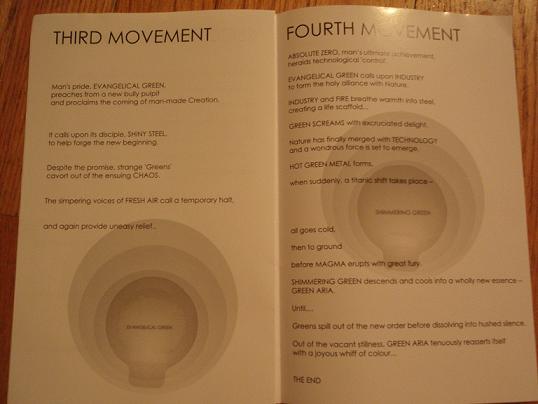
The basic story (by Stewart Matthew) is: nature is corrupted by industrialism and technology must find a way to save it, to create new fresh air. The five basic elements (Earth, Air, Fire, Water, and Base Metal) are the core characters, with other characters named things like Funky Green Impostor, Green Metal, Evangelical Green, Screaming Green, Shimmering Green, Chaos, Absolute Zero, etc. Here’s a full list of the Dramatis Personae from the back of the little Playbill they made:

p6022197

In the auditorium they set up little tubes (which looked like microphones) at each seat. You could adjust your tube, but they blasted in enough scented air that you really didn’t need to be sitting too close to it. They told us to breathe normally, not to sniff like a police dog (which of course most of us were inclined to do anyway). The tubes at each seat were necessary, Laudamiel told us, because if scented air was just blown into the auditorium in whole, it could take up to 50 seconds for the scents to spread to everyone. It would be impossible then to coordinate the scents with the music, or for everyone to have the same experience at the same time.

p6012187

p6012183

The scents were “stored” in this gigantic compression tank parked outside of the Guggenheim.

I thought since I have chronic sinus issues and a deviated septum and all, I might not get the same effect as everyone else, but it wasn’t a problem for me at all. Laudamiel’s scents (he’s worked as a perfumer for Ralph Lauren and other designers) were all very strong. They were mainly earthy because of the nature of the opera: Earth smelled like freshly mowed grass, Green Aria was like a dewy field, Evangelical Green was like grass mixed with sweet perfume, Shimmering Green yet sweeter. The sweetness and the grassiness didn’t always mix well, I think intentionally — Evangelical and Shimmering Greens were meant to be overly preachy, a surfeit, an excess, not authentic.

And you’d think the way people perceive smell would be subjective, but I think everyone pretty much despised / was horrified by Funky Green Impostor, who smelled very gassy, very foul, like gas combined with rotten eggs. Others I disliked were Fire, who smelled like 9/11 to me and Shiny Steel, who smelled very metallic but with a sweetness that just didn’t mix right.

By far my favorite somehow (besides simple Earth, and Green Aria) was Chaos. Chaos, according to the Playbill, was supposed to create “strange greens” which would  make Chaos seem bad. But Chaos was not the least bit foul-smelling to me! To me Chaos smelled like tropical fruit punch, or bubble gum. It was the only non-earthy scent. The Playbills they gave us had various sample scents, but Chaos was not there! I want my Chaos!

p6022195

p6022196

I’d said earlier that Muhly was the ideal composer for scent, but now that I’m remembing the whole opera, I’m realizing that that music, those sounds, were a large part of how I interpreted the scents. You knew when Funky Green Impostor was on his way by the sounding of harsh notes — at first faint, like he was just approaching — and then you knew when you’d be hit with some very threatening whiffs by the swelling of those chords. And you also knew when sweet, sunshine-y scents would be on their way when the music became mellifluous and Mozart-like. There’d be a fight, you’d smell the characters duking it out, the scents all mixed but at various points one or another rising above the rest — stinky, then perfume-like, then the freshly mowed grass, more sweet surfeit, etc. — and you knew when good had triumphed when it sounded like the end of a Tchaikovsky ballet followed by the dewy fields. I honestly never realized how strong my auditory senses were, what powerful effect sound could have, until I heard Muhly’s work.

Read Anthony Tommasini’s NYTimes review for far better descriptions of the music than I can provide 🙂

This was a fascinating experience, what I live in NY for.

DAY OF THE UNEXPECTED: AN OPERA WHOSE CHARACTERS ARE SMELLS & A TUDOR-ESQUE STORY BALLET BY RATMANSKY


I had a crazy day. This afternoon I went to the Guggenheim to see this new ScentOpera — an opera told entirely through music and smell (each seat had a little microphone that blew the scents into your face) — which I’ll write about soon. Suffice it to say it was very interesting and I think Nico Muhly has found his niche: composing for smell — because, unlike with dance, his music most definitely did not overpower these whiffs at all, at least not as created by perfumier Christophe Laudamiel. I nearly passed out from “Funky Green Impostor.”

Anyway, more about that soon.

Tonight was the premiere of ABT‘s new resident artist Alexei Ratmansky’s first ballet for the company — a night for which many have been waiting ever so eagerly. For those not up on the ballet-world gossip: Mr. Ratmansky (from the Ukraine, and former artistic director of the Bolshoi) initially was rumored to be contemplating taking the resident choreographer position at NYCB. Then he didn’t and everyone was depressed because Christopher Wheeldon was leaving to start his own company and everyone really liked Ratmansky and wanted to see more of his work stateside. Then, next thing everyone hears is that he’s accepted the same from ABT, making everyone happy but confused — NYCB is known for being more daring and contemporary in its repertoire; ABT sticks more to the traditional classical story ballets. Ratmansky,who was leaving the Bolshoi because he wanted more of a challenge (the Bolshoi’s rep is akin to ABT’s), seemed a better fit for NYCB.

Anyway, I was expecting tonight something along the lines of Concerto DSCH or something he’s done for NYCB (which is all that I’ve seen by him): a contemporary Balanchine-esque ballet without a linear narrative but with a discernible theme and with original, clever, thought-provoking choreography. Instead, On the Dnieper (the Dnieper is a river in the Ukraine), set to Prokofiev’s music of the same name, is a story ballet that I found to be about three parts Tudor, one part Robbins (with some of the fight scenes).

It’s the story of Sergei (danced by Marcelo Gomes), a young soldier who returns home, after war, to his fiance Natalia (Veronika Part), only to realize he no longer loves her but is attracted to Olga (Paloma Herrera), a flighty, flirtatious local girl who is betrothed to another man (David Hallberg). After a brief encounter, Olga falls for Sergei and begins to doubt her love for her fiance. One evening at a party, Olga dances with her fiance and Sergei becomes jealous and challenges the fiance to a fight. Sergei is felled, and Natalia rescues him — picks him up, cleans him off. But soon Olga is back. Natalia, after trying desperately and unsuccessfully to win Sergei back, heartbroken, does what she knows she must for the man she loves — helps him escape with Olga.

It reminded me of Antony Tudor because there’s a lot of drama — albeit without all the heavy psychology — a lot of hurt, wounded tragic characters with broken dreams, unrequited love, painful sadness that just reverberates through the whole auditorium. And the characters each seem to have a way of moving unique to them: Marcelo’s Sergei jumps back and forth a lot with lots of beats of the feet — as if he can’t decide whom to choose, what to do, as if he’s torn.

David Hallberg’s fiance is rather borderline psychopathic, highly impassioned (to make an understatement) but almost frighteningly controlling of Paloma’s Olga. After the way David had described his character on the Winger, I was expecting a reprisal of his “friend” in Tudor’s Pillar of Fire or his R&J Paris – -vulnerable and hurt but proud and trying to bear his pain noblely in a way that made me want Juliet to leave Romeo for him. That’s not what we got at all! Our first viewing of him is slicing madly through the air at Paloma and her friends as if to say, stop everything, I’m here. Besides the jumps and aggressive arms, he has a lot of crazy fast footwork throughout. At one point, when his jealousy is getting the better of him, he starts shuffling his feet so fast, he actually looks down at them, stunned, like he really can’t control them. A way out-of-control Fred Astaire.

Paloma is all about the fickle, flirtatious girlish jumps. And Veronika is more adagio, and she keeps extending her arms both to one side, then laying her head on that shoulder as if an expression of her loyalty and devotion to Sergei. Later, when she realizes he’s drawn to another woman, this movement looks more like a prayer that he’ll return to her. Veronika is heartbreaking and she’s the emotional centerpiece to the ballet. You really want to cry for her at the end.

I think it’s a good ballet — a little slow in places, but generally compelling and with meaningful movement that echos the characters’ desires and actions. It just surprised me that it wasn’t what I’m used to from him. I think after seeing so much NYCB, I’m becoming so enamored of Balanchine and non-narrative contemporary rep of the kind he’s done on that company. I hope that not all of the work he’ll do for ABT will be story ballets. I hope he will do some Concerto  DSCH and Russian Seasons and Dreams of Japan-like ballets for ABT as well. ABT’s dancers are so brilliant; it’s fascinating watching what they can do with those kinds of movement-heavy, dramatically open-ended kinds of dances.

Also on the program — which I’ll write more about after seeing the other casts — were Balanchine’s Prodigal Son (danced tonight by Herman Cornejo, replacing Ethan Stiefel, who’s still out with an injury), and James Kudelka’s Desir. Desir is about several different relationships — mostly couples — about sexual angst, romance, fighting, etc. I liked parts of it but not all (I’ll write more about it after more viewings), but what really floored me was a beautifully romantic pas de deux with sweeping lift after sweeping lift performed by Cory Stearns and Isabella Boylston. I’ve never really seen Isabella before and Cory I have but not much, and he’s definitely never stood out as much as he did tonight. Those lifts looked hard and he didn’t tire one bit. He was the ideal strong male partner, showing her off, making her look beautiful, giving her such gorgeous height, sweeping her up through the air, without being the least bit show-off-y himself. He was all about her and they both shone. They were breathtaking. And I’m definitely not the only one who thought so. The audience went wild with applause when they took their bows. They got even more applause than Gillian Murphy and Blaine Hoven! (who were excellent as the angst-ridden couple who eventually gets it together in the end). I’m glad Kevin McKenzie gives young dancers these kinds of chances to stand out.

More soon on the rest of the ballets, and hopefully some pictures as well.

NYCB: A DIFFERENT DREAMER, A BRILLIANT HALLELUJAH JUNCTION AND A SWAN LAKE DEBUT


I spent all of Saturday at New York City Ballet, watching both matinee and evening performances like the obsessive I am 🙂 Highlight of the daytime performance was Jerome Robbins’s 1979 ballet, Opus 19 / The Dreamer in which Robert Fairchild and Janie Taylor made their NYC debuts in the lead roles. This is only my second time seeing this ballet — the first was a season or two ago when the main parts were danced by Gonzalo Garcia and Wendy Whelan. (Robbins created the ballet on Baryshnikov and Patricia McBride). My research has revealed that critics don’t consider this to be a major Robbins ballet; Arlene Croce seems not to have written a word about it. Audiences seem to adore it though, me included.

Funny but the first time I saw it, I thought the main male character was a “dreamer” in the sense of being an idealist. Wendy seemed to represent Gonzalo’s ideal. And there often seems to be a kind of charmingly airy, carefree, “head in the clouds” quality to Gonzalo’s dance persona.

Robert was more solid and sharp and weighty than Gonzalo. In his beginning solo, he’d slice through the air with his arms and legs, stretch an arm out, hand bent up, as if to be pushing out against something, or stopping something from getting too close to him. What that something is isn’t entirely clear. It seemed more like he was a literal dreamer, someone lost in a dream that was neither entirely pleasant nor unpleasant, something he kind of wanted to escape from but was drawn to as well. And Janie — I love her! — was all tantalizing, bewitching, taunting little mischief-maker haunting his subconscious, not leaving his psyche a moment’s peace. Whenever she was onstage, she completely captivated — both him and us. Even when she’d collapse in his arms, he’d struggle to straighten her up again. He’d lovingly wrap his arms around her; she’d be out of them in a split second. It was very different from the way Wendy danced, if I remember correctly. I wonder how Patricia McBride did it.

I read a review of a dancer who performed the male lead in the 80s. The writer — Jack Anderson — said the dancer — Jeffrey Edwards — looked like a thinker, very introspective. I always love watching Robert — I think he is one of the most fascinating movers around. I’m not sure if what I saw here was introspection or more like inner turmoil. He was definitely lost in himself — he doesn’t even seem to notice all the lavender-clothed dancers flitting about him, didn’t seem to notice anyone until Janie came darting by and commanded his attention. I guess it seemed more like he was lost in his own angst, haunted by his dreams, than lost in his thoughts or his art. But it would be hard, I’d think, to embody introspection.

They don’t seem to be performing this ballet a lot, but I’d love to see Tyler Angle dance the part as well.

Also during the day was Chaconne, which I’m growing to love more and more — particularly the first pas de deux where the man lifts the ballerina and she has her arms out to the sides and does these large, sweeping steps forward, every few beats lightly tickling the floor with one toe shoe, and it looks like she is flying — and Vienna Waltzes, which, probably ridiculously for me since I’m a ballroom dancer, honestly just kind of bores me. The choreography’s not very intricate or compelling (odd for Balanchine) — it’s mostly straight-forward waltzing, which I can only watch for so long. There’s a middle section composed of high-energy allegro ballet which was danced very theatrically by Yvonne Borree and Benjamin Millepied. That section seriously kept me from falling asleep.

Highlights from the evening program were Peter Martins’s Hallelujah Junction, Joaquin De Luz in Donizetti Variations, and Sebastien Marcovici’s debut as Prince Siegfried in Balanchine’s Swan Lake. I hadn’t seen this cast of Hallelujah before — it was Sterling Hyltin, Gonzalo Garcia, and Daniel Ulbricht. This cast wasn’t so dramatic, so romantic, so intent on telling a little story, as other I saw (Marcovici, Taylor, Veyette), but seemed more focused on simply making the music visual — and they did so to fascinating effect. I greatly enjoyed just sitting back and watching all that brilliantly fast-paced, razor-sharp movement — Gonzalo with his sexy impish bouyancy (he’s not really a small man but somehow he seems like he’s always airborne; I think he’d make a great Sleeping Beauty Bluebird), Sterling with her Russian ballerina-high extensions that she does with incredible speed, and Daniel for his intense precision. This is the best I think I’ve ever liked Daniel Ulbrich before. He didn’t just jump inhumanly high; he really nailed very difficult-looking, intricate footwork and he did so with such sharpness and tautness. If he’d only be given more than just jumping guys parts, he can show that he can actually dance extremely well.

Sebastien danced Siegfried with great passion, expectedly. Balanchine really eviscerated the man’s part in his version of the ballet but Sebastien went as far as he possibly could with it. At one point, one of the corps swans in the back row fell and of course the audience had to go “ooooooohhhhhhh,” but he didn’t let it faze him as his Siegfried searched desperately among the swans for his beloved Odette. He had a minor flub on one of the many traveling turn jump thingys but no big deal. It was heartbreaking when Wendy bourreed back away from him and he reached out to her like she was taking his life with him as she went. Also, I love the black and white plastic swans swimming in the little stream at the beginning and end, but the people working them should just make sure the white swan appears at the right time! One time Wendy wasn’t fully into the wings yet when her swan form began sailing across the stage and Charles Askegard’s Prince Sig didn’t know where to run — the swan or Wendy. This time it was a little late and Sebastien kind of had to go searching upstream for her 🙂

Balanchine’s Donizetti Variations was danced brilliantly by Joaquin De Luz and Megan Fairchild. But what I really love about Joaquin isn’t his bravura dancing but his dramatic abilities — how he interacts with the other dancers. Even when dancing a storyless ballet, he’ll look at the others as they do their thing, shoot them a cocky grin — or a genuine smile — and do his thing, his steps a clever or comical response to theirs.

Also on this program was the newish ballet by Melissa Barak, A Simple Symphony – -my second viewing of that. She does borrow from Balanchine, but her choreography also has its own wit, which you notice on multiple viewings. Like Balanchine, the drama is in the actual choreography — every little flex or softening of the wrist meaning something. At one point, the ensemble of ballerinas all turn their hands and flex their wrists, and it looks like they’re cutely shrugging their shoulders. It’s such a pretty ballet with such mellifluous music though, sometimes you don’t want to focus on the choreography; you just want to sit back and enjoy the loveliness of it all.

EIFMAN BALLET’S "EUGENE ONEGIN"


Last night I went to see the Eifman Ballet of St. Petersburg in their New York debut of Boris Eifman’s Onegin, based on the 1837 novel in verse by Alexander Pushkin. I’ve seen this company once before and I’ve always been thoroughly entertained. They’re very Russian, very dramatic, very theatrical, very emotional, very angst-filled, doing everything as full-out both movement-wise and acting-wise as you possibly could. There’s never ever a dull moment.

Mr. Eifman’s work is very controversial here amongst the critics — I remember Joan Acocella (of the New Yorker) calling him a “public menace” at one of her book signings! I think he’s very Russian though (as well as very daring), and many in the audience are Russians, of all ages. I felt just as much as if I were in a nightclub in Brighton Beach as at a ballet performance. I also think he would be well-liked among the So You Think You Can Dance crowd. He often combines classical ballet and classical music (here Tchaikovsky) with more contemporary dance (like hip hop or jazz / theater dance) and music (here by contemporary Russian rock musician Alexander Sitkovetsky).

He sets his Onegin not in Imperial Russia but in 1991 in the wake of the fall of the Soviet Union and local uprisings against Gorbachev and his liberalism. We see, above the dancers, projected onto a circular backdrop, video clips of people marching, demonstrations, police trying to keep order, and then the images switch to an ensemble of classical ballerinas performing what appears to be Swan Lake. The dance / play begins with the main male characters — Onegin and his friend Lensky (who in Pushkin was a poet, here is a guitarist and musician) in a bar. Lensky seems to be trying to comfort Onegin with his guitar-playing but it doesn’t seem to help much.

Next we’re in the countryside where Lensky has taken Onegin, presumably so Onegin can have a break from the city. (In Puskhin, Onegin is a jaded aristocrat who retires to the country). The setting, by Zinovy Margolin, and lighting, by Gleb Filschtinsky and Eifman, are really cool by the way. Whenever the characters are in the city, the back wall on which are painted a series of black lines is lit in red and those lines become kind of abstract but imprisoning; when they are in the country, the wall is lit in blue and the lines turn into a bridge crossing a river, and the circular backdrop (which the movie images were projected onto) becomes a moon.

Anyway, Lensky goes to the country to see his girlfriend, the playful, flirtatious Olga, and there the bookish Tatyana immediately falls for Onegin, who doesn’t return her affections. Tatyana (danced brilliantly by Maria Abashova) has some really compelling dance sequences, by turns lyrical (showing she’s in love) and more angst-filled with awkward, angular lines and contorted mid-body movements. During part of this sequence, Tatyana’s love letter to Onegin is read (in Russian) by a voice-over. As Olga and Lensky dance a romantic duet, Tatyana walks up and across the bridge holding the letter. It’s really striking, the contrast between the sexually suggestive dancing of the pair and the lone Tatyana with her letter.

Soon, Tatyana has a dream in which she is being seduced by Onegin (pictured at the top of the post). The stage is lit in red and hard rock music is played. It’s very sexual and turns very violent, as soon Onegin turns into several men all clawing at her — a foreboding of the violence and tragedy to come.

I didn’t completely follow the story in the next section — and this is where I think it’s hard to bring Pushkin into the present — but Onegin gets angry at Lensky for some reason — (in Pushkin it’s because Lensky organizes a socialite party which angers Onegin because it represents everything he desires to escape from) — but it wasn’t as clear to me here. Maybe here Onegin’s just a tormented soul in general, maybe his anguish has to do in some way with what’s going on politically and culturally in Russia. Anyway, Onegin gets angry and starts to flirt obnoxiously with Olga (in a very intense duet filled with daring lifts and sexual overtones), leading the same place it does in Pushkin – -to Lensky’s anger resulting in a fight in which Onegin stabs Lensky to death (in the Pushkin, Lensky challenges Onegin to a duel, which Onegin wins).

Then, there’s a really beautiful scene — one of my favorite — where Lensky returns to life, ghost-like, and he and Onegin do a pas de deux. It begins with Lensky hovering over a small table, Onegin underneath. The men see each other through the glass and Onegin pulls himself up as Lensky slowly lowers himself down. They then do a lift sequence, but a very masculine one — with lots of kicks and anguish-filled jumps. One critic interpreted this as a gay scene, but I thought it was more about Onegin expressing his sorrow at what he’d done to his friend, praying for forgiveness.

Eventually Tatyana meets and marries a blind colonel and moves to the city, becoming a member of urban high society the way Pushkin’s Tatyana did. Years later Onegin (who now has greyed hair) spots her at one of the clubs he frequents and becomes enamored of her. There’s an intense pas de deux between them and she tells him she is taken, she’s no longer his to have. It ends with Onegin sitting at a desk crazily writing love letters to her the way she once did him, trying desperately to get the wording right, shredding paper after paper and starting anew. But the letters go nowhere, his time and energy is wasted. Instead, a wind comes along and blows the papers about and he becomes flooded by them.

The main dancers — Abashkova as Tatyana, Oleg Gabushev as Onegin, Dmitry Fisher (who bears a striking resemblance to Slavik Kryklyvyy!) as Lensky, Natalia Povoroznyuk as Olga, and Sergei Volobuev as the Colonel — and are all excellent, both with the intensity of the acting, and the incredible flexibility and gorgeous lines for the women and the athleticism for the men. The two women especially really moved like their characters — Abashkova at times making her movement awkward, at times beautifully lyrical, as if in love, and Povoroznyuk, more playful and sexual as Olga, would often fall into these amazing splits, legs wrapped snakily around her male partner.

One thing: I wish the women would have been on pointe. They all danced in flat ballet slippers. I think pointe work brings out not only the poetry and beauty of ballet but its intensity as well. Eifman could have used it to powerful, dramatic effect here.

The company performs at City Center through Sunday. I think they’re definitely worth seeing if you have the chance, though it might be a bit of a jarring experience for people devoted solely to classical ballet 🙂

BLACKPOOL FINALE

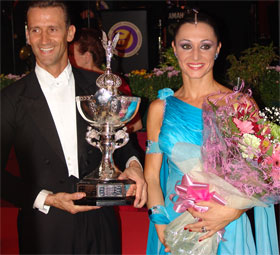
So, predictably, last night Mirko Gozzoli and Alessia Betti from Italy took the final Blackpool championship, the Standard (above photo from BlackpoolDanceFestival.net). Our Arunas Bizokas and Katusha Demidova came in second, Britain’s Jonathan Wilkins and Hazel Newberry took third, the US’s Victor Fung and Anna Mikhed fourth (good placement for them; they’re moving up every year!), fifth were Italy’s Roberto Villa and Morena Colagreco, sixth Domenico Soale and Gioia Cerasole also from Italy, and seventh Britain’s Warren and Kristi Boyce.

Eleanor says:

“Yesterday was fantastic — went to the Chrisanne party which was packed as usual — then the main highlight was the comp. Last year I was so tired I don’t remember much but this time I really enjoyed it. Top three was pretty predictable but I think I prefer Domenico to Roberto and would loved to have seen Paolo (Bosco) and Silvia (Pitton, from Italy) in the final — instead they made only the Semi in a few dances. Also managed to come away with a massive poster of Katusha! Can’t believe I’m on my way home now. 🙁 ”

I don’t follow Standard as closely as Latin and only really know the top four couples, all of which I like very much. Still disappointed Arunas and Katusha didn’t at least get a win in one dance. Those Chrisanne parties are always packed — and sometimes dangerous 🙂

See more results here.

GILLIAN AND ROMAN STEAL THE PIRATE SHOW, AND THE LAST OF THE SYTYCD AUDITIONS


Ethan Stiefel was supposed to dance Ali last night at ABT, but he was out with injury. I was disappointed of course, but it wasn’t like it was such a horrible thing having to see Angel Corella in that role again! He jeted out from behind the curtain during curtain calls last night (as did Gillian!– so I was happy)

Anyway, the male cast was mainly the same as opening night: David Hallberg as Conrad, Carlos Lopez as Birbanto, Daniil Simkin as Lankendem. The main differences were the two female leads: the spectacular Gillian Murphy as Medora, and the small, lovely Maria Riccetto as Gulnare — and, as it turned out Roman Zhurbin as Seyd, the goofy pot-bellied pasha. See my earlier post if you don’t know the characters and story.

Gillian and Roman made my night. Gillian has definitely got to be athletically the strongest ballerina in the company, maybe in the world. During her fouette sequence she did so many multiple pirouettes between each fouette I couldn’t even count; she was a blur. I don’t even see how that’s physically possible. She is truly a marvel, to make a massive understatement. And she goes so fast during the chaines and those traveling pirouettes around the stage’s perimeter. But not only that, she has such soft, beautiful liquid lines. And she and David I think are so used to each other now, they dance so well together in the romantic scenes. The bedroom scene was really really beautiful. She threw herself into those lifts like Nina did with Marcelo, except David isn’t Marcelo and so he didn’t do such flamboyant dives that it looked like he’d practically shoot her to the sky 🙂 But it was a really beautiful scene and she really floated in his arms.

And David is so good at those romantic scenes because of the kind of romantic dancer he is. I think he’s aware that those looks can at points be limiting and so he tries overly hard to be a hardass in those pirate-y bravado scenes. He was really kicking at and pushing around some of his fellow pirates! But I think maybe he doesn’t really need to do that. He doesn’t need to be a kick-ass aggressive warrior Conrad; he can always go for the more brooding Romantic pirate and let his hard-ass buddies help him along with getting the girl and fending off Lankendem and his crew, etc. And then the scene where he realizes Birbanto has betrayed him and he has to kill him to protect himself and Medora is all the more compelling since it may not be his nature to do that.

Anyway, Roman stole the show as well. Good lord! They usually have retired dancers who still teach and coach at the company do these character parts — the role of Seyd has been played by Victor Barbee at the last two performances I saw. But sometimes they give Roman these parts because he’s such a good actor. He was so giggle-out-loud hilarious as he rolled around the stage patting his big old pot belly and goofily lusting after all those slave girls. He was too much! It reminded me of this short film I saw a few years ago about a couple of movie extras. One of them just could not fulfill the requirements of “extra” work, and at one point there’s this scene where the two principal actors are having an important dinner conversation and you see the guy in the background open-jawed, smacking his hands on the table, laughing hysterically about something and it’s so funny because your attention is completely drawn to him and away from the main characters’ all-important conversation. (The film was mainly a comedy but had a little of the tragic about it, focusing as it did on the minor people who work hard and never get any recognition but who are essential in making a big film happen — kind of like Jerome Bel’s film about Swan Lake from the perspective of a corps dancer). Anyway, Roman was very lively, to put it mildly. Absolutely hilarious.

(headshot from ABT site)

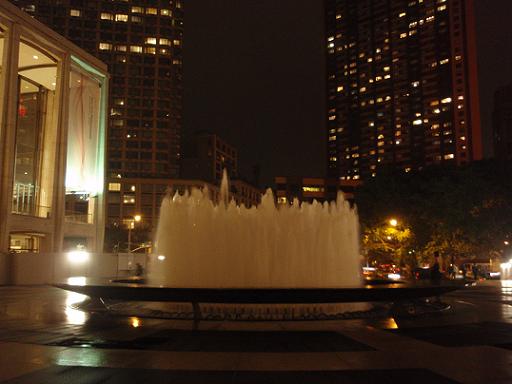
Also, happily, the Lincoln Center fountain is operational again!

p5282152

Unfortunately, it was such crap weather last night, no one was able to enjoy it.

So then I came home and, since I remembered to record SYTYCD for once, was able to watch the last day of auditions, which I was thoroughly disappointed with. I wish I would have seen Alex Wong’s audition Wednesday night because I feel like they only have the bad people on at this phase– like that blonde contemporary dancer whose father has multiple sclerosis (sorry, I can’t remember names this early on!) She was pretty — and all three judges kept remarking on that ad nauseam. She did a pretty pirouette at one point, but she seemed totally off-balance, like she was on the verge of falling every time she lifted one leg off the ground. The judges didn’t seem to notice that at all and advanced her straight to Vegas seemingly on the basis of her looks (since they kept going on about how gorgeous she was).

I did really like the pop & locker guy though – the one with the charming smile. He was amazing — not only what he was doing with his facial muscles, which Nigel recognized as well, but those ticks (I guess that’s what they’re called). His didn’t seem to be as robotic as they normally look (which are cool anyway), but his seemed more fluid, and it looked like he was moving in slow motion. Amazing. I’m glad he passed choreography and advanced. And I also thought the female tap dancer from last season was very impressive and am glad to see she made it.

What were they going on with that Asian Latin couple about? Nigel telling her to make sure and be sexy and then all of them remarking how much she stole the show with her sex appeal. I honestly thought he was technically better than she. Do the judges care about the art of dance or about sex appeal? And, when the female of the couple said when you think ballroom you usually think Russian or South American dancers, not Asian: anyone who’s ever been to a ballroom competition knows that’s untrue. Russian yes — ballroom is dominated these days by Eastern Europeans, Western Europeans (mainly the Italians, Germans, and English), and by Asians — Asians are a huge presence in ballroom competitions these days. Japan often has a team at Blackpool for the world competition and the Chinese always have Latin formation teams there (which are a blast, by the way – the Chinese Latin formation teams!) And the world pro demos take place in Japan. And Asians often take the top individual awards. So Asians are everywhere in serious ballroom competitions right now; South Americans nowhere. South Americans dominate ballet these days, but they don’t dance serious ballroom; Latin dance is social dance for them, not competitive.

Anyway, sorry for the rant — it just upsets me when something really wrong and misleading to the public is said on these television shows!

Maybe we just didn’t see enough of the other dancers, but none of the others seemed very good at all. Except for the ballerina who didn’t advance because she couldn’t pass choreography. That really made me upset because her solo was beautiful and technically very solid. I can’t imagine David Hallberg — or many of the current ballet greats — excelling at hip hop either. So then I got upset all over again just like I did last year during the auditions wondering what this show is about and why everyone can’t be valued for what they’ve worked on their entire lives to be brilliant at.

Anyway, I’m glad the auditions are over and we can advance on to the real show so I don’t have to get so pissed off anymore 🙂

DANNY TIDWELL UPDATE


You guys! I missed So You Think You Can Dance again last night! I thought it was on on Thursdays (wasn’t it on Thursday last week?) and was all set to tape tonight when commenter Jonathan sent me an email asking me what I thought of the second week of auditions. Argh. Trying to find somewhere online to watch re-runs…

Can’t they wait till ballet season is over?! Seriously, it wasn’t on this early last year right? I don’t remember it conflicting with Blackpool, ABT, and NYCB like this.

Anyway, in lieu of a post on this week’s show, I thought I’d just link to this Rickey post (which is where I got the pic above from), which commenter Jonathan sent me. Thank you, Jonathan!

Apparently, Danny Tidwell will be in the Broadway cast of Memphis, which is scheduled to open in the Fall, and will be in Fire Island over the summer for the Fire Island Dance Festival.

It’s always interesting to keep up with the SYTYCD dancers and see what becomes of their careers, if and how the show has helped them. So far we have Danny and Neil Haskell on Broadway, Sabra in a very cool NY-based contemporary ballet company, Chelsie Hightower and Dmitry Chaplin on Dancing With the Stars… I wish Danny would come back to ABT but I know that’s not going to happen. But it’s okay — there are plenty of fabulous dancers there to keep me in a pretty constant state of awe 🙂

For others who missed last night’s show, I find Ballroom Dance Channel does a good job of straight-forward reviews.