EVIDENCE


I’ll write more after I see the second program, but I want to highly recommend for people in NY to go see Ronald K. Brown’s company EVIDENCE, at the Joyce Chelsea now through February 15th. His work is by turns serious, sobering, thought-provoking, humorous, celebratory, exciting in a makes you wanna stand up and dance yourself way, and always spiritual. His movement style is a beautiful blend of African and American modern, danced to music ranging from percussive African drums (played live) to Duke Ellington, Sweet Honey in the Rock, and Fela Kuti, and, unlike with the majority of dance companies I’ve seen, the women (who are, gloriously, all shapes, sizes, and ages) really stand out!

On Tuesday night (opening night), the audience was so into it, applauding and cheering on the individual dancers throughout: “You go, girl; Okay, Clarice, tell it!”, etc. I don’t know if I’ve ever seen that level of excitement at concert dance.  Usually everyone’s so quiet and “well behaved” 🙂 My friend Alyssa and I were cracking up. If you can, do go!

Go here for more info and to see a video.

One-Sided

I was riding the Brooklyn-bound 2 train during evening rush hour when suddenly a man sitting across from me collapsed onto the woman next to him. The man was white, mid-forty-ish, with oily hair and lines of black under his fingernails and in the crevices of his hands. His jeans and jacket bore caked dirt and his pants were very worn. He may well have been homeless.

Of course people often fall asleep on the subway, and their head ends up on the next person’s shoulder. But they usually wake up, embarrassed and apologetic. This man didn’t budge. And I remembered him appearing fairly alert; when I boarded he’d made eye contact with me.

The woman next to him tried to inch away. When his body trailed hers as she went, she tapped his shoulder. When he still didn’t move, she took both hands and tried to push him upright. When she let go, he lurched slightly left, then fell forward, straight to the floor, crashing head first into the metal gear box under the seats.

Everyone in the car heard the thud and gasped. He remained motionless and I started to worry he’d had some kind of seizure or stroke.

Continue reading “One-Sided”

New York City Ballet: Tradition and Innovation


On Friday, Judy and I went to see New York City Ballet’s “Tradition and Innovation” program. I know, I really should just move into Lincoln Center…

On the bill were Balanchine’s Concerto Barocco, Mauro Bigonzetti’s Oltremare, and Balanchine’s Tschaikovsky Suite No. 3 (I’m using their spelling of Tschaikovsky, with the first “s”; I often see it spelled without).

Concerto Barocco is one of Balanchine’s leotard ballets that makes music visual (the two ballerinas — here Wendy Whelan and Rachel Rutherford — almost become the double violins of Bach’s Double Violin Concerto in D Minor) and, according to Terry Teachout, is one of Balanchine’s most definitive. It’s funny. I’ve seen it before and really liked it then, but I think in contrast to the similar Stravinsky Violin Concerto, that I saw on Wednesday, it didn’t fascinate me as much. There didn’t seem to be as many interesting little flourishes. I still enjoyed it though — especially where the groups of women all hop repeatedly on pointe — it’s so sweet — and the way the dancers nearly become the violins is always fascinating.

Oltremare is one of my favorites this season. I’ve written about it before. It’s an expressionistic piece with some brilliant lifts, some high-charged jumps, at times the mood rather haunting, about immigrants coming to the New World, dejected about all they are leaving behind and fearful of what may lie ahead. My favorite part is always Andrew Veyette’s bravura turn. See a great video here of him talking about that role and the ballet in general, along with scenes from the ballet. (you may have to scroll down for it; I don’t know if the link will go directly to that video — but do scroll down, it’s worth watching!)


And my favorite of the night was Tschaikovsky Suite No. 3. It’s divided really into two parts, and I’ve seen the second — Theme and Variations (pictured above, Sterling Hyltin and Benjamin Millepied in the leads) — before a few times. (I wrote about a small bit about it here when ABT did it). I hadn’t realized though until now that there even was a first part.

Well, the first section is really beautiful (pictured at top), and kind of reminded me of La Valse. The ballet begins behind a black netted scrim, and takes place in a kind of Romantic dreamscape. A man, Ask La Cour, searches for his beloved, his ideal, represented by the poetic Sara Mearns, who kind of gets lost in all the women, all dressed in long, floating lavender gowns. Interestingly, no one was on pointe; everyone was barefoot, which would seem to undermine the women’s ethereal quality. And yet it gave the whole a kind of softness and lightness. They were almost like ghosts floating through the air.

The next part of this section was a soft, melancholic waltz performed by a duo — Rebecca Krohn and Jared Angle, which was juxtaposed with a fast, sprightly “Scherzo” by a really impressively quick-footed Tiler Peck (don’t think I’ve ever seen her like that before!) and the always high-jumping Daniel Ulbricht.

And then the curtain went down and when it lifted again, we were in a courtly ballroom in imperial Russia, no scrim in sight, the chandeliers shining brightly. Beautiful as the first Romantic, part with Sara Mearns, was, I still love this courtly celebration the best with the Tchaikovsky music swelling to a climax, the floor flooded with dancers, all performing the extremely fast combinations, the big huge twisty jumps for the men — my favorite. I first saw my favorite dancer dance this part, so it’s hard for me to judge fairly anyone else, but Benjamin Millepied did very well with that first set of continuous jumping turns that seem wondrously to go on and on and on, and then, in the end, when the music starts to go at the speed of light, because he is so much smaller than Marcelo, he seemed to keep up with it a little more. Marcelo is still more leading-manly though 🙂 And Sterling Hyltin was the perfect princess. Funny, but when I see ABT perform, I tend to miss the women because the men so stand out to me. Not so with NYCB; they’re more equal. I kind of feel like I saw Sterling’s part for the first time.

Marcelo Has a New Headshot!


I know how excited everyone is about this! He really did need a new one.

I found out when I was looking through old posts to see what I wrote about Balanchine’s Theme and Variations and this one came up. I was scrolling down and suddenly there was someone I didn’t recognize, at first. I almost dropped the playbill I was holding. Look at those puppy dog eyes! Don’t they just melt you? Okay I’ll stop. But, well, cool, I guess my blog automatically updates ABT headshots!

Live Blogging DWTS Name-Dropping

I guess I’ll try to post the name-drops (for Dancing With the Stars Spring season 2009) as they’re announced. I think. Unless I get tired. Or need to get a cupcake. I should probably do that now…

Anyway, they’ve so far announced that new stars will include a famous male reality TV show star (who won’t be famous to me since I never watch reality TV), a football star, some kind of celebrity gossip show host, and someone else who I’ve already forgotten… When are they supposed to start announcing the names for real? It’s 8:30 already.

Okay, first four are:

1) Rapper L’il Kim;

2) reality tv star Steve-O (I think that’s the right spelling);

3) NFL star Lawrence Taylor;

4) Nancy O’Dell (missed who she is);

they said the next four will be announced during Desperate Housewives, coming up next. So, making a cupcake run.

Okay, got cupcakes. Did anything happen?

Well, they just said they’re dropping all names in less than 30 minutes, but I’m tired of waiting. Awesome Katrina just posted the list down in the comments! Thanks Katrina, you rock!

So, going by this list that Katrina linked to:

5) Belinda Carlisle, formerly of the Go-Gos. Oh cool, I haven’t seen her in forever. And I used to love them. They were the first group I ever saw on MTV (back when it was first created :S) — ah memories 🙂

6) David Alan Grier. I think I remember him from In Living Color. I can’t remember exactly which one he was though without looking him up, which I’ll do in a minute. I used to like that show though, so this is a good one by me.

7) Jewel, the pop star. Hmmm, I like her.

8) Shawn Johnson, the youngest ever contestant on the show, at 17, and Olympic gold medalist in women’s gymnastics on the balance beam. Ridiculously, I’m not even sure I remember her.It was the Bejing Olympics! What’s wrong with me?

9) Gilles Marini, from Sex and the City. I never watched the series, but Katrina says he’s a hottie!

10) Ty Murray, a rodeo star. Hmmm, a shit kicker? Interesting.

11) Denise Richards, the movie star.

12) Chuck Wicks, singer and song-writer. Don’t know him. He’s dating Julianne Hough, Katrina?

13) Steve Wozniak, a “Silicon Alley icon and philanthropist” who designed for Apple, according to the Reality TV website.

I’ll edit the post again if there are any changes in the announcements. Otherwise, I guess it’s overall an okay cast. I like a few of them anyway. Several I don’t know. Without seeing anything so far, I predict Wozniak is first to get booted. An entrepreneur, intellectual type? Maybe he’ll defy stereotypes, who knows…

My Musketeer!

p2081903

Yesterday I went to Williamsburg (Brooklyn) with a new friend I met recently at the Dance on Camera festival, Teressa Valla. Teressa’s an artist — a painter and sculptor. She calls herself a “kinetic artist” because she’s inspired by and tries to capture movement. She often uses dancers as her models. Visit her website to see some of her beautiful work. We went to Brooklyn to see one of her paintings that is currently showing in the Sideshow gallery. I think it’s this painting.

I loved this gallery. It’s one of those whose walls are almost entirely covered by art. I love that. That’s the effect I try to create with my walls, although my art is all quite cheap! Some people may think it looks too busy, but not me. I love busy!

Anyway, I totally fell in love with this one piece of art by an artist named Terrence Miele. Unfortunately, the painting isn’t on the gallery’s website and the artist doesn’t seem to have his own site. It was called “Portrait of –” — someone with a long Polish or Czech-sounding last name that began with “K” — and it wasn’t really a realistic, lifelike portrait (like the above), but kind of more expressionistic, like more expressive of a feeling (like Scream — one of my favorite art works). The man, K’s features — his mouth, his eyes, and eyebrows, were all doubled, so it looked like he was shuddering. It was really disconcerting, even dizzying, to look at.

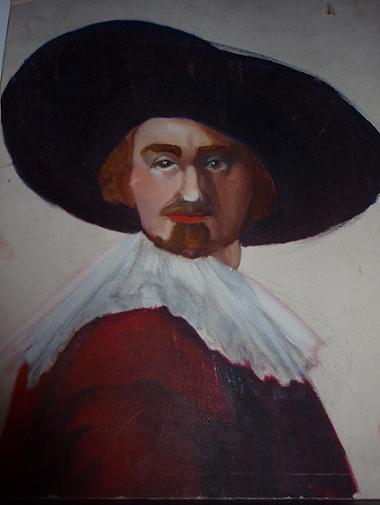
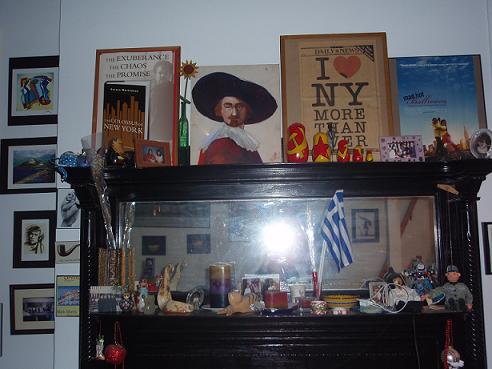
Anyway, we walked around Williamsburg, which is one of those recently gentrified arty areas where there are many galleries, browsed some over-priced used books on the street (guy wanted $10 a piece — the covers were all dirty and buggy, some pages rain-soaked, etc., come on), had Thai food (and I had Thai iced tea with brandy, which was fun but I later got a violent migraine — either from that or perhaps they used msg in my fish), and then we ended up at this great store called Junk. It was huge and they had everything from antiques to used furniture, paintings, jewelry, buttons, clothing, videos, books, etc. Teressa found a chair and a shirt and I found a table (we didn’t buy the furniture — yet) and this painting (above, for $5) that I really fell for. She laughed and said, “hmmm, Rembrandt??,” but to me it said, Musketeer! It makes me wonder who painted it — an art student playing around with Rembrandt style or is it indeed a Musketeer (I think he is about to withdraw a sword) — and how long ago was it painted, and how did it get to Junk?

Anyway, he looks kind of cute on my mantle, no?

p2081909

Splendid Night at NYCB: 20th Century Music Masters Program


Wednesday night was one of the most enjoyable nights I’ve had at New York City Ballet. I’m totally in love with Balanchine’s La Valse. I wrote about it here when Miami City Ballet performed it and it grew on me immensely when I saw it on NYCB. My friend, Judy, fell head over heels for it too — I think she was the first person in the whole theater to begin clapping (when the curtain began going down admist the swirling Viennese waltzing couples, the group of men carrying Janie Taylor’s limp body high above their heads, pall-bearer-like).


It’s such an intoxicating ballet, with the gorgeously bedazzling, mid-calf-length tulle (which fashion industry person Judy tells me is called “tea length” or is it “t-length” or “tee-length”?) — deep maroon for the waltzing women, bride-white for main character Janie. Janie and Sebastien (who played the leads, pictured in top photo) and Tyler Angle all gave the whole thing such a tragic pathos. When Janie was waltzing with the “devil-character” — a frightening Philip Neal (just about the most intensely captivating I’ve ever seen him) and getting swirled and whirled and tossed madly about, she did these gorgeously elaborate back kicks on the fast third step, when he lifted her high into the air, almost tossing her like a rag doll. It added greatly to the crazed momentum.


It was really Tyler Angle who blew me away though. (See Times article on him by Claudia La Rocco here). He danced one of the waltzing men, prone to romanticism, who gets swept away by the seductive atmosphere, kind of a foreshadowing of what will happen to Janie’s character. At one point, he falls to the floor, and just sits in the middle of the stage, unable to lift himself of out this dream, but doing this fabulously expansive port de bras, waving his arms all about dreamily all the time kneeling, while the women twirl around him, their skirts flying, and couples whiz by him, through him actually, almost ghost-like as they separate their waltzing bodies from one another just enough pass their connected arms right over his head. Somehow his swan-like arms narrowly manage to miss them. It’s really brilliant.

I was sitting really close to the stage this time (third row!) and picked up on so many things like this that I’d missed before, when I was just taking in the whole spectacle. Such a beautiful ballet.


Also on was Jerome Robbins’ West Side Story Suite, which is always a load of fun and I’m always floored by Andrew Veyette’s booming but melodious voice as the leader of the Jets, and Georgina Pazcoguin as the sexy salsera Anita. I love how Robbins uses dance style to separate the gangs from one another and identify each’s prevailing ethos: the Jets wear white and are Swingers performing crazy aerials, the Sharks wear red and are fast-dancing, hip-swaying Saleros.

Also performed was Balanchine’s Stravinsky Violin Concerto, a story-less leotard ballet. I love how sitting so close up you can see the dancers’ facial expressions, as well Balanchine’s delectably intricate choreography. At one point, while a main couple is dancing, several women line the back of the stage and stand in place, but they don’t stand still; they flex their wrists and splay their fingers and turn their hands back and forth to the beat. It creates a kind of twinkling star-like effect on the main couple. At another point, the men stand to the sides of the main dancers and simply do port de bras. It creates kind of a fluid, beatific effect, like they’re blessing the couple. I feel like a lesser choreographer wouldn’t have done anything with them, would just have had them standing around while the soloists dance. But Balanchine adds these little details that really make the dance.

Wendy Whelan was, again, very intense and striking (and we saw her and her husband, photographer and filmmaker David Michalek, after the performance, at P.J. Clarke’s, which was fun!) And Robert Fairchild: just, all I can say is show-stealer, naughty little show-stealer!!


“That’s Romeo,” I said to Judy.

Doesn’t Dance, Like All Art, Come From the Soul?


Sunday evening I attended another Works & Process event at the Guggenheim. These programs are so fantastic — they’re designed to kind of make the average person an insider, to give you a behind-the-scenes view of how art or cultural programming is created. Anyway, this one was on female choreographers and American Ballet Theater. Unbenownst to me (and most I think), ABT in conjunction with Altria has set up the Women’s Choreography Project, whose mission is to encourage more young women to venture into choreography — an excellent aim given that there are so startlingly and inscrutably few female choreographers, at least in ballet.

The women participants whose work we saw were: Gemma Bond, Misty Copeland, Nicole Graniero, Elizabeth Mertz, and Xiomara Reyes — all ABT ballerinas, and all, except Xiomara and Misty, members of the corps de ballet. (Xiomara is a principal and Misty a soloist.) It’s not a given or a demand of course that these ballerinas will necessarily become choreographers, but the program, led by Stephen Pier, exists for them to explore their talents, ultimately decide whether choreography is for them. It will be interesting to see, if programs like these proliferate, if it leads to more women dancemakers.

Anyway, it was really interesting watching Pier work with the women, but, to be honest, a bit confusing. At the beginning, Pier defined choreography for the audience as the movement of bodies through time and space. “That’s all,” he said. Then, he had Gemma Bond demonstrate a phrase she’d been working on.  She walked to the middle of the stage, smiling bashfully, and did a short, abstract lyrical segment. Then, Pier told her to focus on the back wall, to look at the shape of three windows, the lights coming through them, their geometry, and some writing on the wall underneath them (which I think was something like a dedication to whoever funded the auditorium, in small letters).

Bond used her hand to shield her eyes from the stage lights, and squinted up toward the windows. We all turned around, followed her gaze to the back of the room. She then laughed, shrugged her shoulders, and gamely re-performed the phrase. “It’s the same thing,” said the woman next to me. But I didn’t think it was. I thought she used the stage a little more; the pattern was now more horizontal than vertical, which went along with the three, horizontally aligned windows. She did exactly what was asked of her, I thought. Then Pier asked her, “well, what are you going to do with that red light coming out from the middle window?” She looked back at the windows, focused for a moment on the middle one, then, seemingly concentrating hard, repeated the phrase again. This time it was the same horizontal pattern as before, but now she stepped forward in the middle, kind of punctuating the movement with a little dot, making both vertical and horizontal use of the stage. “Now, that’s different,” said the lady next to me.  I agreed, but thought this difference was far more subtle than the last.

It was really interesting, but I think we were all intrigued because we knew exactly what was going on, what the choreographer was using to guide her. If we didn’t, I think it would just have been three slightly different patterns with no real meaning.

Pier then gave the women a pair of opposites to work with: fast and slow, light and dark, sharp and soft. All chose sharp and soft, except for renegade Misty, who chose freedom and constraint — which wasn’t one of Pier’s categories! (At one point, he asked each what they found hardest about the project and Misty said it was keeping within the rules. I love her!) Anyway, I looked deeply at the dances, trying hard to concentrate, to see the contrasts, but couldn’t always find them.

But as I was watching this, I was thinking of what I’d seen earlier in the day — the rehearsal footage of Alvin Ailey choreographing on his dancer Donna Wood Sanders, which I wrote about here. How he told her, you’re a prisoner, you can’t escape, you’re struggling, trying, let me see that. And this dance, Masekela Langage, about a group of people living under systematized racial oppression, was obviously very close to his heart.

I realize Pier was only giving these women exercises, that he wasn’t saying this was all there was to choreography. At least I hope that’s what he meant. He had said choreography was only about the movement of bodies through time and space. Is that all? I couldn’t help but get the feeling that Ailey’s world was so different from that of a lot of contemporary ballet, where it’s all about geometric patterns, interesting shapes, use of space, use of different rhythms, and not so much about creating something from the heart. I mean, literary writers and artists have to create because they have something to tell the world, something they find deeply meaningful. Although this was obviously only a glimpse into their process, I didn’t get the sense that these women were being encouraged to explore their visions of the world and learn to make movement that emanates from that place. It makes me wonder how most contemporary choreographers work — if they’re just thinking of light and shadow and abstract oppositions and geometry; if they’re not concerned with trying to tell us something.

Anyway, I have to say Xiomara (photo up top) completely blew me away with her work. She danced a lyrical balletic piece, but it had a kind of hippy-ness to it, a kind of swaying Gyspy-like, Latin feel. She danced with so much emotion. Her facial expressions almost reminded me of a flamenco dancer’s. I’ve never seen her dance like that before. I feel like perhaps she’s someone who’s better at dancing her own work than classical ballet. And perhaps she’d be good at creating work for other contemporary ballet dancers like her. Maybe she’ll be our next female ballet choreographer?

They also showed pieces by women who’ve choreographed for ABT: Lauri Stallings (whose Citizen I wrote about here) and Aszure Barton, whose work I’d never seen before and really loved. ABT II (the studio company, comprised of teenaged dancers) performed her Barbara, a sweet ballet that didn’t really have one single linear narrative, but had a lot of little subplots involving cutely intriguing characters.


On an endnote, Irlan Silva  — whoa! Methinks he is going to be in the main company soon…

Alvin Ailey Day at Lincoln Center Film Society

p2011898

I spent most of my day yesterday at the Walter Reade theater at Lincoln Center watching films about Alvin Ailey: rare footage of interviews and rehearsals with the legendary choreographer, and of him as a young dancer in the 50s and early 60s dancing with the equally legendary Carmen de Lavallade, along with later coverage of Judith Jamison and others dancing, newer PBS specials on the company, and even a couple of panel discussions with filmmakers, collaborative artists, and dancers who worked with Ailey. What a treat! The all-day event was co-produced by the company (AAADT) and the Film Society of Lincoln Center in honor both of the company’s 50th anniversary and the start of Black History Month.

p2011897

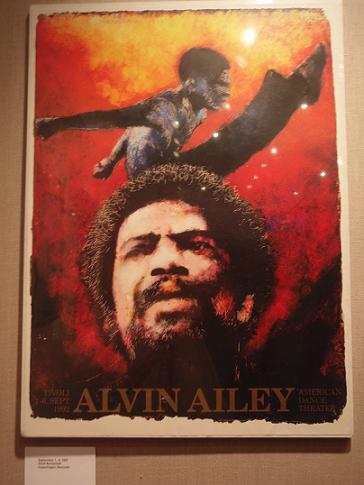
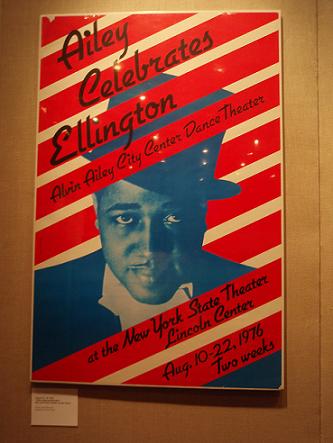
First off, there was a collection of vintage posters in the art gallery right across the hall from the theater. (top two pics above, taken by me.) There was also a little reception with complimentary wine. Complimentary strong wine (which, I hadn’t eaten much and, well, probably got carried away excitedly tweeting over seeing some of the dancers there — namely

Yannick Lebrun — wearing gold earrings in both ears and dressed very stylishly in one of those skinny scrunchy bubble-jackets, baggy jeans and bright red-soled sneakers — it’s always fun to see your favorite dancers outside of the theater, just dressed like ‘normal people’. Also there were  Renee Robinson, Matthew Rushing, Vernard Gilmore, and Hope Boykin, and choreographer Robert Battle. Renee and Yannick both showed up to the church event they had last year and I love that both the newest company member and the dancer who’s been there the longest show up to these kinds of things).

Anyway, the first set of films consisted of a movie directed by Orlando Bagwell made for PBS called “A Hymn for Ailey.” I’d never seen it before, but it was a filmed version of Judith Jamison’s dance / theater piece for the stage, Hymn, which she choreographed for the stage not long after Alvin Ailey died (of AIDS, in 1989). I’d never seen that either and I wish the company would stage it again. It was filmed mainly in the church where Ailey’s funeral was held, the magnificient Saint John the Divine. Dancers danced to a series of spoken word pieces recited by playwright / actor Anna Deavere Smith, who was, of course, a very powerful presence in the film. At times she’d stand next to the dancer — at one point Renee Robinson — and speak about body image, as Renee danced her words, and interacted with her at the same time, at one point seeming about to lash out on a negative thought, as if she were a mirror. At another, she spoke about Ailey’s artistry as an excellent male dancer who’s name I didn’t know belted out the movement with great passion. Or, one of the parts that stayed with me for a while — Smith took on the voice of an African woman talking about how much easier it is to be “real,” to be oneself, back in Africa; how here everyone has to wear a mask to survive. It kind of reminded me of Invisible Man. Both the performance and the words were very moving.

p2011893

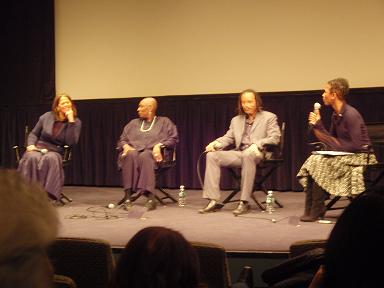
(there was a panel discussion after the Bagwell film, including from right to left, company rehearsal director Ronni Favors, filmmaker Bagwell, Jamison, and Deavere Smith). Judith Jamison is so charismatic, I’m sure it goes without saying. No matter what she’s talking about, you just want to hang on to her every word.

But the biggest highlight of that program — of the day for me — was footage of Alvin Ailey rehearsing a female dancer, Donna Wood Sanders, for her role in Masekela Langage (depicting denizens of a bar, set simultaneously in 1960s race-torn Chicago and apartheid-era South Africa, or anywhere oppression exists). I can’t tell you how much I got from this and I really really wish companies would do this more — would show audiences rehearsals and give us a glimpse into the artistic process. He was telling her, you’re an older woman, you’re stuck, trapped in this bar, in this place, you can’t escape and your life is dreary but that doesn’t mean you’re giving up. And, as she’d do certain things in the choreography, like push her arms out and step backward, he’d say to her, “let me see you in a prison, trying desperately to escape, but you can’t.” And she’d do the movement in such a way that that’s exactly what you saw. It was brilliant. And so powerful. I sometimes wonder how much is lost when a choreographer like that dies, if the entirety of his rehearsal and notes on direction are not kept. Dancers should of course add their own interpretations, but not without reviewing the master’s directions again for guidance. Now I want to see this ballet again.


Also included in the programs I saw were an interview Harry Belafonte conducted with Alvin Ailey, vintage footage of dancers Carmen de Lavallade, James Truitte, and Ailey performing classic works by Ailey’s mentor, Lester Horton. I particularly enjoyed The Beloved, depicting a relationship fraught with tension but compassion that kind of reminded me of some of Ulysses Dove’s work.  (A program later in the day included films of some of his dances, but unfortunately I couldn’t stay).

A final highlight of the day for me was watching vintage footage of Alvin dancing Porgy and Bess with Carmen de Lavallade. Learn about that story (originally an opera) and its history here. Ailey danced the part of the the man who threatens the crippled Porgy and seduces but mistreats Porgy’s beloved Bess. I’d never actually seen much of Alvin Ailey dancing and this was such a treat. As someone said in one of the films — I think it was Jamison but am not sure — “He WASN”T skinny!,” which made me laugh, but she’s right.


He was a meaty man. And he had hefty strength and ferocity to his dancing, a virility that was simultaneously sexy and threatening and that I totally didn’t expect since, by the way he speaks and from what I’ve read about him, he seems to have been such a soft, gentle man, and given that most of the male characters he created in his ballets seem like soft, gentle men as well, full of vulnerability and sympathy. Plus, with the possible exception of Glenn Allen Sims, no one  in the current company really dances like that. Not that that’s a bad thing – -just a different aesthetic.

I wish I could have stayed for the full day, but I went to ABT’s female choreographers program at the Guggenheim, which I’ll write about soon. This company always makes me so happy and inspired.