BARYSHNIKOV DANCING IN L.A. FOR $350+ PER TICKET


Monday night Baryshnikov will be dancing in a one-performance-only show in Los Angeles. Ticket prices range from $350-$1,000 (top end includes a dinner with the man himself). Wow. Good thing we got him for only $20 a pop of BAC! It’s for a good cause though — proceeds go to the Merce Cunningham Dance Foundation (it’s actually their annual gala, and Baryshnikov is dancing a Cunningham piece set to John Cage).

ANOTHER GOOD SWALLOW REVIEW

From Elizabeth A. White at Musings of an All Purpose Monkey:

“Plank has created a wonderfully three-dimensional and quite believable character in Sophie, and Swallow presents an almost painfully realistic portrait of a young woman’s journey from emotional repression and self-doubt to emotional freedom and self-assurance.”

Read the rest here.

Thank you so much, Ms. White! I’m so beyond thrilled that people are really liking the book!

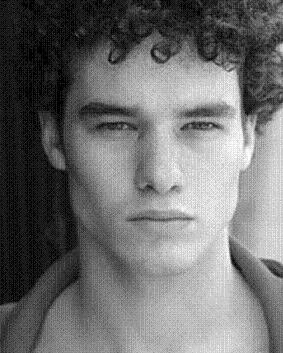
BENJAMIN MILLEPIED IN DETAILS MAGAZINE


Says writer Katherine Wheelock: “…Millepied, 32, has the potential to become rarer still—that once-in-a-generation crossover star and actress-courting boldface name previously embodied by Mikhail Baryshnikov.”

Read the rest of the article here.

Above photo taken from Details, by Eric Ray Davidson.

CHRISTOPHER WHEELDON’S ESTANCIA


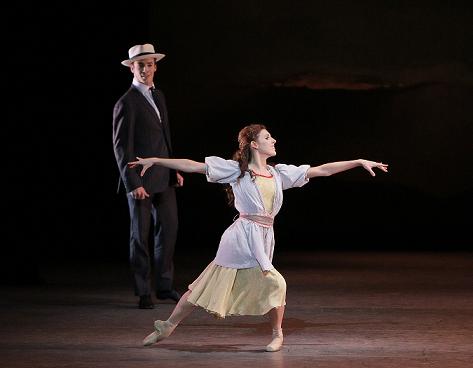
Last Saturday night was the premiere of Christopher Wheeldon’s new ballet, Estancia, at New York City Ballet. Everyone in the audience seemed to go wild over it. When it ended, I overheard people saying they didn’t want it to end, and others saying they thought it was his best work, and in the lobby, several of my friends said they really liked it. I thought it was so so. And definitely a departure from Wheeldon’s usual.

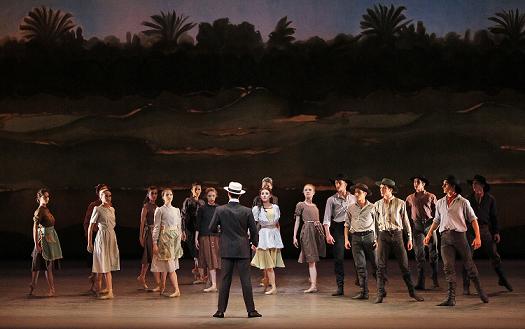
Estancia is a story ballet, set to to music by Alberto Ginastera, that takes place on a ranch (Estancia is Spanish for ranch) in the Argentine Pampas (countryside). A young city man (Tyler Angle) is smitten with country life, and a girl he meets there (Tiler Peck), particularly after he watches her tame a horse (Andrew Veyette). The ballet is his attempt to woo her, and of course at the start she wants nothing to do with him and his annoying urbanity (he wears a suit throughout), but eventually she overcomes her prejudices and lets herself fall for him. He ends up proving his adroitness at being a rancher by taming another horse (Georgina Pazcoguin).

The dancing was all very good — Pazcoguin and Veyette were wonderful as the wild horses, and the T(i)ylers were perfect for these roles. Tyler Angle is always so good at those deep longing romantic lunges toward his partner. For the most part, though, the choreography was a bit blah, I thought. Except for some interesting backwards walks, that looked at bit like moonwalks, performed by the “horses,” the choreography seemed like nothing I hadn’t seen before, which is unusual for Wheeldon. The romantic pas de deux  between the leads were pretty but the lifts were rather basic.

The Ginastera score was originally commissioned in 1941 by Lincoln Kirstein for a ballet to be made by Balanchine to be shown when Kirstein’s American Ballet Caravan toured Buenos Aires. But the Caravan disbanded and the ballet was never made. I feel like Wheeldon, or someone at NYCB, felt the need for closure on the project. It had the feel of something out of a bygone era, particularly with the horses – you really don’t see dancers galloping around stage these days in horse costumes. But it doesn’t seem as corny if you think back to Firebird, for example, with all the forest creatures.

The sets were designed by architect Santiago Calatrava (and NYCB is showing a short film about his work and his collaboration with the choreographers every time his sets are used this season). They consisted of water-color-looking paintings displayed on the back wall, one of a countryside, another more abstract one of horses (I think – because of the storyline, but maybe they were bulls … they seemed to have horns).  Anyway, all in all, it was a fine ballet but didn’t blow me away like it did many others.

Two other ballets were performed, both by Balanchine — Danses Concertantes, with my favorite, Gonzalo Garcia and Sterling Hyltin in the leads, and Brahms-Schoenberg Quartet in which Yvonne Borree danced particularly well partnered by Benjamin Millepied. It’s going to be sad to see her retire this Sunday afternoon.

Above photo by Paul Kolnik.

SWALLOW REVIEWED ON BASIL AND SPICE

I love this review, from a writer, Randall Radic, whom I met on Facebook.

Here’s an excerpt:

“Plank’s writing style is fluid and easy to read.  And she certainly has a knack for getting inside the heads of her Ivy League characters.  Her portrayal of New York’s hoity-toityness provides a crispy snap-crackle-pop kind of humor to the story.  And even though Sophie is a product of Yale Law School, she’s really just a small-town hick from Arizona.  Which means she’s like a vegetarian at a Kansas City steak house – out of place.  And it’s this asymmetry that brings about laugh-out-loud moments for the reader.

Essentially, Swallow is a coming-to-grips-with-who-you-are story.  And it’s a good one.”

Thank you thank you, Mr. Radic!

ABT’S LADY OF THE CAMELLIAS NOT VULGAR!


Photo by Gene Schiavone, of Roberto Bolle and Julie Kent in Lady of the Camellias, taken from ABT website.

I was so busy last week carting pounds and pounds of books back and forth from the Javits Center – and killing my back and shoulders in the process, that I haven’t had time yet to figure out how to reinstall my Disqus system, which means you still can’t comment here, unfortunately. Sorry! I was going to wait to write about ABT’s Lady of the Camellias (and their other ballets I’ve seen) until I had the comments system up again, and until I’ve seen the second Lady cast, but I just have a few things to say now, mainly prompted by the critics, as usual.

This ballet, by John Neumeier, the artistic director of the Hamburg Ballet, is based on – and closely follows – the 1848 novel by Alexandre Dumas, Fils, which in turn is based on the tragic true story of a beautiful and rather famous Parisian courtesan, Marguerite Gautier, who falls in love with a young rich Frenchman, Armand Duval. The story is told in flashback and through various viewpoints and utilizes a play within a play to create theme (or a ballet within a ballet — in this case Manon, which tells the same doomed story of a prostitute and her lover), but this complicated structure doesn’t seem to confuse since the basic story is pretty clear. Though she initially rejects him when they meet at a performance of Manon, Marguerite eventually falls for Armand, and is torn between her role in society and her love for him. Armand is by turns angry, jealous, smitten, in love, and finally devastated when Marguerite terminates her relationship with him, due to pressures from the powerful Duke and Armand’s upright father, then dies of tuberculosis. Neumeier, an American who, like William Forsythe, has for most of his career worked in Germany, made the ballet in 1978, but this is the first time ABT has performed it. The novel has previous incarnations in the opera La Traviata and the Greta Garbo movie Camille.

I saw not Tuesday’s opening night but Thursday’s performance, by the same cast as opening night: Roberto Bolle as Armand, Julie Kent as Marguerite, and Gillian Murphy and David Hallberg as the “ballet within the ballet” dancers from Manon, Manon and Des Grieux. My first thoughts are: I loved Neumeier’s Death in Venice (based on the Mann novel) and I loved this as well. He really knows how to make a theatrical ballet, how to grab you and make you feel like you’re in these characters’ story. The settings are extravagant and specific, evocative of the 19th Century, the costumes are plush, and good use is made of the front edges of the stage, where the dancers come to reflect on the onstage action or to carry on with their own drama outside of the main action. The music is all Chopin, both orchestral and piano, and often the pianist is onstage; at times he actually becomes a character in the drama, interacting with the others, making music while they dance, and whom the characters may tease, or stop from playing to create a commotion. There were so many things to watch — the characters on the front side of the stage, the ensemble dancing in the middle, the pianist. It created a world. And the ballet within the ballet was done very well too: a red curtain masking the back half of the stage parted to reveal David and Gillian in heavy makeup and 18th Century garb, and they danced a Manon pas de deux as the others reacted — Armand falling for the beautiful Marguerite as Marguerite began to identify with Gillian’s Manon.

And then the beautiful partnering between Marguerite and Armand becomes front and center whenever it happens. Many critics are finding the choreography vulgar and crass but I didn’t. I thought the many sweeping lifts were beautiful and evocative of that world – this isn’t Romeo and Juliet, it’s the story of a courtesan and her very passionate lover, so it makes sense for Armand to lift Marguerite high above his head in adulation one moment then bring her down and place her on the floor the next. At times it reminded me of Kenneth MacMillan (both his versions of Romeo and Juliet and Manon) without copying him; the lifts were original. At one point, Armand holds his arms out in a T shape and Marguerite wraps her arms around his from behind. It looks like she’s on a cross. Or at times he’ll pick her up by holding onto her lower arms, which she’ll hold down. It looks like she’s a prisoner and can’t move – which she is in a way. And then there are lifts where she’s lying on her side, like he’s glorifying her.

Also, some of the choreography reminded me of Tudor, such as when Marguerite is begging for acceptance from Armand’s father and she circles around him repeatedly on pointe, or where a character will show hesitation and conflicted feelings with the almost Swan Lake-like rapid fluttering of a foot or by going in one direction, then with intentionally awkward rapidity, stopping and going in the opposite.

And I loved some of the floor choreography. At one point, Marguerite and Armand are sitting opposite each other, back to back, legs extended out, and they lean back and lovingly wrap their necks around each other’s side to side. So sweet.

I don’t know, look at some of these NYTimes slides and see if you think “vulgar” or original, evocative. Critics are also saying the choreography is severely lacking in musicality. To be honest, I didn’t pay much attention to that. I thought Chopin was evocative of that era, that world, as was the choreography, but I didn’t pay attention to the ways that the movement complemented the music. In general I don’t think a certain movement has to hit a certain beat; sometimes movement can play with a rhythm, question it, or work against it for effect. I don’t even think movement needs music. But I’ll pay attention to the music and movement when I see the ballet again next week.

I’ll also write more about the dancers’ interpretations after I’ve seen the second cast.

BEA

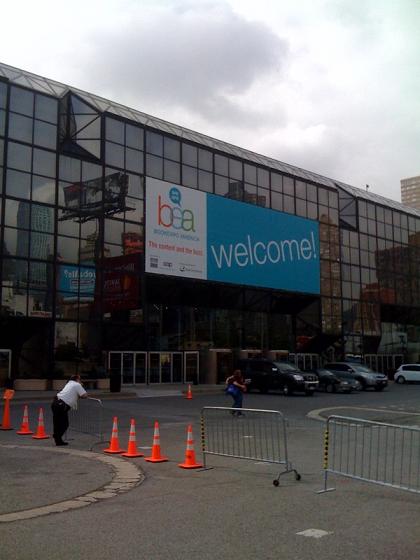
You guys, I am sorry about being out of it the last few days. BookExpo America is currently underway at the Javits Center and my week is nuts. But I promise to get up a review of the two ABT Bayaderes that I saw last week — especially since it was Cory Stearns’s debut as Solor and Hee Seo’s debut as Gamzatti! I will write more later this week, after all the madness has ended. In the meantime, here are some photos of BEA thus far. Above, the entrance, although early in the week there wasn’t much activity. Today is the beginning of the free galley (book before book goes to market) giveaways so I think it’ll be a lot more packed.

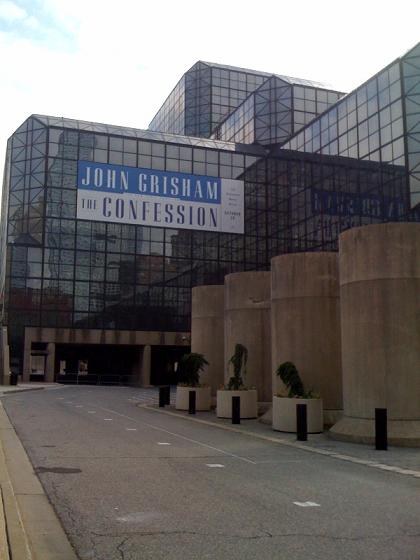
Big advertisement for John Grisham’s new, soon-to-be-released book — because who needs more publicity than John Grisham, right?

Inside the Javits Center. I’m standing in the ridiculously long Starbucks line, for my overpriced cup of coffee. Everything in Javits is ridiculously expensive. If you ever have a conference there, bring your lunch!

My book, along with some of the other Book of the Year Award finalists in the ForeWord Reviews stand at the new book exhibit.

And last night at Providence in midtown was the IPPY (Independent Publisher) Book Awards. For each of the gold medalists they had a continuous little slide show whereby they’d project a picture of the cover of your book, along with details like author and publisher, onto these big screens throughout the restaurant so everyone could see. Very very nice 🙂

Anyway, thoughts on Bayadere, as well as the Millepied / Karoui / Escaich event at the Guggenheim coming soon!

BARYSHNIKOV RETURNS TO THE STAGE


Here’s an interesting preview by Joel Lobenthal of Baryshnikov’s return to the stage, which happened at BAC this Wednesday. He danced three solos, along with two other men — Steve Paxton and David Neumann. Program was called, aptly, “Unrelated Solos.” I went last night, and particularly loved the last piece for Baryshnikov, a work in progress by Susan Marshall, which, to me was a meditation on how dance is meant for an audience, a performer must have a viewer or s/he is not a performer. It left a lump in my throat at the end. The other two solos for Baryshnikov were by Benjamin Millepied and Alexei Ratmansky – the Millepied another rather sobering reflection on a life spent in dance and the aging process, and the Ratmansky a rather funny retelling of composer Mikhail Glinka’s obsession with an aristocratic woman that made me realize how great an actor Baryshnikov was and made me sad that his and Ratmansky’s eras didn’t really intersect. I’d think Ratmansky could have come up with a lot of very clever, humorous work for him.

Both of the Neumann pieces were highly entertaining and witty, and the Paxton reminded me of Sara Rudner and the dance for dance’s sake / Judson Movement where the emphasis is more on the inner awareness of the dancer than strictly on the “performative.”

Anyway, don’t have much more time to write about the program right now but plan to write more this weekend. But read the Lobenthal article. And here is Macaulay on the program.

Photo by Julieta Cervantes.

GET WELL SOON, ROBERTO!


There’s been a casting change for ABT’s La Bayadere tomorrow (Saturday) night. Roberto Bolle (above, with Julie Kent) is injured and is being replaced by Cory Stearns (below). This will be Cory’s debut as Solor. Veronika Part is still dancing Nikiya. I hope the injury’s nothing serious; speedy recovery Mr. Bolle!

All images from ABT‘s website.

COMMENTS

As everyone who may have tried to post a comment in the past couple of days has probably noticed, something is awry. You can write a comment but then there’s no button to click “post” or “publish” or whatever. I wrote to Disqus and they said they’ve recently upgraded their system and my WordPress plug-in was too old to automatically upgrade. Which means I have to uninstall the old one and reinstall the new edition. Since I’m really busy right now, not to mention technologically inept, this could take me awhile (someone else installed my old plug-in of course). Anyway, I will try to reinstall everything as soon as I can. But in the meantime, if you have a comment, you can always put it on Facebook, where I almost always link to my posts here. That’s where most people have been leaving comments for about the past year now anyway. You can also @ me on Twitter, although I think Facebook is better organized for comments on a particular subject. My Facebook account is here, and Twitter is here. Sorry for the inconvenience and thank you for your patience!