
Oh my gosh, oh my gosh, oh my gosh!!! Okay, I can breathe again. Haven’t been able to do so for a few days now…
Sitting in the gay man section …
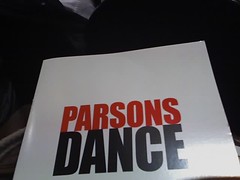
Sitting in the gay man section …
Originally uploaded by swan lake samba girl via mobile.
Should be fun!
Update: Actually the whole theater turned out to be the gay section 🙂 Mr. Parsons is very popular amongst a certain population… Hehe, I can see why; it was a lot of fun and he’s got some very good dancers in his troupe. His piece “Caught” appears to be his claim to fame. In it, a man frantically runs toward various lights shining down from above and dances underneath their heat. But then the lights leave him and focus on another part of the stage. At one point, strobe lights just begin flashing all over the stage, completely overtaking him, and he can’t escape. He dances, doing some amazing moves — continuous grand jetes, high twisty jumps — as the lights continue to flash on him. It’s an amazing visual effect — he looks like he’s literally flying, never coming down to the ground — and he must be very focused to be able to dance in all that chaos. I’ve seen things not unlike this before, but the audience was going completely nuts with applause. The guy next to me said to his boyfriend, “it’s worth the price of admission for that alone!”
Parsons also does some interesting things with the body, the male body in particular. His main muse appears to be male dancer Miguel Quinones, judging from the first program. At one point Quinones does these really jazzy barrel turns, where he kind of shakes and shimmies his whole body on each rotation. He doesn’t always gain as much height as a classical ballet dancer, but it’s incredible that he can move so in the midst of the turn. (I was sitting next to a critic — I think the guy from the New Jersey Ledger. His pen started going the same time mine did at those amazing turns 🙂 ) At another point, Quinones did a lovely arabesque, but instead of remaining still, he did these body rolls, starting from his hips and undulating up through his waist, torso, chest, shoulders, then out to the fingers of the outstretched arm — all the while steadily balancing on one leg, the other beautifully lifted behind.
Anyway, I’m going to Program B as well, and I’ll do a write up after! They’re at the Joyce Theater in Chelsea through Jan. 20th.
Okay, gotta go glue myself to the TV — Oh my gosh, Hillary won, Hillary won, HILLARY WON!!!
Jock!
I saw a documentary last night at New York City Ballet’s State Theater that I really really loved. AND it’s going to air on PBS on April 8th, so everyone can see it! Don’t worry, I will definitely be reminding you all closer to April 🙂 It’s called WATER FLOWING TOGETHER and is about the life of recently retired and widely beloved New York City Ballet dancer Jock Soto (pictured above after the showing speaking with photographer / filmmaker Gwendolen Cates — whom I’m told is related to Phoebe, though I don’t know if it’s true — and a moderator whose name I didn’t get).
There was some real hype over this, and I’m always ready to pounce in such instances, but in this case the hype was deserved. Although the film gets off to a slow start, it quickly gains momentum. I think what makes it so engaging is Soto’s interesting background and wonderful personality. He’s part Navajo, part Puerto Rican, and he grew up on a reservation in New Mexico, before moving to Phoenix (!) for ballet school. The film’s title is the name of his mother’s clan. There’s some great footage of the West, and my favorite parts of the film are (in addition to clips of his rehearsing Christopher Wheeldon’s tear-jerking duet “After the Rain” with the equally engaging Wendy Whelan, who is interviewed as well) those about his Native-American roots. (This could be partly because I have a Native American great-grandmother — Blackfoot to be exact — though I know next to nothing about her since, sadly, she’s been all but erased from my family history). Anyway, Jock’s mother was an artist and used to make Katchina dolls (how I miss Arizona…) and ceramic bowls, and he and his brother used to make and sell Indian Fry Bread (how I SO miss Arizona…) when they were kids. After he retired from NYCB in 2005 he went to culinary school and he and his partner, professional chef Luis Fuentes, have just begun a catering business, so I guess those foodie roots were always there!
Another thing that struck me: Jock’s homosexuality has always been accepted by his mother’s side of the family. American Indian culture, she says, holds homosexuals in high esteem because of their difference. (His paternal Latin side: not so accepting; aunts and grandmas keep asking when he’s gonna get married and, because his father hasn’t said anything, he feels uncomfortable revealing his sexuality to them). But interestingly, Indian society is also matriarchal. So, where women are valued, so are gay men.
And, like his longtime partner Wendy Whelan, Jock has such a sweetly endearing personality and a great sense of humor. He laughs easily at himself. Upon entering his apartment (which he openly tells you is a typical NYC dancer shoebox that he nevertheless pays $1,850 for) there’s a sign that reads, “No liquor served to Indians after 6:00 p.m.” Later, while preparing for a performance, he says, “as I put on my makeup and my costume and do my hair, I think, what a strange occupation for a 40-year-old man,” and at another point, trying hard to conceal his fear of and heartache about permanently leaving the stage says, “well, June 19, 2005 will be the last time I’ll ever have to dress in drag.” At one point, he actually lets loose and cries over his eternally pained body and his pending retirement. The scene makes him human and vulnerable and it really drives home that it must be so awful for a dancer to have to leave what he’s lived his entire life for at such a young age.
Anyway, it’s an excellent film and I left out a lot: his meeting and befriending Andy Warhol (I wish Cates had actually gone into a bit more detail on this); his ruminations on his coming to NY at only age 14, living without his family and dropping out of school in the 7th grade; and a lot of amazing dancing, including some great footage of him flying all over stage with his young little sprightly teenage body! Please do watch it on PBS in April, though they have to chop a good twenty minutes off for TV, which seriously frightens me since PBS seems to have a knack for making everything they show as bland as possible. If they cut any of the parts I just mentioned, there will be hell to pay!
It already seems this film is a slightly different version than that others have seen. In her lengthy review, Tobi Tobias mentions several classroom scenes where he’s teaching students at the School of American Ballet (from which aspiring NYCB dancers must graduate), which seemed to be missing from last night’s version. And smartly so, I think: “Classical ballet being the last bastion of chivalry in our disheveled era, Soto works continually to encourage a worshipful attitude in the gentlemen toward their ladies.” Considered the quintessential “manly” dancer though he may be, something about that line kind of makes me want to vomit.
Sometimes it can start to feel a bit stiflingly cliquish inside the State Theater if I’m there for too long, but I had a nice time hanging out before and after with Philip and Ariel, whose reports are here and here.
In Serious Praise of Cuba
Spent a lovely early evening at the New York City Ballet watching wonderful short film of Jock Soto‘s life (more on that soon!), then came home to watch the art of dance be totally and completely demeaned worse than I’ve ever seen by the insulting new TV show, Dance War. I’ve never in my life seen more people with less dance training seeking to become “stars.” They sang their hearts out and wiggled their butts and seemed in all honesty to have no clue that ass wiggling did not constitute dance. Some actually tried to do jumps but didn’t understand the concept of line (amongst many many other things) and so looked like monkeys.
But I’m more horrified that judges Bruno Tonioli and Carrie Ann Inaba (from Dancing With the Stars) actually praised them. Carrie Ann said of one woman who did a single fouette then stumbled on the very second whip around, that she had “technique.” A man did a grand battement (really fast high kick — anyone can do one) and Bruno jumped around onstage orgiastically screaming “excellent extension, did everyone see that extension?!” I’m not even going to bother criticizing this assininity; suffice it to say the judges know the fraud they’re perpetrating on the public. They know.
On one hand, I seriously feel like boycotting “Dancing With the Stars” unless they resign. On the other, I guess what can you do when you have a TV show and these are the applicants? You’ve gotta pick someone or the show’s off the air. And you can’t call everyone a bad dancer. So you shrug your shoulders and say, as Carrie Ann did, “Well, it’s easier to teach someone who can sing to dance than someone who can dance to sing.” Could anything be more of a smack in the face to a person who deeply respects dance?
And yet I’m very conflicted. I just can’t understand why people would try out for a show that necessitated the ability to dance when it’s obvious they’ve never had a single dance lesson in their lives. But I also don’t want to sound like the horrendously elitist critics and ballet dancers and afficionados I abhor who insist that in order to be a “real” dancer, one must have “proper training,” which, to them, just happens to include a very expensive education affordable only by the very rich, who are, in our lovely society, usually the very white. A friend and I were talking the other day about how wealthy many of the New York City Ballet dancers are (NOT the aforesaid Jock Soto, by the way).
So, I say, the only way out of this dilemma is to “buy” Cuban! There dance is highly respected as an art form, it is taught by some of the world’s greatest, and it’s also completely free. And free doesn’t exactly produce shoddy. And, if you don’t believe me, take Danny Tidwell’s word 🙂 More Jose’s, more, more!
Okay, it’s late and I’m tired and being a bit goofy all because I got so worked up I got over a stupid dance show… But, seriously, everyone please just watch this! Why oh why isn’t there more dance like it on TV?…
I Second Anthony Lane on "Persepolis"
…in giving this film an overall not so fresh tomato. And I mean second literally — everyone is raving about this movie; Lane (my favorite of all art critics) is the only one who hasn’t. Of course I’ve been looking so forward to seeing it, and of course that’s never a good thing, with me at least. With the exception of Alvin Ailey, it seems that everything I’ve looked forward to lately I’ve ended up being disappointed with.
Anyway, this is a graphic film, in French with English subtitles, based on Marjane Satrapi’s graphic memoirs about growing up in Iran during the country’s political turmoil of the 1970s: first the displacement of the Shah, followed by the violent revolutionary war, then the oppressive regime of Khomeni. At the movie’s start, the Shah is being overthrown and of course there are all kinds of imprisonments and murders. Marji’s father and uncle are supporters of the revolution and the movie begins with them telling her (and us) in detail about the politics of the period, and why the Shah is bad for the country. To me, this is not only confusing but becomes very boring very fast: I like my narratives to be character-driven; if I want to know about the politics of a time, I’ll consult a history book. Plus, Marji’s only about four years old when they’re feeding her these views, so how much can such a young child take in anyway? Just showing Marji’s family and friends being taken away and not heard from again from her child’s point of view makes enough of a statement. But, fortunately, we only get this for about the first twenty minutes; then we delve more into the characters.
I think my biggest problem was that I couldn’t fully connect to Marji. Having learned from her outspoken grandmother and mother to speak her mind, she challenges her teachers’ authority when they spout political propaganda in the classroom, then flouts police commands to wear her veil on the streets. Fearing for her safety, her parents send her off to a French school in Vienna. But several other people, including her grandfather who is severely in need of medical attention unavailable in Iran, have been denied passports, so I was curious at how quick and easy it was for her parents to obtain the necessary documents. That’s never explained.
It’s at her school in Vienna where she reaches puberty and begins her studies in earnest, discovering major philiosophers and knowledge she’s been denied in her home country, as well as lipstick, fashion and boys. She falls in with a group of young French intellectuals, which seems to suit her well, she has fun going to parties and meeting new people, and she gets her first boyfriend. But she has problems generally getting along with people. Though most of the students at her school come from international backgrounds, she feels out of place as an Iranian. And her aunt, to whose security her parents had entrusted her, promptly and inexplicably throws her out of her house and into a convent. Marji doesn’t get along with the nuns and their strict rules, so she runs away and becomes a border at the home of an older woman whom she fights with as well. Then, most astounding to me, after surviving the horrors of wartorn Iran, witnessing bombs destroy neighboring houses and their inhabitants, watching relatives be hauled off by the police, and hearing of their murders, she ends up having a breakdown over her boyfriend’s unfaithfulness. In a fit of anger, she leaves the house where she has been staying, begins living on the streets, catches bronchitis and nearly dies — supposedly over the boy. In the hospital, she calls her parents and asks to return.
She returns to Iran grown, the war now over but the oppressive regime firmly in place: the police are everywhere making arrests if women don’t wear veils in public, if they suspect people of going to or coming from a party where there’s been alcohol consumption, if someone is dressed in too Western a manner, etc. etc. Her family organizes a sweet extended family reunion for her, but, having come of age in the West, she now feels disconnected from everyone she knows. She begins seeing a shrink (how middle-class, how American?…) who pronounces her depressed and gives her meds that don’t work. Eventually, she is able to pull herself out of it and begin an Art degree, but after police arrest her and a new boyfriend for holding hands in a car, she decides, at 21, to marry the man and give up her education. And this is where I really felt like walking out of the theater. After surviving all that she has, she makes so many ridiculously stupid choices: nearly killing herself over a cheating boy, getting married and giving up her education because she can’t hold hands with a man in public?… I can’t even understand what she’s doing back in Iran in the first place and I want to scream at her to go back to Europe.
Anyway, eventually a resolution is reached and the ending hints that Marji has been able to find a kind of peace with herself. I’m definitely glad I saw the movie because it does give you a good sense of what it was like to live in Iran during the reign of Khomeni. But as an examination of displacement, exile and identity, I felt it was lacking, that it didn’t hold a candle to something like Andrei Makine’s brilliant “Dreams of My Russian Summers.” When when when are they going to make that into a movie?! (Actually, I have no idea how they’d make a film out of that book — it is so perfect as a novel; I just want everyone I know to be exposed to it, and unfortunately many more people see movies than read…)
But having said all of this, Persepolis has been nominated and received all kinds of awards, and everyone besides Lane is raving about it (and he wasn’t that harsh, for Lane anyway; only said it was “simple”), so I’d be interested to hear what others saw in it, if anyone did?
My First Pina Bausch Experience, Dance On Camera, and Writing (Slightly) Negative Reviews
Just quickly before I go out to meet Ariel (who’s now living in NY :D), here’s my review of “Rhythm of Love” on Explore Dance. Basically the same as what I said here on my blog, but more critical. I sometimes feel badly being critical (especially when reviewing ‘small people’ — biggies like Christopher Wheeldon and Jerome Bel can handle it), but I tried to be constructive and respectful.
Also, for people in New York, the Dance On Camera Festival is currently underway at the Walter Reade Theater in Lincoln Center. A lot of the films are experimental, and most programs have a combination of shorts with small documentaries. On opening night I saw Program 2, which included, most excitingly for me, a 45-minute documentary about (in)famous (depending on your perspective) German choreographer Pina Bausch. This was my first Bausch experience and I definitely can see what people both love and hate about her. Funny because, according to the critics, she doesn’t seem to talk much about her work, so to big Bausch fans the fact that she was actually talking was the draw. To me, though, I wanted her to shut up so I could see more of the excerpts of her work the film provided! In one excerpted piece, women wearing very flimsy nightgowns were violently thrasing their bodies about from the waist down, their hair flying about wildly. It was both beautiful and disturbing. In another, one woman screamingly commanded another woman to smile, the woman being yelled at tried but her smile wasn’t big enough to please the first woman, so woman #1 violently dunked the second woman’s head into a bucket of water several times. You can hear the audience’s upset. In another excerpt, a man reaches down under a woman’s dress and lifts her up, seemingly by the crotch. In its awkwardness, it is both unsettling and comical. If you saw the film “Talk To Her” by Pedro Almodovar, her choreography is performed at the very beginning, but from what I saw on Wednesday, that seems to be a very watered-down version of her work.
Anyway, I am now dying to see her dance group (Tanztheater Wuppertal), if they ever make it to NY. Art had his first Bausch experience this year as well, live at UCLA, and he seems as smitten as I! Here’s dance writer Eva Yaa Asantewaa’s take on the Bausch doc and another short in Program 2, and here is a post on the same by Anna Brady Nuse (who is a dance filmmaker). For a good, detailed break-down of the whole festival, visit Anna’s blog post here.
How Do We Learn To Read?
If you’re bored, take part in this interesting study on how people learn to read. I’m not sure the test measures exactly what it sets out to, but I don’t want to say anything more so as to skew the results. I found it from Maud Newton.
The Diving Bell and the Butterfly
I was recently reprimanded by a co-worker at my office holiday party. He told me, “You used to be interesting. You used to know about all the cool small independent films and off-off-Broadway plays. Now all you ever go to is dance stuff.” So, in an effort to revisit my days as an “interesting” person, over the holidays I went to see a little independent film, which I really liked.
The movie, based on the book of the same name, tells the true story of the Editor-in-Chief of French Elle, Jean-Dominique Bauby, who suffered a massive stroke in 1995 and was henceforth in a “locked-in” state. This horrendously frightening situation means he was completely paralyzed throughout his entire body, and could not speak, but could still hear, see, and understand everything happening around him. The sole part of his body that was not paralyzed was his left eye and eyelid and, through the help of an ingenious speech therapist, he learned to communicate by blinking that one lid. Basically, the therapist devised this method where she would begin reciting letters of the alphabet to him, beginning not with “a” but with the most often used letters, such as “r,” “n,” etc. (think “Wheel of Fortune”, not that I watch the show…). When she arrived at the letter contained in a word he needed to express his thought, he would blink and she would write down the letter. They went along this way until he had an entire sentence. It sounds extremely cumbersome, but he was able to write his entire memoir this way. And it wasn’t really as time-consuming as it would seem: just like with your cell phone when you go to text message, the therapist would be able to figure out the entire word based on the initial letters long before she had to go through the entire alphabet.
Anyway, I found both this method of communication and watching how Bauby’s friends and family react to him as well as the way he deals with his situation simply fascinating. Director Julian Schnabel included a bunch of flashbacks to Bauby’s life pre-stroke, as this flashy womanizing powerhouse of a fashion editor, which I guess makes sense, because it’s such an obvious contrast, but I actually found those to be the most boring parts of the film. The present, with this man confined to a wheelchair hooked up to an IV and a breathing machine receiving visitors and learning to communicate (and giving us his often rather satirically amusing thoughts through a voice-over) was just captivating. And the actor who played Bauby, Mathieu Amalric, was beyond amazing. The acting job he did with that left eye — whoa!
And his voice-overs are hiliarious. At one point his friend comes to visit and he’s trying like hell to get the hang of the communication method. But of course he keeps looking at the letters on the page that he’s supposed to recite and in what order, so he keeps missing Bauby’s blinks at the proper letter. “You have to look at me, you idiot,” Bauby yells, without being heard by the offending friend of course. And it’s such a human thing to do, because who can remember the order of letters you’re supposed to recite? That same friend also keeps pacing back and forth while speaking his thoughts, which I do all the time. But Bauby can’t move his head, which sits still in the wheelchair’s frighteningly enormous padded headrest, and he can’t see through his right eye, so, with the camera situated through his vantage point, we see the friend mumbling first off-screen to the left, then off-screen to the right, popping every so often into view. “He can’t see you…” a nurse finally calls out, and the friend yells, “oh shit, oh shit.” You feel both the extreme frustration of Bauby as well as the annoyance and embarrassment of the friend for screwing up.
My only qualm is that, for an artist, Schnabel can really be annoyingly literal with those voice-overs. At the beginning, we see the operating room through Bauby’s working eye. The doctor asks him, “can you tell me your name?” Bauby answers. The doctor again says, “your name, can you tell me your name?” Again, Bauby answers. “It’s okay,” the doctor says, “it just takes time. It’ll come to you.” Bauby says dejectedly, “they can’t hear me.” But he hardly needs to; we get it! Later, two technicians from the phone company come to install a phone in Bauby’s room so he can “talk” through the speech therapist to friends and family. They manage to get in without going through reception, and they begin asking Bauby, in his bed, where to place the phone, until they take one look at his completely immobile body and extremely animated left eye and become thoroughly bemused. Just then the nurse arrives, furious that they’re in the room without her permission, and explaining he can’t talk. The workers regard each other, thinking the obvious. One hesitantly asks her why then he needs the phone, and the other says under his breath that he must be a heavy breather. We hear three people laughing — the two workers and Bauby himself, but then Schnabel has Bauby say anyway, via voice-over, to the nurse’s horrified face, “Henriette, you have no sense of humor.” But by this point in the film, we’re well used to the sound of Bauby’s voice, and his laugh, so we don’t need the added obvious commentary.
Anyway, it’s a really fascinating movie and I think it’s going to do well at the Golden Globes. I may even pick up the book; from some of the voice-overs it sounds really beautifully poetic.
My Best of 2007 in Dance
It’s already the second day of 2008 (Happy New Year everyone!) and I’m just now getting my best of last year up; sorry so late! I was tagged by Jen & Jolene, so I’ll formulate my “best of” as a response to their survey:
1) Best Performance of the Year: I had many favorites, but I guess overall I’ll have to say Alessandra Ferri’s farewell performance with ABT in Romeo & Juliet at the Met. She was my favorite ballerina for many years and I’m still missing her. Plus, I was introduced to La Scala’s Roberto Bolle, who guest performed 😀
2) Best Male Performer of the Year: Definitely Clifton Brown of Alvin Ailey!
3) Best Female Performer of the Year: I thought a lot about this, and I know I’m mixing dance genres, but I’m going to say Yulia Zagoruychenko. She had a damn good year. She, with Max Kozhevnikov, made the Latin finals at Blackpool this year, being the only US couple to do so, then, later in the year, went on to displace the several-year-long U.S. National champs to win that title. At the end of the year, she survived a partner change and went on to win her first competition with him, Riccardo Cocchi. She is adored by many both nationally and internationally and she is very deserving of her hard-won success. Go Yulia and Riccardo!
4) Best New Discovery of the Year: This is too hard because there were so many dancers and choreographers whom I was introduced to this year who aren’t necessarily new to the scene, but just to me! List includes: choreographers Camille A. Brown, Luca Veggetti, Luciana Achugar, Kyle Abraham, and Robert Battle; composer Nico Muhly; dancers Kirven Boyd, Antonio Douthit and Yannick LeBrun (all of Alvin Ailey — the last I forgot to mention in my last post on AA; fortunately Susan reminded me in her comment!), and Roberto Bolle (who was new to me this year); Brazilian troupe Mimulus; Nora Chipaumire of Urban Bush Women (pictured above this number) at the Jacob’s Pillow Dance Festival; the Jacob’s Pillow Dance Festival itself (it’s been around for aeons, but I had my first experience there this year). That’s all I can think of for now, but I’m sure I’ll think of bizillions of people I forgot later…
5) Best Regional / Local Performance of the Year: I think this is more of a theater question since there’s usually a big distinction between regional theater and a Broadway show, or a company who tours, but, since physically it was “local,” I’ll say NYCB’s spring season opening night. It was just too much fun watching all those celebrities walk down that red carpet and overhearing goofy crowd comments, and then writing about it all (although my mother was aghast at me for my using the word “whores” in my blog title!)
6) Best Performance in a Non-Traditional Venue: This is a toss-up between the wonderful “Accounting For Customs” performed on the steps of the US Customs House, and the super fun and impossible-to-tear-yourself-away-from Lincoln Center ‘drive-in,’ David Michalek’s “Slow Dancing” films.
7) Favorite Televised Theater Event: I didn’t really have a favorite in this category (since the only thing I saw fitting it was Mark Morris’s “Mozart Dances” on PBS which I didn’t care for), so I’ll just state my favorite dance TV show, which was SO YOU THINK YOU CAN DANCE. Duh.
8) Biggest Dance Obsession: Alvin Ailey, Alvin Ailey, Alvin Ailey. Again, if you’ve read my blog over the past several weeks, Duh 😀
9) Most Likely To Be The Next Big Thing: Eee. Hard! So hard to predict. But I’m going to name a few: ABT’s Blaine Hoven and Vitali Krauchenka,
Kirven Boyd and Antonio Douthit at Alvin Ailey,

Craig Hall at NYCB,
choreographer Camille A. Brown…
Again, I’m sure I’m leaving people out…
10) Most Anticipated Performance Of 2008: Eee, another tough one. There are so many things I’m looking forward to this year. I guess the biggest is going to be Blackpool. Since the current decade-long Latin champs retired last year, there will be a new Latin winner, which is really exciting to me since it’s my favorite event there. I’m hoping for Slavik Kryklyvyy and Elena Khvorova,
I’m also looking forward to Twyla Tharp’s new ballet that ABT will premiere in the Spring at the Met,
And I’m looking forward to Nikolaj Hubbe’s farewell performance with NYCB (he is returning to Denmark). Not that I’m looking forward to bidding him farewell, but to the show NYCB will put on in his honor.
Okay my brain is tired now. If anyone else wants to add their “best ofs” in a comment here or on their own blog, please do so!
Polls Open :)
I’ve now been nominated in both the “best design” and “best blog written by a PD that has nothing to do with the job” categories. It’s so sweet of them to recognize me — so flattering! Go here to vote! And happy New Year everyone!
Alvin Ailey Season Wrap-Up
“One of the promises of my company is that its repertoire will include pieces that ordinary people can understand. I still dream that my folks down on the farm in Texas can come to an Ailey concert and know and appreciate what’s happening onstage. That’s my perception of what dance should be — a popular form, wrenched from the hands of the elite.” From REVELATIONS, The Autobiography of Alvin Ailey, pg. 101.
That must be why I love this company so. Everything they do is sublime, humanistic, evocative, easily relatable, and immensely meaningful; it speaks to your soul, and it speaks to everyone. It’s the antithesis of elitist. I was so upset their New York season is over (well, not competely; they still have a big shindig tomorrow night in celebration of New Year’s Eve), that I spent all weekend reading Ailey’s Autobiography, which I picked up at a rare bookstore I’m fond of in Durham, while visiting Mom. I highly recommend it.
Anyway, highlights for me of the past several weeks were:
1) “Revelations” (top picture, by Paul Kolnick, from AAADT website). But, I mean, duh, that it’s a season highlight. You’d be inhuman if you didn’t respond to this one 😀 I wrote about it previously, here.
Oh, another thing I discovered whilst confined to my apartment by my recent (ridiculously debilitating) sinus infection + migraine episode / end-of-AA-season depression: the Alvin Ailey organization has a bunch of videos posted on YouTube!!! The quality’s not tremendously high (hopefully they’ll improve on that soon :)), but for those unfortunate souls who have never experienced this brilliant company, I can link to just about everything so you can get a taste!
2) This season I fell in love with “Love Stories,” a dance in three parts and three styles, all of them set to Stevie Wonder music. I love how the three parts are so fundamentally different from each other while somehow still managing to sequeway well into one another: the first one is beautiful modern / balletic (above top pic, danced by Clifton Brown), composed of a solo followed by a group of duets that include some very acrobatic partnering; the second part is raucous mad fun hip hop that makes you want to get up and dance yourself; and the third is what I’d call African / modern blend. That third part has honestly never done much for me until this season when it somehow become my favorite. For one thing, in one of my viewings this season, Kirven Boyd, a favorite whom I blogged about before, danced the beginning of that section, and watching him made me all the more intrigued. Weird how that happens: you have a favorite dancer and you end up liking anything they’re in — they make something totally beguiling when you’d never really even noticed it before.
So, the crazy fast hip hop number of the previous section ends, a voice calls out, “I want to hold a mirror up to society so that everyone can see how beautiful they are.” And, at that point a man emerges from the right wing wearing this earthy-toned, roomy outfit resembling to me a kind of religious, Hare Krishna-ish garb. He’s bent over and he takes a few slow hesitant steps forward, then several runs back. He gains the courage to inch forward again, then more steps back. The movement is African. Eventually, an ensemble of dancers emerges and they all dance together, making various formations, resembling possibly a kind of chain gang, or perhaps a multitude overtaken by a kind of religious spirit. At one humorous point, they bounce around in a circle, stick their arms out awkwardly at their sides, and look up to the ceiling making huge ‘Stevie Wonder’ smiles. When I saw the piece at one point with Apollinaire, she said she thought the first man out looked like a prisoner. I guess he could have been, although, I hadn’t thought of it that way. Maybe he’s a man who’s imprisoned by blindness or some other kind of handicap … racial prejudice even… At the end, the group happily bounces together going toward the back of the stage, when the back curtain lifts to reveal a multitude of bright lights. It’s really a sight. I’m really not sure what to make of it, but I’m intrigued. Robert Battle choreographed this section, and I was so taken with a small enchanting piece of his the company premiered, “Unfold,” which I wrote about here. This season was my first experience with this choreographer and I’m very interested to see more.
3) Several of the male dancers, including Clifton Brown (really the star of the company, to the extent this company has such things), Kirven, and Antonio Douthit (pictured above as the Firebird in a photo by Eduardo Patino). Like ABT, this is a company strong in men. Antonio is a tall, slim man with long, sinewy ballet muscles and he makes these gorgeous leg extensions. At one point in “Flowers,” Ailey’s fun but ultimately heart-rending ballet in tribute to Janis Joplin, there are several men dressed as her ‘boy toys’ in these hilarious shiny booty shorts (just what went on in the 70s?!) carrying her all over the stage in worship. At one point, they’re all simultaneously doing these rotating arabesques (turning on one foot with one leg lifted up to the back), and I suddenly noticed Antonio’s foot was practically to the ceiling! It was stunning! He makes beautiful shapes, and he’s very expressive with both his face and body. If anything, he probably needs to work a little more on his jumps, as well as on that intangible something that makes one a real artist. I say this only because he took over the role Clifton had in “The Road of the Phoebe Snow” — that of the young, innocent dreamy boy who falls in love with the girl who is killed, and he just didn’t make me want to cry for him the way Clifton did. Plus, I remember these crazy scissor split leaps that just completely blew me away when Clifton did them. They were impressive when Antonio did as well, but not quite as much — which isn’t bad and it’s probably completely unfair to compare anyone to Clifton The Miraculous (by the way, I wrote more about Clifton here). Basically, I think Antonio is a Clifton in the making but he’s not there yet; he just needs to work on it a bit more — he’s young, so he has time! Here’s an excerpt from “Flowers.”
I also liked Glenn Allen Sims, a favorite of mine from other seasons as well. He was just beautiful in this small little five minute jazz ballet of Ailey’s that the company just revived, “Reflections in D.” And the night I saw him dance that piece, he followed it by dancing the similarly sweet balletic solo in the opening of “Love Stories.” I was in love 🙂 In contrast, he also perfectly performed the bad-ass scary band manager / boyfriend in “Flowers,” tormenting poor Janis and signaling her downfall, as well as the hardened lover in “Phoebe Snow.”
Of the women, I LOVED Linda Celeste Sims (above in “Flowers”). She absolutely shined in everything she did. She brought me completely into her world: I wanted to cry for her raped, beaten innocent girl in “Phoebe Snow,” I felt angry at the men who mistreated her in Ulysses Dove’s darkly sexual “Episodes” (pictured below), and her beautiful ethereal creature with that impossible-looking back arch in Battle’s “Unfold” took my breath away. She is like my Veronika Part!
I also liked Briana Reed, for giving everything she did such sass and conviction and major attitude!
Alicia Graf is another one with a very beautiful balletic body.
I know a lot of people love her for that reason — with her balletic form and training, they think she brings something new and special to Ailey. I agree, but only somewhat. I didn’t love her in everything I saw her in, and while I certainly don’t think she’s superior to anyone else because of that background, I do think she really excels in the more balletic parts. I thought she was beautiful in the “Fix Me Jesus” section of “Revelations” (pictured here, but with Linda dancing the female part). She has gorgeous pointed toes, reminiscient to me of (again) Veronika Part. I also loved her in the balletic parts of “The River,” which was originally a ballet on pointe created for ABT. I’m not sure why the company doesn’t put that on pointe; it’s not like Alicia (or the other women — “Flowers” is partly on pointe) couldn’t do it. It seems like it would be so much more magical… Anyway, it was other roles where I felt like she didn’t bring as much as some of the other dancers. For example, she danced the jilted lover in “Phoebe Snow” very differently from Briana; Alicia’s character seemed more fragile, more innocent and more hurt by her jerky boyfriend, making her, in my opinion, too similar to the other female character in that ballet, the fragile innocent who ends up killing herself. And, I was underwhelmed by her jazz divas in “Night Creature” and “Pas De Duke” (the latter created by Ailey for the legendary Judith Jamison)
But really, one thing I love about this company, and why it’s rather ‘star-less’ I think, is that I think every one of the dancers brings something unique. I only talked about some, but I really like them all. I’m only leaving out the others because I’m dead tired and I need to go to sleep! I’m one of those unfortunate souls who has to work tomorrow….
Oh but quickly, I also really liked Camille A. Brown’s Groove to Nobody’s Business. I thought it was cute and completely relatable and fun and I hope that she does more for the company in the future, but really takes it up a notch in terms of depth. I saw a smaller piece by her earlier this year at the Fall For Dance Festival called “The Evolution of a Secured Feminine.” It was a smart, witty solo, by turns funny, by turns more reflective, which she performed herself. I hope in the future she will create more, fuller-length work like that for a larger group, on a larger scale.
Anyway, happy New Year’s everyone! And please look at some of Ailey’s YouTube videos, especially if you’ve never seen this company before. And please do go see them live if they come to your neck of the woods! They combine everything — modern ballet, African, jazz, hip hop, Latin — everything! They are the future I do believe. I can practically promise that you won’t be disappointed 🙂
Dance Times Square In-House Competition

A couple of weeks ago I went to Dance Times Square‘s in-house competition, an event the studio holds every once in a while to give their students who are thinking of entering an actual pro-am competition with their teachers a little taste of just what that would be like.

It’s judged by actual judges who arbitrate at the local and national competitions. Above are John Nyemchek and Edward Simon, a former American Smooth champion who now runs the New York Dance Festival and Empire State Dance Sport Championships.

Melanie LaPatin (studio co-owner) emceed.

(Sorry pics are blurry; I didn’t want to scare anyone with my flash!) I haven’t danced in so long, and it was exciting (albeit somewhat sobering) to see some of my old friends dancing so well at a much higher level than they were. Here’s long-time student Elaine (one of Pasha’s former students) dancing with her new teacher, Jacob Jason. She used to be at my level; now she’s far surpassed me! I MUST go back to dancing!
Anyway, here’s my full write-up of the event.