
The 2007 Weblog award winners were announced today here. Again, there is no category for Dance. Nor is there a category for Performing Arts. Nor is there a category for Art. If you look at the Culture blogs, they’re all pop. Thankfully, there’s at least a category for Literature. Will I ever not be saddened by the role the arts does not occupy in our society?
Mesmerizing Traditional Thai Dance Versus Dumb White People Tricks
Last night I had my first Jerome Bel experience at Dance Theater Workshop in Chelsea. I went to see the latest work by the French experimental choreographer known for refusing to return the money of disgruntled customers, entitled “Pichet Klunchun and myself.” In the piece, which the program says is an exploration of “very problematic notions such as euro-centrism, inter-culturalism or cultural globalization,” Bel and Thai dancer Klunchun (who is brilliant, by the way) sit on chairs across from each other, Bel with a laptop on his knees. Bel first interviews Klunchun, asking him about his work, Thai culture, the type of dance he practices — “Khon” — a centuries-old Thai dance, and asks him to illustrate various moves. Klunchun then queries Bel about the same regarding himself. The first half of the program I found fascinating and I recommend that everyone in NYC go see it (showing through Saturday, the 10th) for that reason alone.
Khon, Klunchun reveals, began with a Thai king, who danced himself, and is a celebration of Buddha. The body is literally like a temple, the Buddha contained within both the center of the body and the center of the temple. So, arms legs, hands and feet, like Thai architecture, are shaped so that the energy flows out from the center, down through the limbs and rooftop structures, and is then re-directed back to the center, to the Buddha of the temple and soul. That’s why Thai dancers hold their hands and feet as such, which the fingers and toes splayed and flexed outward and upward. After he gives this explanation and begins dancing, you can really see the arcs of energy radiating out and back and out and back. Thai dancers practice flexing their fingers backward, and he shows us how. Ouch! Bel tried to flex his own, but to no avail. I tried as well, equally unsuccessful. It looks like it takes as much work as balletic turnout.
I found his this fascinating, along with Klunchun’s illustrations. At one point, he walks slowly slowly slowly across the room, showing how the spirit of a character who has died inhabits the stage (this after Bel asks him to feign dying onstage and Klunchun says he can’t; for a character to die onstage is for the king to die, for the country to die). Anyway, in his walks, the feet slowly lift from the floor, almost toe by toe, then the knee slowly bends, the leg rises, lifts, extends out, bends, the foot slowly drops to the floor, the step only ending when the last toe has touched ground. I can’t explain — you just have to see for yourself — but it was mesmerizing. His movements were so perfectly stylized down to the very last detail, so formalized, not a skin cell out of place. It really made me want to see the Thai dancer in David Michalek’s Slow Dancing films again, especially now that I understand the movement. He illustrated the four main characters of Khon: male, female, demon, and monkey — demon being his specialty; monkey he can’t do to save his life (my word choice of course; his language, like his dancing was very formal and ascetic). At first I couldn’t see the difference between the characters, but after Bel asked him to explain, I understood. Everything is so subtle. You have to watch really closely. And you will because it’s really so breathtaking in its simplicity. When Klunchun finally danced the role of a woman learning that her husband had died, I understood every movement, every discreet but articulated gesture to a tee. Beautiful! Bel thought so too.
Throughout Bel’s interrogatories, there were little culture clashes, most of which I felt were forced and contrived. Bel exclaims to Klunchun that Western dance (meaning ballet) also originated from a king — King Louis. But it’s a superficial similarity, of course, as, far from having the energy re-directed to one’s inward Buddha: the French king demanded that his court dancers have their bodies always turned not straight ahead, but toward him, thus the balletic turnout. “You direct your energy out,” Klunchun says at one point, demonstrating a very funny faux grand jete. “Out, out, out,” he said as he leaped through the air throwing his arms up. He was really quite an actor and could be very funny in his deadpan seriousness.
Then Bel turned the tables and asked Klunchun what he would like to know. After the exchange of some personal details intended to reveal cultural differences (Klunchun doesn’t understand how Bel can be unmarried and have a child, for example), Bel gets up and illustrates his work. He plays music from his computer. The song is “Let’s Dance” by David Bowie. Bel walks to center stage and stands stationary, looking out at the audience, eyeing us left to right. After about a minute, he begins jumping around, breaking into an unsophisticated version of club dance. After another minute or two of doing that, he sits. Klunchun, playing the outsider / voice of reason asks him, basically, WTF?? (my words again). Bel explains that in France they had a Revolution during which commoners overthrew all of the royals, sparing no family members. Hence, long live the French principle of egalite. He is deconstructing the spectator / performer dichotomy, showing the audience that he is just like them, no better. “But why then would they pay?” asks the voice of reason. “Well, they sometimes want their money back, in fact,” says Bel. The audience erupts with laughter — clearly these are all Bel groupies in the know about his history. “And do you give it back?” asks Klunchun. “No.” You see, Bel explains, he is a “contemporary” artist — this means not ballet, not Swan Lake, not the Nutcracker. “Contemporary” means there can be no expectations, no preconceived notions. It’s in the present. The government pays him a lot of money to go out and do research on this present state of things, about which he then produces work. He walks back to center stage, throws a vase of pencils and other small object onto the floor, falls down, and pretends to fall asleep atop the objects. Not to sound like a philistine, but I really don’t understand what kind of research one needs to do in order to come up with this, Mr. Bel?
Later, Bel talks about the work I think he is most known for, “Jerome Bel,” in which a man and woman, both naked, come out onstage, stand, look down at their bodies, and begin scrunching together a role of fat from their waists, which they kneed up and down and all around, distributing the fat throughout their torsos. “The body is such a marvel in and of itself,” Bel exclaims orgiastically, “who needs movement!” With this piece, he says, he was trying to explore the bare essentials of theater. What better way to do that than by having a stage with no props, no costumes and hardly any light?
Okay, knowing me, this is the kind of thing I would have thought was brilliant — or maybe not brilliant but something I would have at least been into — when I was in college, so I do see where he has his followers. After last night, I have decided that I am not, however, one of them, if my tone hasn’t made that obvious. Having only seen this one piece of his, though, I could be missing something. Here is another perspective from someone I highly admire.
At the end, Bel has just finished sleeping onstage for several minutes to “Killing Me Softly,” when he gets up and begins to pull down his pants. “No, no,” Klunchun stops him. “I don’t, I don’t want to see you naked, Mr. Bel, it is not right.” “Why,” says Bel unzipping. “Because in Thailand, there are certain people you, you don’t share nakedness with,” Klunchun says visibly distraught. “But, Mr. Klunchun,” Bel snickers, “in Bangkok clubs, there’s lots of nudity.” “That’s different,” Klunchun says, averting his eyes, unable to hide a look of disgust, “they’re, they’re working.” “I’m working too,” Bel says with the tone of a high-schooler. “But in Bangkok, they’re working for tourists.” With this the Bel groupies moaned as if the skies had parted. The international trafficking of women as sex slaves has long been one of the most disturbing social issues to me, so this may well not be everyone’s reaction, but I found it completely insulting that Bel assumed that I didn’t already know the truth of Klunchun’s last line, that that was supposed to be a revelation to me as a white person.
Anyway, as I said, “Pichet Klunchun and myself” is totally worth seeing for Klunchun alone. Who knows, you may up enjoying the deconstructionist French guy as well. Go here for tix.
Is the FAA Allowing Airlines to Jeopardize Our Lives?
Am I the only one who’s upset about this? I saw it on 7 News (NY’s ABC station) after Dancing With the Stars on Tuesday night, and I’m still all worked up over it. I still have post 9/11 stress and have only recently begun flying again, and just made a plane reservation to visit my mom in North Carolina over the holidays. And now this report about how in the past six months there’s been an insane number of emergency landings at Newark airport alone (guess which airport I’m flying into coming home…) because some airlines are cutting back on fuel, allowing each jet only the minimum amount necessary to get to its destination. Hence, any delay (because we all know those never happen) necessitating a detour, or circling around in the sky or sitting on a runway for any amount of time, equals very possible tragedy. The FAA seems not to even care. If costs of fuel are going up, increase the damn airplane prices???
And what’s up with 7 News not giving the names of the offending airlines? I would like to know if the airline I just bought my ticket for is one of those who has no value for human life so that I can demand a refund and take another. Which airline did the pilot who had to lie in order to protect his and his passengers’ lives work for? How can we protect ourselves?
Sports Injuries
According to Ballet Talk (a reliable source), my other favorite Brazilian dancer (the professional one, not the amateur 🙂 ) is unfortunately injured and will be unable to keep his upcoming guest appearances with the Los Angeles Ballet. Thanks to Delirium and Barbara for pointing me to this. Poor Los Angeleans! And poor Marcelo — this is not his first injury.
Many people don’t realize how hard ballet is on the body; they think it’s just a beautiful art, which of course it is, but it is also one of the most physically demanding and difficult of all sports. I think it was Einstein who called ballet dancers God’s athletes. While it should come as no surprise that dancer injuries are not uncommon, it’s disappointing to me that they’re not treated the same in popular culture as sports injuries. Anyway, speedy recovery, Marcelo!!!
Also, for New York City Ballet fans: Ashlee Knapp recently left a comment on my former post, where there was discussion about her whereabouts. Poor thing; she has a really horrible-sounding injury. Go here and scroll down to the comments section to see what she wrote.
Could They Please Stop Scaring Me
by waiting so late into the show to announce that Helio is safe?!
So Jane Seymour left tonight, which I don’t think was much of a surprise to anyone, though I did think she was a lovely Standard dancer. What was a surprise to me was that Kenny Mayne actually has quite a sense of humor, as exhibited in that little faux sports broadcast he did with Judge Len and Jerry Rice. I haven’t seen that skit before, if it’s been on. Did Mayne mean to wear all of that makeup?
I saw the Apple iphone commercial after the show was over and with My First Time guy doing the advert. Doesn’t it make more sense to show Kristin demonstrating her use of the phone and during the show?
First Cha Cha in Six Months
I was so sad over ABT season ending, I felt like I needed to pull myself out of my depression. And what better way to do that than by … taking a dance class! I returned to my very first studio, Paul Pellicoro’s DanceSport, where I began three and a half years ago with group classes before I’d transferred to Dance Times Square and started privates with Pasha. It all seems like such a long time ago now, but remarkably, I recognized so many faces — so many of my old friends were still there and I was reunited with four of them in a one-hour period! Passion for ballroom is something that just stays with you forever.
Unfortunately, I wasn’t all that prepared with my dance bag. I forgot to pack a pair of beige tights, so had to look like a bit of an ass with mismatched shoes.
I wanted to ease myself slowly back into it — it’s been six months since my last lesson at DTS — so I decided on a bronze (lowest-level) Cha Cha — always my easiest dance.
Ugh, not anymore! I remembered all the steps but forgot how hard it is to maintain proper technique when the teacher plays the music at full speed! Warm-up went well-ish, but when the actual partner dancing began, I was tripping all over myself in no time. Plus, I forgot how hard it is to dance, to function really, in those blasted high-heeled, open-toed shoes. I’m always sliding forward in them, leaving my heel unstable. I guess it helps if you normally wear similar street shoes, like high-heeled sandals, but I don’t.
Happily, whenever I felt or saw myself in the mirror reverting to a nasty habit — like rising up on my toes during the middle cha cha cha instead of staying grounded with my heel on the floor, or falling backward during an underarm turn because I forget to have my body weight forward — I’d hear Pasha’s voice (“no leaning back, Tonya”), or feel his hand lightly but firmly pushing down on my head (which he used to do to keep me from rising on the cha cha chas). So, even though bad habits die hard, the words of great teachers don’t 😀
So I made a lot of mistakes. But, eh, I’ll get back into it.
Interestingly, I met an old friend from my Swing team, Mark, in the lobby. He was heading to a Hustle class and asked me what I’d signed up for. When I told him the International Cha Cha, he told me he thought the teacher, Werner Figar (who is new since I was last at the studio), was a member of the modern dance group, Elisa Monte Dance. He told me he recognized his name from a recent New York Times article, which I looked up when I got home and is here. The guy in the picture does look like Werner (who was very good — both as a Latin dancer and teacher), but his name isn’t on the company’s website. It’s just so odd to me that someone dances both Latin Ballroom and Modern professionally. They are such different kinds of dance and usually a person isn’t good at both. But very cool if he is! I’ll have to ask him next class…
DanceSport has relocated since I was last there — used to be at Columbus Circle and is now on 34th Street right near the Empire State Building. Their new space is way the heck bigger than the last — really floored me.
So many rooms!
And here’s the new huge lobby, which even has a little cafe off to the side. Paul, the owner, taught Al Pacino to dance for “Scent of a Woman,” so that poster stays up always. 🙂
ABT Marathon Weekend Wrap-Up
Just finishing my City Center-spectating season and am so sad. I hate this time of year. My favorite dance company is gone and I won’t be seeing them again until May. Oh well.
I went to the last three performances (Friday night, Saturday matinee, Saturday night); here are my highlights:
I really loved all of the dancers who performed my favorite short ballroomy ballet — Tharp’s “Sinatra Suite” — but yesterday Herman and Misty Copeland (in headshot above) in particular took my breath away. Herman was the closest thing to Baryshnikov that I’ve seen, in terms of the actual movement (he has the smallest body of the three men who danced the role — other two were Jose and Marcelo — thus the closest in body type to Baryshnikov). The piece was choreographed on Baryshnikov and some of the movement, like the quick, jumpy weight shift in the first song, looked the cleanest on Herman; whereas Marcelo, for example, almost couldn’t move fast enough and missed a beat. But what Marcelo and Jose may lack a bit in that department, they more than make up for in the over-the-top personality they give to the role, particularly in the “That’s Life” song. In fact, everyone seemed to be able to do the “That’s Life” cocky shithead guy very (almost frighteningly) well; it’s the other three songs: “Strangers in the Night,” “All the Way,” and “My Way,” where they seem a little more bland, seeming to play the same guy three times. To me the first song (“Strangers”) is about two people just meeting and falling for each other, the second (“All the Way”) actually falling in love, the third (“Life”) having a problem moment, and the fourth (“My Way”) his saying he needs to go it alone, then the fifth, the male solo danced to “One for My Baby,” evokes his missing her. It seems like all the men danced to each of those songs besides “Life”, played each of those roles, the same way: all classy and romancy, giving only cocky “That’s Life” guy something unique.
Misty danced the female role better than I’ve ever seen it done, including by Elaine Kudo, who danced the original with Baryshnikov. That girl had personality galore and was not about to let the guy get away with anything. Go Misty! The others seemed to let the guy push them around too much. But again, I focus on “That’s Life.” She didn’t seem to do anything breathtaking in the other three duets. It’s funny, ballet dancers normally dance dreamy in-love princes and princesses, temple dancers and warriors, fairytale characters and their knights in shining armour — you think they’d be able to do a contemporary romantic routine?…
Anyway, Misty also floored me with her performance in Tharp’s “Baker’s Dozen,” which I ended up seeing a total of four times. In my final viewing of it yesterday, Misty danced the part of the flirty girl who keeps hopping on poor Craig‘s unsuspecting back. She was so fun and playful, proved to have just as much charisma as Craig, and she just has a natural jazz body. If I was Twyla, I’d definitely choreograph everything new I did from here on out on Misty; she is THE female Tharp dancer.
Also, when I first saw this ballet I wrote that I felt the company wasn’t putting everything they had into it, but suspected that may be because it was a brand new one for them. After having seen it numerous times now, I know I was right. They’re doing so much better, they’re really nailing the teasing / sexy / cool / jazzy / clownish / playful / swingy nature of it all. What a fun ballet! Craig still stands out, but in a ballet like this that requires solid acting skill, it’s almost unfair to compare anyone else to him, he’s such a natural. If he wasn’t a ballet dancer, I’m positive he’d be enjoying a very successful Broadway career.
(do not ask why these photos are varying sizes; I’m simply copying them from ABT’s website and have no clue what kinds of codes they’ve written in or what kind of codes my blog software is somehow putting in! It just so happens that pictures of Marcelo come out the largest, I swear! Above are Marcelo and Julie in “Leaves”)
Yesterday, I had my first ever viewing of Antony Tudor’s 1975 ballet, “The Leaves Are Fading,” which the company has revived for this season. Wow, it was really beautiful, albeit in a bittersweet kind of way. It began with a woman coming out onstage wearing a long, green ballroom dress. She walked around as if deep in thought, reminiscing. She left and several male and female dancers entered all wearing pinky-peach costumes — the women in flowing summery dresses, the men in blousy tops with sweet gentlemanly little silk scarves. The group danced lyrically as an ensemble then broke into duets, each seeming to symbolize a different time in a relationship — young innocent love, then slightly older and more fraught with angst, then more mature; and Marcelo and Julie, my favorite partnership (have I said that before? 🙂 ) danced the main, more mature couple. They dance so beautifully together, she just floats in his arms so effortlessly, so romantic, so poetic. The backdrop and wings were painted various shades of green, as if to evoke a field, and the pink costumes made the dancers almost look like flowers at points. At the end, green dress woman re-enters, her presence framing her memories, coming to terms with them, making clear they are about a past youthful love that no longer exists but will always remain part of her. Fittingly teary end to my own emotional farewell to ABT season! It was so lovely you just get caught up in the images, in the feelings they evoke. They didn’t have many performances of this ballet and I only got one chance to see it, so I hope they put it on again next year. I’d really like to see it again.
Finally, this year the company revived Agnes de Mille’s “Fall River Legend,” based on the true life story of Lizzie Borden, who killed her parents with an axe after their severe abuse of her. I saw this ballet on Friday night with Apollinaire, who loved it. Go here for a little write-up on that (read the “Note,” at the end of this post; also read the post for her review of Ballet du Grand Theater du Geneve, which I saw with her (and really liked!) but haven’t had a chance to review yet). Anyway, I personally didn’t care much for the de Mille. I feel that she only presented a partial story, leaving out the parental abuse that’s necessary to make sense of Lizzie’s actions. The ballet begins with Lizzie’s being sentenced to hang for her crime, then flashes back to her life. The flashback begins with her father being very loving toward Lizzy, then a sister dies and a stepmother enters the scene, who doesn’t much seem to like Lizzy, but doesn’t seem particularly horrible to her, and the father still seems to be loving albeit traumatized by the sister’s death. All of a sudden Lizzie is shown fighting the urge to hack up her dad and stepmom, then eventually succumbing to it. The rest of the ballet (the main part) is devoted to Lizzie being remorseful and haunted by what she has done, slowly accepting her fate. I agree with Apollinaire that Gillian Murphy was just amazing in this role — she perfectly captured the awkward outcast, making me both feel sorry for her Lizzie and fearing her. But, without the choreographer’s devoting any time to the family’s abuse of her, all of that great acting was unfortunately reduced to melodrama.
Lastly, I saw Benjamin Millepied’s “From Here on Out” again yesterday and it did grow slightly on me the second time around. I’m still far more in love with the Nico Muhly musical score though and can’t wait to get my hands on a recording of it. Again, I particularly liked the final third of the ballet, when the crescendo really starts to build. I feel like Millepied was really getting started just as he was ending. I really liked the second cast that I saw, led by Isabella Boylston and Cory Stearns. Isabella in particular was perfect at those angular abstract contemporary moves — I almost thought I was seeing NYCB (who does more abstract contemporary ballets) at points!; Isabella’s ideal for contemporary.
Well, I’ll be excited to hear what others, for example, in Berkeley, (for example, Jolene!!!), have to say about the new Millepied as well as the new Elo, “Close to Chuck.” Sad as I am about ABT leaving NY now, the good thing is they’re a touring company, so you don’t have to be in NY to see them. Go here to check their touring schedule. These are the greatest dancers in the world (Tidwell was once one of them, remember 🙂 ); please do not pass up the opportunity to see them if they come near your neck of the woods!
Mentally ill ballet fan!
Originally uploaded by swan lake samba girl via mobile.
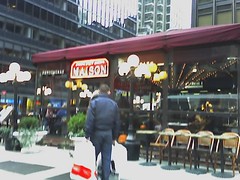
Killing time at my favorite midtown restaurant between matinee and evening ABT performances.
Herman so good as sinatra just now!

Herman so good as sinatra just now!
Originally uploaded by swan lake samba girl via mobile.
A bit stuffy up here though. And they have run out of programs!
Capitalism, Poetic Clothes hangers, and $500 Apartments in the Village?!
Last night I went to see experimental choreographer John Jasperse‘s new work “Misuse Liable to Prosecution” at BAM’s Harvey theater in Brooklyn. Fun night! I went with Tony Schultz from the Winger, and we met up with some of his friends, one of whom is Ashley Byler, an up and coming choreographer who also contributes to the Winger and just landed a coveted residency at experimental dance venue Dance Theater Workshop in Chelsea. (Her first show will be in May.) We all went out for drinks and little foodie things afterward at nearby Scopello, which I loved. Very good food, spacious comfy area and very decent prices. I guess this is why people live in the outer boroughs… Everyone was so smart and it was a great time hanging out and talking about dance and art and Jasperse and Chuck Close and Labannotation, and all kinds of compelling stuff! I didn’t get home until early this morning, which is why I’m late with my review…
Anyway, Jasperse. Ashley and Tony loved it, I liked but didn’t love it, but thought certain parts were brilliant. According to the program notes, Jasperse began with the idea, “What is it like to exist in a capitalist society with little or no capital?” Sets and props are comprised of other people’s discarded items — clothes hangers, brooms, milk crates, bottles, etc., which Jasperse and his group of four dancers seek to re-invent, finding new, poetic meaning in society’s refuse. So, I guess by finding new uses and meaning in what society deems trash, while starting with the initial capitalist question, he is in a roundabout way perhaps questioning what a capitalist society finds meaningful (work that produces money) and what it doesn’t (experimental art / art in general).
I felt that the most brilliant reinvention of trash was the set. As I walked into the theater, my eye was immediately drawn to the stage, which looked ablaze with gleaming white holiday lights weaved into some kind of intricate snowflake formation. It was really breathtaking. Once I sat down and looked more closely though, I realized the Christmas lights were actually about 1,000 ordinary clear plastic clothes hangers. The way the plastic was lit by stage lights produced the glowing effect. It reminded of a sculpture I once saw in an American exhibit in the then newly-opened Kiasma Museum of contemporary art in Helsinki. From afar this striking piece hanging from the ceiling looked like a gorgeous chandelier. But on closer inspection I realized it was made entirely of chicken bones, which made me momentarily disgusted. I had to walk away, but I then kept returning to that piece, it was so jarringly mesmerizing. When I first saw the coat hanger sculpture, part of which hung quite close to the stage, forcing the dancers to interact with pieces of it, I thought it was brilliant. I felt that the movement, though, just didn’t rise to that same level.
As four dancers walked slowly around the stage carefully balancing several tied-together broomsticks on their heads, Jasperse came up front, sat on a milk crate (the name of the work, by the way, comes from a warning on a milk crate, which is really rather funny when you think about it — what possible wrongful, prosecution-inducing uses are there for a milk crate?), propped an orange traffic cone on top of a broomstick, and used the cone as a bullhorn reading various economic statistics through it: Judge Judy’s salary is something like $26 million more than that of all of the United States Supreme Court justices combined (which enrages me), employees of small arthouse BAM make half of what those of Manhattan’s posh Lincoln Center do, how much our government spends on the Iraq war as compared to funding for the arts (don’t even ask), how much money Jasperse makes ($26,000), and his various expenses, including those involved in transporting props to the studio, rehearsal space fees, food, and, most audience-wowing, his apartment — $500 a month, in the Village! Well, that’s certainly a thing of value, Mr. Jasperse! (For non-New Yorkers, the average teensy one-bedroom in the Village is currently going for $3350, says my friend who is looking.)
Anyway, after these stats are read, Mr. Jasperse joins the other dancers interacting with various props. Music is played by a woman (musician Zeena Parkins) standing off to the side wearing a mini-dress made of FedEx envelopes who plays a homemade industrial-looking harp. Bagpipes occasionally sound from above, from musicians standing on the balcony sides.
Some of my favorite moments: a dancer brings Mr. Jasperse a large box containing an item he seems to have purchased. He opens the box, finds a bean bag chair. He takes the chair out and looks quizzically at it, as the dancer throws the open box over his head. He takes the box off and begins playing with the bean bag chair, eventually with others, who throw it at each other like a giant hacky sack. Eventually, when the players tire of the game, Jasperse winds up with the bean bag chair over his head, walking around stage completely unable to see or breathe, stumbling into the clothes hanger sculpture. So, it’s like he’s been consumed by his own consumption.
Another favorite moment: four dancers take off their jeans. They then sit down on the ground and meticulously begin to fold the pants, like you see Banana Republic and Gap employees often doing. As soon as they’ve smoothed them all out, ready to be presented to the customer on the display table, the dancers lie down on them, use them as bed and blanket, wend their feet through the pants legs, eventually getting all tangled up. They then rise, untangle themselves, take the pants in one hand, grab the bottom of a leg, and begin whirling them around over head like a lasso. They whip the pants at the floor, each other, and eventually into the back wall. I saw in this well-founded anger at all those horrendous chain stores that have completely taken over and all but ruined parts of the city like SoHo, which, for non-New Yorkers, used to be the gallery district and is now basically a mall.
At another point, a male and female dancer take a clothes line on which several garments are hung, lie down, and, using only their feet, somehow weave the clothes all into the woman’s top. She ends up a Humpty-Dumpty-esque literal “stuffed shirt.”
A part the audience found amazing, judging by the ooohs and aaaahs: two women roll out a sheet as if they’re about to have a picnic. They disappear into the wings and return with several water bottles, which they put onto their picnic cloth. They disappear again, making me think they were going to get their baskets filled with food. But instead they return with more bottles, then more and more, until it’s not they who are having a picnic at all but the water bottles themselves. They then lie on the sheets amongst the bottles, and, using only their feet and legs, scrunch up the sheet so that eventually they have several water bottles lined up between their legs. They lift their legs in the air, rotate them, the bottles still held tightly between legs, then one by one deposit each bottle into the sheet, still using only their legs. I guess it is a difficult feat, but what was this supposed to mean? At another point, one which takes up a large part of the whole, a mattress is brought out and dancers thrash themselves at it, the mattress eventually enveloping a dancer as had the bean bag chair earlier. But the bean bag chair had arrived in a box, so it was like a purchase; the mattress was just lugged out onstage. A lot of these kinds of uses of the props were comical and interesting and involved difficult feats using entwined limbs, but some of them I couldn’t figure any meaning into, and none had the poetry of the clothes hanger set.
At the end, Jasperse returns to his traffic-cone megaphone and tells the audience that he couldn’t really figure out how to end the piece. He thought of lining the theater’s edges with explosives and setting them off like firecrackers so that the walls would fall like dominoes and the ceiling would open up so we could see the sky. The audience cracked up at this. Realizing that wouldn’t do, he asked us all to take a deep breath and open our imaginations instead. He gave us a moment to do so, then told us all he hoped we enjoyed the rest of our evenings. It felt like the end of a yoga class.
I guess it’s kind of one of those things where everyone takes away something different. Here’s Counter Critic’s review, and here’s Jennifer Dunning’s in the Times. It’s showing tonight and tomorrow, go here for tix.
Three Sailors Made My Night
No, I don’t mean at the Halloween parade, but onstage at City Center 🙂 Well, last night was my first less than stellar night at ABT. But I’m not that bummed because I still had a good time.
First, the best.
Last night marked the debut of one of my favorites, David Hallberg, in Jerome Robbins’s “Fancy Free”, a short but sweet ballet about three loveably cocky sailors on shore leave vying for the attentions of only two ladies, and who, due to their silly preening competitiveness with each other, don’t fare so well.
This was an interesting role for David because he’s usually either the ethereal, lyrical type or the noble prince. He hasn’t been assigned a part with a real comical acting job before, that I know of anyway. He actually brought his dreamy, head-in-the-clouds romanticism with him to this role and it worked really well. And, I’ve never noticed the Fred Astaire-ish “tap dancing” steps so vividly. Oftentimes, the sailors all kind of blend into each other. Here, each had his own personality, which is the way it should be. David’s sailor was the romantic, sandwiched between Craig Salstein‘s show-off, jumping-jack of a funny guy who tries to wow the girls by performing such feats as jumping off the bar into a splits, and Jose Carreno‘s cool, hip-swaying, macho dude who fancies himself (wrongly of course) Mr. Seduction. (The way Jose grabs his dazed girl and forces her into a “romantic” tango is beyond funny; it’s like Pepe Le Peu tango.) David’s sailor initially tries to impress his girl with tall tales of military feats he hasn’t performed, but soon realizes, what the heck, he’d really rather just dance with her. Showing off is just not his thing, and he’s almost forced into performing his little solo by the other two, which, after finishing, he ends up at Gillian Murphy‘s feet, lying on his stomach, head propped up in his hands, dreamily gazing into her eyes. Sweet!
Anyway, those three guys were a good end to a rather blah night.
More notably, the evening also marked the company debut of Twyla Tharp’s “Baker’s Dozen.” I sat in the Front Gallery, which is way up at the top of the City Center auditorium. They rarely open this area, especially for dance performances, but ABT was so sold out, they were forced to create some more space. Though I could see David and his marines okay, I don’t think it was generally a good place for viewing dance. Jorma Elo’s “Close to Chuck,” showed for the second time, and from all the way up there, the backdrop of Close’s gorgeous self-portraits was almost entirely obscured.
Anyway, back to Tharp: this was my first time seeing “Baker’s Dozen,” and I thought it was a fun jazzy little number. It involved an ensemble of 12, all dressed in egg-shell-colored jazz clothes (pictured above, with Isaac Stappas and Kristi Boone dancing). Nothing was on pointe, only jazz shoes were worn, and the piece — broken down into five parts all danced to Willie Smith music — varied between the playful and the lyrical. At times dancers would run up behind each other, tease with a shoulder-tap, leap-frog over each other. Craig Salstein (the poor man danced in three of the four ballets performed: I don’t know how he was still standing at the end of the evening), the best actor of the bunch, was constantly cajoled by a woman who repeatedly jumped on his back unexpectedly. He’d carry her off, she riding over his shoulders childishly flexed-footed, almost playfully piggy-back but upside-down, he with a sadly funny, hopelessly wearied frown. But then he’d return dashing across the stage with crazed high jumps, almost drunk on his freedom, however temporary.
The problem was, Craig was the only real actor of the bunch, and Tharp’s work methinks requires very good acting skills. Isaac Stappas and Sarawanee Tanatanit impressed as well, but they still didn’t have Craig’s level of comedy, and the rest of the company just kind of seemed to be going through the motions, not really giving the piece their all. Maybe that’s to be expected since it’s their first time with it, though. I have high hopes they’ll get more into it the more they perform it.
And then there was Marcelo‘s Sinatra in Tharp’s lovely, ballroomy “Sinatra Suites.” I fell in love with this piece last year this time when I saw Marcelo dance it. For some reason, it didn’t have the same magic for me this time around. I’m not really sure why. Perhaps, this is where I really needed to be down lower in the theater. I couldn’t see his face very well at all, and, like I said, Tharp requires a real acting job. But maybe he just wasn’t that on, either, which is unusual for Marcelo. Or maybe my expectations were so high because of last year. Or maybe it was … Argh .. maybe it was
this damn DVD!!! I’d fallen so head over heels in love with the ballet last year that I: bought the DVD, in which Baryshnikov and Elaine Kudo dance the piece; insisted my ballroom teacher incorporate some of the lift sequences into a Foxtrot showcase I was working on; and, in preparation for said showcase, I then watched the blasted Baryshnikov DVD what must’ve been well over a hundred times, because I realized last night, I really have that thing memorized. Not good. I have to say, I do think when you know something too well, your spectating enjoyment is just diminished. All I could see were the things Baryshnikov and Kudo did that were not quite as smooth here, the tricks that weren’t quite as fancy, the difficult drags and pulls that went on for too short of a time, unlike B&K’s longer, extended ones, the little cheeky lifts where she is bent over butt up under him, between his legs, and he bends down and lifts her up toward his crotch, upside-down — it’s a very funny and contorted lift, but B&K did a few ups and downs, here there was only one. And, like, at the end of the third song, “That’s Life,” after he’s been a cocky, gum-chewing shithead treating her like crap throughout, and she angrily runs at him, throwing herself like a cannonball and he catches her in his arms but at the very last minute, surprising the both of them and the audience, and showing that she can really make him her slave if she wants: well, Baryshnikov was looking the other way when he caught her as she flew at him, so he surprised even himself. Marcelo looked back at her while she took her running leap, both making the trick not as extravagant (since he knew when she was going to jump because he was watching her) and dissipating his degree of cockiness since he was actually paying some attention to her. Which in a way is good really. Marcelo’s a nice guy; it’s hard for him to load on too much swagger 🙂 His Sinatra is simply different than Misha’s. And what am I even saying? I mean, I’m faulting Marcelo for not dragging his woman across the floor like a sack of potatoes for long enough, not lifting her by the butt like a naughty child enough times, and paying her some attention … what’s wrong with me? Hmmm… I don’t know. Just don’t watch a DVD of someone else doing something a million times and then go see your favorite do it live. Others loved it: the audience downstairs went wild and I even heard some “Yeah!!!s” so it wasn’t just polite applause. Okay, no more DVDs. At least not when I have access to a live Marcelo. If you don’t have access, however, to a live Marcelo, or a live Jose, or an Angel, or a Herman, do buy the DVD of Misha — it’s gorgeous!
I Big Huge Heart Louis Van Amstel!
Ah, wasn’t he brilliant tonight on Dancing With the Stars! That, ladies and gentlemen, is the greatest Latin ballroom dancer in the world! Excepting Slavik 🙂 Actually, not though – Louis is the best; really years after his retirement from competitive ballroom dancing he is still the world’s greatest I strongly declare. And damn was that a fast cha cha he and Cheryl Burke did to that Barry Manilow song! Kind of a funny thing with this show: they hire a certain singer to perform, the song their choice, and then tell the dancers to dance something to it. Sometimes there really isn’t a ballroom dance that perfectly fits the beat of that particular song, so the dancers really have to be creative. I think Louis and Cheryl could have gone with a Hustle, but they chose to do a crazy fast Cha Cha instead, and wow! That standing ovation was so deserved. Oh, I love him so!
And I thought Jonathan Roberts and his wife Anna Trebunskaya did a beautiful waltz to “Oh Mandy!” What an adorably sweet couple! And, am I a dork for loving that song?
I loved the group Swing number and am glad they showed it again tonight. Christian Perry, the choreographer, actually used to teach at my old studio, Paul Pellicoro’s DanceSport. Every Friday night they’d have a social dance party, and beforehand they’d have an all-levels group class. All levels can mean either hideously over your head or ridiculously easy. In his case, it was always the latter, which I appreciated because it became more of an occasion for fun, or to work on improving technique since you weren’t worried about getting the simple steps down. This group number was really sophisticated though, for a bunch of amateurs. I would think that would be so hard, to choreograph a routine that had sufficient amounts of fun, performance-worthy showiness with some good lifts and fast dancing for a group of amateurs of varying abilities. Of course these are all extremely hard-working amateurs. He pulled it off well. Good for Christian!
I also enjoyed their little footage of the amateurs talking about how great it was to connect with each other over ballroom and yet how competitive they were as well. I feel what they all said is so true: you do really bond with each other, especially when you do a performance showcase, and you do really compete with each other when doing a competition. I think that’s why I grew to prefer the former so much more over the latter. Competition makes me so uneasy.
But what a shocker are the results?! Hip hop Cheeta Girl dancer extraordinaire Sabrina Bryan, whom I think everyone fully expected to make it to the finals, was axed tonight unexpectedly, to make a ginormous understatement.
 Now I feel badly for criticizing her pro partner, Mark Ballas, earlier… it could have been that people were displeased with him either for the reasons I stated — that he was spending too much time showing off and not properly framing Sabrina (although I thought he did much better on that front with their foxtrot last night — hard to show off in standard ballroom though), or perhaps because people might have felt Sabrina had an unfair advantage getting to work with Mark’s mother, ballroom dame Shirley Ballas. Or, perhaps they thought it was unfair that she already had a good deal of dance experience and the scales were unfairly tipped to begin with? I think the show’s producers do that on purpose though — try to get people of varying levels of ability. I think they want to make sure the audience doesn’t get too bored with too many “bad” people. But they also want to have enough low-level beginners who can grow and improve during the show so the audience can have an underdog to root for. I think here their thinking might have backfired a bit, unfortunately for Sabrina.