L.A. Dance Project’s FRAMEWORK at MOCA

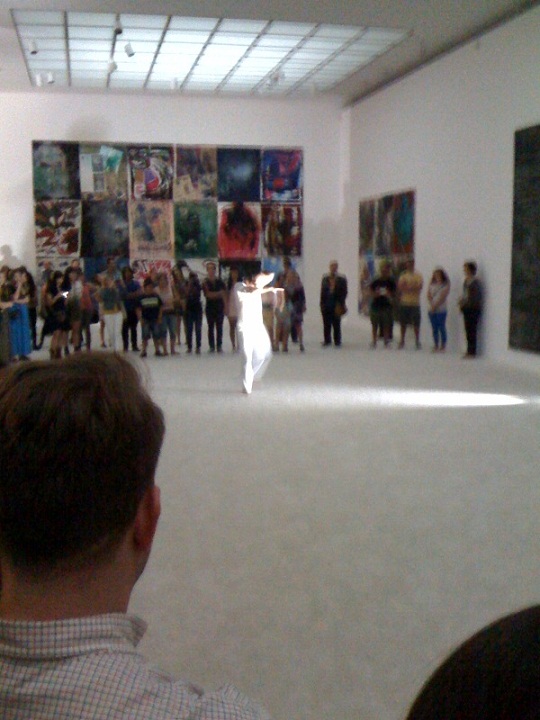
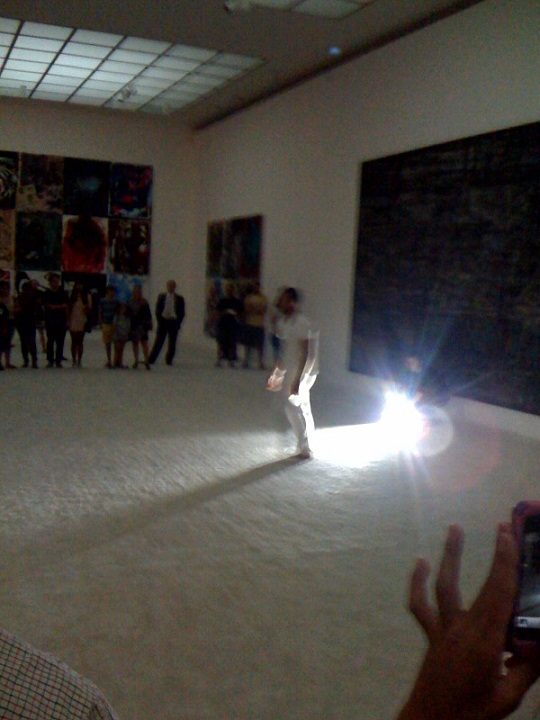
Thursday night marked the first of three “sneak peeks” of Benjamin Millepied’s new L.A. Dance Project at MOCA – the Museum of Contemporary Art – in downtown Los Angeles. Millepied danced with Amanda Wells in four different galleries in the museum. At times they were accompanied by a live violinist, who played classical music, and at times, they danced to a voice recording by L.A.-based artist Mark Bradford, who was also there. Natalie Portman was not, or at least I didn’t see her.

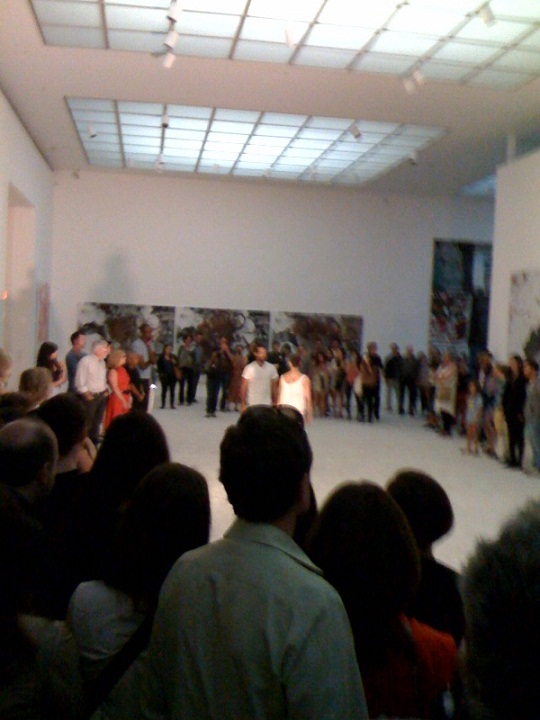
Here are some of my photos.

The performance, called FRAMEWORK, lasted about half an hour, and was pretty good. The biggest problem was that it was hugely crowded, as probably anticipated, and it was very hard to see much, at least in the first three galleries. Even if you arrived early and got a good viewing spot in the first gallery, the second the dancers darted to the second room, you were going to now be behind a mass of people. Some people gave up and left. Others ended up turning their cell phone cameras on, and, holding their cell phones above the mass of heads in front of them, watched through the viewer. It was really the only way to see. There were early warnings from security guards that no pictures were to be taken, but either they meant no photos of the art on the walls, or else they realized that was the only way people could see, because soon the warnings stopped.

From what I could see in the first three galleries, the dance was lyrical, balletic, classical. The violinist played classical. But then came Bradford’s voice-over. Bradford is an African-American artist, his work mainly abstract. I don’t remember the soundtrack word for word, but I remember Bradford mentioning that race played a role in his art and that he strove to push boundaries. At that point, Millepied and Wells, two white dancers, were dancing fairly classical western dance to classical western music. So, I found that to be an interesting juxtaposition.

I, and I think everyone around me, enjoyed the performance much better in the fourth gallery, where Millepied broke the fourth wall and began dancing in and around and among the crowd, dancing with us in a way. At this point in Bradford’s voice-over, he spoke about how difficult it sometimes was for him to manipulate a crowd, partly because of his height – he’s a tall, tall man.

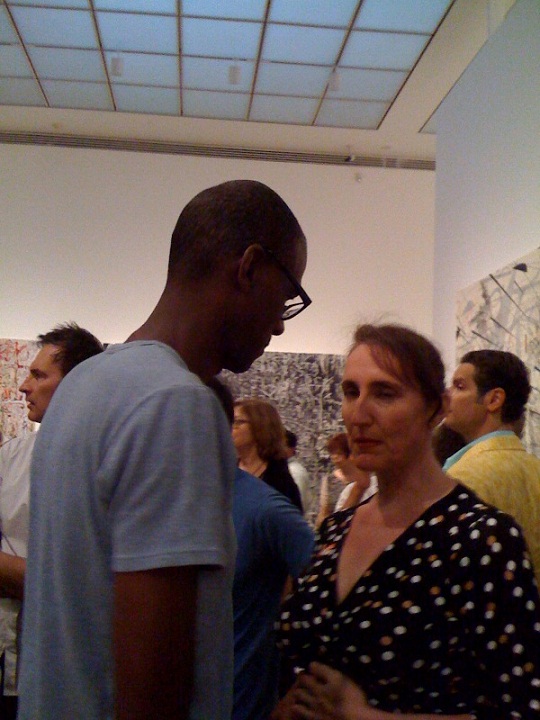
Here he is after the performance talking to an audience member.

Millepied was most playful here, and he interacted with the crowd very well, weaving around people, making eye contact, smiling, not touching. People were giggling and having fun with it.

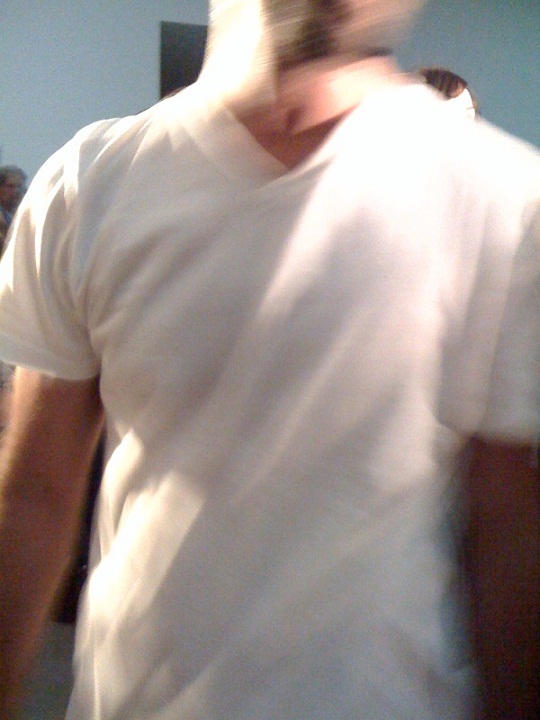
Here’s an up-close photo I got of his torso.

Back in the middle of the floor, he did a few corkscrew jumps and multiple pirouettes and the audience was very impressed. I think he is a mini-star here!

He also interacted with Bradford’s visual art. He stood in front of a large-scale abstract painting and, as Bradford’s recorded voice said something about how he studied a scene before painting it, Millepied stood squarely in front of the painting and contemplated it.

It’s a short program, definitely worth seeing. It shows on two other Thursdays, which are the nights when the museum is open free of charge: August 2nd, and August 9th. Go here for details.

In September the company has its much anticipated first regular performance in the Walt Disney Music Center hall.

Palm Springs Film Festival, With a Stop at Cabazon

I spent this past weekend with my dad in Palm Springs. He came down with a group and invited me to meet them, which, now that I’m in L.A., was pretty easy. It was the last weekend of the two week-long film festival there, so we caught a few movies. Unfortunately, I wasn’t able to see either of the two dance films showing. One was Pina, by German filmmaker Wim Wenders, a biopic – in 3D – about Pina Bausch, which I know is coming to L.A. and which I definitely plan to see. The other was a Russian movie called My Father Baryshnikov, about a Soviet era student at a strict Russian dance academy who pretends that his father is Baryshnikov. It looks like that one toured the arthouse film circuit in N.Y. in October, but that was my moving month, so no wonder I missed it. Did anyone see it?

But I did see a film that involved dance – namely Allegra Kent. Bert Stern: the Original Madman is a pretty good documentary of the photographer, who is most known for having taken the last pictures ever shot of Marilyn Monroe (for Vogue). He photographed numerous famous women, like Audrey Hepburn, Elizabeth Taylor, Kate Moss, Twiggy – the list goes on and on and on… and Allegra Kent, to whom he was married for a time and with whom he has three children (two of whom were interviewed in the film, along with Kent). He is also, I guess somewhat infamously, known for taking those Marilyn Monroe-esque photos of Lindsey Lohan for New York Magazine a few years ago. Finally – and most interesting to me – he’s also known as a great innovator in advertising for some now iconic photos he took for Smirnoff Vodka, mainly of the Egyptian pyramids, very coolly reflected upside down through a martini glass.

I guess it’s no surprise that Allegra Kent was attracted to him – he came across in the film as a huge womanizer, much like Balanchine. He calls women saints and man their slave. How Balanchine is that! And his womanizing is of course what led to their divorce… He says in the movie that the moment he saw Kent, he thought she would make a wonderful mother, and she did indeed become the mother of his only children. But he didn’t really want the children, he later admits. He didn’t know what to do with children.

He also admits he was greatly drawn to the beauty of the women he photographed, and wanted to have sex with (or “make out with” as he called it) the vast majority of them. But he admits he seldom wanted anything more; he never wanted to marry them, or be more to them than a lover. This is what, he says, made him the photographer he was.

It’s a very honest film. A very straight depiction of a man who seems very shallow emotionally, but was an artistic genius.

Anyway, I tweeted a bit about the film, and one of my friends, who’s a dancer, said he’s reading Allegra Kent’s biography and, according to it, Stern is a horror. I can believe he must have been a horror as a husband. But interestingly Kent says only nice things about him in the film.

It’s really Stern who makes himself look bad regarding Kent. When she confronted him about his relationships with other women, he remembers, he threw it back on her saying she let men (in the form of dancers) touch her all day. When she finally asked for a divorce, he thought how dare she; she couldn’t do that to him.

Their oldest daughter tells the filmmaker (Shannah Laumeister, formerly one of Stern’sĀ  models as well) that she is really a daddy’s girl, and her daughters – still small children – echo her, giggling that they are grandpa’s girls too. But the younger daughter, who also seems very genuine, and a bit more shy than the other daughter, tells Laumeister she never really got along well with her father. She had a bit of a weight problem, though I still thought she was a lovely young woman. But I wonder if that has something to do with her father not getting along well with her, given the way he seemed to think about women.

Anyway, very interesting film and definitely worth seeing if you have the chance. I found Stern to be annoying, shallow, and very unlikeable as a person, and still a genius, an artist and an innovator.

I also saw Haywire, Steven Soderberg’s latest, starring Gina Carano, Ewan McGregor, Michael Douglas, Antonio Banderas, Michael Fassbender, and Channing Tatum. This was almost the complete antithesis of the Bert Stern film. Women here are all powerful but not because of their looks. I loved loved loved this movie! Finally, a female James Bond! And Ms. Carano supposedly did all her own stunts! But I don’t think I will ever stop loving Ewan McGregor, even when he plays the “bad guy.” šŸ™‚ This one’s opening all over the U.S. very soon.

Finally, I saw a Belgian film called The Invader, by visual artist Nicolas Provost. I joked on Twitter that it was one of those European films filled with gratuitous nudity, gorgeous cinematography and no plot whatsoever. A friend from graduate school promptly reminded me via Twitter that those were exactly the kinds of films I used to love (and would make her watch ad nauseam with me). I do still love them! It’s kind of funny though because now that I’m a writer (or trying to become a writer or whatever) I wonder how one pitches that kind of thing…

Seriously, I really enjoyed The Invader – about an African immigrant trying to create a new life for himself in Belgium, and meeting women, and having fantasies (I think) and getting into fights with men who were trying to manipulate him (the outcomes of which may or may not have been fantasies), etc. Beautifully shot, which I guess makes sense since Provost is a visual artist. And the actor playing the main character, Issaka Sawadogo, is absolutely captivating.

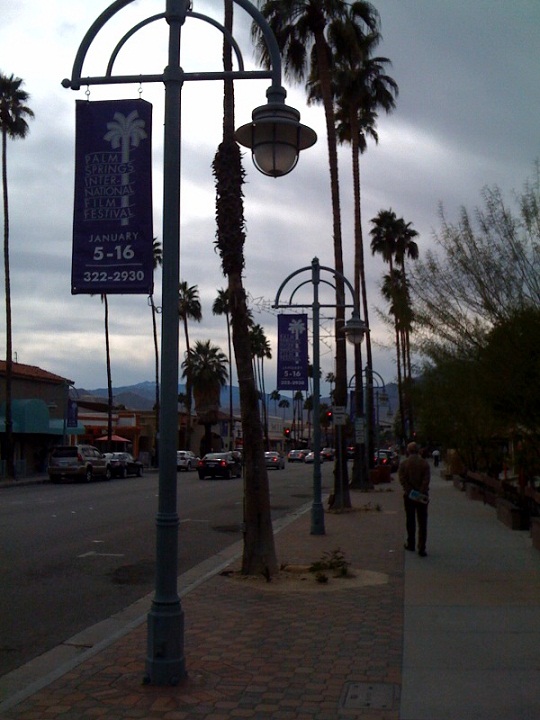
Anyway, Palm Springs itself was really lovely – it was the first time I’ve actually been there, though I’ve driven by many many times on Interstate 10. Here are some photos (it was a bit overcast, so they didn’t come out all that well):
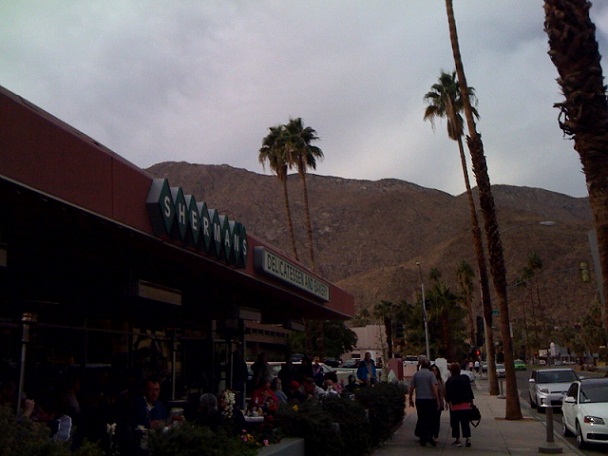
A very popular diner called Sherman’s near the main theater and festival center.
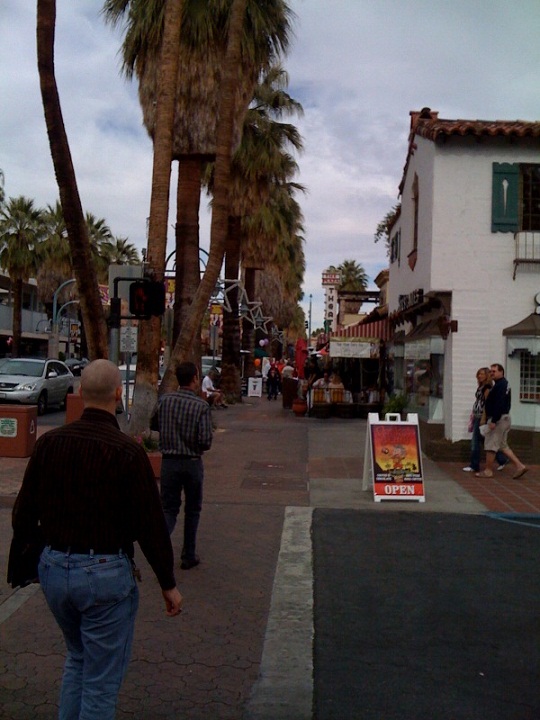
The main street – Palm Canyon Drive.
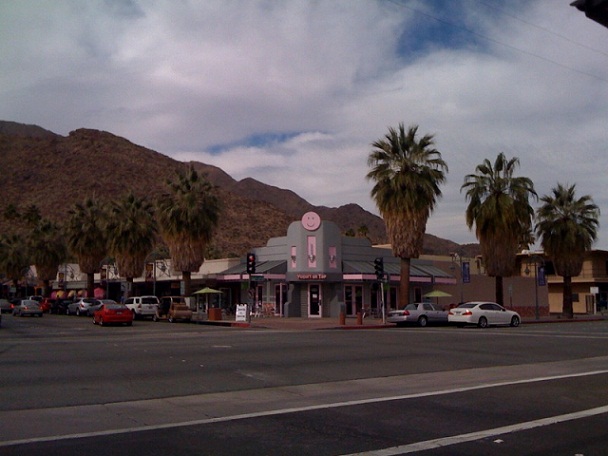
I was very attracted to this cute little smiley face atop a yogurt restaurant.
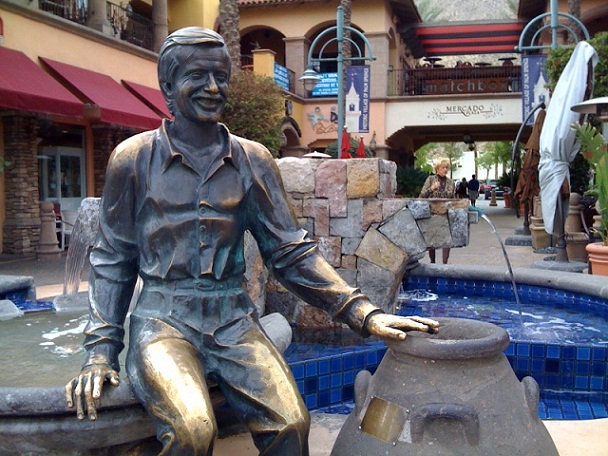
Sonny Bono was the major of Palm Springs. Here is a statue of him on Palm Canyon Drive.

You can tell you’re getting close to Palm Springs when driving on I-10 because you begin to see these modern windmills.

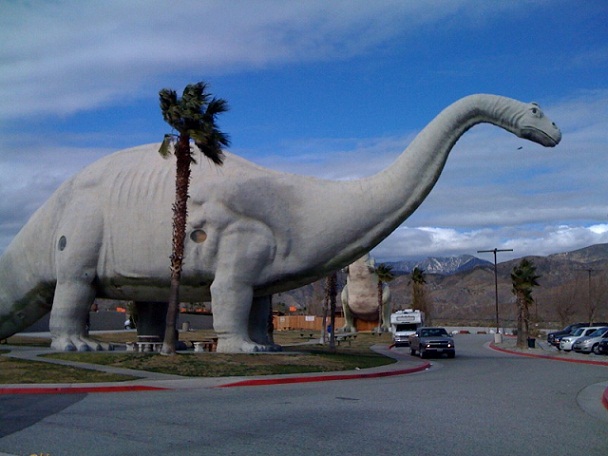
On my way back to L.A., I couldn’t help stopping at Cabazon, a town just west of Palm Springs that boasts the largest dinosaur replicas in the world, designed by Knotts Berry Farm sculptor Claude Bell. I remember Dinny, the apotosaurus above, so fondly as a child. We took many vacations to L.A., Anaheim, or San Diego, and on the drive over from Phoenix, I’d always be on the lookout for him. Whenever I saw him, I knew we were almost there.

Inside Dinny’s belly there’s a little gift shop.
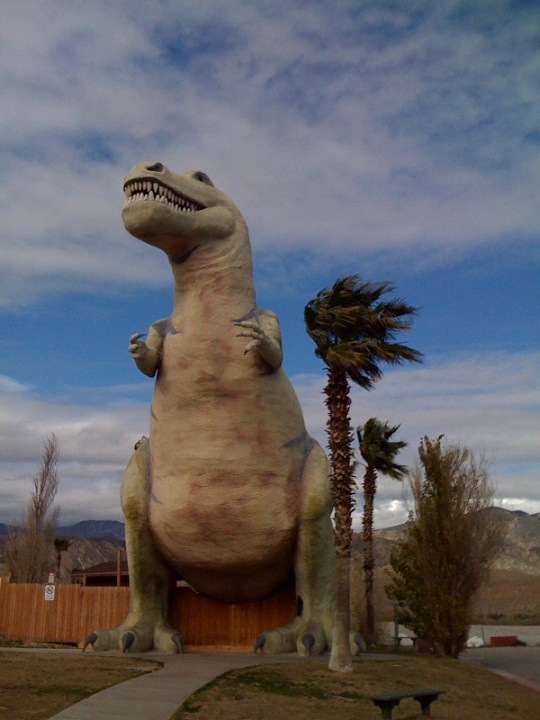
Mr. Rex was built years later, so I don’t remember him. I think he might have scared the wits out of me as a child though.

When I tweeted photos of the dinosaurs, a friend told me they were featured in the movie PeeWee’s Big Adventure, which I haven’t seen.
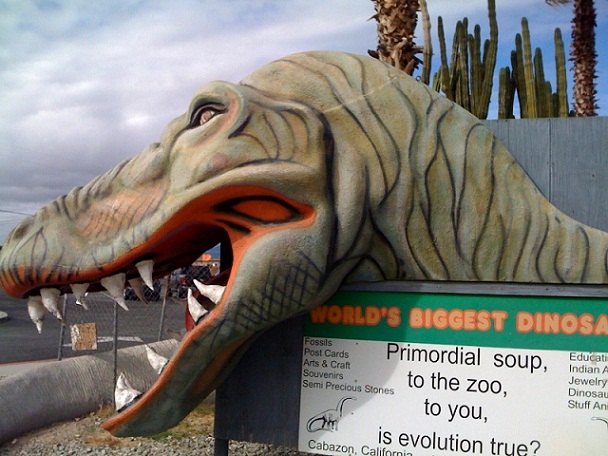
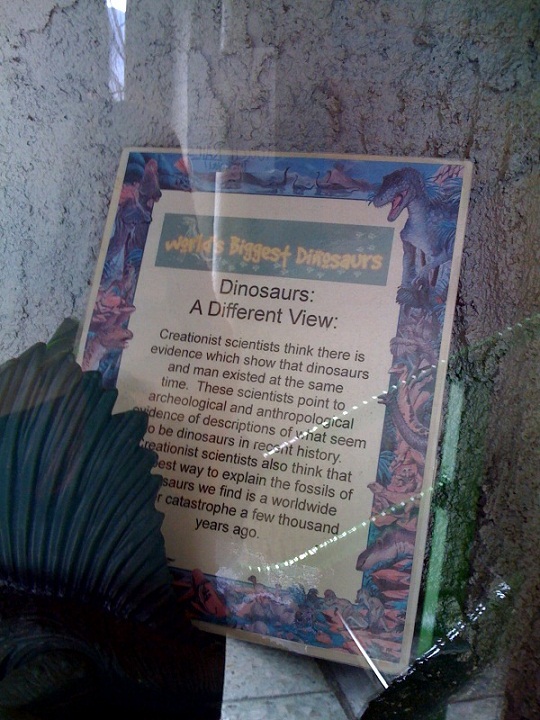
There’s also a creationist museum off to Mr. Rex’s side, which I didn’t have time to visit. A strand of creationism postulates that dinosaurs co-existed with humans.
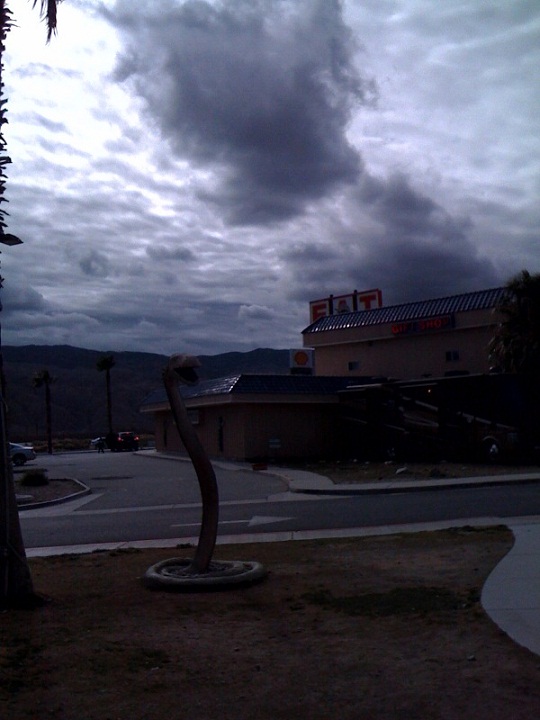
And there’s a little place to eat in front of Dinny. Ominous-looking clouds, huh? Unbelievably, I didn’t hit any rainstorms on the way back to L.A.

SLSG’s Dance Highlights of 2010

Instead of trying to remember which were my favorite performances of the year, I’m just going back through my blog archives from January of this year and linking to the most memorable posts. More fun that way! A lot happened in a year…

January

Pacific Northwest Ballet made their debut at the Joyce; it was my first time seeing them live.

The Post‘s Page 6 announced that you know who and you know who are dating, and the ridiculous homewrecker attacks began.

Baryshnikov and Annie Liebovitz starred in a very cool Louis Vuitton ad.

February

I totally fell for New York City Ballet’s Sleeping Beauty.

…and Mark Sanchez šŸ™‚

I found myself quoted in Colin Jarman’s book, Dancing With the Quotes.

I also fell for Sara Mearns’s Odette in Peter Martins’s Swan Lake.

On a personal note, my former judge, the esteemed Honorable Sylvia Pressler, passed away.

The Kings of Dance came to town.

Morphoses shocked the ballet world by announcing that Christopher Wheeldon was leaving the company.

March

My friend’s organization, Art for Change, held a benefit for Haiti after the earthquake.

Rasta Thomas’s Bad Boys of Dance announced that Danny Tidwell and SYTYCD’s Jacob Karr were joining the company.

Corella Ballet Castilla y Leon finally made their NYC debut!

I found myself actually getting press for liking Kate Gosselin – or for not hating Kate Gosselin rather – on Dancing With the Stars.

I fell for Keigwin + Company’s Runaway.

I was delighted to receive an email from NYCB ballerina Yvonne Borree’s aunt regarding of all things, my novel.

April

I had my first experience as a dance writer panelist! Thank you, Marc, from TenduTV!

Tiler Peck appeared on Dancing With the Stars in a Travis Wall routine, which everyone was so excited about. But it ended up amounting to not a whole lot…

Roberto Bolle danced a naked Giselle, in Italy of course.

May

New York City Ballet opened their spring season with premieres of Millepied’s Why Am I Not Where You Are and Ratmansky’s Namouna, both of which I liked, though Ratmansky’s had to grow a bit on me.

Baryshnikov returned to the stage.

I greatly enjoyed ABT’s new production, Lady of the Camellias, though most critics panned it.

June

ABT celebrated Alicia Alonso’s 90th birthday with three all-star Latin American casts (plus Natalia Osipova) dancing in Don Quixote.

Yvonne Borree gave her farewell performance at NYCB.

Bill T. Jones won a Tony for best choreographer for Fela!

Philip Neal gave his farewell performance at NYCB.

Natalia Osipova was mugged right outside of Lincoln Center.

Two of the greatest ballerinas in Europe – Osipova, and Alina Cojocaru – gave back to back Sleeping Beauty performances at ABT.

Albert Evans gave his farewell performance at NYCB.

Tap great Savion Glover made headlines by voicing his annoyance with Alastair Macaulay’s NY Times criticism of him – onstage, during a show.

Conductor Maurice Kaplow gave his farewell performance with NYCB.

Darci Kistler officially ended the era of the Balanchine-trained dancer with her farewell performance with NYCB.

July

Carlos Acosta announced his retirement from ballet and his foray into modern dance.

Alex Wong, probably the second greatest contestant ever on SYTYCD was injured and unable to finish the show.

My friend, Taylor Gordon, was profiled as a freelance ballet dancer in a New York Times article šŸ™‚

Alvin Ailey American Dance Theater’s beloved Denise Jefferson passed away.

Nilas Martins retired from NYCB oddly sans fanfare, sans criticism, sans a performance.

August

I interviewed tWitch about his role in the movie Step It Up. Fun fun interview!

I had a blast covering Ailey Camp.

I nearly fell over when Wendy Perron, esteemed E-I-C of Dance Magazine recommended Swallow on Twitter!

September

NYCB began their excellent “See the Music” series.

October

I loved Ashley Bouder’s Serenade.

Emerging Pictures’s awesomely exciting Ballet in Cinema series began with the Bolshoi’s Flames of Paris.

This cool new Lincoln Center-area street art sprouted up.

One of my favorite posts of the year, though it received no comments, was about Anne Fortier’s novel, Juliet. I jokingly daydreamed about it being made into a film, and which of my favorite ballet stars might take the lead.

November

ABT made an historic visit to Cuba and oh how I wished I could have gone with them.

I think I was the only person in the entire dance world to sympathize with Bristol Palin on Dancing With the Stars.

I had a blast covering New York So You Think You Can Dance auditions.

All of a sudden Black Swan was everywhere.

Nearly fell over again upon hearing Riccardo Cocchi and Yulia Zagoruychenko took the world Latin ballroom title – making them the first U.S. couple ever to do so.

December

My take on SugarPlumpGate.

Black Swan finally premiered which I didn’t love but was happy to have ballet brought back into the spotlight.

I was in awe of Alvin Ailey’s 50-dancer Revelations, staged in honor of the 50th anniversary of that dance. I also loved several other dances in their City Center season – Ailey’s Cry, Ronald K. Brown’s Dancing Spirit, and Geoffrey Holder’s The Prodigal Prince – just to name a few.

Robert Wilson / Roberto Bolle’s Perchance to Dream exhibit in Chelsea was a lot o’ frightening fun.

ABT’s new Nutcracker premiered, which I really enjoyed, almost as much as the Bolshoi’s.

Portman and Millepied revealed they are now engaged and expecting.

I had great fun, despite the crazy snowstorm, going down to Wall Street and covering Judith Jamison’s ringing of the closing bell at the NYSE.

Pretty busy year.

Happy New Year, everyone!

MORE PHOTOS OF CALATRAVA’S AWESOME MIRAGE SET


Above are a couple more photos of Peter Martins’ new Mirage ballet, which I wrote about here, that better showcase Santiago Calatrava’s stunning architectural set. I’d described how it closed at one point, and you can see that in the bottom photo, and I’d forgotten to mention that in the end it radiated a rainbow of color (top photo). Photos are by Paul Kolnik and are taken from Marina Harss’s excellent write-up in The Faster Times.

Funny, I recently discovered The Faster Times (I know Marina but I know her as a New Yorker writer) and was really amused to see that my very first ballroom teacher (the one who’s ultimately responsible for the title of this blog) is their ballroom critic!

MICHAEL PAUL BRITTO

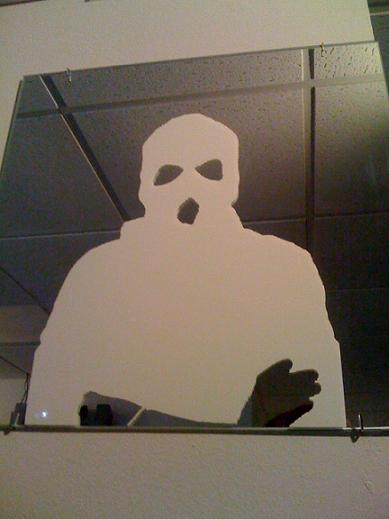
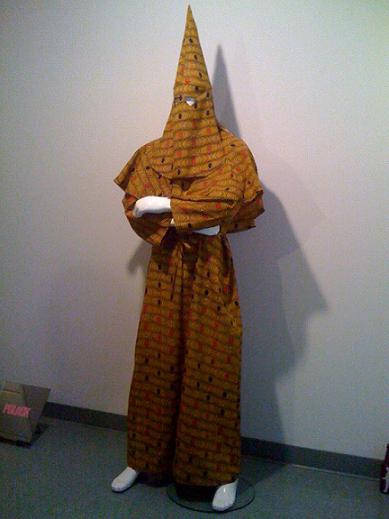
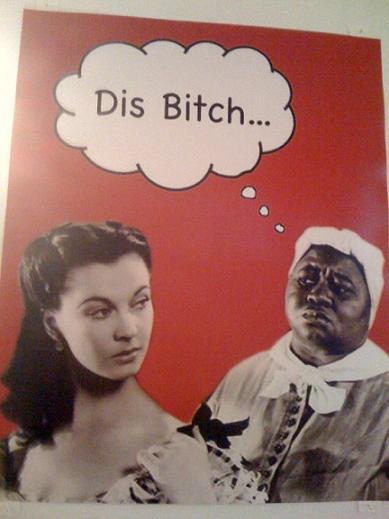
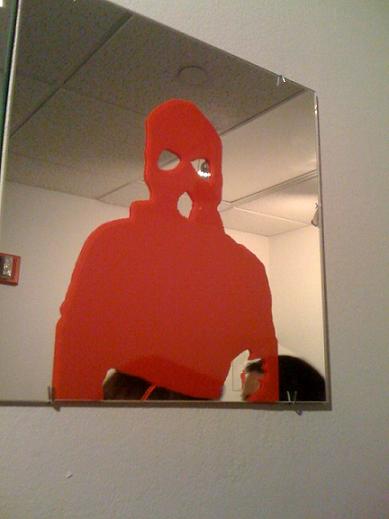
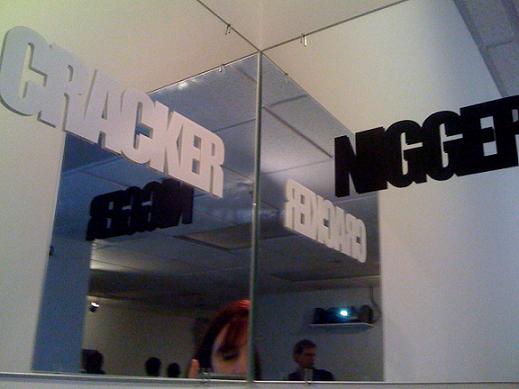
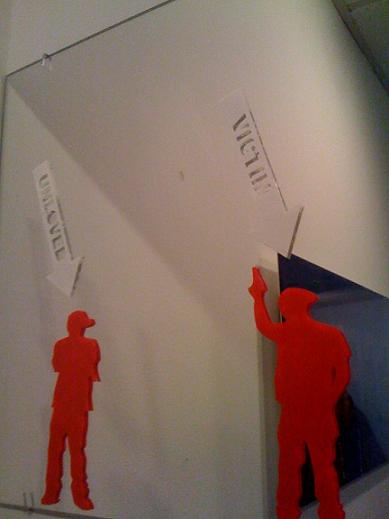
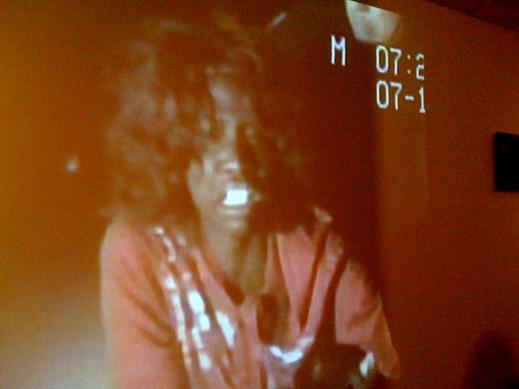
Last weekend, my friend Alyssa and I went to the Lower Manhattan Cultural Council’s Open Artists’ Studios visit. I was really taken with this artist, Michael Paul Britto, and I took some pictures with my iphone. Most of his work speaks for itself, but the bottom photo is of a video depicting a young black woman being attacked by police officials while John Mayer’s song Daughters plays in the background. And several of the paintings (like the one up top) were done on mirrors so that, as you approached, your own reflection became part of the piece.

Read more about him here.

WILD FIDDLEHEADS

My friend and I went to DUMBO yesterday for an open artists’ studios tour (some of the buildings that house groups ofĀ  artists’ studios have a day once a month when they allow visitors inside to peruse and talk to the artists about their work). We stayed for a while afterward to explore the area a bit. We found these in a grocery store there, which I found interesting. Never had fiddleheads before. And $25.99 per pound?!!!

ART FOR CHANGE PRESENTS: HAITI: BEYOND THE MOUNTAINS THERE ARE MOUNTAINS


My friend, Alyssa, who is an independent art curator, is helping to curate a new show for Art For Change. This one is to benefit Haiti and opens this Friday, March 5th in the Art For Change lobby, located at 1699 Lexington Avenue. There’s a party on opening night, from 7-11 in said lobby, with a suggested donation of $20-$100. All proceeds from door admissions and a portion of proceeds from art sales will benefit Partners in Health in Haiti. Hors d’oeuvres and entertainment, featuring Haitian DJ Sabine, will be provided, along with of course the art. Should be exciting! For more information and a list of artists, go here.

LADY GAGA: "ONE OF THE NIJINSKYS OF OUR EPOCH"

Over the weekend, the Los Angeles Museum of Contemporary Art celebrated its 30th anniversary with an evening of performances, including one by pop star Lady Gaga, who debuted her new Speechless while members of the Bolshoi danced along. Milan-based artist Francesco Vezzoli orchestrated the pairing, telling the Daily Beast, “Gaga is one of the Nijinskys of our epoch. So I don’t know if it’s going to be great artwork. But so far I think I made a good choice.”

Hmmm, not completely sure what he means by the Nijinsky ref (unless he means she has scattered moments of genius mixed with a bit of insanity, or that she’s iconoclastic…), but anyway, here’s a sampling of what happened:

Via Black Book.

KANDINSKY’S BLUE RIDER IN PERFORMANCE AT COLUMBIA U


Over the weekend I saw the second of the two experimental performances sponsored by the Guggenheim in celebration of the museum’s current Kandinsky exhibit. (The first was the Isabella Rossellini reading / light show I wrote about earlier). This one, which took place at Columbia University’s Miller Theater, sought to honor the ideals of the early 20th Century Kandinsky-led Blue Rider movement, which advocated the bringing together of visual, music, and literary artists to produce art that would engage all of the senses.

So, this production, The Blue Rider in Performance, combined poetry/opera libretti, music, dance, and paintings and other visuals. During the first half of the program, soprano Susan Narucki sang libretti by various composers including Arnold Schoenberg, Thomas de Hartmann, Arthur Lourie, and Anton Webern, while Sarah Rothenberg (who also conceived and directed the show), played piano.

Both women were brilliant. I also loved the images projected onto the back wall during the singing and piano playing. Sometimes a vibrant full-blown painting by Kandinsky would appear, at other times the wall would go blank and a black line would slowly begin wending its way across that wall — a painting in progress. At other times, there would be no painting, but instead a kind of light show of shadow play of what was happening onstage. The lights would catch Rothenberg as she played. She’d sometimes appear rather ghostlike, sometimes macabre, sometimes threatening, as she’d hunch over her piano, creating a rather wicked shadow, while swaying her body rather violently about as her hands flew back and forth across the keys, producing an equally violent-sounding melody.


I didn’t know that much about Kandinsky, and so, after these performances did some research. ArtĀ  historians and critics have used his painting, The Blue Rider (above), to show how he used color. Kandinsky was considered the father of abstract art. He wasn’t as interested in painting figures realistically as he was evoking an emotional response in the viewer through color and shadow – -blue being the color of spirituality to him. In the image above, your eye is drawn to the movement of the rider. But the movement is depicted through a series of colors– the blue of his jacket is lighter than that cast on the ground by his shadow — rather than specific details. Is he carrying a child in his arms or not? It’s not really clear. But you get the sense that the rider is moving very fast toward something; you feel an urgency.

I felt that as well with the way they used the lights to shadow Ms. Rothenberg as she played piano. You couldn’t see details in her movement, which was illuminated in large shadows on the back wall, but she was moving across that keyboard madly, her movements blending into one another. She looked like a mad scientist at times. The sometimes chaotic melody, along with these shadows, combined to create this feeling of frenzy, or of being haunted by something.


In the second half of the program, the piano was removed and the Brentano String Quartet took the stage and played Schoenberg’s String Quartet No. 2 in F-sharp minor, Op. 10 (Arnold Schoenberg was a member of the Blue Rider Group as well). During the first part of this second half, four dancers from Armitage Gone! Dance performed choreography by former “punk ballerina” Karole Armitage. Opera Chic informs that Schoenberg wrote this piece during a rather trauma-filled period in his life, when his wife left him for another man – an artist Schoenberg had hired to teach him to paint — then returned home, upon which the artist committed suicide and destroyed all of his artwork.

The four dancers — two male, two female — in broad strokes portrayed this story, the two women initially beginning as companions, then fighting, breaking into couples with the two men. The couples would mirror each other — one would struggle, performing tension-filled lifts and supported stretches, while the other would be more at peace with one another. Then it would change. At one point, one of the couples was engaged in this really sadly beautiful statue-like embrace where the woman leaned toward the man, putting her weight into his chest, seemingly needing him, while he, considerably taller than she, rested one elbow atop her shoulder, and held his hand to his forehead, as if his mind was full of turmoil, trying to decide what to do about her. It was such a mesmerizing pose, especially with the way they held it for a considerable time, I almost couldn’t take my eyes off of them to watch the other couple dance.

During the second half, the dancers exited and the soprano returned. So there wasn’t a whole lot of dance. But, despite that, I really enjoyed these two experimental performances the Guggenheim put on. More please!

The Kandinsky exhibit continues through mid-January.


LEVELS OF NOTHINGNESS STARRING ISABELLA ROSSELLINI

levels-of-nothingness-exh_ph01

levels-of-nothingness-exh_ph02

levels-of-nothingness-exh_ph03

levels-of-nothingness-exh_ph04

Photos above courtesy of the Guggenheim Museum.

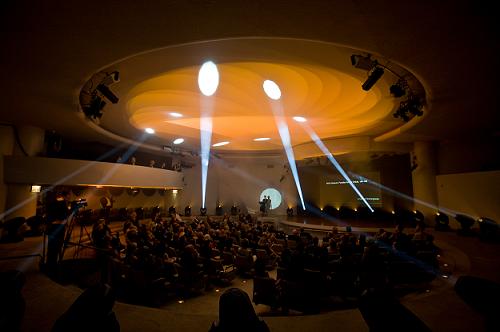
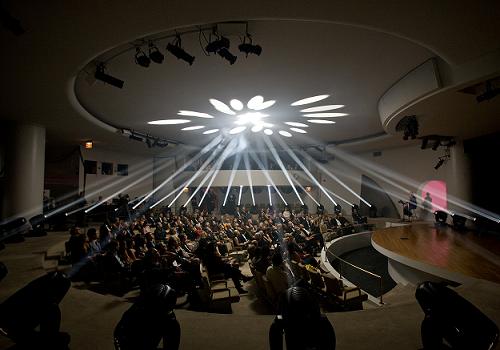
Over the weekend, I went to see a spoken word / light performance by Mexican artist Rafael Lozano-Hemmer called Levels of Nothingness, at the Guggenheim, as part of their Works & Process series. The work was inspired by Kandinsky’s Yellow Sound. (There is currently a large Kandinsky exhibit in the Guggenheim, in celebration of the museum’s 50th anniversary). Wassily Kandinsky is considered the father of abstract art, he used color extensively to evoke inner states, and he believed in the convergence of all art forms — painting, sound, movement. Yellow Sound is basically a compilation of his notes describing his ideas for an theatrical piece or an opera in which color and lighting played a large role.

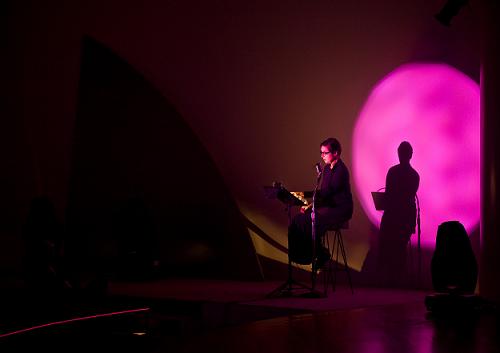
So, starting from that idea, Lozano-Hemmer (and co-writer Brian Massumi) constructed an interactive installation in which a system of lights would respond to spoken words. Actress Isabella Rossellini read the words, which were quotes from various philosophical texts about perception and color (interestingly, all texts were by non-Newtonian thinkers, who believed, in contrast to Newton, that one’s perception of color was subjective.) Basically, a computerized microphone analyzed Rossellini’s voice, taking into account her: pitch, wavelength, amplitude, intensity, speed, accent, intonation, and speech patterns. That information triggered robotic lights (these rather cute little R2D2-looking guys which were set up to surround the stage and perimeter of the auditorium) to create various light effect, such as those used in a rock concert — fly-aways, bump cues, color chases, ballyhoos, builds and flash-throughs — I don’t know what all of those things are but figure there may be theater-people reading who do!

Anyway, the effect was interesting but not really what I was expecting. Go here to see a clip of it; scroll down about halfway through the article until you see the video on the left side — on the video, you can click on the little box in the right-hand corner to enlarge the video to fit your entire computer screen.

It’s very cool to be sure, but it seemed more orchestrated than I was expecting. For example, every time Rossellini began on a new piece of text, she’d wait a few seconds for the machines to all re-adjust and prepare for that segment. So with each text there would be a specific light pattern: a white-based kaleidoscope one on the ceiling, a yellow-based one, a red light would light up behind her and go off and on as her voice stopped and started, sometimes there would be a multiplicity of lights all shining up at the ceiling making circles of light in multiple colors, etc. But they weren’t all happening at once. Each quote was set up to show one kind of pattern and then the lights would blink on and off or move around in the kaleidoscope according to her voice. It’s hard to explain, but watch that video if you want to see what I mean.

Afterward, the audience got to test it, which was fun. The host walked around with a microphone and let various people speak into it, reading from text projected on the back wall. Everyone was behaved and no one did crazy voices or spoke really loudly or anything so the lights were kind of mild as well. What I (and another woman, who asked) really wanted was for several different people to say the exact words side by side to see how the lighting design was different for each voice. But the system wasn’t set up to do that. At one point, Lozano-Hemmer re-read the same text an audience member had just read, and there did seem to be a subtle different in the lights, but I needed to see more of that to compare.

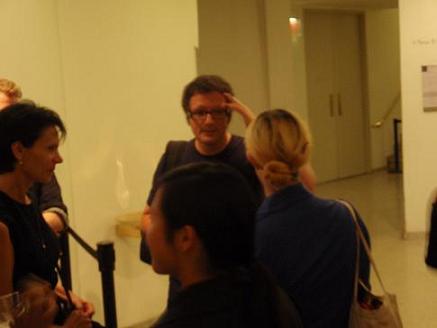
Anyway, after the performances, the Guggenheim hosts these little cocktail hours where you can meet the artists.

p9202312

Here is Lozano-Hemmer speaking with some of the attendees. I couldn’t find Rossellini. Sorry so blurry — I hate flashing in people’s faces.

p9202308

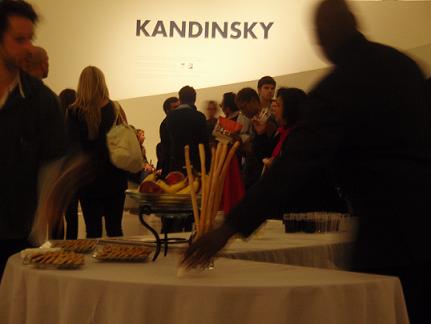
Well, anyway, the Guggenheim seems to have replaced their tray-loads of mini sandwiches with these rather long bread sticks. Probably a wise idea to get rid of the mini sandwiches because, as James Wolcott has noted, people go downright mad for those things, nearly killing each other in the stampede toward the food tables. You’d think none of these people eat for a month before a Guggenheim Works & Process event just so they can load up on “free” (if you subtract the $30 you paid for the ticket) little cucumber and mayonnaise squares. Could never figure out what gives with that?

Anyway, the bread sticks are tasty, and surprisingly filling, but when I went to put one to my mouth I realized how blasted long they were — it was like eating a baton. You had to really hold the end of the breadstick out quite a distance from your mouth. It was rather amusing watching all these people standing around with a glass of wine in one hand, holding a bread stick up in the air with another! For a moment they looked like cigarette holders and the whole scene looked a bit Breakfast at Tiffany’s.

ABT, LARRY KEIGWIN, AND DANCES INSPIRED BY KANDINSKY AT GUGGENHEIM THIS FALL


The Guggenheim Museum has just released its Works & Process events schedule for the fall and there’s some good stuff coming up.

On October 11 and 12 ABT will give a program, entitled, The Art of Adaptation, in which dancers will perform portions of the company’s upcoming contemporary season, held this year at Avery Fisher Hall, and panelists will discuss how they’re adapting work for a non-dance venue. (The company is performing at Avery Fisher this year because City Center, where they usually have their fall season, is going to be temporarily closed for remodelling). It hasn’t yet been revealled who the dancers or moderators will be, but I’ll let you know when I do!

On September 23 and 25 there will be a new dance / music commission inspired by artist Vasily Kandinsky’s Blue Rider Almanac of 1912, performed at the Miller Theater at Columbia University. Music is by the Brentano String Quartet, soprano Susan Naruki, and pianist Sarah Rothenberg; the dancing will be by Armitage Gone! Dance. This, along with a couple of art installations in the museum and another music piece, is commissioned in conjuction with a Kandinsky retrospective to show in the main museum.

On September 11 and 12, young choreographers Larry Keigwin and Peter Quanz are each showing a piece they’ve made to Steve Reich’s Pulitzer-winning Double Sextet. Dancers will be from Keigwin + Company and the Royal Winnipeg Ballet. Reich will participate in the panel discussion on the 12th.

And, finally, on October 24 and 25, Shen Wei Dance Arts will perform in celebration of the company’s 10th anniversary and Shen Wei will discuss his creative process.

There are other, non-dance events as well, including a talk on “Sex Stress and Music,” a world premiere by composer Charles Wuorinen, and a spoken word performance inspired by Kandinsky’s Yellow Sound (1912) in which actress Isabella Rossellini will read and Mexican artist Rafael Lozano-Hemmer will generate an array of colors from the sound of her voice. Very cool-sounding!

The schedule’s not yet on line but it’ll be here when it is.

ART FOR CHANGE ACCEPTING ENTRIES FOR HACIA AFUERA

My friend Alyssa is an independent art curator and she’s working with Art For Change on an upcoming festival in East Harlem, called Hacia Afuera. The festival will take place August 22-23 in the streets and parks of Spanish Harlem.

The festival organizers have issued a call for submissions or project proposals in installation, visual, and performance art, which includes music and dance — that speaks to that community and has a social justice bent. I know some choreographers and dance artists read my blog, so I thought I’d put the word out here. If you’re interested in submitting (and please consider doing so if you have work that fits), go here for more information. The deadline is July 17th.