Who Took the Dance Out of Stripping?


I recently saw Magic Mike XXL and, though I generally loved it – the endearing actors, the engaging characters, the setting – it’s just a generally fun movie – I have to say, compared to the first Magic Mike, I just thought something was missing. And it wasn’t the plot. Who really cares about such things in a movie like this! You see it for the aforesaid. No, it was the dancing that was missing for me. The first movie was filled with fun, interesting, well-choreographed routines, many of which kept you on the edge of your seat wondering what was going to happen next. And Channing Tatum’s hip hop acrobatics were both mouth-watering and thrilling. It seemed like the  performances in XXL consisted mainly of the guys shaking their booties, and crotches, in the women’s faces, and not a whole lot more.

Yet it mirrored what I’ve recently seen in Vegas. NOT that I’m any expert on male strip shows, but I’ve been going to this romance novel convention there for the past couple of years and the man who founded it has a friend who choreographs for male revues. The choreographer, who’s also a dancer, creates a little show for the convention’s attendees, and also invites us to his formal revues off the strip. Last year’s performance, which he made for the cover model “casanovas” at the convention had a lot of the Magic Mike-esque routines performed on a raised stage by the men. Then, he performed his own routine and he did all these amazing gymnastic stunts, flipping over and atop the female romance novelist brave enough to participate. It was jaw-dropping; it completely wowed all of us  – you could tell by the noise the audience made. But then, he invited us to his show this year, and it was mostly just the men working the audience, giving individual lap dances and gyrating in women’s faces. I figured they might have taken the gymnastic feats out for liability purposes. But most of the fun group numbers were gone too.

So, I was excited to see XXL. And then disappointed. It was the same as the show I’d just seen. So is this how strip shows are these days? Is this what women are wanting?

I remember going to Chippendales when I was younger, and that was full of actual choreographed dancing – cleverly arranged numbers, amazing movement, and, yes, stunning bodies. But the hot bodies without the artistry of the dance are just somehow not as hot.

During an interview for the original Magic Mike, Channing Tatum reflected on differences he saw between male and female strip club goers. He said men tend to take it more seriously, actually thinking or hoping they may get a date with the stripper, whereas women know it’s all just for fun. I think another difference is that women want artistry. During the Vegas show I kept thinking how I wanted the guys to stop shaking their crotches in my face and go up on stage and dance – a thought I’m sure no man in a strip club has ever had! I dunno. That’s what I think anyway. Maybe other women are different and really enjoy the lap dances and that’s what these shows and movies now are catering to…

Angelenos Boo Merce!: L.A. Dance Project’s Dramatic Premiere

This past weekend marked the premiere of L.A. Dance Project at the Walt Disney Concert Hall in downtown LA. Of course this is the event – the full-evening debut of Benjamin Millepied’s new LA-based company – that all dance-going Angelenos have been eagerly awaiting. There were two performances: opening night was Saturday; I went to the Sunday matinee. According to reports of Saturday’s performance, Natalie Portman was present, fully decked out in Oscar attire. Robert Pattinson was also there. No report of what he thought though, other than that the evening made clear to him that he has no talent for dance. His words 🙂

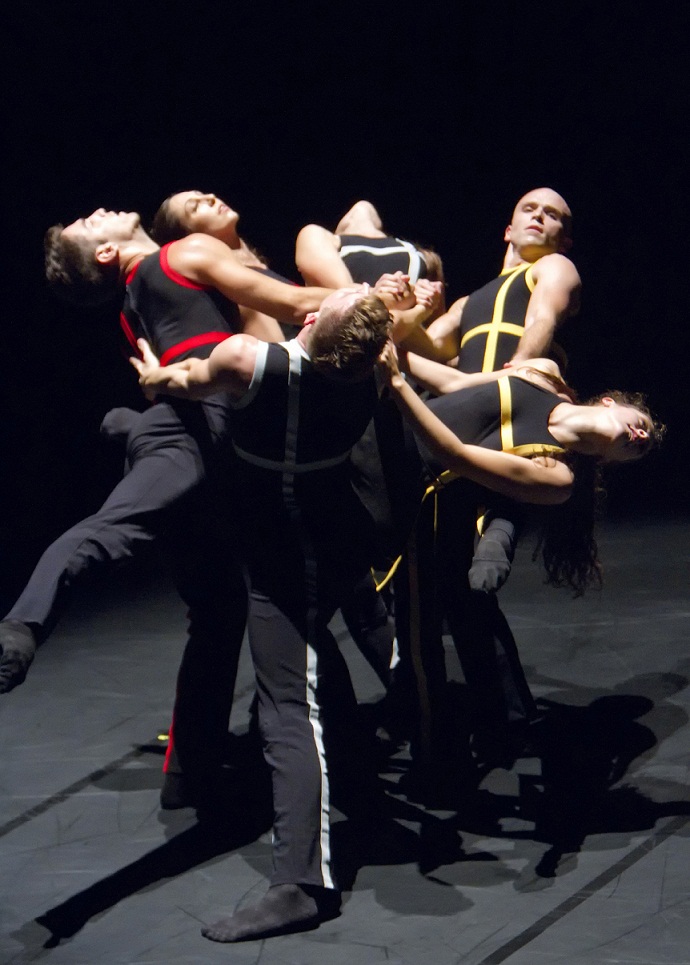
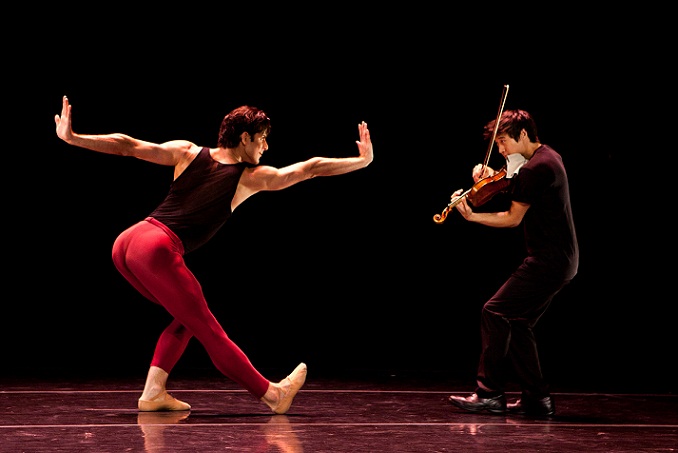
There were three pieces on the program: William Forsythe’s Quintett, from 1993; Merce Cunningham’s Winterbranch, from 1964; and the world premiere of a Millepied dance, Moving Parts (photo above, by Eric Politzer; all photos by Politzer).

By far the most astounding, confounding, spellbinding, brilliant piece on the program was the Cunningham. And for that reason alone L.A. Dance Project proved itself an invaluable asset to its new community. Every critic so far has said the same, so I know I’m not alone in thinking that. But I don’t know how much dance-going Angelenos would agree. During my performance, a woman sitting next to me angrily got up and walked to the back of the theater. Immediately after the dance ended, she cried out, “Thank God!” more than loudly enough for everyone in the entire theater to hear. Many showed their agreement with her as a chorus of loud boos started to emanate throughout the auditorium. This soon was countered by a chorus of cheers. For a moment there was a war going on. I have to say I’ve never ever seen that kind of visceral, dramatic reaction to any dance performance in New York. I’ve never seen that anywhere in response to dance; the only time I’ve ever seen a work of art booed was the Metropolitan Opera’s recent re-interpretation of Tosca.

I mean, part of me was excited that dance could evoke such strong feelings. But part of me was disappointed in the booing Angelenos for not being the least bit open-minded, for not giving the piece even a second’s consideration; for failing to think, “I’m going to go home and look up this Merce Cunningham person on the internet and find out what in the world that was all about.” Cunningham is obviously a master, and I don’t know as much about him as I should. This definitely made me want to know more. It also made me kind of sad that I wasn’t around in the 60s if that kind of art was going on. I wish Alastair Macaulay would have been in L.A. reviewing this for the NY Times. I’d like to know what he would’ve thought – of the piece, and the audience reaction, he loves Cunningham so.

According to program notes, Winterbranch was taken out of the Cunningham repertoire not long after it premiered, so most people probably know nothing about it. It was a collaboration between Cunningham, Robert Rauschenberg, and sound artist La Monte Young. Rauschenberg designed the costumes (all six dancers are in black sweatsuits with smudges of black painted under their eyes) as well as the absolutely brilliant lighting (which was reconstructed for this stage by Beverly Emmons).

At the beginning one dancer (originally Merce himself) slithers across a dark stage carrying a flashlight. Following him, other dancers take the stage, and the piece is basically a meditation on the act of falling and and pulling yourself back up. Dancers sometimes fall quickly and violently, sometimes they fall slowly, as if they’re being crushed by some invisible psychological weight. Sometimes they have difficulty rising; they crawl over each other, they contort their bodies and crab-walk across stage. Meanwhile the stage is dark, except for that brilliant Rauschenberg lighting whereby a light will briefly flash, like a headlight, then fade, then reappear tunnel-like, growing stronger, again like the lights of an approaching car.

About half-way through the sound starts. And, yes, it’s very harsh. Young’s composition is called simply 2 Sounds and those two sounds are: the sound of “ashtrays scraped against a mirror;” and of “pieces of wood rubbed against a Chinese gong.”

Yes, the whole thing was very unsettling. It felt like being caught in headlights, perhaps in a tunnel, or on a dark street, with sound so shrill you couldn’t escape. It felt very industrial, urban, Los Angeles – probably why Millepied thought to bring it here.

Wasn’t Cunningham all about questioning what dance is? Do people really want it to be all about pretty girls doing sexy things? Don’t people want to be challenged? Believe me, the people doing the complaining (mainly about the sound from what I overheard) didn’t look like they’d never been to a rock concert before. And after this ended my eardrums were nowhere near numb.

I think Millepied took a real chance bringing such a piece to a place where perhaps many have only seen classical ballet and popular dance on television. And for that I respect him more than ever.
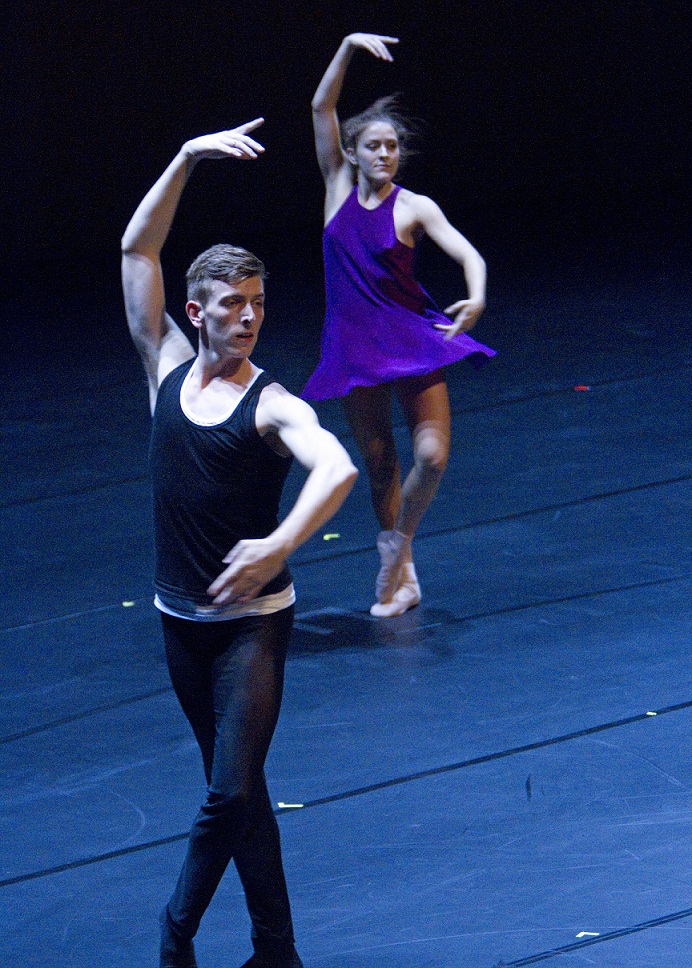
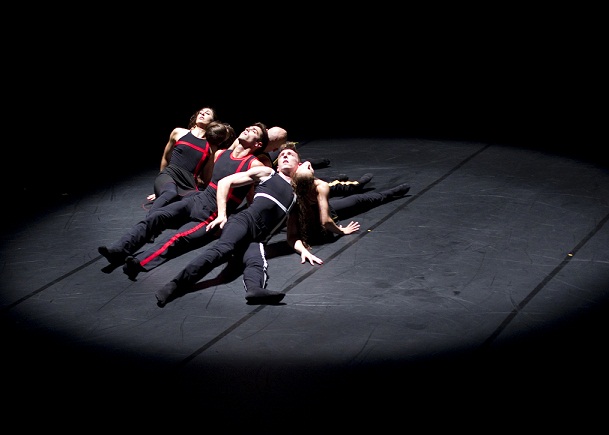
The other two pieces weren’t quite as strong. I think Forsythe’s Quintett (photo above) meant more if you knew about it, about him, and about his wife who died young of ovarian cancer. It’s a waltz but there are five people – three men and two women. So there’s a woman missing. The music is Gavin Bryars’s Jesus’ Blood Never Failed Me Yet, a sweet, folksy choral piece in which the singer keeps repeating that line over and over and over again. The dancing is mainly light and joyful, and the press notes state that he meant it to be a kind of tribute to her. Unfortunately the program notes don’t give out that information, so the audience was unaware.

I kept thinking of Forsythe’s intense, unforgettable installation piece, You Made Me a Monster, another take on the same thing, with a completely different mood, which showed in New York several years ago at the Baryshnikov Arts Center (and which I wrote about here). The dancer Charlie Hodges – my favorite of the six-person dance troupe – reminded me of a similar-looking dancer in Monster. His movement was the most expansive with every motion seemingly filled with intent. And he was the character who seemed to evoke the sole man, the man without the partner. Quintett had much more lightness and fluidity than Monster, and was far more hopeful than tragic, and it nearly made me cry. I’m just not sure if an audience who knew nothing about his wife and the work’s origins, and who’d never seen Monster, would have gotten the same out of it.

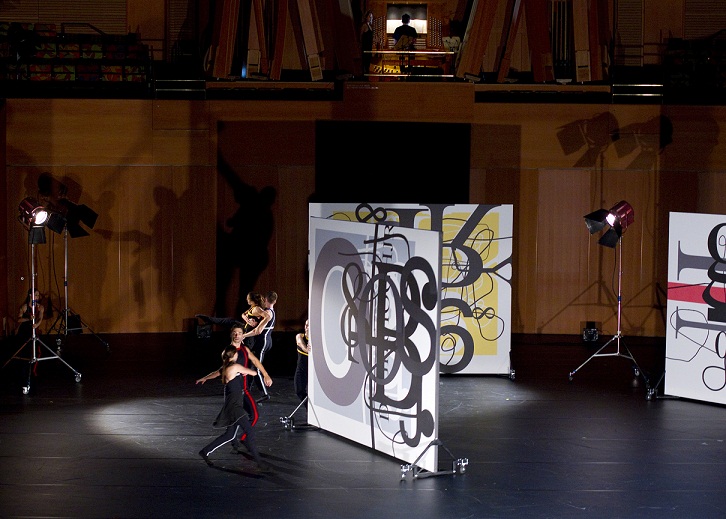
Third on was Millepied’s new Moving Parts, a collaboration with the always rousing Nico Muhly, costumers Kate and Laura Mulleavy of Rodarte, and visual artist Christopher Wool. I thought the most interesting parts of this collaboration were Muhly’s music – a bold, rich combination – at times mellifluous, at times slightly off-kilter a la Philip Glass – of violin, clarinet, and organ (played spectacularly on the magnificent, elevated organ at the top of the concert hall) and Wool’s artwork, consisting of three large canvasses bearing a combination of letters and numbers. One or two of the six dancers would push the paintings, on wheels, around the stage, the others dancing around them. The dancers wore basic black unitards; and were paired – male and female – by a same colored stripe running along the top of the costumes. Each painting also bore one of those colors. But this color-coordination didn’t seem to have much meaning.

The dancers were all very good – Hodges, Frances Chiaverini, Julia Eichten, Morgan Lugo, Nathan Makolandra, and Amanda Wells, but I didn’t find the choreography particularly intriguing or the dance as a whole to have much meaning. But I find Millepied to be like that – he’s either on or off. This time he was off, but next time he may well be very on.

Nevertheless, every time this company performs, I will always be there. That Cunningham revival made me trust that Millepied will always bring something significant.

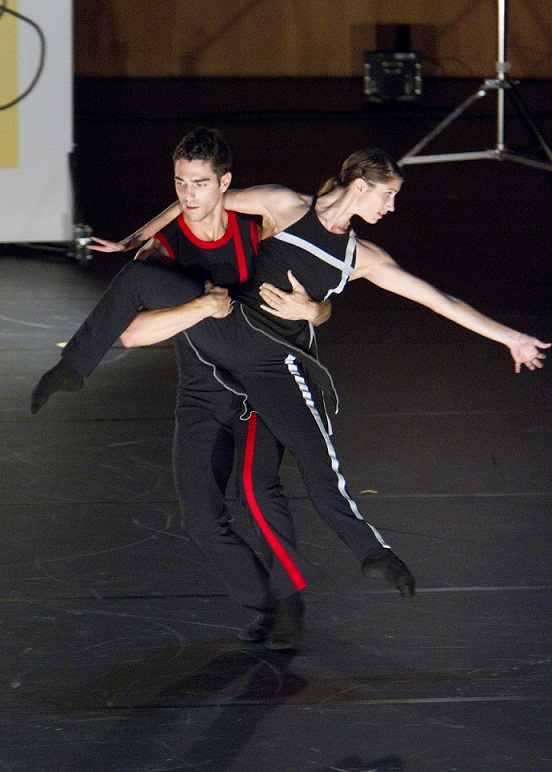
Here are a few more photos of Moving Parts, courtesy of the Music Center.
L.A. Dance Project’s FRAMEWORK at MOCA

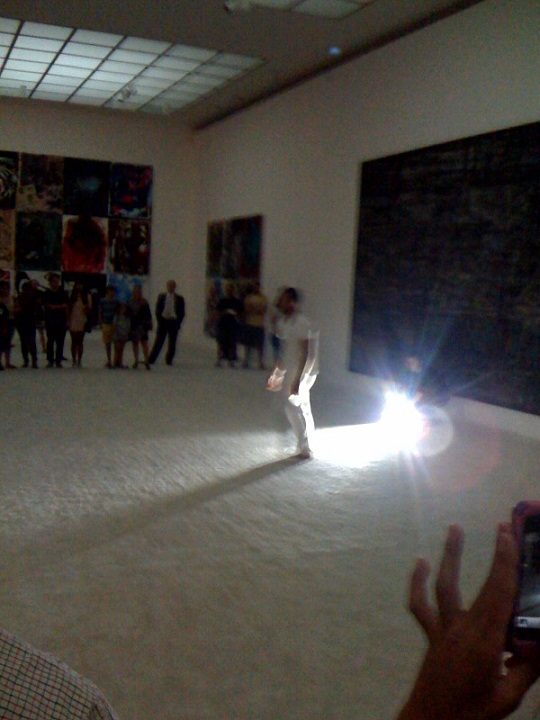
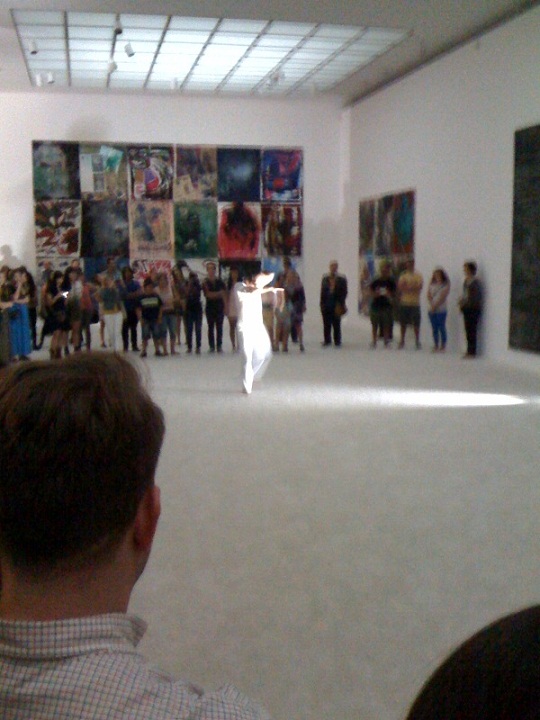
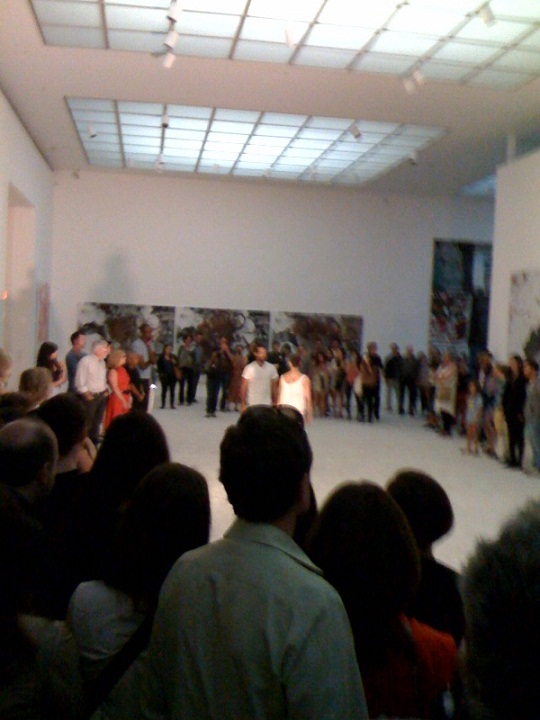
Thursday night marked the first of three “sneak peeks” of Benjamin Millepied’s new L.A. Dance Project at MOCA – the Museum of Contemporary Art – in downtown Los Angeles. Millepied danced with Amanda Wells in four different galleries in the museum. At times they were accompanied by a live violinist, who played classical music, and at times, they danced to a voice recording by L.A.-based artist Mark Bradford, who was also there. Natalie Portman was not, or at least I didn’t see her.

Here are some of my photos.

The performance, called FRAMEWORK, lasted about half an hour, and was pretty good. The biggest problem was that it was hugely crowded, as probably anticipated, and it was very hard to see much, at least in the first three galleries. Even if you arrived early and got a good viewing spot in the first gallery, the second the dancers darted to the second room, you were going to now be behind a mass of people. Some people gave up and left. Others ended up turning their cell phone cameras on, and, holding their cell phones above the mass of heads in front of them, watched through the viewer. It was really the only way to see. There were early warnings from security guards that no pictures were to be taken, but either they meant no photos of the art on the walls, or else they realized that was the only way people could see, because soon the warnings stopped.

From what I could see in the first three galleries, the dance was lyrical, balletic, classical. The violinist played classical. But then came Bradford’s voice-over. Bradford is an African-American artist, his work mainly abstract. I don’t remember the soundtrack word for word, but I remember Bradford mentioning that race played a role in his art and that he strove to push boundaries. At that point, Millepied and Wells, two white dancers, were dancing fairly classical western dance to classical western music. So, I found that to be an interesting juxtaposition.

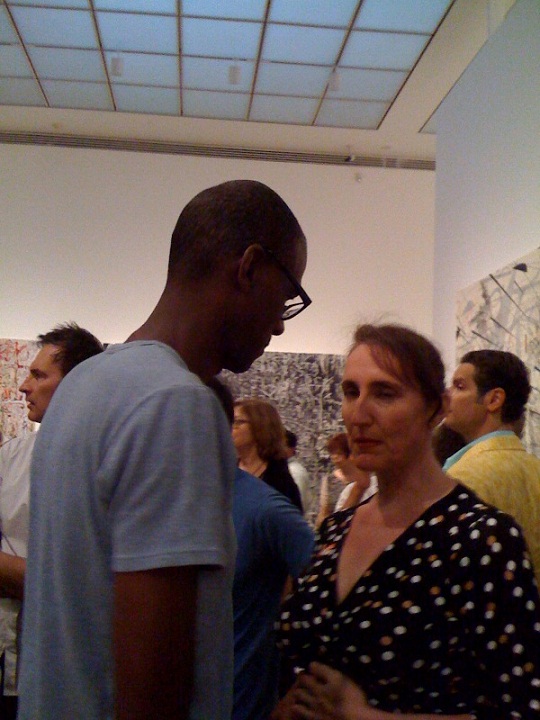
I, and I think everyone around me, enjoyed the performance much better in the fourth gallery, where Millepied broke the fourth wall and began dancing in and around and among the crowd, dancing with us in a way. At this point in Bradford’s voice-over, he spoke about how difficult it sometimes was for him to manipulate a crowd, partly because of his height – he’s a tall, tall man.

Here he is after the performance talking to an audience member.

Millepied was most playful here, and he interacted with the crowd very well, weaving around people, making eye contact, smiling, not touching. People were giggling and having fun with it.

Here’s an up-close photo I got of his torso.

Back in the middle of the floor, he did a few corkscrew jumps and multiple pirouettes and the audience was very impressed. I think he is a mini-star here!

He also interacted with Bradford’s visual art. He stood in front of a large-scale abstract painting and, as Bradford’s recorded voice said something about how he studied a scene before painting it, Millepied stood squarely in front of the painting and contemplated it.

It’s a short program, definitely worth seeing. It shows on two other Thursdays, which are the nights when the museum is open free of charge: August 2nd, and August 9th. Go here for details.

In September the company has its much anticipated first regular performance in the Walt Disney Music Center hall.

Body Traffic in L.A.

On Thursday night I was invited to an L.A. preview of Body Traffic‘s upcoming New York premiere. They’ll be performing in N.Y. at the Joyce (Chelsea) June 6th and 7th (they just received a $25,000 grant from the Joyce) as part of the Gotham Dance Festival, and I very highly recommend them.

Being new to L.A., this was my first experience with the four-year-old company (which is co-founded and directed by Tina Finkelman Berkett and Lillian Barbeito) and they weren’t at all what I was expecting. (I guess in L.A. I tend to expect to be surrounded by popular entertainment dance – hip-hop, the kind of contemporary modern showcased on So You Think You Can Dance, etc.) This company is more Batsheva, and the work is very intelligently choreographed and intelligently danced.

I don’t want to write much about the program right now; I’m just anxious for New Yorkers to see it and it’s work I think the New York critics will actually like, for a change!

The highlight, for me, was Israeli choreographer Barak Marshall’s And At Midnight, the Green Bride Floated Through the Village Square… which was kind of a cross between a dance and a play with multiple speaking parts (very funny, clever repartee) interspersed with ensemble dance. I loved it. Marshall gave an onstage interview during intermission. He has an endearing personality, as well as a beautiful voice. He sang a lovely, haunting-sounding song for us, in I think he said Yemeni, at the request of the interviewer.

Also on the program was Dutch choreographer Stijn Celis’s Fragile Dwellings, a poignant piece with four dancers dedicated to the homeless people of Los Angeles, and O2Joy by Richard Siegal set to music by Ella Fitzgerald, Billie Holiday, Glenn Miller, and the Oscar Peterson Trio and just about the best homage to the pure joy of dance I’ve seen.

If you’re in New York, please do not miss them at the Joyce (June 6 & 7)!

To give you an idea, here are excerpts from an earlier Barak Marshall work:

Los Angeles Ballet’s “Next Wave L.A.”


Last weekend my friend Christopher McDaniel (a fabulous dancer with Los Angeles Ballet!) invited me to Santa Monica to see the company’s “Next Wave L.A.” program. There were four pieces by four contemporary choreographers – including two who regularly choreograph for So You Think You Can Dance. I really enjoyed the whole program. I think contemporary looks very good on this company.

The first ballet was Colony, by Kitty McNamee. McNamee is the artistic director of Hysterica Dance Company, a Los Angeles-based company. She’s choreographed for Julianne Hough, Margaret Cho, Vanessa Williams, Anna Netrebko, and the women of The L Word among others. All of the ballets were on pointe, which happily surprised me, since much of contemporary ballet seems to eschew toe shoes. But other than that, Colony, about a group of men and women who seemed at times at war, at times at peace with each other, bore little resemblance to ballet, instead seeming more modern, with sharp, staccato movements and angular lines. The women wore white, flowing gowns and I found it interesting how the lyricism of the clothing and the women’s free flowing long hair were sometimes at odds with some of the sharp movements.

The second piece was called Duets in the Act of… and was by Sonya Tayeh of SYTYCD. This one was my favorite overall, and the photos posted here (courtesy of Los Angeles Ballet) are from that dance.


There were four duets: “Cold Desperation, “Artificial Seduction,” “Fleeting Nostalgia,” and “False Ego.” Each was lit differently (by Ben Pilat) which helped contribute to the changing moods and tones of the relationships. “Artificial Seduction,” my fave, was replete with lots of snaky, sinuous, seductive moves. I also liked “Fleeting Nostalgia,” where we saw some of Tayeh’s more signature shapes that manage to be simultaneously sad and funny, ethereal but human, like two dancers doing backbends over each other, then walking that way, a bit crab-like. Tayeh is always so original and clever, and intense.


Third on was Sirens, by Josie Walsh, a former dancer with the Joffrey and the Zurich Ballet, who has choreographed for a lot of TV and opera, particularly rock operas. The sires here are those Odysseus encounters, except the men are dressed more modern, in garb that reminded me of cowboys. This piece was really beautiful, with some lovely music by Paul Rivera Jr. that gave it a bit of a new age-y feel.

Last was Be Still by Stacey Tookey, another SYTYCD alum. Hers was a study on time, on the ways it can pass so quickly, how we sometimes want it to, and sometimes long for it just to stand still. There were many literal evocations of time here – like two men swinging a ballerina’s leg back and forth, like a metronome – and many more metaphorical. There would be “fast” dancing – like a group of men doing high corkscrew jumps, long jetes – interspersed with slower, calmer movement, like women standing in place doing port de bras, or very slow-moving floor work.

A Facebook friend, Leslie, asked me if I knew of any videos, particularly of Tayeh’s work with the company. I found a few of the company’s Next Wave rep on YouTube. Here’s one of the season overview:

And here’s one of Tayeh rehearsing with the dancers:

You can find more on YouTube on LA Ballet’s channel, here.

Ratmansky’s Fantastically Funny, Tim Burton-Esque New FIREBIRD

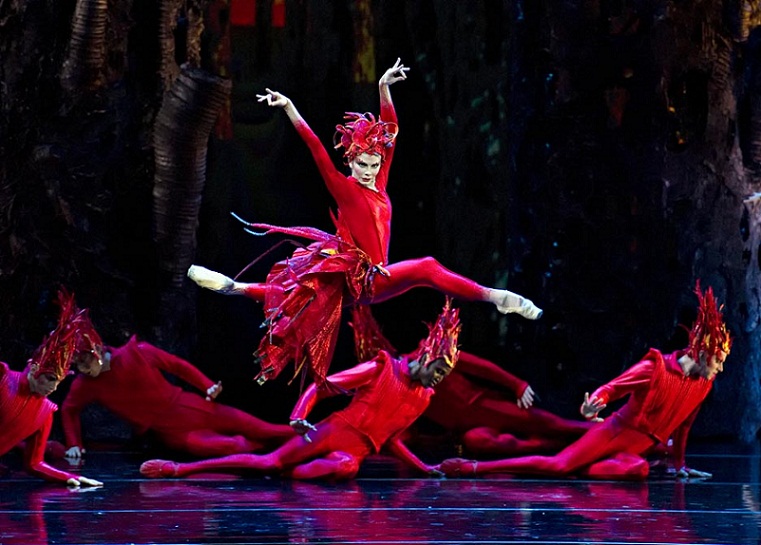
Thursday night I went down to Costa Mesa for ABT’s premiere of Ratmansky’s FIREBIRD at the Segerstrom Center for the Arts. I’m so glad I braved the nearly three hour drive (with traffic; without about fifty minutes) from west L.A. because it was an excellent evening. This is I think Ratmansky’s most theatrical, spectacular ballet – certainly of those he’s done for ABT – and I loved it. (Photo above of Natalia Osipova in the lead role, by Gene Schiavone, courtesy of Segerstrom.)

The curtain opened onto this magnificent set. The prince is supposed to be in a forest searching for his lost beloved, and so strewn about the stage were these fantastically creepy dead tree-trunks with spindly branches that magically sprouted blood red blossoms. I was so enchanted with those tree trunks, which to me resembled a witch’s hand, and the crimson blossoms bright red fingernails. It all had a very fantastical Tim Burton feel.

Then behind a scrim we see the prince, Marcelo Gomes, dressed all in white, searching about frantically for his lost maiden. At one point, he bumps his head into a branch on one of the creepy witch-hand trees. The audience seemed really to appreciate the humor in this; they laughed at this, and laughed pretty frequently throughout.

Soon, a flock of red birds devoured the stage, and Natalia Osipova emerged as their leader, or the most remarkable one, whom the prince became taken with. This was the one problematic part for me. It makes sense to have a flock of birds with a leader rather than one bird, as in I think most versions of this ballet – but the stage here was really too small. Natalia went to take one of her famous leaps but then seemed to hesitate and took it down several notches. There were too many birds, and as she turned to run to one side of the stage, she almost smacked into one of them. I think that set the note for the rest of her performance, because unfortunately, she just seemed to be holding back throughout the whole thing – not only in her solos but also in her pas de deux with Marcelo after her firebird is captured by his prince. I didn’t really see her struggling to be set free, and when she gave him her magical feather, it seemed more an afterthought than in barter for her freedom. Marcelo is ABT’s most dramatic male principal and he kept up the act well, being enthralled with the firebird, but ultimately feeling sympathy for her and setting her free, but you could tell he was also concentrating on making his dance partner feel as assured as possible. I’m sure as they iron out the kinks, Natalia will be perfect though.

Simone Messmer actually stole the show to me. Well, she shared it with David Hallberg (who, judging by the cheers, has quite the fan base in L.A!) Simone danced the role of the maiden who captures the prince’s attention, and she danced it with a really wonderful sense of humor, as she alternated between being controlled puppet-like by a sorcerer’s spell, being annoyed by the prince’s intrusion, then falling for him, then being fought over by him and the sorcerer, who keeps trying to retain his spell on her.

Ditto for David, who danced the part of the sorcerer set on keeping the prince and maiden apart. We first see David’s wicked magician in shadow form, from the back of the stage, which looked both malevolent and funny at the same time. When David emerged, he sported this big green bouffant, and Ratmansky had him chasing the maidens about the stage in this bent-legged run (almost like a Russian folk dancer). He was really both creepy and funny at the same time.

The comedy continued when the firebird returned (after the prince, threatened by the sorcerer, summoned her protection) and compelled everyone to dance themselves silly. It was particularly interesting to watch David here. Ratmansky gave him these rather crazed lightning fast steps danced in place that reminded me of a sequence he danced as the mentally unstable boyfriend in Ratmansky’s earlier ballet, On the Dnieper. There they were meant to convey extreme anger and were frightening because it meant the character was about to become unhinged and violent; but here they’re more funny than scary, and I think that’s what Ratmansky intended. I think Ratmansky is making an actor out of David Hallberg 🙂 He certainly got a great brilliant comedic performance out of Simone.

I wasn’t really a fan of the ending. Prince and maiden danced, sorcerer and firebird, then they switched partners, but the sorcerer tried to reclaim the maiden. Finally the firebird shattered the egg containing the sorcerer’s power and prince and maiden were sweetly reunited. The last scene is of the firebird being held up high by a group of men, in a group lift, heroizing her. I don’t remember the firebird appearing at the very end of other productions, and it felt a little too cutesy to me, or a little too ‘good triumphs over evil.’ I realize that’s the theme of a lot of ballets but I was expecting a bit of a twist here since the whole was more comical and different in tone than other versions.

Other dancers appearing as the firebird later this week are Misty Copeland and Isabella Boylston. I can’t make the trek to Orange County again this weekend unfortunately, but will be really interested to hear what others think of the other casts.

The other two dances performed were Christopher Wheeldon’s Thirteen Diversions and Merce Cunningham’s Duets. At first I’d forgotten I’d seen Thirteen Diversions – it premiered during ABT’s Met season last year. I was charmed by it all over again; definitely one of my favorite Wheeldon ballets. Misty Copeland, Stella Abrera, and Craig Salstein stood out to me. Misty really made that ballet she was so spellbinding as the girl who seems to struggle with herself and her partner. What I like about this Wheeldon dance is that he really allows the dancers to create characters; it’s not just about musicality and creative patterns (although that’s there as well). Craig Salstein was sweetly funny as he kind of flicked his partner off stage and into the wings, so he and his male cohort could have the stage all to themselves.

Duets was first on the program, and it was new to me. It got off to a slow start. It seemed the first two couples were stiff and nervous and just going through the steps without giving them much meaning. But the fourth couple – Xiomara Reyes and Arron Scott – changed the tone when they took one look at each other, as if to say, “let’s go, let’s do it!” and took off on a quick paced, very precisely and charmingly danced sequence of steps. After that, everyone else seemed to unwind and perform more full out and with intention. I’m really beginning to like Xiomara. She and Arron were my favorite couple, but Julie Kent and Jared Matthews got the most applause. At the end of the whole program, David got the most applause – people really love him there.

This was my first time at Segerstrom Center for the Arts. The building is so interesting. The orchestra is on the right half of the theater (if you’re facing the stage) and the mezzanine is a raised portion on the left half. And then the balcony is up above. It’s definitely not as big as the Lincoln Center stages or City Center, but it was packed full of a very enthusiastic audience. It made me wonder if most lived around there or if people often drive down from L.A. I’m sorry, I’m still this stunned New York expat unable to fathom how people can drive three hours a day in gridlock and not go insane!

It was kind of unsettling seeing my favorite N.Y.-based dancers in L.A. I looked around the press section thinking there must be some N.Y. critics there to cover a premiere, but I didn’t recognize anyone and a Facebook friend later told me Macaulay was with her at a N.Y. performance Thursday night. And the one L.A. critic friend I have wasn’t there either. It made me sad. I really miss spotting the writers in the audience, wondering who’s going to write a review, who’s covering for the Times, who’s thinking what, who’ll write what. And most dearly I miss hanging out with my N.Y. dance-goer friends on the Koch Theater promenade during intermissions, or at Ed’s Chowder House or Fiorello’s afterward to discuss a performance, especially a premiere. I guess I’ll eventually make those friends here…

Ballet Arizona’s SLEEPING BEAUTY, and Phoenix Society For the Arts Reads SWALLOW!

I feel so badly that I haven’t had time to write very much here lately. Writing doesn’t come close to paying the bills right now (will it ever??) so I do legal contract work, and I have a really time-consuming assignment right now. When I’m between assignments, I’ll try to write as much as I can, but otherwise it’s going to be slow going, sadly…

Anyway, I spent last weekend in Phoenix. I was a guest of the Phoenix Society for the Arts book club whose February read was Swallow! I was so honored, and it was such a wonderful experience. People asked all kinds of interesting questions, and they pointed to specific scenes and characters in the novel that they found particularly entertaining or related to well. One of my early writing instructors – the illustrious James Conrad 🙂  – once told me that you can tell if people are really into your book if they talk about specifics; if they just say general things – even nice things like “I really liked it,” or “I thought it was really good” – they are probably just b.s.ing. So it made me so happy that people were remarking on how horrible the sister and her nephews were or how wicked Alana was or how they couldn’t believe what Sophie did with the wedding dress or how the judges behaved in the courtroom.

They also asked me a lot of questions about how real everything was – how autobiographical the novel really was. I found that so hard to respond to because the inciting incident – Sophie’s globus hystericus – came from a very real experience, and yet I don’t think there’s a single scene in the book that actually happened, from start to finish. Most of the characters are combinations of so many people I’ve known and then added onto that they’re virtually made up. In order to make something dramatic and interesting that will keep readers’ attention, you really have to work with climax and character arcs and creating a twisting turning plot that will surprise and maybe even shock. You have to make stuff up, and a lot of it or the book just won’t compel readers to turn pages. And then at a certain point you get so carried away with your characters, they start to have a life of their own. And then that removes it further from “reality.” Yet everything is true with that proverbial capital T, you know. Anyway, I got very tongue twisted trying to explain that.

It was such a wonderful experience, though, and I’ll be forever thankful to the Phoenix Society for the Arts for having me, and for giving me such an engaged, inquisitive, alive audience of extremely thorough readers. It was one of the very best experiences I’ve had yet as a writer 🙂

That Saturday, my dad took me to downtown Phoenix to see Ballet Arizona’s production of Sleeping Beauty. (This was also with Phoenix Society for the Arts). I was so happily surprised by how excellent the company is! I really didn’t know what to expect, because once you see dancers like Alina Cojocaru and Veronika Part and David Hallberg and Marcelo Gomes in all the main roles, you really don’t know if you’re going to be able to have a favorable response to anyone else. I thought the company very much resembled New York City Ballet, which isn’t surprising since the director, Ib Andersen, was a Balanchine protege and a dancer with NYCB. He really has a wonderful little company of dancers. The principals stand out with their charisma, their very strong dance technique, and their good acting, but without being flashy and star-like – just like NYCB.


I especially loved Astrit Zejnati (above, click on photos for original source) as Prince Desire and Natalia Magnicaballi as the Lilac Fairy. And I thought Tzu-Chia Huang was a very sweet Aurora who acted each of the three acts very well. She and Zejnati got loads of applause in the third act, not surprisingly, for their gorgeous fish dives – and her legs were straight up in the air, like Cojocaru’s. Some of the best fish dives I’ve seen! Her Rose Adagio balances were good – not the best I’ve seen – but she held onto them long enough for the audience really to applaud her. Zejnati is small – he reminded me a bit of NYCB’s Joaquin De Luz – but with a very commanding presence. He was a true prince. And he had the ever so engaging expressiveness of Gonzalo Garcia, and everyone knows how I feel about him 😀 It’s so hard for me not to think of dancers back home when I write about dance now – sorry if that’s annoying!


Magnicaballi (above, second photo of Swan Lake, with Zejnati) was one of the most magical, larger than life Lilac Fairies I’ve seen. She reminds me a bit of San Francisco Ballet’s Maria Kochetkova. She was the perfect embodiment of the “fairy godmother” as she blessed baby Aurora with her beautifully eloquent port de bras, countered Carabosse (Nancy Crowley) with a swift but elegant flick of her arm, and she captivated the audience along with the Prince at the end of the Vision scene as she whisked him off to the real Sleeping Beauty.

Ib Andersen has a wonderful company. It’s too bad they don’t have a very long season – they seem only to perform for two or three days every two or three months. They do mainly classical ballet and Balanchine, with some Robbins, and some of Andersen’s own work, which I now really want to see. Fans of NYCB would definitely love this company.

Lula Washington Dance Theatre’s Kwanzaa Celebration


Last week my friend Debra Levine invited me to another dance performance; this one by Lula Washington Dance Theatre, who were giving their annual Kwanzaa celebration concert. This was one of the most enjoyable dance performances I’ve seen thus far in L.A. There were many pieces on the program – twelve in all! – and we were there for over three hours. The dances were mostly either African or American modern or a combination of the two, with some ballet thrown in, and music ranged from Fela Kuti to Steve Reich to Quincy Jones’ arrangement of Handel’s Messiah, to a live Samba band with a medley of conga drums that really made you want to get up and join the dancers. Most but not all of the choreography was by Ms. Washington, and one of my favorite pieces – a modern dance one from 2005 – was a very moving tribute to American soldiers, For Those Who Live and Die For Us.


My other favorite was Washington’s 1995 Harambe Suite (all of the photos posted here are of this dance), which encompassed the entire third act. There were a group of what I interpreted to be head tribesmen and women dancing at the back of the stage, behind a table bearing religious candles and celebratory food. A choir dressed in colorful, flowing African garb stood to the side and sang and danced. Children, one by one, would run onstage holding a corn husk or other item of food, which they would take to the table to add to the feast, before going to the center of the stage and breaking into a celebratory dance. Their dancing was accompanied by the singers as well as a live band, seated on the side of the stage opposite the choir.

Some of these kids were AMAZING – seriously; they are going to be stars! There was one little girl, named Tyler, who was the daughter of a professional dancer in the troupe, who just really blew me away. She had so much rhythm and was a real natural. She’s small now but is going to go far. And there was an older boy, a teenager, who could do some of the highest jumps I’ve ever seen. He also did this incredible back bend, bending his knees to lower himself slowly all the way to the ground, only to lift himself back up again by the strength of his legs alone without touching the floor. People went wild. It was incredible.

After the children, the adults came one by one to center stage and danced as well. They’d dance solos, eventually in groups. The children then came back out as a group, accompanied now not only by the choir and the drums but by the audience’s applause as well. After a while, the audience got up and danced at their seats, cheering all the way through.

Not every dancer was perfect – and some of the little kids you could tell were just embarking on their dance training, but that wasn’t at all the point. The evening was just a pure and simple celebration of movement, of being human. So perfect for the holidays.


RedCat, Ohad Naharin, and the Beauty of Downtown L.A.

Last Friday night, my friend Debra Levine invited me to a winter dance concert by students of CalArts (California Institute of the Arts, a prestigious arts college here), at  the RedCat in downtown L.A. For New Yorkers, the RedCat reminded me a lot of the BAM’s smaller Harvey theater. It was about the same size, very low-key, and had a very similar, comfy cafe / bar off to the side.

There were four pieces on the program, all of them modern: Yes Is Not Passive, by Stephanie Nugent; The Sea, the Sea, by Colin Connor; and two by Ohad Naharin – Humus and Echad Mi Yodea. I’d never seen Echad Mi Yodea before – and it’s one of the pieces Naharin’s most known for. I don’t know how I’ve missed it, but I do think I’ve seen excerpts. Anyway, it was by far my favorite piece on the program. Here’s a version, performed by Israeli dancers. In the version I saw, everyone was dressed in full black suits, black shoes, and hats. They all stripped down to their underwear by the end, except for the dancer in the front right-side chair, who kept falling at the end of each line. I really loved this piece. So much energy and layered with meaning.

I also liked Yes Is Not Passive, the first piece. There were many different parts, but my favorite was a solo where one man – Jose Luis Trujillo – simply stood in front of the audience and shouted “Yes” so many times his voice became distorted and his contorted face nearly began to melt with sweat. It reminded me of William Forsythe or Pina Bausch. Captivating.

I was also captivated by the architecture of downtown L.A. This was the first time I’d been to the Dorothy Chandler Pavilion (an opera house where ballet and other kinds of dance performances take place), and the gorgeous Walt Disney Concert Hall (pictures below). So so so stunning!


All of the buildings together were very much like Lincoln Center, except with that breathtaking architecture, far more magical. I was really truly blown away. I was also blown away by how dead it was. It really broke my heart that there were so few people out and about down there on a Friday night during holiday season when you’d expect there to be concerts and performing arts events galore. (Bill T. Jones’ Fela! is playing in one of the buildings.) L.A. is definitely a very different town from N.Y. in so many respects.

Afterward, we went to a small, popular hole in the wall in Little Tokyo (also in downtown) where I had the best meal (salmon teriyaki) I’ve had since I moved here. And after that Debra drove me down the east side of Sunset (the only stretch of Sunset I hadn’t been on) to the trendy neighborhoods on that side of town: Los Feliz, Echo Park, and Silver Lake. Echo Park looked pretty happening and like a place I wouldn’t mind living. And it’s very close to Dodger Stadium 🙂

Los Angeles Ballet’s NUTCRACKER, and More Settling Into LA Angst


Last night was the opening of Los Angeles Ballet‘s Nutcracker. Above photo – of my favorite dance – taken from LA Mommy Poppins.) It had its premiere at the Alex Theater in Glendale, and will be showing again there tonight. Then, it’ll travel to UCLA’s Royce Hall in mid December, and will end at the Redondo Beach Performing Arts Center at the end of the month. I find it interesting how the productions here seem to travel around the city, in contrast to those of the NY companies.

Anyway, my new Twitter friend, the wonderful Christopher McDaniel, a dancer in the company, generously invited me. And I’m so glad he did because I was worried I would miss getting my Nutz fix this year. The production was fun. This company is much smaller and you can tell has far less of a budget than the two big New York companies. So no live music, no ginormous trees magically shooting through the roof, no Stella McCarthy-designed costumes. But it was a sweet production, and the theater was really packed – mainly with families, I assume from the suburbs. And the audience really seemed to enjoy it. This ballet is all about pleasing children anyway.

The Alex Theater is quite small and every seat is pretty close to the stage, which is nice for a change from the huge NY houses. I think that up close feeling, the feeling that you’re part of the action compensates for theatrics like NYCB’s magic tree.


Here is my extremely crappy night-taken iphone photo of the entrance, which I loved and found gloriously West Coast with its Art Deco-y design and bright sparkling lights noticeable from quite far away 😀

The choreography (by artistic directors Thordal Christensen and Colleen Neary) wasn’t as clever and intricately detailed as Ratmansky’s but it was still very lovely classical ballet. My favorite overall was the Arabian (pictured above). The couple entered the stage with the man holding the woman high above his head in a beautifully snaky overhead lift. The female dancer, Julia Cinquemani, was really flexible and long-limbed and she did an excellent job with the part. She also had terrific stage presence, and I’m not the only one who thought so – they got huge applause at the end.

Of course I loved the Russian dance, as I always do. And Christopher was in that one so it was all the more special! There was no Tea / Chinese dance, which I found refreshing because that one always seems to end up embarrassing me with its ridiculous stereotypes.

I found the mouse costumes splendidly creepy – it’s just that those tails reminded me of an appendage to a costume that I saw recently on an episode of the HBO series Bored to Death and, well, eeeek. And when the mice died they did so with their little legs bent and up in air – so real looking, it made me laugh! Mother Ginger was danced by a man, as in NYCB’s, but here he wore an actual gingerbread house as a costume, his head coming up through the chimney. And little children came out of the house and danced. They were very popular, those kids! I think they had lots of family members in the audience 🙂 No ornery little mouse, as in Ratmasky’s.

My friend was impressed with the boy who played Clara’s little brother, Fritz – Aidan Merchel-Zoric. She thought he was a very good young actor.

All in all, I really enjoyed the production and am so glad I went.

But I think for a while going out is going to be a bit fraught with angst for me, until I get used to things more… So, the performance began at 7:30. At 5:00 my friend who I’d invited, who lives in a beach city, called on her cell phone. She sounded a bit frantic. “Tonya?!” she said when I answered.

“Uh huh?” I answered.

“Um, I’m really sorry and I don’t understand this at all and I really don’t know what’s going on, but I’m in my car and I’m getting ready to leave, and I just typed the address of the theater into the GPS, and it’s telling me my estimated arrival time is 8:20 pm?!”

“Three and a half hours? What?” I was as astonished as she. “I’d think you’d be in Palm Springs in three and a half hours.”

“I’d think I’d be in Arizona in three and a half hours!” she shrieked.

Glendale is in northeastern LA, up over the Hollywood Hills, and so on the reverse edge of town from the beach cities. But come on, it’s like 25 miles. It really shouldn’t have surprised me that much. I spent several days this week driving to UCLA, which is diagonally across town for me, and is about 20 miles away, and I’ve spent about three to four hours per day in my car going to and from. Anyway, she told me she’d try to be there as soon as possible, she’d go on back roads and avoid freeways to save time, but she’d perhaps have to pick up her ticket during intermission. I said no worries, but did worry about her sanity after spending a total of seven hours in her car in one day – which is longer than it takes me to get to Phoenix…

Anyway, she drove through town, avoiding the freeways, and got there in two hours, thankfully.

Then, afterward, we had planned to go to a newish cocktail lounge nearby with this supposedly up and coming mixologist. The cocktail lounge was close but not close enough to walk to. But when we looked it up online it seemed like there was only street parking, which may have been a real pain. We’d each be in our separate cars and it might take me a while to get out of the crowded garage near the theater that I’d parked in, and what if there were no parking spaces there, and I didn’t have any quarters for the meters anyway, etc. etc. We ended up deciding to go to the bar of a chain restaurant down the street, that we could easily walk to. And that bar was all nice and good, and we ended up meeting some movie industry people (I’m starting to realize you meet them everywhere) and discussing various flavored ciders and new caloric menu listings now required by law and how horrid it was for the government to require restaurants to shove in our faces just how much we were consuming, and all manner of interesting things … But it still bothered me that parking angst prevented us from going where we’d originally planned to go – the more interesting, newish place with the supposedly brilliant cocktail mixologist, rather than the chain. That never would have happened in New York (my friend happens to be from NY as well, though she’s been here a lot longer than I have).

We were chatting so, we forgot the time and soon it was well after midnight. When we left the restaurant the street was deserted. We agreed to walk together to the parking garage she’d parked in, then she’d drive me to my car in the garage I’d parked in because I was freaking out a bit about walking through a dark garage alone. It all came out okay, but it made me think, what if each of us were covering the performance on our own – or the opening of the new cocktail bar with a supposedly brilliant mixologist – and had to be out late and had to go to our cars alone…

I don’t know, I guess it’ll take me a while to get used to this new life…

Brief Update & Review of Peter Martins / Paul McCartney Collab at NYCB

Hey everyone,

Just a brief update since this motel’s wifi is expensive and not secure: but I now have a car (a cute little Toyota Prius – used) as well as an apartment in LA that I love but that unfortunately won’t be ready for move in for two more weeks. Which means I’m back in Phoenix for the next two weeks, shuffling around between family who have space for me and who aren’t allergic to Rhea and pet-friendly motels. Once I’m settled in to my new place – which, again, I LOVE!!! – I will most definitely resume regular blogging.

In the meantime, I did see the much spoken about new Peter Martins / Paul McCartney collaboration – Ocean’s Kingdom – at New York City Ballet when it premiered a couple weeks back. NYCB has sent me some pictures but I don’t have time to post them now. I will soon! I liked but didn’t love the ballet. I thought the story-line was simplistic and not very compelling and didn’t love the choreography, although there were some good pas de deux between Sara Mearns and Robert Fairchild – the lovers. I very was impressed with Paul McCartney’s ability to create such a rich orchestral score – really lovely. I thought Mearns, Fairchild, Amar Ramasar, and Georgina Pazcoguin all danced very well. Ramasar, who as most of you know is non-white, danced the part of the bad guy… So sigh on that. But he danced very well. For the most part, I wasn’t in love with the costumes, designed by Stella McCartney, except Pazcoguin’s, which was lovely and worked well. I kept worrying Mearns’s was going to come off, an idea my male friend liked and wished would have come to fruition. It didn’t; at least not the night we saw it.

McCartney was in the audience and gave a big wave to the audience when Martins introduced him. He has big, big hair! He doesn’t look his age at all. Martins toasted him not with champagne but with a cup of tea. Alec Baldwin was sitting right behind him in the audience. I don’t recall seeing any other celebs there but I’m sure there were oodles.

Anyway, as I said, I promise to post pictures of that ballet as well as some others from the beginning of the season that City Ballet has sent to me as soon as I’m home and have a secure (and free) internet connection. This afternoon is Charles Askegard’s farewell performance, which I unfortunately won’t be able to see. I hope to see his new company tour LA though, soon soon soon!

Thank you so much for continuing to read my blog, everyone, when I’ve been too busy to post much lately! I very greatly appreciate everyone’s support through this rather huge transition in my life. Thank you again, and will talk soon!

More Photos of Marcelo With Cisne Negro

You guys, I am so sorry it’s taken me so long to post these when I promised them, what, over two weeks ago?? I had no idea how much went into planning a cross-country move, especially when working lots of overtime… I’ll try to get caught up on blogging this weekend when Hurricane Irene (keep wanting to call her Irina…) will likely prevent me from running back and forth between my apartment and The Strand, Housing Works, Goodwill, and various Williamsburg used clothing stores bearing bags of books and clothes to sell and donate… I think I’m giving away far more than I’m taking with me.

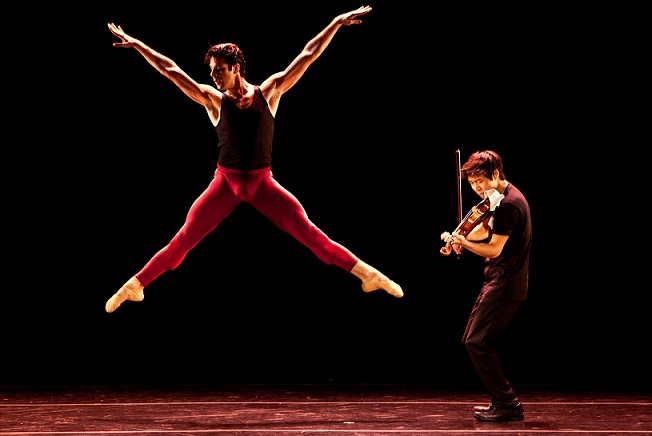
Anyway, here are more photos of Marcelo Gomes and Charles Yang performing with Cisne Negro two weeks ago at the Joyce. And a couple photos of Cisne Negro’s other pieces. All photos are by Matthew Murphy.

I don’t have much time for a review, but briefly: I loved Marcelo’s Paganini (two top photos). There were quite a bit of tempo changes throughout the piece, and Marcelo executed them all splendidly, as did Yang. The two interacted very well together. It kind of reminded me of Robbins in that sense, the playfulness between musician and dancer.

The bottom two photos are of the company in Calunga, the last piece on the program, which reminded me of a combination of Alvin Ailey’s Revelations and The Prodigal Prince, also performed by Alvin Ailey American Dance Theater (though I momentarily forgot the choreographer’s name). Calunga was a combination of very Alvin Ailey-esque movement (much of the program was; there was a section in Flock, the first piece on the program, that was almost the same choreography as in end of the first part of Revelations to a tee), with some balletic movement, combined with authentic Brazilian. Throughout there were so many samba steps, I was in heaven 🙂 The company is very athletic, the men were very acrobatic, many of the women were hyper-flexible, some of their arabesque penchees were quite beautiful. The dancers were definitely remarkable even if the choreography could have been a bit richer. I also liked how ethnically diverse the company is – not all whites like other Brazilian companies I’ve seen tour here, but more how I expect Brazil to be!

Sorry I can’t write more. I have to go to bed now so I can get up at the crack of dawn…