Don’t Miss the Jerome Robbins Doc on PBS Wednesday


Don’t miss — don’t fail to record so you have it forever — the Jerome Robbins documentary on PBS this Wednesday evening, February 18th at 9pm EST. It’s long — 2hours — and very extensive; includes discussion and excerpts of nearly all of his ballets and Broadway shows. There are interviews with many many people — Baryshnikov, Chita Rivera, Rita Moreno, Peter Martins, Violette Verdy (a former ballerina), Suzanne Farrell, Stephen Sondheim (who is not at all what I expected!), Jacques D’Amboise (who is quite the character!) writers Deborah Jowitt and Robert Gottlieb (the only two critics whose faces I’d never seen), and more — can’t even think of everyone who spoke. And there’s footage of interviews with Robbins himself both recently and further in the past.

He and others talk about his inspiration for and meaning of much of his work — The Cage, Fancy Free (one of my favorites, which was based on a Paul Cadmus painting, which I hadn’t known), Interplay, Dances at a Gathering, Glass Pieces, NY Export Opus Jazz, Afternoon of a Faun, West Side Story, Gyspy, the wonderful Fiddler on the Roof (Broadway) and Les Noces (a rather haunting ballet about a Russian wedding based on Fiddler, which I guess is kind of obvious, now that I know), Goldberg Variations, Watermill (lots of interviewees defending this pretty controversial work!), Suite of Dances, etc. etc. etc.

There’s brilliant footage of Tanaquil Le Clercq and Jacques D’Amboise dancing Afternoon of a Faun (and please tell me if you’ve ever seen anyone better than those two in those roles!), of Robbins himself dancing Fancy Free, of Barysh also dancing FF, Dances at a Gathering, and Other Dances (with Natalia Makarova), of Robbins and Balanchine dancing in a piece Robbins choreographed for the Stravinsky Festival, etc. etc. — there’s so much, I can’t remember it all, but I think they’ve got excepts of just about everything.

There’s also coverage of major events in his life — so upsetting when his ex-fiance talks about discovering one evening that he was in love with Montgomery Clift and was gay and trying hard to marry and be “normal”; his excruciatingly difficult decision that would forever haunt him to testify before the House Un-American Activities Committee; his visits to Eastern Europe that resulted in the making of one of his masterpieces — Fiddler; the quite nasty things he did to a Gypsy actress who couldn’t remember some important actions in the play…

And dancers and actors talk about how Robbins rehearsed them, which I found extremely interesting. An actor from West Side Story says he always made people do their own character sketches, which they’d have to present to him — which I love! He was a hardass to put it mildly, but only in a certain respect. He worked the dancers hard mentally (similar to one of his tutors, Antony Tudor), but when it came to the physicalities of the dance, he’d ease up considerably, ask dancers why they were working so hard — the opposite of Balanchine. At then end, Peter Martins remarks that it was mentally challenging to work with Robbins but physically relatively easy; it was the complete opposite with Balanchine.

This is honestly one of the best PBS specials on dance that I’ve ever seen. It does get slow in some points — especially early on when there are all these people talking and you can’t read the subtitles quickly enough to figure out who everyone is — and Robbins was so prolific that the film moves quite quickly and sometimes you can’t figure out which dance the interviewee is even talking about. So, I’d highly recommend taping it so you can watch it again and again. Believe me, you’ll want to. Go here to check local listings. (Type in “Jerome  Robbins: Something to Dance About”).
Alvin Ailey Day at Lincoln Center Film Society

p2011898

I spent most of my day yesterday at the Walter Reade theater at Lincoln Center watching films about Alvin Ailey: rare footage of interviews and rehearsals with the legendary choreographer, and of him as a young dancer in the 50s and early 60s dancing with the equally legendary Carmen de Lavallade, along with later coverage of Judith Jamison and others dancing, newer PBS specials on the company, and even a couple of panel discussions with filmmakers, collaborative artists, and dancers who worked with Ailey. What a treat! The all-day event was co-produced by the company (AAADT) and the Film Society of Lincoln Center in honor both of the company’s 50th anniversary and the start of Black History Month.

p2011897

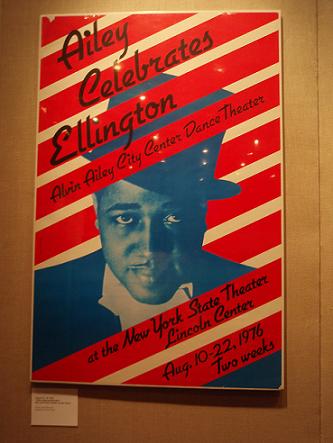
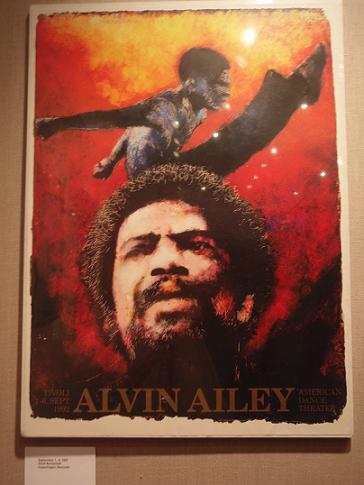
First off, there was a collection of vintage posters in the art gallery right across the hall from the theater. (top two pics above, taken by me.) There was also a little reception with complimentary wine. Complimentary strong wine (which, I hadn’t eaten much and, well, probably got carried away excitedly tweeting over seeing some of the dancers there — namely

Yannick Lebrun — wearing gold earrings in both ears and dressed very stylishly in one of those skinny scrunchy bubble-jackets, baggy jeans and bright red-soled sneakers — it’s always fun to see your favorite dancers outside of the theater, just dressed like ‘normal people’. Also there were  Renee Robinson, Matthew Rushing, Vernard Gilmore, and Hope Boykin, and choreographer Robert Battle. Renee and Yannick both showed up to the church event they had last year and I love that both the newest company member and the dancer who’s been there the longest show up to these kinds of things).

Anyway, the first set of films consisted of a movie directed by Orlando Bagwell made for PBS called “A Hymn for Ailey.” I’d never seen it before, but it was a filmed version of Judith Jamison’s dance / theater piece for the stage, Hymn, which she choreographed for the stage not long after Alvin Ailey died (of AIDS, in 1989). I’d never seen that either and I wish the company would stage it again. It was filmed mainly in the church where Ailey’s funeral was held, the magnificient Saint John the Divine. Dancers danced to a series of spoken word pieces recited by playwright / actor Anna Deavere Smith, who was, of course, a very powerful presence in the film. At times she’d stand next to the dancer — at one point Renee Robinson — and speak about body image, as Renee danced her words, and interacted with her at the same time, at one point seeming about to lash out on a negative thought, as if she were a mirror. At another, she spoke about Ailey’s artistry as an excellent male dancer who’s name I didn’t know belted out the movement with great passion. Or, one of the parts that stayed with me for a while — Smith took on the voice of an African woman talking about how much easier it is to be “real,” to be oneself, back in Africa; how here everyone has to wear a mask to survive. It kind of reminded me of Invisible Man. Both the performance and the words were very moving.

p2011893

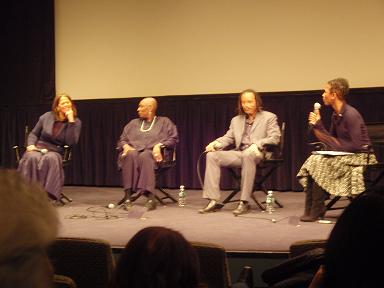
(there was a panel discussion after the Bagwell film, including from right to left, company rehearsal director Ronni Favors, filmmaker Bagwell, Jamison, and Deavere Smith). Judith Jamison is so charismatic, I’m sure it goes without saying. No matter what she’s talking about, you just want to hang on to her every word.

But the biggest highlight of that program — of the day for me — was footage of Alvin Ailey rehearsing a female dancer, Donna Wood Sanders, for her role in Masekela Langage (depicting denizens of a bar, set simultaneously in 1960s race-torn Chicago and apartheid-era South Africa, or anywhere oppression exists). I can’t tell you how much I got from this and I really really wish companies would do this more — would show audiences rehearsals and give us a glimpse into the artistic process. He was telling her, you’re an older woman, you’re stuck, trapped in this bar, in this place, you can’t escape and your life is dreary but that doesn’t mean you’re giving up. And, as she’d do certain things in the choreography, like push her arms out and step backward, he’d say to her, “let me see you in a prison, trying desperately to escape, but you can’t.” And she’d do the movement in such a way that that’s exactly what you saw. It was brilliant. And so powerful. I sometimes wonder how much is lost when a choreographer like that dies, if the entirety of his rehearsal and notes on direction are not kept. Dancers should of course add their own interpretations, but not without reviewing the master’s directions again for guidance. Now I want to see this ballet again.


Also included in the programs I saw were an interview Harry Belafonte conducted with Alvin Ailey, vintage footage of dancers Carmen de Lavallade, James Truitte, and Ailey performing classic works by Ailey’s mentor, Lester Horton. I particularly enjoyed The Beloved, depicting a relationship fraught with tension but compassion that kind of reminded me of some of Ulysses Dove’s work.  (A program later in the day included films of some of his dances, but unfortunately I couldn’t stay).

A final highlight of the day for me was watching vintage footage of Alvin dancing Porgy and Bess with Carmen de Lavallade. Learn about that story (originally an opera) and its history here. Ailey danced the part of the the man who threatens the crippled Porgy and seduces but mistreats Porgy’s beloved Bess. I’d never actually seen much of Alvin Ailey dancing and this was such a treat. As someone said in one of the films — I think it was Jamison but am not sure — “He WASN”T skinny!,” which made me laugh, but she’s right.


He was a meaty man. And he had hefty strength and ferocity to his dancing, a virility that was simultaneously sexy and threatening and that I totally didn’t expect since, by the way he speaks and from what I’ve read about him, he seems to have been such a soft, gentle man, and given that most of the male characters he created in his ballets seem like soft, gentle men as well, full of vulnerability and sympathy. Plus, with the possible exception of Glenn Allen Sims, no one  in the current company really dances like that. Not that that’s a bad thing – -just a different aesthetic.

I wish I could have stayed for the full day, but I went to ABT’s female choreographers program at the Guggenheim, which I’ll write about soon. This company always makes me so happy and inspired.

Alvin Ailey Day at Film Society This Sunday

This Sunday, February 1, in honor of the start of Black History Month, the Film Society at Lincoln Center will be showing a full afternoon and evening of films about Alvin Ailey and the Alvin Ailey American Dance Theater in the Walter Reade Theater. Onstage guests will include playwright and actor Anna Deavere Smith, dancer Donna Wood Sanders, filmmakers Orlando Bagwell and Patricia Birch who will present their films and answer questions afterward, and of course Judith Jamison. There’s also a poster exhibit in the Walter Reade lobby.

Sounds like a wonderful day! I can’t make all of the films but hope to see some. Go here for a full list of screenings.

Is Slumdog Millionaire Really All That?

So, if you watched the Golden Globes last night, you know that the Danny Boyle movie Slumdog Millionaire took home just about all the top awards. Did you guys see it? I did, and I generally liked it, was on the edge of seat throughout (which doesn’t often happen at the movies for me), liked Boyle’s signature fast paced cinematography, the scenery of Mumbai, etc. But I also had some problems with the unreality of it all and am kind of dumbfounded that it got so much blind praise.

For one thing, I found the romance so over-the-top and unbelievable, it really kind of ruined the whole for me. We’re not really supposed to believe that he could have found his girl, and she’d still be there for him, after all those years, right? And if it is supposed to be a bit of magical realism, then I think it kind of undercuts the rest, which is supposed to be brutally realistic, right? Or is it? Do the police in Mumbai really torture a suspect like that, and over whether he cheated on a game show? I thought initially his torturers were mafia, but, according to the story, they were just plain old police, who became his friends later on. And there was so much suffering — the Christian mobs brutally murdering the Muslims, the gangs of organized kidnappers gouging out the eyes of the children before using them to make money, the selling into slavery. It was all so horrid. But then given the outrageous love-story plot and then

Continue reading “Is Slumdog Millionaire Really All That?”