WE ARE THE WEST, in a Santa Monica garage

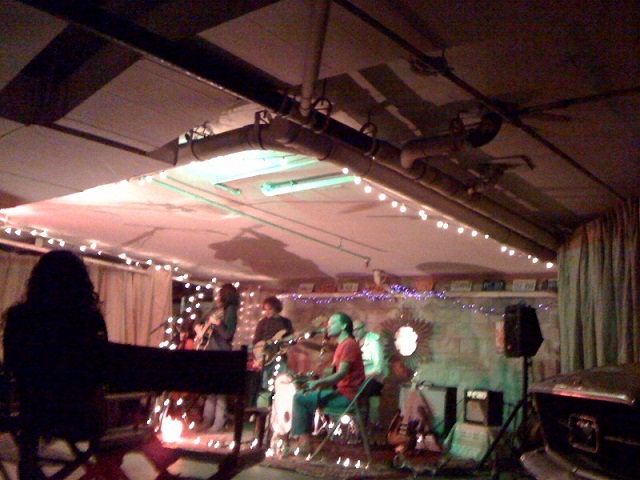
I had a cool L.A. experience last night that actually felt rather New York-ish. I drove out to Santa Monica to see a band called We Are The West perform in a parking garage below an office building on 7th Street and Santa Monica Boulevard. Above is a photo of one of the two warm-up bands, Zenda Marie, who were also really good and whose lead singer was a charming guy who once lived in N.Y as well (I’m finding a lot of New York transplants here). With the candles, cozy seating, and decorations (including a Mustang, whose front bumper you can kind of see in the lower right corner of the photo), it was a pretty cool venue. Felt very underground.

We Are The West is a two-man band – Brett Hool and John Kibler – whose music I find very poetic, which makes sense since Hool was in Columbia’s MFA program where he focused on poetry. (I know him through a New York artist friend, and he invited me to the event via Facebook). They seem to have a very loyal following and have played in upstate New York and the Netherlands as well. Below are a couple of videos, the first shot in that same Santa Monica garage a few months ago, and the second in the Netherlands.

New Haven by We Are The West from kristopher Kasper on Vimeo.

Maira Kalman at the Jewish Museum

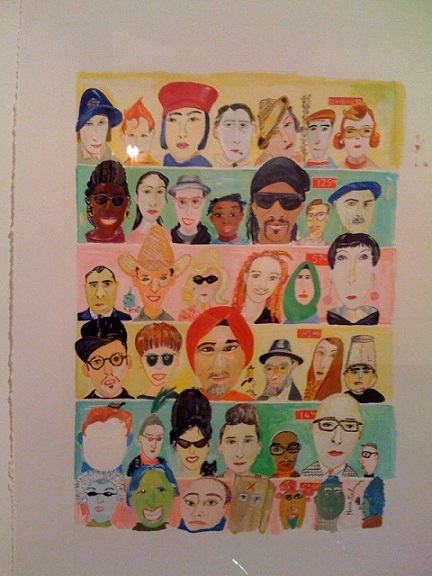
Last week my friend, Alyssa, who’s an independent art curator, invited me to an art / law celebration at the Jewish Museum. The Jewish Museum really knows how to put on a party! They had the most splendid array of hors d’oeuvres, two big carving and sushi stations, and a full bar (not just wine and champagne). I hadn’t been to the Jewish Museum since I saw a Marc Chagall exhibit there I don’t know how many years ago. So, in between nibbling on mini Tuscan pizzettes and sipping Glenmorangie, I wandered into the main exhibit, which is currently featuring the work of Maira Kalman.

Kalman’s mainly a painter and illustrator but is also an essayist and performance artist; kind of an artist at large. She illustrates a lot for the New Yorker. The top picture is from an illustration from that mag.

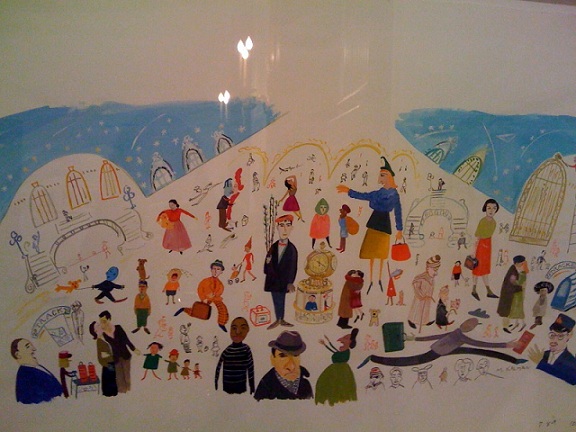
I really love this one, though. It’s called Grand Central Station. I love it because it evokes the kind of sentiment I was going for in the closing line of Swallow (which I’m not giving away 🙂 )

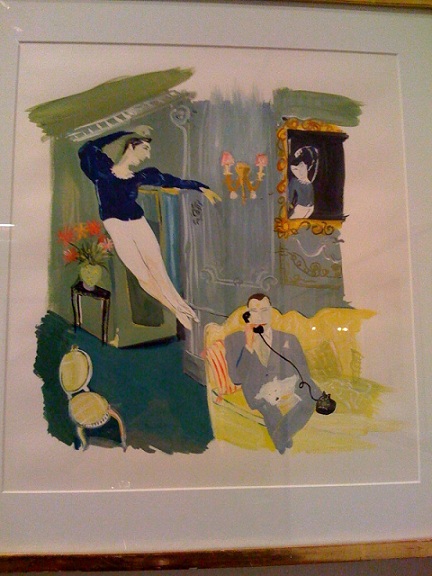
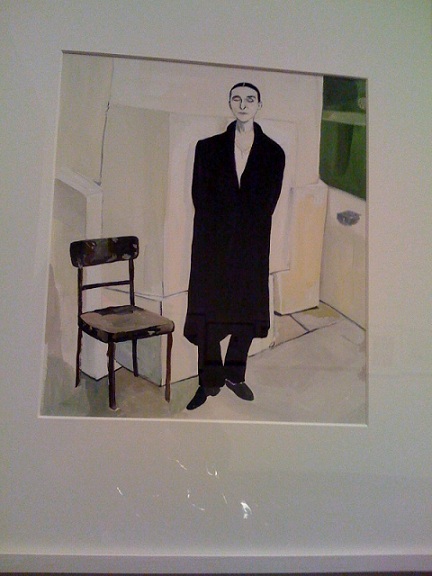
Then I came across a couple of illustrations of dancers, which of course excited me.

I don’t know who the dancer in the first illustration is, but the bottom is of Pina Bausch. The little explanatory caption below the illustration said that Kalman had a deep admiration for Bausch, got along well with her, and, before Bausch’s death, had wanted to collaborate with her on a dance.

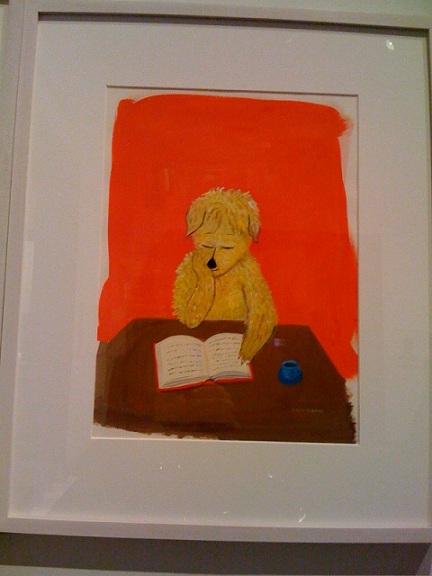
As I walked through the exhibit, I happened upon a couple of sets of videos. In one Kalman, who seems to be quite a character, was collaborating on a performance piece with Nico Muhly and an opera star (whose name I forgot). Muhly was his usual slightly whacked self. Fun! Kalman’s also been involved in a lot of social projects, such as helping to design and create art work for a new library in Harlem. And, much of her work features her dog (below).

Hehe, I was so excited when I saw this. I actually have this picture, clipped from a old New Yorker copy, hanging above one of my bookcases at home. That’ll teach me to look at the name of the illustrator more often!

Anyway, it’s a very good exhibit, and I recommend it. It’s at the Jewish Museum through the end of July.

MERRY CHRISTMAS

to everyone who celebrates is. I found this video from my friend, the great writer Michael Northrop 🙂 I love it.

It reminds me of a scene in my favorite novelist Andrei Makine’s Once Upon the River Love, where two Siberian boys wake up to find their entire town covered in snow, as they often do during winter there, and they have a blast burrowing their way up and out.

WHY ARE OUTDOOR CROWDS SO MUCH MORE RESPECTFUL OF THE OPERA THAN DANCE?

p9032296

p9042301

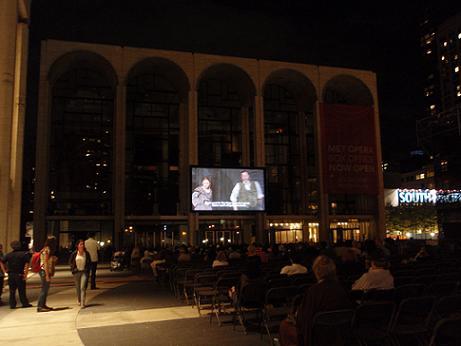
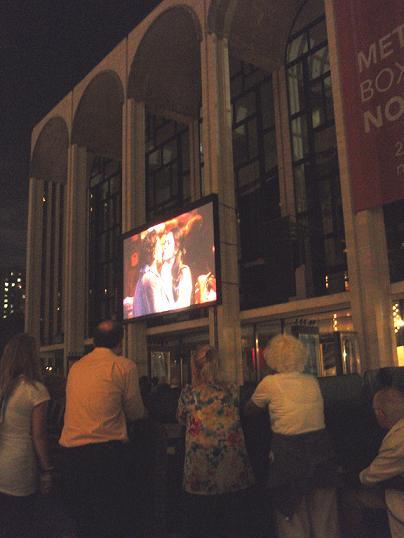
For the past few evenings I’ve been partaking of the Met Opera’s outdoor Summer HD Festival on Lincoln Center Plaza. The first night I went was Benjamin Britten’s Peter Grimes. It was on a week night and the plaza was about half full. I’d bought a sack pique-nique dinner from Bar Boulud across the street — which was delic by the way (chilled gazpacho soup, baguette of brie and fresh fig spread, waffle chips, bittersweet chocolate tart, and bottle of Pellegrino). But when I took a seat in the back and began to unwrap my brown bag I realized what a commotion I was making, how dead silent it was. I waited until a noisy helicopter buzzed around above us for a few seconds to tear into my sandwich. I absolutely loved the quiet, but figured it must be because this opera was so serious and esoteric — only true opera-manes would go.

But then last night, Puccini’s far more popular La Boheme was the same. Plaza was packed. I mean, every single seat was taken (both of the fold-out variety set up by the event organizers and make-shift seats like construction cones aligning Avery Fisher Hall), there was hardly a square foot of ground to stand on all the way to the street — people were even camped out atop the temporary Koch Theater ticket trailer (until police came around telling them to get down). But once the music began, there was the same dead silence. Everyone stared up and the screen, completely captivated. It was even quiet around the food and liquor stands, where people were basically whispering their orders. Children (the few that were there) behaved, dogs (the many that were there) behaved. Well, dogs usually behave in a crowd, actually… But even the little kids seemed to know it was important to try to concentrate on the screens.

The noisiest part of the evening was when South Pacific, showing next door at the Vivian Beaumont, let out. But once the theater-goers realized there was something important going on out on the Plaza, they shushed each other and ventured up to watch — in total silence — as well.

Such a complete contrast with some of the outdoor dance festivals — Lincoln Center Out of Doors, the Downtown Dance Festival, site-specific summertime events, sometimes SummerStage. I’ve heard from several people now that the Saratoga Performing Arts Center where NYCBallet has their summer season, is much the same, making me honestly not all that excited to go up there. I mean, kids are running around, parents yelling, people talking to their friends at the same pitch as if they were in a noisy bar, people unwrapping food, opening soda cans, popping gum.

So what gives? Do people just think opera is mainly about music and so to enjoy it everyone must be able to hear it above all else, whereas dance is more visual — so you can make all the noise want and not bother people because they can still see? Maybe it’s about the children — people are much less inclined to bring small kids to the opera, but they somehow think their two-year-old is going to have a deep appreciation of Balanchine or Karole Armitage or classical Indian dance. Maybe they equate outdoor dance performances with outdoor social dance events like Midsummer Night’s Swing, where you’re hardly going to disturb social dancers by talking. Or maybe there’s something about a big ole screen being up there.

I wonder if it would be different if ABT would have a summer HD festival and show outdoor broadcasts of some of the spring season’s ballets. Probably not… although the crowds were pretty quiet for the David Michalek Slow Dancing exhibit two years ago (once Midsummer Night Swing ended anyway)…

Anyway, tonight (Saturday) is Mark Morris’s Orfeo ed Euridice. I mean Gluck’s Orfeo ed Euridice but Morris produced and choreographed. We’ll see how it goes when there’s some dance involved… The Met outdoor HD festival continues through Monday night, ending with Anthony Minghella’s production of Puccini’s Madame Butterfly.

TO APPLAUD OR NOT TO APPLAUD


Here’s an interesting article on the BBC’s website about audience applause during classical music performances that I found to be at least somewhat apropos of our earlier discussion about applause during ballet. They’re a bit different since applause at the wrong time interferes more directly with music than with dance-watching, but, still, many of the same issues came up. Apparently, the BBC Proms festival of classical music is currently underway, which draws many newcomers.

I have to say, I greatly appreciate the word “numpties” used by one commenter 🙂

ABT, LARRY KEIGWIN, AND DANCES INSPIRED BY KANDINSKY AT GUGGENHEIM THIS FALL


The Guggenheim Museum has just released its Works & Process events schedule for the fall and there’s some good stuff coming up.

On October 11 and 12 ABT will give a program, entitled, The Art of Adaptation, in which dancers will perform portions of the company’s upcoming contemporary season, held this year at Avery Fisher Hall, and panelists will discuss how they’re adapting work for a non-dance venue. (The company is performing at Avery Fisher this year because City Center, where they usually have their fall season, is going to be temporarily closed for remodelling). It hasn’t yet been revealled who the dancers or moderators will be, but I’ll let you know when I do!

On September 23 and 25 there will be a new dance / music commission inspired by artist Vasily Kandinsky’s Blue Rider Almanac of 1912, performed at the Miller Theater at Columbia University. Music is by the Brentano String Quartet, soprano Susan Naruki, and pianist Sarah Rothenberg; the dancing will be by Armitage Gone! Dance. This, along with a couple of art installations in the museum and another music piece, is commissioned in conjuction with a Kandinsky retrospective to show in the main museum.

On September 11 and 12, young choreographers Larry Keigwin and Peter Quanz are each showing a piece they’ve made to Steve Reich’s Pulitzer-winning Double Sextet. Dancers will be from Keigwin + Company and the Royal Winnipeg Ballet. Reich will participate in the panel discussion on the 12th.

And, finally, on October 24 and 25, Shen Wei Dance Arts will perform in celebration of the company’s 10th anniversary and Shen Wei will discuss his creative process.

There are other, non-dance events as well, including a talk on “Sex Stress and Music,” a world premiere by composer Charles Wuorinen, and a spoken word performance inspired by Kandinsky’s Yellow Sound (1912) in which actress Isabella Rossellini will read and Mexican artist Rafael Lozano-Hemmer will generate an array of colors from the sound of her voice. Very cool-sounding!

The schedule’s not yet on line but it’ll be here when it is.