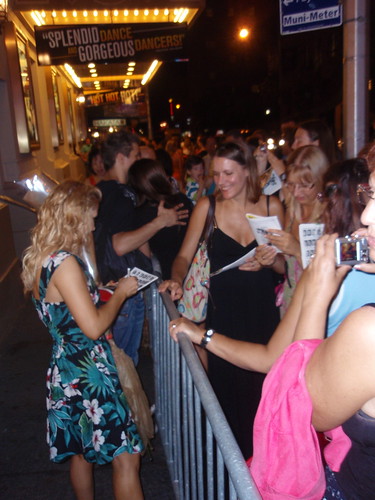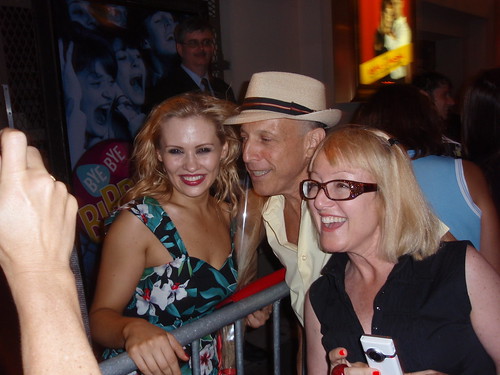
FELA! ON BROADWAY A MUST-SEE


All photos by Monique Carboni.

If you’re in NY or are coming here at all for the holidays, definitely do not miss FELA! It’s honestly one of the best musicals — if not the best — I’ve ever seen (and I don’t often like musicals!)


It’s a very “real” musical in that it takes place in a night-club in Lagos, Nigeria — called The Shrine — founded by  real-life Nigerian composer, musician, founder of Afrobeat, and human rights activist Fela Kuti (1938-1997). It’s the late 1970s and he and his dancers (mostly female) perform their unique — and fascinating — blend of what seems to me traditional African, Reggae, and funk, and you’re part of the night-club audience!


Through the songs — most of them are actual music by Kuti — Kuti tells his story, and that of his mother, Funmilayo Ransome-Kuti, who was killed by the police just months earlier, when they raided Kuti’s compound. Funmilayo was a feminist and human rights activist who was vocal in her opposition to colonialism, and to the corrupt government, and her death, along with the attack on Kuti’s compound, were politically-motivated.

It’s hard to understand the exact political problems in Kuti’s Nigeria — I’d think it would be near impossible to explain something that complicated in a show like this — but suffice it to say the government is corrupt, there’s no accountability of government officials, the police force / Army is murderous, Nigerian citizens are suffering, and Kuti is speaking out against it all through his songs.


The story-line moves back and forth in time, much of it devoted to Kuti’s memory of Funmilayo, played brilliantly by Lillias White (in photo above).


The show is expertly choreographed and directed by Bill T. Jones (photo above by Joseph Moran), who, I feel, does his best work on Broadway. The dancing is so incredibly stunning. I have never seen African dance done this well. Jones must have looked long and hard for those miraculous performers! The play obviously provides a great history lesson, but, seriously, you can go for the dancing alone and be completely blown away.

But, as I said, you’re made to feel you’re part of the Shrine audience — and Kuti (played, on my night, excellently by Sahr Ngaujah — Kevin Mambo alternates with him in the role) will ask everyone to stand up and clap, dance (at your seat!), sing, repeat words after him — it’s a lot of fun. At one point, they re-enact the police breaking into the compound, kidnapping several of the dancers, torturing them, beating Kuti, and throwing Funmilayo out of a top-floor window, killing her. But when the police storm the place, the dancers and cast -members run about the theater, through the aisles, you hear screams, shots. You feel like you’re one of them, and it’s really actually quite frightening for a split second. I actually wished they’ve have done a bit more of that — had not just the compound’s inhabitants running around screaming, but the police chasing them, waving batons, threatening everyone, including you, the “foreigner.” (My friend who I saw the show with, a black man, thought I was a bit off my nut wanting this — this rather authentic re-enaction of police brutality…)

Anyway, brilliant brilliant show — a definite must-see! I also loved Saycon Sengbloh as a female friend, whom Kuti meets during his travels. She mainly sings, and, like White, she’s got a really beautiful, powerful voice.

One last thing: at the end, the dancers and singers all emerge from the wings and carry through the aisles and out onto the stage small tombstones. It’s really cool — there are cameras all about filming live and the scene is supposed to be a political demonstration. Because of the cameras, even though the audience is all seated, everyone still kind of looks like they’re part of the demonstration. Very cool effect. Anyway, Kuti carries a tombstone bearing his mother’s name; the others’ bear words like peace, dignity, etc. At the end, they stack all tombstones atop one another onto a pile in the middle. I noticed as we were putting on our coats to leave that the one in the middle said “I am Sean Bell.” I thought that was interesting because obviously Sean Bell is a contemporary American reference and this took place in Nigeria decades ago. And, the Nigerian police stormed Kuti’s compound and attacked him and his followers for their outspoken political beliefs, whereas Bell was shot and killed by police during a failed prostitution bust because they thought — notoriously wrongly of course — that his friend was reaching toward his waistband to retrieve a gun. One outlash of violence seems so much more politically-motivated than the other. But then maybe the Bell case is political just in the fact that the police had targeted a club in a black part of town in the first place and were looking for criminal activity. Maybe both the Kuti and Bell communities were equally “under siege” in a way. I don’t know … racism in the U.S. these days takes such complicated forms because there are just layers upon layers upon layers of historical oppression.
MORE ON MEMPHIS


Here are a few more pictures of the Broadway show Danny Tidwell’s currently in, Memphis.


The photos (all by Joan Marcus) should give you a sense of what fabulous fun some of these musical numbers are. In the bottom photo Danny Tidwell is on the right side of the picture, in the gold pants.

So Memphis tells the story of Huey (played excellently by Chad Kimball), a poor white southern guy who falls for “black music,” along with a diva (Felicia, played well by Montego Glover) in a local black nightclub he frequents. It’s the 1950s and racial segregation is in full swing but Huey is far ahead of his time and believes, naively and without question, that white mainstream audiences will come to love the music as well as he, and that white society will accept his and Felicia’s relationship. The first he’s right about, the second he’s not — and Felicia pays the price for his insistence on making their relationship public.

The story begins with Huey’s being fired from his record store job for playing the hip-swaying, soulful music he’s so enamored of, though customers seem accepting of it. He then finagles his way into a local radio station, gets the station owners to give him a spin in the deejay booth, and once there, he locks the door and blasts away with his music. Just as the station owners break down the door and throw him out, the calls praising the music start pouring in. Though the station owners are still suspicious of the music, they’re also good capitalists and capitalism trumps racism, so Huey lands himself a new job. Huey soon introduces his audiences to Felicia, who sings live on his show; audiences adore her. Eventually the radio station becomes the most popular in the city, bringing in oodles of money, Huey becomes rich and buys his poor, practically worked-to-death mother a mansion, Felicia becomes famous, and Huey is offered a national TV show.

That’s the first act. It’s a happy, almost fantastical story where things seem to happen too easily; the characters have little struggle. The second act is still mainly upbeat but it’s not quite so syrupy sweet and the characters gain more depth. This is where I thought Kimball in particular excelled.

Felicia, Huey and the dancers and singers of Beale Street (the local nightclub where Huey met Felicia) are now in the North, in New York, where Felicia is on the verge of scoring a big record deal, and production on Huey’s TV show (which kind of resembles Soul Train or an early Dick Clark program) is beginning. Felicia is successful, Huey is not: the TV-show producers are not quite so open to change as the those of the radio show and they insist he replace all the black dancers and singers with white ones. The brave soul he’s always been, Huey tells the TV producers where to go.

“When did I become more black than you,” Huey cries to Felicia as she tries to get him to reconsider. This scene, which takes place in Felicia’s dressing room as she is about to go onstage for an important career-making performance, could have been the most poignant in the play, but Glover is way too sweet. She responds with something along the lines of, “I’ve had to struggle all my life.” But she’s far too nice; she wants way too much to please him after he’s said such a horrendous thing to her. She should have really smacked him, let him have it, driven home to him just what racial privilege means.

Huey returns to Memphis and resumes his local fame at the radio station, and Felicia goes on to become a national sensation. At the end they have a bittersweet reunion in which Kimball practically broke my heart. I haven’t seen this actor in much, but he gave what’s mainly a cute, feel-good story with fun dance numbers as much depth as it would allow. I’ll definitely look forward to seeing him more.

The dancing and singing is tremendous. Danny completely blew me away in every number he was in. All of the dancers are very good, but, I mean, he is just Danny Tidwell 🙂 He’d do a splits jump and, oh good lord… I really really really want to see him front and center. That’s where he so deserves to be.

Another one who blew my friend and I away was James Monroe Iglehart (center in bottom pic above). He plays well a very lovable character, and, okay, especially for someone who doesn’t exactly have the traditional “ballet physique”, damn can that man dance!

I didn’t go to the stage door to meet the cast members, but here is a link reader Jeanette sent me of her meeting the great one.

PASHA & ANYA TAKE BROADWAY!

P8182234

I remember several years ago — maybe five now — sitting in another, much smaller theater on Broadway watching a Dance Times Square teacher / student showcase and nearly falling out of my chair during the all-pro part when my teacher, Pasha (Kovalev), and his partner, Anya (Garnis), danced a West Coast Swing-turned Jive to Tina Turner’s Proud Mary. They also danced a Samba and, if I remember correctly a Rumba and though I’d started lessons with him, it was the first time I saw him dance with her. It was one of those performances where you feel kind of sick afterward because you don’t have a DVD or any kind of recording and you fear you’ll never see dance like that again. I also remember thinking how they should really be on Broadway. I mean, real Broadway, like in a regular theater.

So this is, to make a massive understatement, Surreal!

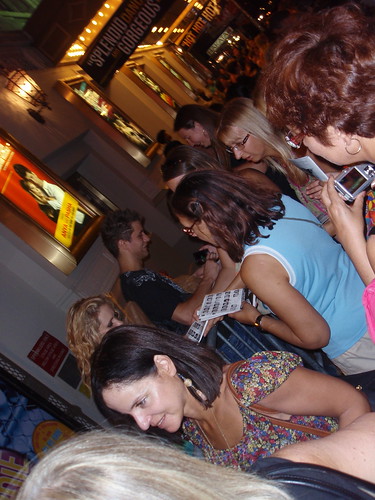
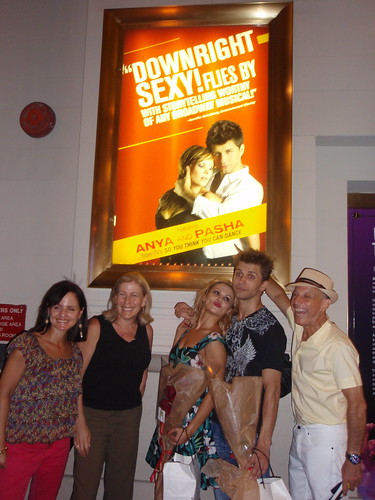
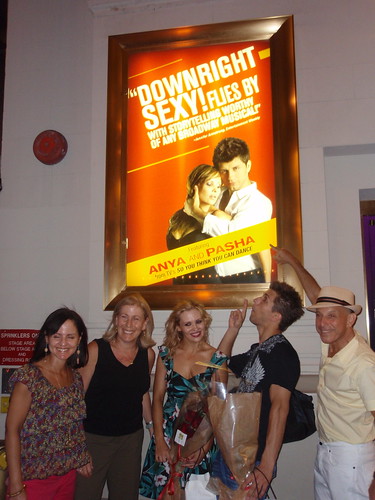
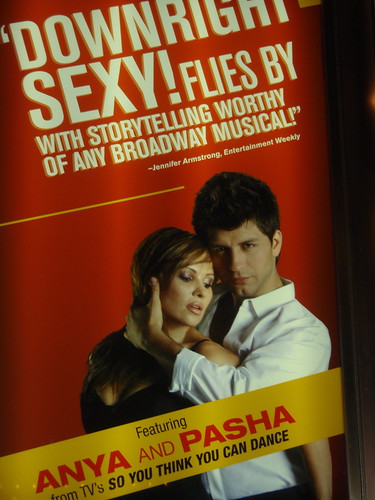
Several of my friends from Dance Times Square and I went to the Longacre Theater tonight to see our friends made their Broadway debuts in Jason Gilkison’s Burn the Floor. Of course we had to go to the (insanely packed) stage door afterward.

P8182231

P8182228

P8182219

Pasha’s about to give me a hug here 🙂 I guess I repaid him by flashing my camera right in his face. Oh the endlessly annoying paparazzi…

P8182214

How gorgeous is Anya?! Posing with my friend Steve and his wife, Ina.

They took over the roles of Maks Chmerkovskiy and Karina Smirnoff and of course they were radiant. I think they worked better with the show size-wise because of that small stage (which Maks was too large for — I love him, but he made it look all the more crowded up there).

If you didn’t read it, see my earlier review of the show here.

I think the dancers got used to the small floor; everything went much more smoothly. My favorite parts remain the extended Swing / Jive section that ends the first half and the two Rumbas in the second half (Peta Murgatroyd’s classic, dance-hall Rumba, and the more contemporary, sensual, half-dressed Rumba by the leads — although I noticed Pasha and Anya wore more clothes in that number than Maks & Karina did 🙂 ). But … I also like the Tango- turned dual Paso Dobles in the second half. Okay, I like the whole second half (mainly devoted to Latin).

In my earlier review, I don’t think I mentioned Sasha Farber as one of the dancers who most stood out to me. He’s a character dancer, kind of like Craig Salstein, and he has a rather fun part early on during a Jive where he’s trying hard to get the girl and gets carted off, kicking madly, by two men. He’s lively, actorly, and can really move quite fast. And Murgatroyd, which I wrote about in the earlier review, captivated me again, with her long limbs and gorgeous balletic lines. I mean, I really liked everyone; it’s hard even to single people out.

P8182223

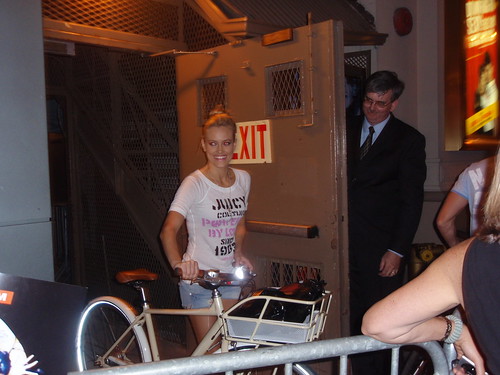
Here is Peta Murgatroyd exiting the stage door, on a bike! Actually, almost all of the dancers were on them. Apparently the show’s producers or someone from the company had given them the bikes so they could get around town more easily. Peta was popular with autograph-seekers too.

P8182229

P8182226

P8182235

Ooh, wonderful night. I miss them…

Oh and this seems to be making headlines.

P8182211

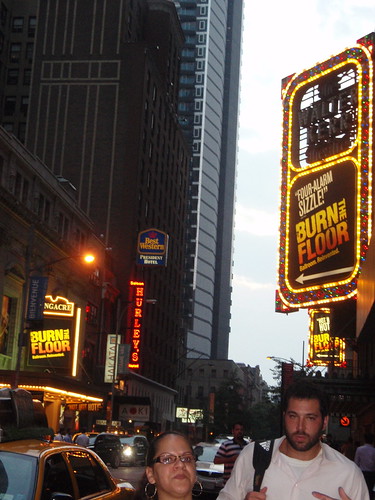
The Walter Kerr Theater across the street from the Longacre is advertising the show as well. See the arrow in the sign on the right side of the street. It’s pointing across the street. It’s the first time a Broadway theater has ever advertised for another show!

BILLY ELLIOT — WHERE WAS STEPHEN HANNA!!!


I finally got around to seeing Billy Elliot on Broadway. I’d resisted for a while since I’m not a fan of musical theater — at all — but my friend Mika had an extra ticket and talked me into going with her (by telling me there was a lot of dancing) 🙂 And she was right — there was. Unbelievably, I actually liked it!

It follows the movie pretty closely, is the story of a boy from a working-class town in Northeast England who, amidst a miners strike his father and older brother are involved in, falls in love with ballet after mistakenly happening in on a dance class — he’s only supposed to be returning some boxing mitts to their proper place but the teacher sees him and asks him to join class, which he does begrudgingly. Once he realizes he’s pretty good at the turns, etc., he’s a goner. Of course his father believes that ballet is for pansies and, besides, the family doesn’t have the money for expensive lessons and admission to the Royal Ballet Academy and all that, but of course it all works itself out throughout the course of the play.

There was a lot of dancing — not only in obvious places like the dance classes and audition, but in the scenes between the striking miners and their clashes with police — in full riot gear, present to protect Scabs — and the ballet students, and Billy. It was really well orchestrated. Go here to see some great performance photos.

I also loved the actor who played Billy’s father, Gregory Jbara. He’s of course the most dynamic character in the whole thing since he’s got a lot of gender prejudices and class issues to overcome, and when he does finally begin to change, to support his son, he really makes you want to cry.

There are three Billy’s — the one on my night was Trent Kowalik, who was pretty good as well. As a dancer he excels at turns. But of course what I was waiting for the whole time was Stephen Hanna, (former) New York City Ballet principal dancer, who plays the older Billy. I was a bit disappointed in the way they used him though. The film ends with the grown-up Billy doing a portion of Matthew Bourne’s Swan Lake, so I was expecting that. But they completely cut it! And I was so upset! I waited all night to see Stephen Hanna do that! Instead they had this rather corny scene in the middle (pictured above) where the little Billy is having a dream and he dances with the image of who he will become — Stephen Hanna. At first it’s nice — they both do some turns and jumps in tandem, and eventually some partnering with Stephen lifting Kowalik into some lovely little fish dives. But then Hanna straps Kowalik into a harness and for about the final third of the piece, the damn harness carries Kowalik all around stage — it’s like circus tricks, not dance!

After that I kept waiting and waiting for more Stephen, but the only other time we see him is in a non-dance scene with the father. It’s actually a pretty funny scene and Hanna’s able to utilize his acting skills — and he’s pretty good, except that he falls back into an American accent at the end of his last line 🙂 . It’s at the Royal Ballet Academy where Billy is about to try out. Billy’s gone back to change and the father’s left in the hallway alone — still trying to get over his homophobia / fear of male ballet dancers, when along comes Hanna (and then you knew why they needed such a big, muscly dancer), for a smoke. Hanna’s dressed in a blousy 18th Century-style top and tights, so when he takes out a smoke and strikes a nonchalant pose it’s rather funny. Then he starts doing some developpes (slow lift of one leg, with bent knee, into full extension of that leg), lifting his leg right in Jbara’s direction, exposing his crotch. Jbara looks like he’s going to have a heart attack and the audience is cracking up. It ends with Hanna warning Jbara to support his son lest he may lose him to his dream, and the father listens.


But no dancing in that scene. So, I was waiting and waiting until the end, and then, curtain call after curtain call, and dance-within-curtain-call after dance-within-curtain-call and it just never happened. Hanna also plays one of the regular strikers and so is dressed for the final dance scene in his construction boots and all, so I’m thinking maybe he just didn’t have time to do a costume change. But then just have another actor / dancer do those scenes — you certainly don’t need a NYCB principal-caliber dancer for that! — and leave Hanna to the ballet! Argh! I realize Hanna took the role knowing what it would entail, but they really could have used him to much better effect, showing audiences what male ballet dancers are really capable of, and what the future Billy will be like.

Anyway, overall I did enjoy it — for those very well choreographed dance scenes I mentioned above and for the actors, particularly Jbara. It’s worth seeing if you get the chance.

Blacks Acting "White" is Hilarious, But What Would the Reverse Be?

…and other questions I had after seeing Young Jean Lee‘s The Shipment, a very compelling off off-Broadway play about Black identity in America by a Korean-American playwright, starring an all-black cast.


Warning: if you’re in NY and you plan to see this, you may not want to read this yet!

I’d been really excited about seeing this play for a while and it definitely didn’t disappoint. Also made me think. A lot. And methinks this “review” may be all over the place because of those thoughts.

The play is divided into three sections, or acts. The first consists of a foul-mouthed Eddie Murphy-type stand-up comedian who says he’d love to spend all his time telling jokes about pooping (his very favorite subject of comedy) but is being forced to talk about race instead (because he’s black, because it unfortunately affects him as a black American). He remarks on some of the differences between whites and blacks: whites obsess about their weight throughout their lives, blacks — once they get married, forget about that shit. Occasionally, he’s confrontational but in a funny way, and, though I think he made many in the mostly white, mostly young, very liberal audience somewhat uncomfortable at points, everyone laughed. This was my least favorite section, mainly because I wish Lee would have been more specific at times and also because she overlooked class differences a bit. For example, the comedian says that whites love to accuse blacks of “whining,” but look at what whites whine about: “Ooh, I just don’t know what to dooo with my life!,” he says in falsetto, or “Ooh, am I too fat?!” It’s funny — because that’s exactly what a lot of whites do whine about — but upper-middle-class whites. Believe me, poor whites are not worried about how they look; they’re worried about putting food on the table, about how far they can stretch their next paycheck. Just visit any small working-class town in the south or the mid-west.

But also, I don’t really know what whites accuse blacks of whining about. Historical oppression? The disproportionate rates of incarceration? Racial targeting by the police? I’ve never heard any whites accuse blacks of whining about any of these things. Most whites don’t even want to think about those things.

Continue reading “Blacks Acting "White" is Hilarious, But What Would the Reverse Be?”