Petipa is the New Black

“‘What color would you say this is?’ Lana asked, handing her the pump. ‘Not quite turquoise.’

‘Oh I’d say Bluebird. Very franco-russe, very Petipa.'”

Hehehehe, I’m really enjoying this novel, Women About Town, by dance critic, Vanity Fair contributing editor and novelist Laura Jacobs. One of the main characters, Lana obviously, is a dance critic, and it’s so fun reading about her world. At times kind of frighteningly competitive and at times sweet. Dance critics so live, breathe, sleep (and shop!) dance, sometimes more so I think even than the dancers… Anyway, can you imagine going shopping with your girlfriend and speaking about the clothing and colors in ballet terms? I love it — can totally see me and Ariel doing such a thing, when she moves to NY 🙂 Probably with us, it’d be more like, ‘whoa, that’s Tybalt yellow!’

Times Joins SYTYCD Debate, Ignoring Some But Not All Blogs

Claudia LaRocco writes briefly in today’s NYTimes about TV show So You Think You Can Dance and whether it’s of any value in bringing concert dance to a larger audience. She didn’t mention the lively debate taking place on Apollinaire’s blog, in which I nominated the wonderful Rasta Thomas as “Ambassador of Dance.” Apollinaire sweetly made me feel good about the Times’ mention of him as well in that role, since when all the other nominations came in and people began talking, I felt really stupid, as if I’d nominated Playgirl’s Playmate of the Year (if they even have such a thing 🙂 ) So, I’m glad the powers that be were on a similar wavelength 🙂

I’m also glad that Ms. LaRocco interviewed Kristin Sloan of the Winger to weigh in on the question, and so didn’t completely leave out the blogosphere. Unfortunately, SYTYCD was mentioned not once on the Winger. I don’t mean to be critical at all, it’s still my favorite dance blog and I dearly love many of the contributors, but I think with so many of them now, no one’s really in charge and everyone’s expecting someone else to take on the important issues, so the debates have been had elsewhere. I just wish the dance community was a bit more cohesive. I just feel sometimes like everyone’s writing, blogging, talking in a vacuum, and that’s unfortunate for dance because it cuts down the level of discussion…

Update: Kristin just published a really interesting post on a Chinese TV show on cable that she compared to our SYTYCD. I like the sound of this one! Okay, I take back what I said above 🙂 🙂

Survived First Dance Class in Four Months!

Okay, how come I always look like an ass in ballet class, but a ballerina in all the other styles of dance I take? Tonight, I took my first dance class in four months now (yikes) — a beginner Flamenco class at 92nd St. Y. Seriously, in lieu of the beautiful palmas (fluidly wrist-bending Latin / Indian hand movements that are one of the three basic elements of the dance), I did the perfect port de bras (balletic arm movements). I mean, I’m sure they wouldn’t have looked like perfect port de bras in ballet class, but they sure did in Flamenco. No matter how much Latin I take, for some reason I always have the tendency to turn my wrists inward so that my palms are toward my body (as in ballet), rather than turned out, away from it, as they usually are in Latin. It’s ridiculous.

And damn do those castanets require patience! We only did basic taps, but tapping the pinkie finger, then the ring, then the middle, then the pointer, then moving to the left hand in a continuous one-two-three-four-five rhythm, faster and faster and faster was so unbelievably trying on my nerves, for some reason. I had to keep shaking my hands like I was shaking off a bug or something. And keeping my arms up in the air was a bit painful, embarrassingly. I am just a bit out of shape here 🙁 And forget trying to coordinate the castanet taps with the wrists with the arms with the foot toe / heel stomps (my favorite part — gets rid of some real aggression :D)… forget it! This dance is so hard. It’s not athletically hard in the way ballet is, but it requires maximum coordination that I don’t have!

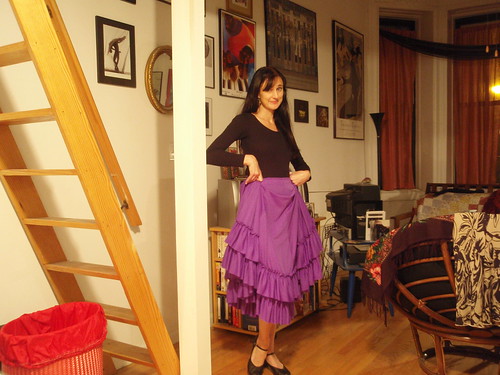
I’ll probably stick with it anyway; it’s good for me 🙂 Unfortunately, the teacher has a strict dress code — all black — so I can’t wear my pretty purple Flamenco skirt (above). Don’t really understand this — I took a Flamenco class at Ballet Hispanico months ago and wore the skirt to Paso Doble classes at two different ballroom studios and no one’s ever had a problem with the color. It cost $75 too, so I have no intention of buying another one in black. My black ballroom skirt will have to do, though it doesn’t have the pile of ruffles at the bottom so is not going to look wholly right for Flamenco… I just always pride myself on being different, so was rather pleased with myself for finding such a color.

I’ll never forget the first dance class that blew me completely to Heaven, made me feel like I was experiencing a whole new level of humanity, made my heart race: it was basic ballroom Samba with Roula Giannopolu at DanceSport studio. I remember I was squealing when I came out of there, practically crippled with blisters, my classmates trying to steady me and asking if I was okay. “What kind of music was that?” I screamed out demandingly, collapsing on the lobby sofa. No one knew and Roula had sprinted off to her next class. “That was like ballet and African and Latin and just the whole world!” I cried, flailing about. I haven’t had that same exact experience since and I so long for that feeling again. I think I may sign up for group ballroom classes next month. I like the solitary Latin dance classes I’ve taken — Brazilian Samba at Alvin Ailey and now Flamenco. But ballroom’s really where my heart is.

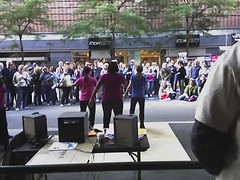
Anyway, on another note, here are some more pictures I took today during my lunch hour of the Bill Shannon “Window” site-specific dance performance that I blogged about at the beginning of the week. It was funny seeing it down on Liberty Plaza this time, after having watched from the high-rise before. I had thought when I was inside looking down that people were trying to be good New Yorkers and avoid any weirdish person making a “scene,” but being down there with the people, I realized that the area the dance was performed in was so vast, without music, it was actually pretty hard even to notice. You had to really seek him and his dancers out to see him. Dance is also so music-dependent I realized. Upstairs we had the music blasting from the speakers to accompany the movement we saw out on the plaza. It really got you into it, made you move a little yourself. Being down there with no speakers, the movement just didn’t have the same meaning, it wasn’t as fun, it wasn’t as noticeable, it wasn’t as “performancey” which I guess was the point…
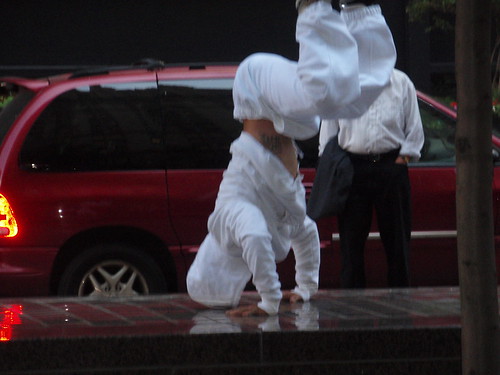
One of Shannon’s break-dancers.
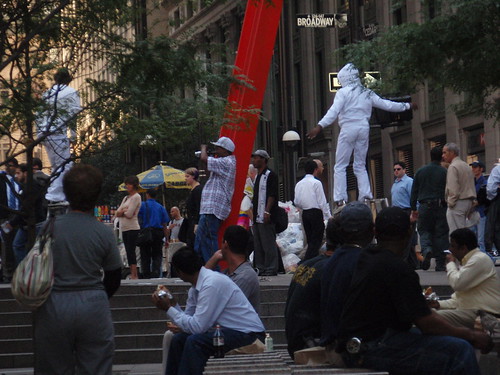
The guys in white are the performers. It might be apparent, it might not.
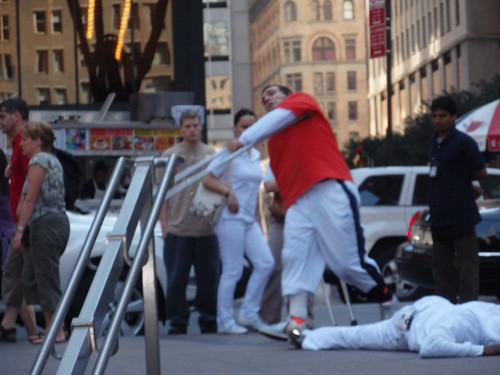
This is Shannon himself, on the crutches. I didn’t notice him zooming around on the skateboard this time; he used it more as a prop than a vehicle, unless I just arrived a bit late and missed that part of it.
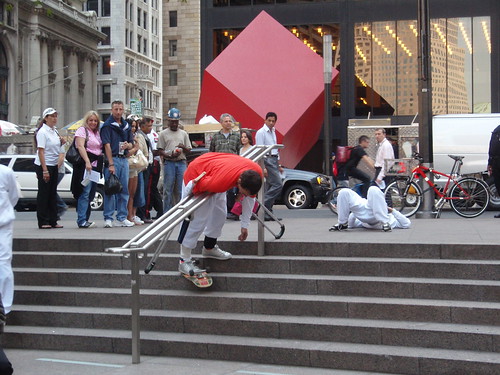

On, and another thing, at one point a woman walked up to him while he was on the ground break-dancing. I guess because he had the crutches, she thought he was hurt and tried to help him up! He spoke with her a bit, but with all the city noises, I couldn’t possibly hear what they were saying. I wonder whether he went along with her, told her what was really going on, or if I just completely misunderstood the whole interaction and she was actually part of the performance!

David Speaks!

Matt posted a little video he made of him and David Hallberg attending a live taping of the Broadway play “Legally Blonde” for MTV. Pretty good video, Matt! But interesting thing to me is, this is the first time I’ve actually ever heard David speak! He’s more fragile-seeming than he appears onstage. He’s so cute 🙂 🙂 🙂 It’s just funny because in dance (in contrast to theater, movies, etc.) you see a favorite dancer onstage many many times and you never hear the sound of his voice.

If Only!

“It turned out it was Lana who had to have the stage. Not in the way they did, not being on it. . . Each production was a mystery to be solved. . . Lana would answer with her own performance — on the page. . . Deep down, Lana knew she would end up in New York. A city where they argued about the arts. And respected critics.” (emphasis added).

From the novel, Women About Town, by Laura Jacobs.

My First Suzanne Farrell Experience!

Last night, I met up with fellow dance blogger, Art, at the NY Library of the Performing Arts to watch a newly restored film of George Balanchine’s 1965 ballet Don Quixote, performed by the choreographer and his then muse (and one of the greatest and most famous ballerinas of the 20th Century) Suzanne Farrell. The film, which is now available for private viewing in the library’s research carrels, was shown last night to an audience.

I’m currently reading Ms. Farrell’s autobio (one of MANY books overspilling my night table…) but this was my first time actually seeing her dance, and, oh my gosh, I was beyond blown away. She was just the epitome of grace and serenity and beatific, angelic, ethereal purity. Her arms were like water and her body at times looked like a candle’s brightly flickering flame. I can see why she was his muse! And she was only 19 in the film; all of those qualities that make a sublime dancer thusly so are present from the get-go, several of us agreed after the showing in the lobby.

The film is a bit wobbly in places. The filmming wasn’t sanctioned (making the movie a piece of bootleg!) So, at times the light is so dim you can’t really make out what is happening; sometimes the camera is focused on a dancer who isn’t dancing, cutting off someone else who is, there’s lots of blurriness, and the sound is often distorted. Somehow you can always see radiant Suzanne, though, which is what is most important of course!

Also, this version of the ballet is rather dark, based closely on the original Cervantes, not on (19th Century ballet-maker) Petipa’s more fun-loving, celebratory classical ballet filled with flirty characters and thrilling, virtuostic dancing. I rather liked Balanchine’s more melancholy interpretation. I wish New York City Ballet was still performing it today. Sadly, the ballet got mixed reviews, so they nixed it.

It was really fun seeing this with an actual audience. I think if I’d viewed it at a private carrel or checked it out and watched it at home on video I might have got bored. But seeing it with other ballet fans (some very long-time), hearing their gasps when Balanchine’s Don Quixote has his feet washed by Farrell’s Dulcinea, then dried by her long, flowing hair (Balanchine, many many years Farrell’s elder, suffered an unrequited romantic love for her), their heavy applauding at the end of one of Farrell’s solos, their enthusiastic whispering when someone who was obviously a famous dancer back then came on the screen, all made it so much more intriguing, made it all come alive. Some of the faces I’m seeing at all of these dance events are beginning to become familiar now, and it’s really nice sensing that you’re part of a community, especially in the hugeness of New York City.

Speaking of familiar faces, Art and I ran into Monica in the lobby and we chatted for a bit, which was fun. Her daughter is an aspiring ballerina and currently studies at the School of American Ballet, founded by Balanchine and connected to New York City Ballet.

Art is just amazing, and, after reading his blog for several months now, it was so great finally to meet him! So knowledgeable about ballet, though so young 🙂 He lives in L.A. but was here checking out grad schools in art admin. After the showing, I dragged him to Cafe Mozart because I’m a pig and a half 🙂 to chat more. As an undergrad at USC he took a dance history class with the (in)famous critic Lewis Segal! He said I should be reading Edwin Denby (which Terry Teachout and my friend the great dance writer Apollinaire Scherr 🙂 have told me as well), so when my next Borders coupon arrives via email, I will have to break down and buy it. We discussed dancers, dance companies, dance journalism, dance presenters, theater, London verses New York for all of the above … he recommended for my next Blackpool trip (in May / June next year), I fly into London instead of Manchester so I can bookend my ballroom dancing extravaganza with some dance at Sadler’s Wells. He even knew what was on their agenda at that time of year! See, smart!! It was so nice meeting you, Art, and I hope you do relocate here for grad school 🙂 In the meantime, keep blogging!

Boston Ballet at the Guggenheim

Last night I went to my first Works & Process discussion of the Fall season to investigate the Boston Ballet, who will soon be performing as part of the Fall For Dance Festival at City Center. These Works & Process events held by the Guggenheim Museum, by the way, are really a good value. For only $25 you can see, in a very intimate setting, prestigious dance companies perform new pieces from their upcoming reps, and hear the artistic directors and/or choreographers talk about the works.

Last night’s program featured speakers Mikko Nissinen, Boston Ballet’s artistic director, and choreographers Helen Pickett and Jorma Elo. Elo is the main reason I wanted to attend, as I have loved both of the two very modern ballets I’ve thus far seen of his: “Slice to Sharp” performed by New York City Ballet; and “Glow Stop” by my favorite American Ballet Theater 🙂 This makes me a bad person, as dance critics just lurve to hate Elo 😉 I guess many find him vapid and aerobic. But I think his ballets are fast, fun, sharp and bedazzling, and they both showcase the dancers’ athletic abilities with their numerous mid-air turns, high jumps, and fast precise footwork, and take dancers out of their comfort zone (as this favorite of mine once put it) which, in a weirdly extended way, does the same to us.

Anyway, tonight’s piece of his, an excerpt from “Break the Eyes” was the best thing I’ve seen by him yet. The music alternated between a section consisting of heavy, disconcerting, foreboding sounds (at first sounded almost like something out of “Jaws”), and was accompanied by the voice of a young woman breathing frantically and speaking urgently in Finnish, and a section of sweetly mellifluous Mozart piano music. A solitary ballerina danced to the foreboding soundscape, her movements at the start sharp, jerky, and frazzled, which became less so as the ballet went on. The Mozart pieces were danced by a small ensemble whose dance vocabulary — pretty partnering, lifts, quick-paced but mellifluous allegro steps — mirrored the flowing music, the solitary ballerina’s angular, harried, awkward movements a stark contrast to theirs. As the piece developed, the music was at times played together, the frantic Finnish woman’s voice crying out over, disrupting the Mozart. The ensemble and solitary ballerina seemed to struggle with and react against each other, eventually helping to define each other. The dance was intriguing: though I didn’t “get” everything the first time around, as I never do with abstract ballets, there was a real development there, a kind of story, and I felt Elo was trying to say something, making me curious to see it again. I’ll get that chance with Fall For Dance, as Elo’s is the piece the company will perform.

Boston Ballet, as Nissinen explained, seeks to perform a blend of contemporary and classical ballet. Ballet, he said, is “not just a church or museum, but must pave the way for the future.” I like that, and it’s true. There’s nothing more beautiful and romantic and fairytalish than classical ballet, but for the art to stay alive, there must be new along with old. (What if the only plays performed on all of Broadway were by Shakespeare? Going to theater would be a historical enterprise, like visiting a museum.) In this vein, the company also presented a Swan Lake pas de deux — you realize just how beautiful classical ballet is, what genius possessed Ivanov, and how iconic Tchaikovsky is when you see something like this juxtaposed with the modern — along with an excerpt from the first professional work by new choreographer Helen Pickett. Interestingly, Pickett said her process was to choreograph a dancer’s solo, then allow the five or so others sharing the stage to improvise their own moves, taking cues from the soloist’s movement “reading” her vocabulary and reacting to it. She said it was empowering to the dancer, which I can see. Still think I’d be very nervous making up my own movement right on the spot before an audience though!

Anyway, if you wish to see the Elo piece at Fall For Dance, go here; for Guggenheim’s W&P schedule, go here.

Watching "window" by bill shannon

Watching “window” by bill shannon

Originally uploaded by swan lake samba girl via mobile.


This was so cool! Review to come. Definitely try to go if you can!

Okay, now that I’m back at my desk I can write more. Bill Shannon’s “Window” is the last of the works shown as part of the Lower Manhattan Cultural Council’s “Sitelines” series (consisting of site-specific dance performances) in its “River to River Festival” for this year. (“River to River” takes place downtown each summer). The two others I was able to see, I blogged about here and here.

I really really liked “Window.” Bill Shannon is a disabled dance / conceptual artist who uses crutches. (If you’re in L.A. right now, he is one of the performers included in the David Michalek “Slow Dancing films” exhibit.) Here he and three other men — one wearing black pants, top and hood, one wearing all white, and one dressed in a business suit — performed break-dance and hip-hop out on Liberty Park Plaza while Shannon, skateboarding on crutches, zoomed around on the streets surrounding the park. At points Shannon would skate into the park and dance, very well mind you, on the crutches.

There were two sets of audiences: the random passersby in the park and on the street who got caught up in all the commotion; and us, those who RSVP’d to the event through lmcc’s website and were escorted into the 8th floor of the high-rise at 140 Broadway, where, amongst the bemused real-estate brokers who regularly inhabit the office, watched the scene down below through the window. A couple of camera people outside filmed the performances by Shannon and the three others and those films were projected live onto four screens inside, where we stood. One screen was set up in such a way that it would reflect on the ceiling, where you got kind of an upside-down version of what was going on outside. The filmmakers also played with the projections a bit so that the colors of the dancers’ clothing would change, or, at points, the dancers would be projected onto a different background; at times the images looked rather 3D. So, you had your choice of watching what was actually going on outside through the window, or the way it was projected onto the screen, as intermediated by the filmmakers.

They also had speakers set up inside, which played a variety of hip hop, techno and pop music. Shannon had headphones bearing a small microphone so he danced to the music and interacted with us through the mike.

I preferred watching what was actually going on through the window, partly because, Liberty Park being so big and crowded, everytime I took my eyes off of Shannon, I lost him. I also found it more interesting seeing how normal everyday besuited business people and tourists, not expecting to see a show — and a rather odd one at that (I didn’t see any speakers down there so assumed they couldn’t hear the music and only saw a bunch of guys rocking out to silence), interacted with him. Of course this being New York, most pretended not to notice him at all, although you could kind of see them spying him out of the corner of their eyes. They didn’t have the roads blocked off and at one point I thought he may be hit by a large white van barrelling down Liberty Street, but the driver thankfully saw the crazy guy bopping around on crutches whilst skateboarding and slowed to a stop. “Whoaaa” Shannon sang over the speakers.

At the beginning, Shannon looked up at us and called out, “How do you put rhythm into a city? How do you make a city come alive?” while clapping his hands above his head and shaking his hips to the percussion like a rock star. There was something at first eery but eventually comforting about watching him rockingly skateboard around what was once a triage unit, the construction site that was once Ground Zero and before that the World Trade Center diagonally behind him.