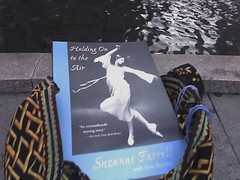
Purchase from the corner book guy
Originally uploaded by swan lake samba girl via mobile.
Only 75 cents 🙂

Purchase from the corner book guy
Originally uploaded by swan lake samba girl via mobile.
Only 75 cents 🙂
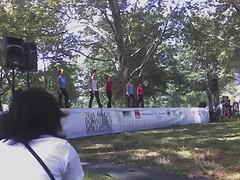
Originally uploaded by swan lake samba girl via mobile.
This time in battery park. Can’t get enough of this daniel cardoso!
Nice thing about New York in August is that there are lots of outdoor art festivals offering free viewings. I of course have been attending as many of the little dance performances as I can. Many are by very small companies, and the works are brief. Here’s a troupe that caught my eye yesterday, Quorum Ballet from Lisbon, Portugal, who performed at Chase Plaza as part of the Downtown Dance Festival organized by Battery Dance Company.
Their movement style was what I’d call contemporary ballet mixed with modern — no toe shoes but some lovely balletic lifts — and in one piece I saw a smidgeon of Flamenco. Music was mainly poppy with a fun, solid beat.
Beautifully sexy movement, and I don’t think I’ve ever seen such a gorgeous group of dancers! It’s a small, very new company founded only in 2005, by choreographer and dancer Daniel Cardoso,
(how much does he look like Herman or Joaquin 🙂 — jumps not unlike them too!), who, along with lead dancer Theresa da Silva, was previously affiliated with seminal modern dance company Martha Graham. (The two are pictured above and below, in “Kismet,” my favorite, and the piece that, at least in its solo parts, reminded me of a balletic flamenco).
Here are some more pics from their other pieces:
My only qualm was that some of their lifts looked a bit too “trick-y” as in, you kind of felt like drum rolls should be preceeding them, similar to what I’ve seen at many of the exhibition dancesport competitions I’ve been to. Suits some people’s tastes but not mine, and I don’t think this company really intended for them to be that way, although maybe they felt they were playing to an audience unaccustomed to dance and felt like they should play up the showy aspects. And some of the lifts seemed a bit out of sync with the style. For example, the “bluebird” lift above (where da Silva is balancing on Cardoso’s shoulder, back arched), a typical ballet lift, seemed to me a bit at odds with the flamenco-y flavor of that dance. I would rather have seen more original parterning, specific to the dance style, such as that employed by Mimulus, which I wrote about earlier. But the solo and ensemble work were just gorgeous.
Cardoso had some beautiful pelvic and ribcage isolations going on. Very Latin 🙂
Okay, that’s all for now. Will likely be more to come depending on whatever else strikes my fancy in the next few days … 🙂

As promised, here are a bunch of pics I took of yesterday’s first peek at the collaboration between Brooklyn-based choreographer Reggie Wilson, and Andreya Ouamba (originally from Congo but now residing in Senegal), entitled, intriguingly, “Accounting For Customs.” The work is part of the Lower Manhattan Cultural Council’s “Sitelines” project — comprised of dances that are created specifically for a certain site, outdoors, free and open to the public 🙂
This dance took place on the steps of the U.S. Customs House, which the dancemakers assured was significant. I honestly had to stop and think of what the Customs House represented. I have no background, or interest, in economics and actually almost got lost trying to find the place, since I think of this building as The Museum of the American Indian (which it now is; in 1973 Customs was moved to the WTC, don’t know where it is now…). Well, I guess the work that goes on in an official Customs Building is the setting of tariffs U.S. citizens have to pay on goods over a certain amount that they purchased abroad, right? So, a customs house deals with the price one pays for bringing something “foreign” into one’s own culture. A custom is also of course a cultural tradition.
Wilson has said (see Kourlas article linked to above) that one of his interests is to examine the intersection between “traditional” (by which I assume, in the African context, he means traditional African dance) and “contemporary” (by which I assume he means, in the American context, modern, hip hop, jazz, etc.). How do people react to contemporary dance containing traditional movement, he asks. Do they see the contemporary movement “evolving” the traditional, or “bastardizing” it. And how does innovation happen in this context — which force is credited with being “innovative?”

Thought-provoking questions no doubt. I’m not sure I can answer them, but I did really like what he and Ouamba came up with here. It was short but evocative and fun. The dancers began in a horizontal line on a low step, then two by two they paired off, greeted and hugged each other, then, holding hands, ran up the stairs, both together and apart, as they were separated by a central hand rail. Some dancers fell and lay down on a middle step, forcing others to find a way around them. Soon all dancers had fallen and lay down on a step, some atop each other. After a short silence, a loud bang emanated from the speakers (was it a car’s backfire, a gunshot?…), and the dancers then began rolling up the steps, eventually manoevering themselves to a crouched position, and crawled downstairs. All then stood up and danced, each his or her own way, up and down and all around those steps — at times fighting each other, at times being playful, at times embracing, helping each other up or down, carrying each other, stopping on a step to do a pose — a pretty arabesque evoking flight / freedom, a more urban, hip-hoppish stance — at times they would crash up against the side pillars, pushing and shoving against them, at times holding onto them for dear life while another tried to pry them off. All the while a woman dressed in traditional African costume sat off to the side, under a pillar, making crafts and from time to time looking over at the dancers — the children of the diaspora… her children. The music (not live, but played over loudspeakers that in my opinion were not amped up enough for outdoors) varied between what I assume was Senegalese music, poppy tunes with pulsating drums, folksy guitars playing a melody that sounded like a patriotic American song, and silence. At one point the woman on the side hummed a spiritual.
Anyway, great thing about outdoor performances is that you can take many pics!


I really liked these two guys. At one point they kind of hustled each other down the steps — rather playfully aggressive, each throwing the other down a few notches in a funky little turn. I think I’d be too scared to do that on narrow stairs. According to the articles, they only had two weeks of rehearsal!

In places the scene as a whole was even a little Rent-esque. Very urban. The photographer in the front with the long dreadlocks and the colorful outfit — he must work for some major publication around here because I see him practically everywhere!


Here’s the woman making her crafts and humming spirituals off to the right.


I loved this guy in the front … obviously — I kept taking pictures of him!


As I said, it was short and not entirely fleshed out, but their larger project together is to take place in 2009 at the Brooklyn Academy of Music. I’ll definitely be excited to see what they come up with given more time!
If you’re in New York, to see this work, about 20 minutes in length, just go down to the Customs House, at Bowling Green station, at either 12:30 or 1:30 today and tomorrow.
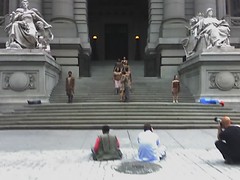
Originally uploaded by swan lake samba girl via mobile.
For free lunchtime performance of amazing “Accounting For Customs” by Reggie Wilson & Andreya Ouamba. Better pics to come tonight, when I have a chance to download them 🙂 Til then, read articles by Gia Kourlas in TONY and Claudia LaRocco in NYTimes on this fabulous piece of public art.
I’m so upset. Last night in the mail I received my New York City Ballet brochure announcing the company’s Winter / Spring season and noticed right off that the photo of Carousel featured not the usual Seth Orza (my favorite NYCB dancer!!!) and Kathryn Morgan (together below, in photo by Paul Kolnick, taken from Explore Dance.com), but instead Damian Woetzel and Tiler Peck. In fact there were no pictures anywhere of Seth! Unheard of! I frantically searched the roster and his name was nowhere to be found!@#&^%! Philip had told me earlier that word had it Seth was leaving NYCB for Pacific Northwest Ballet in Seattle, but I told Philip to shut up and stop spreading base lies! Ohhh, now it appears he was right… I don’t get it. Seth was just promoted to soloist. And he was a favorite of all the critics — New Yorker’s Joan Acocella and even Alastair Macaulay from the Times who likes hardly anyone. You don’t leave New York under those circumstances! You just don’t! And he and Kathryn look so adorable together. Just look at them in the two pics below. (bottom one is taken from New Yorker, accompanying Acocella article). Who’s Kathryn going to dance with now? And who’s going to be Swan Lake Samba Girl’s favorite now?! Come on man! I was just starting to really love NYCB because of him. It’s not fair! Release him, Peter Boal!
In slightly less devastating news, Ms. Acocella writes in this week’s New Yorker that PBS will broadcast a bio-documentary on Rudolf Nureyev, to air in NY on August 29th. I should be excited, given that he’s my favorite dancer of all time. But it’s hard to work up sufficient enthusiasm when I’m just so sad sad sad I’ll never see my favorite NYCBer dance live again, at least on a regular basis.
Over the weekend, I watched Mark Morris’s Mozart Dances, filmed for TV and shown as part of PBS’s Live From Lincoln Center. I actually watched the tape I made of it three times, plus I’d also seen it live last year. Doug Fox was very disappointed with the televised filming; visit his blog for some interesting commentary. Also, as I’d linked to earlier, read Apollinaire’s article for more on the filming aspect of the program, and an interview with the filmmaker.
Before turning to the filming, I briefly want to give my two cents on the dance itself. I’m not a huge fan of contemporary Mark Morris. I’ve skimmed Joan Acocella’s book on him and wish like anything I would have been able to see Strip Tease and some of his earlier, more iconoclastic work from the 80s when he was a young upstart. Now, it seems like he’s toning it down. My first thought on seeing the program was that it was too slow and repetitive, making it long-winded and a bit tedious. But each time I watched, I liked it more and more and saw more of the things Acocella had written about, just in subtler form. (Go here for her current New Yorker article on this piece). One of the ways in which the dance is broken down is by gender, as Alastair Macaulay noted in the Times. The first movement is danced almost entirely by women, the second by men, the third by both together. In the first, the women, as Macaulay also noted, look very weighted and “flat footed.” The men in the second act (my favorite), in contrast, look light and feathery. This is the opposite of course of classical ballet, where the ballerina on pointe looks poetic floating about in the air and the grounded man is her support, her connection to the earth. So to an extent this is the usual Morris turning those gender assumptions on their heads.
And he does it well: during the part of the first act’s piano concerto where the music sounds like a lullaby, the women, wearing these almost dominatrix-looking black costumes — black bra and underwear with diaphonous black chiffon gown hanging from the bottom of the bra to the knee — do not tiptoe around in a circle all willowy and delicate, but brashly stomp forward, arms swinging front to back as if in a march. Hardly the maternal ideal. During the men’s portion, at one point, the men, wearing blousy, billowing white shirts, dance in a circle as well. But their dance is quite different; it’s light and lyrical, poetic, like a Balanchine ballet. But where Balanchine would have pretty ballerinas with long flowing blonde hair bouncing around, playfully holding hands with each other, raising arms, and inviting a dancer through their arc, Morris’s dancers do the same but the whole look is altered because they are men. Or is it? What is femininity and why does gender matter in dance? Maybe it doesn’t. And I love Joe Bowie, the main soloist in the men’s section. I love that the man who, at least to me, represents Mozart himself is an urbane black guy dressed in hipply ripped black conductor’s jacket and black spandex bike shorts. Morris definitely challenges gender and race assumptions, though it’s rather pathetic that they still need to be challenged. And the costumes were simply superb.
Also, Morris is known for being a very “musical” choreographer, meaning what exactly? He works with the music well? To me, his dance is almost a contradiction of the music. His dancers’ movement is very modern, yet the music is obviously classical. Also as Macaulay notes, Mozart has a lot of beautiful lyrical flourishes in his compositions. Morris doesn’t seem to follow those by creating his own lyrical poetic flourishes; the dancing instead is rather intentionally mundane, earthy. There’s no virtuosity either (big leaps, multiple pirouettes and fouette turns, etc.) Which is part of why Morris doesn’t thrill me. Cool costumes, evocativeness and assumption-questioning aside, to me the whole thing generally dragged and there didn’t seem to be any climactic arcs or discernable overall themes.
Interestingly Morris says during his interview segment of the show, that he doesn’t like “poses;” he finds the steps in between poses to be “the dancing.” I guess that’s what I’m missing here. Of course that’s what Ballet and Latin are all about, so call me shallow, or bun-brain or Latin girl or whatever, but I’m for the poses. Of course getting from one pose to another easily is what dancing is all about and it’s necessary to make smooth transitions. [In my own dancing I concentrate so much on the pose — the arabesque (one leg lifted in back), the develope (slow, unfolding delicate kick), or how my body looks in position in a lift, that I forget to think about getting into the position in the first place. The result: I look like crap on my way into a lift, etc. But I think this is common among students / amateurs, and I’m learning… :)] In any event, watching my Morris tape a few times, though, the dance has grown on me a lot, so maybe if I kept watching it would continue to do more for me.
So, the film aspect. Funny but I felt the exact opposite of Doug. I didn’t think the camera did enough, had enough of a point of view. I was glad that, for once during a full-length concert dance performance, someone didn’t simply plop a tripod at the edge of the stage and hit ‘record’; the camera-operator actually had an opinion, told the viewer where to look. The camera would at times home in on one dancer, either his or her entire body or just torso, then would pan out to the ensemble. At times it would follow a dancer or smaller group of dancers, excluding perhaps things happening at the other end of the stage. These were all reasons Doug gave for disliking it; I felt that this was too rarely done, and when done was still too lacking in focus. When the camera homed in on a dancer’s upper body, it did a half-assed job; if you want to humanize the dancer, make people relate to him or her, get a close up of the person’s face. It doesn’t have to stay there long, but a few close-ups go a long way. The eyes are the window to the soul, you know.
And you can’t just focus the camera in and out without playing with angles. Everything here was a straight shot. Forgive me, by the way, for not knowing correct film terminology; I know what I mean, but don’t know if I am expressing it right because I have no film-making (only extensive film-viewing 🙂 ) background. For example, when some of the dancers were doing pirouettes, do a close-up of that dancer and angle the camera so that it’s focusing on the dancer at a diagonal. It makes the dancer look superhuman, like s/he has miraculous balance and it’s really cool. And, like with those little wrist-flourishes the dancers were doing, home up really closely and find a better shot — maybe of the wrist coming toward the camera — to make it look multi-dimensional or something. And, as I said, unfortunately, there were no big jumps and leaps here, but if there were, have the camera underneath the dancer. This emphasizes the majesty of the height and showcases the dancer’s musculature. Generally, it always heroizes the subject to have the camera focused upward at him / her — so this could have been done at any point, with pirouettes, etc. Conversely, if you want to highlight a dancer’s vulnerability, create poignancy or sympathy, do the opposite and place the camera at a downward angle on top of him or her. Also, it would be cool to have, like in those highly successful Anaheim Ballet videos on YouTube, the camera directly behind or immediately next to the dancer so that the viewer would be given a sense of what the dancer sees, during, for example, fast pirouettes.
Of course none of this could be done with the Morris the way it was constructed. To do any of the above, the choreographer would have to work very closely with the filmmaker discussing the most effective correlation of movement and film angles. It would change the entire choreography. This piece was meant for the stage; Morris meant for the audience to come to its own conclusions about its meaning and evocation. He specifically tells us during the interview segment (which I loved — in a way those interviews were the best part), that he directs his dancers not to make any decisions about the emotion of the movement — if a movement is fast, dance it fast, not happy; if it’s slow, dance it slowly, not sad. So, he certainly wouldn’t want the filmmaker intruding on the audience’s turf either. Which is largely why this didn’t work for me. You can’t effectively film a play made for theater for the same reasons you can’t film a dance made for the stage. You can obviously create a film version of a play, a film version of a dance, but they are versions, not the same exact thing placed on film. Film is a completely different animal than live theater and it must be treated as such for it to be effective, exciting, and garner a good-sized audience.
I mean, I’m glad that this film exists and that I have it taped; I can now watch it repeatedly and gain more appreciation for Morris. I’m just saying that I doubt that anyone new to dance was blown away by it, unlike with SYTYCD. Did anyone else see it?
A few final thoughts. Doug was also annoyed by the film’s flashing to musician Emmanuel Ax, playing piano, or to the conductor. I actually liked this because I felt it gave the viewer an idea of the whole performance with all of its various elements. The conductor and musicians are part and parcel of a live performance. Plus, I loved the music so much, I wanted to see who was responsible for it! I also liked the interviews with Ax and Morris. I like that Ax mentioned that he had a camera on the piano so he could see the dancers as well. Sometimes, when I’m at the ballet and I’m lucky and have a seat up close and central where I get a good view of the conductor, I like watching how he relates to the dancers, if at all. Sometimes it seems that the conductor doesn’t even look up onstage, which can result in music played way too fast, not giving the dancers sufficient time to get where they need to go or to act something out fully in a dramatic ballet. And the interview with Morris: it’s always fun to hear a choreographer talk about his work. Always! I also liked the behind-the-curtain shots, though I don’t know if anyone noticed them but me. I love how some of the dancers just collapsed after that curtain went down! And, when Sam Waterson (did his voice seem shaky and nervous or was it just me?) gave his opening remarks, it was prior to the curtain going up, so we got to see dancers warming up and talking and planning, maybe giving each other little pep talks. That was quite fun too!
I would have liked to have seen some interviews with the dancers as well. One of the reasons these shows — SYTYCD and Dancing With the Stars — are so popular (I know, some of us have had this discussion before with America’s Ballroom Challenge), is that the competitors are portrayed as not ‘just’ dancers, but real people to whom everyone can relate. Little background stories are given — where the dancers are from, how they fell in love with dance, etc., little interviews, little clips of them in rehearsal trying to learn choreography, sometimes struggling with it (again, something we all can relate to), having their own hurdles to overcome — it’s all part of what makes the dancers, and therefore the dance, come alive to us. Mark Morris after all isn’t performing, his dancers are! They could have at least had interviews with Bowie and Lauren Grant, the two main soloists, or we could have heard the dancers talking with Morris during the segment where he is shown instructing them.
Okay, that’s all I can think of, for now…
Every summer I must go out at least once to Brighton Beach / Coney Island. I don’t know why, really; I just feel like it’s not a proper summer without it! I usually take a day off of work around mid-May, before it gets too crowded and humid, but this year I must have been too busy because I never made it. Now that our fiscal year’s over at work and I have a couple of vacation days I must take before Labor Day, I looked up on weather.com to see which day this week would be most ideal weather-wise, only to find that it’s going to be rainy and cloudy and fall-like temperatures all week — Saturday was the only day with a little sun icon 🙁 So, I decided to brave the weekend crowds and went out yesterday. It’s kind of more fun that way anyway!
Here’s a little photo essay:

Fun in the sun! And relatively nice blue water.

Beside sunbathing, I love the town. Brighton Beach is very Russian; many people are new immigrants and hardly speak English. I love shopping in these stores, flipping through the Russian romance novels, the Russian videos and CDs, seeing if I can understand anything. I must have a very slavic-looking face; have actually been told several times that I look Eastern European, which is funny because I think I’m more Spanish-looking with my olive skin and dark hair… Anyway, everyone here assumes I’m Russian and begins conversations with me in Russian. Gives me a decent chance to practice my Russian — although, who’m I kidding; I haven’t had any classes since college, I barely remember the Cyrillic alphabet… Most of them don’t know any English anyway, so it makes no difference once they realize I have no idea what they’re saying and then I massacre their language with my hideous American accent. We end up gesticulating wildly with each other — just like in St. Petersberg, the one time I went to Russia, several years ago now — best foreign travel experience of my life!
I remember trying to impress Pasha once by telling him I came out here regularly and he just made this goofy smirk and rolled his eyes. I said, “What?!” and asked him why he didn’t come out here to get a taste of his homeland, be with people with whom he had so much in common. He said that just because someone’s Russian doesn’t mean they’re going to be your friend. I asked him why not; he mumbled something about generation gaps, culture clashes, judgments… It’s kind of sad, but I remember seeing that documentary Ballets Russes about that early 20th Century ballet company (a great movie by the way), and I remember one of the Russian ballerinas laughing and saying that Russians don’t like each other very much. They love us, they love everyone else, but it does seem like they don’t get along with each other very well for some reason.
Anyway, after I finished with the Dom Kniga (bookstore; or literally, house of books), I walked along the boardwalk down to Coney Island.

where they have the huge amusement park. I’ve only been on one ride — the giant ferris wheel, when my roommate from law school, Chris, and I came out here years ago. I was so terrified; that thing is so high off the ground. Chris, who normally had a very tough exterior, admitted as soon as we were safely on the ground that, when we were at full height, she was a bit worried too, though her way of so indicating was to say that she realized, if we were killed on the ride, our estates wouldn’t be able to sue because we’d assumed the risk… typical law students 🙂

And here’s the famous Cyclone, which I think they are supposed to be taking down at some point in the future (?), but apparently not yet, behind this cute froggie ride.

Haha, one of the many lovely eateries aligning the boardwalk on the Coney Island part. This one caught my attention because the name reminded me of dance 🙂 Do you think they misspelled “hole” on purpose??

This kind of freaked me out. They had this guy running around behind some garbage cans with a helmet and shield and people paid to shoot him with what I think was a BB gun?…

Can’t ever go to the beach without a little stop at the aquarium!

Where I saw all manner of wonderful sea creatures. If I was an animal, I’d either want to be a cute little primate denizen of the warm gooey rainforest or some kind of marine animal who inhabits warm waters…

Big, fattypants walrus entertained the crowd greatly 🙂

As did this saucer-eyed giant turtle. I love the woman with the camera. Everyone has digitals these days. No wonder you never see postcards anymore.

Ooh, scary shark, my biggest animal fear. This little girl was adorable though.

They have a couple of seals in this tank that used to be inhabited by the adorably cherubic white beluga whale. He died a couple of years ago and I think he’s too expensive for them to replace, but I always loved coming to see that little whale and his cute little “smiley face.”

Walking back along the boardwalk to Brighton, so I could dine at my favorite Russian restaurant, Tatiana’s (!), I passed this volleyball tournament. Must have been a big deal because they had bleachers set up and there was a big crowd.

The boardwalk kind of scared me. Some of those planks were quite loose, and the street was far below!

If you want to make lots of money off of a food or drink item, just call it “Naked”!

Final desination: Tatiana’s, on the boardwalk, getting my annual fill of caviar (red not black, I can’t afford $120 for lunch!), with sour cream and red wine. Mmmm, so good…

but so filling. Even though it always looks so small, I can never finish it all and I always feel badly for wasting such good food! Summer reading, by the way, New York Magazine restaurant critic Gael Greene’s memoir “Insatiable.” This woman cracks me up: when she was a fledgling journalist, she slept with Elvis after getting herself admitted to his suite following one of his shows by playing up her press credentials. She was in such shock the whole time that all she could remember about the entire thing was that he asked her to call room service for him and order him a fried egg sandwich. She said she knew she was destined to be a food writer after that 🙂

Originally uploaded by swan lake samba girl via mobile.
Can never resist a stop at Coney Island Aquarium when I’m here. My favorites are the little seahorses — so delicate and dancerly the way they move about, coiling their long, windy tails around a small sea plant while snaking around with their upper bodies searching for food on the ocean floor or a piece of coral. They graze constantly & never get fat 🙂

Originally uploaded by swan lake samba girl via mobile.
En route to brighton beach for my annual nyc beach trip – accd to weather.com is last sunny day here for forseable future. I love how the subway goes above ground in brooklyn.
…since I know everyone’s eyes were glued to PBS tonight and not anything else on TV! Haha 🙂 Or, actually, who continually flipped back and forth between Fox and PBS between 8 and 10 pm? That’s what I would have done if I was at home tonight. I taped the Live From Lincoln Center program while I was out at a play (saw My First Time, off Broadway. Eh, was okay. Funny at first, but grew a bit old after a while. How long can you talk about your first sexual experience after all… Lacked the political import of The Vagina Monologues, the genre on which it was based. Project actually began life as a community blog though, making me curious!)
Anyway, I ran home from the theater, just in time to see who won SYTYCD. Didn’t realize my newish tape recorder wouldn’t allow me to tape one channel and watch another, so my tape of Mark Morris will now exclude the final five minutes!
So the SYTYCD results … I’m okay with it. Of the last four I wanted Danny, but I guess I am kind of happy it’s a woman for once. And, I feel that Pasha and Anya and Hok and Danny, and everyone basically, is now in the public consciousness dance-wise. Danny put ballet on the pop-dance map, as did Pasha and Anya excellence in Latin ballroom. So, I kind of have an all’s-well-that-ends-well attitude about it. Will be fun to see how this tour goes!
Anyway, I missed the first 55 minutes of the show, so am going to have to wait until I’ve caught up on what happened through the Blogging SYTYCD blog, etc. to make any comments. Unless anyone has any thoughts?
Regarding Mark Morris and his Mozart dances: I’ve been totally remiss lately, ugh! I meant to link earlier to Apollinaire’s article on this special in Newsday, but didn’t, so here it is now. If you missed it tonight, or didn’t catch enough of the Morris because you only saw it during Fox commercials 🙂 , you can still catch the Morris / Mozart program in full on Sunday, at least if you’re in NY; check PBS local listings here if you’re not.
Okay, I’m out of toothpaste so have to run to the deli now and get a chocolate bar… Did anyone see that Fox News story following SYTYCD on how chocolate cleans your teeth, hehe! I’m more than happy to believe that 😀