
I am very happy to announce that I will be writing some articles on ballroom dance for Exploredance.com, an innovative online magazine covering all different kinds of dance, including my beloved ballroom and ballet. Here is my first article, which is on the U.S. National Dancesport Championships that I attended last month. I’ve also put a link on the bottom right-hand side of my blog, which will take you to all of my pieces published on that site. Yay 🙂
Castration, Female Genital Mutilation, and Male Spanish Choreographers Making Sexist, Un-American Faux Pas!!!
Yep, rollicking great fun in Brooklyn the other night! On Thursday night I went to the Brooklyn Academy of Music to see Spanish choreographer Nacho Duato‘s modern dance troupe, Compania Nacional de Danza, which I have been wanting to see ever since I saw a brief piece he’d choreographed for ABT a couple years ago. On the program were three pieces: “Por Vos Muero,” a beautiful work celebrating the variety of social dance in 15th and 16th Century Spain, set to lovely Baroque music and spoken word by pop musician Miguel Bose (whom I used to have a big crush on when I was first introduced to him in Spanish class); “Castrati,” an absolutely breathtaking all-male piece about the centuries-old Italian practice of castrating male opera singers so they could perform soprano roles, set to Vivaldi; and “White Darkness,” a dance that illustrated the effect of drug use through movement, at times spasmodic and violent, at times euphoric.
All three works were filled with beautiful movement that alternated between dark and heavy and light and lyrical to show different moods or states of being. The pieces were all gorgeously danced and Duato has a very strong, athletic, good-looking company. My favorite piece, though, was the second, “Castrati.” It began with one group of men all wearing these very interesting, almost foreboding, dark brown, monk-looking robes, which opened to reveal a muscular chest, then were buttoned tightly at the waist, and then flared into a skirt which was open in the front to reveal nude-colored footless tights. These men also wore these heavy black wrist-bands which added to the virility to the costume. This ensemble produced lots of high, heavily-landed jumps, hard kicks, fists pounding in the air, and crotch-grabbing, almost in Eminem fashion. So, it was very virtuostic, puissant, very manly. Yet, the way the skirts flared seemed to contrast sharply with all this “manliness”; it added a lyrical, more feminine quality. I guess you could read this group as either the ‘male’ men of the opera (the baritones and tenors), or as the pre-castrated version of the sopranos, or perhaps the sopranos’ lost masculine selves.
Then that group of men exited and a man wearing only skin-toned shorts danced a sad, lonely, frightened-looking solo, as he crouched on the floor in a fetal ball, shuddering. I was really scared for him.
His solo was followed by two men wearing powdery face makeup, white corsets and tights — so, the castrati, or the sopranos. This duet was obviously meant to evoke effeminacy, their dancing very feathery light and tightly controlled, their movements very small and slight, rather dainty, I guess, but in a beautiful, not silly, way. It was both sublime and immensely fake, like modern men in drag, as their built chest muscles popped out over the upper ties of the corsets. They looked sad, but was that because their painted-on faces were meant to be so, or because of what they had endured?
The three groups alternated, at times the baritone / ‘masculine’ men danced alongside the feminine men, sometimes partnering them, and in the end both groups hovered over the poor sole man wearing only the nude shorts, who ended up devoured and then, ultimately, bloodied by the group (fake blood of course). When the three groups danced together, the movement all became fluid and lyrical to me — making it both beautiful and violent and frightening. It seemed at times the ‘manly’ men would take on some of the more lyrical charms of the sopranos, symbolizing the fluid nature of masculinity, of gender, perhaps. Basically, what I loved about this piece was that it both made me think about the nature of masculinity and the issue of castration — it produced beauty but at what cost? — and it stimulated my visual and aural senses with the beauty of the movement and music. So, it engaged me both intellectually and sensually, which, to me, is what the best art does.
Anyway, according to the rather detailed program notes, the practice of castrating men to perform the soprano roles was borne of the Church’s forbidding women to speak in church, or in a theater. Opera, originating from church choir, was thus was forbidden from using women singers. “Castration,” the program says, “produced extraordinary vocal skills and a rather peculiar color to the voices, which meant castrati were in great demand and highly paid.” The program notes also give a brief history of castration in general, asserting that Egyptians used it as punishment, Arabs for religious reasons, and Turks to create a group of men with no sexual urgings to guard their harems. The program didn’t need to go into all of this detail, but it’s interesting that it did.
After the second show of every run, BAM holds an audience Q & A with the choreographer. There were a few interesting moments at this BAM dialog. One man approached the audience mike, and in a very agitated tone, asked Duato who was responsible for making the audience understand the meaning of the work. Duato looked confused and asked him to repeat his question. The man again asked whether it was the dancers who were supposed to impart meaning, the choreographer, or how the audiences were supposed to understand what was going on. Who decided the meaning? He seemed very frustrated; he sounded like I felt after the Wheeldon! Duato thought about it a bit, then told us how he worked: he went into the studio with music and a thematic idea; he did not go into the studio with any movement in mind, the dancers were responsible for that, and he worked out the movement together with them, to the music, after telling them his themes and ideas. So, everyone was responsible. He also likened dance to poetry, said his dances had no narrative, but he tried to give his audiences images to reflect and express his ideas, and if the viewer got something from it, even if it wasn’t what he had in mind, then he is happy with that. He gave an anecdote: a woman once told him she hadn’t read the program notes and thought the drug piece was about the passage of time, the salt thrown down from above onto the dances not a powder drug, but the sands of an hourglass. She was really shocked to discover it was intended to be about drugs. But Duato was happy because she loved the exploration of the passage of time that she saw. He was happy that his work spoke to her in that way, in a way that had meaning to her.
A little later, two young women, very Barnard-looking (but possibly young graduate students), approached the microphone. One asked, reading from her notebook, whether he ever considered setting the “Castrati” theme on women, and if so, how would that look. Murmurs sounded throughout the (rather packed, for a discussion) theater. Duato looked thoroughly confused. “No, but this is about the men, can’t be women,” he said frowning.
“No, I mean, in the context of female castration in general..” she began to clarify… But he didn’t seem to hear. “To have women jumping around aggressively like that,” he continued, “no, women can’t do those kinds of things.” At this, “Ooooohs” reverberated through the auditorium. Elizabeth Streb, where are you when we need you!?
“No, she means female genital mutilation” someone, a male voice, said.
“But… wait, why not?” Barnard woman said, now looking rather dejected at his answer to her misunderstood question.
“No, no,” Duato said now realizing, with her expression and all the “ooooooohs,” he’d said something very wrong but not really knowing what. “I mean, those jumping, it doesn’t look right on women. Too much. Women are beautiful.” More, louder “oooooooooooooohs!” “No,” he continued now getting flustered. “Women … I LOVE women,” he said spreading his arms out, He’s Got The Whole World In His Hands style. “Women, they are beautiful, but they are delicate,” he said, open-mouthed and flailing about. Many many more ooooooooohs. Duato looked flummoxed.
“But but but … that’s not … right…” Barnard started.
“No, she doesn’t even mean that,” another male voice called out. “She means female genital mutilation,” someone else said. Pandemonium was starting to happen, papers shuffled, people sat up, whispered to each other. “Ask your question again,” another male voice (all were male voices!) said. “Go back to you question, ask it again,” said another.
Barnard, now visibly upset from Duato’s women can’t do the same things as men faux pas said, “Yeah, I meant female castration, how would you show that?”
Duato looked even more befuddled. “Female… what? No, no, it can’t be,” he nervously laughed. “I mean, how can it be? These are men this happened to, the castrati, can’t be women?”
“No, female genital mutilation, female genital mutilation,” audience members started shouting. Poor Mr. Duato. First it was a sea of “ooooooooohs,” now a chorus of people chanting “female genital mutilation” at him. He looked horrified. Looking back it was rather funny.
Eventually, the moderator had to close the discussion and send us all home because it was so late, but as people began to gather their things and put on their jackets, several men approached the young women. “You just didn’t ask your question properly,” one said to her. “Yeah, he didn’t understand what you were trying to ask,” another agreed. I wanted to stay around and listen to their conversation but ushers were now walking up and down the rows asking people to leave and I had a long commute home. If I would have thought, I would have given her my card and asked her to email me or comment on my blog. Sometimes I just don’t think!
Anyway, I found the whole experience interesting, from the question itself, to some of Duato’s answers, to his misunderstanding of her, to all of the men who were trying to help her get her question across, obviously taking great interest in it. I thought it was a rather odd question to ask an artist, though I think I understand why she asked it. I think because the program notes went into such detail about the history of castration, she probably thought he was speaking to the entire history of the practice and not just the sopranos. Duato clearly didn’t seem to understand what she was saying, though I wasn’t sure whether he thought she was asking how would women look dancing exactly as the men had danced including the masculinity of the baritones, whether he didn’t understand that she was asking him to think of castration in an entirely different context, or whether he really didn’t even know what female genital mutilation was. It could have even been a language barrier issue with his Spanish, who knows. But I found her question interesting in that, to her, dance spoke at least in part on socio-cultural terms. On my way home I thought, well, what was she asking, and how could he have answered? If female genital mutilation in the places where it is still practiced stems from the belief that women are not entitled to their sexuality, which must be quelled in order to avoid a supposedly chaotic society, and the practice is so deadly dangerous, then where is the beauty, which was a huge element of Duato’s dance. The contrast of the violence with the beauty was part of what made the piece work for me. But then I realized that these sopranos were pre-pubescent boys when they were castrated and their fate was someone else’s decision. Certainly from the perspective of the young boy, what happened to him was not only through his own volition, but rather violent as well. So, where was the beauty in that? Maybe those corseted sopranos were only sad and it was my superimposed notion of beauty that made me think of them as such, that they weren’t like men in drag at all and I shouldn’t be thinking of the work in terms of its challenging gender assumptions.
Anyway, in the end, the whole evening from performance to discussion made me aware of what I look for in dance, and taught me that others share some of the same issues I do — others have a hard time deciphering meaning in abstract forms and don’t understand how the process many choreographers use aids in that; and others look for social relevance in art and don’t always focus on the visuals and the beauty of the movement and music. It also taught me that very good art provokes discussion, makes people more curious, and is ultimtely a dialog, a give and take, between the creator and the receiver. I hope Duato thinks about that question she asked even if just for the same reasons I did and not to construct another dance out of it.
And as for those notions of what female dancers are and aren’t capable of or what will or will not look good on them, I think Mr. Duato needs to be taught a thing or two!
More Voices on Morphoses
So, the first round of Morphoses reviews are flowing in. Thank you Tobi Tobias for saying what I was trying so very hard to say way too late at night (there are plusses and minuses to writing immediately after a performance: on one hand the “afterimages” in Arlene Croce speak are the most vivid and fresh that they’ll ever be, but on the other sometimes your brain needs to chew things over a bit). Particularly resonant with me was Tobias’s paragraph about Wheeldon not engaging the emotions of his audience, or even perhaps himself. And thank you, Ms. Tobias for giving me one brief glimpse into the value of “Slingerland.”
One thing Tobias mentions that struck me: she says that she doesn’t know if Wheeldon’s desire to give the dancers too much free reign in the dances’ creations is a good thing. I’ve now heard several choreographers (Jorma Elo, Wheeldon, and most recently Nacho Duato — promise I’ll get to that review today!) say that the way they work is that they have some vague notion of what they want when they go into the studio, they choose the music, they have a general idea in mind, then they let the dancers go and figure it all out, discover the movement and how best to convey that idea. Helen Pickett even said at a Works & Process event that she lets her dancers improvise right on stage, during the actual performance. So what is the choreographer then? The music selector, the originator of the basic idea? I’ve heard theater and film people laugh when someone asks if they’d thought of a co-director. No way, they all say, there’s got to be one person and one person alone behind the helm of a project or everything just gets all confused and there’s no “voice” to the work and meaning is lost. I wonder if that’s partly what’s happening to me, I can’t always make sense of things in dance because there are too many interpretations going on at once on that stage and there’s no single voice or authority (ie: that of an older person with life experience and well-developed artistry) in control?
Anyway, I so would have liked to have gone to the Morphoses open rehearsal yesterday, but unfortunately couldn’t take off work. Kristin went and wrote a bit about it — apparently it was a rehearsal of Mesmerics, one of the pieces on Program 2, wherein Wheeldon corrected and instructed dancers on the movement, but it doesn’t seem that he talked about his process. There was an audience give and take but Kristin didn’t write anything about. I always like to hear what audiences have to say about something, what others get and don’t get and what they want to understand and know from an artist. Oh well, maybe next time I can go. Damn work interfering with my blogging life!! Also, maybe Works & Process can institute a little audience Q & A into their programs in the future?
Here’s Sir Alastair’s review. He echoes others, saying that the most notable thing about the company thus far was the fame of the dancers (true), but also adds that in his opinion, Wheeldon doesn’t take seriously enough his female dancers, makes them too passive. It’s an interesting take and something I hadn’t thought of.
Joel Lobenthal in The Sun gives a very fair, balanced review saying Wheeldon may not be the “great white hope” of ballet but is nevertheless a young, very talented choreographer “still in the process of finding himself.”
Apollinaire’s Newsday review is also fair and balanced (as always with her), and I love this paragraph in particular: “The sculptural twining of limbs yields imagistic sparks, but they don’t light a fire this time. Wheeldon seems to have gotten carried away by his own dexterous invention.” So, my “meaningless weird abstract shape after meaningless weird abstract shape” gibberish expressed much more eloquently 🙂 She also gives me more to understand regarding Forsythe.
By the way, speaking of my phrasing, James Wolcott linked to my write-up (so wonderfully nice of him!!), calling it “a trembling ordeal of terror worthy of the Simpsons’ Halloween special” as I found myself “buried under a paper mache rock slide of ‘meaningless weird abstract shapes,’ and live[d] to tell the tale.” Hehehehe, I couldn’t stop laughing. I guess it did sound like a nutty Simpsons-esque Halloween cartoon! Good, imaginative writers can make things sound so nice… (Off the topic of Wheeldon but on the topic of Wolcott, he has an entertaining, socio-cultural history of the Twist in the November Vanity Fair.)
And here is Philip, who said what I thought he would, focusing on all of the great dancers involved in the program (although he is also a big opera lover and talked about the beauty of the music a bit too).
Here’s a Washington Times review.
Here’s what Ballet Talk balletomanes had to say.
And, in case I left something out, here is a fuller list of reviews, including those from London, where Morphoses premiered in September.
Critics Becoming Subjects of Art, JP Morgan's Interesting Alternative to Altria, and Nacho Duato at BAM!
I saw Spanish choreographer Nacho Duato’s Compania Nacional de Danza last night at BAM and had an absolute blast — both during the performance and afterward at BAMs audience dialog with the choreographer, which was nearly as well attended as the dance performance — something I don’t think I’ve EVER seen before. Anyway, I have lots and lots and lots to say about both the dances (in particular about the second piece performed, “Castrati,” a gorgeous work about Italian male sopranos) and the talk (the latter not so much for what the choreographer said but for the audience’s scintillating questions and how he responded to them … or not!) It was a thrilling evening, and I don’t know how long it’s going to take me to get the post up and I don’t get a lot of readers on late Friday afternoons, so I’ll just say now that I highly encourage everyone in NY to go out to BAM and see this show: it’s only on tonight and tomorrow. Go here for info.
A couple of other things: experimental choreographer Clare Byrne sent me a couple of videos she put on YouTube in response to chief NYTimes dance critic Alastair Macaulay’s writings (and some of his remarks recently at Barnard), which I think are quite funny, especially the second one (which can apply to some other people I know as well 🙂 ). I once saw a piece at PS122 about the choreographer’s excitement over a cool pair of shoes he saw Gia Kourlas wearing, which was pretty funny. Interesting when critics become the subjects of the art they critique…
And here is something else I found really interesting. JP Morgan is apparently running a writing contest for students. The subject is which non-profit organization do you think is most deserving of funding, and the winner gets a $25,000 grant given to their subject organization. Chris Elam of Misnomer Dance Theater is encouraging students to enter the contest in support of dance.
Finally, Doug Fox is going to be giving a talk downtown next Wednesday on the internet and the future of dance. He found classical music writer (and blogger) Alex Ross’s article in the New Yorker about the internet’s promotion of classical dance thought-provoking. I’d skimmed that article but started to get discouraged because many of the things he highlighted seemed largely inapplicable to dance because of the way music better records than dance (shades of Paul Parish here). Anyway, read Ross’s article and Doug’s post on it yourself and if you have any thoughts write to Doug and he’ll hopefully address it all next week.
And (NYers) don’t forget to go to BAM this weekend (and read my enormous upcoming write-up on castration and female genital mutilation and gender and masculinity and femininity and beauty and drag and all the other deliciously sexy thoughts Duato’s work and discussion of it provoked!) Dance can really be so much fun 🙂
Look For Kristin on TV!
How cool is this?! Kristin Sloan of the Winger recently made a commercial for Apple’s iphone, promoting the device, which she now uses for mobile blogging for the website. It’s like cross-advertising: she’s promotes Apple and they in turn promote the Winger (and, by extension, dance!) Everyone wins. Very cool. According to the comments, people have already seen the commercial; I haven’t because I hardly ever watch TV, save for my two favorite shows. Hopefully they will air it at those times, because, hello, it would make sense! There are four real-life, non-actors promoting the phone on the commercials; another is the “My First Time” guy, who has started this new theater networking site. Kristin’s new site, offering the same for the dance community, cleverly titled “The Intermission,” is here.
Morphoses' First Full Program: A Complete and Utter Bore, Unfortunately
And anyone who has been reading my blog for the past couple of weeks knows it pains me to say that. But unfortunately tonight was one of the most mind-numbing, boring nights I’ve ever had at the ballet. And I was looking so forward to it! Maybe too much…
First of all, when I referred earlier to Christopher Wheeldon as a genius, I meant the Christopher Wheeldon who’s choreographed some of my favorite ballets for NYCB, like “Scenes de Ballet” his first, “An American in Paris,” “Carousel,” “Klavier,” “Evenfall.” What happened to him? Not that I like everything syrupy sweet — definitely not — but those ballets had meaning you could latch onto, a storyline even if slight, SOMETHING. Tonight was like an extended Rorschach test, and even those can be more fun assuming you’re with someone who’s oversexed and keeps seeing genitalia in everything. Tonight was completely meaningless weird abstract shape after completely meaningless weird abstract shape after completely meaningless weird abstract shape. I’m not stupid, can you please engage my mind, Mr. Wheeldon? One abstract piece fine, but a whole night of them is insulting; I have better things to do. I probably shouldn’t say it that way: I mean that I just get tired of visuals all the time; can a dance-maker alternate the visual with the intellectual? I just don’t know what I’m supposed to be getting out of all this abstraction and it gets so frustrating when that’s all there is.
Second, regarding my earlier pronouncement of Wheeldon a genius: I think either I need to stop going to the Guggenheim Works & Process things or else I need ONLY to go to those, because everything looks so different on that small stage and in that intimate setting. All of these ballets tonight were not only abstract but when they weren’t pas de deux they utilized very few dancers, and I think either these dancers didn’t know how to dramatize or project or emote, or else the stage was just too vast and the audience too far away to really see any subtlety, to make any sense of anything. Either Wheeldon needs to make larger-scale works for a larger stage or keep these smaller scale ones and put them in a more intimate setting.
Okay, first on the program was “There Where She Loved,” a piece which I’d just raved about after seeing it at the Guggenheim. Unfortunately, the only part of it that was really compelling was the part that they staged at Works & Process. The whole is about 20 times longer and it’s so long and drawn out, it really loses its steam; it’s just completely boring. And by the time we get to the good part which I’d seen earlier (and was waiting and waiting and waiting for), I was so on the verge of falling asleep I almost missed it. To be sure, there was one earlier sweet little pas de deux evoking young love danced by Sterling Hyltin and Gonzalo Garcia whose charm is likely due to its prettiness (lots of “awwwwws” in the audience), but it only lasted a couple of minutes.
Second was “Tryst Pas De Deux” which was danced by just-retired Royal Ballet legend Darcey Bussell, and Jonathan Cope. All I could see in this ballet was: two people come out onstage, regard each other, walk toward each other with purpose (making me momentarily intrigued), but then simply begin doing lifts, making a series of abstract shapes with their connected bodies. Then it was over.
Then came William Forsythe’s “Slingerland.” From what I’ve seen of his work, Forsythe is a choreographer who really respects the intellect of his audiences; he’s a very smart man and he really gives you something to chew over with his dances. And everytime I’ve seen anyone other than his own company perform his work: it’s a no-go. I wish if others were going to put on something of his, they’d work directly with him, let him coach the dancers. He has something very specific in mind and if the dancers or the person who staged the piece isn’t in on it, the audience certainly isn’t going to be. The way this came out here, it was now Wendy Whelan and Edwaard Liang who walked out onstage, regarded each other, then proceeded to make weird meaningless abstract shape after weird meaningless abstract shape with their bodies.
Next was “Prokofiev Pas De Deux.” What can I say: more abstract shape after abstract shape, although these shapes were more traditionally balletic than awkward, and the female lead was danced by Tina Pereira, who is one of the few exceptions to what I said above in terms of dancers not really knowing how to emote, dramatize or project. Other exceptions to that are: Sterling Hyltin, Gonzalo Garcia, Ashley Bouder (for sure!), Michael Nunn, and sometimes Wendy Whelan and Maria Kowroski depending on the piece. Unfortunately, for anyone who wasn’t there tonight, you’re not going to get to see the affecting Ms. Pereira because she’s being replaced by Alina Cojocaru for the remainder of this program.
Next was “Dance of the Hours.” Okay, I’ve never seen this one, but, according to the Playbill, it is taken from La Gioconda, Act III from 1876. The audience found this funny, and I easily got the idea that it was a riff, a joke on something, but I didn’t know what. Because of the way the magnetic Ashley Bouder dramatized it, I laughed along with everyone else, but the problem I feel is that if Wheeldon wants to draw new audiences to ballet through his work, he has to make sure everyone gets the joke. The humorous riff is a lot funnier if you have a sense of what is being “riffed” of course. And the program doesn’t tell us.
Then last was “Fools’ Paradise,” another Rorschach test, this one involving several dancers instead of just two. At one point Maria Kowroski came alive, she had a series of abstract, awkward shapes, but she had a real intention to them, her body was making a shape for a reason, and believe me the entire audience in my section leaned forward almost simultaneously. Dancers: please understand, we can tell when you think, when you’re not just doing a series of steps by rote. Unfortunately, within 15 seconds she’d disappeared into the wings.
In the New York magazine article, which I linked to in my last post, the writer frames the piece by showing Wheeldon’s venture from the perspective of a very young girl who happens in on a rehearsal, presumably the kind of new viewer Wheeldon wants to attract. The little girl likes sports, not ballet, which she knows nothing about. Wheeldon invites her in, lets her watch. At the end of the first performance, he asks her if she likes ballet now. She says no. He asks her if she likes ballet dancers, she smiles and nods yes. He says, “well then you like ballet.” But is that true? I think that’s a big part of what goes on in the ballet world right now. People are connecting to their favorite dancers. Do NYCB fans really love Balanchine and all that his ballets stand for, or are they connecting with their favorite dancers? Would I like “Clear” and “In the Upper Room” and “Sinatra Suite” as much if they weren’t danced by Marcelo Gomes and David Hallberg and all of the ABT faces and bodies and personalities that I’ve come to know and love over the past few years? I don’t really know; I’ve never seen those ballets performed by anyone else. Maybe part of the reason I wasn’t so enthralled with tonight’s program is that Wheeldon has used many dancers with whom I’m not familiar; I’m positive Philip is going to have a completely different take when he sees the program tomorrow night, and I’ll bet you he focuses mainly on his favorite dancers and not on Wheeldon’s work. Is this a good thing though? I want to get something from the choreography; I want the choreography to speak to me, the same way Forsythe’s choreography does, not just the dancer. Otherwise, I’ll only ever want to see ABT. And, how will new fans be made, who don’t already love these dancers, who don’t already have favorites? In my opinion, there’s far too much, almost absurdist, abstraction in contemporary ballet, that speaks to no one. On Friday afternoon, at his open rehearsal, Wheeldon really should spend a good deal of his time explaining to young newcomers exactly how they are supposed to read these ballets, exactly what they are supposed to get out of them. Because I’m almost positive that, with this program, no new fans will be made.
Anyway, I feel badly disliking my evening as much as I did, since I had such high hopes. As I said at the beginning of this post, maybe I had been looking too forward to this, with all the hype. So, the good thing is, if you’re reading this and haven’t yet seen Morphoses and are going to, now you’ll have this nasty review in your mind and can think how off the mark that crazy blogger was, how it’s not at all as bad as she said it was, she was just nuts. So there, I just made your enjoyment of it that much better 🙂
Auspicious Kickoff for Writers Room Reading Series

Last night marked the start of the new season of Writers Room member readings downstairs at the Cornelia Street Cafe in the Village. Turnout was amazing — the best I’ve ever seen! Hey man, it had better be the same for my reading, in January… Last time I read was in late June, when everyone had apparently already taken off for the summer… This was an interesting audience: I’d say about two-thirds were men, yet three of the four readers were women. That’s the way it should be of course: a bunch of men listening to women 😀
It seriously made me very happy to see so many people supporting the written word. Readings are every third Tuesday of the month; cover charge is $7 and includes a glass of wine. What better way to spend a Tuesday evening than drinking wine and hanging out with a bunch of writers, right!
Got home just in time to see Dancing With the Stars. Aw, I was sad boxer guy got eliminated; he was one of the ones whose attempts at the Paso tour jete I was so enjoying Monday night. And I’ll definitely miss my favorite, Karina, although it seem like the pros are returning often to perform on the elimination shows. It was kind of nice that when Gloria Estefan didn’t show, they bumped the backup band to center stage for once. They were pretty good. As for Wade Robson: I’m sorry, I just don’t get him. I’d say his dance was like a circus, but, well… I think he is a great mover himself though. My favorite part was at the beginning when he danced. He kind of reminded me of Walter Dundervill. To be honest, I think I’d like to see more of him, less of his choreography, though it seems everyone else loves the latter, so I must just be weird.
Anyway, a couple of other miscellaneous things: here’s a good article on Christopher Wheeldon in New York magazine; the same issue also has an interesting cover story on huge media blog Gawker and what the writers’ increasing snarkiness says about the have and have-nots in today’s media hierarchy. (Should there be a Gawker for dance? Perhaps that’s part of our friend CC‘s purpose?) And here is a website I just found devoted to Pacific Northwest Ballet company. It’s mostly website as opposed to blog: you can write in and ask your favorite dancers questions, and there’s a little portrait of one dancer at a time (current one is of Carla Korbes), and some photos, but it would be very cool if they could host several of their dancers’ blogs as well. And I can’t seem to find anything on my former favorite NYCB man, Seth Orza yet. Hmmm….
Christopher Wheeldon (AKA The Genius) at Guggenheim, and Ballet Makes an Appearance on Dancing With the Stars!
I had such a great dance-watching night last night! First I went to yet another of the Guggenheim’s Works & Process events, this time to hear choreographer / artistic director Christopher Wheeldon talk about his new company, Morphoses, which, I know, I just can’t shut up about and am likely driving everyone crazy with! (But at least I’m not the only one! Also, Philip has an interview up with Morphoses choreographer Edwaard Liang, who was supposed to dance last night but unfortunately did not.)
I just think Wheeldon is such a genius, at least in terms of his choreography. His head may be a bit in the clouds as an artistic director regarding what the company may be capable of in terms of all the visual artists / musicians, etc. etc. ETC. he wants to collaborate with (especially in light of last week’s huge news about corporate giant Altria’s pulling the plug on crucially-needed dance funding in NYC), and executive director Lourdes Lopez told a funny story about his extremely last-minute, day-of-performance, without-a-care-in-the-world wish that she locate a violinist in rural Colorado to play live. But one thing is for sure: as a creator of dances he is brilliant; he is a contemporary Kenneth MacMillan, I do believe.
So, we saw a solo excerpt from “Elsinore,” an abstract, mesmerizing feast for the eyes (which I usually don’t say about either abstract ballets OR solos) danced by Russian ballerina Anastasia Yatsenko. And that was preceded by this absolutely beautiful bittersweet pas de deux called “There Where She Loved,” which tells the story of a woman trying in vain to make herself believe she doesn’t love her cheating husband, and which contained some of the most inventive, gorgeous partnering I think I’ve ever seen. It was danced by NYCB ballerina Maria Kowroski and Ballet Boyz danseur Michael Nunn. It seriously nearly made me cry, a sentiment expressed as well by a woman I met afterward waiting in line for the bus.
They also showed a short documentary-style film about the troupe’s world premiere in Vail, Colorado this summer which was really cute. An excited Tyler Angle exclaimed that you don’t even realize how hard you’re working because of all the excitement of being part of something fun and new. Wendy Whelan sweetly remarked that it was clear Wheeldon had taken pains to assemble a group of dancers who got along so well together, which was a part of the joy and success of working with him. There was no studio in Vail so they brought barres out onstage and took class there. (I always love watching professional dancers take class; I once watched an instructional tape of Fernando Bujones doing the same and it was so unbelievably thrilling just watching a master execute beyond perfection everything you try so hard to do.) Illustrating his charmingly goofy sense of humor, Wheeldon, raising a cup of coffee to the camera man, said, “Okay, I’m ready to run a company now, I’ve had my morning coffee.”
Wheeldon told us his artistic vision and reasons for starting the new company were twofold: to take ballet in new directions by creating fresh programming that would both draw new audiences and re-invigorate current ones; and to give dancers as fulfilling a career possible by allowing them to broaden their training in new dance styles and to share in the creative process by collaborating on the pieces. He believes the old way of running a company top down doesn’t work anymore: dancers are intelligent, they juggle college courses now with their full-time dancing, they don’t need to be lorded over and their minds can and should be used in the artistic process. You can always tell when a dancer had a part in creating a role, he said.
Wheeldon is such a little cutie — a genuinely wonderful, warm, happy guy with a very cheery outlook. I can’t wait to see their first full program, on tomorrow night!
Then, I came home and watched Dancing With the Stars. I was very happy to see Jonathan Roberts convince his celebrity student Marie Osmond to take a ballet class in order to get down some dance fundamentals, such as finding her center. “I don’t know what a core is!” she screamed, like a typical beginning adult. How much can I relate to that, and to her complete inability to do those grand jetes!!! Too funny 🙂 I loved to see her trying though, and realizing how very hard it is.
But more: ahhh, how much do I love watching all those amateur men try the tour jetes in Paso!!!! This is by far my favorite Paso Doble step for the men, of course being the bravura-loving balletomane that I am 😀 It’s really the one ballet step that is used in a Latin dance and it’s so gorgeous of course when executed properly, balletically, as Slavik Kryklyyvy, my favorite, does! Looks very Don Quixote. I’d always get very annoyed at competitions when there wasn’t at least one big huge tour jete in each Paso routine. But those amateur men last night! They were so cute trying to get it right! The boxer guy dancing with Karina Smirnoff jumped quite high, but kicked his feet together then lifted both legs in back instead of only one; I thought he was going to come down right on his knees. Fortunately he fixed it mid air and did what looked like a spiffy Jive bent-knee jump instead, but with a bull-fighter Paso attitude. But it was cute! And another guy just jumped forward with the one foot and turned around in the air and came down on the other, but without gaining any height or even trying to bring his legs together, so looked very squat! Still, definitely better than I can do and I found it all a thrilling blast to watch. I think Karina and the other pros should send their students to Vladimir (I don’t know how to link to that specific step in ABT’s dictionary, but go here, scroll down to jete entrelace and watch Vladimir Malakhov execute the perfect balletic tour jete). Actually wouldn’t it be awesome to have a ballet dancer come on the show and teach!!!

And how cute is that Helio! I love him so much I am already worrying myself sick over him getting injured in a car accident. Be careful, Helio! Judge Carrie Ann said, “Watching you makes me happy to be alive, Helio.” Exactly. That’s precisely the way I feel about Marcelo. It’s a Brazilian male dancer thing, quite obviously. Brazilian male dancers make you happy to be alive 🙂
Speaking of which… it’s just one week now!!!
Movmnt Magazine Has Lots of Promise
When I was in the bookstore earlier I finally had the chance to check out this newish magazine, co-founded by Danny Tidwell and journalist David Benaym, devoted to pop culture, fashion and of course dance. I remember they had a stack of an earlier issue in the lobby at Bad Boys of Dance at Jacob’s Pillow, and I remember flipping through and seeing some ads featuring Mia Michaels, but at that point I wasn’t really sure what it was.
It’s slim (as is to be expected with any new publication), but has some good articles. There are, amongst other things, an interview with choreographer Lar Lubovitch (one of my favorites) by dancer Rasta Thomas (also one of my favorites!), an article on up-and-coming choreographer Aszure Barton, an interview with Grey’s Anatomy song writer Ingrid Michaelson, a photo essay on Cuba that’s part glossy travel essay and part photo-journalism, and a write-up of The Winger featuring interviews with five of its contributors: founder Kristin Sloan, ballet and modern dance stars David Hallberg and Miki Orihara respectively, and, happily, South African grad student and dance artist Maia Jordaan, and dance and technology expert and B-boy Tony Schultz. Being theory-based, the Winger posts of the latter two are a bit more esoteric than the others’, and thus harder to understand (though definitely worth trying!), and I’m really happy the magazine decided to include interviews with them instead of only the most “popular” contributors. In particular, I just love Maia — she’s so smartly charming: “My work is inspired by the sense of a body in motion emoting a connection with the audience. Even stillness contains movement … In a society where the head is often cut off from the body, it is essential to bring head, heart and body together … My work is open-ended, asking the audience to fill the empty spaces with their own appreciation and understanding…” There’s also a little description of one of her own dance pieces, entitled “Still Waters” a site-specific work in which Jordaan, wearing pink underwear, half submerges herself in the dangerously murky waters of the Kaolin Quarry not knowing what may be found underneath. I don’t remember ever seeing this posted on the actual website and I wish she’d post more often her own work and South African performances she attends. She and Tony have thus far concentrated on leading the book discussion group, which so far has focused on the very theory-oriented work of dance philosopher Andre Lepecki, which is, I think very difficult for non-grad students of dance to comprehend.
In his “letter from the editor” at the front of the magazine, Benaym says he’s recently travelled around the country speaking with today’s teens, asking them that age-old question, what do you want to be when you grow up? Benaym laments the responses of the Facebook / MySpace generation (which Thomas Friedman calls Gen. Q.) as centering more around being “famous” than real achievement. “What happened to wanting to be an actor, or an astronaut, or a fireman?” he asks. “Yesterday’s kids dreamed of becoming heroes. Today they just want to be famous.” The magazine, by bringing pop culture together with artistry, “yearn[s] for a movement where talent and dedication take precedence over a thirst for stardom.” Hopefully they’ll continue to showcase and bring public attention to those who, like Jordaan and Schultz, have a hunger for art and knowledge and can pass it on to their audiences, and not just go after the celebrities. Anyway, I think it’s off to a great start!
§ devoted to dance on main floor of b&n
§ devoted to dance on main floor of b&n
Originally uploaded by swan lake samba girl via mobile.
A few little kids have walked by expressing interest in the alvin ailey. Aww!
Morphoses Free Open Rehearsal!
For people in NY (or nearby), Morphoses (which I blogged about earlier when they premiered here at Fall For Dance) is going to have a free, open-to-the-public rehearsal next Friday, October 19th at 4:00 p.m. at City Center.
During the rehearsal, choreographer and artistic director Christopher Wheeldon will work with several of the company’s dancers in order to illustrate the artistic process involved in creating a new work, and will hold an open conversation with the audience. I think this is such an excellent idea, especially in light of my earlier post where I was so upset over my inability to understand some of the newer pieces because I felt no one was really talking about them. I think events like this, which is really one of the first of its kind (in terms of the conversation aspect), should go far to helping newcomers to dance understand this art form. Go Christopher!
So, that’s City Center next Friday the 19th, doors opening at 3:30, limited seating on a first come first served basis. If New York City Ballet’s recent open rehearsal for Romeo + Juliet was any indication, if you plan to go, get there way early!
Very Happy Night :)
It’s almost 4 in the morning and I’m very tired, so am just going to post some pictures now and will blog about it (So You Think You Can Dance tour) tomorrow (well, later on today, I guess). In general, it was a lot of fun, the dancing was all excellent — really some of the best I’ve ever seen, the choregraphy so so (some good, some not as good as the rest, but oh well … there was a new group number I hadn’t seen before: the swamp creatures? Was it on a show I missed? Anyway, I really liked it — it was contemporary lyrical mixed with some African moves, very interesting). Dominic is a doll, has THE BEST personality with a great comedic sensibility and I think has a future as an actor, seriously! He also looked awesome break-dancing on that big stage! Danny it goes without saying looked great on a big stage as well, but I still think his solo (same one he did on the show) could be much better — turn some of those grand jetes into barrel turns and do some of the pirouettes on a bent knee going up and down like Angel Corella 🙂 In my opinion Pasha and Anya stole the show with their samba/cha cha, but of course I am biased 🙂 One thing I noticed is that Latin / Ballroom looks better on TV and on a small stage, ballet on a big stage. (Tidwell, by the way, introduced himself as a jazz and contemporary dancer, no ballet.)
My only real criticism of the program is that they had too many flashbacks and too much talk about the show and not enough dancing! They had three big screens erected over the stage and they used them to show all these scenes of early rounds in which bad people were eliminated (why do we need to see this again?), they showed scenes over and over and over again of people falling, they had a bunch of footage of those little off-screen moments between the dancers most of which were already shown on TV, and the judges’ reactions to things, and even some of the dancing on the show. I wish they would have axed all this and just created more original dances for the dancers to perform. I guess it was more of the actual show on tour rather than the dancers on tour. But it was still a very fun night. I’m perturbed at Danny though for not showing up to the backstage “meet and greet”!!!!! Where were you, Danny????
Anyway, here are a few pics (the rest you can find by clicking on the link to my Flickr page, which is that very last link on the right-hand side of the blog):
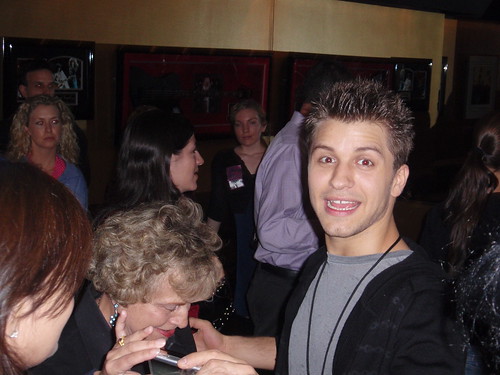
Pasha greeting former student, Elaine, and spotting me!!!
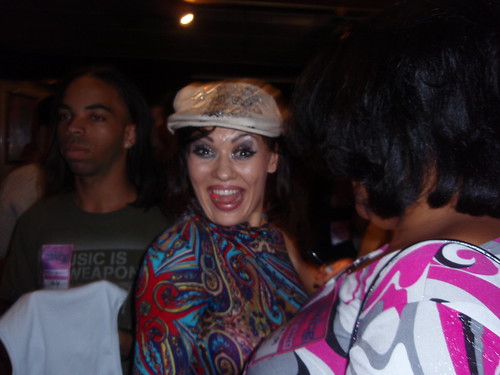
Anya doing the same! (greeting another of Pasha’s former students, Mariana). So many of us 🙂 He sure was popular 🙂
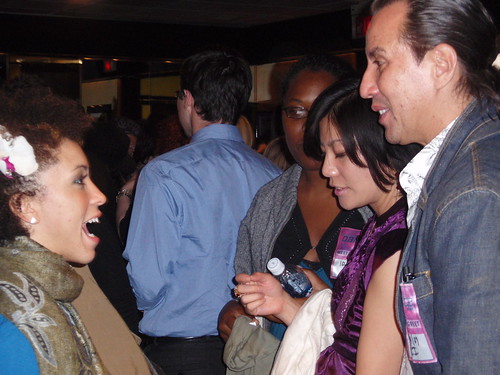
Sabra greeting Tony Meredith.
Dominic and Lacey.
Neil greeting what appear to be friends.
Neil and Lacey performing the Mia Michaels choreography dedicated to her father.
Danny and Neil doing Mia’s “Princes” piece.
Sorry my pictures are so blurry but I was one of the few who actually obeyed orders and turned off my flash. If you’re a dancer and you’re reading this and you’re thinking of trying out for the show, just be assured that if you make it to the end you’re going to be performing amongst bizillions of flashes going off incessantly! It was crazy — it was like a continuous light show in there!
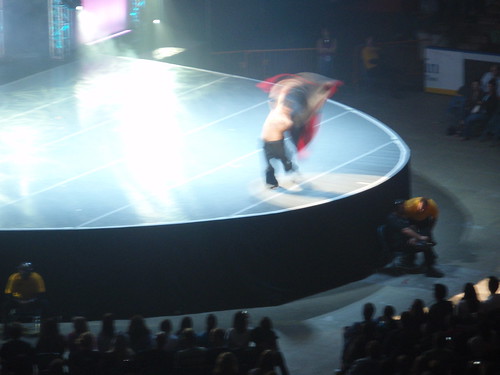
Pasha’s solo. He used a cape this time, no mannequin 🙂
Group number.
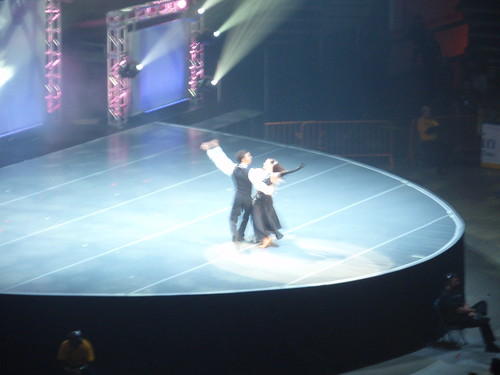
Danny and Anya’s beautiful waltz.
Pasha and Anya’s samba / cha cha.
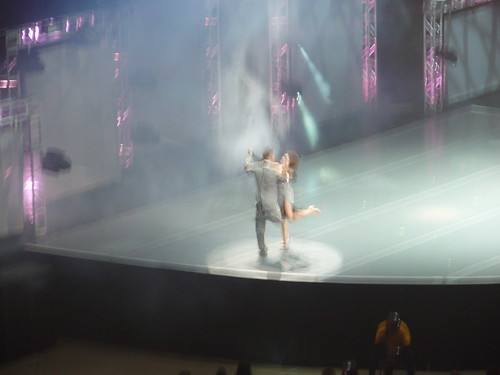
Pasha and Sabra’s quickstep.

Hehhe, going back in time to the beginning of the trip, when we were just boarding the bus to go out to Long Island, this is Steve, a friend of mine from the studio and Anya’s former student, telling me, apropos of my crazy rampage yesterday against poor Claudia LaRocco and dance criticism in the Times (he assures me he reads my blog, just doesn’t comment 🙂 ), that he enjoys The Sun!
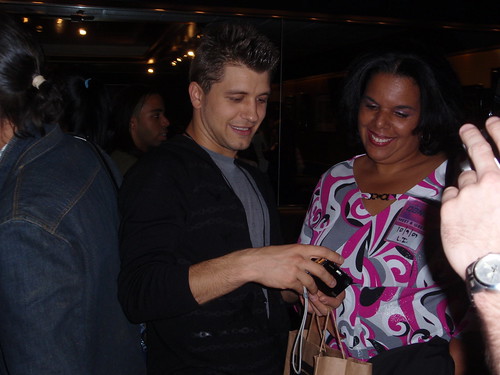
One more of Pasha! Here with former student Mariana. Isn’t he cute!!!!!
Okay, that’s all for now, I have to go to bed. It was a very fun night and I really had a lovely time reuniting with all of my friends from the studio, and of course seeing Pasha and Anya, and of course watching all of these amazing dancers. I am out of my bad mood now 🙂 At least until I read the reviews!!!