Hey everyone,
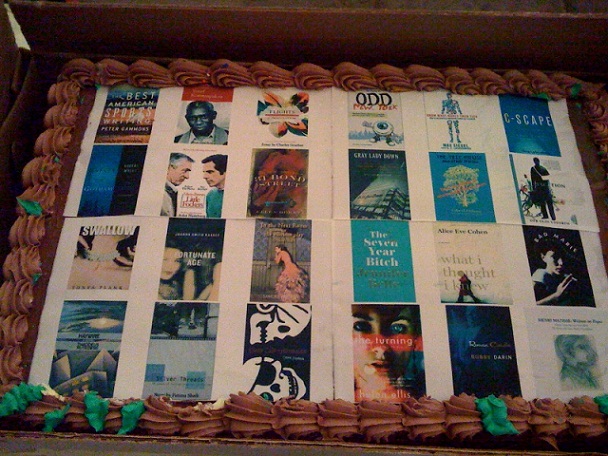
So for this week’s Sample Sunday, I’m putting up the first part of Swallow‘s Chapter 3. This is where Sophie (a lawyer suffering from Globus Hystericus, the feeling of an imaginary ball lodged in your throat) has her first courtroom argument, and where the ball (whom she personifies as “FB”) first causes problems with something other than eating. A fellow student in one of my first writing classes whose writing I greatly admired and opinion I respected (and who now works for the PEN American Center) said this is where Swallow really began to come to life for him. So, here it is.
By the way, I just want to thank you all, and everyone who’s supported my writing – both the book and this blog – over the past year. The book sold a total of 3,232 copies in its first year out there in the world, and I’ve been told that’s fairly decent for a first novel, especially one that’s self-published, and especially one that’s more literary than commercial. So, including the several hundred I’ve given out to readers who’ve won giveaway contests around the blogosphere and to all the wonderful bloggers and professional reviewers who’ve been so kind by reviewing it, there are nearly 4,000 people out there who’ve read (or have at least downloaded) Swallow. I had absolutely no idea what to expect this time last year – and, to be sure, I’m definitely far behind many self-published authors who’ve sold over a hundred thousand in a year – but I’m really overjoyed with the 4000 readers I’ve had – especially since, going by the reviews, a good many of them are liking and getting something out of the book. So once again, thank you thank you thank you!
Okay, here’s the beginning of chapter three:
Three
Not Exactly Audrey
I knew how horribly oral arguments could go from having watched, in preparation for this day, oodles of them given by my colleagues — mostly by my supervisor Jeannie. Jeannie was in her mid thirties, with radiant red hair shimmering half-way down her back, gorgeous green eyes, and, regardless of what she was saying, always sparkled with never-can-fail attitude, though I was realizing more and more that appellate PDs almost always do – fail to win their cases, that is. Well, we were asking the court to reverse the convictions of people who, at least on the record, could sometimes appear rather unsavory. Anyway, the justice presiding on my panel today — grandfatherly Justice O’Grady — absolutely adored Jeannie. After she’d finished an argument once, he’d pronounced with the proudest of grins, “As always from you, Ms. Davis, excellent argument. Well reasoned, persuasively analyzed, and eloquently rendered. And as always, the Court thanks you.”
“You won!” I’d squealed as we left the courthouse.
She’d laughed. “Sophie, you’re so cute. That was actually the kiss of death.”
“Death?”
“Yep. What he really meant was: ‘your client’s an evil crack-head and if you think for one second we’re letting him out to spread more of his poison throughout our fine city, you’d better think again. But don’t you take it personally dear; you did as well as you could for the bastard.’” She’d laughed.
Okay, I’d thought. I guess you can get jaded with this job at some point.
I knew I wouldn’t be able to eat well in the morning regardless of FB. But I had to force myself to eat a little lest I run the possibility of keeling over with hunger pangs at a quite inopportune time. So I set my alarm for extra early to have plenty of time for the ever so melodramatic production of breakfast. I fixed a tiny bowl of Cocoa Pebbles, figuring their size would make them relatively easy, and, being a childhood favorite, soothing to boot. But no such luck: saliva disintegration took just as long and I ingested just as little.
Funny thing about food, I was beginning to realize, is that, when it took me so long to finish, I was just as full after eating only about twenty percent of what I’d usually eat. I remembered my Calcuttan bean-pole of a yoga instructor once telling Francie and me that this was the ideal way to consume in order to achieve healthy digestion, slow metabolism, and that ever-elusive but so highly coveted female goal: low body fat. But when we’d put it to the test afterwards at a Belgian bistro with Croque Madames and Dutch chocolate waffles — and failed ridiculously — we determined that such a feat must require something our American socio-biological make-ups simply lacked. Of course, it could have been our choice of food. Regardless, we resigned ourselves to the fact that gustatory nirvana never would be ours. Hmmm, things seemed to be changing for me every day…
So, the defendant, the subject of my first argument, was this very polite elderly Jamaican immigrant named Joseph White who’d been convicted of drug possession with intent to sell. I didn’t think he was a drug dealer at all, but simply unlucky enough to be in the proverbial wrong place at the wrong time. Police had stormed his daughter’s apartment to search for drugs, and he was sitting on the living room couch talking to his son-in-law, after his grandson, whom he’d come to see, went to bed. The couch was next to a bookcase whose shelves were loaded with small glassines containing “a white rocky substance” and a scale. Yes, someone in that apartment had a lovely little crack business going, but I strongly believed it wasn’t Mr. White.
But the law says he can be convicted of possession with intent to sell just because he was in a room where the contraband was in open view, even though no one saw him so much as touch the stuff and he had a totally innocent reason for being there. I argued in my brief that the search warrant said a confidential informant had been in the apartment three times and saw two black guys in their twenties with long dreadlocks weighing and packaging the crack. That description fits the son-in-law to a T, but certainly not bald, 73-year-old Mr. White. At trial, the defense attorney asked the judge to make the informant testify so he could tell the jury what the people looked like whom he saw. But the judge didn’t want to jeopardize the informant’s identity by making him testify in open court. And his testimony, the judge said, wasn’t necessary since Mr. White could be found guilty of possession just because he was in the same room with the drugs in open view. In my brief, I argued the judge’s ruling was wrong: the jury should have been able to hear from the informant that he saw other men packaging those drugs for sale. I think that would have been crucial information in determining whether Mr. White himself was guilty. He was on trial, after all, not the son-in-law.
I’d had it pounded into me ad nauseam by my colleagues that you’re not supposed to get attached to the client or let yourself feel too strongly for his innocence because you can get too emotionally involved in his plight and get really upset when you lose. Which I understood. But I also felt that there wasn’t much of a point to doing a job you weren’t really compassionate about. And it was hard because Mr. White was the sweetest, most nonviolent man and so not a big-time drug dealer. And I felt like his situation was the result of something a family member did. Like he had any control over whom he associated with by virtue of biology.
Cedric, the doorman of Stephen’s building, was on duty bright and early. He was the strangest-looking man: ghostly pale skin, no eyebrows, and could honestly be anywhere in age from 20 to 55. And he always shot me the nastiest glares — at least I perceived them that way. Nearly made me cry when I’d met him while visiting Stephen one weekend during school, with his slow, full up and down followed by a decidedly disapproving frown delivered straight to my eyes. Of course I was a dowdy backpack-bedraggled student then. But even after I moved in and started wearing more polished business attire, he kept it up. And he always gave Stephen a polite “Mr. Walsh” address, accompanied by a professional nod, but never a greeting for me. Not that I’d want him calling me “Ms. Hegel” though; I’d feel so silly I’d surely laugh. But I could have done without the “dear lord, what troglodyte has moved in and desecrated my building” look.
So, professional and polished though I thought I was, Cedric’s admonishing up and down frown that continued through my entire journey from the elevator, around the lobby corner and out the front glass door, should’ve come as no surprise. But it still unsettled me, as always.
Next to our building was a frame shop. Through the window you could see a huge mirror framed with brilliant gilding, where I often took a quick peek at myself to ensure I wasn’t as hideous as Cedric would have me believe. One of the first things I noticed about New York was that mirrors are everywhere — on the streets, in restaurants, in the lobby of every building. Stephen always said they’re to create the illusion of space, which I’m sure is part of it, but I think they really exist to encourage the vanity that IS this city. Well, fully-acclimated participant in the Vanity Fair was I: I stood squarely in front of the mirror, squinting at myself through the metal bars of the gate still latched securely over the front windows since the shop hadn’t yet opened for the morning. My long brown hair was held neatly behind my ears by a pink silk scarf whose edges daintily brushed my shoulders, evenly-trimmed bangs grazed my big Audrey eyebrows, cat-eyed knock-off Chanel sunglasses looked deceptively posh, tiny pearls on earrings matched those on necklace, scarlet raincoat was as of yet unwrinkled, facial t-zone as of yet un-shiny, pumps as of yet unscuffed. I looked just fine. Cedric could eat it.
I sauntered into the courthouse an hour early. The courtroom doors weren’t open yet, so I darted straight back to the lawyers’ lounge — the supposedly cozy waiting area with couches and the like. Having thought, comfy chairs or not, how much I’d be freaking out when I was here for my first argument, I’d dubbed this the “freak out lounge.” And freaking out I was. I slinked into a couch cushion, unbuckled my briefcase, and began reading my already memorized outline.
Nearly an hour later, the bailiff popped his ruddy face into said “freak-out lounge” to say the courtroom doors were now open and calendar call was in fifteen. I decided to sit in the front row, where I had an ideal preview of which justice would sit in which elephantine black chair, as indicated by their nameplates. I’d seen everyone on this panel before, except newly appointed Justice Adele Parks, who, according to the nameplates, would sit second from left. I began another read-through of my outline, when I saw Jeannie breezing over, all confident smiles.
“Hiya,” she said patting my shoulder. “How ya doin’?”
“Ugh, Okay,” I said rolling my eyes. “Nervous.”
“You’re gonna be great. I know it, you know it,” she laughed, shaking her head at my absurdly over-highlighted outline. “I’m going to sit in back. Pretend I’m not there. You’re gonna knock ’em dead,” she said, giving my shoulder one final pat, before skating off.
“All rise, all rise,” the bailiff cried, and I felt like I was going to lose the few Cocoa Pebbles I ate.
The justices glided in in their flowing black capes. There was wizened Justice O’Grady first, followed by short, bald, angry-looking Justice Boyd, then haggard Justice McKinley, who appeared to have just climbed out of bed, and lastly Parks, the only woman on my panel, who I was hoping would be a liberal, underdog-sympathizing ally, even if her sympathy was for the new, nervous female lawyer. She had batty eyelashes, flowing black hair, a flawlessly lipsticked mouth, and was about fifty years younger than the others.
“People versus Joseph White,” O’Grady hollered before I could even take a breath and brace myself.
I walked to appellant’s podium, careful not to trip over nothing — like my own feet — not because I’m usually clumsy, but weird things seem to happen when I sense a plethora of eyes on me. The Manhattan Assistant District Attorney, ADA Claudia Gromes — a fiftyish woman with grayish brown hair tied into a taut bun, and dressed in a matronly navy suit, approached the podium next to mine, looking very unafraid, very serious, very mature. I hoped I wasn’t too much of a contrast. All butter-fingers, I fumbled a bit with my outline before getting it into position on the podium, then looked to Justice O’Grady for his “Thou Shalt Begin” cue. He nodded.
“May it please the Court.” My voice was shaking but not as badly as I’d expected. “I am Sophie Hegel, from the New York City Public Defender’s Office, and I represent appellant Joseph White.” So far so good.
I began my argument, trying to space my words and look into the justices’ faces, unnerving though they may be. Boyd, whose feet couldn’t reach the floor nor head the headrest, spun around repeatedly in his mammoth chair. McKinley couldn’t curtail continual wide-mouthed, tonsil-revealing yawns. And O’Grady remained face-down, looking into an open notebook, head resting in open palm, a pen in hand, appearing to be completely immersed in a doodle.
I was becoming dejected over how uninterested they seemed in my client’s case when Parks pounced.
“Counselor, a C.I. only need testify if his testimony is pertinent to the ultimate issue in the case.”
Her voice was so loud and authoritative, so final. She seemed to glare at me. I wondered what I’d done.
“Well, here the infor…” I began.
Suddenly I felt him, FB, raising his knuckly little head. This was the first time I’d sensed him when not eating. It confused me.
“Excuse me. I’m sorry,” I said. “Uh, in this case, the informant’s testimony would have been probative of whether other people had dominion and control…” My voice was weakening.
“No, no, counselor,” Parks blasted. “The test is whether the C.I.’s information is probative of the ultimate issue — which is whether your client had constructive possession of the drugs that were found, after all, right in front of him.”
Okay, female judges are not more sympathetic. I succumbed to a stupid stereotype.
“Well, Your Honor…” I said hoarsely, struggling to force words out around FB. “This goes to the ultimate issue, which is appellant’s possession. If others were seen packaging the drugs on other dates, then he didn’t have…” I realized I was talking loudly, but I had to get the words out.
“We’re not talking about other dates. We’re talking about on this date, the date on which your client was arrested, on which date he was found by the police to be within a number of inches from a bookcase containing — containing what? Dostoevsky?” A snicker emanated from the back of Boyd’s chair, which in its current rotation, was presently facing the back of the room. “Shakespeare?” she continued. Laughs now from the courtroom audience. O’Grady’s face sank deeper into his hand, and he shook his snowy head. I felt my face redden. “No. Containing what? Containing five entire shelves of crack, another of empty Ziplocs and a scale. The jury can find your client constructively possessed the drugs by testimony regarding the amount of space between him and the contraband.”
I couldn’t believe she was so hostile, even using sarcasm, in court. I opened my mouth, trying to ignore FB’s pulsing, hoping he’d let me get through this. “Um, well it was…” I was still hoarse. “The testimony was…” I had to get the words out. “RELEVANT,” I unintentionally shouted, “to whether…”
“But counselor, the test isn’t simple RELEVANCY.”
Oh no, the way she highlighted the last word indicated she thought I was challenging her by raising my voice.
“It’s whether it’s PROBATIVE of the ULTIMATE ISSUE,” she continued. “We can’t allow our C.I.s’ confidentialities to be compromised for any little reason. The term ‘confidential’ means something, does it not?”
More stifled laughs from behind me. She was so angry, seemed to take this so personally. And I was becoming the same. Someone’s freedom wasn’t just “any little reason.”
“Yes, Your Honor, but…” I squeaked, sounding like a child’s squeezable doll, which is exactly how I felt.
“Counselor, we have your argument. We’ll take it under advisement. Please be seated,” O’Grady said, now peeking up and looking exhausted.
I knew you weren’t supposed to keep talking after the presiding judge told you to sit. I obeyed, feeling dumb, powerless, and deeply sorry for having botched Mr. White’s case.
“Thank you, Your Honors.” I tried to smile. O’Grady gave me a conclusive nod. I could already see the written decision affirming Mr. White’s conviction, Parks authoring.