Jenifer Ringer Talks About Her Weight on the Today Show

If you guys haven’t seen this yet, Jenifer Ringer was on the Today Show talking about Sir Alastair’s criticism of her weight, her past eating disorder, and the struggle to be thin for ballerinas in general. I hadn’t known, but Natalie Portman lost 20 pounds for Black Swan!

Poor Jared Angle! He hasn’t gotten anything out of this – and he supposedly sampled half the damn Sweet Realm!

Oh also, it’s interesting to look at the comments in the Huffington Post post; quite different from those on Jennifer Edwards’ earlier post in which many commenters supported Macaulay.

Bolshoi’s NUTCRACKER Live-Streamed in Movie Theaters This Sunday


This Sunday, December 19th, the Bolshoi Ballet’s Nutcracker will be live-streamed direct from Moscow into theaters all over the world. In New York, the production will be shown at 11:00 a.m. at the Big Cinemas Manhattan located at 239 E. 59th Street. Check Emerging Pictures Ballet in Cinema website to find a location hopefully near you. If there is no location near you, I noticed there’s a little “request an Emerging Pictures cinema near you” button on the right side of the page. Maybe if there’s enough demand, they’ll get working on striking a deal with one of your local theaters!

Check the Bolshoi’s website for further details on broadcast times in other countries, like France. And see Haglund’s Heel for casting.

I can’t wait – this is the first ballet I’ll see live-streamed!

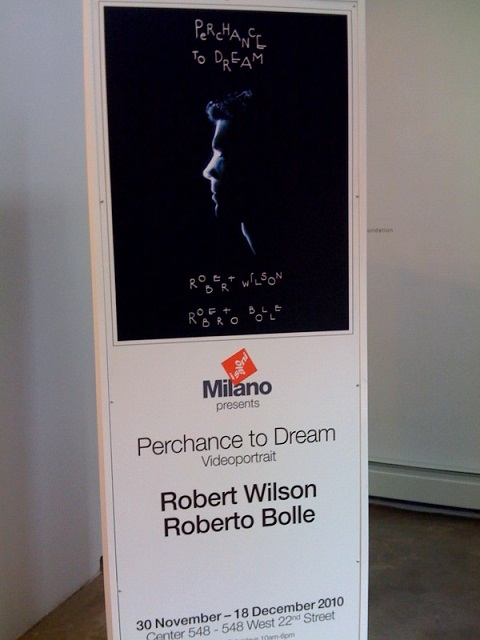
Roberto Bolle & Robert Wilson’s “Perchance to Dream” Scared the Crap Out of Me

My friend, Oberon, told me about this exhibit – a video installation by Robert Wilson showcasing Roberto Bolle, showing at Center 548 in Chelsea, as part of Milano New York Isaloni. So I went to check it out yesterday.

Scared the absolute crap out of me! I don’t really want to say too much or it will ruin the mystery for people who go, but I’ll just say, definitely go see it – I’ve never really seen a gallery exhibit, or even a museum exhibit quite like this before. Just try not to go alone. I think that’s partly why I was so spooked. It’s very dark in there; the first room is lit only by the small amounts of light emanating from some x-ray-like photos of light bulbs.

At the beginning there’s some nice classical music playing, but then the sounds get more ominous, and at points become quite harsh.

The second and fourth rooms really scared me the most – the rooms with three-dimensional art depicting scenes both classical and apocalyptic. Some of the three-dimensional art – well, it just looked too real… I’m not even sure if I saw the entire exhibit because I was just too nervous to go to the very end of the second big room and see if there was anything around the corner. It’s like a dark maze after you enter the first room. I almost couldn’t find my way out. I think if there are more people, though, if would be obvious where the entrances and exits were. As I was exiting, there was an art critic speaking with the curator and the critic said she thought this exhibit was really compelling and should be expanded to a museum, but then said the danger of doing that would be to diminish its mystery precisely because it would be more crowded.

Anyway, another thing that startled me – I kept forgetting it was a video installation because many of the projections looked like still photos … until Bolle would move ever so subtly. It’s like the moving eyes in the portrait effect… And I never realized how doll-like he can look…ย  And, had I not seen Black Swan, there are additional associations I probably would not have made but…

I’ve said too much! Just go see it! I do hope they someday expand it into a larger project.

For now, it’s at Center 548, which is at 548 W. 22nd Street in Chelsea. It’s only showing through December 18th so hurry.

I’m Interviewed at Independent Publisher, Along with Evil Wylie!

I’m interviewed today at Independent Publisher magazine, the people who gave me my IPPY gold medal. This is the first interview where I was asked more detailed questions about how autobiographical the psychosomatic disorder aspect of Swallow was, and so I talked a bit about that. It’s funny because when the writer, Nina L. Diamond, was asking me questions about my own experiences with the disorder and how closely they paralleled Sophie’s experiences with it, I really had to think back. I think when you really get into a novel and you start creating your own characters and filling out the details of their lives and creating situations for them that will increase the conflict and the dramatic tension of the novel and will lead to a fuller arc for both the characters and the overall plot, then you really distance yourself from what actually happened. And then, when asked, you have trouble remembering what actually happened! So, I kind of stuttered a bit on that.

Also in the same issue, Diamond interviews the writer known as Evil Wylie (and also Emperor Franzen). Fun to be in the same issue as he!

Gillian Murphy Critical of “Black Swan”


Apparently, Gillian Murphy gave an interview to the L.A. Times in which she called Black Swan unrepresentative of the ballet world and said she was a little disturbed by its intentionally overdone darkness. She says in her experience the lecherousness of the artistic director is fake (thankfully!) as is the competitiveness within the company, though she admits it’s competitive to get into a big company in the first place. I would have thought it would be competitive within a company as well, but from the time I’ve spent around ABT and NYCB dancers (and from reading their blogs) it does seem that the dancers are very supportive of each other. And the support doesn’t seem false, like it’s forced whenever outsiders are around, but genuine. Look at how everyone came to the support of Jenifer Ringer over Macaulay’s snarky comment about her weight.

But apparently Dancing on My Grave presents another story. Maybe things have really changed since then.

Interestingly the article mistakenly calls Murphy British (as if they’re trying to present her as uppity toward Hollywood). She’s American though, and has never seemed the least bit snobbish, imo.

Above, Gillian with Ethan Stiefel in Swan Lake (as the white swan! ๐Ÿ™‚ ); photo by Fabrizio Ferri, from here.

The Royal Ballet’s Nutcracker


Yesterday I was invited to a pre-screening of a filmed version of the Royal Ballet’s Nutcracker, which will be shown later this month at cinemas in New York and around the country by Emerging Pictures’ Ballet in Cinema series. Check their website for local schedules.

The Royal Ballet version was very good, albeit different from what I’m used to (which, as a New Yorker, is basically Balanchine’s). The Royal’s was directed and choreographed by Peter Wright (after Ivanov), the orchestra conducted by Koen Kessels, and was originally shown at the Royal Opera House in Convent Garden in December 2009.

The biggest difference between this and Balanchine’s is that Clara and the Nutcracker Prince dance all throughout the second half, the Land of the Sweets (here called the Sugar Garden). They participate in the Arabian dance, the Russian dance, the Chinese dance, and the flower dances. The dancer who dances Clara (unfortunately, I don’t have a full cast list and didn’t get her name from the quickly scrolling credits at the end of the film, so I don’t know her name) was older – not a child – and she was a really beautiful dancer. Very fluid, light, willowy, with an innocence in her movement. Very child-like (in a good way, because it was called for here). At first I didn’t like that they danced throughout because I thought at points it almost looked like they were making fun of the various styles of dance. But then I realized, no they weren’t doing that at all; they were playing and having fun, like children would, and like audiences composed heavily of children would want to see them do, and would want to do themselves. The Nutcracker Prince’s name I do have – Steven McRae, and he was very good.

The Sugar Plum Fairy and the Prince were danced brilliantly by Miyako Yoshida and McRae. The ending pas de deux was a traditional one and it was danced just about the best I’ve ever seen it. Yoshida in particular was really stunning. She’s a small dancer but has a lot of power – particularly in her developes –ย  her leg just seems to shoot up there! Her assisted pirouettes and her fouettes done in a diagonal line were also stunning. She’s a fast, spirited dancer with great clarity in her lines, which were never over-extended and which she always finished with zest. But even with all the demanding athletics of that pas, she didn’t turn into an Olympic performance; she remained sweet and princess-like. It was really magical. It’s a performance I could have watched over and over again.

Drosselmeyer, the magician, really blew me away too. He is a main character here – he doesn’t just appear at the beginning to present the toys and give Clara her nutcracker doll; he acts as a guide all throughout the second half, bringing Clara and her prince on a tour through the Sugar Garden, presenting the various national dances to them. He’s clearly in charge of Clara’s dream, although at the end, there’s a little twist on that. You’ll have to see the production to find out what it is ๐Ÿ™‚ And Drosselmeyer was portrayed very well by Gary Avis. It’s not a dance role, but requires a big stage presence and Avis really came through on that. He received lots of applause at the end and took all the curtain calls with all the main dancers.

The only thing I have to say – and this is not at all bad – but did Macaulay ever review dance in the U.K.? He was a theater critic for most of his career there, right? Because if he ever reviewed the Royal, I’d think he would have had to remark on the weight of some of the dancers. Some of them made Jenifer Ringer look like a twig. Not that they danced badly because of it. I think for a while I’m always going to be thinking “hey, she’s bigger than Jenifer Ringer, she’s bigger, she’s way bigger”…

Anyway, if anyone reading this is in the U.K. and / or has seen this production, I’d love to hear your thoughts!

Photo taken from the Ballet in Cinema website.

Sneak Peek of ABT’s New Nutcracker

The Guggenheim just sent me the above video, which is of their Works & Process event a few weeks ago that I’d attended and written about a bit here, featuring excerpts of ABT’s upcoming Nutcracker at BAM. It starts December 22nd – getting excited!

Also, yesterday I attended a screening of the Royal Ballet’s Nutcracker, as part of Emerging Pictures’ Ballet in Cinema High Definition film series in theaters across the country. I’ll write about it soon. They put on a very good, very different Nutcracker!

Alvin Ailey: New Dances and New Productions

Alvin Ailey season is upon us! I attended two performances over the weekend and, of course, they made my weekend. I’m always so happy when I come out of an Alvin Ailey performance. Particularly with their new, 50-dancer Revelations, which I think is only for this year because it marks the dance’s 50th year anniversary. I’ve always thought of this dance as the quintessential American dance, and it’s so stunning seeing the stage completely filled with dancers. For some of the solo sections like “I Wanna Be Ready,” they triple up the number of dancers, and they often use students from the Alvin Ailey School and from the Ailey II company for the larger sections like “Pilgrim of Sorrow” and the “Honor Processional” from “Take Me To the Water.” So, please, if you’re in New York, try to see one of the 50-dancer versions. They’re only showing that production of Revelations on certain dates, so make sure you check the City Center schedule. I hope they consider doing this a few times a season in the future, though, because (expensive as it probably is) it’s really so brilliant.

Also, my new second favorite dance is now Cry. I’ve seen it twice this season, and don’t really know now if I’ve ever seen the whole thing. Maybe I’ve only seen Judith Jamison dance it on video and I’ve seen the individual sections before onstage, never in whole. It was created by Mr. Ailey in 1970 but this is a new production. This year they have three different dancers dancing the three solos. The first solo is set to Alice Coltrane’s “Something About John Coltrane,” and was danced the nights I saw it by Linda Celeste Sims on the first night, and Rachel McLaren on the second. They were equally spellbinding. This section, to me, is very powerful, the movement is very modern, with lots of sharp staccato movements meant to convey strife and longing and fear and a whole host of emotions – along with clever, ironic uses of a towel-like sheet – and it requires very powerful dancers.

The second section, the adagio set to Laura Nyro’s “Been on a Train,” which often nearly brings me to tears, was danced both nights by Constance Stamatiou, who is really growing on me this season. She’s a really beautiful, very “womanly” dancer, and she is really growing to have a great stage presence.

The third section, the more rhythmic African section, set to the Voices of East Harlem’s “Right On, Be Free,” was danced both nights by Briana Reed, who’s always been one of my favorite dancers in the company. She was out of most last season and I’m so glad she’s back. Mr. Ailey dedicated this dance to “all Black women everywhere – especially our mothers.” I love how it begins with a powerful evocation of oppression and ends with a celebration of African roots. I hope they perform it every season.

The two new dances I’ve seen so far (there are many to come in the next few weeks), are Christopher Huggins’s Anoited (which is a world premiere this season), and incoming artistic director Robert Battle’s The Hunt (which is new for Alvin Ailey this season).

The Hunt is great fun! I loved it. I could see that one every night, just like Revelations. All six dancers are men and it depicts, as the name implies, the rituals involved in preparation for a hunt. It conveys how physically and mentally grueling the hunt will be as a test the men’s limits, and it also showcases the athletic power of Ailey’s male dancers. And the music is mad fun! It’s Les Tamours du Bronx, wildly percussive, so much fun! I joked on Twitter that I needed to get it for a workout tape. Seriously!

It’s certainly a male moment in dance! This dance received loads of applause and a full-audience standing ovation. In Revelations, which followed, “Sinner Man” then received huge whoops and hollers from the crowd. As they should have. But the women of Cry deserved a full-audience standing ovation too! Not fair!

Christopher Huggins’s Anoited is really beautiful. Huggins is a former member of Ailey and this dance is a tribute to the leaders of the company, both past and present. The first section is a really lovely duet by Jamar Roberts and Linda Celeste Sims, with the two meant to depict Alvin Ailey and Judith Jamison.

Over the music we hear Jamison’s words to Ailey, when he told her he was sick and asked her whether she would take over the company. “And I said, ‘Of course!'” she repeats many times. At the end of the duet, he lies down, and she sadly kneels over his body. These two dancers are perfect to represent Ailey and Jamison. If this company does have a “star” right now it’s Linda Celeste Sims, and Jamar Roberts, with his physicality and stage presence is larger than life.

In the second section, set to more percussive music by Sean Clements, Jamison is joined by four other women known for keeping Ailey’s legacy alive over time: Sylvia Waters (director of Ailey II), Denise Jefferson (director of the Ailey School, who recently passed away), Nasha Thomas Schmitt (director of Ailey’s arts in education program), and Ana Maria Forsythe (director of the Ailey / Fordham BFA program). The women are all dressed in celebratory purple and they dance a rhythmic, high-charged African / modern combo.

In the third and final section, entitled “52 and Counting,” the dancers all come together and are joined by others, all dressed in red. They dance to a fast-paced beat, sometimes in ensemble, and breaking into duets replete with thrilling lifts. It reminded me a bit of the second section of Love Stories, or of Tharp’s The Golden Section and it stood for me as a celebration of some of the more contemporary pieces the company is known for. Amidst all this, the figures of Alvin Ailey and Judith Jamison return, and perform another beautiful lift-heavy duet, this time with Roberts dressed in white.

I’ll write more as the season continues. As I said there are many more premieres to come (check out City Center’s website for the schedule). For now, I’m off to a Nutcracker by the Royal Ballet. I love the diversity of dance ๐Ÿ™‚

All photos from AlvinAiley.org. Top photo by Christopher Duggan; all other photos by Paul Kolnik.

My Take on BLACK SWAN


I saw it over the weekend. Overall, I thought it was hilarious. Totally campy and just plain funny. Way too silly to be scary though. And I think Aronofksy was going for both. So, to me, it failed to that extent. But it may have just been me. Maybe I just have a dark sense of humor, because I went with two friends – one a ballet fan of the Gelsey Kirkland era, the other not. They both loved it and were on the edge of their seats throughout, although they also laughed quite a bit (particularly Gelsey Kirkland friend). Gelsey Kirkland friend said it reminded him of Dancing on My Grave. I must read that! I don’t know why I haven’t yet…

Anyway, so if you don’t know the story, it’s about this young ballerina who dances with a New York City ballet company housed in the Koch Theater. The artistic director (played by Vincent Cassel) is basically Peter Martins but with brown hair and a French accent.ย  Peter Martins guy tells the company that they are doing a new production of Swan Lake and to attract new audiences, they are going to cast a brand new ballerina, a new face. The old prima, Winona Ryder, is approaching menopause anyway. Never mind that she looks the same age she did in Reality Bites, at least to me. Apparently this company doesn’t have a system of principals and corps members because no one has any idea who the new face is going to be.

Peter Martins guy soon reveals that he favors Nina (Portman), but thinks she can only do the White Swan. He thinks she’ll have trouble with the Black Swan (he never uses the names Odette and Odile, which I know annoyed some ballet fans on Twitter, but I think it would have alienated non-ballet audiences had he used those names). He tries to seduce her (literally) in the name of getting her into the character of the Black Swan, which of course in the film is characterized as a sinister, conniving slut. But maybe he goes too far and unleashes the inner beast in Nina. She suddenly seems hell-bent on destroying herself (and she’s had problems in the past with self-mutilation and, it’s hinted at, anorexia). Or, maybe it’s that a new dancer from San Francisco (Mila Kunis) is trying to destroy her in order to take her place as the lead. My biggest problem with the movie is that it’s billed as a thriller but we never really find out the answer to that question. At the end, you’re still left wondering WFT was that about??? I mean, you’re left wondering that with many David Lynch films too, but with those, if you think long and hard enough, you can piece it all together. This, I don’t think so. I think it was just meant to be scary, sexy, creepy, gory camp.

For serious ballet fans, you have to suspend disbelief. Natalie Portman I thought did an excellent acting job, and her dancing is very very good for someone with very little training. I know Sarah Lane was supposedly her double, but you never really see any stunning dancing. The camera mostly focuses on Portman’s arms – and Benjamin Millepied did say he focused on the port de bras when training her and Kunis because you just can’t teach someone with no training to go on pointe and do the fouettes and pirouettes and all. So, you simply have to suspend disbelief that someone at Nina’s level would land the lead in the first place. And if you’re looking for thrilling dancing – the fouettes, the lightening-speed chaine turns, a beautiful pas de deux, etc., you’re not going to get it.

When we were all walking out, I did hear a couple people say now they wanted to see Swan Lake. Of course I hope it renews interest in the ballet, but it does worry me a bit that people will be disappointed, because the film makes it seem like the black swan pas de deux is a sex scene. The Peter Martins character keeps yelling at Nina to “seduce me, seduce me!” During a break he rhetorically asks Millepied (playing the role of Siegfried) if he would ever sleep with Nina (except he termed it differently). No one in the audience laughed but me. What am I the only New Yorker who reads the tabloids??? But in the ballet, the ballerina seduces both Siegfried and the audience with her allegro dancing, with her athletics. It’s more dance than theater; the seduction is in the dancing not the acting.

The whole thing had a Valley of the Dolls feel to it. Barbara Hershey is Portman’s mother, and she seems a bit off herself. You sometimes wonder if the mother (who never made it out of the corps, and who left ballet to have Nina) is trying to sabotage her daughter as well. There are some really funny (though I’m not sure if they were meant to be) screaming screeching cat-fight scenes between the two of them. But I think the funniest are between Winona Ryder as the aging ballet star forced into retirement and Nina, particularly those involving discussions of how to get ahead in the ballet company (guess; not by great dancing)… I miss Winona Ryder. I miss movies like Heathers

Anyway, I still don’t know how to feel about this movie. I’m happy that it’s put ballet on people’s minds again, but how misleading is it to what an actual ballet performance is all about? What do you guys think? It seems to have received fairly good reviews from the film critics.

Does a Ballerina’s Weight Affect the Quality of a Performance?


So, if you haven’t heard, the New York dance world is all up in arms over NY Times chief dance critic Alastair Macaulay’s review of New York City Ballet’s Nutcracker. The full review, which is here, I think is generally pretty good. But then he begins his concluding paragraph with this:

“This didnโ€™t feel, however, like an opening night. Jenifer Ringer, as the Sugar Plum Fairy, looked as if sheโ€™d eaten one sugar plum too many; and Jared Angle, as the Cavalier, seems to have been sampling half the Sweet realm. They’re among the few City Ballet principals that dance like adults, but without adult depth or complexity.” (Ringer and Angle are pictured above, in that production. Photo by Paul Kolnik.)

Angry reactions have abounded: here are a couple on Huffington Post. In the second piece, Jennifer Edwards, quoting critic Eva Yaa Asantewaa (a friend of mine), notes that Ringer has had an eating disorder in the past and argues that this sentence was disrespectful, reckless, and irrelevant. Edwards also quotes an earlier reflection of Macaulay’s on his role as dance critic:

“My job is to be a professional aesthete with serious criteria; and I share my perceptions and my values with the reader as best I can.โ€

Edwards concludes by posing two questions:

“1. Do you read the Times dance reviews? Has this changed over time?

2. Do you feel reviews of this nature are of use to venues, arts organizations, audience members, aspiring young dancers, and artists?”

I wrote a little comment on HuffPo but thought I’d elaborate a bit here because I think it’s an interesting, and complicated, issue.

I definitely don’t think a dancer’s weight affects the quality of a performance unless the dancer really can’t dance. I’ve seen Ringer dance pretty recently and she is a tiny thing with no weight problem whatsoever. I didn’t see this performance but I’ve always thought she was technically a very good dancer with a lot of charisma, particularly in roles like the one Melissa Barak recently gave her where she can act as well as dance. And I think Jared Angle is one of the best male partners – if not THE best – City Ballet has.ย  I think Macaulay just wanted to be snarky – that’s part of his critic’s voice. I think he thinks he’s being funny. Maybe snark and sarcasm in critical reviews are partly a British thing? I see a lot of it though in reviews these days.

I think Macaulay knows a lot about dance history and I get the most out of his reviews when he focuses on that – on the history of a production, how this compares to others’ or past productions, the history of the performers, the artists, etc. I generally like his Nutcracker review, most of which focuses on Balanchine’s unique take on Tchaikovsky. The serious parts of it are very illuminating and show why this production is important and thus why a reader of his review might want to go see it. So the snarky part about Ringer’s weight seems really out of place. I actually re-read the sentence and that directly following it a few times, thinking maybe he meant that Ringer and Angle were dizzy, dancing with childish abandon when they usually dance like adults. But, no, I think he has to mean that they were both plumper than usual – the same as everyone else’s interpretation.

In response to Edwards’s question 1 above: I do remember former chief critic John Rockwell making references to dancers’ bodies, albeit not with the same snarky voice. In particular I remember him likening Marcelo Gomes’s legs to “tree trunks,” which offended some dance-goers. But it also seemed that he really loved Gomes and he’d lauded his dancing in the same review. So then it didn’t seem like he was making a value judgment, just a description.

It is tricky, because it’s hard not to talk about bodies since they’re kind of inherent in this art form. I offended readers (mainly on Facebook) once in my review of Burn the Floor on Broadway by saying that the tiny Broadway stage looked way too crowded during the ensemble numbers with all of those dancers and the band sharing it. I said it looked particularly crowded when Maks Chmerkovskiy and Karina Smirnoff were the leads, as opposed to Pasha Kovalev and Anya Garnis, since the former two – Maks in particular – were so large. I didn’t at all mean it as a criticism of him, but of the staging (and I suggested they take the band off of the stage, like in Tharp’s Movin’ Out). And, everyone who’s read my blog for any length of time knows that I often prefer larger dancers (Veronika Part, Marcelo, Roberto Bolle, Vaidotas Skimelis – come on!) But I was still attacked and even told if I didn’t remove it, those people would never read my blog again.

Also, sometimes a partnership just doesn’t work right when one dancer is too large for the other. Sometimes certain movement, certain styles look better on one dancer because of that dancer’s physique. I think those are valid criteria for judging the quality of a performance. But it can still get out of control – as in So You Think You Can Dance when the judges just start talking about the dancers’ bodies. How many times did they have to remark on Josh Allen’s butt? I always felt embarrassed for the whole show whenever that happened but everyone else seemed to think it was funny. But of course New York Times is not a corny TV show.

What is the purpose of a newspaper review anyway? To let your audience know from your educated perspective what is good and bad about a performance, and whether or not they should spend their money and go see it. I don’t really like Edwards’s second question because I don’t think the purpose of a review is to be of use to venues, artists, aspiring dancers, and arts organizations. The critic’s duty is to his readership – a general audience of potential dance-goers trying to decide whether to spend their money on a certain show. The critic has to be honest about what she thinks did and didn’t work in the show and why. And I also think for the presumably well-educated NY Times audience it’s nice when the critic goes into the history of a production, of a dance, the way Macaulay often does. But the critic can’t be protecting the artist from hurt and also serving his readership of potential dance-goers. Otherwise, he’s going to end up lying to someone.

Which gets back to the issue of whether a dancer’s weight gain or loss is a serious criterion in judging the quality of a performance. I think it’s ridiculous that someone would think it is, but what do you guys think? Why are we, as a culture, so hung up on weight anyway? People are always criticizing certain dancers for being too thin as well…

Happy Belated Thanksgiving from North Carolina

So I went to North Carolina to visit my mom and cousin for Thanksgiving. I really needed to get out of New York for a while, as I’ve been developing a real love / hate relationship with the city for the past few years now. My second novel, which I’m trying desperately to finish right now, is also set here, like my first, and I need to be here to do research. But I also derive much of my inspiration from this crazy place – from the people, the neighborhoods, the culture, the art, the public places, the landscape, the architecture, the history. I don’t think I can ever really leave it. Yet, it’s so hard to work here with all the noise (which prevents both sleep and, at times, access to your own mind), the total lack of privacy, the constant over-stimulation. Not to mention the expense, which I now feel the weight of so much more than when I had a full-time law job. So, I don’t know. Maybe someday I really will move to San Francisco or L.A. or Miami where things are more low-key (and warm!) Or maybe I’ll just keep taking short trips.

Anyway, here are some photos of my much-needed trip to N.C. Very small town, very quiet, very peaceful, very relaxing.

Country road.

Local church.

Small restaurant in the small downtown area. It was the only place I could find open the day after Thanksgiving. There were just enough people there for it to be interesting without being uncomfortably overcrowded.

Katy. Once a farm cat, she’s become an indoor kitty since moving out of the country and into town. She’s very sweet but she always refuses to look into the camera when getting her photo taken.

…unlike my cousin’s cute little parakeet.

Cat and bird seemed to get along quite nicely. At least that’s what kitty led me to believe… Twice when the bird flew off his perch to have some birdfeed, I found kitty suddenly sitting up all alert and ready to pounce…

My favorite little mall in Durham, built out of old tobacco warehouses, and which houses one of my favorite rare and used bookstores, Wentworth & Leggett.

Where I found an early edition of one of my favorite books.

Thanksgiving dessert: pumpkin cheesecake!