Just letting everyone know I was able to reduce the price of the paperback version of Swallow to $9.99 on Amazon. The price of the ebook is still 99 cents; Amazon and Kobo have it discounted to $.89. I intend to raise the ebook price after the beginning of the year though. But I will probably keep the price of the paperback as low as I can for a while. I know not everyone has, or likes to read with, an ereader 🙂
Thank you again for all of your tremendous support you guys!
Here is the link to the Kindle edition (above is the paperback version):
According to this UK article, Carlos Moore, the only official biographer of Fela Kuti, is suing Bill T. Jones and Fela! playwright Jim Lewis for $5 million for basing the highly successful Broadway musical (that’s set to open on London’s West End on November 16th) on his book without properly crediting it, and by buying the rights to the book for only $4,000, which he considers “grossly insufficient.” Moore also claims the show was made without his “knowledge, authorisation, or consent.”
But if they bought the rights… ? I don’t know; will be interesting to see how it plays out in court, though it’ll probably settle outside. Will also be interesting to see what the Brits think of the show.
Here are a couple of pix of Roberto Bolle with Italian model Mariacarla Boscono in HerculesMagazine. See more from the spread here. Photos by Paola Kudacki.
Okay, I don’t want any of them to go home right now. I really like everyone who’s still on the show at this point and I want to them all to advance to the finals. I know, it’s impossible.
So, tonight was divided into two rounds: the classical standard round, then the new “instant dance” round, by which the couples are given their music minutes before they dance. Len explains that this is what an actual ballroom competition is like. Not in any competition I know of. True, they play generic music with the proper beat in the individual dance sections, but in those competitions you’re only competing in technique, not so much performance quality. I mean, those dances are not showdance – choreographed, cabaret-style performances set to certain music with certain lyrics – you know? They’re dances where you’re exhibiting your mastery of technique. So, I don’t know exactly what he’s talking about.
Anyway, on to the first round:
I thought Kyle and Lacey’s Viennese Waltz was really lovely. He is turning into a real ballroom dancer. His technique was excellent, his posture and carriage were elegant, he was graceful, and he really glided around the floor. I agree with Carrie Ann: “It was like a fairy tale come to life.”
They draw “Good Golly Miss Molly” for their “instant dance” which is a jive. So, now they have 45 minutes to prepare, and off they go to create their insta showdance.
Jennifer and Derek dance a Quickstep. Jennifer’s knee begins hurting in practice and the show’s doctor tells her she has severe tendinitis with serious inflammation. He tells her she needs to think about whether she wants to continue dancing or risk further injury to the tendon. Then her father, Joel Grey – awwww, so sweet – comes on and tells her simply, the show must go on. And on she goes.
And what a beautiful Quickstep! As perfect as perfect can be in my opinion. And I love her dress with the feathery pleats on the lower half of the skirt. And wow, Derek honestly looked like a real Fred Astaire. He did so well with that solo. I don’t think I’ve ever enjoyed watching him dance so much!
She draws “Waiting for a Girl Like You” by Foreigner for her instant dance. She’s never heard of it! Haha!
Above is a video of U.S. Latin champions Riccardo Cocchi and Yulia Zagoruychenko dancing recently in Tokyo at the World Superstars Latin Dance Festival. This is an annual festival (there’s one for standard ballroom as well), where the top Latin and ballroom dancers are invited to perform a showdance in each style. I’ve always wanted to go, but have never been able to. I’ve heard it’s prohibitively expensive! But I almost always buy the DVDs of the performances (they’re usually available from DanceVision), which come out a couple weeks later.
According to this write up, the Latin performers this year included, in addition to Riccardo and Yulia, my favorites Sergey Surkov and Melia, and Slavik Kryklyvyy and Anna Melnikova, as well as current world champs Michael Malitowski and Joanna Leunis. Some year I must go!
So, American Ballet Theater performed at the Karl Marx Theater in Havana, Cuba, as part of the Havana International Ballet Festival, this Wednesday and Thursday. This is the first time ABT has performed in Cuba since 1960 when diplomatic relations between the U.S. and Castro began to break down. They honored Alicia Alonso who danced with the company in the 1950s and 60s and whose 90 birthday is coming up, on December 21st. Apparently, she came out onstage and took a bow.
Unlike ABT’s historic trip to Beijing last year, this one has received a lot of coverage, both in the press and in some blogs. In addition to the Reuters article, here are some others:
My friend Erin Gilbreth recently started her own theater company here in New York called American Bard Theater Company. They specialize in putting on Shakespeare plays. Tonight, they open Measure For Measure at the Roy Arias Theater Center on 43rd Street. See their website for more info. And watch the promo video below. So excited!
The ballroom dancer I was raving about earlier on seeing a few video clips of his dancing has wonSo You Think You Can Dance Canada‘s season three. Thank you to “Twirly” for letting me know by commenting on my prior post! Still so annoyed we don’t get the show here… I do hope he tours the US at some point. I would really love to see him dance live.
Congratulations, Mr. Drozdyuk! And congratulations, ballroom world 🙂
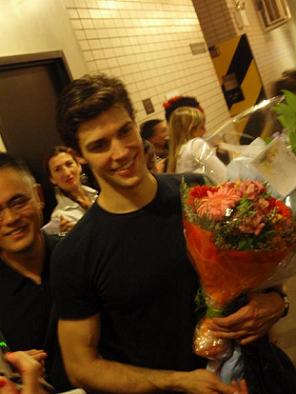
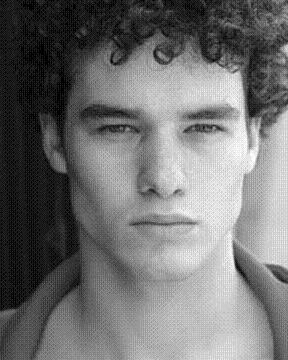
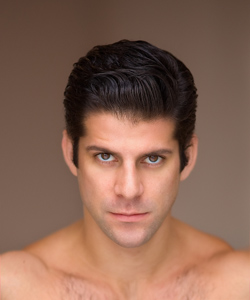
Haha, I don’t even think this book has been optioned yet for film! It should be though – it’s very cinematic. All throughout reading it, I kept “seeing” Romeo – and always as one of my favorite male dancers who’s danced the role. Roberto (top left) is of course the natural choice since he’s Italian and the book’s set largely in Italy. But I feel he may not have enough of the delicious cockiness in him; Roberto’s too nice, at least onstage. Ditto for Cory (top right). Marcelo of course would probably be best … although I don’t know if he has acting skills required for a speaking role in a film. He’s definitely a good stage dancer/actor.
I’m being goofy. I’m sure they would cast Andrew Garfield or Louis Garrel or someone.
Anyway, Anne Fortier’s Juliet, which I recently finished, is a really interesting read, especially for fans of Kenneth MacMillan, and I guess … Shakespeare 🙂
It’s part historical fiction, part romance, and part mystery / suspense and it shifts back and forth between the present day and the Siena, Italy of 1340, when the two people Shakespeare based his characters on – Romeo Marescotti and Giulietta Tomolei – actually lived. Of course in Shakespeare’s version, the lovers were from Verona, but according to this book, early stories – and there were many tales of Romeo and Juliet; Shakespeare’s was only one of many – had all the action happen in Siena.
The novel starts when 24-year-old American Julie Jacobs receives an inheritance after the death of her great aunt Rose, who raised her after her mother and father were suspiciously killed when she was a child. The inheritance is simply a key to a safe deposit box in Siena, which her mother had originally left with the aunt. Julie is told by her aunt’s butler and his lawyer that it contains a treasure, which she must go to Italy to find. So she sets off for Siena. There she encounters other, less savory types, who are equally interested in her treasure, and so begins the suspense part of the novel.
Julie soon discovers that at the time her mother died, she’d been researching the history of Romeo and Juliet, or Romeo and Giulietta. Julie’s mother’s last name was Tolomei, and it turns out Julie is related to the original Giulietta. I don’t want to give too much away, but the contemporary part of the story consists of the suspense and romance of finding the treasure – which is related to R&J – as well finding Romeo’s descendant.
Julie finds in her mother’s belongings in Italy the earliest version of the story of Romeo and Giulietta, and her reading of that accounts for the historical half of the novel, which was the most compelling and poignant to me. It’s different from the version we all know through Shakespeare. The warring families are the Tolomeis and the Salimbenis, with the Salimbenis being far more vicious and far more financially powerful. At the beginning of the historical story, the Salimbenis have just raided Giulietta’s house and murdered everyone but her. (She was in church at the time.) In a nutshell, Friar Lorenzo is able to sneak Giulietta out to her uncle Tolomei’s estate. Romeo, who is a Marescotti – a historically highly respected military family with connections to Charlemagne but who currently has no financial power – is a hopeless playboy. But once he sets eyes on Giulietta’s portrait, while he is having his own Marescotti-family portrait done, he is in love.
The artist tells Romeo that Giulietta resides at the Tolomei castle. He goes to a ball there in search of her, finds her (she’s a Helen of Troy type and stands far out from the crowd), and follows her into her chamber. She’s still traumatized by what’s happened to her family and so is immune to his flirting. She does tell him though that he can have anything he wants from her if he brings her the heart (or was it the head?…) of the master of the Salimbeni family, who ordered the execution. Romeo’s a bit taken aback, but tells her he’ll do anything.
The next day Friar Lorenzo brings Giulietta to the Marescotti estate and she tells Romeo she doesn’t know what came over her the other day to ask such violence of him; she doesn’t want him to get hurt. He kind of plays with her a bit, she softens, and over the course of this and several other meetings, they fall in love.
Romeo talks his father into asking Tolomei for her hand in marriage. For Romeo I mean. The father is reluctant because he doesn’t want to be seen as “getting involved” in the Tolomei / Salimbeni feud. But seeing how in love his son is, he agrees.
But just as he goes to approach Tolomei that night, old Salimbeni, smitten with Giulietta whom he spies in the distance, reveals that he wants her for himself. This will end the violence between the families once and for all, he claims. The whole crowd gasps, since Salimbeni is old enough practically to be her grandfather, not to mention married (although everyone also knows his wife will soon be dead, as he is starving her, as he’s done to prior wives… Medieval society must have been so lovely…) Of course Tolomei has no choice but to say yes – the Salimbenis are far more powerful – both physically and financially. Saying no to Salimbeni would be family suicide.
Poor Giulietta nearly collapses upon hearing she’s to be the wife of the man who slaughtered her family, and she begs Tolomei not to let the marriage happen. Tolomei refuses. Romeo declares that he will beat Nico, Salimbeni’s son, in the Palio (a Medieval-style horse race that continues to this day), and, if he does, he will win Giulietta’s hand.
At the Palio the following day, Romeo does win, but during the course of the race, Nico kills Tebaldo, Tolomei’s son, but with Romeo’s dagger, making it look like Romeo is the murderer. This is how Romeo gets banished. Although Romeo sneaks back to town with Friar Lorenzo and marries Giulietta in the back of the church where she is at worship, Salimbeni finds them and, well, things don’t go too well for Romeo… Salimbeni’s wife finally starves and he marries Giulietta, then keeps her a prisoner in his country castle.
I should stop there! But the story goes on and there are all kinds of twists and turns. It’s a fascinating narrative and you can see all the same – or many of the same – elements Shakespeare included. But the theme in Shakespeare is the warring families or factions, gangs, what have you – and how innocent individuals get unfairly, tragically caught up in the fighting. In the original, it’s more about the viciousness of one evil, all-powerful man. I found it interesting to see how a great writer manipulated facts to craft a story with themes that would reach far beyond the time and place in which the story was set. I mean, Shakespeare’s version also contained beautiful poetry of course, but his basic story is more powerful and far-reaching than the original. The original does give you a sense of how violent and how absolutely awful Medieval society was for women though.
Anyway, the novel’s very good – at least the historical part. I highly recommend it for that. The contemporary part is cute romance-wise, and definitely suspenseful, but in my opinion not nearly as powerful from a literary perspective as the historical.
Funny, I didn’t really think of who would play Julie / Giulietta. Diana Vishneva or Veronika Part would be good – she has to be Helen of Troy beautiful! But they both have Russian accents and I don’t know if that would work… Hmmm, who else?…
(Photos above, clockwise from top left: Roberto Bolle, taken by me; Cory Stearns, from ABT’s website; and Marcelo Gomes, from ABT’s website.)
Here’s an addendum to my earlier post on Emerging Pictures’ exciting new Ballet in Cinema series.
All of the showings on the schedule I posted are at the BIG Manhattan Cinema except for the December 19th Nutcracker, performed by the Bolshoi. That one is at the Kew Gardens Cinema in Queens.
There is one additional performance:
The Nutcracker, performed by the Royal Ballet, December 26th, 3:00 p.m., at Symphony Space (this one is recorded).
For other performances in the series, and for people outside of New York, you can consult the Ballet in Cinema website for further showings. You can search for showings by typing in your zip code. I am told you should check the website frequently as it is updated often.
I’m very excited about this, as you can probably tell 🙂 The Metropolitan Opera has been very successful with their in-cinema showings, really brought opera to younger audiences by making it more affordable and engaging in this way, and has increased opera’s popularity. I hope this series will do the same for ballet.
Yesterday I was walking along 65th Street and, maybe I just haven’t walked down 65th Street in a while, but I just noticed on the side of the street across from Juilliard, they now have these little two-sided block panels. On one side, they have an advertisement for something going on at Lincoln Center – an opera, a symphony, a ballet, but on the other, they have brief moving pictures. One set is of dancers warming up, another of musicians. One is of waiters who decide to break-dance out on the sidewalk. There’s no sound, but they’re fun just to watch. And the street is lined with benches so you can sit and stay for a while.
It felt a bit like Paris to me 🙂
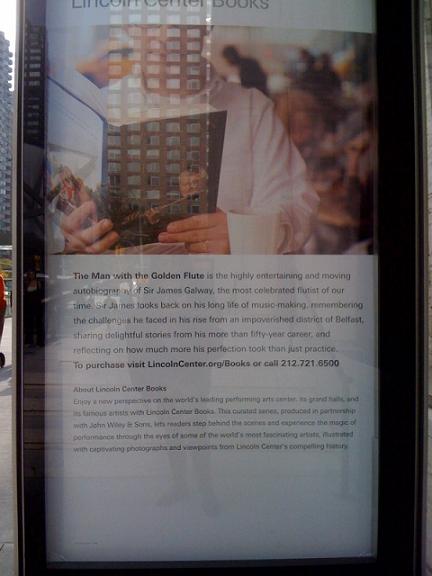
I also noticed a poster (below) on the Broadway side of Lincoln Center, advertising Lincoln Center Books. Sorry my photo isn’t so good – the sun was in my eyes!
Apparently Lincoln Center and publisher John Wiley & Sons, Inc. have entered into a joint venture to publish books of importance to Lincoln Center and its patrons. The books will bear both brand names.
This book – The Man with the Golden Flute – is the autobiography of Sir James Galway, an eminent flutist from Belfast.
They have several on their list. You can search the list on their website.
New York City Center’s Studio 5 will open its 2010-11 season on November 9th with a performance and discussion of three Balanchine ballets that are celebrating their 50th anniversary this year. Four New York City Ballet dancers (Tiler Peck, Joaquin De Luz, Jenifer Ringer and Jared Angle) will perform Tchaikovsky Pas de Deux, Donizetti Variations, and Liebeslieder Walzer, and Damian Woetzel and Violette Verdy (who danced in the original productions) will discuss. Verdy will also coach the dancers.
Later performance/discussions this season will center on Paul Taylor Dance Company and Dance Theater of Harlem. Click on link below to read the full press release.