PATTI LUPONE WILL MAKE NEW YORK CITY BALLET DEBUT NEXT YEAR


According to Playbill, Broadway legend Patti LuPone will make her NYCB debut next year, in the company’s Spring 2011 season. She’ll act in a new production, by Lynne Taylor-Corbett, of The Seven Deadly Sins, a Kurt Weill ballet with libretto by Bertolt Brecht. Balanchine choreographed the original version of that ballet, which is about a character depicted both by an actress and a dancer.

I’ve never seen the ballet but I love LuPone. Something definitely to look forward to. For a little more about the history of that ballet, see the NYTimes ArtsBeat blog’s post.

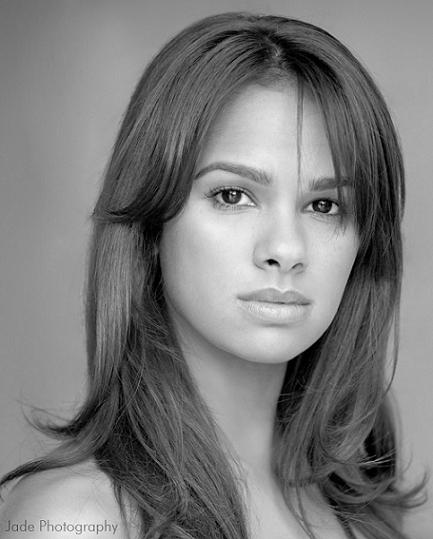
Above image of LuPone in Gypsy, taken from PaperMag.

HELP, ALICIA ALONSO IS FLYING THIS PLANE!


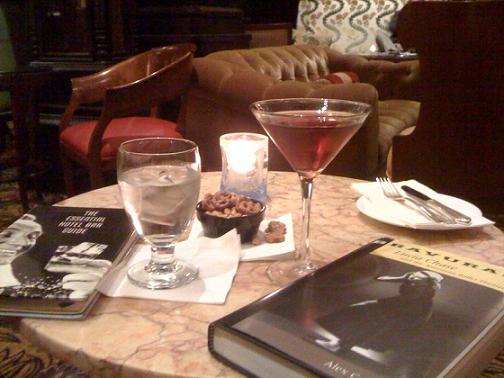
I’ve been reading this book, which was given to me by the publicist for purposes of review. It’s by Alex Ewing, about his mother, Lucia Chase, who basically founded what is now American Ballet Theater.

I’m about halfway through it now (I tend to read non-fiction a lot more slowly than fiction) and it’s very informative and very entertaining in places. I thought this following passage was particularly amusing. It’s 1950 and ABT (then called Ballet Theatre) is embarking on its first European tour when, unexpectedly, the Korean War breaks out, making a mess of, amongst other things, international travel:

“…Although the Air Force had officially agreed to provide the transatlantic travel, suddenly all government planes were diverted to the Pacific. The company took off instead on a commercial flight to Brussels, then proceeded on to Frankfurt where army buses transported them to Wiesbaden for their first performances. When it came time a few days later to fly behind the Iron Curtain to Berlin, an outpost city occupied by the four Allied powers, the approach into Tempelhof Airport had to be made through ‘the corridor,’ a narrow strip between Russian gun emplacements. The Russian government, in order to prevent spying on the surrounding sector that it controlled, required all arriving flights to come in at frighteningly low altitude, and the dancers were told to don heavy parachutes for the flight into Berlin.

“As recounted by Charles Payne, then editor and publisher of the Ballet Theatre Annual, the company was flown ‘in a transport plane equipped with bucket seats suspended from the inner walls, with parachute tracks leading to the escape hatches.’ Understandably, everything was much less formal than a standard commercial flight. The pilot even invited the dancers to visit the cockpit a few at a time, and at one point Nora Kaye emerged from up front, greenish-white in the face, to scream back at the others, ‘Do you know who’s flying this plane? Alicia Alonso! Do something about it!'”

Can you imagine?!

The great Alicia Alonso is turning 90 this year and ABT will honor her during the Met season, on June 3rd. ABT turns 70 this year. Image of Alonso above taken from here.

JEWELS


Janie Taylor and Benjamin Millepied in “Rubies.” All photos are by Paul Kolnik.


Sterling Hyltin and Gonzalo Garcia in “Rubies.”


Jonathan Stafford and Sara Mearns in “Diamonds.”


Maria Kowroski and Charles Askegard and cast in “Diamonds.”


Abi Stafford and Jason Fowler in “Emeralds.”

So New York City Ballet ended its Winter season with Balanchine’s Jewels, his three-act abstract ballet in homage to three different styles of classical ballet: “Emeralds” set to Gabriel Faure in honor of the French style; “Rubies” set to Stravinsky in honor of the American jazzy / showgirl-y style; and “Diamonds” set to Romantic Tchaikovsky and in the imperial, celebratory Russian style.

“Diamonds” has long been my favorite part, but the more I see of the full-length ballet (“Rubies” is often performed apart from the rest, in mixed rep programs), the other two are growing on me, particularly “Emeralds” with its complex patterns, its subtlety and nuance. And of course I like “Rubies” because I think, through this part of the ballet, new audiences unfamiliar with Balanchine can best see how he created a certain kind of “Americanized” ballet for his adopted country.

There were several debuts in the various roles: Janie Taylor and Gonzalo Garcia in “Rubies,” and I think Sterling Hyltin in “Rubies” as well (it was my first time seeing her anyway). Janie was an absolute blast to watch. She doesn’t really have the proper hips for this heavily hip-jutting, hip-swaying role — she’s so tiny and waify — but she was putting everything she had into it, taking every single movement, every jump and stretch and supported penchee and pose as far as it could possibly go and you just couldn’t take your eyes off her. It was the best performance of that part that I’ve seen since Ashley Bouder debuted in it a couple years ago. What was also so stunning about Janie’s performance was her commitment to perfecting every little detail in making a certain shape — it reminded me of her absolutely captivating performance as the Novice in Robbins’ The Cage. Except this wasn’t a creepy male-devouring insect, but a fun flirty showgirl. And yet there was a certain darkness to it — I think there always is with her (Alastair Macaulay has noted the same), but that darkness somehow worked here. She made the role her own, which is what a great interpretive artist must always do.

Janie Taylor danced with Benjamin Millepied, who was very good as well — the most animated I’ve seen him lately, actually. Maybe Natalie Portman was in the audience? I didn’t see her though.

When Gonzalo debuted he danced with Sterling. Of course I always love Gonzalo and, as always, he was very animated and dramatic, making a little story out of every little interaction with Sterling. Which is what I always love about him and what I find so engaging. They did have a few kinks to work through though – -sometimes it seemed like they’d nearly missed hands in connecting, like they weren’t completely in sync with each other. But that was only physical and was likely something you might have only caught if you were sitting up close (as I was). Emotionally they connected perfectly — which to me is more important — unless of course a physical mis-connection results in a fall or something. Hyltin does have the hips for this role and she seemed like she was having a lot of fun with it too. She was really stunning.

Of course I loved Sara Mearns in “Diamonds,” which I knew I would. This was my first time seeing her in the role and she was perfect. It was just like Swan Lake all over again. Sir Alastair in his end of the season review calls her the best ballerina in NYCB and perhaps all of New York and I generally agree, especially regarding her adagio. I guess the perfect ballerina would be someone with her or Veronika Part’s adagio technique and Gillian Murphy or Paloma Herrera’s allegro — I would have preferred for Mearns, for example, to be a tiny bit more seductive with the fouettes in the SL Black Swan pdd — but I don’t know if that ballerina exists today. I don’t know if she’s existed ever. Maybe Gelsey Kirkland? I don’t know, I never saw her dance live, but judging by what I hear from those who did, and from my own video-watching, she seems to have had everything…

Anyway, “Emeralds”: I liked Abi Stafford in the solo; I liked her port de bras — very beautiful arms, very well-articulated gesturing. Her performance was sweet. I also liked Jenifer Ringer as the second girl who does what I call “the courtship walk” with the male dancer. Her performance was full of subtlety and charm; I sensed a kind of  sweet shyness as she tip-toed en pointe along with the boy, first going in his direction, then kind of changing direction and walking around him in circles, making him kind of follow her.

At my final performance of the season, I sat next to James Wolcott and Laura Jacobs, who introduced me to several Ballet Review people. Ballet Review seems like such an excellent publication and it’s really too bad the articles aren’t available online because Jacobs has a very interesting scholarly piece on this ballet, arguing that it’s more about Balanchine’s love of Suzanne Farrell than anything else. If you can get your hands on it, I highly recommend that article!

DANCING WITH THE STARS SEASON 10 CAST ANNOUNCED


The contestants are:

Pamela Anderson/Damian Whitewood
Chad Ochocinco/Cheryl Burke
Aiden Turner/Edyta Sliwinska
Erin Andrews/Maksim Chmerkovskiy
Shannen Doherty/Mark Ballas
Buzz Aldrin/Ashly Costa
Niecy Nash/Louis Van Amstel
Nicole Scherzinger/Derek Hough
Evan Lysacek/Anna Trebunskaya
Kate Gosselin/Tony Dovolani
Jake Pavelka/Chelsie Hightower

My thoughts:

Buzz Aldrin — wow! Evan Lysacek – wow!

I wonder when Julianne Hough is returning?

Above photo taken from EW.com.

BARYSHNIMOSS


So now Baryshnikov and supermodel Kate Moss are making a ballet movie together. I know — all of these ballet movies! Moss is reportedly taking ballet lessons in preparation. The film is by Michael Clarke and shooting will begin in July in Marseilles. It’s not clear how widely the film is to be distributed but it’s to premiere at a fundraiser in England and later will be shown in galleries as a work of art.

Interesting: according to New York Magazine via British Vogue, Moss shouldn’t have too hard a time learning to dance on pointe since toe shoes aren’t that different from 6-inch heels. Toe shoes even include padding. What do we think about that one?

Above image from Leibovitz gallery on PBS.org.

ART FOR CHANGE PRESENTS: HAITI: BEYOND THE MOUNTAINS THERE ARE MOUNTAINS


My friend, Alyssa, who is an independent art curator, is helping to curate a new show for Art For Change. This one is to benefit Haiti and opens this Friday, March 5th in the Art For Change lobby, located at 1699 Lexington Avenue. There’s a party on opening night, from 7-11 in said lobby, with a suggested donation of $20-$100. All proceeds from door admissions and a portion of proceeds from art sales will benefit Partners in Health in Haiti. Hors d’oeuvres and entertainment, featuring Haitian DJ Sabine, will be provided, along with of course the art. Should be exciting! For more information and a list of artists, go here.

CORELLA BALLET CASTILLA Y LEON UPCOMING AT CITY CENTER

Just a reminder that Angel Corella’s new company is making its U.S. debut at City Center next month (March 17-20 to be exact). Here are a few pictures to whet your appetite:


Angel with his sister, Carmen Corella (who, if you remember, was a SLSG favorite before she left ABT); photo by John Anderson;


Angel and dancers in String Sextet (Corella’s first piece of choreography), photo by Manuel de los Galanes;


Two pics of Angel, in Corsaire by Joseph Aznar (top), and in Bayadere by Rosalie O’Connor; and


Rehearsal photo of dancers Kazuko Omori, Ashley Ellis, and Alba Cazorla by Fernando Bufala.

In addition to Angel’s first piece of choreography, String Sextet (set to Tchaikovsky’s Souvenir From Florence), the program will feature new work by Russell Ducker, a new pas de deux by flamenco dancer Maria Pages danced by Angel and Carmen (which I am particularly excited about), and works by Christopher Wheeldon (DGV: Danse a Grand Vitesse, which was nominated for an Olivier award when it premiered in London in 2006) and Leonid Lavrovsky, and Vladimir Vasilyov and Natalia Kasatkina’s Sunny Duet to be danced by Adiarys Almeida and our Herman Cornejo (who is married to Carmen, for those who didn’t know).

Go here for more info and schedule.

NEW PLANS FOR MORPHOSES

Most of us have already heard (and were somewhat shocked by) the news that Christopher Wheeldon has decided to leave Morphoses, the company he founded three years ago. And most of us were wondering how or if the company was going to go on without his name attached. Today, Lourdes Lopez, Morphoses’ co-founder and executive director, announced a new plan for the company: to have resident artists curate programming on a seasonal basis.

Here is more from the press release:

“Morphoses will adopt a curatorial model in which the company will invite artists from various disciplines to take on the role of resident artist for one season, leading the company’s artistic vision for that year,” said Ms. Lopez.

The embrace of a curatorial model is a natural evolution and expansion of the company’s mission and vision.  To date, more than half of the company’s repertory is comprised of works by a diverse group of emerging and well-known choreographers that include Michael Clark, William Forsythe, Tim Harbour, Adam Hougland, Lightfoot León, Edwaard Liang, Pontus Lidberg, Annabelle Lopez Ochoa, Liv Lorent, Emily Molnar, Alexei Ratmansky, as well as Frederick Ashton, George Balanchine and Jerome Robbins; the balance of the works were created by Christopher Wheeldon.

Morphoses has become a robust platform for some of the most talented choreographers in contemporary ballet, enabling them to create work with a versatile company of dancers.  Collaborators have included such artists as Los Carpinteros, Francisco Costa, Hugo Dalton, Narciso Rodriguez, Joby Talbot, Isabel and Ruben Toledo, and Martha Wainwright.

“Christopher’s artistic vision and talent has helped make Morphoses one of today’s most important dance companies,” said Ms. Lopez.

By adopting this curatorial model, the company will afford artists the opportunity to use Morphoses as a stage to forge dynamic creative partnerships that will produce innovative works for the dance world. This model will enhance the company’s capacity to reach out to a larger, broader audience and engage a younger generation.  The company has begun the process of identifying the roster of resident artists for the upcoming seasons and will be announcing plans in the near future.

“In addition to its artistic achievements, Morphoses has established a successful business model and self-sustaining administrative structure that allows the company’s resources to be focused on its artistic goals, bringing forward a new generation of talent to younger audiences,” added Ms. Lopez.  Since its founding, Morphoses has achieved artistic and financial success through annual seasons in New York and London, domestic and international touring, and private and institutional support.

“The company has built up a reserve of funds to support the curatorial model,” stated Catherine Gildor, a member of the board of Morphoses. “We see this as validation of the crucial role that Morphoses has taken on in the world of contemporary ballet and are therefore committed to building upon our success.”

Morphoses’ mission is to broaden the scope of classical ballet by emphasizing innovation and fostering creativity through collaboration.

For more information, visit www.morphoses.org.

NYCB CLOSES ITS FIRST CLASSICAL SEASON WITH BALANCHINE AND ROBBINS


(photo of Liebslieder Walzer by Paul Kolnik, taken from Washington Post review).

New York City Ballet is closing out its Winter season — and first ever Classical season — this week. Tomorrow begins Balanchine’s masterpiece (imo), Jewels (which continues through Sunday); last week were two programs of mixed rep, which included Balanchine’s Liebeslieder Walzer and Tschaikovsky Piano Concerto No. 2, and Jerome Robbins’s Dances at a Gathering and West  Side Story Suite.


Making his debut in Liebeslieder was corps member Justin Peck (headshot above by Paul Kolnik, from NYCB website); he danced the part that Nilas Martins is dancing in the photo at top, along with Jennie Somogyi (who is also in that photo). I thought they really did well, and they stood out the most to me of the four couples.

This ballet is divided into two sections: it begins with the ballroom section where the women are in ballgowns and dancing in regular heeled ballroom shoes, and the section section where they are in long skirts made of tulle, and toe shoes. The men remain in tuxedos throughout. Balanchine has said that in the first section, it is the couples who dance; in the second it is their souls.

And that sentiment is really beautiful. But I don’t see a real difference, except for the obvious — the women’s costumes and shoes. I still thought each section was lovely though, particularly the opening ballroom section, but that could be because I’m trained in ballroom.

Critics have also said that each couple is supposed to represent a man and woman at a different stage in their romantic lives (one couple was supposed to be young love — which I thought would be Justin and Jennie; another more mature love, etc. — so I thought Darci Kistler and Philip Neal). But I didn’t really see that — I thought at points Justin and Jennie represented young, sprightly love, but then at other points their movement is slower and more deliberate and less scoop-me-off-my-feet — and at one point he picks her up and carries her horizontally, as if she’s collapsed, either from fainting or from sleep or perhaps sickness? It’s a beautiful lift whatever it means. And then at points Darci will run playfully and let Philip chase her. It’s sweet and made me fall in love with them momentarily and become involved in their story. But it didn’t seem then like they were this more mature couple. Not that you can’t run and jump and be excited and playful if you’re not “the young ones” of course, but I mean, the couples didn’t really seem different to me. And the fact that I couldn’t discern any particular story behind any of their actions made me less involved in the ballet than I wanted to be. But I still found the movement and the music (Brahms Opus 52 and 65) relaxing and engaging. Maybe I need to see it a few more times.

Every time I see Tschaikovsky Piano Concerto No. 2 on the program I think I’ve never seen this Balanchine / Tchiakovsky piece before, and then once it begins, I realize it is the ballet ABT calls Ballet Imperial. I think ABT has a set though, which resembles a palace, which makes it seem more “imperial.” At NYCB the stage is bare. This is the ballet with all the beautiful brises for the main man — the jumping from side to side with many beating together of the feet in the air. Here, that man was Stephen Hanna and he did an excellent job. Teresa Reichlen and Kathryn Morgan were the female leads. Hanna was most memorable to me though. Hanna partnered Reichlen very well, and I’m thinking he and Jared Angle are probably two of the strongest male partners in the company.

The Dances at a Gathering production on Sunday afternoon (Feb. 21) was the best I’ve ever seen of that ballet. SLSG favorite Gonzalo Garcia (!) was the guy in brown, and he did an excellent job. That character really sets the ballet in motion as, at the end of his opening solo, he looks out with a bit of nostalgia at the stage, surveying it, kind of preparing the audience for all of the characters who will appear on it — who seem to be people from his life, his memories. It’s like he’s taking you on a journey with him and Gonzalo set that up perfectly. And then everyone else was just so on! Maria Kowroski was the carefree, independent girl in green cutely shrugging off male onlookers, Jenifer Ringer and Abi Stafford were the younger, frolicking girls; when Jenifer partnered with Jared Angle those two did some of those lifts with the most sweep I’ve ever seen — the audience exclaimed practically in unison.

And Jared Angle was stunning with his tour jetes and his series of corkscrew jumps flowing right into the Russian folk-steps afterward. He is definitely one of the best men overall at NYCB right now — in terms of his technique, his form, his ability to both partner strongly and dance those bravura solos perfectly. You don’t think of him as a bravura dancer, and he’s not really — he’s more of a great partner, which is probably why I’m just now recognizing his brilliance, during this classical season where strong partnering is essential for being a successful romantic lead.

Sara Mearns was brilliant (again) as the dreamy, pensive woman in mauve, and I realized at one point what it is that makes her a favorite of mine. She was dancing alongside two other women — all three were partnered by men and they were all doing supported slides with the women in a dipped position, the men sliding the women across the floor like that. Well, the two other women immediately brought their free arm down at the beginning of the slide and held it in that position, which was pretty and created a nice line. But Sara brought hers down slowly and made a fuller, kind of half-circle motion, nearly brushing the floor with it. She doesn’t seem to strike poses so much as she is always moving and I think that’s what makes her so captivating — she’s always doing something, carrying out the line and extending the shape, and embellishing the music.

As for the other dancers: Antonio Carmena was very on with all of his jumps and turns, as was the fast-moving Megan Fairchild, and Jonathan Stafford and Amar Ramasar stood out in their roles as well. Amar always looks good in those strutting walks and that Russian folk-like movement Robbins uses in many of his ballets.

And that day ended with West Side Story Suite, which the audience went wild over. A woman behind me exclaimed that it was better than what she’d seen on Broadway. This ballet is always a romp, though I think it starts to lose some of its thrill the more times you see it. Still, I always love Andrew Veyette as the leader of the Jets and watching Georgina Pazcoguin do all those gorgeously high kicks and belt out the tune to America. I can’t imagine ever seeing anyone else in that role. And of course she gets loads of applause at curtain call. Benjamin Millepied danced Tony, which I’ve seen him dance before. He did fine, as always, but I wondered what Gonzalo might be like in this part?

Okay, on to Jewels!

KINGS OF THE DANCE SHOWS HOW DANCER-RICH BUT CHOREOGRAPHY-IMPOVERISHED BALLET IS IN THE BALANCHINE-INUNDATED U.S.


Photo of Desmond Richardson by Andrea Mohin, taken from NYTimes.

So, “Kings of the Dance” made the New York stop of its international tour this weekend at City Center. I was there Friday night. The last time this show toured here several years ago (it is produced by Russian dance promoter Sergei Danilian) there were only four male dancers — Angel Corella, Ethan Stiefel (both of American Ballet Theater), Johan Kobborg of the Royal Ballet in England, and Nikolay Tsiskaridze of the Bolshoi. This year, there were many more dancers and Tsiskaridze was the only one who returned (and, funny, but I totally didn’t recognize him). The others were: David Hallberg, Marcelo Gomes and Jose Manuel Carreno from ABT, Joaquin De Luz from NYCB, Guillaume Cote from Canada, Denis Matvienko from Ukraine, and Desmond Richardson from NY-based Complexions Contemporary Ballet (So You Think You Can Dance fans may recognize his photo above, since he has guest performed on the show a couple times).

What I liked about this program the last time it toured here was that there were fewer dancers, and that way you kind of “got to know” them better, by seeing them each perform several different pieces. Here, you basically only saw many dancers once, and a few twice. If you weren’t familiar with them (as my two friends who came with me weren’t), you could easily get them confused. They played a short movie at the beginning where each dancer (besides Desmond Richardson; I think he may have been a late addition to the American tour) talked a bit and you saw them dance. Jose’s cute Cuban accent seems to have gotten more pronounced 🙂 — I think he did it on purpose, knowing how many female fans would be in the audience! David’s voice somehow sounded a bit deeper than it does in person. Matvienko (who, for ballroom dancers, looks A LOT like former US champ Andrei Gavriline) and Tsiskaridze spoke in Russian and their words were translated.

What I loved about this program though was that there were so many solos that exposed us to so many different choreographers whose work I’d never seen (and some of whom I’d never even heard of) before. Every company in this country is obsessed with Balanchine, so it’s a wonderful wonderful change when we actually get a taste of something else. But more on that in a moment.

As with every Danilian production, there were lots and lots of Russians in the audience, and I think Desmond Richardson and Joaquin De Luz in particular grew a new fan base. Poor Joaquin — well, maybe: after the performance and during intermission I kept hearing, “That little guy was great!”, “That little guy was just incredible,” “Where can I see that little guy dance?” So, Joaquin is the great “little guy” whom everyone is seeking out now. And everyone went wild after Richardson’s solo, Lament, choreographed of course by Dwight Rhoden, an absolute master at presenting his friend’s spellbinding combination of gracefulness and masculinity. My friends were floored, along with the rest of the audience judging by the exclamations.

After the movie, they opened with Christopher Wheeldon’s For 4, for four dancers, which is a carry-over from the last performance. On the night I went it was performed by Matvienko, Carreno, De Luz, and Cote (but the cast varied each night). It’s an adagio lyrical piece, as with the vast majority of Wheeldon’s work, and I wished there would have been some more allegro parts with bravura solos. But that’s just not Wheeldon’s thing.

Then, after intermission, we saw a solo performed by each man, ending with a drop dead gorgeous duet danced by Cote and Gomes choreographed by French choreographer Roland Petit, from his Proust ou les Intermittances du Coeur. The men were dressed in skin-toned unitards, which almost made them look naked, and the duet to me seemed to be about a man obsessed with his reflection, or another side of himself, as each’s movement was mainly a reaction to the other’s. But at some points there was some really beautiful partnering, some really beautiful lifts and it seemed like a man dancing with his soul. Breathtaking!

Anyway, other highlights of the solo section were: a really beautiful solo for Marcelo choreographed by Adam Hougland, called Small Steps, which was like lyrical iron-pumping — a series of beautiful poses showing off his musculature interspersed with flowing lyrical movement; a beautiful, lyrical piece danced by David Hallberg from Frederick Ashton’s Dance of the Blessed Spirits; a fast, fun, more virtuosity-heavy solo by David Fernandez for Joaquin De Luz called Five Variations on a Theme; Jose Carreno dancing a gorgeous adagio to Ave Maria — a modern version — by Igal Perry (which I’d seen before and fell in love with it all over again); and Rhoden’s Lament for Richardson, which, like Marcelo’s solo, reminded me of lyrical iron-pumping (which I mean in a good way of course) highlighting as it did that seemingly incongruous combination of male elegance and virility.

The only ones that didn’t really work for me well were Boris Eifman’s Fallen Angel danced by Tsiskaridze, which I think just didn’t have enough context, and Vestris by Leonid Jakobson danced by Matvienko, which was by turns a comical and bravura piece first danced by Baryshnikov in 1969. I thought Matvienko was a lovely dancer with really beautiful lines who could really deliver on the jumps and especially turns, but I just think it needed to be better acted because there were some places where it almost seemed like he made a mistake, and then you realized it wasn’t a mistake by the dancer; it was supposed to be the character who humorously screwed up. I heard Baryshnikov was excellent and I wish I could see a video of that.

Then, we saw Spanish choreographer Nacho Duato’s Remanso, which I’d never seen live before, but saw in a video performed by ABT. It involves a wall with three dancers interacting with each other around it, climbing over it, looking around it. It’s sweet, flirtatious in places, and loving and romantic. The night I saw it it was danced by Gomes, Cote, and Hallberg, though this cast alternated each night as well.

The program ended with a bravura “Grand Finale” with each dancer coming out and doing jumps and turns, and all the big fancy “male things” of classical ballet.

But the thing I kept thinking throughout was, wow, that’s really cool choreography, who’s that choreographer? Oh,  I’ve never heard of him, or, oh I’ve heard of him, how cool that I finally got to see something by him! I mean: Roland Petit, Igal Perry, David Fernandez, Adam Hougland, Nacho Duato, Leonid Jakobson. We NEVER get to see choreography by these people here. Petit is a major choreographer. As is Duato (we really see his choreography only when his own company tours here, infrequently), ditto for Eifman, and the others I’ve never even heard of. Why don’t we see more variety here? Why don’t we see more Mats Ek and Pina Bausch and John Cranko? Why do we have to drown in Balanchine over and over and over again? Why do dance companies think that we want to see Balanchine? Why do they think Americans are into this man? As far as I’m concerned, his only truly great work is Jewels. The rest, okay, his footwork is more intricate and there are certain subtle little embellishments in the variations, but really, what was so great about his ballets in their entirety? What was so great that we have to be so completely inundated with him here in the US? I mean, it makes sense that NYCB does his work because they were founded by him but every other major company in the US is likewise obsessed – San Francisco Ballet, Miami City, Boston, Pennsylvania, even the Kirov and POB when they tour here they think we want more of this crap. And whenever ABT doesn’t do classical, there seems to be an overload of Balanchine. Does anyone consider that maybe, just maybe, we might get bored? That he doesn’t speak to younger generations of Americans AT ALL? Did someone tell POB and Kirov that Americans only understand Balanchine so you have to do Balanchine when you come here? I think ballet is dying in this country because of every artistic director’s completely inscrutable obsession with this boring boring man.

Anyway, I greatly thank Mr. Danilian for allowing Americans to see something else for a change.

For a completely different perspective, see Macaulay’s review.

JUDGE PRESSLER HAS DIED


Oh, I’m so sad. The judge I clerked for following law school, Sylvia Pressler, just died. She was only 75 and had only retired a few years earlier. Of course, she worked until the last possible moment a judge could until mandatory retirement under New Jersey law.

She was head of the Appellate Division (New Jersey’s intermediate appeals court), and had a reputation for being very intelligent, very formidable (but sweet!), and very liberal. She’s responsible for a good many important civil rights decisions, involving mainly gender equality, sexuality equality, and the death penalty and due process. Apparently, if I’d been born a New Jersey resident, I would only have been able to play Little League (as I did in Phoenix) because of her. (Btw, New Yorkers just love to condescend to New Jerseyians, but Hoboken, you know, is the birthplace of baseball… and Frank Sinatra. And, New Jersey law tends to be far more progressive).

I remember the year I was there our flashy, press-attention-heavy due process case involved a high-school’s extreme last-minute decision to prevent a student from graduating because she’d gotten into some kind of vague fight with another student earlier that day. The appeal was emergent (since it needed to be decided right then, the graduation ceremony being just about to happen), and Judge Pressler determined in a few precious moments that since the school had failed to give the student a hearing beforehand, they’d violated her due process rights. The student graduated. Her photo was in the paper the next day waving about her diploma, wearing a huge smile. The school board was not happy, but the student and her family sure were. Judge Pressler was always a champion of the underdog.

The several judges who shared our Hackensack building would often take all of us law clerks out to lunch together. Judge Pressler was one of only two female judges (I think I remember her saying she was the only woman in her entire class at Rutgers Law), and by far the most liberal, and she managed to be both sweetly likable, and formidable (she was the head of the entire Court after all). She’d start going off on some conservative politician (usually Giuliani :)) and the male judges would sit there biting their hands, dying to say something but too intimidated to speak up. It was great — we were in awe!

According to the Times, she died at her summer house in Sparta, which I remember from our end-of-the-year judicial panel party (and which I always thought sounded very balletic). It’s out on this beautiful lake, where there were many swans. I remember approaching one (which I’d never seen in person before) and realizing they’re beautiful and elegant, but if you get too close and they get threatened — especially if they have babies around — they can be very aggressive, which I guess makes sense.

Anyway, I was very honored to have clerked for her. Below is a photo of her swearing me into the New Jersey Bar — one very cool thing she’d do for her law clerks (as did most of the other New Jersey judges; in New York, I got sworn in along with about a thousand other people in a gigantic room by a nameless, faceless someone).

She has a son, Noah, and a daughter, Jessica, who is a writer. I think Jessica writes for New York Magazine.