ANNA DEAVERE SMITH TO APPEAR WITH ALVIN AILEY AT CITY CENTER THIS WEEK


This week, playwright and actor Anna Deavere Smith will perform with Alvin Ailey American Dance Theater, who are currently in the middle of their winter season at NY City Center. Deavere Smith (remember Twilight: Los Angeles 1992, about Rodney King, and Fires in the Mirror, about Crown Heights) will join the cast for a performance of Judith Jamison’s Hymn, Jamison’s 1993 Emmy award-winning homage to Alvin Ailey. Deavere Smith wrote the libretto and acts in the piece, which I haven’t yet seen live, but saw in a film. The excerpt I saw was excellent. A definite must-see (photo below by Andrew Eccles).


She’ll be performing December 16, 18, 19, and in the matinee on the 20th. She’s taking a break from her latest one-woman show, Let Me Down Easy, to perform with Ailey.

In addition to Hymn, Ailey’s also putting on several premieres this season: Jamison’s breathtaking Divining and Ronald K. Brown’s equally wondrous, African-based Dancing Spirit (which received loads of applause the other night, well deserved!), dancer Matthew Rushing’s sweet Uptown (a tribute to the Harlem Renaissance), Jamison’s Among Us (which I haven’t yet seen but will soon), and Robert Battle’s In-Side (ditto).  In addition they’ve spiced up last year’s Festa Barocca, they’ve got a Best of 20 Years program — a compilation of the best work Jamison has commissioned during her time with the company, and company classics like Night Creature, Love Stories, Suite Otis, and of  course the always uplifting, quintessentially American (probably the best American dance ever made, imo) — Revelations.

If you’re in NY (or anywhere else in the world where they tour), definitely don’t miss them. Go here for more info on the City Center season.

Above photo of Deavere Smith from University of Chicago.

INTERVIEWS WITH SONYA TAYEH AND BILLY BELL


Okay, here are the interviews I did with Sonya Tayeh and Billy Bell last week at the DeMa Dance Company rehearsal. (Bell and Tayeh are most known for their work on So You Think You Can Dance, if you don’t know – Bell was on the show briefly at the beginning of the season and had to withdraw due to illness, and Tayeh is a choreographer). I spoke with them very quickly, during their tiny lunch break, and I shared the interview with a writer from Dance Spirit magazine. It was hard to get everything down (especially with Billy, who is a fast talker!) and remember the other writer’s questions, etc. (I intend to get a flip camera for the future). Anyway, it’s hard to put this in a question / answer format, so I’m just going to summarize and paraphrase what they each said.

Billy was so sweetly enthusiastic and excited about his life. So much fun to talk to!

First things first – SYTYCD, since that’s how most people know him. He said he definitely plans to return to the show next season. The producers told him he’ll be automatically advanced to the top 100 – so he’ll start out at the Vegas auditions and go from there.

He had to leave the show at the beginning of this season after being diagnosed with Mononucleosis. The problem wasn’t that he was contagious any longer by the time he was diagnosed, but that the illness had significantly enlarged his spleen, and he even had to be hospitalized. Doctors told him if he moved too much with his spleen so enlarged, he could have ruptured it and died. It would likely take a few months for the spleen to return to normal size, they said, which is why he had to leave the show at that point. Now, it’s nearly back to normal though it’s still a slight bit enlarged. “That’s why I wasn’t really dancing full-out,” he said with a little laugh, referring to the rehearsal we’d just seen. Dance Spirit woman and I nearly fell off the couch at this. “If that wasn’t full out, I can’t imagine what you normally look like!” she said. And I agreed. He seemed completely healed to me, to make a massive understatement.

I asked him how he got started in dance. He said he started late, in high school, and he actually began with Hip Hop. His lack of early training didn’t matter for that dance because, unlike ballet for example, the movement isn’t codified. But he soon became interested in Jazz, for which he needed ballet training. He initially learned by mimicking movement, but he soon enrolled in the ballet academy at Ballet Florida and, in order to make up for lost time, really threw himself into it, moving very close to the studio and taking several hours of dance per day, along with his other studies. After a while of ballet, he became interested in tap, and so began training in that too. He’s interested in multiple dance forms but considers his main style to be contemporary ballet.

I asked him who his favorite dancers were or if he had any particular heroes or sources of inspiration. He immediately named Andrea Miller, choreographer and director of Gallim Dance, whom he called his “personal mentor.” He’s worked with her before – when he was 18, his first pro experience — and he performed her work at the Joyce SoHo. He loves her approach to movement and how she teaches: she wants you to experience the movement in your body, he said; it’s not just about the positions, but about how the movement makes you feel. He’s excited to be able to work with her again at Juilliard; she’s to set a piece there soon.

I asked him what other choreographers or companies he’d like to work with. In addition to Gallim, he named William Forsythe and Ohad Naharin’s Batsheva. He finds in this “dance theater” an outer simplicity and yet so much complexity behind it. “What’s going on inside you – (with Gallim and Naharin’s Gaga training) – is simple and yet so complex.” He would also love to do some Paul Taylor, Merce Cunningham, Jose Limon, Jerome Robbins, to name a few.

But his biggest passion: choreographing. He wants to dance while he’s young but eventually his goal is to create dances. He said with a laugh that he loves “destroying ballet” – kind of bending those rods ballet dancers seem to hold up their spines and freeing them up, allowing them to go back and forth between different kinds of movement. He loves being able to work with dancers and bring certain things out in them. He strives to move people emotionally, to move the audience, he loves having that power. He choreographed his first piece — 15 minutes long — at Dreyfoos, his high school back in Florida. It was performed there at a show in January.

But that’s in the future. In the meantime, he’s finishing up at Juilliard (he’s about halfway through his BFA; has another couple years to go), he has the SYTYCD Vegas auditions coming up next season, he’s participating in a choreographic competition that travels throughout the States, and he just became a principal dancer at DeMa this month. Despina Simegiatos, one of the artistic directors of DeMa, says back when she was looking for strong male dancers for her fledgling company, she found him on YouTube, through some videos he’d posted, and really fell for him. He hadn’t yet gone on SYTYCD.

He’s excited about working with DeMa because it’s a company that seeks to fuse the creative with the commercial. Companies are where artists can focus on their creative work, but commercial work is what pays the bills. In an ideal world these would be fused, but in the U.S. they rarely are, he said. He seeks to be able to transition back and forth between the two. He’s excited about working with Sonya because he was just about to work with her before he had to leave the show. A couple of other Juilliard students are also dancing with DeMa, which makes the company feel homey to him.

He sweetly said he considers himself the luckiest person in the world that he gets to do what he loves and get paid for it.

Sonya Tayeh, like her work, was very intriguing and I wish I would have had more time with her but she was so busy creating this piece. This is her first time working with DeMa. As I mentioned earlier, her dance, titled When the Love Enters, the Light Shines, is six minutes long and is set to Bjork’s Unison.

When asked a bit about this piece, she said it’s about finding moments where you look at your life and you’re just in love with it. She actually found making this dance a bit challenging, she said. She’s really in love right now, very comfortable with herself and unafraid, and usually her choreography is about fighting. Lately she’s been so peaceful. But it’s nice to exhale, she said with a laugh.

When asked what she wants of her dancers, she said all she asks is that they listen to her instructions but that they try to find the emotion in themselves, to embody it in the movement, not just go through movements she’s creating. She has a very disciplined way of working and seeks to embellish movement as much as possible. She likes to have fast, abrupt stops and starts; she likes elements of surprise. She’s high-strung, she said with a little laugh – she has wild hair, wears crazy clothes, is really out there. Her choreography echoes that.

I asked her what inspires her, how she works, and what her goals are. She said it’s hard to talk about inspiration. She’ll have an idea in her head, but not the movement. She needs to get to the studio to see the dancers in order to create the movement. She begins with a mood in her head. She doesn’t watch much of others’ choreography because she’s afraid of duplicating them. Instead she watches a lot of documentaries of dancers and dance makers for inspiration. She watches cartoons, a lot of animation, and has a rather fantastical mind. Her focus is on making a mark in the world with movement, with her choreography.

Here are some more pictures, by Kim Max, of Tayeh rehearsing with the DeMa dancers (the picture at the top of the post is of Tayeh choreographing on Bell).



"PRAISE THE LORD!"


Alvin Ailey audiences are always so fun! Last night was their “Target night” (tickets were severely discounted, sponsored by Target), and these kinds of audiences are the best — people screaming and cheering throughout; yelling “yeah” and “go girl!”, unable to help themselves from taking pictures — with the flash (!), and this one guy kept yelling out “Praise the Lord” during Revelations.

I have no time to write — am off to Art Basel for the weekend — but it was an excellent night. In addition to the always moving Revelations (I will never tire of seeing that), they’ve done something to Bigonzetti’s Festa Barocca — it’s so much better now; they captured the humor this time, and they’ve really amped up the passion / sensuality / struggle in those pas de deux. The audience went wild for it, including myself.

And Judith Jamison’s Divining was so magnificent. It’s a beautiful combination of ballet and African and the music is fascinating. She made it in the 80s but they’ve restaged it. Don’t miss it!

ABT may have the world’s top ballet dancers, but this company has the best all-around dancers who can do just about anything and look like the best in the world at it. And does Antonio Douthit have a skeleton? That man’s body moves in ways I’ve just never seen a body move before!

Go see them — they’re at City Center through the very beginning of January.

More when I get back (and the interviews with Bell and Tayeh as well). Now off to Miami!

Photo above of cast in Jamison’s Divining, by Nan Melville.

SONYA TAYEH REHEARSAL WITH BILLY BELL, ET AL, AT DEMA DANCE


Today I was invited to attend a rehearsal for a new company, DeMa Dance Company, at their studio in Brooklyn. For their first set of performances, which will be in May at the Alvin Ailey Theater, Sonya Tayeh, from So You Think You Can Dance is choreographing a piece, called When the Love Enters, the Light Shines, set to Bjork’s Unison. They let me sit in and watch her work, which was really thrilling!

Thrilling also because none other than Billy Bell (who, all regular readers of this blog will remember, I was going on and on and on about at the start of this SYTYCD season) just became a principal dancer with this company. So I got to watch him rehearse too 😀

And then, I got to do little mini-interviews with both Tayeh and Bell. (A first for this blog!) Billy is one of the sweetest, most enthusiastic people I think I’ve ever met and I’m just so intrigued by Sonya’s unique work; she’s really endlessly fascinating, as was just watching her work — and this is the first time I’ve ever been invited to a rehearsal when the dance is at its beginning stages; you learn so much more about how a dance is actually created by watching at this stage than when you only see the finished, or almost-finished product. So I’m really thankful to DeMa for inviting me today.

It may be a couple of days though before I’m able to get the interview and rehearsal notes up because I have Alvin Ailey tonight and then tomorrow I’m leaving for Art Basel in Miami for the weekend. But I wanted to at least get some of the photos up now (all taken by DeMa’s photog Kim Max).


Above are Tayeh and Bell with the founders and artistic directors of DeMa, Despina and Matina Simegiatos (Matina is on the far left, Despina on the far right). Below is the whole company. All of the dancers (at least those I saw today) are very good, with strong technique and loads of energy (you need it to work with Tayeh). More on the rehearsal and the interviews to come, but in the meantime, check out their website — I think they’ll be a promising company. And check out the videos — I particularly like the top one — Zaloggos — about the Greek women.


AMERICAN BALLET THEATER’S NEW NUTCRACKER SEASON AT BAM

pb302363

Yesterday morning at the Brooklyn Academy of Music, ABT announced their plan to hold an annual Nutcracker season at BAM. Above is SLSG favorite, soloist Craig Salstein, enthusiastically speaking to the crowd. He was the only dancer to address the crowd; David Hallberg was there too but stood in the back the whole time. A group of young dancers from the Jacqueline Kennedy Onassis School of Ballet (associated with ABT) was there as well — they’ll be dancing in the party scenes when the production opens next year, on December 23, 2010. For the first year, the season will be two weeks, but after that the company hopes to have a longer run.

pb302361

ABT resident choreographer Alexei Ratmansky will be choreographing.


Here’s a slightly better picture of him, by Fabrizio Ferri. Someday I will get a pro camera, I swear!

This was the first time I’d heard Ratmansky speak. He is very soft-spoken and has a heavy Russian accent and seemed to know what he wanted to say but struggled a bit to get the words out in English. And he makes the same grammatical mistakes as Pasha and Baryshnikov (mainly leaving out articles — there are no definite or indefinite articles in Russian — a, an, the — so they tend to leave those out: “…is great score,” etc.) I think English must be the hardest language to learn, especially for Russians. I know Russian is the hardest language I ever tried to learn…

Anyway, Ratmansky seemed shy and soft-spoken but genuinely excited, especially when talking about Tchaikovsky’s score, which he called the greatest ballet music ever written. I felt vindicated 🙂

But Brooklyn Borough President Marty Markowitz really kind of stole the show with his little speech. He was so out of place in this crowd of rather gentle artists with that booming Brooklyn-accented voice! He of course praised ABT’s decision to hold the season in Brooklyn, then told Ratmansky he should move to the borough since it boasts the greatest Russian population in the U.S. He also called Brooklyn the dance capital of New York (in terms of studio space — which leads to the great number of companies rehearsing there), which is in turn the creative capital of the U.S. These politicians do kind of know how to make their constituencies proud. After bemoaning the fact that the last time ABT was in Brooklyn was before Baryshnikov defected, he called the ABT / BAM plan “a grand jete into the future for Brooklyn.”

The project is expected to cost $5 million and is being partly funded by David A. Koch (yes, of the Koch Theater — he’s matching dollar for dollar donations up to $2.5). ABT also plans to perform community outreach, particularly in Brooklyn schools, including pre-performance workshops for the children, attendance at dress rehearsals, and dance classes.

The rest of the production team includes Jennifer Tipton, lighting designer extraordinaire, and Richard Hudson, an award-winning theater designer, who will design costumes and scenes. Below are some of his sketches:


FELA! ON BROADWAY A MUST-SEE


All photos by Monique Carboni.

If you’re in NY or are coming here at all for the holidays, definitely do not miss FELA! It’s honestly one of the best musicals — if not the best — I’ve ever seen (and I don’t often like musicals!)


It’s a very “real” musical in that it takes place in a night-club in Lagos, Nigeria — called The Shrine — founded by  real-life Nigerian composer, musician, founder of Afrobeat, and human rights activist Fela Kuti (1938-1997). It’s the late 1970s and he and his dancers (mostly female) perform their unique — and fascinating — blend of what seems to me traditional African, Reggae, and funk, and you’re part of the night-club audience!


Through the songs — most of them are actual music by Kuti — Kuti tells his story, and that of his mother, Funmilayo Ransome-Kuti, who was killed by the police just months earlier, when they raided Kuti’s compound. Funmilayo was a feminist and human rights activist who was vocal in her opposition to colonialism, and to the corrupt government, and her death, along with the attack on Kuti’s compound, were politically-motivated.

It’s hard to understand the exact political problems in Kuti’s Nigeria — I’d think it would be near impossible to explain something that complicated in a show like this — but suffice it to say the government is corrupt, there’s no accountability of government officials, the police force / Army is murderous, Nigerian citizens are suffering, and Kuti is speaking out against it all through his songs.


The story-line moves back and forth in time, much of it devoted to Kuti’s memory of Funmilayo, played brilliantly by Lillias White (in photo above).


The show is expertly choreographed and directed by Bill T. Jones (photo above by Joseph Moran), who, I feel, does his best work on Broadway. The dancing is so incredibly stunning. I have never seen African dance done this well. Jones must have looked long and hard for those miraculous performers! The play obviously provides a great history lesson, but, seriously, you can go for the dancing alone and be completely blown away.

But, as I said, you’re made to feel you’re part of the Shrine audience — and Kuti (played, on my night, excellently by Sahr Ngaujah — Kevin Mambo alternates with him in the role) will ask everyone to stand up and clap, dance (at your seat!), sing, repeat words after him — it’s a lot of fun. At one point, they re-enact the police breaking into the compound, kidnapping several of the dancers, torturing them, beating Kuti, and throwing Funmilayo out of a top-floor window, killing her. But when the police storm the place, the dancers and cast -members run about the theater, through the aisles, you hear screams, shots. You feel like you’re one of them, and it’s really actually quite frightening for a split second. I actually wished they’ve have done a bit more of that — had not just the compound’s inhabitants running around screaming, but the police chasing them, waving batons, threatening everyone, including you, the “foreigner.” (My friend who I saw the show with, a black man, thought I was a bit off my nut wanting this — this rather authentic re-enaction of police brutality…)

Anyway, brilliant brilliant show — a definite must-see! I also loved Saycon Sengbloh as a female friend, whom Kuti meets during his travels. She mainly sings, and, like White, she’s got a really beautiful, powerful voice.

One last thing: at the end, the dancers and singers all emerge from the wings and carry through the aisles and out onto the stage small tombstones. It’s really cool — there are cameras all about filming live and the scene is supposed to be a political demonstration. Because of the cameras, even though the audience is all seated, everyone still kind of looks like they’re part of the demonstration. Very cool effect. Anyway, Kuti carries a tombstone bearing his mother’s name; the others’ bear words like peace, dignity, etc. At the end, they stack all tombstones atop one another onto a pile in the middle. I noticed as we were putting on our coats to leave that the one in the middle said “I am Sean Bell.” I thought that was interesting because obviously Sean Bell is a contemporary American reference and this took place in Nigeria decades ago. And, the Nigerian police stormed Kuti’s compound and attacked him and his followers for their outspoken political beliefs, whereas Bell was shot and killed by police during a failed prostitution bust because they thought — notoriously wrongly of course — that his friend was reaching toward his waistband to retrieve a gun. One outlash of violence seems so much more politically-motivated than the other. But then maybe the Bell case is political just in the fact that the police had targeted a club in a black part of town in the first place and were looking for criminal activity. Maybe both the Kuti and Bell communities were equally “under siege” in a way. I don’t know … racism in the U.S. these days takes such complicated forms because there are just layers upon layers upon layers of historical oppression.

NYCB’S FIRST NUT OF THE SEASON


Photo by Paul Kolnik, copied from NYCB website.

Okay, after blabbering on about the audience Friday night and new post-ballet restaurants, on to the actual performance.

It was magical, as always. Megan Fairchild and Joaquin De Luz were charming as the leads (the Sugarplum Fairy and her cavalier) — above headshots by Paul Kolnik, from NYCB website. I always love watching these two — Megan’s so sweet and she always seems to have this “cat who just swallowed the canary” smile on her face. She’s the ideal ballerina for this role. Maybe it’s just that I haven’t seen City Ballet in a while now, but Joaquin, who was injured at the end of last season, seems to be jumping higher and spinning far faster than ever before. As always, he was the perfect manly cavalier.

Beautiful Sara Mearns danced the other main role — Dewdrop. (Headshot by Paul Kolnik)


I wonder if something was done to the stage floor during renovations because Ashley Bouder had slipped on opening night in the new Martins ballet, and Mearns slipped twice on Friday night. I don’t think I’ve ever seen Mearns fall and Bouder was just kind of standing when she fell, so it made me wonder if something’s slippery. Anyway, Sara seemed a bit shaken at first, but she soon recovered and danced with her typical beautiful fluidity and lush, expansive lines.

The little girls are so cute — you can hear all the ooohs and aaaahs when Dewdrop and her ladies in pink fill the stage. Below, Megan Fairchild in that role, photo by Paul Kolnik, taken from Explore Dance.


Other highlights were the magical-seeming Christmas tree that in little Marie’s dreams rises up from the floor and shoots straight through the ceiling, Sean Suozzi as Candy Cane — the incredible things he did with that hoop! — and, even though the Chinese stereotypes bother me in the Tea section, high jumper Daniel Ulbricht did expectedly well as the lead there, although I thought I remembered that dance being longer? And of course Justin Peck was a lot o fun as Mother Ginger, the role many of us most remember from seeing the ballet during childhood.

Balanchine’s version of the Christmas classic is a little shorter with a more children-heavy cast than most, making it the ideal holiday treat for families. It runs through January 3rd.

ANYTHING BUT PRIMA: LEE SAAR AT P.S. 122


Reviewed by Christopher Atamian

The actress Lee Scher and her partner-choreographer Saar Harari belong to a generation of Israeli choreographers who have all been influenced to a greater or lesser degree by the immensely talented Ohad Naharin and his “Gaga” dance technique.  While I quite like Batsheva and Naharin, many of the choreographers that have followed in his wake, including Inbal Pinto and Lee Saar, have left me indifferent at best.  In Prima, four performers Jye-Hwei Lin, Hsin-Yi Hsiang, Hyerin Lee, and Candice Schnurr-all quite graceful and talented-dance around the stage, gesticulate, crawl and otherwise shake legs, arms and booties for the better part of forty-five minutes to a mix by d.j. filastine, Latino club music, and a fado or Arabic-inspired Spanish fusion of wailing and techno.  Sometimes they also crawl around in complete silence.

The highlight of the piece comes every so often when one of the dancers yells out her name, introducing herself to a somewhat weary audience.  At times the rather stock movement seemed influenced by break, rave, krump and even pole dancing, and at others it looked simply like random movement. I will not attempt to deduce the theoretical hermeneutics that I imagine may underlie this rather hermetic, uninspired choreography-what it either signified or meant is beyond me; on an aesthetic level it was rather bland as well.  Part of a critic’s job of course is to evaluate how close a choreographer or artist on comes to achieving his or her (stated) goals-in this context Lee Saar’s Prima was, I suppose, more or less successful.  But if a performance falls flat both theoretically and aesthetically then what, one wonders, is the viewer meant to take away from it?

Seen on November 22nd.

Photo taken from Broadway World.

TCHAIKOVSKY AND TWIZZLERS DO NOT MIX, NYCB!

New York City Ballet’s Nutcracker season opened on Friday night. Review coming soon, but first I just have to complain about what I assume is a new custom in the Koch Theater, at least during Nutcracker season — the selling of Twizzlers, gummy bears, M&Ms and other bags of candy, along with bottled water, in the concession area, which is situated so close to the auditorium, audiences are assuming they’re for consumption inside the theater.

My friend Mika and I were seated comfortably in our orchestra seats (my first time in the new Koch house orchestra — wonderful wonderful improvement from the old: each row of plush velvety seats is staggered considerably higher from the prior row so that you can easily see above the head in front of you! Yay!), the lights dimmed, Faycal came out and took his cute little bow, the orchestra began — this is some of my favorite music in all of ballet — and suddenly, the row behind me began this all-out candy fest. Multiple bags were torn into, water bottles opened. “Here, honey, have a licorice,” said the mother. I turned around and shot the mother a look but she completely ignored me — or perhaps didn’t even register that I was looking at her for a reason. This continued — the passing of the crinkly bags, the water bottle’s cap being removed and replaced, the noise the plastic bottle made as the water was drunk and it filled with air, the “here, have the rest of this cookie,” etc. continued throughout the entire first act. I don’t think anything has ever disturbed me so much in the theater. I felt like I was at a movie — and a noisy movie at that. I almost felt like crying during the mouse / soldier fight scene — I love those tantalizing flutes! And I could hardly hear them.

When the curtain went down on the first act, I turned around, but the family of four kept right on gorging, staring right back at me, like they had no idea what I was looking at, and not even trying to hide their food. I felt like lecturing them on manners, on music appreciation, on ballet-going not only being a visual experience. I looked down the row to see if anyone else was annoyed and then noticed several others were doing the same exact thing.

I decided this wasn’t a regular ballet crowd and some random audience member lecturing everyone would be ridiculous. So, I spent most of intermission walking up and down the aisles searching for an usher — did they get rid of half the staff or something? Finally, a woman dressed in black asked me if I needed something, and I asked her if she worked here. She said yes, and I told her about the picnic-ers, and led her to them, where she told them eating wasn’t allowed in the theater. They all looked rather astonished.

Then Mika and I walked out front and I saw the concession stands overflowing with that same candy. Then I felt bad. I realized they didn’t just go to the Duane Reade and buy out the candy counter in preparation for the night; they bought it inside the theater, thinking, like at the circus or something, it was perfectly okay to chow down during performance. They’d dressed up their little girls in bright satin-y dresses, they’d obviously splurged on orchestra seats, and they didn’t look that wealthy. I felt like an obnoxious snob! On our way back in, I saw several others carrying bags of candy in with them. The family in back of me clearly weren’t the only offenders. (see the comments too)

I mean, it is about manners, but it’s not just about etiquette. It’s about art appreciation. Most mainstream movies don’t rise to the level of art; they cater to people’s preconceived notions and their plots don’t require many brain cells to understand. So it makes sense that people can take considerable time from looking up at the screen to focus on getting at their candy and passing it all around. But of course not every form of entertainment is so simple. In order to appreciate the artists’ abilities to subtly structure sound and movement to tell a story, you can’t be so focused on your food.

Anyway, happily, they obeyed the usher and didn’t eat at all during the second act (which I was able to enjoy much more). But I think, to avoid that kind of embarrassment and audience annoyance, if they’re going to sell circus-like candy at the concession stands during the Nutcracker, then there should be signs posted nicely but clearly instructing people to consume the food and beverages in the lobby, not the theater.

ED'S CHOWDER HOUSE IS THE NEW PJ CLARKE'S FOR AFTER-BALLET DRINKS AND DELICIOUS FOODY THINGS!

pb2823552

pb282357

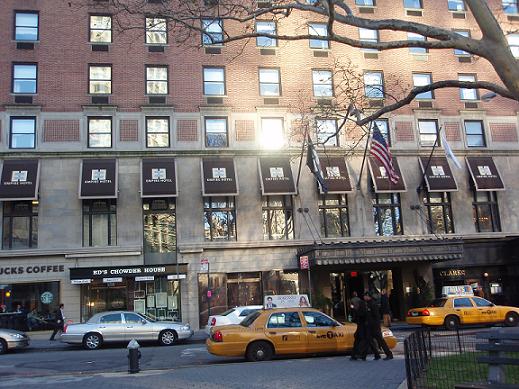
So, after NYCBallet’s Nutcracker Friday night (review coming soon), my friend Mika and I discovered a new place for after-ballet drinks and interesting foodie things — Ed’s Chowder House (located right across the street from Lincoln Center, two doors down from PJ Clarke’s and at the bottom of the Empire Hotel).

The dining area is nice, but the bar room (where you can get less expensive a la carte items — mostly fresh fish and chowders) is what really rocks. My friends and I always used to go to PJ Clarke’s, which is a bit cheaper, but it was always so crowded — both bar and resturant, the bar stools have no backs and are extremely uncomfortable, and the wait staff is always so pissy about seating you at a table if your party is not fully arrived or if you’re only getting appetizers or desserts — even if you get an expensive cocktail (or three) and a couple appetizers to share (which comes out to be far more money-wise than if you order one entree and a non-alcoholic drink). And then once you are seated the wait staff makes it their sole mission to get you out of there as soon as humanly possible, nearly opening your mouth for you and shoveling in the food. I once nearly had to smack a waiter on the hand for repeatedly trying to take my plate away… Plus, I was in there nearly every night last season, and could the hostess’s face ever register any recognition?…

Rosa Mexicano around the corner is lovely, but for me, it’s best in summer so you can sit outside. The bar is too cramped (though the chairs do have backs) and the restaurant area is not very interesting, imo, though the little swimmer guys diving down the waterfall-covered wall aligning the stairway are very dancerly and cute.

Anyway, we were extremely excited to find an excellent alternative in Ed’s! The bar area is spacious and there are multiple little tables behind the actual bar. Bar is made out of very cool material by the way — hard to describe — we weren’t sure if the objects underneath the glazed covering were sea shells, but they were very cool — do check it out! The restaurant area can get a bit pricey, but the bar serves really good a la carte items — oysters, various chowders, seafood appetizers like lobster rolls, scallop ravioli and mini crab cakes, and individually-ordered fish steaks and interesting sides like chili-glazed spinach and horseradish mashed potatoes. And they have a nice cocktail list and a pretty good wine selection. They made the best Tanqueray martini – which I now call the “Laura Jacobs martini” since she introduced me to it a few weeks ago when she and James Wolcott took us out for after-ABT dinner at Shun Lee — and it’s the best I’ve had since that evening.

And they have bowls full of chewy saltwater taffey on the way out 🙂

PALOMA'S TURN ON SYTYCD

For people who missed it this past Wednesday, here is our Paloma Herrera on So You Think You Can Dance:

From what I can tell through Google, it looks like nearly all responses from the gen pub have been positive 😀

Some people mentioned they’d have preferred a pdd (since SYTYCD is about partnering, after all) — something more like this:

Dancers above are our studly Jose Manuel Carreno and the Royal’s lovely Tamara Rojo.

I miss Jose; he hardly danced with ABT this past Met season…