Maria (who is based in DC) has the story here.

Maria (who is based in DC) has the story here.
Wednesday night was one of the most enjoyable nights I’ve had at New York City Ballet. I’m totally in love with Balanchine’s La Valse. I wrote about it here when Miami City Ballet performed it and it grew on me immensely when I saw it on NYCB. My friend, Judy, fell head over heels for it too — I think she was the first person in the whole theater to begin clapping (when the curtain began going down admist the swirling Viennese waltzing couples, the group of men carrying Janie Taylor’s limp body high above their heads, pall-bearer-like).
It’s such an intoxicating ballet, with the gorgeously bedazzling, mid-calf-length tulle (which fashion industry person Judy tells me is called “tea length” or is it “t-length” or “tee-length”?) — deep maroon for the waltzing women, bride-white for main character Janie. Janie and Sebastien (who played the leads, pictured in top photo) and Tyler Angle all gave the whole thing such a tragic pathos. When Janie was waltzing with the “devil-character” — a frightening Philip Neal (just about the most intensely captivating I’ve ever seen him) and getting swirled and whirled and tossed madly about, she did these gorgeously elaborate back kicks on the fast third step, when he lifted her high into the air, almost tossing her like a rag doll. It added greatly to the crazed momentum.
It was really Tyler Angle who blew me away though. (See Times article on him by Claudia La Rocco here). He danced one of the waltzing men, prone to romanticism, who gets swept away by the seductive atmosphere, kind of a foreshadowing of what will happen to Janie’s character. At one point, he falls to the floor, and just sits in the middle of the stage, unable to lift himself of out this dream, but doing this fabulously expansive port de bras, waving his arms all about dreamily all the time kneeling, while the women twirl around him, their skirts flying, and couples whiz by him, through him actually, almost ghost-like as they separate their waltzing bodies from one another just enough pass their connected arms right over his head. Somehow his swan-like arms narrowly manage to miss them. It’s really brilliant.
I was sitting really close to the stage this time (third row!) and picked up on so many things like this that I’d missed before, when I was just taking in the whole spectacle. Such a beautiful ballet.
Also on was Jerome Robbins’ West Side Story Suite, which is always a load of fun and I’m always floored by Andrew Veyette’s booming but melodious voice as the leader of the Jets, and Georgina Pazcoguin as the sexy salsera Anita. I love how Robbins uses dance style to separate the gangs from one another and identify each’s prevailing ethos: the Jets wear white and are Swingers performing crazy aerials, the Sharks wear red and are fast-dancing, hip-swaying Saleros.
Also performed was Balanchine’s Stravinsky Violin Concerto, a story-less leotard ballet. I love how sitting so close up you can see the dancers’ facial expressions, as well Balanchine’s delectably intricate choreography. At one point, while a main couple is dancing, several women line the back of the stage and stand in place, but they don’t stand still; they flex their wrists and splay their fingers and turn their hands back and forth to the beat. It creates a kind of twinkling star-like effect on the main couple. At another point, the men stand to the sides of the main dancers and simply do port de bras. It creates kind of a fluid, beatific effect, like they’re blessing the couple. I feel like a lesser choreographer wouldn’t have done anything with them, would just have had them standing around while the soloists dance. But Balanchine adds these little details that really make the dance.
Wendy Whelan was, again, very intense and striking (and we saw her and her husband, photographer and filmmaker David Michalek, after the performance, at P.J. Clarke’s, which was fun!) And Robert Fairchild: just, all I can say is show-stealer, naughty little show-stealer!!
“That’s Romeo,” I said to Judy.
Sunday evening I attended another Works & Process event at the Guggenheim. These programs are so fantastic — they’re designed to kind of make the average person an insider, to give you a behind-the-scenes view of how art or cultural programming is created. Anyway, this one was on female choreographers and American Ballet Theater. Unbenownst to me (and most I think), ABT in conjunction with Altria has set up the Women’s Choreography Project, whose mission is to encourage more young women to venture into choreography — an excellent aim given that there are so startlingly and inscrutably few female choreographers, at least in ballet.
The women participants whose work we saw were: Gemma Bond, Misty Copeland, Nicole Graniero, Elizabeth Mertz, and Xiomara Reyes — all ABT ballerinas, and all, except Xiomara and Misty, members of the corps de ballet. (Xiomara is a principal and Misty a soloist.) It’s not a given or a demand of course that these ballerinas will necessarily become choreographers, but the program, led by Stephen Pier, exists for them to explore their talents, ultimately decide whether choreography is for them. It will be interesting to see, if programs like these proliferate, if it leads to more women dancemakers.
Anyway, it was really interesting watching Pier work with the women, but, to be honest, a bit confusing. At the beginning, Pier defined choreography for the audience as the movement of bodies through time and space. “That’s all,” he said. Then, he had Gemma Bond demonstrate a phrase she’d been working on. She walked to the middle of the stage, smiling bashfully, and did a short, abstract lyrical segment. Then, Pier told her to focus on the back wall, to look at the shape of three windows, the lights coming through them, their geometry, and some writing on the wall underneath them (which I think was something like a dedication to whoever funded the auditorium, in small letters).
Bond used her hand to shield her eyes from the stage lights, and squinted up toward the windows. We all turned around, followed her gaze to the back of the room. She then laughed, shrugged her shoulders, and gamely re-performed the phrase. “It’s the same thing,” said the woman next to me. But I didn’t think it was. I thought she used the stage a little more; the pattern was now more horizontal than vertical, which went along with the three, horizontally aligned windows. She did exactly what was asked of her, I thought. Then Pier asked her, “well, what are you going to do with that red light coming out from the middle window?” She looked back at the windows, focused for a moment on the middle one, then, seemingly concentrating hard, repeated the phrase again. This time it was the same horizontal pattern as before, but now she stepped forward in the middle, kind of punctuating the movement with a little dot, making both vertical and horizontal use of the stage. “Now, that’s different,” said the lady next to me. I agreed, but thought this difference was far more subtle than the last.
It was really interesting, but I think we were all intrigued because we knew exactly what was going on, what the choreographer was using to guide her. If we didn’t, I think it would just have been three slightly different patterns with no real meaning.
Pier then gave the women a pair of opposites to work with: fast and slow, light and dark, sharp and soft. All chose sharp and soft, except for renegade Misty, who chose freedom and constraint — which wasn’t one of Pier’s categories! (At one point, he asked each what they found hardest about the project and Misty said it was keeping within the rules. I love her!) Anyway, I looked deeply at the dances, trying hard to concentrate, to see the contrasts, but couldn’t always find them.
But as I was watching this, I was thinking of what I’d seen earlier in the day — the rehearsal footage of Alvin Ailey choreographing on his dancer Donna Wood Sanders, which I wrote about here. How he told her, you’re a prisoner, you can’t escape, you’re struggling, trying, let me see that. And this dance, Masekela Langage, about a group of people living under systematized racial oppression, was obviously very close to his heart.
I realize Pier was only giving these women exercises, that he wasn’t saying this was all there was to choreography. At least I hope that’s what he meant. He had said choreography was only about the movement of bodies through time and space. Is that all? I couldn’t help but get the feeling that Ailey’s world was so different from that of a lot of contemporary ballet, where it’s all about geometric patterns, interesting shapes, use of space, use of different rhythms, and not so much about creating something from the heart. I mean, literary writers and artists have to create because they have something to tell the world, something they find deeply meaningful. Although this was obviously only a glimpse into their process, I didn’t get the sense that these women were being encouraged to explore their visions of the world and learn to make movement that emanates from that place. It makes me wonder how most contemporary choreographers work — if they’re just thinking of light and shadow and abstract oppositions and geometry; if they’re not concerned with trying to tell us something.
Anyway, I have to say Xiomara (photo up top) completely blew me away with her work. She danced a lyrical balletic piece, but it had a kind of hippy-ness to it, a kind of swaying Gyspy-like, Latin feel. She danced with so much emotion. Her facial expressions almost reminded me of a flamenco dancer’s. I’ve never seen her dance like that before. I feel like perhaps she’s someone who’s better at dancing her own work than classical ballet. And perhaps she’d be good at creating work for other contemporary ballet dancers like her. Maybe she’ll be our next female ballet choreographer?
They also showed pieces by women who’ve choreographed for ABT: Lauri Stallings (whose Citizen I wrote about here) and Aszure Barton, whose work I’d never seen before and really loved. ABT II (the studio company, comprised of teenaged dancers) performed her Barbara, a sweet ballet that didn’t really have one single linear narrative, but had a lot of little subplots involving cutely intriguing characters.
On an endnote, Irlan Silva — whoa! Methinks he is going to be in the main company soon…
Wow, a future female Junot Diaz? We need one!
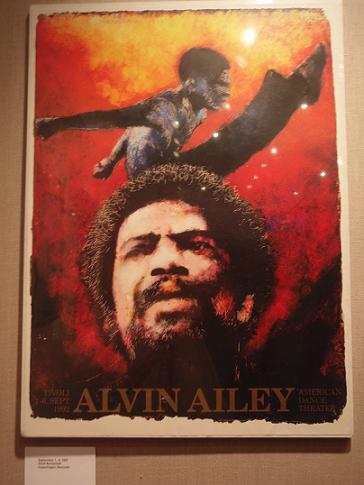
I spent most of my day yesterday at the Walter Reade theater at Lincoln Center watching films about Alvin Ailey: rare footage of interviews and rehearsals with the legendary choreographer, and of him as a young dancer in the 50s and early 60s dancing with the equally legendary Carmen de Lavallade, along with later coverage of Judith Jamison and others dancing, newer PBS specials on the company, and even a couple of panel discussions with filmmakers, collaborative artists, and dancers who worked with Ailey. What a treat! The all-day event was co-produced by the company (AAADT) and the Film Society of Lincoln Center in honor both of the company’s 50th anniversary and the start of Black History Month.
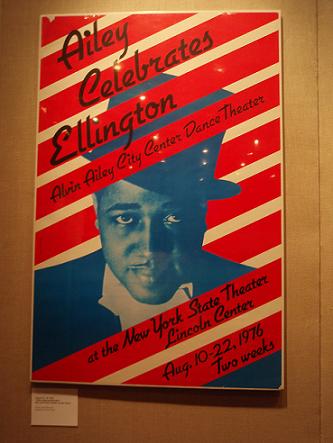
First off, there was a collection of vintage posters in the art gallery right across the hall from the theater. (top two pics above, taken by me.) There was also a little reception with complimentary wine. Complimentary strong wine (which, I hadn’t eaten much and, well, probably got carried away excitedly tweeting over seeing some of the dancers there — namely
Yannick Lebrun — wearing gold earrings in both ears and dressed very stylishly in one of those skinny scrunchy bubble-jackets, baggy jeans and bright red-soled sneakers — it’s always fun to see your favorite dancers outside of the theater, just dressed like ‘normal people’. Also there were Renee Robinson, Matthew Rushing, Vernard Gilmore, and Hope Boykin, and choreographer Robert Battle. Renee and Yannick both showed up to the church event they had last year and I love that both the newest company member and the dancer who’s been there the longest show up to these kinds of things).
Anyway, the first set of films consisted of a movie directed by Orlando Bagwell made for PBS called “A Hymn for Ailey.” I’d never seen it before, but it was a filmed version of Judith Jamison’s dance / theater piece for the stage, Hymn, which she choreographed for the stage not long after Alvin Ailey died (of AIDS, in 1989). I’d never seen that either and I wish the company would stage it again. It was filmed mainly in the church where Ailey’s funeral was held, the magnificient Saint John the Divine. Dancers danced to a series of spoken word pieces recited by playwright / actor Anna Deavere Smith, who was, of course, a very powerful presence in the film. At times she’d stand next to the dancer — at one point Renee Robinson — and speak about body image, as Renee danced her words, and interacted with her at the same time, at one point seeming about to lash out on a negative thought, as if she were a mirror. At another, she spoke about Ailey’s artistry as an excellent male dancer who’s name I didn’t know belted out the movement with great passion. Or, one of the parts that stayed with me for a while — Smith took on the voice of an African woman talking about how much easier it is to be “real,” to be oneself, back in Africa; how here everyone has to wear a mask to survive. It kind of reminded me of Invisible Man. Both the performance and the words were very moving.
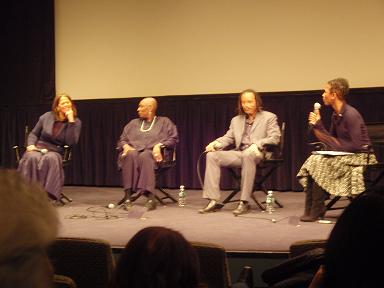
(there was a panel discussion after the Bagwell film, including from right to left, company rehearsal director Ronni Favors, filmmaker Bagwell, Jamison, and Deavere Smith). Judith Jamison is so charismatic, I’m sure it goes without saying. No matter what she’s talking about, you just want to hang on to her every word.
But the biggest highlight of that program — of the day for me — was footage of Alvin Ailey rehearsing a female dancer, Donna Wood Sanders, for her role in Masekela Langage (depicting denizens of a bar, set simultaneously in 1960s race-torn Chicago and apartheid-era South Africa, or anywhere oppression exists). I can’t tell you how much I got from this and I really really wish companies would do this more — would show audiences rehearsals and give us a glimpse into the artistic process. He was telling her, you’re an older woman, you’re stuck, trapped in this bar, in this place, you can’t escape and your life is dreary but that doesn’t mean you’re giving up. And, as she’d do certain things in the choreography, like push her arms out and step backward, he’d say to her, “let me see you in a prison, trying desperately to escape, but you can’t.” And she’d do the movement in such a way that that’s exactly what you saw. It was brilliant. And so powerful. I sometimes wonder how much is lost when a choreographer like that dies, if the entirety of his rehearsal and notes on direction are not kept. Dancers should of course add their own interpretations, but not without reviewing the master’s directions again for guidance. Now I want to see this ballet again.
Also included in the programs I saw were an interview Harry Belafonte conducted with Alvin Ailey, vintage footage of dancers Carmen de Lavallade, James Truitte, and Ailey performing classic works by Ailey’s mentor, Lester Horton. I particularly enjoyed The Beloved, depicting a relationship fraught with tension but compassion that kind of reminded me of some of Ulysses Dove’s work. (A program later in the day included films of some of his dances, but unfortunately I couldn’t stay).
A final highlight of the day for me was watching vintage footage of Alvin dancing Porgy and Bess with Carmen de Lavallade. Learn about that story (originally an opera) and its history here. Ailey danced the part of the the man who threatens the crippled Porgy and seduces but mistreats Porgy’s beloved Bess. I’d never actually seen much of Alvin Ailey dancing and this was such a treat. As someone said in one of the films — I think it was Jamison but am not sure — “He WASN”T skinny!,” which made me laugh, but she’s right.
He was a meaty man. And he had hefty strength and ferocity to his dancing, a virility that was simultaneously sexy and threatening and that I totally didn’t expect since, by the way he speaks and from what I’ve read about him, he seems to have been such a soft, gentle man, and given that most of the male characters he created in his ballets seem like soft, gentle men as well, full of vulnerability and sympathy. Plus, with the possible exception of Glenn Allen Sims, no one in the current company really dances like that. Not that that’s a bad thing – -just a different aesthetic.
I wish I could have stayed for the full day, but I went to ABT’s female choreographers program at the Guggenheim, which I’ll write about soon. This company always makes me so happy and inspired.
Last night I brought my friend Judy with me to New York City Ballet for their Early Music Masters program. It happened to be a very ballroom-y night: I saw two sets of ballroom dance friends — one a fellow former Pasha student from Dance Times Square, and the other a former fellow West Coast Swing team member from my first studio, DanceSport. Always fun to reconnect and see what everyone’s up to. Actually I often see people I know from the ballroom world at the ballet. So, just a little note to ballet companies: I do really think serious ballroom dancers are a potentially big cross-over audience for ballet.
Anyway, first on the program was Balanchine’s Divertimento No. 15 set to Mozart and in the style of a courtly dance from his era in which ballerinas are clad in sky blue and yellow tutus and their cavaliers in blousy tops with ornate vests. Honestly I find Mozart rather bland for ballet.
Continue reading “New York City Ballet: Early Music Masters Program”
Here. Looks exciting — Pacific Northwest Ballet, Jason Samuels Smith (in pic above), Rennie Harris, Cedar Lake, Doug Varone, Merce, etc. etc. I hope I can make it up there for a day or two. Or three or four. So nice and quiet, and a rather studious atmosphere, like a college campus in the middle of the woods. See my photo album from 2007 here.
Tuesday night I went to see New York City Ballet’s Founding Choreographers I program (I know, I’m very late; it’s been a nasty week of migraines and sanity-destroying upstairs neighbors — more on the latter later).
It was a good, varied program. First on were two short abstract but very musical “leotard ballets” by Balanchine, both set to Stravinsky, that went together nicely (though they were choreographed years apart), Monumentum Pro Gesualdo and Movements for Piano and Orchestra. The pieces are mainly abstract and play with geometrical shapes and configurations, and there’s a bit of cute “Egyptian” styling in the flexed hand and feet gestures, and the ballets really give the dancers the chance to show off their musicality, especially the second, fast-paced one. I’m liking Maria Kowroski (in the top picture with Charles Askegard) better and better. She was very charismatic. Even though the ballets were story-less, she was kind of playing a part, and it really drew your attention to her. Askegard was really on too.
The second piece, Robbins’ Dances at a Gathering (pictured second, up top) was what I really went for. It was Kathryn Morgan’s debut in the ballet. She was very good, but who really ended up standing out to me was Sara Mearns. She danced her part in a way that really reminded me of ABT’s artiste supreme Julie Kent in Robbins’ similar but shorter, more virtuosic version, Other Dances. Mearns, like Kent, really connected with the music — not just like she was dancing to the music but with it; it, rather than the male dancer, became her partner. I remember in Other Dances when Kent girlishly lifted her shoulders and a big, joyful grin sweetly overcame her face when the onstage pianist first put his fingers to the keys. Sure Angel was there too, but the music is what made her dance, he was secondary. Robbins has I think three (that I know of) of these dancers-interacting-with-musicians dances: this one, Other Dances, and Suite of Dances, danced by a solitary man to/with an onstage cellist.
The problem to me with Dances at a Gathering is that there’s so much, it’s just too long, and you lose the quality and the mood that are so prevalent in the other two. Instead of one dancer connecting with a musician, or a duo with each partner connecting in his and her own particular way, here there’s a multitude of dancers, each trying to do that throughout the l-o-n-g dance. Every time I see it, I’m in love with it until about half-way through when it starts to drag. Then there’ll be another section that draws me in, and then another section that drags, then another section that drags, then another that begins to draw me in again where I begin to think, gee if there weren’t all those sections earlier that dragged, this one would be quite engaging, but by this point, I just want the damn thing to end already. And I know I’m not the only one who felt that way. You can feel the whole audience shifting in their seats. You can hear the heavy breathing. Someone needs to seriously edit that ballet!
Anyway, that said, I also really liked Benjamin Millepied. He dashed around the stage as if he were desperately searching for someone or something he’d lost. There was a longing and a quiet urgency to his performance that was really quite poignant.
See principal Megan Fairchild talk about that ballet (and see excerpts) here.
Last on was Balanchine’s Stars and Stripes, the high-speed, super-energetic ballet danced to John Philip Sousa’s marching band music that today looks kind of goofy in its hyper-patriotism. At first you want to roll your eyes at what seem to be a cheesy series of Rockette-like high kicks and formation changes and almost circus-like high jumps and stage-traversing turning jetes in the soldier section, but then you realize that in 1958, when it premiered, it was still kind of a point at which America was becoming acquainted with ballet, with the movements and with the Petipa structure — the wondrous in sync ensemble work, the pas de deux with the breathtaking lifts, the solos with their athletic jumps for the man, fouettes and fast chaine turns for the woman. As eye-rolling as this ballet may now be, if you look at it with a historical eye it was very original in its celebratory Americanization of the classical.
This Sunday, February 1, in honor of the start of Black History Month, the Film Society at Lincoln Center will be showing a full afternoon and evening of films about Alvin Ailey and the Alvin Ailey American Dance Theater in the Walter Reade Theater. Onstage guests will include playwright and actor Anna Deavere Smith, dancer Donna Wood Sanders, filmmakers Orlando Bagwell and Patricia Birch who will present their films and answer questions afterward, and of course Judith Jamison. There’s also a poster exhibit in the Walter Reade lobby.
Sounds like a wonderful day! I can’t make all of the films but hope to see some. Go here for a full list of screenings.
My review of Champions of the Dance at Town Hall on Friday is now up at Explore Dance.
I spent practically the whole weekend at Miami City Ballet (at City Center). Wow, what a great, world-class company! They presented two programs of almost all Balanchine (one Tharp) and they really brought Balanchine to life for me. The company’s director is Edward Villella, who performed with Balanchine and was a very renowned dancer in the fifties and sixties, still considered by many to be the greatest American male dancer ever. He was there of course and took bows with the dancers. Twyla Tharp was also there for the program showing her In The Upper Room, bouncing around during the curtain calls in jeans and sneakers with her gray hair tied back into a pony tail, and of course her signature glasses. What fun!
Anyway, program one was: the excellent Symphony in Three Movements (my first time seeing it), La Valse (also my first time — gorgeous ballet), and Tharp’s Room; program two was: Square Dance, “Rubies” (the second section of Jewels), and Symphony in C.
My favorites were mostly from the first program.
Well, I was going to say it didn’t bother me this week as much as last, but then I watched the first 15 minutes (I had a legal seminar tonight and didn’t get home until after the show had already begun, so had to watch the first 15 after the rest). The Flatley number was horrendous. What was up with that girl in the bikini walking around playing Yankee Doodle Dandee with a flute at the beginning? What is this, a boxing match? Soft-core porn? I actually thought this whole show was kind of porn-ish — generally more about flaunting bodies than artistry.
Except for Maria Kochetkova — the Russian ballerina who competed — and WON thankfully! — in the solo category. I think that’s probably why I liked tonight better than last week — she was on, just about the show’s only saving grace. And I’m not just saying that because I’m a ballet fan. I would really have loved to have seen some wonderful ballroom, but, I’m sorry, I’m just not into that Australian couple. I thought the same of their Jive tonight as I did their Samba last week — fast footwork but just lacking in precision and clarity with an overall sloppy look. At least compared to the Latin I’ve seen at the big competitions.
I liked Victor DaSilva and Claudia Sawides — the South African duo — tonight better than the last time we saw them. The routine was still about the lifts — those exhibitions always are — but this one had a bit more narrative and emotion, passion to it. I felt like they connected better this time than last. I also liked the Argentine couple. Their Tango was very polished with sharp footwork. Lovely! I pretty much agreed with the couples results.
And I agreed with the solo results too, but only because I liked ballet. I’m sure Robert the popper is excellent at that kind of dance style, as was the Indian dancer at classical Indian dance. As I and others have said repeatedly, you just can’t judge these wholly different styles of dance next to each other.
I’m again annoyed at camera guy though. Camera person, I should say — don’t know why I think it’s a guy. S/he kept homing in on the Indian woman’s face and we couldn’t see some of her beautiful hand and foot gestures. You don’t dance with your face! I felt like she must have been going very fast with her feet at one point because of all the applause, and I think I heard the sound of the bells she wore around her ankles, but I’m not sure because the show’s acoustics weren’t so great. I also think I saw Maria Kochetkova do continuous fouettes with some double pirouettes thrown in, and at one point changing feet right in the middle — which is marvelous! But because of the camera panning in and out, then down to her feet, then a faraway shot, etc., I’m not exactly sure if that happened.
Sorry, by the way, to keep calling most of these dancers by their nationalities and dance styles. The show’s website doesn’t seem to have their names, only those of the judges and team leaders.
I didn’t think any of the group routines were anything to write home about, and both the intro to the American team and that silly Yankee Doodle Dandy number by Flatley and crew up front were ridiculously chauvinistic (I mean in a nationalist way). Why the need to celebrate America and proclaim it the nation with no boundaries, encompassing all the world, etc. on a supposedly international show like this? And is anyone surprised that our team, and our country, won the gold? The whole thing was just so corny. When Flately said at the end to his co-host, “I know, I’ve never seen anything like this on television!”, it looked like he was trying hard not to burst out laughing. At least he should have been.
And what happened to Pasha and Anya? Who knows. According to the website, team Russia was supposed to have two soloists from the Bolshoi, one pair of ballroom dancers, and a Cossack team. I saw two pairs of ballroom dancers and one soloist from San Francisco Ballet. But I missed the first night, so I might have missed the “other” Bolshoi soloist? I don’t know; I’m not a huge fan of the show’s website.
I think the idea behind this show is a good one. I like having dancers from a variety of countries dance different styles — some native to their country, some not, giving audiences wide exposure to the art. But there were just so many cheesy, corny, porn-esque moments, the camera work seriously frustrated my ability even to see what I was supposed to be seeing, and the judging was downright ludicrous.