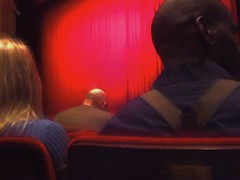
Originally uploaded by swan lake samba girl via mobile.
T-Mobile
Theatre is totally packed. Was never like this when i danced!

Originally uploaded by swan lake samba girl via mobile.
T-Mobile
Theatre is totally packed. Was never like this when i danced!
Last night was the New York debut of ABT‘s newest star soloist, Russian-born, Daniil Simkin. He danced the Tico-Tico section of Company B, which I wrote about here, and which is going to be a dance I can tell will grow on me each time I see it. Tico Tico is probably the solo with the most bravura theatrics, and it suited him well. He has a small, compact body and can go very high on those jumps, really sail around the floor on those barrel turns. But the solo is also jazzy, and he pulled off the softer, subtler elements as well. At the solo’s end he got huge applause from the crowd, and more whooting applause mid-dance (which rarely happens with dance crowds these days) in the very last ensemble section, when he went whizzing halfway up to the ceiling in a twisty turning jump. “That little one was sure something!” exclaimed a couple of women as we left the theater.
My only thing — and this goes for the whole cast, not just him — at the end of the male solos, each man falls to the floor. This is meant to show that they’ve died in war. It it only their spirits that are dancing; the duets are the memories of the women they’ve left behind; the solos are ghosts. So, the dance on its surface is fun and frivolity with jazzy music and pretty girls and the whole nine yards, but there’s underlying tragedy, which gives the dance its power.
On the way out of the theater a woman was complaining to her friend that the ABT dancers “aren’t doing it right; it’s not clear they’ve fallen,” she said. And I agree. At the end of Daniil’s solo, he raised his arms and pushed back from the waist while disappearing into the wings as if he was hit in the stomach by a bullet. But he wore the same happy carefree smile as he had throughout the whole solo (likely because the audience could tell he was finishing, the cheers were beginning to sound and he’d just finished his NYC debut), so you’d never know he’d been shot. But it wasn’t just him — others in this cast did the same. I think the first cast, and especially Herman Cornejo, gave those moments more gravity and pathos. I still don’t know if it was enough though — something tells me people missed the war leitmotif altogether — but it was more. Don’t know how much is enough, really. I’ve never seen Paul Taylor’s company perform it so it’s hard to tell the choreographer’s original intent. You definitely don’t want to overdo it or it becomes preachy. It has to be subtle.
Anyway, I will look forward to seeing Simkin again next week in the Russian ballet, Flames of Paris (Ratmansky, woo hoo!) which I’m, obviously, immensely excited about. Simkin, by the way, keeps a blog; it looks like he updates his Twitter feed more often than the posts.
Also on were Antony Tudor’s Pillar of Fire and Jiri Kylian’s Overgrown Path. This was my first time seeing Pillar and I found it absolutely riveting.
The ballet’s from 1942 and the story’s dated — girl longs for good boy, good boy’s into her sister, girl doesn’t want to grow up to be spinster like older sis, so goes for bad boy who takes her virginity and “ruins” her, so that when good boy leaves brainless sis and comes around, she’s damaged goods. This results in tragedy; she can now only have good boy in her dreams, in the moonlight. At least that was my interpretation.
The great thing about Tudor, dated as this story is, is that he’s so dramatic, his drama comes from within, within the body. You can tell his dancers have to spend so much time working out the characters, and everything is made so clear not so much by facial expressions, but by body movement and posturing and gestures — which is dance, after all. David Hallberg as the good boy (I know, immensely annoying — good boy is shiny American blonde, bad boy is big dark Brazilian Marcelo; there are also “lovers of innocence” blonde and wearing white nightgowns and “lovers of experience” dark-haired and dressed in ‘slutty’ gypsy-like attire, but we won’t go there for the time being) has this quick, rushed gait, so that he passes right by Gillian’s heroine, paying no attention whatsoever to her body, contorted and hunched-over from the waist, cramp-like, with pain. Marcelo definitely notices her, and throughout he keeps doing this thing, rubbing his hands with the flat of his palms on both sides of his groin. It’s so sexual and so sexy and so threatening. I kept bolting upright and leaning forward every time he did it, and had to keep reminding myself, this is City Center, you move a millimeter and you’re blocking every single head behind you.
Marcelo was Marcelo, perfectly in character as always, and Gillian blew me (and the audience, judging by the substantial applause) away with her inner development and tragic portrayal of heroine Hagar. Only thing lacking (apart from the stereotypical casting and costuming), and just a smidgen, was David, in the beginning. His walk was perfect (Tudor concentrated greatly on gaits as a revealer of character), but he was a bit too severe. I couldn’t really see how Gillian’s Hagar was so enthralled with him. He seemed like a jerk the way he ignored her. Then, when he comes around to her, he slows it down, but then he has his regular pointy-footed, slightly hip-swaying, rumba-esque walks. It’s quintessential sexy David, but I don’t know if it’s this character.
The only piece that wasn’t to my liking was Kylian’s Path. They’re putting it on this season because Kylian made it in honor of Tudor, who considered the Czech choreographer his artistic grandson, and the season is devoted to Tudor. It just seemed too one-note, too dreary, without a serious drama you could latch onto. It’s meant to evoke sadness and pathos — is set to piano music by Leos Janacek, who composed the piece (On an Overgrown Path) not long after losing his son, then daughter, and you see a set of women who seem to be mourners, heads hung down, at times reaching out into the air as if in vain, and a young woman dances several duets with a man (Jose Carreno, who, weirdly, couldn’t even save the ballet for me), then disappears into the curtains. I don’t know, maybe I wasn’t in the mood, maybe it’ll grow on me, because I’ve certainly liked other things Kylian has done.
The company has a mini-website devoted to Tudor, where you can view videos and pictures here.

Originally uploaded by swan lake samba girl via mobile.
T-Mobile
Ended up @ Ten Bells, an excellent (albeit loud) Lower East-Side organic wine bar. Great inexpensive wine that, because of no sulfites, won’t give you a headache!
(that’s supposed to be a picture of my glass of Jamet, by the way 🙂 )
Originally uploaded by swan lake samba girl via mobile.
T-Mobile
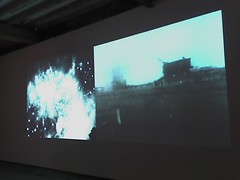
Film projection on back wall: on left side 2 fireworks displays -one from fifties, one from today are superimposed on each other; on right is Thomas Edison’s train wreck experiment (from his 1904 film) in slow motion. Frightening visual effects evocative of effects of war. I’ve noticed lots of war-related art works lately, both in visual and performing arts.
Originally uploaded by swan lake samba girl via mobile.
T-Mobile
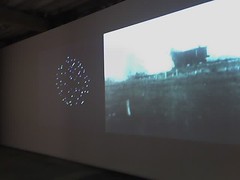
Gallery-ing on the Lower East Side last night with my art friend, Alyssa. Here @ Lorna Simpson exhibit @ Salon 94.
Last night at American Ballet Theater was the world premiere of a new ballet, Citizen, by Lauri Stallings. Stallings definitely knows how to hold an audience’s attention by creating spectacle, and I’m hoping ABT sends me some photos soon, because there was a lot to see. In the meantime, I will describe.
First, big kudos to ABT for putting on something so completely contemporary, so experimental. The company has a reputation for being a bit conservative and I’m not sure you could get farther from Swan Lake or Don Quixote!
So, the curtain was raised to the sound of falling rain. The background was open — it looked like walling was removed — to reveal pipes and such. The back stage doors were fully visible to the audience, and, at points, people dressed in plainclothes walked in and out. David Hallberg was heavily made up and dressed in a bright, richly textured-looking corset, over a skin-toned mesh undershirt and skin-tight resplendent silver tights that stopped at the knees. The costumes were really brilliant (and on more than one level this dance reminded me of Jorma Elo. In terms of the movement, it reminded me of his Brake The Eyes, my favorite of his works, and in terms of the marvelous costumes, it reminded me of his Close to Chuck, his last commission for ABT.)
Blaine Hoven was dressed in hippy-style, flared-bottom silvery pants and a mesh top with a shiny white satin-looking tie. Paloma Herrera, the main ballerina, wore sequined halter top and short shorts. Of the two other ballerinas in the piece — Isabella Boylston and Nicola Curry — one wore a ratty, netted dress, and the other a ruffled white top and I think short sequined pants. Everything was in greys, silvers, and whites. The elaborate costuming (by April McCoy) — suggesting heavily made-up veneers, false masks that we all put on perhaps — made for a stark contrast with the completely open, mundane setting.
Honestly, I found the costumes so stunning, I need to see this dance again; I paid too much attention up front to the clothes and too little to the movement!
Soon, music began — stringed instruments creating an atmosphere of sad nostalgia. The dancers moved robotically, or like puppets, like they were being controlled from above, perhaps like some citizens are? Movement was intentionally awkward, arms jutted out elbow-first, legs flicked out by the knee, pelvises stuck up and out as a dancer bent over, and at points they would walk in short staccato Charlie Chaplinesque steps, with turned-out feet, like clowns. At one point, Paloma bourreed on her tip-toes toward David, resembling the doll in The Nutcracker. Not a real ballerina, a toy version. At times they’d make circular patterns above their heads with their arms, ballet-like, but the movement was anything but fluid. They were all more like dancer dolls, false replicas.
At one point, all the people working in the wings — technicians, the sound gals — came out, dressed in regular streetclothes. They just kind of stood behind the dancers, looking out at the audience. The violins stopped and the lights went on, shining out on us. But the dancers didn’t seem to be breaking “the fourth wall” — they kept going on with their thing; it was only the technicians who confronted the audience, returning our gaze. I couldn’t tell if the technicians were supposed to be participants in the actual dance, or if their presence was supposed to suggest this was a dress rehearsal — “all the world’s a stage” – like, or all the world’s a dress rehearsal, rather. Soon, the lights went down again, the techies left, people walked back out the back stage door, and the sound of raindrops resumed as before, this time with glitter falling from the sky. “The show” resumed.
Robotic as the dancers moved, they were also very human, or trying to be, struggling to seek connection. David would walk his Charlie Chaplin walks toward Paloma, but she’d dart away; he’d put his nose to her face as if trying to know her by taking in her smell, like a dog. But struggle as they did, there was never a real connection. This movement, this following one another, seeking one another out, continued to the end, when Paloma crawled away from the rest of the crowd, toward the front of the stage, and made her way practically to the edge of the orchestra pit. The curtain slowly fell, and right before it landed on her, a hand reached out and pulled her back in. So, maybe they did connect in the end.
It did make me think of the world we, as citizens, inhabit. How much our actions are controlled by others, even in a (so-called) democracy. How much of our actions and the faces we put on are false, but how we’re still fundamentally human and yearning for connection.
I’m not sure if this is what she was getting at, but I’d love to hear others’ takes! It’s showing again this weekend and next.
The program was nicely varied: in addition to the Stallings, were Tharp’s sassy, frolicking Baker’s Dozen, Tudor’s sadly beautiful Leaves are Fading, and Theme and Variations, Balanchine’s super-charged homage to Imperial Russia replete with majestic Tchaikovsky, glittery tutus and tiaras, and brilliant, high-jumping twisty turns.
If anyone sees the Stallings, let me know what you think.
My HuffPo piece is up.
Just a reminder about the DTS showcase this Saturday night. Eugene Katsevman and Maria Manusova (very strong Latin dancers; see here) are performing, as are Neil Haskell and Sabra Johnson from SYTYCD, among others.
So, last night was opening night of ABT’s fall Contemporary season (which will last for the next two weeks) at City Center. I love galas, for the most part: I love seeing all my favorite dancers in the best excerpts from my favorite ballets. Although the only piece that really fit that tonight was Jose Manuel Carreno dancing the bravura pas de deux in Don Quixote with Xiomara Reyes. I am such a child; I again got a bad case of the giggles the second he stepped onstage — both during the duet and then when he had his leaping, fouetteing, barrel-turning solo — this always happens with Jose — and really had to control myself; I was sitting only a few seats down from Kevin McKenzie (who is thin — most go the opposite way after they stop dancing — and as I mentioned before, behind Alessandra). Anyway, see a video here of Jose dancing DQ with Paloma Herrera.
First, because it’s most on my mind since it was the only piece (performed in its entirety) on the second half of the program: Company B, choreographed by Paul Taylor, which I LOVED. I’d never seen it before: it’s a jazzy modern piece (no toe shoes) set to several 40s era songs by The Andrews Sisters (like Boogie Woogie Bugle Boy of Company B). Both song and dance are cute and fun on their surfaces, but in the background from time to time a line of men march slowly, their bodies at the back of the stage, in shadowed silhouette. Some of them hold what appear to be guns. Some hold their arms up as in surrender. They are going off to war (timely then — during the era of the songs, timely now). But you almost don’t notice them. At points, a sweet romantic duet will be centerstage, and one of these men will join the dancers, flying happily about the stage, along with them, then suddenly slam to the ground, as if shot. Because of the marked contrast between fun and play and love, and being shot dead in the line of battle, the background war theme is all the more poignant.
Herman Cornejo stood out to me here. He was cutely carefree, leaping about (as usual, halfway to the ceiling, though the height seemed like pure coincidence, like he hadn’t meant to go that high at all, it was just natural for him), then is left sadly, starkly alone in the end, without the girl, without his carefree ways, and perhaps eventually without life (at times he is also one of the silhouettes in the background). Herman used to be all about huge jumps and leaps and turns to me, but he’s grown hugely as an artist, and now the jumps and leaps and turns are all done in the furtherance of character, though no less awe-inducing. He grows on me each time I see him perform. The Taylor piece was perfect for him. And, as I said, it’s timely and I’m thrilled ABT’s chosen to put it on this season. It’s showing several more times and I can’t wait to see it again and again.
The first half of the program consisted mainly of excerpts (except for Craig Salstein’s excellent Time, which I’ll get to in a sec); in addition to DQ, there was Balanchine’s Theme and Variations performed by my favorite, Marcelo Gomes, and Paloma Herrera. When, at the beginning of a solo, Marcelo walked out onstage and kind of looked out at us, it looked like he was looking right at me. How does he do that? How does a performer do that? It’s uncanny! When Kevin then came out and gave his little thank-you to all the gala sponsors, he did the same thing. Angel Corella does it too. Hmmm.
Anyway, Marcelo was excellent, of course. The far-too-shy crowd was ridiculously late in applauding his series of 15 or so continuous twisty multiple-turning-jumps. American audiences, argh! Marcelo is the quintessential romantic leading man, as I’ve said about 10,000 times throughout the course of this blog :)Â — the way he lifted Paloma about every which way, all over his head; partnering is his forte. But, because of his size, you can tell when the choreography is really fast 🙂
Second on was a scene from Romeo and Juliet (when Romeo leaves Verona), danced by David Hallberg and Gillian Murphy. But this R&J was not the one I’m used to, the one by MacMillan; it was choreographed by Antony Tudor (whom the company is honoring this season; it would have been his 100th birthday this year). Tudor’s R&J is much more dramatic than pashmina, without all the flourishes and breathtaking lifts, but instead with lots of yearning arabesques where the dancers lean toward each other, balancing on the tip of their toes, nearly falling forward, longing but seemingly unable to reach the other. It was passionate in its own sad way and makes me look forward to more Tudor.
And then there was Time, a new piece by well-liked soloist Craig Salstein, a short solo, danced by Michele Wiles. I think this piece marks his choreographic debut. It was originally made in December 2007 for Dancers Responding to AIDS. I loved it. It was soft and lyrical but had modern elements as well, such as short, staccato movements of the arms and legs, and a frontward leaning arch, with arms extending up and back, like a bird taking flight, reminiscent of Alvin Ailey or Martha Graham. Michele danced with a sorrowful passion; it was hauntingly beautiful. As its name and the group it was created for implied, it felt like a woman struggling hard to extend her time here on earth. She would reach upward toward the heavens, but in vain, and she kept brushing her right leg backward, as if trying to brush off a negative thought, a harsh reality. Later, she would dance with fluidity and grace, in acceptance. And the movements would repeat themselves, like they would psychologically in someone who is grieving: denial, anger, acceptance, denial, anger, acceptance. To me, this one little work showed that Craig has wonderful originality, understands how to build structure, understands different kinds of movement and what they do, and has a strong sense of how to convey what he is trying to convey to the audience and really move us. BRAVO CRAIG!!! And brava Michele!
There was a little more, but these were my favorites. Also, Gillian Murphy and Jared Matthews impressed me last night. I don’t know exactly why because she’s always technically brilliant, but Gillian just shined last night; everything she did brought my attention right to her, even when she was surrounded by many others; she just had an extra glow. And Jared I’ve always seen as kind of the skinny blonde guy who blends in with everyone else, but he is looking more and more polished, dancing with greater and greater sharpness and precision and standing out for those reasons — and he was looking even rather majestic last night.
this week, for commending that young Latin dancer for putting fouettes into her jive (which I’ve never seen before either), and for telling them to continue taking ballet, since that is the best way to learn all dances. Yay, Bruno!
I’m glad they had Cody and Julianne dance again. That jitterbug was the best routine I think I’ve seen on the show, ever. I can’t believe he did that!
How fun were The Stray Cats! Or I guess the Brian Setzer Orchestra now. He looks different, but sounds exactly the same.
Wow, I didn’t see those results coming at all. Wrong was I…Â I’m rather annoyed, actually. I feel like the public was too blind to the judges. Toni’s WCS was NOT bad yesterday.
Interesting NYTimes article about Cloris Leachman, by the way.
Originally uploaded by swan lake samba girl via mobile.
T-Mobile
At the ABT gala performance, that is. Not dancing, but watching. Fun, sitting behind my, still, favorite ballerina.
Blah! I had a very strange dream last night in which this one basically told me in his own sweet way that I need to calm down and not stress over blogging like a mad fiend. I have no idea why Angel Corella was on my mind since, although my favorite ballet company begins their City Center season tonight, he, for the second CC season in a row now, is not participating (likely to work on his own company, in Spain). Which is probably why he invaded my dreams — I’ll be missing him badly these next two weeks.
I do know why blogging like a crazed nutter was on my mind. I’m trying to juggle way too much. I’m like a rabbit on speed these days. While I love blogging about dance, sadly, it doesn’t pay and I need to spend less time writing ridiculously long reviews (which I don’t think people appreciate anyway) and more time on paying work (and on writing the two novels I’m currently working on simultaneously, as well as revising my first, and on legal CLE courses so I can keep my license). I honestly think I was less busy when I was practicing law full time.
So, in the interest of shorter reviews (there will be a couple of longer ones in other publications, and I’ll link when they’re up), here goes my last, insane, week:
1) Chase Brock Experience:
Went to this last night. Was supposed to see Danny Tidwell perform as a guest artist but he didn’t show, nor did Neil Haskell. Edwaard Liang did, and he and Elizabeth Parkinson (Tony-nominated star of Tharp / Billy Joel project, Movin’ Out, pictured above in John Bradley photo, taken from here) were, by far, the highlights. Parkinson, in specific, showed me how a great dancer can make any choreographer look good. Everything she did had meaning, even basic choreography (and Brock’s choreography is very basic) like rising to the balls of her feet. The way she went on releve was heavenly.
I hadn’t heard of Brock, but he’s a 25-year-old choreographer who makes theater, modern, and ballet (non-pointe) dances. His modern and ballet were lacking — choreography was very basic, very unoriginal. It was like he was a Larry Keigwin but without the ingeniousness, originality, and sophisticated sense of humor. He’s young though, and can learn a lot by watching other, more sophisticated artists.
2) Three Movements
This is an off-off-Broadway play on Theater Row I saw on Sunday, about the Balanchine, Tanaquil LeClerq, Suzanne Farrell true-story melodrama. The characters were given different names, but playwright Martin Zimmerman made clear it was based the Balanchine story.
First, I finally got to meet (NYTimes writer and now blogger) Claudia La Rocco, in the elevator of all places! Fun fun – -by far the best part of the afternoon, as well as hanging out with my ballroom friend, Mika.
If you’re not a balletomane, story is basically this: Balanchine, the Russian / American choreographer, could only work, and could only fall in love (non-sexually, as many contend he was a closeted gay man) with ballerinas who could be his muse. He often married his muses, but of course, no sex. He married his muses, then obsessed over their bodies, every little flaw, and starved them (in the documentary Ballets Russes, many of the dancers remember him taking food away from his wife Maria Tallchief, because she was too “fat” — ie: large-boned; their marriage lasted approximately 5 minutes, because Tallchief had a brain). Is it obvious yet how much I like Balanchine as a person?
So, he married Tanaquil LeClerq, up-and-coming ballerina extraordinaire, his main muse, and therefore star of all of his ballets. After driving her hard in rehearsal — the choreographer comes across here as completely impossible to please — she collapses, tragically stricken with polio, unable ever to walk again. I don’t know why more writers don’t focus on her — her story seems the most awful, the most pathetic, the most heart-wrenching. Because she can no longer be his muse, he falls out of love with her. He must look for a new one, which he finds in 18-year-old Suzanne Farrell. Of course he falls in love with her, dumps bedridden LeClerq, and proposes to Farrell (he’s 60, mind you, and is dumbfounded when she doesn’t accept). But Farrell is in love with a male ballet dancer in the troupe, Paul Mejia. In a jealous rage, Balanchine fires Mejia (yes, the man is a walking advertisement for the need for sexual harassment law), fires Farrell, and threatens she’ll never be anything without him, etc. etc.
It’s very hard to make Balanchine likeable. Here, I could tell there were many in the audience who knew nothing about him, judging by all the snickers and harrumphs when the actor (Mike Timoney) recited his more misogynistic fare (telling Farrell her tiny thighs were too fat — which the dancer recounts at the beginning of her autobiography, so it’s not untrue — and screaming at her later when she tries to leave him, telling her he didn’t teach her, but “created” her — the man had a major God complex, to put it mildly). To me, this play did nothing to make me feel any sympathy toward Balanchine whatsoever. Nor did I feel what it was about him that made his work genius. But, then, I already knew the story and had preconceived notions of how I’d feel upon seeing it dramatized. Perhaps someone who didn’t already know the story is a better judge here?
It’s no mystery why writers choose to re-tell this story. It makes for great drama. Of the fictionalized accounts I’ve read though, I like Adrienne Sharp’s the most, and recommend it, particularly if you don’t know the story (it’s a short story contained in this collection, all about dancers). She most softened Balanchine’s edges, making him human, vulnerable, and to some extent, even forgivable.
The play runs through October 26th and tix are $18.
3) San Francisco Ballet
Went back for more on Saturday, and loved them again. Dancer-wise, they are one of the best companies in the world. Everyone, down to the most recently-hired corps member, is just flawless. Standing out to me again were the same ones as before — Lorena Feijoo, Davit Karapetyan, Pascal Molat (their bravura dancer), and the newbie Cuban guy Taras Domitro — probably because I was looking for them; they also had main roles though.
As far as the dances go, my favorites (I saw two out of three programs) were Concerto Grosso and On a Theme of Paganini, both by the company’s artistic director, Helgi Tomasson; Ibsen’s House, by Val Caniparoli, whose work I’d never seen before; and Balanchine’s The Four Temperaments. Sir Alastair did not like anything on that list besides the last and, though I disagree with him, I can see his point. Tomasson’s choreography is very basic, very classical ballet, nothing out of the traditional vocabulary, and nothing like the richness, the variety, the suspenseful development, and the engrossing intricacies of Balanchine. Seeing the Balanchine next to Tomasson makes you realize Balanchine’s genius (the way a play about him likely never could).
But what I like about Tomasson is that he knows how near-perfect his dancers are, and he showcases that to maximum, brilliant, spectacular effect. Concerto Grosso is basically a male ballet class, beginning with simple tendus, all the way up to the super-advanced ginormous leaps, barrell turns, and twisty, impossible-looking corkscrew jumps. These men are such excellence personified, I could sit there and watch that ballet repeat all day long. In fact, I recommend to anyone seriously trying to learn ballet to see this company, and watch very closely. The dancers are not only perfectly precise, every movement perfectly, fully executed, but they somehow add so much character and passion to every little thing they do. Even non-story ballets grow to have little narratives with this lot.
Which is why I liked Ibsen too. This is not so much a rendition of any of Ibsen’s plays as a kind of an expressionistic work of Ibsen’s universe. Women wearing richly hued fabrics in 19th Century designs, dance in solo, in units, and with their men, all of their stories fraught with drama, with anger, conflict, love. I didn’t know what exactly was going on in each little segment, and I don’t think the choreographer meant for you to, but watching the dancers lament, cherish, struggle both internally (which, brilliantly, could be read on both face in movement of the body, particularly with Feijoo) and with each other, was deeply engaging. And made me want to read up on my Ibsen!
Philip has some more great pictures of the company on his blog, here and here.
4) Cynthia Gregory at Barnes & Noble
On Friday night, I went to see the legendary ballerina give a talk with writer Joel Lobenthal at the B&N at Lincoln Center, basically to promote her new DVD, of her dancing with equally legendary Fernando Bujones (now deceased). We saw some clips of that DVD, particularly of her dancing Strindberg’s Miss Julie (had no idea there was a ballet made from that play!) and excerpts of her dancing Sleeping Beauty. She was a truly gorgeous dancer, moved with a great deal of emotion and purpose and fluidity, and with her size, seemed to devour the stage (kind of like a Veronika Part). And she was very dramatic, very expressive — would have been my kind of dancer, and I can see why Apollinaire loves her. Apollinaire’s also right about Bujones: he does resemble my favorite!
Gregory has a sweet, very charming personality. She talked about dancing with Bujones, and her various other partners, including Erik Bruhn, and Nureyev, whom she characterizes (unlike many who’ve worked with him) as very sweet and mild-tempered, albeit passionate, and said she was thinking of writing a book about all of her male partners — she danced with basically everyone who was anyone in the 70s and 80s. She was greatly encouraged to do so (write the book, that is) by the crowd (which pretty much packed the reading room).
One thing I found interesting, she said Bruhn taught her how to make up words to her movements and her miming gestures, which helped a great deal with her acting. Brilliant, Erik Bruhn! So, inside, she was singing words to herself while dancing. I think all dancers should do this, so they know what they’re trying to do, all the better to show us.
She talked about what she learned from other female dancers of her day, Carla Fracci (how to imbue her roles with humanity), Natalia Makarova (making the most of slow, dramatic developpes), how she coaches today, what it was like to work with big choreographers like Ashton, Tudor, and Balanchine (only worked with the latter once), traveling with the company, and just her life in general. She also mentioned she’s taken up painting and there will be a showing of her work in December at the Vartali Salon (yes her hair salon!), in NY.
5) Doctor Atomic
I saw this opera at the beginning of last week at the Met. It tells the true story of J. Robert Oppenheimer and his work in creating the world’s first atomic bomb, which we of course dropped over Hiroshima and Nagasaki, during WWII. The opera takes place before we bombed Japan, though, in July 1945 when Oppenheimer and his crew were testing it in New Mexico. It deals with the different personalities involved — Oppenheimer and his wife, his co-workers, the demanding military man who oversaw production — and each person’s internal conflicts and power struggles with the others.
Because I am tired and hungry — I started this post nearly 4 hours ago — I’m just going to refer you to Anthony Tommasini’s review for description, to scenes of the opera on the Times website, to the Met’s mini-site, and to Alex Ross’s blog where you can listen to one of the best arias in the work.
As I said before, I don’t have a lot of opera-going experience, but I liked this and think it’s definitely worth waiting in line for one of those $30 tickets, as I did. In particular, I liked: the sets — the mobile art-work suggesting pieces of debris hanging from the ceiling, the enormous bomb itself (anatomically correct, as the artist worked from a model), the cubicle-d office the physicists worked in, the posters of the actual people involved posted at times over the cubicle holes in place of their bodies, the gorgeous Native American katchina-like statues that at one point stand atop the the cubicles in warning; some of the choreographed movement — at one point singers are contorted in their cubicles, limbs askew, doing a prolonged handstand, their legs and feet bent awkwardly, shoved up against one side — in synecdoche of the effects of the blast; the libretto, comprised of actual documents from that period, writings and speeches of Oppenheimer, and the poetry of Baudelaire, John Donne, and Muriel Rukeyser, beloved by Oppenheimer; and of course the John Adams score itself, creating the whole atmosphere of horror, conflict, fear, and at the end, right before the blast, the drums just beat through your body — I was actually shaking — and this is followed by the voice of a Japanese woman searching for loved ones, for water, asking for help. The whole thing is spectacular, chilling, haunting.
Okay, I don’t know how well I obeyed, Angel, but it’s time to stop, time for my poached eggs & croissant 🙂
