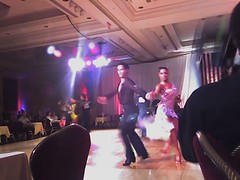
Jonathan roberts & valentina won smooth!
Originally uploaded by swan lake samba girl via mobile.
T-Mobile
Beating even j.t. Thomas and tomas mielnicki. Val & val won amateur latin 🙂

Jonathan roberts & valentina won smooth!
Originally uploaded by swan lake samba girl via mobile.
T-Mobile
Beating even j.t. Thomas and tomas mielnicki. Val & val won amateur latin 🙂
Chmerkovskiys are in the house
Originally uploaded by swan lake samba girl via mobile.
T-Mobile
And dovolani is a judge, and jonathan roberts has a new partner and is competing in smooth. Very sexy tango!
I went back to ABT last night for another Merry Widow with Jose and Julie in the leads. Couldn’t resist! And I’m glad I did; I ended up meeting Roslyn Sulcas, writer from the New York Times, who is really nice and down to earth, and elegantly beautiful.
Anyway, I already wrote a bit about this ballet earlier, and have to get ready for a pre-competition dinner, but I quickly just want to mention a few other tidbits about Jose that make him so great, that I noticed last night. He keeps in character throughout, even when he’s not center stage. I mean, they all do, but Jose really keeps in character. As Julie’s rich widow was dancing with the Pontevedrian men, each man trying to curry her wealthy available favor, Jose was sitting off to the side flirting devilishly with Misty Copeland. And he was really flirting, not just chatting. At one point he raised his eyebrows at her in a way that made me nearly fall out of my seat.
And the way he struts around stage, like a cocky, spoiled, at times drunk, misbehaving boy … it’s not at all balletic, the way other dancers might do, but perfectly in character (and somehow on him, mischievous as it is, becomes so endearing).
I also noticed that when he spots as he’s doing a slow turn, carrying his ballerina in his arms, he looks at each spot on the floor with intent. During his pas de deux with Julie when he was remembering happy times with her in the past, he looked down at each point on the floor like he was lost, forlorn, wondering where they all went. With most dancers they look like they’re doing exactly what they’re doing — spotting so they don’t lose balance. He turns simple technique into art.
I also wanted to point out how fantastic Joseph Phillips was, as leader of the Pontevedrian men, with his spectacular bravura-embellished folk dancing, and Craig Salstein as he sweetly but sadly unsuccessfully vied for Julie’s hand. And Julie as the widow was sweetly flirtatious, her smiles and raised eyebrows infusing her prolonged flexes of the foot into quick, snappingly sharp points, with added sexual meaning.
Anyway, I’m very excited for Giselle next week!
Happy 4th of July, everyone!
I’ve been so busy lately trying to juggle various things I got very behind on my reading, particularly dance reading. So I spent part of my weekend browsing the online arts sections of my old favorite magazines and newspapers and found a few interesting things. I’m really loving some of Claudia La Rocco’s recent reviews. This Bayadere piece is really beautiful in her descriptions, and this one had a poetic charm to it as well — look at the Ravel simile! Made me wonder what her background was — if she was a fiction writer or poet. So, I did a Google search and found several of her poems, like this one and this one, and this one on Shen Wei. (At least I assume this is the same Claudia La Rocco!) It does make perfect sense; poetry, fiction, and dance (and perhaps music) writing have a good deal in common. It’s so hard to write about something so inherently visual or sensual and it really makes you strive for that perfectly specific adjective or metaphor or simile that will convey to your readers as precisely as possible what you saw and what it felt like, how it touched the senses and the soul, without resorting to cliche (which tells the reader nothing). Of course you also need analytical faculties, but I personally find the most challenging part is just getting a well-written, apt description down without over-using the “amazing”s and “beautiful”s, etc. etc.
I was also looking through Time Out, after Ariel pointed out a few Gia Kourlas pieces, and found this interview with Tom Gold, who recently retired from New York City Ballet, particularly interesting. About halfway through he talks about how City Ballet has changed over the years and how technique now seems to be stressed over developing the dancer’s personality, conveying the humanity of the dance. I think that’s all important. I feel like, with a few definite exceptions, dancers are focusing so much on the steps, on making them perfect without thinking about what’s behind them, what they’re trying to convey to us with those steps. Didn’t Damian Woetzel recently say people don’t go to the ballet to see technique? We don’t! Gold said he hopes we return to the age of Romanticism soon and I couldn’t agree more. He also has a few amusing expressions of annoyance at artists who are so insistent on being the “new thing,” on being original, that they seem to lose focus on what they’re doing, on the joy and spontaneity of dance, and their work ends up being contrived and derivative anyway. There’s nothing new under the sun, but there are new ways of bringing things to light and exploring them.
Here’s a little preview I wrote for HuffPost about the Manhattan Dancesport Championship coming up this July 4th weekend. Oh, and by the way, thanks so much for commenting on my posts there, those of you who have!
Jose carreno is dancing again!
Originally uploaded by swan lake samba girl via mobile.
T-Mobile
Although hopefully with all this drunken choreography he won’t reinjure himself.
Update: So, this week’s ballet at ABT is “The Merry Widow,” created in the 1970s and originally an opera. When I first read the synopsis I thought, this plot is so intricate, like an Oscar Wilde-ish comedy of manners, how are they ever going to pull it off without words. They didn’t really — and so you need to read that synopsis — but it’s still a lot of fun to watch the dancers try to mime everything.
I love Jose Carreno with all my heart. Every little emotion, no matter how subtle, registers thoroughly on his face, every perceived rejection, every memory. When he wrapped his hands around Julie Kent’s waist, finger by finger, before lifting her, when he traced his hand from her wrist to her shoulder, when he looked as if he was biting at her neck — just sends chills!
Julie was beautiful, Xiomara Reyes did a great acting job, the whole cast was excellent. I thought the very modern choreography had great humor and was a lot of fun, but I must warn you, this is this season’s Cinderella, so purists are likely not going to be too happy.
Oh and the sets and costumes on this one — extremely lavish. Don’t think I’ve ever seen such elaborate sets for an ABT production; they put a lot of money into this one.
The Ballroom Dance Channel (a social networking site for ballroom enthusiasts founded by Dancing With the Stars’ Maks Chmerkovskiy and Tony Dovolani) is doing a series of podcasts. In their upcoming one, they’re going to be interviewing Melanie LaPatin and Tony Meredith, who choreograph for So You Think You Can Dance. Here’s a little preview, where they talk a bit about what it’s like to work on the show.
I was sitting in front of my air conditioner engrossed in an essay by Edwin Denby called “Dancers, Buildings, and People in the Streets” — I know, brilliant Saturday night — when my cell phone did the little chirp it does when I have a text message. I wondered who could be calling at midnight. Thinking it may be an emergency I jumped up and ran to my dresser to see it was my friend, Parker Sanchez, telling me she was just crowned Mrs. New Jersey!!! I’m so excited! I’ve never known a real beauty queen before! Go Parker! I think she’s now going to go on to Mrs. America or Mrs. USA. Yay 😀
More reviews up: here is my SYTYCD piece on HuffPost, and here is my review of the Christopher Caines Dance Company performance I saw recently at the Rose Hall in Jazz at Lincoln Center. Many people were lukewarm about it, and most hated the venue (see here, here, here, and here), but I thought the ballet was really quite charming and the venue was nice and intimate and made me see ballet in a new way. The whole thing REALLY made me want to take up dance again myself, especially the last waltzy section…
Also went to NYCB last night for their Dancers’ Choice Program (a variety of excerpts from favorite ballets all selected by the dancers, and including a little video footage), which was excellent. Sat next to Mr. Artiste 🙂 And LOVED Flit of Fury — the Monarch, the new ballet by NYCB dancers Adam Hendrickson and Aaron Severini. One of the best new ballets I’ve seen in a while. Review coming soon!
I have been getting a good number of visitors to my blog through Google searches from this little ole mobile post I did when I was in Blackpool. I’ve also gotten several comments. Damn, I wish we could see the show here! Perhaps American networks should take notice of its popularity… sounds much more interesting than that “Who’s the Biggest Loser” we have now.
I’m behind on my dance writing again. Here is my piece on V&M’s Bayadere in HuffPost, and several reviews are upcoming on Explore Dance. Just so people know, since I’m so backed up on my writing, it’s very difficult for me to get to emails right now.
On Tuesday I went to see Joaquin De Luz‘s Prodigal Son debut. His was the most passionate, most intense, most pathos-driven prodigal son I’ve seen yet. He had all the high jumps in the beginning, but they weren’t about the acrobatics; he used them to show his character’s pent-up frustration with his parents, his youthful angst, his need to leave home and go out and explore the world. You could see that both on his face and with his body. Later, when encountering the Siren, danced fine by Kaitlyn Gilliland (Mr. Martins, could you please show me Georgina Pazcoguin in that role!), you could really see his seduction, his becoming completely entranced by her. After their sex scene, he runs up this ladder (which later becomes a cross to which he is tied) with such speed and in such a burst of fervor, it’s as if he’s simultaneously still in the throes of rapture and beginning to realize how dangerous she is.
I noticed that De Luz also, just like a very skilled actor, brought you into the world he created by making you “see” props and scenery that the stage simply can’t hold. The way he crawled about the stage after being beaten, the way he looked around and suddenly shielded eyes when glancing upward, the way he scooped his hands along the ground then brushed his body with them, it all made you feel like you were in a vast desert with him, blinded by the sun, blinded by your own shame, and looking desperately for whatever small pools of water you could find, to splash over yourself, washing off your sins. I haven’t seen any of the other dancers be that specific. And then at the end the way he crawled after his mother and sister, grasping at their skirt tails, then, on first seeing him, shielding his face from his father, as he did from the sun, it drove home the drama and pathos of it all so profoundly.
Nearly equalling Joaquin in intensity, albeit with a much smaller role, was Antonio Carmena, who danced one of the son’s servants. At one point he gets into a fight with the other servant, Kyle Froman, and while his jumps over and leaps at Froman are astonishing in their power and precision, they’re almost animalistic. He uses them to show how vulgar and inhuman and corrupting this world of the Siren, which they’ve entered into, really is.
Also on the program was Peter Martins’ Thou Swell, a modernist ballroom-style dance that takes place in a dance hall replete with crazy cool Art Deco mirrors and flashy, sharp-patterened Twenties-style ballgowns. I was excited to learn, via a Joseph Carman article in the Playbill, that Mr. Martins (also Director of the company) was once a champion ballroom dancer in Denmark! No wonder I like this ballet so — it’s not just ballroom through the eyes of a ballet maker, but an authentic combination of the two. Denmark has really produced a lot of ballroom champs throughout the years.
And the program ended with this sweet little late-eighteenth-century-French-styled ballet, Brahms-Schoenberg Quartet, by Balanchine, replete with ballerinas in decadent, cotton-candy-colored multi-layered tutus, plush, champagne-colored curtains, and a backdrop featuring the palace and gardens at Versailles, one of my favorite places.

“Shortly after the article [in the New York Times, about murder convict Gary Gilmore] caught his eye, almost immediately in fact, Susskind’s old friend and associate Stanley Greenberg called, and they had a good conversation. Stanley had written a TV story fifteen years ago about a man awaiting execution. The man had been so long on Death Row that he changed in character, and the question became, “Who was being executed?” Metamorphosis the play had been called, and Susskind always felt that it had had some effect on the end of capital punishment in New York State, and maybe even a little to do with the Supreme Court decision that saved a lot of men’s lives on Death Row.”
From The Executioner’s Song, by Norman Mailer.
Intelligent lawyers leave the law because they know art produces social change, not legal arguments.