Janie Taylor Debuts in Millepied’s “Why Am I Not Where You Are” Etc.

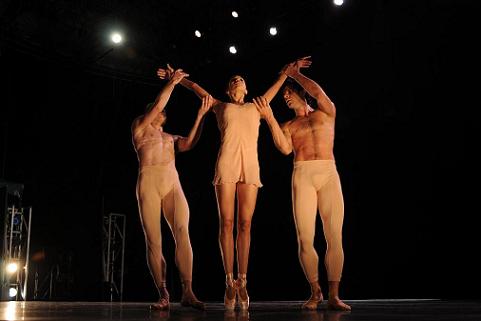
I’ve been remiss in my New York City Ballet posts! Last week I saw two programs: one featuring three dances to three different violin concertos – Peter Martins’s Barber Violin Concerto, Robbins’ Opus 19 / The Dreamer, and Balanchine’s Stravinsky Violin Concerto. And the other program was another in the “See the Music” series but was also dedicated to Santiago Calatrava, who designed sets for all three of the ballets performed – Benjamin Millepied’s Why Am I Not Where You Are (pictured above, photo by Paul Kolnik), Christopher Wheeldon’s Estancia (pictured below, photo also by Kolnik), and Mauro Bigonzetti’s Luce Nascosta, all of which premiered last season and which I wrote about here, here, and here.

Calatrava was in the theater, and after encouragement by Peter Martins, he rose and took a bow.

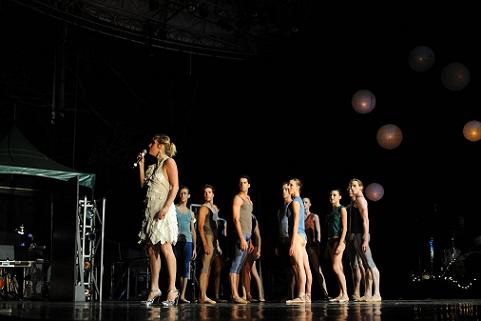
Then, as with the first “See the Music” program, before the performance began, the orchestra pit rose and conductor Faycal Karoui gave a humorous little explanation of various parts of the Thierry Escaich score from Millepied’s Why, the first ballet performed.

These explanations are really interesting to me, I have to say. I only took one classical music class in college and now wish I’d taken more. Karoui talked about how there were four main parts to the score: a waltz, a tango, a disco, and a final climactic part, and he talked about the differences in tempo between them, and between them and a typical waltz, tango, etc.. He also talked about how the ballet has a central male character (danced very well by Sean Suozzi – in top picture, being carried by the group of men), and how you can hear that central character’s theme – or voice – throughout each section of the music. But the voice changes with each section: at first, he’s shy and mysterious (and his voice in the first section is portrayed by a violin solo), then as the orchestra grows sharper and stronger in the second, tango, section, so did the character, etc.

When we got to the “disco” section (it sounded nothing like disco to me but just slightly more mechanical and percussive than the preceding sections), Karoui really began rocking out as he led the orchestra. It was like he was actually dancing in a disco, and I nearly cracked up. I’m not sure if that’s what he normally does down in that pit – if he regularly starts to embody the music literally like that, or if he was just being a goof for the audience. He didn’t seem to be hamming it up at that point, though – oddly – so who knows. Anyway, he is very entertaining and I find his musical explanations very educational as well. What more can you ask than to be both entertained and educated, right?

Anyway, Janie Taylor debuted in the Millepied. She was supposed to have debuted when the ballet did last season but she was out with injury and so Kathryn Morgan had filled in. Character-wise I thought she played it the same as Morgan. Except with Morgan it seemed to have a West Side Story feel to it; with Janie it was darker and more La Valse-like. Both were tragic, but in a different way; Kathryn’s character seemed more innocent. Anyway, this was my second time seeing the ballet and it grew on me. It’s very dramatic, not a dull moment in the whole thing, and you’re really on the edge of your seat, both because of the intensity of the music – maintained throughout each section – and the dramatic story of the poor innocent guy who’s drawn into another world by his enchantment by this ethereal creature, only to get trapped and ultimately destroyed, along with her.

To me, Sara Mearns and Amar Ramasar, with their bravura roles, largely stole the show – I think I remember thinking the same last time. She with those crazy fast chaine turns all around stage that almost make you sickly dizzy, and he with his virtuosic leap sequence – they are kind of the sinister characters, seducing Suozzi but also the audience.

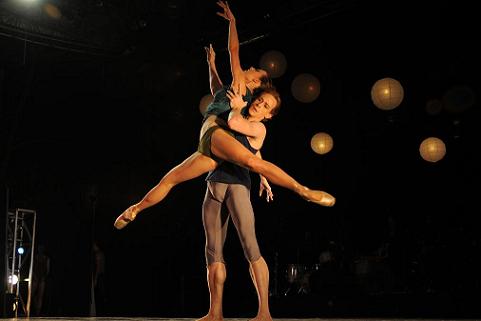
Then came Estancia, and it was my first time seeing Ana Sophia Scheller and Adrian Danchig-Waring (pictured above) in the leads. I’m not a huge fan of this ballet – well, I like the ensemble sections, particularly the dancing and taming of the “horses” – but I nearly fall asleep during the middle, romance part, where city boy wins country girl over. I think it’s just the choreography in that middle section (that I found relatively bland) that slows it down – along with the music – but I liked Scheller and Danchig-Waring just as much as the first pair of leads – Tiler Peck and Tyler Angle. In fact, they seemed to fit the roles a bit more. Scheller reminded me of the main character of Agnes de Mille’s Rodeo and there was something more sweetly, playfully tomboyish about her look than Peck’s. And Danchig-Waring perfectly suited the city boy trying to woo her. He acted his part very well. And his movement is always very sharp. Andrew Veyette and Georgina Pazcoquin as the horses who are eventually tamed, were fabulously entertaining.

And lastly was Bigonzetti’s Luce Nascosta (picture at left by Kolnik), which I’ve seen now three times and which I like but think is too long. I missed seeing Craig Hall in the middle section that seems to be softer and looser than the other sections, where the movement is more marked by those extreme shapes with the flexed hands, splayed fingers, and angular balances and slides on pointe. Hall seems to have the ability to move in a more undulating, kind of serpentine way than most of the others and it seems to me to suit that middle section well.

In the previous program, I loved Megan Fairchild again as the “modern” dancer in Barber Violin Concerto, and, as always, Gonzalo Garcia as “the dreamer” in Robbins’ Opus 19!
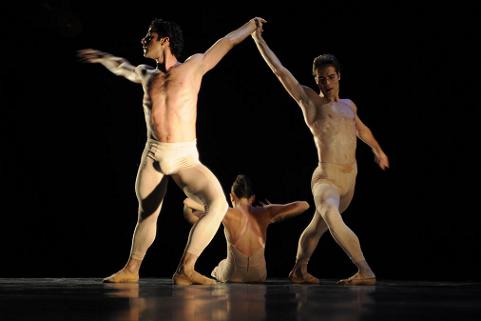
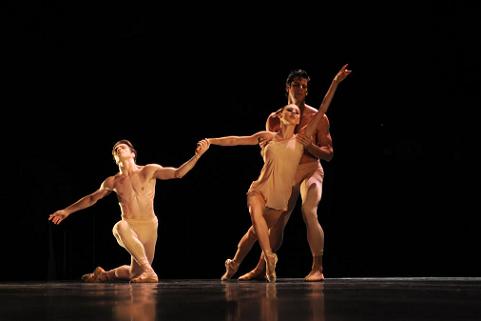
WAYNE MCGREGOR’S OUTLIER


Some photos of the new ballet, which premiered last Friday at NYCB, by Paul Kolnik. Top is of Wendy Whelan and Craig Hall, bottom is of cast with Gonzalo Garcia and Sterling Hyltin front and center.

I liked Outlier if mainly because it provided something different for New York audiences, and the dancers seemed to love dancing it, perhaps to be challenged by a different movement vocabulary. Music was to Thomas Ades and was generally sharp and made for an unsettling vibe, which the movement complemented. Cast was all principles: in addition to Hyltin, Garcia, Whelan, and Hall, there were Ashley Bouder, Maria Kowroski, Tiler Peck, Adrian Danchig-Waring, Joaquin De Luz, Robert Fairchild, and Amar Ramasar. Dancers mainly danced in male / female pairs and movement was intentionally awkward, with lots of sharp, angular lines,  jutting, hyper-extended limbs, at times rubbery-looking as a foot would go from pointed to flexed in a split second, and there were lots of kind of sliding motions in the upper body, which is uncharacteristic of ballet – classical anyway. The whole thing felt alien, ominous, something seriously awry.

Maria Kowroski, Wendy Whelan, and Robert Fairchild shone, as I think they have the bodies most suited to this kind of movement. The audience gasped audibly and some laughed in astonishment when, at one point, Maria Kowroski did an arabesque penchee with her lifted leg in attitude and she swung her leg up so fast and with such force (intentionally) that she looked like she was completely jointless. Then she wrapped her bent knee around her partner’s head — I think it was Amar but can’t remember for sure. She looked like a spider. And Robert Fairchild is really becoming one of the greatest male dancers around – at least that I know of. He can do anything and with such precision, not to mention massive amounts of stage presence.

Lighting (by Lucy Carter) was really cool as well, starting out a bright red, with an almost kaleidoscopic image on the back wall,then turning cream-colored and solid, and creating at times rather ominous shadows that highlighted the bizarre movement.

My main problem with the whole was that it didn’t really seem to go anywhere. A story never seemed to take hold and the movement and overall feeling you had remained the same throughout. Maybe I just need to see it again though.

Outlier was shown with two other, completely different ballets – Balanchine’s beautiful Serenade in which Kaitlyn Gilliland really moved me, and his Cortege Hongrois, with Sara Mearns dancing the part of the classical ballerina to splendid perfection with the very capable Jonathan Stafford as her partner, and Sean Suozzi and Rebecca Krohn ever entertaining as the Hungarian folk dancing duo.

MORE BEAUTIES


So, toward the end of last week I saw two more casts of Sleeping Beauty in New York City Ballet’s production. Above are the beautiful Kathryn Morgan as Aurora and Tyler Angle as her Prince Desire (Paul Kolnik is the photographer). Below are some photos of the other couple I saw, Tiler Peck (both she and Kathryn were making their Aurora debuts), with Gonzalo Garcia, albeit not from this ballet.


(in Four Bagatelles, photo by Paul Kolnik)


(and in the Christopher Wheeldon / Martha Wainwright collaboration over the summer, photo from NYTimes by Andrea Mohin; I like this photo because I think it shows each of their personalities well).

And then last week, I saw Ashley Bouder and Andrew Veyette.

I’ve been thinking about who I thought was best in what role but it’s actually really hard to do that. I honestly ended up liking everyone, though there were definite differences.

I do have a lot to say about Gonzalo Garcia though. I LOVED him as Prince Desire — he really melted me, he really completely stole the show that night and I feel like I’m not ever going to like anyone quite as well in that role now. I mean, you just have to see him in a classical ballet, as the romantic lead, and you realize why San Francisco audiences were so upset when he left SFB for NYCB a couple years ago. Some of those SFBallet fans were really devastated when he left. And I think it’s been such a puzzle to those fans that New Yorkers haven’t really fallen for him the same way. And I think it’s because he hasn’t had the chance to shine because NYCB is so Balanchine-heavy. He needs roles where he can act and become a character. He’s such the quintessential romantic prince.

You can really tell how differently he’s trained than the other NYCB dancers, who’ve nearly all come from SAB and been trained on Balanchine’s non-actable abstract ballets. I felt like with Gonzalo I was seeing someone from ABT — mainly Angel Corella (in terms of the body type, dramatic style and boyishly handsome face). The way he’d hold onto the music, draw it out while it crescendos, by for example in the vision scene holding out a finger to the princess and then leaning back, then looking out to the audience — not AT the audience but in the audience’s direction — to show how enthralled he is, how much he wants to catch her, all before then turning and running toward her. The other two — Tyler and Andrew — they didn’t do all that. They just kind of looked toward her standing more and more toward the tips of the toes, ready to run toward her when the music told them to. Gonzalo’s way was so much more Petipa and Tchaikovsky and Bolshoi and Romantic Russian and all that, and it might all seem overly melodramatic to audiences who aren’t used to that. But that’s what I’m used to with ABT — and that kind of stuff makes me swoon!– so that’s why I think I loved him so much. But I’m wondering what others who saw this cast thought?

And Gonzalo just knows what’s expected of him, as the prince. Later, when he went to do that crazy series of jetes, he was rested up and ready and he nailed them like I’ve never seen him nail anything. I’ve never seen his legs straighter, in perfect splits, and the whole way around the perimeter of the stage, without tiring. And it’s like he knew that was a very important part, and he had to do them perfectly because that’s just what the romantic hero does — that’s the way he shows his love for the princess, and that he’s worthy of her. The other two obviously took them seriously (because they’re crazy hard, you have to take them seriously), but it just was more of a difficult feat, instead of having the same meaning. You know what I mean? Like he looked out all across the stage wistfully, and then he just took off flying around it. It gave it a different meaning than just flying around.

It makes me wonder though if contemporary audiences understand that, or appreciate it. Or whether they prefer for the emotion to look more “natural”? I’m not saying Gonzalo was better than the other two, just different.

I wonder what Joaquin De Luz was like, since he’s not SAB trained either. Did anyone see him?

As far as partnerships, Kathryn and Tyler were my favorites. Tyler had a few flubs on some of his solo variations (but I still love him!), but he was always the perfect partner, he was always solid when supporting her. And the series of fish dives in the wedding pas de deux were some of the most breathtaking I’ve ever seen. Her legs were pointing completely up toward the ceiling! Magnificent! And the final hands-free fish dive was picture perfect.

I liked all of the Aurora interpretations, but they were different too. Kathryn was the most princess-like, the most regal, though that may just be the way she looks. She just kind of looks like royalty! Ashley and Tiler seemed more “real girlish”  – all smiles and sweetness and awe at the world and their cute suitors.

The rose adagios were all near perfect. (ABT’s Sarah Lane is still the queen of the balances to me — it seems like she could hold them for hours.) Kathryn had the most absolutely gorgeous extensions. Do I have to giggle every time Robert Fairchild comes out leading the cavalcade of suitors? I loved Craig Hall as the “African prince,” – I don’t know what exactly stood out about him but something did. And even though it wasn’t a dancing role, I loved Henry Seth as the King; he acted it really well. Chase Finlay was lovely as Gold in the wedding scene – -he’s a really beautiful dancer with exquisite lines. Everyone’s talking about him being the next romantic lead. I loved tiny Erica Pereira as the fairy of eloquence and Ana Sophia Scheller as the fairy of courage, thought Faye Arthurs and Adrian Danchig-Waring were brilliant as The White Cat and Puss in Boots, and Daniel Ulbricht is the quintessential gymnastic court jester.

And there’s NEVER been a better Carabosse than Georgina Pazcoguin! Nor has there ever been (or, perhaps, could there be) a better Lilac Fairy than Sara Mearns. I love how she arches her back so luxuriously and opens up her chest. And the rich, full-out port de bras. Such beautiful expansiveness, that, with her beatific face, makes her perfect for this angelic role. She reminds me of Veronika Part.

Okay, that’s all I can think of, for now!

This week begins the Swan Lakes. I’ve never seen Peter Martins’ version, so I’m really excited. In particular, I’ve heard wonderful things about Maria Kowroski as Odette and I’m psyched for Stephen Hanna’s debut as Prince Siegfried!

MARTHA WAINWRIGHT, MORPHOSES, AND MARCELO IN THE PARK

copy-of-pic-17

Philip was really sweet and sent me some pictures taken by his friend, Kokyat, of the Morphoses / Martha Wainwright performance Saturday night in Central Park. Above are my three favorites from ABT and NYCB respectively: Marcelo Gomes, Gonzalo Garcia and Tiler Peck (seated). They’re dancing Christopher Wheeldon’s Fool’s Paradise.

It was a fun night. For people unfamiliar with Martha Wainwright’s music, she’s kind of a folksy, bluesy, country mix. So, the dances, mostly choreographed by Wheeldon, a couple by Edwaard Liang, complemented that with lots of wavy-armed, lyrical, softly jazzy, almost social-dance-like movement, with ruffly dresses for the women and open t-shirts, casual vests and buttoned Oxfords with ties for the men.

Here’s a photo by Andrea Mohin of the NYTimes, of Bleeding All Over You, chor by Liang and set to Wainwright’s song. Teresa Reichlen is in the middle, surrounded by Jason Fowler and Adrian Danchig-Waring of NYCB. See Mohin’s slide-show here.


Here’s another favorite of mine by Mohin from the NYTimes slide show, of Gonzalo Garcia and Tiler Peck in Love is a Stranger (set to Wainwright’s re-interpretation of the Annie Lennox hit). This was one of my favorite dances of the evening because, well I love both these two, and it kind of reminded me of when they danced Other Dances together at NYCB this season.


And my other favorite from that slide show, of Rory Hohenstein dancing a solo in Far Away, the first piece of the night.

I don’t know if it was Craig Salstein and the wine or the promise of seeing Marcelo in the second act or what, but everyone seemed to have an extra glow or something; everyone seemed to dance so much better than I’ve ever seen them before — particularly Hohenstein. He was really fluid, really beautiful in this dance.

See more photos in the Times slide show here. And read the accompanying review by Sir Alastair in which he gets just a bit caught up in the spelling of the word “Whither.” I don’t see that anyone has blogged about the review, but it’s certainly making its way around via email because of that paragraph. It’s like the critics are becoming part of the performance…

Anyway, Marcelo danced in the last two ballets — Wheeldon’s well-regarded Fool’s Paradise, and Tears of St. Lawrence (a new collaboration between Wheeldon and Liang). Paradise was set to recorded music by Jody Talbot (the only non-Wainwright music of the night) and Tears to Wainwright’s song of the same name.

Marcelo danced the opening pas de deux in Paradise with Tiler Peck and I feel like I saw things anew and like I was more connected to and moved by some of the twisted, unique, two-body shapes just by seeing a dancer I connect with in the part — his covering her ears, his bowing down to her in arabesque… No one could make the arabesques Marcelo was making, and there were several parts where he and another male dancer — at the beginning Gonzalo — would frame the women with those arabesques and Marcelo’s raised leg was always significantly higher. I always love Gonzalo, and it could just have been my seeing him next to Marcelo, but he didn’t seem as stretched-out Saturday night. His extensions weren’t as heavenly as they usually are. Actually, there was nothing in any of the ballets that really brought out the qualities that make Gonzalo Gonzalo. No Mercurial Manoeuvers, no Hallelujah Junction, no MNS Oberon, no Other Dances, no Concerto DSCH where he could fly all over stage and charm you to death. He doesn’t excel as well at the slower, pretzel-shape pas de deux-heavy dances. Well, it’s not that he doesn’t excel, it’s just that his personality doesn’t have the chance to shine. I want Wheeldon to choreograph something high-flying for him and put it in the Morphoses program 🙂

Back to Paradise: I have to say, upset as I was over not being able to see the dancers up close, I was able to see the patterns better from sitting back in the sky box. Wheeldon and Liang both came back there and stood beside us to get a view of the overall, so I guess Susan and I ended up in the kind of ideal Balanchinian viewing area. From there I really could better appreciate the patterns and the look of the whole.

For all the “whither wather” goofiness, one of Macaulay’s lines in the afore-linked-to review really resonated with me: “I like the control with which Mr. Wheeldon keeps making you pay attention, but I can’t get interested in these dances as thought or drama.” I think that’s what prevents me from getting entirely into a Wheeldon ballet (at least his ballets for Morphoses; some of his ballets for NYCB have been far more dramatic or expressionistic); I feel like I need to come away from a work of art with something other than just a beautiful image. I need more in order to keep thinking about the piece over and over again, which is the effect I want a work of art to have on me.

But I’ll keep trying with Wheeldon — I’m sure if I liked Mercurial Manoevers and the After the Rain pdd, other dances of his will eventually grow on me. Especially if he uses my favorite dancers more often 🙂

Here are some more Kokyat photos of Fool’s Paradise:

copy-of-pic-1-1

copy-of-pic-2-1

And here are some of Tears of St. Lawrence:

copy-of-pic-16-11

copy-of-pic-6-21

copy-of-pic-20-1

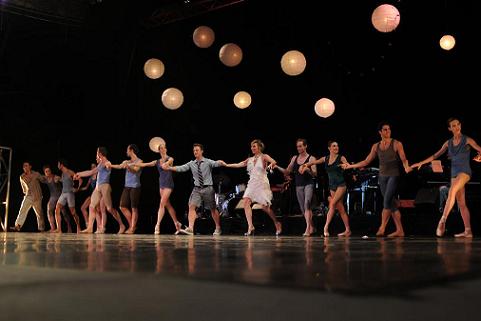
Cast taking a bow, with Wainwright and Wheeldon in center. Look how cute they are 🙂

As I said earlier, there was a lot of music and it almost felt like a music concert with some dance thrown in, but, like others have mentioned, I’m glad the program exposed Wainwright fans to dance. Toward the end, Wheeldon came up onstage and introduced the dancers the way Wainwright introduced her band. He called his dancers “his band” and jokingly noted this wasn’t often done in the dance world. At one point, he remarked to Wainwright that he thought she might dance some and she responded, “Oh … no … oh, I don’t know… I could lie down and let people do things to me?” Everyone laughed. “Maybe it could be you,” she tacked on. “Ah, I don’t think it would be me,” he said after a long pause. He seemed a bit embarrassed. It was cute.

Anyway, thank you again to Philip for letting me use some of Kokyat’s photos. Definitely visit Philip’s blog where he has several posts filled with more gorgeous photos. The photos begin with this post (keep clicking on previous posts titled “Starry Night” to see more).

ADRIAN DANCHIG-WARING AND REBECCA KROHN MAKE IT HIGH ON NY MAG’S APPROVAL MATRIX


Just skimming this week’s New York Magazine and saw this — look at top right corner! It’s the exact pose from Robbins’ In G Major that I was going on about in my Dancers’ Choice post! I loved that piece and loved Danchig-Waring and Krohn in it. I thought no one else would really like it since it was a bit slower-paced and less flashy than some of the other pieces performed that night, but someone else apparently did!

MIDSUMMER NIGHT’S DREAMS


Last week, I saw two Midsummer Night’s Dreams at New York City Ballet. This was my first time ever seeing Balanchine’s version of the ballet and it was really sweet. It follows the Shakespeare pretty closely: Theseus, Duke of Athens is to be wed to Amazonian queen Hippolyta and Hermia is to be wed to Demetrius. But Hermia doesn’t love Demetrius, she loves Lysander, but her father insists she obey him and marry Demetrius. She and Lysander elope and wander the forest. But first, Hermia informs her friend Helena of her plans. But Helena is in love with Demetrius, a love he doesn’t return. He is in fact quite rude to her. So she decides to try to win his favor by telling him of Hermia and Lysander’s plan of escape.

Meanwhile in the land of the fairies, King Oberon and Queen Titania are fighting because Titania refuses to give Oberon her boy servant, which Oberon badly wants. So Oberon arranges for his friend, the devious Puck, to apply a magical potion to Titania’s eyes while she’s asleep that will make her fall in love with the first person she sees on awaking. After turning a man from the wedding entertainment troupe into an ass, Puck applies the potion to Titania and arranges for her to fall in love with the man/donkey when she awakes, which she does.


Angry about Demetrius treating Helena badly, Oberon also instructs Puck to put the potion on Demetrius’s eyes so that he will fall in love with Helena. But Puck mixes up Demetrius with Lysander and Lysander falls in love with Helena, to Hermia’s obviously great dismay. The two women fight, and the two men fight over Helena. Puck eventually realizes his mistake, rights his wrong, and Demetrius ends up with Helena, Lysander with Hermia. Eventually, he changes the entertainer back into a human and Titania and Oberon make up, she giving him the servant.

The story’s told entirely in the first act, the second consists only of a celebratory divertissement of a three-way wedding between Theseus and Hippolyta, Lysander and Hermia, and Demetrius and Helena.

On my first night seeing this, Faye Arthurs and Abi Stafford most stood out to me as Helena and Hermia respectively. Abi in particular danced with more emotion that I’ve ever seen before from her. I really felt sorry for her when Lysander ran off with Helena and she ran through the forest, searching desperately for her lost love, and scared like a child. Sometimes she disappears to me in the story-less Balanchine or Robbins ballets, which makes me think maybe she needs more roles like this, where she can really delve into a character, because she really blew me away. I haven’t seen much of Faye Arthurs, but she was really hair-pullingly tormented by Demetrius. I really felt for her too. Give these two wonderful women more acting roles, Mr. Martins!

My first Oberon was Antonio Carmena, who danced the role very very well.


There’s a very difficult Scherzo (a humorous section of music with a typically very fast tempo) with lots of high jumps with the fluttering bird-like beats of the feet and multiple turns, and he pulled it off very well. He was a rather nice Oberon, seeming to ask Maria Kowroski’s spectacular Titania nicely for the boy-servant and for Puck to commit his mischief (rather than to demand those things of them).

Andrew Veyette was my Oberon the second night I saw the ballet and I loved his interpretation. Andrew’s a more virile dancer and he made all the demands Antonio’s Oberon did not. Overall, Veyette was probably my favorite dancer in the whole two nights.


Andrew’s Oberon was a deliciously pissed off fairy god, a real match for Teresa Reichlen’s stunning Titania and Daniel Ulbricht’s over-the-top Puck, directing the two of them all around this way and that. Daniel Ulbricht as Puck was of course an excellent jumper, as always — and he did these moves where it looked like he was running in the air. Others do more of a cute scampering hop, but he’s able to really run in the air because he attains such height on those jumps. He’s a true gymnast, you can tell from his body when he’s not in tights! But critics have noted that he tends to take over, make Puck the central figure of this ballet when he dances it. Not here. At least not in my mind. Andrew’s Oberon was most definitely the main character. He has too much virility and command to ever let anyone else take over, whatever he’s dancing.

One other thing about Ulbricht: audiences really seem to love him. I’m not a sucker for the high jumps and the pyrotechnics unless they’re necessary to character (though, looking back, I admit I was more of a sucker for that kind of thing when I first started watching ballet). I think audiences go completely wild for that though and I think they expect him to be cast as Puck and when he’s not, they feel cheated. When it was announced he’d be subbing for an injured Sean Suozzi the audience went wild with applause, making me feel sorry for Suozzi. If I was Peter Martins, I’d try to cast Ulbricht as Puck for every single performance, if possible, so as not to upset audiences. Seriously.

Robert Fairchild, making his Lysander debut Thursday night, was cute in the role, as always, as was Sterling Hyltin as Hermia. And Henry Seth was a cutely funny Bottom. He had the slurred-footed “donkey” moves a little more down pat than Adrian Danchig-Waring on the previous night, and you could practically see through his donkey head his hilarious inner conflict over whether to go for that grass or the beautiful Titania.

Savannah Lowery really stood out to me Thursday night as the huntress Amazonian queen Hippolyta. She did her multiple whipping fouette turns like no one’s business. She’s a very strong dancer. An excellent performance.

And Jared Angle did really well as the leading man in the divertissement adagio, which he danced Thursday night with Jenifer Ringer. He strikes me as a very good, very caring partner who will really take care of his lady. And he’s well cast in these noble roles, like his brother Tyler. I think Sebastien Marcovici is likewise a very good partner and he always makes sure he saves his woman before worrying about himself. He worked very hard Wednesday night in that divertissement adagio and big huge kudos to him. The ballerina he was partnering was having a real struggle with her nerves out there — it was visible, and I felt very sorry and nervous for her. It made me wonder whether there’s anything dancers can take for their nerves, to calm them down without making them so relaxed their dancing suffers? I don’t know, is there? Anyway, there are lots of very good, strong male partners in New York City Ballet.

Ariel and I thought we spotted actor Jeff Goldblum in the audience on Wednesday night.

"BRAVO, MR. B.": DANCERS’ CHOICE PROGRAM, NEW YORK CITY BALLET


I love these Dancers’ Choice programs at NYCBallet! Established to raise money for the Dancers’ Emergency Fund, it’s the one night of the year where the dancers plan everything — the ballets to be performed, which excerpts, and who dances them. One dancer plays artistic director for the night (tonight’s was  principal ballerina Jenifer Ringer), another designs the program graphic (tonight, Janie Taylor, above), and another choreographs a ballet to be premiered (tonight, Ashley Bouder, with costumes by Janie Taylor) Dancers who are visual artists donate their artwork for a silent auction during intermission. And that’s my one and only complaint with the evening — the intermissions are always too flipping short. There’s no way people have time to browse through the special items for sale and make their purchases in 15 minutes. Why don’t they double or even triple the intermission? People can buy sparkling wine and browse and buy, not to mention people-watch (practically everyone shows up for these things — all the dancers past and present at NYCB and even ABTers from across the plaza). And it wouldn’t be more expensive to do that, right — if you’re selling alcohol and art, what’s the added expense? What do people need to get home for by 10:00 anyway 🙂

Okay, that’s my little rant.

The program was excellent. They chose the best parts of some great ballets, and some ballets I’ve never seen before — and ended up loving — and of course Bouder’s new ballet!

I’m not going to go in order, but just write what comes to mind first, which is the new Bouder,

Continue reading “"BRAVO, MR. B.": DANCERS’ CHOICE PROGRAM, NEW YORK CITY BALLET”

TONIGHT AT NEW YORK CITY BALLET


Top to bottom: Ashley Bouder and Robert Fairchild in Lifecasting, Tiler Peck in Mercurial Manoeuvres, and Maria Kowroski and Philip Neal in Slaughter on 10th. All photos by Paul Kolnik, courtesy of NYCB.

My friend Michael (whose novel is reviewed in the New York Times Book Review this Sunday, woo hoo!!!) and I saw this program Wednesday night. It was one of my favorites at NYCB and I think his as well. (Well, he loves Ashley and I love Mr. F. so it was a given we’d be melted into our seats by the end of Lifecasting).

But we were also both blown away for the first time by Wheeldon’s Mercurial Manoeuvres, I think because Tyler Angle plus Tiler Peck equals serious magic… Oh my gosh, Tiler Peck really made that ballet. I can’t wait to see her again tonight. She was just everything and more. Unfortunately Tyler won’t be partnering her (he’s my favorite male partner, along with Marcelo Gomes at ABT); she’ll be partnered instead by Adrian Danchig-Waring, a dancer who I am not all that familiar with but am excited to see. Also, heinously, my love Gonzalo Garcia (who owns the lead in this) is not dancing tonight; instead it’s Joaquin De Luz, who, yes yes, I’m sure will be spectacular as well 🙂 It will be interesting to compare, as I so love to do…

Casts are the same for Lifecasting with the aforesaid mesmerizing Robert Fairchild and Ashley Bouder, and Slaughter on 10th, starring Maria Kowroski and her legs, Philip Neal and his tap shoes, and Vincent Paradiso and his gangster persona! I’ll write more about this program after I see it again tonight.

NEW YORK CITY BALLET SPRING SEASON BEGINS! (PROGRAMS 1 AND 2)


NYCB’s Spring season began on Tuesday and I spent much of the weekend at the Koch theater. Friday night was my first time seeing Balanchine’s Divertimento No. 15, (set to Mozart), which Arlene Croce called one of his greatest ballets, and I can see why, particularly with all the complex, richly detailed variations. The ballet begins with an Allegro section danced by the whole ensemble, the women entering the stage first. But I have to say I felt like the dance properly began when the three male leads — Tyler Angle, Amar Ramasar, and Andrew Veyette– came onstage, particularly Angle and Veyette (I prefer Ramasar in the more dramatic roles but he always has a charisma that draws your eye). With the exception of Sterling Hyltin, who is becoming one of my favorite ballerinas, the men just stood out more. At one point, after executing a step perfectly on beat, Andrew looked out at the audience and flashed a knowing, mischievous grin that made me and my friend (and those around us) giggle, and that set the tone of the whole night for me.

Though all of the women seemed to keep time with the fast-tempo and execute all the intricacies of that insanely quick-footed choreography, Sterling’s dancing had the most dash and flair.

Continue reading “NEW YORK CITY BALLET SPRING SEASON BEGINS! (PROGRAMS 1 AND 2)”