
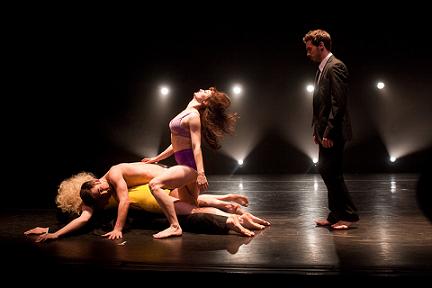
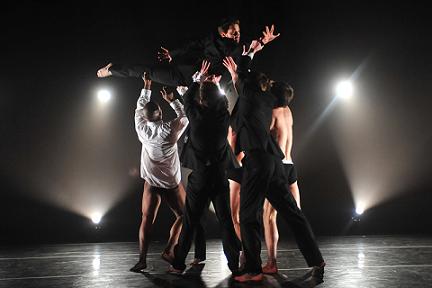
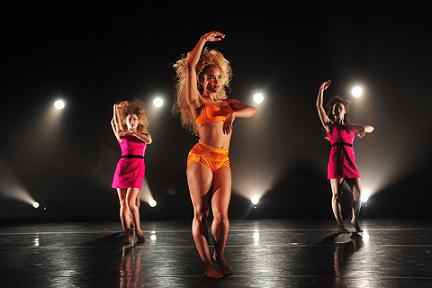
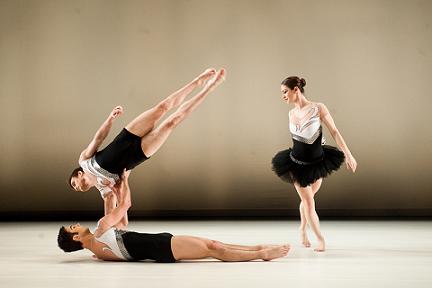
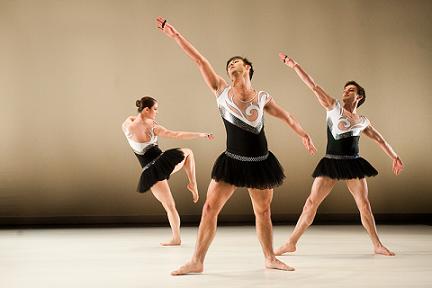
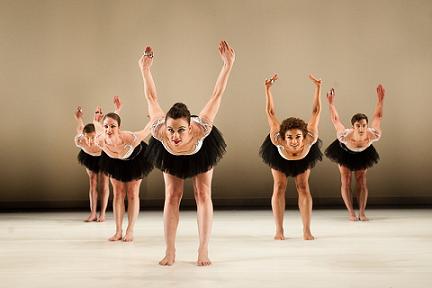
Here are some photos of Keigwin + Company’s recent season at the Joyce in Chelsea. Above is Larry Keigwin’s absolutely stunning Runaway, which I loved, and below is his Bird Watching, which had its premiere at the start of the season. All photos by Christopher Duggan.
My friend and I were blown away by Runaway. It began with a woman onstage wearing a 60s-style dress and a huge bouffant hairdo, checking herself in a mirror held by two male tecchies. The program had advertised that there was to be a “scene change” between the former piece and this one, and it was soon made clear this “scene change” was part of the performance. As stage guys ripped up the floor matting and the back wall drop and laid new ones, this woman primped and posed in the handheld mirror, while men came onstage dressed in briefs, and began climbing into their black suits.
At one point a half-dressed woman ran across the stage, followed by a half-dressed man, running the other way. It was funny; everyone cracked up.
Then, the lights went down, and as the high-energy music (Jonathan Melville Pratt’s Thirteen) began to pump, several men dressed in suits began to walk quickly across stage. The woman with the bouffant hairdo began to dance, her body making sharp angular movements. Soon several woman dressed like her joined the men, walking back and forth across the stage.As the music grew faster, the walking became more urgent, at times turning into a run, a sprint even. Then they began walking into the audience, using the aisles like catwalks.
Soon, they were joined by men who were dressed only in black briefs and women in colored underwear and bras, their hairdos also ratted beehives. The stage was aflutter with people walking or running back and forth, some stopping to dance in the middle, mimicking the first woman’s sharp angular movement. Throughout the whole, everyone had these straight-ahead stares, like zombies. Their walks meant business but their stares were vacant. It was like runaways on a runway. Very cool and not a dull moment! My friend, an emerging choreographer, was so inspired!
James Wolcott, equally fascinated and calling Runaway “what Nine should have been”, wrote about the piece here, and Oberon here. And you can see part of the action in their promo video, which I embedded in my earlier post, here.
Bird Watching was interesting though it didn’t sustain my attention the way Runaway did. It was more lyrical, set to classical music (Hayden’s Symphony No. 6 in D Major). I liked but didn’t love it I think mainly because I couldn’t tell the extent to which it was kind of riffing on certain classical motifs and meant as a funny commentary on them, and the extent to which it was meant to be taken seriously and on its own. Everyone — men included — were dressed in white tops and black tutus, and at one point I could see some movement patterns very similar to Swan Lake‘s White Swan pdd — performed by the men. It wasn’t so funny, though, as it was pretty, which was perhaps the point: that anyone can do anything without it being some kind of statement. I feel like I need to see it again though, and concentrate harder!
Also on the program were Mattress Suite, which I really liked. It was comprised of six vignettes, all involving a mattress, each set to different music and danced by a different set of characters. The story was the progress of a relationship: woman (the brilliant Nicole Wolcott) dancing around in her wedding dress elated and excited but slightly apprehensive, man (Keigwin, who, as a dancer, is often very funny, always charming) in his tux looking excited and lustful but a bit worried, then they’re together on the mattress, then they fight and she lifts the mattress erecting it between them like a barrier, she leaves, he has a fling — with two guys — the mattress getting a bit cramped there toward the end, and then she returns and is alone, struggling with her aloneness on the mattress. It’s by turns humorous, cute, sad, bittersweet. What I love about Keigwin is that his choreography is evocative of human behavior without being obvious or unoriginal. His movement is evocative but original and clever, in other words. And there’s plenty of room for the dancers to act their own drama.
And opening was the high-energy Caffeinated, from 2007, set to Philip Glass’s percussive Akhnaten, which I’ve seen before and is always fun.
But Runaway really blew me away. If you ever get the chance to see it, or his Bolero, or his lamentation in honor of Martha Graham, or anything by him really, go! Their Joyce season was short and is now over, but they’re always around.