THE BRIGHT STREAM at ABT


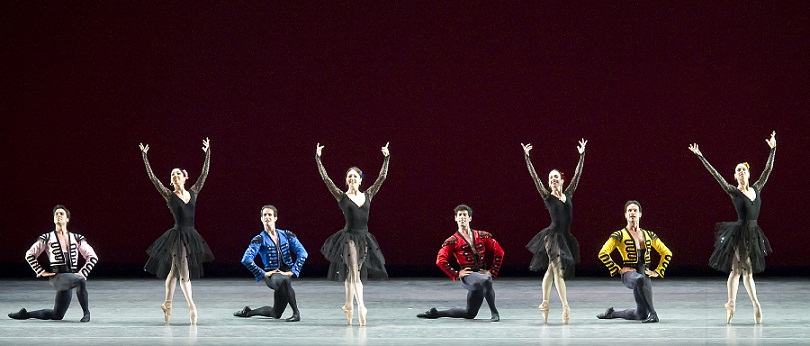
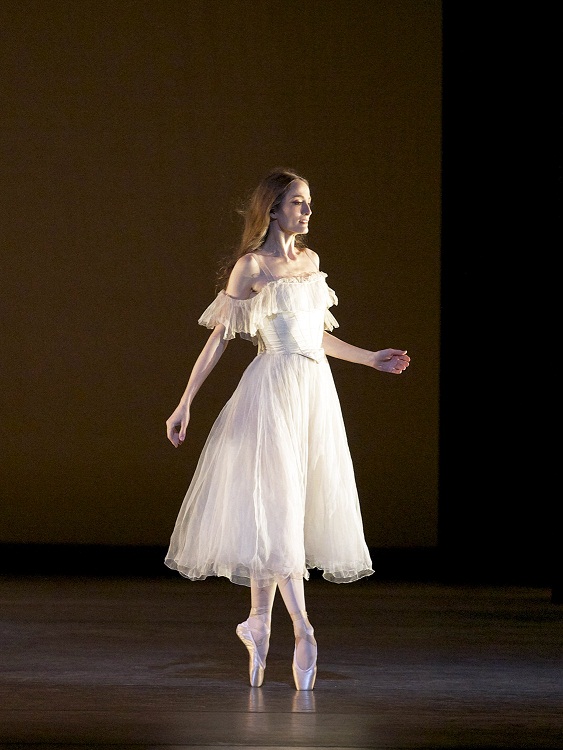
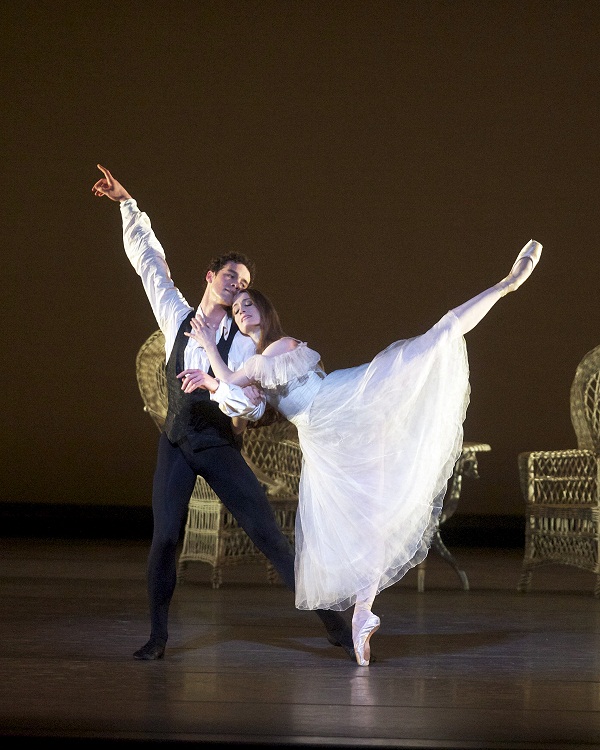
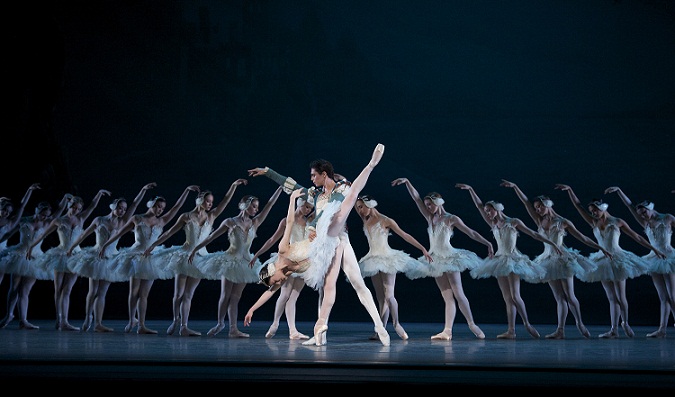
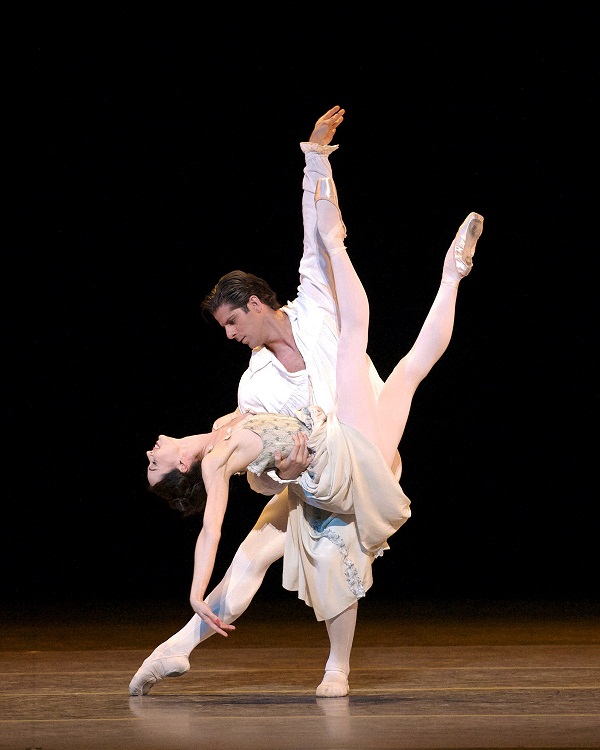
David Hallberg in Ratmansky’s The Bright Stream, Rosalie O’Connor photo.

I’m not exactly sure yet what to think of this ballet, which made its premiere at American Ballet Theater last week. There are a couple more performances left this week and I think I may see it one or two more times. Right now I kind of feel like the history of the production (as told by Marina Harss in ABT’s Playbill) is more interesting than what I actually saw.

According to Harss, the production was originally choreographed by Fyodor Lopukhov and premiered in Leningrad in 1935. But Stalin hated it so, he banned it, and eventually even sent the man who helped write the libretto to the Gulag. It was the last ballet Dmitri Shostakovich ever composed. Alexei Ratmansky (artistic director of the Bolshoi from 2004-2009) restaged it during his reign there, and the Russians loved it.

With a history like that, you have to wonder what it was that angered Stalin so. I can’t see it.  I just see it as a rather silly ballet – kind of reminiscent of Shakespeare’s Midsummer Night Dream but not quite there – that takes place on a collective farm during one harvest season. According to the newspaper Pravda, Harss writes, the producers’ crime was “balletic falsehood,” meaning, she says, it wasn’t a realistic portrayal of what people are like who live on a collective farm. In other words, there was too much silliness, and farmers are serious workers, not goofs. But Ratmansky explains that, in reviving the ballet, he was attracted both to the “lovely, danceable” music and the lightly humorous vaudevillian aspect of the tale, as well as to an underlying darkness, an edge, he found in Shostakovich. “There is always something hidden in Shostakovich,” he says.

To me, that’s fascinating, and is the reason I’m going to need to see it again … and the reason I’m going to need to listen to more Shostakovich.

I think, though, the problem to me may have been more that the Russians have a keener sense of how to put on something like this, where basically every role has bravura parts. I plan to go see the Osipova / Vasiliev / Simkin cast this week to see if I feel differently about it. I saw the third cast – Veronika Part as the main character, Zina (and Part was beautiful, and the one perfect thing I felt about this cast – she was the heart and soul of the ballet), Alexandre Hammoudi as her straying husband, and Cory Stearns and Stella Abrera as the main ballet dancers in the theatrical troupe that comes to town and shakes things up. I liked Cory too. He had the cross-dressing role that David Hallberg is pictured in above and he was very good. He’s a good actor, good with both comedy and romance and has a charming, very stand-0ut stage presence.

Anyway, the plot is rather complicated, and when I expressed that to my friend she laughed and said she’d given up on the synopsis and decided just to enjoy the beautiful music and the humorous dancing. She liked it much better than I did, probably because she decided to stop trying to figure things out and just enjoy… The plot: Zina works as a local amusements organizer. Her husband, Pyotr, has a wandering eye. When a traveling theatrical troupe comes to town to stage a ballet, Zina recognizes the main ballerina – they once took classes together. They dance together, and reminisce — it’s really Zina reminiscing about her dancing past (and Part did this just beautifully) – while Pyotr becomes enchanted with the ballerina. There are also a couple of older, long-married dacha dwellers, who are rather goofy and humorous (danced by past ABT greats Victor Barbee and Martine Van Hamel). The male dacha dweller falls for the ballerina, and the female becomes enamored of the male ballet dancer. When it becomes clear how attracted to the ballerina Pyotr has become, Zina begins to cry. The ballerina calms her, promises her she has no intentions of returning his affections, and suggests they all play a trick on the married dacha dwellers and on Pyotr whereby she will dress as the male ballet dancer and the male ballet dancer will dress as her. So, that’s why the whole cross-dressing thing happens. There are many subplots as well, one involving a milk maid and her companion, a handsome tractor driver (who decides to dress as a dog), but this theme of married man falling for someone who is not his wife, then realizing how much he does value her, is the main theme of the ballet.

It was pretty funny to see Cory Stearns try to dance on pointe, but funnier to watch his character get carried away with the spread-legged, very masculine-looking jumps in that white sylph dress. He and the ballerina are, after all, ultimate hams in need of audience applause, so it makes sense that he forgets himself for a time and starts really acting like a man. I really wonder how David Hallberg does that part – and that makes me want to see his cast as well. Stella Abrera was fine as the ballerina, and mildly funny when she becomes a boy, but she’s not as spectacular of a dancer as, for example, Natalia Osipova, and I’d think that role should go to an allegro dancer like her. I imagine Osipova must be absolutely perfect in that role (since she can do mind-blowingly crazy high jetes better than many men).

Alexandre Hammoudi did well as Pyotr, though there didn’t seem to be a whole lot to that role, which makes me curious to see Marcelo Gomes and Ivan Vasiliev in the part.

I feel like, because the story-line is so slight, and because, as I said earlier, practically every role has some bravura parts, that this is a ballet that needs really spectacular dancing, that needs people cast in every part who are the kind of dancers who are constantly saying, “Hey, look at me, I can jete to the ceiling!” or “I can develope over my head!” or whatnot. And ABT dancers just aren’t trained to be that way – at least most of them aren’t.

One other gripe is the costumes, particularly for the men. The blasted pants. The mens’ lines were clumsy and unfinished and I think it was because the pants were too restrictive. It’s unusual that every single man would be unable to do a proper straight-legged jete or lift his leg more than a couple inches off the ground in arabesque – especially Gennadi Savliev, who always comes through on the stunning athletics. It had to be the pants. I understand why Ratmansky wanted to set the period with the costumes, but as with classical ballets, can’t the tops be the period-setters and the bottoms just be regular tights? Ballet is all about form!

Did anyone see the other casts yet?
Benjamin Millepied, Christopher Wheeldon, and Alexei Ratmansky Premieres at ABT


Above: Isabella Boylston and Marcelo Gomes in Christopher Wheeldon’s Thirteen Diversions, which premiered at American Ballet Theater two weeks ago. (Photo by Rosalie O’Connor.)

Once again, I’m behind on posts. May was a crazy month, filled with family emergencies, last minute travel, and trying to juggle paying legal work with book industry stuff and blogging. Hopefully June will be a bit quieter, though not likely at the rate it’s going thus far…

Anyway, on May 24th, ABT held a night of premieres, showing three new works by today’s “in” choreographers. Wheeldon’s Thirteen Diversions, set to Benjamin Britten’s Diversions for Piano and Orchestra, was overall my favorite. It seemed to have the most going on in terms of emotions, the most developed sections, the most varied movement, and interesting lighting design (by Brad Fields) to boot, though I know others were bothered by that. Background was lit with different colors each section and began with part of the back darkened, with light slowly encroaching. It created an atmosphere of mystery. I also felt like Wheeldon’s dance allowed the dancers to shine the most. Gillian Murphy and David Hallberg were a duo whose dancing had a sweet, light feel to it, like a relationship in bloom, while Marcelo Gomes and Isabella Boylston kind of went back and forth, with more depth and nuance to their relationship. She’d go from peaceful to needy to wanting to escape him back to needing him. They danced it well.


Above: Michele Wiles and Thomas Forster in Ratmansky’s Dumbarton, which I liked as well. (Photo by Rosalie O’Connor.) Dumbarton, set to Stravinsky’s Dumbarton Oaks, was mostly light and lyrical, with dancers clothed in light-colored contemporary costumes (by Richard Hudson). At times, though, the dance took on a more mournful tone, as the music would grow slower and Misty Copeland would collapse, then be carried off by a group of men. But then she’d reappear again in the next, lighter scene, as if nothing had happened. Then, it would happen again. I wasn’t sure if we were going back and forth in time or if there was a continuity of life kind of motif at play.


Millepied’s Troika was a relatively short dance, for three men, set to Bach.  Above are Sascha Radetsky, Alexandre Hammoudi, and Daniil Simkin (being thrown) in photo by Mikhail Logvinov. I started out really liking it but it kind of lost steam. I thought each man would have a different personality or embody a different mood: Simkin more playful, Radetsky more masculine, Hammoudi more soft and lyrical. To an extent it was danced that way, but then mid-way through they each seemed to be doing the same things. They started to blend into one another. Maybe that was the point. At the end, there was a series of lifts where Radetsky and Hammoudi kind of threw Simkin. He’d playfully try to escape them, but they’d catch him, scoop him up, and toss him. Someone remarked that this reminded them of Tharp. It also reminded me of Millepied’s earlier work for ABT, where Simkin was tossed in the air by a group of men in the midst of trying to escape a group of women. So Millepied repeats his themes over a few times.

Also on the program was a revival of Tudor’s Shadowplay with Craig Salstein and Xiomara Reyes in the leads. Created in 1967 and set to Le Livre de la Jungle by Charles Koechlin, it had a very dated feel and many have noted this is not one of Tudor’s better works. To me, it had a kind of Rite of Spring meets Prodigal Son feel to it. Salstein plays a poetic, monk type of figure who wants to be alone to meditate. But he is constantly bothered by this group of beings who appear to be half human, half primate who swing around gymnastically on a set of tree branches. Eventually they bring to him a woman, who’s very Siren-like, and whose sinister charms the protagonist is ultimately able to ignore. That’s what I saw in it anyway.

I felt a bit underwhelmed by the evening overall. It’s always exciting to see new dances though. And it could just be me and my penchant for full-length story ballets 🙂

One other thing: some of the gossip blogs stated that ABT had stricken Sarah Lane from the performance because of Natalie Portman’s presence. I didn’t know Lane was supposed to be dancing that night so have no idea if that’s at all true. Can’t imagine it is. Boylston still danced, and, as I said, I thought she danced very well.

Photos from ABT’s Opening Night Gala

Here are some photos from American Ballet Theater’s opening night gala on May 16th, which I wrote about here. Above, Marcelo Gomes and Diana Vishneva in Manon excerpt, my favorite of the night. All photos by Gene Schiavone.

Jose Carreno (in yellow) and cast of Majisimo (including Lorena Feijoo, Lorna Feijoo, Joan Boada, Nelson Madrigal, Reynaris Reyes, Xiomara Reyes, and Paloma Herrera).

Above, Julie Kent in Lady of the Camellias excerpt. Below, with Cory Stearns in LofC.

Paloma Herrera, Alexandre Hammoudi, and cast in Swan Lake, from Act II pas de deux.

American Ballet Theater Spring 2011 Opening Night Gala

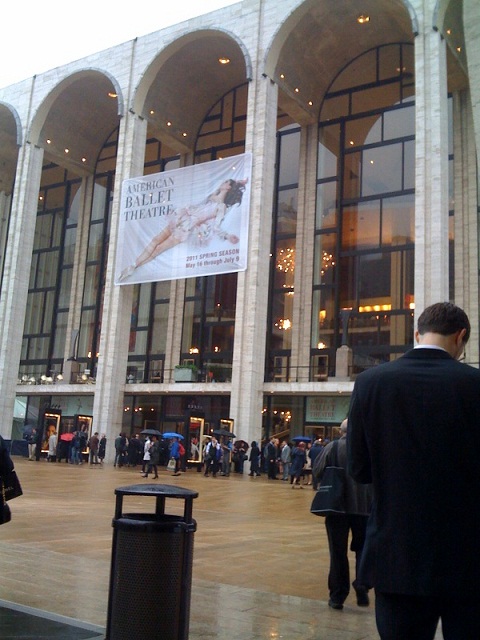
Last night was ABT’s Spring 2011 opening night gala. Dreary, rainy night … but what else is new for New York these days?

Once inside, I really enjoyed the show though. (I’m hoping to receive photos soon, which I’ll post). The program began with a short preview of Ratmansky’s The Bright Stream, which I’m excited to see next week. Seems to have a lot of humor, some bravura dancing, a cute storyline.


(Photo: The Bolshoi’s production of Bright Stream; Natalia Osipova is jete-ing).

Then, there were introductions by Rachel Moore, executive director of ABT, wearing a beautiful green dress, and Kevin McKenzie (AD), followed by Caroline Kennedy, who introduced the students of the Jacqueline Kennedy Onassis School of American Ballet as they danced a world premiere, Karelia March, by Raymond Lukens. The program says the students are Level 7, which must be the highest level, because some of those dancers looked like ABT principals. I’m not kidding, I swear. They really amazed me. That school is doing incredible things!

Next was Balanchine’s Tchaikovsky Pas de Deux, danced by David Hallberg and Gillian Murphy. Everytime I see David dance I think he must be the most perfect male dancer in the world. Gillian was stunning too.

Then came the Grand Pas de Deux from Ratmansky’s new Nutcracker, danced by Marcelo Gomes and Veronika Part. (No, they’re not performing that ballet during the Met season, but there seemed to be a few excerpts in the program from ballets they’re not performing). I missed seeing this couple – overall still my favorite – when the company premiered Ratmansky’s version in December. They were so sweet. Veronika danced with such wonderment in her eyes, such joy. And Marcelo was her perfect, adoring cavalier, all eyes on her. I don’t have kids, but I’d think they’re the perfect wedding couple to wow very young audiences.

Then came Majisimo, a classical ballet piece with Spanish flourishes created by Georges Garcia for the Ballet Nacional de Cuba in 1965 and set to Jules Massenet’s Le Cid. This piece was mainly meant to highlight Jose Manuel Carreno, who of course retires from ABT later this season. But it was really a dance for eight couples, and he danced only the male part of one of them – there were very few solos. He danced with Paloma Herrera. Xiomara Reyes was paired with Reyneris Reyes, guesting from Miami City Ballet. The other couples were comprised of Cuban dancers guesting from other companies as well: Lorena Feijoo and Joan Boada from San Francisco Ballet, and Lorna Feijoo and Nelson Madrigal from Boston Ballet. The dancers were spectacular, but I didn’t think that much of the choreography, which reminded me of a more bland version of an ensemble scene from Don Quixote. Jose had a series of turning jumps, and a really beautiful multiple pirouette that wowed the audience – drawing those turns out are what he’s most known for. And Xiomara really took my breath away with this crazy fast series of traveling turns in a diagonal down the stage. I’ve never seen her dance like that!


(Photo: Jose Carreno dancing with Polina Semionova in Diana e Acteon)

After intermission came two pas de deux from Swan Lake. A Twitter follower asked me why they needed to perform two scenes from the same ballet. I think that ABT, same as everyone else, is just trying to benefit from the Black Swan craze. They should have had Sarah Lane dance one of the pdd though! 😀 Anyway, first pas de deux – White Swan- was Paloma Herrera and Alexandre Hammoudi, which was good. But the second – the Black Swan – I found surprisingly magnificent! It was danced by Michele Wiles and Cory Stearns. There have been so many guest stars from Europe lately gracing ABT’s stage, I’d forgotten how perfect an Odile Michele Wiles is. And Cory really impressed me as well. Whatever he may lack in dance ability (I can’t imagine he’ll ever be a David Hallberg or Marcelo Gomes), he more than makes up for in acting and stage presence. He’s really good at bringing you into the world of the ballet and creating a character you can sympathize with.

Sandwiched in between the two SLs was Jessica Lang’s Splendid Isolation III, danced by Irina Dvorovenko and Maxim Beloserkovsky. I joked on Twitter that Max earned the hot guy of the night award for that, but seriously – he did! Irina was really beautiful as well. And her party dress, which she came out in for the final stage bow, was, as usual, gorgeous. She has such impeccable fashion taste, imo.


Following that was the highlight of the night, for me – Diana Vishneva and Marcelo Gomes in the Act I pdd from Manon. Such a perfectly choreographed pas de deux – beautifully romantic and full of love / lust but with so many breathtaking but capriciously executed, dangerous-looking lifts you sense something out of control. As beautiful as it is, this story isn’t going to have a happy ending. I am liking Diana Vishneva more and more. I’ve always thought she was a great dancer but she always seemed to play too much to the audience for the story ballets. She didn’t take me into the world of the character as much as I want an actor to. But the last two seasons she’s been doing just that: really developing the character and dancing to her partner – Marcelo here and in Lady of the Camellias last season, which is the first time she really blew me away – instead of the audience. This – the Manon pdd – was the audience favorite last night as well. The two got a storm of whoots and bravos at their curtain call, and practically had a standing ovation the audience was so loud in their applause. “So beautiful,” exclaimed the woman beside me. “Okay, we can go home now,” she joked.


(Couldn’t find a photo of Diana and Marcelo, but here is Diana dancing Manon with Manuel Legris. With all photos I post now, I’m linking to the original site via a click on the photo.)

Here are Marcelo and Diana in Lady of the Camellias:


Then, Alina Cojocaru, one of the European guest artists this season, danced the Rose Adagio from Sleeping Beauty. I’m not a huge fan of this ballet in general, but she was lovely. Patrick Ogle replaced Sascha Radetsky as one of the cavaliers.

Second to last was the Act II pdd from Lady of the Camellias danced by Julie Kent and Cory Stearns. Again, Cory did a very good acting job – and physically he fits the character perfectly, as Julie does hers, but I think some of those lifts are so difficult-looking… I just worry about the dancers. Isn’t that how Roberto Bolle got hurt last season – performing this role?

And the evening ended with another ensemble excerpt from Ratmansky’s Bright Stream. People who stood out most to me were Daniil Simkin and, again, Xiomara Reyes. I really am excited to see this ballet.

Tonight Don Quixote begins and runs through the beginning of next week. I’m excited to see Alina Cojocaru dance with Jose Carreno on Friday night, and Russian ballerina Polina Semionova guesting in the Saturday matinee with David Hallberg.

ABT OPENING NIGHT GALA MET SEASON 2010


Photo from inside the gala tent last night at American Ballet Theater’s opening night gala taken from NY Social Diary, who, sadly, don’t seem to have any pics up of Irina Dvorovenko in her beautiful red gown. It was one of the most beautiful dresses I’ve ever seen — long and many-layered but each layer seemed to be made of a light, sheer piece of fabric, so the whole thing looked light and diaphanous, though it wasn’t really see-through, just looked that way. Anyway, if anyone finds a picture of her, please let me know! Roberto Cavalli probably designed it…

Anyway, so the opening night gala was last night. It was loooong — one of the longest I’ve seen. We didn’t get out until 9:30, and it began at 6:30. It opened with an excerpt from Frederick Ashton’s Birthday Offering, of seven couples waltzing at what seemed to be a party (I haven’t seen this ballet), with Irina Dvorovenko and Maxim Beloserkovsky the main couple.

Following that was a series of introductions and thank yous by Kevin McKenzie (Art. Dir.), Blaine Trump and Caroline Kennedy (the two women were honorary chairs of the evening, along with Michelle Obama, who wasn’t there), and then David Koch who has funded the upcoming production of the company’s Nutcracker this winter.

Then, a group of ABT II dancers performed an excerpt of Edwaard Liang’s Ballo Per Sei, which was a contemporary lyrical piece, set to Vivaldi. I recognized a SLSG favorite — Irlan Silva — right away.

Then came the “Rose Adagio” from Sleeping Beauty, performed by Michele Wiles, with Sascha Radetsky, Craig Salstein, Gennadi Saveliev, and Roman Zhurbin as suitors. I don’t think I’ve ever seen this performed so well. Michele really held those balances, and she was so vivacious! Both she and Paloma Herrera, who danced a later excerpt from SB later in the evening, really embodied a young Princess Aurora very well. Michele got loads of applause – the most thus far of the evening.

Then came David Hallberg and Natalia Osipova’s Olympic version of Giselle — this an excerpt from Act II. People laughed and shook heads in amazement at Osipova’s sky-high ballons and sprightly jumps and leaps. She is really incredible. And then at the end when she jeted off and he followed her, it was really beautiful. But athletically astounding as it was, it was still moving; nearly brought tears to my eyes. I mean, how do you manage to do athletic feats like that and make it seem like you’re a light, other-worldly spirit instead of nearly exhausting yourself to death? I don’t know if I’ll ever be able to see anyone else dance Giselle again besides Osipova now. I saw a couple of etoiles from the Paris Opera Ballet perform it at the Guggenheim a few months ago and all I could think was, “wait, where’s the ear-high develope?” and “that arabesque penchee is nowhere near 6:00!” Natalia Osipova has spoiled me.

Then came Veronika Part and Marcelo Gomes doing my favorite gala fare, the Black Swan pas de deux. They were magnificent. Veronika kept doing these equally astounding crazy penchees, and she was so tantalizing with all of her faux White Swan poses! She was really a bad tease! And perfect fouette sequence for her, and his jetes and all — they got loads of applause too (oh, and so did David and Natalia).

Then was the beautiful Thais Pas de Deux by Ashton, danced by Diana Vishneva and Jared Matthews. I recently saw this rehearsed at a studio visit by Hee Seo and Sascha Radetsky, and it looks so different onstage far away and with costumes and all. It looked a lot more like MacMillan than I remembered. I loved it; Diana and Jared did very well but I still can’t wait to see Hee and Sascha. For her gala gown, Diana was wearing a very interesting-looking Japanese-styled dress.

Ending the first half of the evening was the finale of Tharp’s Brahms-Hayden Variations, danced by a group of seven couples, replete with trademark Tharpian flash and crazy lifts and high energy. Can’t wait to see this now either. I have in my notes, “who is dancing with Hammoudi?!” When I looked at my program, I saw it was Stella Abrera. She is really back and really on!

First dance after the intermission was the “Kingdom of the Shades” scene from La Bayadere.  Beautiful as always though it seemed some of the dancers were not completely in unison.

Then came Paloma Herrera and Cory Stearns dancing the Awakening Pas de Deux from Sleeping Beauty, which was followed by the wedding pas de deux from that ballet danced by Herman Cornejo and Xiomara Reyes. I particularly loved Paloma. As I said before, she and Michele Wiles really embodied the sweet, youthful spirit of Aurora. Paloma and Cory danced very well together. They seemed like a real couple.

Then was my second favorite excerpt of the night — the Act III Pas de Deux from Neumeier’s Lady of the Camellias, danced by a very passionate Roberto Bolle (who received a load of applause when the curtain initially opened on him) and a very dramatic Julie Kent. Every excerpt of this ballet makes me want to see the whole. Not much longer now — it begins next week, and I can’t wait. I think they received the greatest applause of the night. Audience really went wild, and it’s partly because he’s so internationally famous, but also I think because they just did so well with it. This seems to be a ballet that requires both good acting and excellent partnering ability because some of those lifts… The pianist, Soheil Nasseri, came onstage too for a bow at the end. He was very good.

Next to last was the Act III Pas de Deux from Don Quixote, danced by ABT audience faves Ethan Stiefel and Gillian Murphy. There was a slight mishap with the lift where he throws her up, she does a crazy twist in the air and then he catches her and the fish dive wasn’t hands free, but they each danced spectacularly on their own. It looked at one point like she was doing quadruple pirouettes between some of her fouettes, and he nearly kicked his leg to his forehead during some of his jumps and then did a flashy little jump during his fouette sequence that had the audience screaming.

The evening ended on a modern note  with David Parsons’s Caught, danced by Angel Corella, who, expectedly did an exquisite job. The audience, many of whom hadn’t seen that dance before, seemed so spellbound they almost forgot to clap right away. Angel’s so cute 😀

And finally, everyone who danced came out onstage at the end and took a little bow while the orchestra continued to play. Dancers still in costume — Daniil Simkin, Craig Salstein, Gennadi Saveliev come to mind — did a flashy trick, the “Shades” did a little dance in unison, and then dancers who danced in the first half came out in party gown (which is how I fell in love with Irina’s dress).

Fun evening. During intermission I checked my cell-phone and found a text from a friend who saw me sitting in orchestra from the side par terre, where he was sitting. So I texted him to meet me afterward, and we went for martinis, clam chowder and crab cake sandwiches at Ed’s Chowder House across from the Plaza, my favorite post-ballet place to go since it replaced Center Cut mid-NYCB fall season. They have a TV in the bar, and I was happy that the Yankees were still on. So I saw A-Rod hit his game-tying home-run… But how my friend ever saw me in that enormous Met crowd I’ll never know. Though many arrived late, house ended up being packed.

Oh, and I almost forgot: at the beginning of his speech, Kevin McKenzie introduced several dancers – each representing an era of ABT (this being the company’s 70th anniversary)- who all came out and took a bow. Included were Lupe Serrano, Baryshnikov, Nina Ananiashvili (who got a lot of applause), Alessandra Ferri, Natalia Makarova, and cutie Frederick Franklin, who gave a little speech as well. Isabella Rosellini was in the audience, a few rows down from me. I didn’t recognize anyone else in the audience.

MORE ON AMERICAN BALLET THEATER’S AVERY FISHER SEASON


Daniil Simkin and cast in Benjamin Millepied’s Everything Doesn’t Happen at Once in Gene Schiavone photo, courtesy of ABT; all photos by Gene Schiavone (except for Arron Scott headshot below and bottom picture).

Just to let people know, as the photos shows above, the guy who was flinging himself into the group lifts in the first cast of the Millepied was Daniil Simkin; in the second cast it was Arron Scott (below). The program notes only gave a special mention to the two dancers doing the pas de deux and a lot of people were asking who the main soloist was.


Anyway, here are a few more reviews:

Here is James Wolcott on opening night gala (and our fab Shun Lee dinner afterward 🙂 ), here is Apollinaire Scherr’s FT review; and here are more of Apollinaire’s thoughts on her blog, Foot in Mouth. I’m surprised there aren’t more reviews — this was a pretty big season, with three world premieres — but that’s all I can find at the moment. (Update: Robert Greskovic’s WSJ review just went up; thanks to Meg for letting me know.)

Re the Wolcott write-up: I forgot to mention the models — Iman and Veronica Webb, who, instead of A.D. Kevin McKenzie, thanked the gala sponsors and introduced the program — screwing up Benjamin Millepied’s name. It wouldn’t have been such a big deal if they wouldn’t have been so giggly over it. It seemed like they were reading their notes for the first time and were really unprepared. I really don’t know how to pronounce his name either — I’ve always said the last two syllables to rhyme with plie (without the “l”) but have been told that’s wrong. But damn did ABT get a lot of press for signing them on. Just Google “ABT Fall 2009 Season” and it’s all about Iman.


(Gillian Murphy, Cory Stearns and Eric Tamm in Aszure Barton’s One of Three)

Anyway, I saw four of the six programs, saw the Ratmansky and the Millepied ballets four times and the Barton three, and they each grew on me the more I saw them. The Saturday matinee was my last performance and I found it by far the best. I felt like the dancers were finally comfortable with the new dances, knew what they were all about, and really made them meaningful. I described the ballets here.

Oh and regarding SanderO’s comment on that earlier post: yes, I do need to see the story in the dance. The dancer and choreographer won’t pull me in at all if they don’t each tell me some sort of story. That doesn’t mean the ballet has to be a traditional full-length dramatic novel or something with a clearly defined beginning, middle, and end, inciting incident, rising action with crises 1,2, and 3, climax and resolution, etc etc. but there needs to be some kind of story; there needs to be some intention in the abstraction. A lot of critics use the word “evocative” — a dance needs to be evocative of something, and I just mean the same thing. If there isn’t something meaningful going on, there’s no reason for me to see it. I can appreciate the neat geometric patterns and pretty images, but that’s not enough to make me go.

Anyway, I saw more in Millepied’s Everything Doesn’t Happen at Once on further viewings. At first I thought it was kind of everything but the kitchen sink the way Apollinaire kind of describes, but after several viewings I saw more of an evolutionary, battle of the sexes theme throughout, which becomes a more literal battle by the end. The piece starts with the stage looking swimming-pool like with the dancers making broad strokes with their arms. The stage gets over-crowded and eventually someone in charge — looking rather conductor-like, kind of throws his arms up and dismisses everyone.

Then, there’s a pas de trois (two men one woman), which becomes a double pas de trois (same), which turns into the central pas de deux (man-woman). Throughout there seems to be struggle going on — in the pas de trois the men kind of manipulate the woman around, until she’s practically on her side. In the central pas de deux is in places tender, in places more angsty as if the girl is trying to get away from the guy or fight him in some way, and he is struggling to hang onto her.

By the end, the scene has evolved into a kind of battlefield with marching music and the ballerinas doing those Balanchinian marches en pointe. Except they’re more unsettling than cutesy, like in Balanchine. This is the part where Daniil / Arron gets tossed into the crowd, throws himself with wild abandon at the groups of men, who catch him mid-split, then gets caught up with a bunch of grabbing girls.

Interestingly, the audience laughed when this role was danced by Simkin — I think because he is small and a bit long-haired and it kind of looked like he was afraid he’d be taken for one of them and was trying like hell to assert his masculinity. (I think it would have worked better had the girls been chasing him and then he flings himself into the groups of guys rather than the other way around, but not a big deal).

But no one laughed when it was Arron. It looked far more serious with him in the role — it looked like he was practically getting raped by that rabid group of girls.

Also I noticed with Arron that after the rabid group of girls leaves him alone, he kind of internalized the tauning; there was now an invisible fist punching him all about. It really looked like he was getting beaten up by that thing. But the fist was invisible so it was like he’d been driven mad. It was very unsettling, and I think, with the music and the rest of the action, this feeling is more of what Millepied was going for — not all the high air flips, crazy long spins, and windmill jumps that Simkin is known for and did here. Simkin’s character made the end of the ballet more playful than battle-like.

There’s also a short section where there’s all this marching music and there’s more centerstage chaos with all 24 dancers out there at once and suddenly a group of dancers standing at one corner break into partners and go waltzing through the crowd. But it’s really short-lived, like even courtship is a battle.

I don’t know — that’s what I saw on further inspection. But I could be making it all up. It’s kind of fun with abstract ballets (the ones that have a lot going on in them anyway) to make up your own story. I mean, the way dances get made anyway, as I learned at a Guggenheim event last night featuring ABT’s efforts to adapt ballets to different stages (including this small one in AF Hall, meant for concerts), is that things get changed depending on space, depending on the logistics of the stage, depending on dancers. Whoever knows if the end product is what the choreographer originally had in mind anyway.

I don’t think Millepied’s was a perfect ballet — I found a lot of the bird-like patterns from his recent NYCB ballet, Quasi Una Fantasia, to be out of place here – he didn’t need all that; he should have focused more on the battle — but I found his the darkest, the most thematically clear and the most absorbing.


Stella Abrera and Gennadi Saveliev in Alexei Ratmansky’s Seven Sonatas.

The Ratmansky grew on me, as did the Barton. On the last day, Michele Wiles danced the main female character (in the long white ballgown) in the Barton and I loved her. She gave the character a real story. When she comes out onstage she is all bitchy and glamorous, but Michele it’s really an act; she is seeking attention from the main man (in that cast Blaine Hoven) while trying to maintain her haughty demeanor so as not to be shown up by him if he dismisses her. At one point, she extends her arm out to him, as if he’s supposed to kiss it but he turns and runs offstage. She crumbles. It’s heartbreaking.

I also really loved Craig Salstein, Jared Matthews and Daniil Simkin in Barton’s second cast (Matthews and Simkin alternated parts opposite Salstein). They danced a section in the second part and all three made it clear (Salstein most so) that they were in a little competition for the girl’s attention. The girl (Luciana Paris), meanwhile, was just dancing on her own, in her own world, paying them no mind at all. It was hilarious.

But back to Michele Wiles for a minute: a wonderful ABT patron gave me her ticket for a company class, which she couldn’t attend, and Michele seemed so sweet — smiling out and waving at people during the class and even during warm-up.

Also, can some choreographer please please please create a little solo or some kind of dance just for Gillian Murphy! Please! During that company class, during the center floor work when the dancers divided into groups and did turns in a diagonal down the center, Gillian blew everyone completely away. She was like a tornado. But a technically perfect tornado! Everyone in my section literally began to laugh and shake their heads in amazement. She needs something to showcase her technical brilliance and athletic prowess. C’mon ABT!

Each of the dancers brought their own special thing to the Ratmansky. Christine Shevchenko (an up and coming corps member) was gorgeous with the role created by Julie Kent (danced opposite David Hallberg). She was more lyrical than Julie, with flowing, expressive arms that resembled Natalia Makarova in Other Dances. Julie’s arms were more staccato. Hee Seo, who completely blew me away as well, did a combination of the two — by turns feathery and lyrical, and modern and staccato. Alexandre Hammoudi and Jared Matthews both danced David’s original part and they were very different than David. Both connected with their ballerinas much more — when they were left alone onstage they clearly looked about for her, wondering where she was, then accepting they were alone and falling into their solo.

David Hallberg. I can never get enough David Hallberg. He didn’t look around for his ballerina when she left him, but when she returned to the stage, he danced well with her. But when she was offstage, she was out of sight, out of mind with him — he was too busy making Ratmansky’s movement wholly his own. He seems to be a rapidly maturing artist, playing with the music, playing with rhythm, giving some things more emphasis than others. When I first saw him dance this role I thought his “character’s” movement was more modern than classical, but I think that was just because of the way he did one section where he keeps pushing out with his hands, like he’s stopping the air, or stopping something from getting too close. He slowed down that movement a lot, really emphasizing the arms, and then did some ensuing footwork at the speed of light, whereas the others did everything in equal measures -so it didn’t have the same look.


Jared Matthews and Maria Riccetto in Some Assembly Required, photo by Rosalie O’Connor.

ABT also put on Clark Tippet’s Some Assembly Required from 1989, a male-female pas de deux evoking a lovers’ quarral replete with difficult-looking angst-filled lifts, struggling pushes and pulls, then more tender making up. It went on a bit too long; some middle parts that were repetitive could have been taken out, but the cast I saw — Jared Matthews and Maria Riccetto did very well with it. Jared is dancing and dramatizing better than ever before, imo.

And the company also did Robbins’ Other Dances, another male-female pas de deux (this one pretty famous) that was choreographed on Baryshnikov and Makarova. I saw both casts — Marcelo Gomes and Veronika Part, and David Hallberg and Gillian Murphy. I liked both — although I think I honestly prefer Tiler Peck and Gonzalo Garcia’s at NYCB. Gonzalo has a smaller body, more like Baryshnikov’s, and I think some of the gestures — like the placing the hand behind the head, kind of primping, looked sweetest on him. Ditto for Tiler. David is dancing very aggressively these days. He’s making the absolute most of every movement — it can be stunning at times, and at times it seems a bit overdone, which it seemed to me a tad here.

I also think that joke on the Kirov dancers getting dizzy and losing their footing because they don’t spot-turn doesn’t come across as such to new audiences. When Marcelo and Gonzalo did it, many in the audience honestly thought the dancers screwed up for real, not on purpose. David really didn’t do the joke because he’s a cheat 🙂 I’m kidding — he did, but he spun, stopped, got dizzy, shook himself out of it, and started the next phrase all in the blink of an eye, so you didn’t even notice he “got lost.”

Gillian was good but it didn’t seem to be a dance that showcased her talents to their fullest. I’ll say it again — I really think she is the most athletic and technically one of the best female dancers in the world and she desperately needs more roles that prove that!

ABT, LARRY KEIGWIN, AND DANCES INSPIRED BY KANDINSKY AT GUGGENHEIM THIS FALL


The Guggenheim Museum has just released its Works & Process events schedule for the fall and there’s some good stuff coming up.

On October 11 and 12 ABT will give a program, entitled, The Art of Adaptation, in which dancers will perform portions of the company’s upcoming contemporary season, held this year at Avery Fisher Hall, and panelists will discuss how they’re adapting work for a non-dance venue. (The company is performing at Avery Fisher this year because City Center, where they usually have their fall season, is going to be temporarily closed for remodelling). It hasn’t yet been revealled who the dancers or moderators will be, but I’ll let you know when I do!

On September 23 and 25 there will be a new dance / music commission inspired by artist Vasily Kandinsky’s Blue Rider Almanac of 1912, performed at the Miller Theater at Columbia University. Music is by the Brentano String Quartet, soprano Susan Naruki, and pianist Sarah Rothenberg; the dancing will be by Armitage Gone! Dance. This, along with a couple of art installations in the museum and another music piece, is commissioned in conjuction with a Kandinsky retrospective to show in the main museum.

On September 11 and 12, young choreographers Larry Keigwin and Peter Quanz are each showing a piece they’ve made to Steve Reich’s Pulitzer-winning Double Sextet. Dancers will be from Keigwin + Company and the Royal Winnipeg Ballet. Reich will participate in the panel discussion on the 12th.

And, finally, on October 24 and 25, Shen Wei Dance Arts will perform in celebration of the company’s 10th anniversary and Shen Wei will discuss his creative process.

There are other, non-dance events as well, including a talk on “Sex Stress and Music,” a world premiere by composer Charles Wuorinen, and a spoken word performance inspired by Kandinsky’s Yellow Sound (1912) in which actress Isabella Rossellini will read and Mexican artist Rafael Lozano-Hemmer will generate an array of colors from the sound of her voice. Very cool-sounding!

The schedule’s not yet on line but it’ll be here when it is.

ROMEO HAS LEFT THE BUILDING: ROBERTO BOLLE AND IRINA DVOROVENKO CLOSE OUT ABT’S MET SEASON, LEAVING FANS DEVASTATED!

p7122015

Because there aren’t nearly enough pictures of Roberto Bolle online, let me just post one more…

So, it all ended Saturday night with Roberto Bolle and Irina Dvorovenko dancing the leads once again in Romeo and Juliet. I’d already seen the same cast earlier in the week and so didn’t get another ticket, but I decided to watch from the Met lobby where they have a couple of high def screens.

I actually did this on Friday night as well for the Herman Cornejo / Xiomara Reyes cast, until I ran into some new friends during intermission who’d snagged a couple of tickets outside from patrons who had to leave for one reason or another. They gave me ticket marked Grand Tier, where I’d never sat before. Well, I didn’t know we weren’t supposed to do that! My friends went in before me and after seeing the hard time the usher gave them (he said all tickets are non-transferrable, but he seemed more irked that she’d made up a story about meeting friends for drinks and then getting stuck or something!), I was about to run back out and resume my place in front of the screen. But then the usher just kind of nodded and laughed and rolled his eyes. “It’s okay, it’s the end of the season. You’ve all got to see your Romeo and Juliet,” he said, softening.


Funny, though, I hadn’t thought of the ticket-swap thing, but another new friend recently suggested it to me as a way to get in, particularly to the opera, which is always sold out here practically minutes after tickets go on sale. And then I remembered reading in a Jonathan Ames book (I think it was The Extra Man, which is now a movie, no?…) where two characters regularly do this, again with the opera. I had no idea it was frowned upon — I mean if the other patrons aren’t coming back…


Anyway, Grand Tier was nice for a change! Different perspective being raised a little above the stage like that. Xiomara and Herman were very good. I liked them much better than the first time I saw them in this — performing the balcony pas de deux at an opening night gala a couple of years back. Xiomara acted everything well and really brought the part to life and, because of her powerful final scenes, Herman really didn’t end up outshining her. And what I really liked about Herman’s Romeo is that he danced him so that at the beginning, he’s a show-off, a dancing show-off of course. The other Romeos kind of dance him at the beginning as if he’s immature, reckless with the sword-fighting, etc. But Herman gave his Romeo a character arc that makes more sense for him given his immense dance skill. So all of that jumping around stage at the beginning of the balcony scene makes sense to me now. And for the first time I noticed that during the balcony scene, Romeo does an extra pirouette right after Juliet takes his hand. It’s as if to say, wait a minute, just one more trick for you! I think I first noticed it with Herman because it was so swift and sharp and pronounced, like typical Herman! And then of course his Romeo grows up and learns to become a partner.

I also really liked the scene where Herman’s Romeo and his two friends, Benvolio (Daniil Simkin) and Mercutio (Carlos Lopez), are play-sparring before they crash the Capulet ball. For once all three men were about the same height, and were perfectly spaced apart onstage (the dancers playing these characters aren’t always), and their movements were all perfectly in sync. I think some choreography that either requires very intricate footwork or that is very evocative of something (like play-fencing here) tends to look better on smaller bodies, particularly smaller bodies that move so well and are capable of making such sharp, enunciated movements. I was still watching from the screen downstairs at that point and it was really visually stunning.

Anyway, back to Roberto and Irina.


Roberto and Irina were beautiful again. And again I really liked Irina’s very real final scene, where her Juliet simply backs into Romeo’s body while walking backward, horrified at the sight of a corpse next to her. No melodrama whatsoever, all very genuine and it really moved me. I wanted to cry for her when she collapsed on seeing Romeo.

The lobby screens of course are not really the ideal place to view dance and of course don’t substitute for buying a ticket and going inside — there’s a lot of talking, ushers going through this rather intense ritual of closing the ticket windows and changing the signs above the booths, moving the expandable line-holders and untaping house manager phone cords from the front walls, and just goofing with each other (on Friday night, the ushers all started singing “One Day More” from Les Miserables in anticipation of the season ending!) Not to mention all the tourists who have to venture in and ask if what’s going on on the screen is actually live, what play it is, who the dancers are, etc. etc.

Still, you do see certain things you miss inside. I noticed, for example, how Roberto takes up space on the stage and how that makes him so much more visible than the other Romeos (excepting Marcelo). On Friday night (Herman and Xiomara in the leads), a tourist came in and asked me what the ballet was, then asked me to point out the main characters to her. It was during the scene where Juliet and Paris are dancing and Romeo’s watching. I actually had a hard time pointing out Romeo to her because Herman was kind of lost in the crowd. If you looked for him, you found him and he was doing what he was supposed to be doing: noticing Juliet and watching her intently. But you had to look for him. I also remembered someone in the audience on David and Gillian day remarking that she couldn’t figure out who Romeo was for half the first act. And then I also remembered thinking how Cory Stearns always kept to the corners and how it made him so much less visible than Hee Seo as Juliet.

But I noticed on Saturday night watching Roberto Bolle on the screen that it’s impossible not to see him, and not because he’s tall and handsome, but because he’s standing far away from the rest of the crowd, practically circling right around Paris and Juliet, the only ones who are centerstage, like a shark. When it’s time, he aggressively goes right in, and pushes Paris aside by literally standing in the very space Paris is currently occupying. Everyone in the lobby watching the screen giggled, some laughed and some swooned when he dove in like that. The other Romeos kind of approach Juliet hesitantly, as if to say, “excuse me, I’m kind of attracted to you.” But he was all, “I want you and you want me too!” The camera is perfectly centered and I watched for the rest of the performance how Roberto is always as close to center stage as he can possibly be and still be doing what he’s supposed to be doing. Not being a performer myself, it made me realize that there is an art to stagecraft — it’s not only about dancing well and looking good, there is actually an art to how to use the stage well. I think Roberto is the most mature and experienced of all the Romeos and the younger dancers could learn a lot about that from watching him.

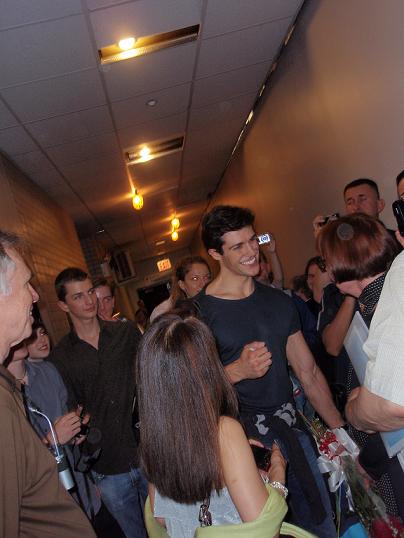
Anyway, I was to meet some of my new friends at the stage door, so after all the curtain calls I waited about fifteen minutes — until the ushers said they were closing the house — then walked downstairs (the Met stage door is basically in the underground Lincoln Center parking lot). I didn’t see my friends at first but ran into choreographer Avi Scher who was there to chat with friends. I was talking to him a little bit when Alexandre Hammoudi, who danced Paris (and who I liked recently as Orion in Sylvia), exited. He and Avi are apparently friends because he stopped to talk. Alexandre was the sweetest guy — kept congratulating Avi on his recent successes with his company (at Jacob’s Pillow, at City Center). And he has the most charming smile and accent 🙂 My new crush 🙂


Anyway, weirdest thing when Irina and Roberto exited. Irina exited first and got mobbed. By the time she got down to where I was standing she seemed really frazzled, like she really needed to get out of there. Max Beloserkovsky (her husband) was with her. They were being nice and polite and responding to people who wanted to say hello and get a picture but they seemed like they really needed to be somewhere. She’s so tiny, and so beautiful in person. Both of them are.

Then Roberto made his grand exit / crowd entrace last and he seemed the same. It was crowded, like it was for Swan Lake, but a little less so, but he seemed like he really needed to be somewhere in a huff as well. I wondered when the company is flying out to L.A.; Irina and Roberto are to open the Los Angeles season this Thursday but I figured they weren’t leaving for a few days.

p7122018

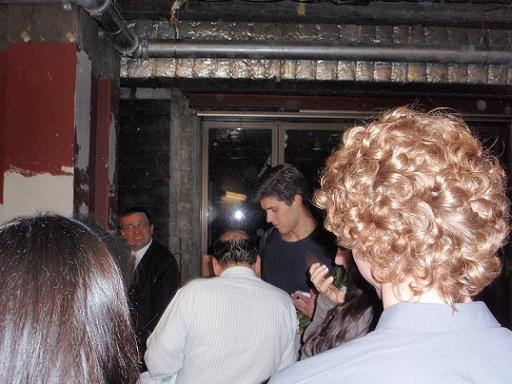
Anyway, he was stopping for some pictures and autographs, but not many. You really had to be an aggressive fan to get a photo with him. Then, this guy beside me with a monster camera asked him for something as he passed by us — I assumed it was a picture — and his eyes got wide and he said “no, no” and shook his head rapidly, smiled and looked quickly away. I wondered what was such a big deal — maybe the guy wanted to take a video and wanted him to talk into the camera or something, because why balk at yet another picture?

Anyway, rather hilariously, Roberto just started walking briskly through the crowd. If you didn’t practically downright clobber him, you weren’t getting a picture or autograph or anything.

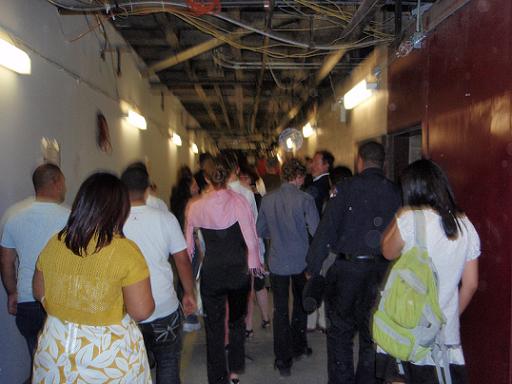
So, he was walking through the crowded hallway kind of snaking through the crowd acting as if none of those people were actually there to see him (which I guess is nice; if a dancer makes this huge exit and dramatically opens his arms out to the crowd like Evita, you’d think, how frigging presumptuous, right). Well people didn’t really know what to do. So everyone just kind of started following him! At this point, I spotted my friend I was to meet in the crowd and I called out and tapped on her shoulder. “Come on!” she said, motioning for me to follow as well. So I followed. Haha, he was like an unintentional Pied Piper leading us all through the underground Lincoln Center maze.

p71220161

p7122019

p7122020

He stopped near the exit to the parking lot for a few more pictures and autographs.

p7122021

And then he just stopped, and stood there, and no one knew what to do! I don’t know if he even realized there was this huge group of people who’d followed him outside and were eagerly awaiting his next move.

It was like we didn’t want the season to end and he was the last performer to leave and we were all kind of devastated! We didn’t want him to go home, and we didn’t want to go home ourselves (it didn’t help that it was POURING with kind of frightening thunder and lightening).

p7122023

Finally, he went off with a couple of incredibly lucky women (who we surmised were agents and the like) and we all stood watching as he exited southside of the lot by Fordham Law School. My friend called out “Ciao, ciao, Roberto.” And then others joined in. He turned around one last time and nodded and said bye.

And we just kept standing there while he walked out into the pouring rain with those women. No umbrella. “He needs an umbrella,” someone said. “I think we should go,” someone else said. After his increasingly small figure finally disappeared into the distance, my new friends and I walked back through the maze to the north exit. Everyone else who was still out there followed. Everyone had their heads down and looked so forlorn! Under the 67th Street scaffolding my friends and I chatted for a while about the season and this final performance and some of the dancers we like and our own dancing. Then, probably about an hour later, a cab came by honking and I told them to take it. They got in reluctantly. We vowed to find each other again next season and hang out and keep up via blogs and facebook until then.

So nice making new ballet friends! And I met several this season. But so horrible when the season ends. I hate this feeling!

MARCELO GOMES STILL MY FAVORITE!


I had an insane weekend (out from early evening until not so early next morning both Friday and Saturday at Brooklyn ballroom competition, with ABT Saturday matinee of Sylvia sandwiched in between. Then spent all day today doctoring ballroom photos –mostly frustratingly unsuccessfully– then met with a friend to discuss a possible excursion to Jacob’s Pillow this summer.) Anyway, I haven’t slept in some time and have to get up early tomorrow morning so I have to make this short, but I saw Sylvia Saturday afternoon. Cast was Marcelo as Aminta, Paloma Herrera in the lead, Alexandre Hammoudi as Orion (making his debut in the role I believe), Arron Scott as the god Eros, and Kristi Boone as the goddess Diana. This viewing confirmed that Marcelo is still my favorite dancer, far and above over Roberto Bolle 🙂

Roberto has beautiful lines and a tall, long-limbed, lean-muscled body and all (and of course he’s really handsome) but Marcelo is a better actor, his facial expressions are more visible, he uses movement to convey meaning well, and his movements have more strength and sharpness and are just athletically astounding. Not that it has to be a competition of course! I was just worrying myself that I might be changing favorites 🙂 They’re each very endearing of course in their own special way — Roberto has a sweet boyish shyness about him while Marcelo seems more graciously personable, but all of the principals have a certain quality that endears them to you — that’s why they’re principals.

Anyway, I love how desperately Marcelo was searching for Paloma’s Sylvia at the beginning, how in love with her he was, how he prayed to Eros, how he took Sylvia’s arrow in his heart when running desperately to protect the god, etc. etc.. Even that glimpse we get of him behind the scrim when Eros shows Sylvia, still in Orion’s cave, that Aminta is looking for her — even though he’s just in a static pose, he looks so forlorn it’s just heartbreaking! And his movement is all so enunciated and precise — his jumps were stellar; I noticed for example, that every time he did one of those jumps where he brings the first leg up in attitude (that Roberto is doing in the photo here), he brought the first foot all the way up to the other thigh. But all of the jumps were there to show Aminta’s quiet desperation, not necessarily for show. And of course Marcelo’s swooping fish dives are to die for.


I do have to point out Roberto’s gorgeous feet though. I noticed them as he’d walk, slowly and pensively, tracing the ground with pointed toes. They’re very flexible, like Veronika Part feet.


Paloma Herrera was the most athletic of the Sylvias I saw (I didn’t see Gillian Murphy in this role). I said earlier that those jetes look very difficult — well, not on Paloma; she made them look like cake! She pulled everything off with such ease. I liked her better though in the first act. She really seemed like a nymph elated with success from her hunt, very happy with herself, very independent, and very annoyed at what she perceives as Eros’s intrusiveness into her life. I thought she was less compelling in the second and third acts, where she’s held in captivity by Orion and then is reunited with Aminta. I felt like those parts — particularly the captivity scene — became a bit Corsaire-like, just kind of about the silly theatrics. Apollinaire Scherr mentions that you never really know what you’re going to get with Paloma, how into the character she’s going to be, and I have to agree. I’ve loved her and felt she was really into the character at times and at others just thought she was so so. She’s always a spectacular dancer though.


Alexandre Hammoudi was excellent as Orion, the evil hunter. He acted the part very well, reacted well to Marcelo — I loved his early scene where he does a wicked dance over Aminta’s limp body — and his spectacular jumps with his legs slicing through the air like swords really showed his wickedness and formidableness.

Arron Scott danced Eros as a very good god, smiling a lot, particularly when he whipped off the old man-healer costume. Daniil Simkin’s Eros was a bit mischievous, but Arron’s was all heroic. He danced the bravura solo in the third act with all the nimble-footed kick-flicks very well.

I loved Kristi Boone, again, as Diana. I also thought a lot of Sylvia’s fellow huntress-nymphs stood out: Isabella Boylston for her expressiveness and Romantic touch, Simone Messmer and her completely original style and sense of timing, Sarah Lane for her sweet eagerness, and I liked Jared Matthews and Leann Underwood in the last scene as Ceres and Jaseion. I definitely prefer Jared in more movement-focused, non-dramatic parts. And conversely, I like Cory Stearns in the more dramatic parts. He danced Apollo with Maria Bystrova as Terpsichore, and while both danced well and were very regal, I just think Cory excels in acting parts. Also Anne Milewski and Carlos Lopez gave quite a show as the cute goats, as did Alexei Agoudine and Luis Ribagorda as Orion’s slaves. Very good Fourth of July production!

Oh but only thing — it being a matinee, and a holiday one at that — there were so many little children in the audience. One had a crying fit right during the hardest-looking part of the last act, with all the difficult partnering for Marcelo and Paloma — the huge overhead lifts and the fish dives! And I mean CRYING FIT. The poor mother! But Marcelo and Paloma kept their concentration and delivered same as always. Audience went wild with applause — partly, I’m sure for that reason alone!

AMERICAN BALLET THEATER’S PROKOFIEV PROGRAM


On the Dnieper grew on me after seeing it the second time on Tuesday night, with the new cast, although I still generally preferred the first cast. If you missed my earlier post on Ratmansky’s new ballet, it’s here. Second cast was: Jose Carreno as Sergei the returning soldier; Hee Seo as Natalia, his betrothed; Diana Vishneva as Olga, the flirt who steals his heart; and Alexandre Hammoudi as Olga’s volatile fiance.

I absolutely loved Diana as Olga. She and Hee Seo, who was excellent as well, really drove home the ballet’s pathos and heartbreak. A BalletTalk poster said that with Diana, Olga became the central character and I think they’re right. Diana’s Olga was the most dynamic character in the whole thing; she really underwent a change in those mere 40 minutes. And it was believable. She starts out this carefree and careless flirtatious girl, frolicking around, teasing Sergei, teasing her boyfriend. And when her flirtatiousness with Sergei sets the whole disastrous string of events in motion — Sergei falls for her and she for him, her fiance has an emotional breakdown and beats Sergei, her parents are distraught, and she realizes what she and Sergei have done to poor Natalia — she really grows up, overnight, becomes a totally different person, takes responsibility for her actions. When she and Sergei bow to Natalia at the end in a prayer for forgiveness, before running off to their new life together, you feel equal heartbreak for both women.

Hee Seo and Veronika Part were equally compelling, although Seo seemed a little younger and more naive up front and I didn’t notice the holding out of the arms and the resting of the head on the shoulder like I did with Veronika. Jose, who’s generally ABT’s best actor I think (he never overdoes it; everything is authentic), was good as Sergei, but different from Marcelo. Jose seemed to be searching for something at the beginning, trying to rediscover his hometown with those short, staccato steps in each direction. His movements at the beginning were more modern than ballet, sharp and staccato at points, like he was unnerved that he didn’t recognize things or that things were different. (That kind of movement is more visible on a smaller body though.) Marcelo didn’t seem as sad or desperate up front. But then when torn between the two women, with Jose I  didn’t notice the back and forth of the jumps, this way and that, as I did with Marcelo. The jumps first to one woman, then the other, are my favorite Sergei movement trait, along with the throwing himself to the ground in anguish, almost like a half push-up.

Alexandre Hammoudi was a very different fiance from David Hallberg. Alexandre was quieter, especially up front, not seeming to realize the potential dangers of Olga’s flirtatiousness. He underwent a character change, like Diana’s Olga, then, becoming aggrieved and angry when he realized what had happened. David was more volatile up front, as if that was fundamentally part of the fiance’s character. Those extremely fast-paced steps during his anger scene were not as pronounced with Alexandre as with David. It looked more like he was kicking up leaves (which they had strewn on the ground); with David he was using those feet like daggers. David made such an impression with that character, and specifically that going nuts scene — I’m never going to forget it; I’m never going to forget that insane, almost terrifying, tap dance.

Okay, can I stop talking about this ballet now and focus on the other Prokofiev pieces?!

I generally wasn’t in love with Desir (photo at top of post) by James Kudelka, at least not as it was danced here. The movement is lovely and much of it original and the dancers are excellent but something was just lacking and I can’t figure out exactly what. It’s a ballet about several different couples, and I think my problem is that all the couples are basically the same, at least the way it’s being danced by ABT. With someone like Tharp or Robbins, different couples have different issues — there’s a romantic couple, a sexed-up couple, a fighting couple, etc. Here, the first two couples on first, dressed in fiery red — the women in long, flowing dresses that really whirl when they turn, the men in brown pants and long-sleeved colored tops —  both seem passionate and in love, all but Gillian Murphy from the first night’s cast, wearing bright smiles. But I don’t know if the happy smiles are supposed to be there. Some of the movement is rather chaotic. The woman seems to want to go one way and the man keeps turning her the other, mid-air. Gillian was the only one who made this dramatic, as if there was something not quite right going on between the characters. Apollinaire Scherr noticed that as well; read her very insightful comments on the whole program here (scroll down).

Then we move to a set of four couples, all dancing at once. My favorite part of the whole ballet is the men of these couples. At one point, men and women split and the men all dance together, followed by the women doing a group dance. When the men group dance in this way, each is doing his own thing — one jumping arms up toward the sky as if in ecstasy, another jeteing back and forth as if confused, another spinning himself into a whirlwind, etc. Then the women dance and they all do exactly the same thing — hold up their skirts and tip toe around, jump waving the skirts all about, all in unison, in sync. They’re all the same character — what does this say about men and women? Then, the couples pair up again, each man to a woman, and there’s one really funny part where the women stand still and the men do a bunch of high, twisty turning jumps,their limbs flying — as if to protest, “what’s up with that?,” “how can you say that to me?” It’s very funny, very evocative of real life relationships. The audience seemed to laugh louder on the first night though.

Still, in all, the couple who stood out to me the most is the more adagio one with all the beautiful lifts. The second night it was danced by Jared Matthews and Maria Riccetto, who were very good, but there was just something extra special about Cory Stearns and Isabella Boylston that really took my breath away the first night. Another performance I’m not going to forget.

And then Prodigal Son. This isn’t really my favorite ballet and I don’t honestly see how critics can trash Boris Eifman so and love this. What’s with all that fist-pounding on the thighs, the wide-mouthed screams at what, being asked to get water from the well with his sisters? How melodramatic is that? I know it’s a classic now, but I feel if it premiered today people would laugh and roll their eyes. Unless Balanchine meant for parts of it to be funny, like that up front melodrama, and the “sex” scenes. Anyway, read Apollinaire’s comments about Prodigal too, though; she made me appreciate it more, and talked about how certain dancers can play up the immaturity in those early thigh-pounding scenes so that it doesn’t look so full of melodrama.

Herman Cornejo as the son and Michele Wiles as the Siren danced the leads on opening night; Angel Corella and Kristi Boone the second night. Unfortunately I have to miss the third cast — the magnificent Daniil Simkin and the tantalizingly beautiful Irina Dvorovenko. If anyone sees them, please report! I’m dying to know how they do together!

Herman was excellent dance-wise. As expected, he nailed all those high-flying, angst-ridden jumps at the beginning. He danced a little more carefully than Angel, who had a minor slip at the beginning, then looked like he might fall on his way down that slide in the middle section. But I felt Angel delivered on the drama better; he took me through the emotions with him. The way he watched his Siren, he was like a little boy mesmerized. It made you mesmerized by her too. And then the way he danced with her — it was like an awkward, boy losing his virginity, sex scene. I’ve never seen it quite look like that before, though it’s probably supposed to! Then when he was robbed and left to die (Herman was really shockingly stunning  in this part too — he was a horrid sight, his body up there, leaning almost lifeless against the cross-like slide), and came crawling back home body all dirt-encrusted, then into his father’s arms, like a baby. It does end up being very emotionally compelling, silly as it is at the top. I’d like to see Herman in this later, after he’s had a few goes at it. I think if he could up the drama more, he’d be perfect.

Kristi so far has been my favorite Siren! This role I find a bit inherently awkward too — all that wrapping the long train of her costume around her legs, crouching to get it between her thighs. It almost always looks more weird than sexy, but somehow Kristi whipped the fabric around so fast, it was spellbinding, practically had a dominatrix feel. And then when she does those — what I call upside-down crab walks — where she’s on her hands and toe pointes, belly up and she walks past him develope-ing her legs up with each step, spider-like — most dancers kick straight up, but Kristi’s developes went all the way back, practically to her chest. It looked so much more tantalizing than I’ve seen that before. Kristi’s pointed toes are so pronounced, her feet practically look like ensnaring sickles — she probably has a better Siren body than anyone (except for maybe Veronika Part — I wonder if she’ll ever be cast?)

Okay, I’m done. Sorry I keep writing so much! If anyone sees the Daniil / Irina Prodigal cast, please let me know!