Excited for ABT’s Nutcracker at Segerstrom!


I was so excited when it was announced a while back that my favorite ballet company, American Ballet Theater, will be performing its Nutcracker season at the Segerstrom Center for the Arts, in Orange County. I’ve so missed ABT since moving out of NY, and now I’ll get them for a whole two weeks! Alexei Ratmansky’s version of the classic is one of the best. And of course ABT has the greatest dancers around, in my admittedly very biased opinion 🙂

My faves, Marcelo Gomes and Veronika Part, will be opening the season. I’m also excited to see Misty Copeland in the lead, and Hee Seo.

If you’re in O.C., I hope to see you there!

Below is the just-announced casting:

Thursday, December 10, 7:30 p.m.
Veronika Part
Marcelo Gomes

Friday, December 11, 7:30 p.m.
Gillian Murphy
James Whiteside

Saturday, December 12, 2 p.m.
Isabella Boylston
Alban Lendorf

Saturday, December 12, 7:30 p.m.
Veronika Part
Marcelo Gomes

Sunday, December 13, 1 p.m.
Stella Abrera
Alexandre Hammoudi

Sunday, December 13, 6:30 p.m.
Gillian Murphy
James Whiteside

Tuesday, December 15, 7:30 p.m.
Hee Seo
Cory Stearns

Wednesday, December 16, 7:30 p.m.
Misty Copeland
Herman Cornejo

Thursday, December 17, 7:30 p.m.
Isabella Boylston
Alban Lendorf

Friday, December 18, 7:30 p.m.
Sarah Lane
Joseph Gorak

Saturday, December 19, 2 p.m.
Stella Abrera
Alexandre Hammoudi

Saturday, December 19, 7:30 p.m.
Misty Copeland
Herman Cornejo

Sunday, December 20, 1 p.m.
Hee Seo
Cory Stearns

Sunday, December 20, 6:30 p.m.
Sarah Lane
Joseph Gorak

Photo of Hee Seo and Cory Stearns by Gene Schiavone, courtesy of Segerstrom Center for the Arts.

THE BRIGHT STREAM at ABT


David Hallberg in Ratmansky’s The Bright Stream, Rosalie O’Connor photo.

I’m not exactly sure yet what to think of this ballet, which made its premiere at American Ballet Theater last week. There are a couple more performances left this week and I think I may see it one or two more times. Right now I kind of feel like the history of the production (as told by Marina Harss in ABT’s Playbill) is more interesting than what I actually saw.

According to Harss, the production was originally choreographed by Fyodor Lopukhov and premiered in Leningrad in 1935. But Stalin hated it so, he banned it, and eventually even sent the man who helped write the libretto to the Gulag. It was the last ballet Dmitri Shostakovich ever composed. Alexei Ratmansky (artistic director of the Bolshoi from 2004-2009) restaged it during his reign there, and the Russians loved it.

With a history like that, you have to wonder what it was that angered Stalin so. I can’t see it.  I just see it as a rather silly ballet – kind of reminiscent of Shakespeare’s Midsummer Night Dream but not quite there – that takes place on a collective farm during one harvest season. According to the newspaper Pravda, Harss writes, the producers’ crime was “balletic falsehood,” meaning, she says, it wasn’t a realistic portrayal of what people are like who live on a collective farm. In other words, there was too much silliness, and farmers are serious workers, not goofs. But Ratmansky explains that, in reviving the ballet, he was attracted both to the “lovely, danceable” music and the lightly humorous vaudevillian aspect of the tale, as well as to an underlying darkness, an edge, he found in Shostakovich. “There is always something hidden in Shostakovich,” he says.

To me, that’s fascinating, and is the reason I’m going to need to see it again … and the reason I’m going to need to listen to more Shostakovich.

I think, though, the problem to me may have been more that the Russians have a keener sense of how to put on something like this, where basically every role has bravura parts. I plan to go see the Osipova / Vasiliev / Simkin cast this week to see if I feel differently about it. I saw the third cast – Veronika Part as the main character, Zina (and Part was beautiful, and the one perfect thing I felt about this cast – she was the heart and soul of the ballet), Alexandre Hammoudi as her straying husband, and Cory Stearns and Stella Abrera as the main ballet dancers in the theatrical troupe that comes to town and shakes things up. I liked Cory too. He had the cross-dressing role that David Hallberg is pictured in above and he was very good. He’s a good actor, good with both comedy and romance and has a charming, very stand-0ut stage presence.

Anyway, the plot is rather complicated, and when I expressed that to my friend she laughed and said she’d given up on the synopsis and decided just to enjoy the beautiful music and the humorous dancing. She liked it much better than I did, probably because she decided to stop trying to figure things out and just enjoy… The plot: Zina works as a local amusements organizer. Her husband, Pyotr, has a wandering eye. When a traveling theatrical troupe comes to town to stage a ballet, Zina recognizes the main ballerina – they once took classes together. They dance together, and reminisce — it’s really Zina reminiscing about her dancing past (and Part did this just beautifully) – while Pyotr becomes enchanted with the ballerina. There are also a couple of older, long-married dacha dwellers, who are rather goofy and humorous (danced by past ABT greats Victor Barbee and Martine Van Hamel). The male dacha dweller falls for the ballerina, and the female becomes enamored of the male ballet dancer. When it becomes clear how attracted to the ballerina Pyotr has become, Zina begins to cry. The ballerina calms her, promises her she has no intentions of returning his affections, and suggests they all play a trick on the married dacha dwellers and on Pyotr whereby she will dress as the male ballet dancer and the male ballet dancer will dress as her. So, that’s why the whole cross-dressing thing happens. There are many subplots as well, one involving a milk maid and her companion, a handsome tractor driver (who decides to dress as a dog), but this theme of married man falling for someone who is not his wife, then realizing how much he does value her, is the main theme of the ballet.

It was pretty funny to see Cory Stearns try to dance on pointe, but funnier to watch his character get carried away with the spread-legged, very masculine-looking jumps in that white sylph dress. He and the ballerina are, after all, ultimate hams in need of audience applause, so it makes sense that he forgets himself for a time and starts really acting like a man. I really wonder how David Hallberg does that part – and that makes me want to see his cast as well. Stella Abrera was fine as the ballerina, and mildly funny when she becomes a boy, but she’s not as spectacular of a dancer as, for example, Natalia Osipova, and I’d think that role should go to an allegro dancer like her. I imagine Osipova must be absolutely perfect in that role (since she can do mind-blowingly crazy high jetes better than many men).

Alexandre Hammoudi did well as Pyotr, though there didn’t seem to be a whole lot to that role, which makes me curious to see Marcelo Gomes and Ivan Vasiliev in the part.

I feel like, because the story-line is so slight, and because, as I said earlier, practically every role has some bravura parts, that this is a ballet that needs really spectacular dancing, that needs people cast in every part who are the kind of dancers who are constantly saying, “Hey, look at me, I can jete to the ceiling!” or “I can develope over my head!” or whatnot. And ABT dancers just aren’t trained to be that way – at least most of them aren’t.

One other gripe is the costumes, particularly for the men. The blasted pants. The mens’ lines were clumsy and unfinished and I think it was because the pants were too restrictive. It’s unusual that every single man would be unable to do a proper straight-legged jete or lift his leg more than a couple inches off the ground in arabesque – especially Gennadi Savliev, who always comes through on the stunning athletics. It had to be the pants. I understand why Ratmansky wanted to set the period with the costumes, but as with classical ballets, can’t the tops be the period-setters and the bottoms just be regular tights? Ballet is all about form!

Did anyone see the other casts yet?

Paperback Dolls and Nutrackers

I have a guest post up today at the Paperback Dolls blog! They’re currently featuring New York authors and bloggers as part of their “Passport to New York” series. So, since I’m both, I talked about both my novel and the blog.

Regarding the blog, I gave their readers some recommendations on what to see in New York for the next couple of months dance-wise. I then realized I haven’t done that for my own readers yet, because I’ve been so blasted busy. But of course everyone who regularly reads my blog knows what I’ll recommend: Alvin Ailey, upcoming at City Center for the month of December (it’s Judith Jamison’s last season as artistic director so there will be lots of tributes to her); New York City Ballet’s Balanchinian Nutcracker which has already begun and continues on through the beginning of the year; and ABT’s new Nutcracker, which begins December 22nd and will be at Brooklyn Academy of Music.

I didn’t have a chance to write about it but I saw a small sneak preview of ABT’s new Nut at the Guggenheim’s Works & Process event a couple weeks ago, at which choreographer Alexei Ratmansky and conductor Ormsby Wilkins spoke. Several excerpts were performed including Veronika Part and Marcelo Gomes dancing part of the final Clara and the Prince pas de deux, the Russian dance, and some of the snow scenes. Ratmansky and ABT representatives had said earlier during a press conference that it would be pretty much traditional, but from what I saw it looks very modern. The costumes and sets – which are gorgeous and are made by Richard Hudson, the Tony award-winning set designer of the Lion King – are period, but the movement looked very modern to me, not at all classical. The pas de deux looked like lyrical and more romantic (without a capital “r”) and less fairy tale-like than I’ve normally seen, and the Russian dance looked folksy and even a bit slapsticky rather than the classical bravura dancing we’re used to with “Trepak.” Anyway, Ratmansky had noted that the original choreography for this ballet is no longer extant so that’s why there are so many different versions. The only two versions I’m really that familiar with, I guess, are Balanchine’s and the San Francisco Ballet’s two-year-old version, the DVD of which I reviewed a while back.

Anyway, I think the new Ratmansky Nutcracker is going to be a departure from the ordinary, and it will be interesting to see the whole and see how audiences react!

Happy Thanksgiving, everyone!

The Flames of Paris, and Emerging Pictures’ Ballet in Cinema Series


Yesterday, I was invited to a preview of a filmed recording of the Bolshoi’s The Flames of Paris. The film will begin showing in New York at the BIG Cinemas Manhattan on November 2nd and will be broadcast nationally in over 30 locations starting on that day as well.

This film is the first in Emerging PicturesBallet in Cinema series, which, like the Met Opera’s high definition series, is a series of live (or recorded, but most are live) ballet performances that will be broadcast in various movie theaters. I’m psyched about this, especially since I’d bemoaned that ballet didn’t have such a thing when the Met Opera first started their film series.

Flames, by the Bolshoi, is the first ballet, and, as I said, it begins showing on November 2nd. That performance is recorded. Here is the rest of the schedule:

The Nutcracker, performed by the Royal Ballet (London), December 1, 2010 (Recorded)
The Nutcracker, performed by the Bolshoi, Sunday, December 19, 2010, 11 a.m. EST (Live)
Giselle, Royal Ballet (London), January 19, 2011, 2:30 p.m. EST (Live)
The Class Concert and Giselle, by the Bolshoi, January 23, 2011 11 a.m. EST (Live)
Caligula, Paris Opera Ballet, February 8, 2011, 1:30 p.m. EST (Live)
Don Quixote, Bolshoi, March 6, 2011, 11 a.m. EST (Live)
Coppelia, Paris Opera Ballet, March 28, 2011, 11 a.m. EST (Live)
Coppelia, Bolshoi, May 29, 2011, 11 a.m. EST (Live)
Children of Paradise, Paris Opera Ballet, July 9, 2011, 1:30 p.m. EST (Live)

At this point I’m not sure of all the locations or the time on the top date, but will let you know more specifics when I know. For now, for more info, visit their website or Facebook page.

Anyway, on to The Flames of Paris. This production is from March of this year, in Moscow, and stars Natalia Osipova, Denis Savin, and Ivan Vasiliev (as excellent a dancer as Osipova). It was originally choreographed by Vasily Vaynonen and performed in 1934, but Alexei Ratmansky has reconstructed it. Music is by Boris Vladimirovich Asafiev, a Russian and Soviet composer, and is based on songs of the French Revolution. Interestingly, it was Stalin’s favorite ballet, which confuses me, unless Ratmansky substantially re-worked things, but I’ll get to that in a minute.

It’s set during the French Revolution and tells the story of a pair of brother and sister peasants, Jeanne and Jerome (Osipova and Savin), a Marseillais (revolutionary fighter) named Phillipe (Vasiliev), and Adeline (danced by Nina Kaptsova), the daughter of the local Marquis. Jeanne and Jerome are young, energetic free spirits at the beginning of the ballet but, upon meeting Phillipe (whom Jeanne eventually falls in love with) become revolutionaries too. Adeline, bored at one of her father’s aristocratic parties (and perhaps jilted by a man there as well – I couldn’t really tell), wanders off, and eventually finds herself in the camp of the Marseillais. She hooks up with Jerome and they fall in love.

Eventually, as well all know, revolutionary fervor leads to the deaths of King Louis XVI and Marie Antoinette. During the last scene, Adeline sees her father, the Marquis, dragged toward the guillotine. She becomes hysterical and begins rushing toward him, trying to save him. Jeanne and Jerome try to hold her back – Jerome out of love for her and Jeanne seemingly out of now hysterical patriotism, demanding the Marquis’ death along with the other Marseillais. But Adeline won’t leave the executioners alone, and when they discover who she is, she is put up on the platform, under the guillotine as well. The ballet ends with her crying and looking terrified as the guillotine comes down on her head.

Jerome keels over crying and Jeanne comforts him, but then, as he is given Adeline’s head wrapped in some kind of gauze, Jeanne is lifted and off she goes with the other Marseillais fist pumping in the air, French flag overhead, with the creepiest most possessed, horror movie-esque look in her eyes I may have ever seen.

When I left the theater I felt very unsettled and more than a little scared of revolutions in general and the uncontrolled murderous mob activity they can lead to. Unless Ratmansky completed changed the ending, I don’t see how this was a piece of propaganda, glorifying the French Revolution and likening it to the equally glorious Russian. I thought Ratmansky had been criticized for bringing back two Soviet-era propaganda ballets – this one and Bright Stream – during his time at the Bolshoi. I feel like either I missed something, or he changed things. New Yorkers will be able to see Bright Stream at ABT next summer.

Anyway, the dancing was tremendous, and Natalia Osipova is just as spellbinding on screen as she is onstage. She just moves so fast and with such precision and power and impeccable technique; when she’s done you feel like you can’t believe what you just saw. I can’t imagine there’s going to be another dancer quite like her. She’s also a very good actress. She had the tomboyish, peasant-like gait down solid here; there was no flirty Kitri anywhere in this performance. She also, as I said, perfectly embodied the almost crazed Marseillais, sad for her brother but too hateful toward the Marquis to feel much for Adeline.

Vasiliev is also an excellent dancer, and his final final pas de deux with Osipova was fantastic. Crowd went wild, of course. And Russian crowds are a bit more fun than American 🙂 They clap in unison, all clapping on the same beat, as if they’re cheering the dancers on to do an encore to the rhythms they’re making. But there were no encores, just bizillions of bows. I realized that the ABT production of the pas de deux, during their City Center season a couple years ago, was altered probably to suit the strengths of Daniil Simkin. Vasiliev did none of those crazy over-rotated barrel turns that Daniil in known for and I thought I remembered a no-hands fish at the end of the ABT performance?… It wasn’t here. Also, they remained dressed in their regular street clothes; no fancy princess tutu for Natalia.

I thought Savin, tall and wiry, was a bit out of control in his dancing in parts, but maybe that was just part of the character. I think the Russians try to move the audience, to tell the ballet’s story, with their acting just as much as with their dancing, which is somewhat different than American-trained dancers, who seem to focus more on technique and movement quality than characterization. I thought Nina Kaptsova was a beautiful dancer. And she was perfect for the part of vulnerable Adeline. But I’m sorry, I can’t help but feel for anyone who has to share the stage with Osipova!

I loved the camera work – it panned in and out, just like in the Met’s HD films, homing in on various characters at certain points in order to make it more cinematic.

I’m really looking forward to the other performances. We don’t otherwise see much of the Bolshoi, the Royal and the POB here and, if the other films are as well-made as this one, I feel like you do get a very full experience.

Above photo (of Osipova, Savin, and Vasiliev) taken from here.

New York City Ballet’s First “See the Music” Program

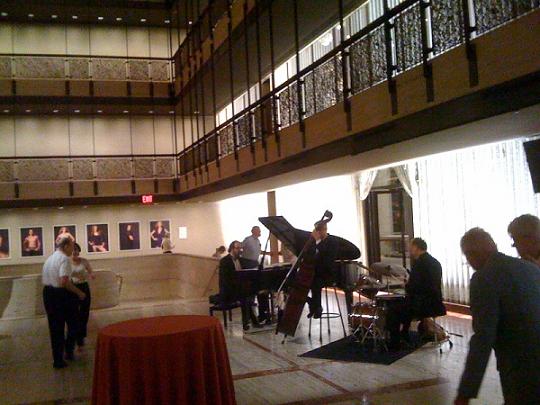
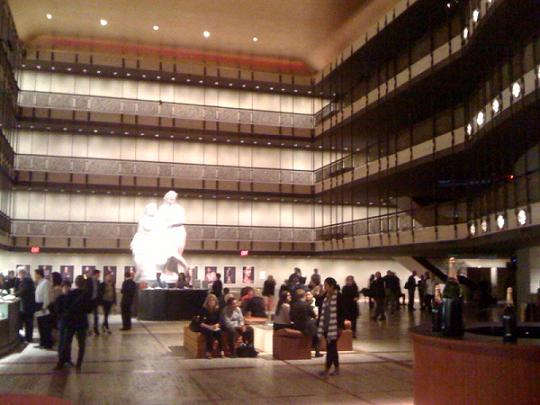
Friday night, my friends Hsien and Alyssa came with me to see the first program in NYCB’s “See the Music” series. First, we met for drinks on the promenade, which, as I mentioned, they’d opened an hour before showtime for the first week of this fall season. We watched members of the orchestra play some soft jazz music, which some patrons were dancing to. I know Hsien from my ballroom dancing days and we had to laugh because some of that music sounded straight out of Blackpool! (Blackpool’s one of the only – perhaps THE only – ballroom dance competition with live music.) (Above are a couple of my pictures of the promenade, about an hour before the performance, with people beginning to gather. My iPhone seems to take better photos outside…)

The two ballets performed were Ratmansky’s Namouna: A Grand Divertissement, which premiered last season, and Jerome Robbins’ The Four Seasons, which served for the first week of this first fall season as a tribute to fall.

Before the performance, Peter Martins came out and introduced the new series, explaining that it was inspired by Balanchine’s highly musical approach to dance, his belief that dance is music made visual, summarized by his words, “see the music, hear the dance.” Then the newly movable orchestra pit rose (as I knew it would!), and up came conductor Faycal Karoui with his crew, to explain a few things about Eduaord Lalo’s Namouna score. No one could give these talks but Karoui. He is hilarious, such a character!


Photo of Karoui by Paul Kolnik, taken from The Faster Times.

Karoui joked, in his thick French accent, that the music is very French, because of its … charm of course. Okay, then he became serious. The Lalo score is too long, of course, to talk about all of it, but Karoui focused on a few sections. One of the sections, he explained is characterized by its transparency of orchestration, meaning the harmonies don’t always  behave the way you expect them to; they are a surprise. He talked about how the beginning of the score had a nautical theme, and it opened with a sound like waves, but more German waves than French, he said, as the opening crescendo sounded more like Wagner’s The Flying Dutchman. He talked about the conversation between the harps and the strings, how Lalo plays with flexibility inside the tempos by following a quick tempo with a slower one, and he showed how Ratmansky had the dancers visualize part of that tempo by having the corps women at one point use cymbals onstage. After Karoui did a little dance himself while clapping the cymbals, he and Martins had the audience clap where the cymbals should be played to get us to internalize that rhythm a bit.

Karoui spoke at length about one of my favorite scenes in the ballet, where a group of smokers (led by Jenifer Ringer) really kind of tantalize the poor male lead, blowing smoke right into his yearning little face. It’s called “The Cigarette Waltz” believe it or not, and Karoui showed how the music really teases and tantalizes you into desperately wanting a cigarette, just like Ringer and her friends tantalize the poor sailor into wanting one of them. “Oooh, I really want one now,” Karoui cried after the orchestra demonstrated part of that waltz.

I liked Namouna much much better on seeing it a second time. I wrote about it earlier here (also, read Marina Harss’s fabulously detailed and in-depth description in Faster Times). It seemed less long this time, and each of the the parts seemed entertaining and compelling, each having its own theme and it own little storyline, however abstract the whole was. Maybe it was because of Karoui’s brief humorous explanations of the music, or maybe it’s just Ratmansky, because I always feel this way with his work – that nothing strikes me that much on first viewing, but that the more I see each ballet of his, the more I see in it, and the more entrancing I begin to find it.

That ballet was all the same, except this time Tyler Angle took over for Robert Fairchild as the main sailor guy. I’m told Robert is out for the moment with an injury. I loved Robert, but I really liked Tyler as well. Robert is so boyishly charming like Jose Carreno, and his dancing is more sharp and precise, hitting every count with spectacular flair and pizzaz, whereas Tyler’s more Romantic with his expression, with stretching port de bras and longing lunges, and he really draws out the music. They are such different dancers and it’s always nice to see another’s interpretation.

The next “See the Music” program will be this Sunday’s matinee.

New York City Ballet’s First Fall Season Opening Night


Tuesday night, New York City Ballet opened its very first fall season with performances of Balanchine’s Serenade, Peter Martins’s Grazioso, and Jerome Robbins’s The Four Seasons. First, before the performance began, Peter Martins came out and introduced each of the principal dancers, who came out onstage one by one, and said this season would be a celebration of them. Tiler Peck in particular was wearing this really gorgeous silky fuchsia dress. Martins said all principals were there except for Benjamin Millepied, who was doing something movie-related “en France,” he said with a funny faux Euro accent. Everyone laughed and gave the dancers a huge round of applause. The house was packed and it was clear how thrilled the company’s many fans are with there being a fall season this year. Martins made fun of himself for being so into toasts and said that during intermission, we’d all be given be given free champagne to toast the principals. Which we were – very fun!

The part of the performance I was mainly looking forward to was Janie Taylor’s debut in Serenade (above headshot and Serenade photo by Paul Kolnik) as the main ballerina. As usual with her, she completely made the ballet her own. I thought the ballet had a somewhat dark element with her, that I’ve never seen before. When she first ran out onstage, late for class, instead of looking like she was all frantic about being late because she’d been held up by a boy, it looked like she was running from something – from him. That man was Charles Askegard and when he danced the middle waltz part with her, the huge size difference between them added to the sense of foreboding, that she was fragile, he was pushing her around, and she’d eventually be hurt by him. At certain parts, it was literally like he was pulling her along. When he lifted her and she raised her legs in a split, it looked almost like she was trying to get away from him. Sara Mearns was the angel and Ask La Cour was the man who I call “blind justice” who take care of Taylor when she falls, and it was interesting how much the two male leads and two female leads looked alike. I almost got Taylor and Mearns mixed up at parts, thinking they were taking on the other’s role. And the end when the men raise Taylor up like pallbearers and she is carried off by them, arching her back, arms outstretched  – so hauntingly beautiful. It reminded me a bit of Balanchine’s La Valse.

I was also looking forward to Martins’s Grazioso, in which three handsome men – Gonzalo Garcia, Andrew Veyette and Daniel Ulbrich – vie for Ashley Bouder’s attention with their bravura moves. I don’t think this ballet has been performed since it premiered a few seasons ago. And I loved it all over again. I love how each guy has his own personality – Garcia is the romantic, Veyette is the manly man one, and Ulbrich is the one with all the high jumping tricks. And Bouder really played the tart, looking at each of them up and down at points kind of lasciviously, really trying to choose. The guy next to me was really giggly over it.

And the evening ended with Robbins’ The Four Seasons, which itself ends with a lovely tribute to fall.

This whole season the Koch theater will open an hour early. The promenade overlooking Lincoln Center Plaza will be open for cocktails, the gift shop will be open, and, for the rest of this opening week, there will also be live jazz performed by the NYCB Orchestra one hour before performance time. They have the promenade and mezzanine area done up nicely, with big plush chairs. Also taking place the rest of this week will be a “meet the artists” session whereby, beginning at 6:45 p.m. in the first ring of the auditorium, the principals dancers will be available to chat with ticket holders. There’s also a photo exhibition of the dancers by photographer HenryLeutwyler on display in the theater throughout the season.

Tomorrow night will be the first of seven “See the Music” performances which will provide a look inside NYCB’s 62-piece orchestra. At the beginning of each performance, Peter Martins and musical director Faycal Karoui will briefly discuss the program’s music, followed by the orchestra performing an excerpt of one of the ballet scores. The subject of tomorrow night’s discussion will be Eduoard Lalo’s score for Ratmansky’s Namouna: A Grand Divertissement, which premiered last season. Additional “See the Music” programs are Sept. 26 matinee, January 20, Feb. 1, Feb. 19 matinee, May 25 and June 11.

BARYSHNIKOV RETURNS TO THE STAGE


Here’s an interesting preview by Joel Lobenthal of Baryshnikov’s return to the stage, which happened at BAC this Wednesday. He danced three solos, along with two other men — Steve Paxton and David Neumann. Program was called, aptly, “Unrelated Solos.” I went last night, and particularly loved the last piece for Baryshnikov, a work in progress by Susan Marshall, which, to me was a meditation on how dance is meant for an audience, a performer must have a viewer or s/he is not a performer. It left a lump in my throat at the end. The other two solos for Baryshnikov were by Benjamin Millepied and Alexei Ratmansky – the Millepied another rather sobering reflection on a life spent in dance and the aging process, and the Ratmansky a rather funny retelling of composer Mikhail Glinka’s obsession with an aristocratic woman that made me realize how great an actor Baryshnikov was and made me sad that his and Ratmansky’s eras didn’t really intersect. I’d think Ratmansky could have come up with a lot of very clever, humorous work for him.

Both of the Neumann pieces were highly entertaining and witty, and the Paxton reminded me of Sara Rudner and the dance for dance’s sake / Judson Movement where the emphasis is more on the inner awareness of the dancer than strictly on the “performative.”

Anyway, don’t have much more time to write about the program right now but plan to write more this weekend. But read the Lobenthal article. And here is Macaulay on the program.

Photo by Julieta Cervantes.

NEW YORK CITY BALLET OPENING NIGHT GALA: NAMOUNA AND WHY AM I NOT WHERE YOU ARE


All photos by Paul Kolnik. Top two are of Benjamin Millepied’s new Why am I not where you are, and bottom two are from Alexei Ratmansky’s new Namouna: A Grand Divertissement.


Sorry I’m late with this post — I had serious internet problems over the weekend and they’d better not continue today or I may kill someone from Time Warner. Anyway, Thursday night was the opening night of New York City Ballet’s Spring / Summer season, and there were two world premieres: first Millepied’s Why am I not where you are, followed by Ratmansky’s Namouna, A Grand Divertissement.  I thought both were good and entertaining, if nothing earth shattering. And maybe it’s just that I’m getting to the point where I’ve seen so much ballet but it seems that everything is a combination of several other things, which isn’t bad. Millepied’s kept me more engrossed, only because Ratmansky’s was just too long.

Millepied’s reminded me by turns of Balanchine’s La Valse (which everyone seems to have thought), Robbins’s West Side Story, and even Balanchine’s version of Swan Lake, particularly where Siegfried frantically tries to find Odette through the swarm of swans who run around her in circles, frighteningly, creating a kind of hurricane.  It seemed there were also parts of the White Swan pas de deux between Sara Mearns (who danced gorgeously, as always), and her “love interest” Amar Ramasar. There even seemed thematically to be elements of Angelin Preljocaj.

The main character is Sean Suozzi who, wearing all white, seems to be a lost in time, or a human searching for other earthlings and who runs into this lot of ethereal creatures all dressed in colorful Romantic tutus. But instead of being beautifully beguilingly ethereal, they are more frightening, like aliens. There’s a very modern set by architect Santiago Calatrava (who collaborated with many of the choreographers who are premiering ballets this season and to whom the season is devoted — he was toasted by Peter Martins at the beginning of the evening), that to me gave the sense that someone — either Suozzi or the others — were from another place. Music, by Thierry Escaich, is unsettling as well. Suozzi falls for Kathryn Morgan, but in their initial pas de deux Morgan can’t see him. She seems to be blind to him. But he tries. The group of men do a kind of intense West Side Story dance, and eventually, Suozzi manages successfully to fit in, to become one of them, as is made clear by Ramasar’s giving him several articles of colorful clothing (a la La Valse) to don. Afterward, he dances again with Morgan but now it is he who cannot see her. Soon, the others swarm around her, violently plucking pieces of her tutu off. Eventually she’s the one wearing nothing but white undergarments, and she’s left devastated, alone and alienated. It was intense and enthralling and I definitely want to see it again, perhaps with Janie Taylor in the female lead (she withdrew due to injury).

Ratmansky’s reminded me of a cross between Branislava Nijinksa’s Les Biches and his own Concerto DSCH with elements of Balanchine’s Midsummer Night’s Dream thrown in. It’s harder to describe than the Millepied because there wasn’t much of a through story, just abstract portions combined with smaller stories that didn’t seem to merge into a larger whole. It’s set to really lovely music by Eduoard Lalo, which in places sounded like Glass’s In the Upper Room. I can’t remember the whole thing but Robert Fairchild is this guy dressed in white sailor garb. At one point, he happens upon some women dressed in 1930s beachy-seeming clothes and wearing hair caps and kind of taunting him with their humorously sexy cigarette smoking. Jenifer Ringer did a fabulous job of playing the main cigarette-bearing “taunter.” She’d puff in his face and he’d look enraptured but confused. Later, a group of people run toward him, carrying a passed-out Ringer and one man bows at Fairchild, as if for forgiveness. The other women haughtily puff on at the front of the stage. Everyone laughed. This cigarette girl part was my favorite. Then, there were some bravura parts for Daniel Ulbricht, dressed in kind of Puck-ish Midsummer Night‘s garb and doing the same high jumping, running through the air leaps as Puck. If I can remember correctly he was accompanied by some cutely impish female elfs, in the form of Abi Stafford and Megan Fairchild. There are sections where a lot of women in long yellow dresses do various port de bras and rather humorous (to me anyway) jumps in place a la Concerto DSCH, and toward the end Wendy Whelan emerges and is this kind of bride for Fairchild. They do a pas de deux filled with lots of classical ballet lifts and then they get married and supposedly live happily ever after.

I liked the Ratmansky and would be happy to see it again if it weren’t so blasted long! It felt like it went on for about an hour and a half! Before seeing it, I recommend taking a walk at intermission to stretch your legs, and go to the bathroom!

CASTING FOR OPENING NIGHT NEW YORK CITY BALLET


Ballet season is almost here in NYC! New York City Ballet opens April 29th with a program that includes two premieres — one by Benjamin Millepied and one by Alexei Ratmansky (now ABT’s resident choreographer). The Millepied ballet, set to music by Thierry Escaich, will star several SLSG favorites: Janie Taylor, Sara Mearns, Sean Suozzi and Amar Ramasar.

The Ratmansky, set to a score by Eduoard Lalo, will be danced by Wendy Whelan, Jenifer Ringer, Sara Mearns, Robert Fairchild, Megan Fairchild, Abi Stafford, and Daniel Ulbricht.

The two world premieres will launch this season’s Architecture of Dance – New Choreography and Music Festival, devoted to new work. Acclaimed architect Santiago Calatrava has created scenic designs for five of the season’s premieres, including opening night’s Millepied piece.

Go here for tickets and details.

Above drawing by Santiago Calatrava.

ABT, currently on tour in Chicago, opens its classical season at the Met, in honor of its 70th anniversary this year, later, in May.

ABT, NYCB, Yankees — CLEARLY the best time of the year 😀

SARA MEARNS’ MOVING ODETTE, A TRIBUTE TO DARCI KISTLER, AND NEW ADAM HENDRICKSON BALLET


Photo of Sara Mearns in Swan Lake, by Paul Kolnik, taken from NY Times.

Last week was the first time I’d seen Peter Martins’ version of Swan Lake. Overall, I wasn’t in love with the production, but I was in love with the dancing, particularly Sara Mearns’ interpretation of Odette, which nearly moved me to tears, which just hardly ever happens with Swan Lake. She is the Veronika Part of New York City Ballet to me and I just love her. She inhabits whatever character she’s dancing with her entire being and she takes you to that place with her; she really creates another universe and she puts you right there and won’t let you leave it! I think here what I loved was that she humanized her Odette. So many ballerinas will focus on getting the fluttering foot just right, waving their arms about with just the proper fluidity that they look like actual wings, and of course totally nailing the chaines and fouettes in the second act. They make the White Swan all about the styling and the Black Swan all about the athletics. And they forget about the story.

But with Mearns — just the way she would wrap Prince Siegfried’s arms around her body, the way she’d nearly dive into an arabesque letting him catch her before turning her, or fall nearly to the floor and arch her back, wrapping herself around his kneeling knee — everything was about the tragic story, about Odette’s loving the prince and longing for him and her need for him, and then his inability to fulfill that need. I’ve honestly never been so moved before, and when she bourreed away from him at the end (there are no suicide swan dives into the lake here), leaving him, it just left me with such a emptiness. I couldn’t stop thinking about that — about her wrapping his arms around her in the pas de deux and then her sorrowful bourrees away from him at the end — for days; I still can’t get over it. I think those images will always be in my mind when I think of this ballet.

And she just had so much stage presence. Sometimes when all the swans are onstage together, I’ll lose Odette, but not with Mearns. I think that may partly be because she has a broad face, allowing her expressions to be more noticeable to the entire house. But of course she makes those expressions that not everyone does — her face, her body, she is always fully immersed in the role.

And Jared Angle was the absolute perfect partner. You can tell he’s a very strong guy and a very solid partner who’s easy to get along with. Because she’d really really throw herself into those arabesques and he’d catch her and she was so off her center of balance — she had to be in order to show the passion and emotion, and the full, expressive line – and he’d promenade her like that, and it was so incredible because you could tell he spent the better part of the ballet supporting a lot of her body weight.

And he acted it well too, and did perfectly on his solos. Very impressive performance by him!

The other cast I saw was on opening night with Maria Kowroski in the lead and Stephen Hanna making his debut as Siegfried. Hanna was very good — he’s a strong guy too, and that night, he performed a major save! Toward the beginning Kowroski went to jump into his arms, on her way into a shoulder-high lift, and she slipped before she ever got to him. He somehow reached out and caught her anyway, and took her up into that lift beautifully. The whole audience went “ahhhhhh”! I think it threw Kowroski a bit though because she seemed nervous and a bit shaky throughout the rest of the ballet. She might also have been a bit anxious because Hanna was debuting in the role, so they obviously hadn’t performed it together yet. At intermission, someone mentioned she might have been less nervous dancing with her usual Charles Askegard. Maybe that’s true. I thought Hanna did a very good job overall.

But I’m not in love with the production. Like Martins’ Romeo + Juliet, the sets are very modern, and the costumes for Siegfried and Benno and his friends are bright, color-coded, and basic with minimal embellishments. But the sets are the worst. In the beginning, you can’t even tell they’re in a palace. In the second act, the sets are not only minimal, but what’s there is so incredibly modern, just a few brown and beige slashes on some backboards. And yet, the people are dressed in Elizabethan costumes. Either set it in modern times completely or go with the historical thing, but don’t do half and half?…

And the production just moves way too fast, in my opinion. This worked for Sleeping Beauty (the paring down of all the miming and the boring court dances, in favor of getting right to the point and to those gorgeous variations), but it didn’t work here because there’s too much story up front missing. We see all these people dancing — we don’t know they’re in a palace, so we just see them all dance, and next thing we know, Siegfried’s all bouncing around with a bow and arrow. Then he runs offstage and a moment later, on comes Odette. Then Siegfried runs back out and they do a pas de deux, and after that’s over, Odette runs one way, Siegfried runs the other, and on come the swan ensemble. And — and maybe this is conductor Karoui’s doing — but you don’t even realize Odette’s run away from Siegfried because she’s afraid of Von Rothbart, and that now Siegfried is running around madly trying to find her. Instead, it just looks like a bunch of running. There should be pauses so that you know exactly what’s happening and why– the pacing is way way too fast. I never really did see Siegfried fall for her. I first realized there was something between them when Mearns’ Odette wrapped Siegfried’s arms around her in the White Swan pdd.

The other thing is the ending, which I both like and don’t like. In this ending, there is no suicide with the two lovers  ending up together in eternity. Instead, since Siegfried has betrayed Odette with Odile, they can’t be together. The problem is that Martins still has Von Rothbart die — he melts into a puddle and dies once he realizes their love is undying and real. But then, if he dies, the spell should be broken and Odette can resume human form. So, the ending then loses its mysticism and becomes a human ending — Odette leaves him because he’s betrayed her, and even though he’s horribly sorry, the damage is done and can’t be undone. So, basically she just can’t forgive him. But why not? It doesn’t really have the resonance to me that it should. I think Martins should just not have Von Rothbart die. That way the lovers can’t be together because of Siegfried’s betrayal. But she still loves him, so that when she bourrees away from him, letting go of him little by little, her arms still reaching out toward him as she disappears into the wings, it just makes you want to bawl your eyes out the same way as the Giselle ending.

One other thing: Martins has some children dance in the beginning courtly scene, which I love. It’s very Balanchine to put the children in, and they were very sweet. And I could tell the people around me thought the same.

Oh and one final other thing: there’s no real dancing for Von Rothbart — it’s really just a character part. But I missed the seductive Marcelo making all the women swoon with his sexy jumps, and then tossing his Odile all about!


Anyway — sorry, I’m behind on blogging and have to blog about these things all together — but earlier in the week, I attended a daytime tribute to retiring Balanchine ballerina Darci Kistler (above photo from the front of the program). She danced the Preghiera passage from Mozartiana beautifully, with some children from School of American Ballet, then the White Swan pas de deux with Jared Angle. And then Kathryn Morgan danced the Sleeping Beauty wedding pas de deux with Tyler Angle, which was sheer perfection. They also showed some excerpts of interviews with Kistler from a 1989 documentary, Dancing For Mr. B, and there was a short panel discussion where Bob Craft from the NYCB Board interviewed her. Later, the two were joined by Peter Martins, Philip Neal (who seems very polite and well-mannered), and the hilarious Albert Evans, who you can tell is the type of guy who puts everyone at ease. He got up there and immediately started reminiscing about a blue sweater Darci’d wear to rehearsals all the time and how much he wanted it (she ended up saying he could have it!) and some rather amusing (in retrospect) goof-ups they had together, and she just really burst into genuine laughter.

Oh and at the beginning, Kathryn Morgan presented Kaitlyn Gilliland with the 2010 Janice Levin Award (Morgan was the 2009 recipient). Both gave little speeches, and Gilliland (who seems like a natural speaker) prefaced hers by pronouncing Kathryn’s recent Sleeping Beauty debut “historical,” which nearly brought tears to my eyes. Can’t think of a more apt description!

And finally, earlier last week, I saw the debut of a new ballet by corps member Adam Hendrickson. It was presented in a small downstairs auditorium at Carnegie Hall and was part of a program featuring newly discovered Prokofiev music performed by students and faculty of Yale’s School of Music. Hendrickson’s ballet was set to his Music For Athletic Exercises, and it was fast, flirty, and fun. It was performed by three dancers — Matthew Renko (who is really a stand-out dancer — I kept wondering why he wasn’t with a major ballet company, and then realized later in the week he’s a corps member at NYCB), Elysia Dawn, and Colby Damon and one pianist — Boris Berman — and Hendrickson’s original, clever choreography had elements of Ratmansky’s Concerto DSCH as well as Jerome Robbins. At one point, Dawn’s feet are moving so fast and furiously, and the pianist just keeps at it and won’t let up, and she kind of stops and shoots him a look. It reminded me of Robbins’ Suite of Dances — it was cute and the crowd loved the joke. This is the second work I’ve seen of Hendrickson’s and I found both to be engaging and memorable. I think he may have a real future as a choreographer. Anyway, here is Philip’s account of the evening, and here is an article on the music.

AMERICAN BALLET THEATER’S NEW NUTCRACKER SEASON AT BAM

pb302363

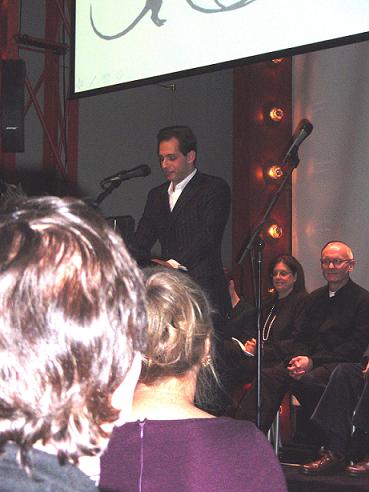
Yesterday morning at the Brooklyn Academy of Music, ABT announced their plan to hold an annual Nutcracker season at BAM. Above is SLSG favorite, soloist Craig Salstein, enthusiastically speaking to the crowd. He was the only dancer to address the crowd; David Hallberg was there too but stood in the back the whole time. A group of young dancers from the Jacqueline Kennedy Onassis School of Ballet (associated with ABT) was there as well — they’ll be dancing in the party scenes when the production opens next year, on December 23, 2010. For the first year, the season will be two weeks, but after that the company hopes to have a longer run.

pb302361

ABT resident choreographer Alexei Ratmansky will be choreographing.


Here’s a slightly better picture of him, by Fabrizio Ferri. Someday I will get a pro camera, I swear!

This was the first time I’d heard Ratmansky speak. He is very soft-spoken and has a heavy Russian accent and seemed to know what he wanted to say but struggled a bit to get the words out in English. And he makes the same grammatical mistakes as Pasha and Baryshnikov (mainly leaving out articles — there are no definite or indefinite articles in Russian — a, an, the — so they tend to leave those out: “…is great score,” etc.) I think English must be the hardest language to learn, especially for Russians. I know Russian is the hardest language I ever tried to learn…

Anyway, Ratmansky seemed shy and soft-spoken but genuinely excited, especially when talking about Tchaikovsky’s score, which he called the greatest ballet music ever written. I felt vindicated 🙂

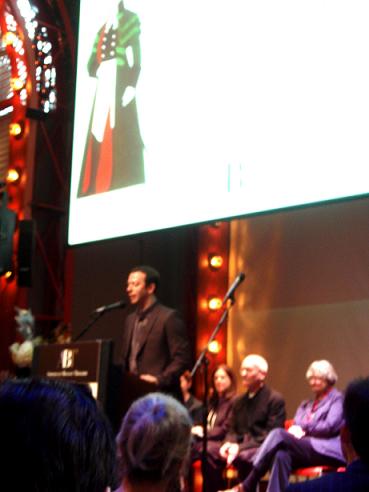
But Brooklyn Borough President Marty Markowitz really kind of stole the show with his little speech. He was so out of place in this crowd of rather gentle artists with that booming Brooklyn-accented voice! He of course praised ABT’s decision to hold the season in Brooklyn, then told Ratmansky he should move to the borough since it boasts the greatest Russian population in the U.S. He also called Brooklyn the dance capital of New York (in terms of studio space — which leads to the great number of companies rehearsing there), which is in turn the creative capital of the U.S. These politicians do kind of know how to make their constituencies proud. After bemoaning the fact that the last time ABT was in Brooklyn was before Baryshnikov defected, he called the ABT / BAM plan “a grand jete into the future for Brooklyn.”

The project is expected to cost $5 million and is being partly funded by David A. Koch (yes, of the Koch Theater — he’s matching dollar for dollar donations up to $2.5). ABT also plans to perform community outreach, particularly in Brooklyn schools, including pre-performance workshops for the children, attendance at dress rehearsals, and dance classes.

The rest of the production team includes Jennifer Tipton, lighting designer extraordinaire, and Richard Hudson, an award-winning theater designer, who will design costumes and scenes. Below are some of his sketches: