DANCING WITH THE STARS SEASON EIGHT FINALE

Well, I was out at the ABT opening night gala last night and so recorded the show and, for some reason, my recording had no sound. I tried to watch it on ABC.go but the site kept telling me the episode was currently unavailable. I tried to watch on YouTube but those posts had no sound either. I wonder if ABC somehow set it up so you couldn’t record sound on the finale (to prevent YouTube posts), because that’s a little weird. They certinaly don’t make it easy on people who go out all the time! Anyway, I had no choice but to watch without sound.

It’s obviously really hard to watch without music — you can’t determine the contestant’s musicality or sense of rhythm at all — but I was pretty underwhelmed by this finale in general. Paso is my least favorite dance, and I thought they all did decently, albeit not superbly. At this point, I can’t really judge who I like most because they each have their own special, likable quality. I thought Shawn was a little lacking in passion in the Paso, I thought Melissa’s lines were gorgeous — she can make such sleek lines with that long, thin, ballet body but she also looked a little stiff in places, and I thought Gilles was more about the acting and the facial expressions than the dancing. So, even though she wasn’t perfect, Melissa was my favorite overall for the Paso.

I used to like the freestyle dance, but it didn’t do much for me this time. Of course, not being able to hear the music could have been part of it, but, in a way, sometimes it helps not having sound because you focus entirely on the visuals and really see what everyone actually LOOKS like. Shawn and Melissa looked like they were having a lot of fun up there, but their dances both looked sloppy — lots of awkwardly bent legs, no real precision, no clarity of line, no control. It was just a lot of jumping around; it didn’t look like any kind of stylized dance. I’m sure it had to do with the many tricks involved — when you’re focusing on tricks you’re not focusing on grace and line and polish — you’re focusing on not killing yourself or your partner. I could totally relate to Melissa’s nearly poking Tony’s eye out during the practice session by the way! Oh how many times have I done such things… But still, when you do a bunch of tumbling, you can’t just throw your legs up all splayed and bent and formless; you still have to tighten your body, keep your legs together and think about the shape you’re creating.

I think I actually liked Gilles’s freestyle the best because it was just kind of low-key. He didn’t move a whole lot — was mostly there to be Cheryl’s support in the lifts and she did most of the body-shaking, fast, hip-shifting moves.Β  And Hustle’s just fun. They danced to Flashdance, right?!

Anyway, since I missed the music and talking, I would greatly appreciate comments filling me in!

I’m going back to ABT for more tonight and am going to have to record the show again. I hope I don’t have the same problem tonight!

AMERICAN BALLET THEATER OPENING NIGHT!

p5182145

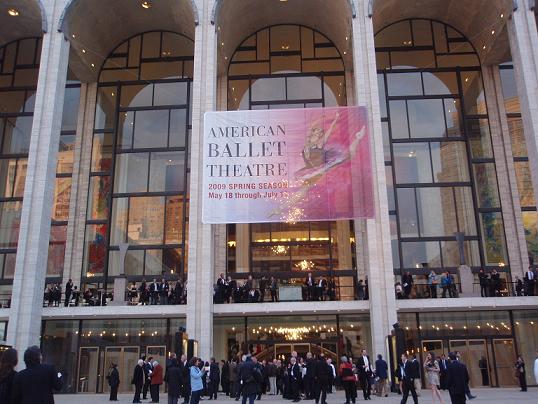
Yay, the season has offically begun! This picture was taken during intermission; that’s why it doesn’t look that crowded. I was sprinting in, nearly late, as usual, so didn’t have time to snap some pics before the performance but fortunately it was still light outside during intermission.

Anyway, Michelle Obama (who served as one of the gala’s honorary chairs) looked smashing in a sleek dark grey sleeveless, knee-length dress with tiny black ruffles lining the bottom. I’m sure there will be beaucoup des pictures seeing as how many blasted camera people there were; I’ll be sure to steal some when they’re posted on all the society websites πŸ™‚ (Oh, look, here it is in the NYTimes already)


It was just about the craziest thing I’ve seen on the Met Opera stage: after Veronika Part’s mouthwatering Mozartiana opened the show, artistic director Kevin McKenzie came out and thanked everyone who needed thanked — all the donors, designer Caroline Herrera who funds the gala, etc., and Senator Chuck Schumer came out and gave a little talk about the importance of funding for the arts, etc. Then, Schumer disappeared behind the curtain and moments went by. Everyone kind of looked around at each other like “what’s going to happen next?!”

Soon, the curtain was pulled back to allow some people to carry out a podium with a banner “American Ballet Theater” draped over its front. The doors to the lobby opened and a flock of people bearing weapon-sized cameras blasted in. Several men dressed in black promptly rose from their aisle seats and followed the flock of weapon-camera-bearers to the front of the aisle, near the stage. Caroline Kennedy was announced. She came out, everyone applauded, and she mentioned that the school of ballet associated with ABT, the Jacqueline Kennedy Onassis School, would be performing on the Met Opera stage for the first time ever tonight. Everyone ooohed and aaahed. Then, she announced First Lady Michelle Obama.

The curtain pulled back again and out she came. Of course everyone gave a standing ovation. She smiled radiantly, then, after a moment, directed us to be seated. Then she gave a short speech. It was a little hard to focus on what she was saying with everyone — both professional photographers and audience members with cell phone and digital cameras alike — flashing away as they were, but she talked about the necessity of the Arts for a culture to flourish, the importance of arts education, etc. Then she introduced the Jacqueline Kennedy Onassis School students.

As soon as she disappeared behind the curtain, the auditorium remained still pending the exit of the flock of pro camera wielders. It’s funny because there were all these non-dance writers in the press section. You could hear the sighs of relief, the sinking down into the chairs, and the putting away of pens and paper — and cell phones, which they’d used to light their writing paper during Mrs. Obama’s speech, which would have been extremely annoying had it not been for all the flashing bulbs anyway. But it made me wonder how they’d ever survive as performing arts critics! I mean, who needs light to see to write!

Anyway, the students were excellent. They performed Le Defile (The Procession) by Raymond Lukens. There were three large groups of them, in three levels — the very little ones, a medium-age / level group, and the older, very advanced ones. The choreography was basically a showcase of classical ballet steps, much like a very advanced ballet class — jumps, jumps with changing feet, jumps with changing feet that went on forever performed by a set of advanced boys (which drove the audience to wild applause), jetes, chaine turns, multiple pirouettes, fouttes, etc., and then a bit of partnering. It gave the students a chance to show what they could do — and the advanced ones could do a great deal! Extremely impressive, and great fun.

Then on were Xiomara Reyes and Herman Cornejo doing an excerpt from August Bournonville’s La Sylphide. This was the most dramatic I think I’ve ever seen Xiomara. I was sitting in the back of the orchestra and she really projected. She was really sweet. And Herman as always amazed with his virtuosity, his jumps, his razer-sharp precision, his astounding clarity of line.

The corps in both this, La Sylphide, and Swan Lake, later in the evening, were absolutely amazing, by the way. Not a head arched back more than the others, not a leg raised higher. They were all so on. When they work together like that, in perfect unity; it’s really visually breathtaking.

Then was Balanchine’s Tchaikovsky Pas de Deux danced by Ethan Stiefel and Gillian Murphy. Ethan and his strutting around stage, taking his own good time after their duet and before beginning his solo, making the conductor wait for him! And his high jumps with all miraculously many beats of the feet. I wished my friend Alyssa could have come so she could see he’s not just Mr. Sexy; he’s a superb dancer. And Gillian was radiant, and a perfect foil with her speed-of-light chaine turns. They enjoyed a long, slow kiss during the curtain call. The audience went mad!

Then was the hunt scene from Sylvia danced by Michele Wiles followed by a piece d’occasion (the first of two of the night), by Alexei Ratmansky, for Nina Ananiashvili, called Waltz Masquerade. It was set to the Waltz from Aram Khachaturian’s Masquerade Suite and it was cute and comical. She was dressed in this long, red dramatic, Carmen-like dress with a sexy black lace overlay on the top. There were four tuxedoed men, each bearing a gold candlelabra, one at each corner of the stage. These men turned out to be: Jose Carreno at the front left corner; Marcelo Gomes, at back left; Angel Corella back right; and a blonde on the front right who I initially thought was David Hallberg (I was sitting FAR back from the stage!) until the fun began and he shook his head about like a sassy mop and I realized DH just does not have enough goofball in him to do such a thing, even if he tried. So, I decided it was either Ethan or Maxim Beloserkovky. Anyway, Nina’s character was supposed to be dancing about the stage in a melodramatic solo — but it was purposefully melodramatic, and so comical. Like a silly, cartoon version of an upcoming swan song, really, which, is of course, what’s coming up for her later in the season (and will be much more sobering when it does). At one point, she just passionately crashes to the ground and remains there, in a heap. Nothing happens. The men, obviously her servants, start looking at each other like, what now? They shrug, slowly walk over to her. Then, Marcelo starts imitating her melodramatic dance, but far more cartoonishly, and of course it’s hilarious. The others join in. Max (I think it was Max, not Ethan) does his thrashing hair thing. I couldn’t see facial expressions but I assume they were making fun of their master. Then she wakes up, catches them, and they’re sent back to their posts.

After intermission was the balcony pas de deux from MacMillan’s Romeo and Juliet, danced by Marcelo and Diana Vishneva. At first, Diana approaches her balcony with all the drama of a ballerina playing Juliet, rather than Juliet herself. I rolled my eyes. This is what I don’t like about her. She’s an excellent dancer but she’s all about the pomp and circumstance and not about the character. Maybe it’s a Russian thing, but I don’t see that in Veronika Part or Irina Dvorovenko. Anyway, she eventually lightened up, thankfully, and I felt like I was watching not a prima ballerina being a prima ballerina but Juliet herself, falling hopelessly in love. When she runs around him one foot solid on the ground, the other on pointe, it’s so girlish, so real yet so poetic. Those are the best — I don’t know what to call them — runs around kneeling Romeo — that I’ve ever seen — not even Alessandra Ferri’s were that sweet. Still, I felt some of the lifts lacked the beauty and magic ofΒ  those Marcelo and Julie Kent do together when they dance this scene. I don’t feel she dances that well with a partner; she’s more into herself. Marcelo’s leaps around the stage and big high passionate jumps were thrilling. He got some good bravos for those.

Then were Paloma Herrera and Max Beloserkovsky in the Act II pas de deux from Swan Lake. I was hoping it’d be the Black Swan pdd, but no. I guess the program was pretty bravura-heavy already. I don’t see him dance much, but Max is really quite good. He’s really a character and he’s the perfect Prince Siegfried, regal yet vulnerable and tragically in love. And he’s a good partner.

Then was the mad fun of Le Corsaire, with Irina Dvorovenko, David Hallberg as Conrad, and Angel Corella as Ali. Except something happened at the beginning and I hope David’s okay. The tallest guy in the entire opera house had to sit in front of me and I was trying to navigate my way around his enormous head just as a bunch of people up front went “Oooooooh!” When I was finally able to see the stage, Irina was standing in front of David, face toward the audience. She didn’t seem to have any particular expression on her face, but, then, I was light years away from her. Then David did an assisted pirouette with her and everyone applauded, so it must have been a lift that didn’t quite happen or something. Anyway, I hope he’s okay; I know his shoulder sometimes comes out of socket. Anyway, all seemed to be fine after that: all three were brilliant. Of course. Angel astounded, as always, and I started giggling during his first solo and couldn’t stop all the way through the second. I love Irina. She was radiant. She did those continuous turning kicks on pointe like they were nothing. She has the drama and the virtuosity when needed and the always beautiful, graceful lines. And David’s leaps all over the stage were magnificent. I could see this goofy ballet over and over and over again, as long as no one gets hurt πŸ™‚ Angel did not leap out from behind the curtain during curtain call, sadly.

Then there was another piece d’occasion. Herbie Hancock played piano, onstage, while first Jose Carreno, then Stella Abrera, danced to his music. This was cute and comical as well, and kind of reminiscent of Jerome Robbins’s Other Dances or Suite of Dances, where the dancer(s) connect mainly with the musician. At one point, Hancock went nuts with the keys, obviously way too fast to be danceable, and Jose stopped in his tracks, looked over at him, and lifted his hands, like what gives, dude? He sat down near the base of the piano and just rested. The same happened with Stella. She danced, then stopped and gave Hancock a look when he began another little virtuoso section. She finally sat down beside him on the piano bench, and eventually, he ended on a romantic note, she snuggling next to him softly, sweetly.

The evening ended with the finale of Balanchine’s Theme and Variations. The leads were danced by Sarah Lane and Daniil Simkin. It was a nice way to end the program, but with the likes of Simkin, I wondered why they only did that group finale, where he and Sarah are basically leading a processional, instead of some of the earlier bravura parts with all the corkscrew turns for the man. An opening night gala performance is meant at least in part to showcase the dancers doing what they do best, and he is best at the bravura stuff, not leading processionals.

Anyway, the whole night, as usual, was magic. Saw Sigourney Weaver and Kelly Ripa in the audience.

Oh, for my Dancing With the Stars readers, I taped the show, but for lord knows what reason it was somehow muted. I have no idea how on earth I managed to do such a thing, but it was pretty amusing watching the show in pure silence — no words, no music. Needless to say, I’ll have to watch online tomorrow.

But now, dead tired, must sleep. Goodnight.

TWO WORLD PREMIERES — QUASI UNA FANTASIA AND TOCCATA — AT NEW YORK CITY BALLET GALA


Last night I went to New York City Ballet’s Spring season gala. I always love galas but they’re especially exciting when they showcase world premiere dances. In this case, there were two such premieres, along with the world premiere of a new piece of music set to one of the ballets.

First things first: I missed most of the red carpet events, unfortunately, since the program began early (so as to make time for the after-show dinner, which I am far too poor to attend). And shame on me for mismanaging time like that — that Waiting For Godot experience from two years ago was too much fun. I did get there just in time to see the paparazzi flashing away at (Sex & the City author) Candace Bushnell and (NYCB principal) Charles Askegard. Sweet Charles soon stepped aside to let his wife bask in the glory all on her own. She looked radiant. I was jealous.

Continue reading “TWO WORLD PREMIERES — QUASI UNA FANTASIA AND TOCCATA — AT NEW YORK CITY BALLET GALA”

WHY NOT MORE JOHN CRANKO IN THE US?


My friend, Mika, who is half Austrian, half Japanese and who spends a significant amount of time abroad was asking me the other day why I thought there wasn’t much of John Cranko’s work performed here when his ballets are so popular in Europe. I didn’t know. But I do know from some of Evan and Patricio’s Winger posts that his ballets are widely performed elsewhere, including obviously Chile. I was intrigued

Continue reading “WHY NOT MORE JOHN CRANKO IN THE US?”

PRESIDENT AND MRS. OBAMA HONORARY CHAIRS OF ABT’S GALA


Also news that is now a few days old (and thanks to my new Pointe friend from last night for pointing me to it): President and Mrs. Obama will be the honorary chairpersons at ABT’s opening night spring gala on May 18th, along with Caroline Kennedy, Carolina Herrera, Blaine Trump, and Renee Zellweger.

Highlights of the pre-dinner performance that evening: in honor of Nina Ananiashvili’s approaching retirement, Alexei Ratmansky has created a piece d’occasion for her set to the waltz from Aram Khachaturian’s Masquerade Suite; and a performance by Herbie Hancock.

Ooh, how I wish I could afford the dinner. Do hope to be at the performance though.

WHO WOULD MAKE A BETTER MODEL THAN A DANCER?


I was in the bookstore the other day looking for literary magazines and somehow got caught up in the latest issue of Vogue Hommes International. I’ve been a fan of Keanu Reeves all the way back since River’s Edge (honestly) and I saw on the cover that there was an interview inside with Bret Easton Ellis (novelist, Less Than Zero, American Psycho, Glamorama, etc. etc.) Interview with BEE is pretty funny, actually, in a way it likely wasn’t intended to be. IE: interviewer: So, you were an icon in, like the 80’s. BEE: Yeah, it was hard being an icon. And confusing. Seriously. I’d get in a fight with my boyfriend and I’d be like, wait, you can’t criticize me; I’m an icon!” But my favorite BEE quote is here.

Anyway, I was flipping through and there are all these little mini interviews with and photos of writers (Stefan Merrill Block too!), architects, actors and filmmakers, of course designers and models.


But not a single dancer anywhere. Why not? They’d make such good models πŸ™‚


(Sergey Surkov, my photo; Slavik Kryklyvyy from here)


(Arunas Bizokas, my photo; Linas Koreiva, from here and here)

Vogue Hommes should so hire me to compile a dancer spread! Fabrizio Ferri can do the pictures. Maybe Bruce Weber, though he can get kind of cliched and corny… No, Fabrizio.

Then, yesterday, I saw Valentino: The Last Emperor, which was pretty good. The Dolce Vita-esque scenes were the best πŸ™‚Β  And it reminded me of Fashion Week’s being moved from Bryant Square to Lincoln Center, and I thought how excellent (and fitting of course) it would be to have NYCB and ABT ballerinas as the models, an idea Kristin Sloan had proposed on the Winger a while back. Ballerinas generally have far better bodies than models. Come on!


UN BAISER AND SWAN LAKE


Over the weekend I saw the French film, Un Baiser S’il Vous Plait, or Shall We Kiss (I don’t much like the English title translation, sounds too much like Shall We Dance and “A Kiss Please” is just cuter). I guess I’d call the movie a sweet romantic comedy albeit not without a bit of tragedy. Problem for me was, soundtrack is comprised mainly of Tchaikovsky ballet music — largely The Nutcracker and Swan Lake, and I learned something about myself: I can’t watch a movie with subtitles and focus on the subtitles when my favorite ballet music is playing in the background — I keep seeing the dancers instead of the little words at the bottom of the screen. I do wonder if I were fluent in French how the music would have affected me — whether I’d likewise have been unable to listen to the words over the notes– but I do know for sure I can’t concentrate simultaneously on three visuals (actors on screen, words on screen, and dancer-visions in my head).

It also made me think how enduring music is. There’s one little scene where a woman is cutely and “innocently” flirting with a man — although the whole film is about how destructive one supposedly simple little kiss can be, what it can lead to — and in the background is playing the Dance of the Four Cygnets from SL. And it’s actually very dulcet, although if you listen carefully, you can see how the music could be interpreted as somewhat threatening in its seductive charm. It ends up being perfect for this story where flirtatious behavior can destroy a relationship. And yet, that’s not what’s really going through your mind during that dance in the ballet. At least I don’t think it’s what’s supposed to be going through your mind? As I’m watching, anyway, I’m not thinking how dangerously seductive are those cute little swans; it’s just a difficult part for four dancers doing challenging steps perfectly in sync. But it made me think how Tchaikovsky’s ingenious music can be used to add insight and emotion to other stories besides that for which it was created. Maybe music has a longer-lasting life than dance, sadly… Although I love that filmmakers are using it — perhaps it will make watchers curious about the music’s origins…


Anyway, I never wrote about Balanchine’s Swan Lake, which I saw at NYCB last season, so now seems like as good a time as any… if I can remember it all.

Balanchine, I guess predictably, makes it all about the ballerinas — his “butterflies”. Prince Siegfried hardly figures – -there’s no ball at which he’s to pick a wife, no mental reflection in the forest, no “bird hunting,” no Odile, no Black Swan pas de deux where Odette’s human imposter seduces him leading to tragedy… Just Siegfried meeting Odette at the lake, falling for her, having her taken away from him by the evil von Rothbart and his flock of black swans.

I feel like the focus on the pretty ballerinas eviscerated the story. Prince Siegfried is the protagonist. It’s his story, his inner conflict, his unmet needs, his all too human weakness of character that you identify with, and that leads to tragedy. The story opens with Prince Siegfried at the first of a series of balls, at which he, having just turned 21, is to choose a wife. Beautiful princesses from all over Europe are being presented to him — what a choice! What more could a prince want! But he’s not at peace, for some reason. He’s just not into any of them. Why, he’s not sure, but something’s just not right. So, he decides to leave the first evening’s party early, go out into the woods, near the lake where he often reflects. His friends want to come with him, but no, he’d rather be alone. And then he’s lying by the lake, thinking, reflecting, perhaps having fallen asleep and dreaming, and he sees a beautiful swan. He takes aim with his bow and arrow when suddenly this magnificient creature turns into a woman before his very eyes. He of course becomes mesmerized with her. She — this fanstasy creature — he knows immediately, is his soul-mate.

She sees him, she’s afraid but he tosses the bow and arrow down, tells her not to worry, she tells him what happened to her — that von Rothbart cast a spell on her so that she’s a swan during the day, and can only be human — her true self — at night out by the lake. But the spell can be broken if someone — a sexual innocent, such as himself — pledges eternal love to her and then remains faithful. Of course Siegfried vows that he can do that, right before von Rothbart, who’s been listening in on their conversation, reclaims her for the evening, turning her back into a swan.

The next night at the ball, von Rothbart casts a spell on his daughter, Odile, so that she’ll look just like Odette. They show up at the ball and Sig is completely taken with Odile (in some versions he actually thinks she is Odette, the likeness is so close; in others he just falls for her, human frailty being what it is). A seduction ensues with all those ten thousand fouettes and gigantic, stage-traversing jetes as the climax, and then Odette appears, making it clear either Sig’s been deceived into cheating on her or making him remember his oath of faithfulness, which, either way, he’s now broken, therefore forcing her to live in eternity as a swan and making their love in this life impossible. They go back to the lake, do a tragically beautiful pas de deux and then — in most versions — she kills herself by throwing herself into the water, he follows suit, vR tears his hair out in agony and then we’re shown a vision of Siegfried and Odette together in the afterlife. (In some Kirov and Bolshoi versions Siegfried slays von Rothbart, and the story ends happily, which I find appalingly cheesy).

So, it’s a story of not being able to love who you truly love because of societal constraints — arranged marriage, familial circumstances, governmentally enforced heterosexuality — what have you, along with themes of deception, unfaithfulness, inconstancy, human fallibility, and deep abiding love eventually conquering all those worldly limitations. But Balanchine makes it about this man caught up in this world of ethereal beauties — which is really a ballet cliche.

There are some really beautiful scenes though. Apollinaire Scherr, who I sat next to the night I saw it (and who likes it much more than I), describes well how in the end, the flock of black swans overtakes Odette, tragically separating her from Siegfried. It’s really visually stunning, horrifying — almost like she’s drowning in the tidal wave they create — and you just want to hold your hand up to block it out. Balanchine does get to the action quickly, and he uses the Tchaikovsky score to its fullest — beginning and ending with the familiar competing von Rothbart and Siegfried / Odette themes, while toy swans slide by in a background lake, showing, at the beginning what Odette has been and in the end what she’s been returned to. I do like the sliding toy swans better than ABT’s version, where von Rothbart, in swamp creature form, is shown grabbing human Odette, taking her behind a curtain, then emerging with a swan stuffed animal. There are other commendable things about Balanchine’s version, but I still think truncating Siegfried’s story the way he does turns it into a ballet cliche and deprives it of its power to speak to the human condition. I know people will disagree with me, but those are my thoughts.

ETHAN STIEFEL AND LARRY KEIGWIN AT GUGGENHEIM


Last night the Guggenheim Museum’s Works and Process event centered on Ethan Stiefel’s new dean-ship of the University of North Carolina School of the Arts (which is both a high school and now a university as well). Stiefel is of course a famous ABT principal, star of both Center Stage movies, and ran the summer program Stiefel and Students / Stiefel and Stars, out on Martha’s Vineyard, which my friend Alyssa and I went to a couple of years ago. It was hosted by blogger / dance writer and photographer (and former ABT dancer and NC School of the Arts alum) Matt Murphy, and also included choreographer Larry Keigwin (artistic director of Keigwin + Company), who was the recipient of the school’s first residency under Stiefel.

It was a fun evening. Discussion centered around Ethan’s decision to take on the position, in light of the fact that he’s still dancing (he’d had several surgeries on both knees, knew he wanted to do something like this at some point but stressed about when was proper time to do it), his new schedule (now waking at 6:30 — as opposed to 11 am when he use to wake as a dancer — to take class, then teach a couple of classes, then do all manner of administrative / financial / directorial things – -not easy tasks in light of current economic crisis, and still try to find time for his own rehearsals), and just generally his teaching and directorial aesthetics (he’d come up with eight “initiatives” to instill a culture and sense of identity in the school, the last of which Matt read — which was to encourage students to be inspired by both art and life.) Gia Kourlas has a good article in the Times that summarizes all of this as well.

Keigwin joined Matt and Ethan for the last quarter or so of the panel, and he spoke about his residency, how he’d choreographed a new work both on the students and his own company simultaneously, what it was like to work with students, and what it was like to be out of NY. I’d never heard him speak before and he’s very personable, fun, and chatty with a good sense of humor (which doesn’t surprise me — his work is largely humorous and accessible as well). He talked about the company being beyond thrilled with the washing machines and the cooking space (if you don’t get out of New York much, this kind of surprise happens!) and so enjoyed performing a lot of domestic activities. He was cute! And Ethan was his usual self — his completely understated, deadpan style of talking oozing with sexiness and manly charm. Before introducing one of his students’ performances — of the Four Cygnets in Swan Lake — he explained the girls wouldn’t have the swans’ usual hairpieces: “We got a lot going on and … we just didn’t get that done in time,” he said with a smile and a shrug. Somehow the way he said it just gave everyone the giggles, which, honestly, often happens when the man speaks.

Anyway, we saw Tangled Tango, a modern piece by Dianne Markham, a contemporary choreographer at the school, the pas de deux and coda from Le Corsaire, which Ethan staged, the Four Cygnets from Swan Lake staged by Nina Danilova, and August Bournonville’s The Jockey Dance, also staged by Ethan.

Finally, we ended with Keigwin’s Natural Selection (a modern piece), which totally blew me away. The Keigwin was based on Darwin, survival of the fittest and all that, and was so stunning, filled with very difficult partnering, lifts, students crawling around on the floor, clawing at the ground and each other, lashing out, really having at each other. (So, not quite his usual humorous piece) A guy crawled around with a girl wrapped around him, underneath him. At one point, it slowed, several dancers huddled around each other in a group, each kind of resting, momentarily, putting his / her ear to the back in front of them, perhaps comforting the other, perhaps trying to determine whether his / her heart was still beating, lungs still rising, to determine whether they’d “won”. Then a girl came rushing at them, climbed right over the huddle and jumped right onto the wall in back of them. Someone crawled after her and pushed her back to the ground. Keigwin’s signature move then ensued: a group of male dancers lifted her and she bent sideways, and ran alongside the back wall. The audience was wowed. But more importantly, I think, it was such a wonderful piece for students. I mean, what better way to teach them partnering, how to work with each other, how to be dramatic, how to make the meaning of a work come alive. I loved it!


My other favorites were: the Four Cygnets — whoa, that was PERFECTLY done! Those girls — Tessa Blackman, Maya Joslow, Amy Saunder, and Lauren Sherwood — should be so proud of themselves; and Le Corsaire πŸ™‚ — but of course I’m a sucker for that kind of bravura dancing. I was really afraid, holding my breath the whole time with that one — I mean that stage is soooo small for all that leaping and those insanely high lifts. The two dancers — Claire Kretzschmar and Kristopher Nobles (who looked like a young Gillian Murphy and Jose Carreno respectively!) did splendidly on their own. I couldn’t help but giggle during Nobles’s huge, stage-encompassing leaps and Kretzschmar’s beautiful continuous fouettes and the gorgeously high lifts — all wonderfully executed — except because of said miniscule stage, her hand almost took a light out on one such spectacular lift. There was a tiny bit of fumbling on some of the partnering — the assisted pirouettes and the promenade, but I was actually glad for the audience to understand how insanely hard those things are. People think that’s the easy stuff — and the lifts are the hard parts — but the assisted pirouettes and promenades, when the girl is totally off her center of gravity and the guy has to help keep her centered, are some of the hardest aspects of partnering. Now maybe Met orchestra peeps will not be so confused when the young dance students in family circle go wild for Marcelo the great’s ten bizillion one-handed turns with Julie Kent πŸ™‚

Here’s a video of the Four Cygnets, here’s some classic Corsaire (they didn’t do all of this insanity, but you get the idea), and here is The Jockey Dance (it was performed last night by two boys, Devin Sweet and Shane Urton).

The Jockey Dance was fun too — one of those dances that looks deceptively easy, but you can tell is really hard, with all the bouncing jumps, playful competitiveness– using a whip no less, and fast footwork.

Gillian Murphy (ABT prima ballerina, Ethan’s girlfriend, and NC School of the Arts alum) was there too. Poor thing had to sit in the critics’ section! Luckily Sir Alastair was not there… The program repeats tonight, but is sold out.

PAUL TAYLOR: DREAMS AND FUNNIES


So, Paul Taylor season is currently underway at New York City Center. I’ll be going several times next week and will be writing more then, but last week I saw three dances: Funny Papers, De Suenos (Of Dreams), and De Suenos Que Se Repiten (Of Dreams That Keep Recurring) — the third a continuation of the second. The first is a humorous piece from 1994 based on newspaper comics, with sections entitled I’m Popeye the Sailor Man and I Like Bananas Because They Have No Bones. The two Dreams pieces, from 2007, like real dreams, ranged from funny to nonsensical to ominous, then back to funny again and were populated by characters like a faun (above), a “golden girl” / angelic character tiptoeing around with a golden crown / halo atop her head, righting all the wrongs created by a devil, peasant women selling flowers and the women or men who buy them, and some underworld urchins who go to battle. I didn’t find any of these pieces tremendously profound, but they were funny and entertaining and often contained surprises both in movement and character-type — not at all cliched.

Paul Taylor is of course one of the masters of American modern dance, loved by most critics and dance fans. My experience with his work thus far has been limited mainly to American Ballet Theater’s production last season of his Company B, which I loved. So I greatly look forward to seeing more next week. The company performs through March 15th. Go here for more info and tickets.

New York City Ballet Season Finale and Wrap Up With Response to Sir A


So, Sunday marked the end of New YorkΒ  City Ballet’s winter season. I was honestly in a blue funk all day yesterday, which shows, I guess, that I am really beginning to love this company since I’ve normally only gotten so sad over ABT and Alvin Ailey.

Sunday was a one-day only program, the All-American Season Finale, which included Robbins’s Glass Pieces, Martins’s Hallelujah Junction, and Balanchine’s Tarantella and Stars and Stripes. Tarantella (this is the only time it showed this season) is always fun, with its cute Neapolitan peasant boy-tries-to-get-girl caricatures, lightening-charged footwork, and series of bravura solos for both man and woman, all performed with a tambourine. I was completely out of breath after watching Joaquin de Luz fly across the stage and ultimately steal a kiss from Megan Fairchild. Joaquin is not just a dancing virtuoso but a dramatist as well and his characters are always these virile, sexed-up, but charming, innocuous men. I really love him.

Glass Pieces and Hallelujah Junction also really grew on me. I don’t know if it was Maria Kowroski or what, but theΒ  slower, more adagio section of Glass Pieces was very compelling this time, and it really spiced up the last man-centric, drum-beating, section as well. At first I wasn’t a huge fan of Maria Kowroski, but either she has improved or she has really grown on me. I always thought she had an excellent dancer body, but now she is using it in a much more expressive way, really to say something. The only thing I’m not in love with choreography-wise in Glass Pieces is in the last section, how the men come jogging out, hands powerfully punching the air, doing their ‘man things’ to the booming drums, and then the women daintily slink in to the sound of the flutes. Corny.

I was able to watch more than just the mesmerizing lighting in Hallelujah Junction this time. I love the movement theme –toward the beginning — of the landing a jump or phrase on releve and then swiftly lowering the ankle to the floor. On Andrew Veyette it looked kind of teasing but in a sinister way, like the slicing of a knife. There is something very sinister in general about Andrew Veyette, very virile in a threatening way, which makes him perfect for the devious man dressed in black here.

And I love how Sebastien Marcovici, the man in white, kind of Janie Taylor’s saviour, would powerfully jete across stage after him, threatening him, banishing him. Sebastien and Janie are such the romantic couple, in part because they work so well together and in part because of their respective sizes. Someone very knowledgeable in the dance world told me they thought he’d been working out a lot, trying to build muscle. I do think he seems to have become more muscular lately, especially his legs. Building muscle often decreases the muscle’s flexibility and he doesn’t seem to make a perfect split on a jete like some of the others, but I still think it’s so romantic that he’s so much larger than little Janie; he can just sweep her off the floor and scoop her up into his arms — aw πŸ™‚

The program notes state that Stars and Stripes, the somewhat cheesily patriotic but excellently danced Balanchine ballet, was shown at presidential tributes, like that of Kennedy and Johnson, and at Nelson Rockefeller’s NY gubernatorial inauguration. It’s so weird to me to think of that, though I could see it performed back then. But now? At President Obama’s inauguration? It just doesn’t seem like it would fit. It would seem kind of anachronistic, sadly…

Anyway, the talk of the ballet world lately has been Sir Alastair’s New York Times season wrap-up.

Taylor Gordon, my friend and fellow blogger / dance writer, says, “whether you agree with him or not, it boggles me that one person has the power to say these things in basically the one print medium dance criticism has left. Ouch.”

Macaulay basically takes the women of NYCB to task, saying none of them really command authority like true ballerinas,

Continue reading “New York City Ballet Season Finale and Wrap Up With Response to Sir A”