
when you completely forget about your countdown 🙁 As of yesterday, just four weeks til City Center season!
Required Reading For The Day
I love this! When’s the book coming out here, when when when?! Perhaps the excerpt contains hints as to why Danny Tidwell may have felt not so at home in the world of ballet…
Also, I don’t have time to blog about Dancing With the Stars today, but hope to later in the week, after the results show tonight, which is, by the way, especially worth watching, even for those not solely into ballroom. The man widely hailed as the greatest tap dancer in the world will be on. That’s Savion Glover of course of course! So, that’s tonight, ABC, 8pm / 7 Central.
Sir Alastair Speaks!
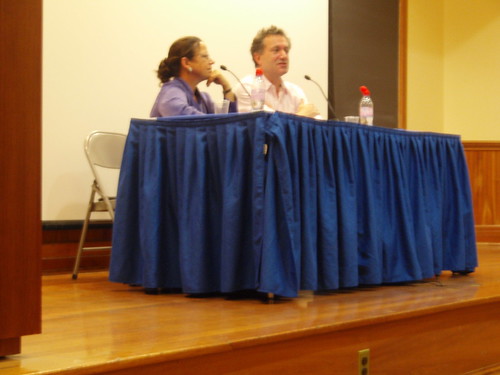
But he didn’t say much. And I should probably stop calling our new(ish) Chief Dance Critic ‘Sir Alastair’ and come up with a different nickname; he came across more as a jolly, down-to-earth commoner than a lord. Anyway Mr. Macaulay, along with dance writer and professor Mindy Aloff, addressed a crowd of mainly students, critics, and dance insiders last night at Barnard College. He spoke of: his move to New York (he’s still not completely moved into his new apartment and has no television, allowing him neatly to evade the question of the moment — what about all this dance stuff on tv?); what he misses about London (his garden, the West End’s plethora of Shakespeare plays); how he felt about becoming the NY Times’ chief dance critic (it was a welcome mid-life change, he and his audience at the Financial Times in London had grown a bit tired of each other, he was worried his appointment wouldn’t be well taken since he was from out of town — and rightly so, why should a critic not be homegrown?– people laughed at this, not sure why); his most trying life moments (serving jury duty and having to announce the verdict to a raucous courtroom, being charged with taking indecent pictures of minors after an officer saw him photographing frolicking children on a beach– don’t worry, it all worked out well as charges were eventually dropped); his dance training (ballroom, reading ballet technique books and sitting in on ballet classes); his favorite artists (Shakespeare and Mozart), etc. etc. — things on that level. It was nice to see his face and hear his voice, and it did make you realize he was human despite his sometimes harsh reviews, which was probably the point of the whole thing, but it was hardly the in-depth discussion of issues important to the dance world that I was hoping for.
During the Q & A, a student asked him if he felt that bad reviews played any part in declining dance audiences. He thought for a moment and answered that he didn’t know how much of an effect reviews really had on audiences. He thought his reviews had absolutely no effect on that of American Ballet Theater, as the Met Opera House was far from packed each week during the their summer season regardless of what he’d said in his most recent review. He also felt as a critic a certain degree of harshness was necessary, as it was the critic’s responsibility to “hav(e) a passionate subjective response” to a work. Wendy Perron, editor in chief of Dance Magazine, after noting that he’d largely written subjective reviews frequently inserting his own voice, asked if he’d ever taken a more objective tone. He responded that he wasn’t sure of the difference between subjective and objective with respect to criticism, but felt that his writing was a combination of the two. He viewed the objective part as describing what he saw, the subjective to tell why it mattered.
Eva sweetly asked him in her beautifully mellifluous voice whether he was going to explore the entire New York City dance scene and all the wonderful things it has to offer. He brightened considerably and said he’d just discovered “downtown” and had gone to a performance entitled something like “Accounting” and really liked it. He sounded authentic and it was actually rather cute. I don’t think he knows he got reemed for his review of that 🙂 Countercritic guy asked him something along the lines of whether he had to consider something beautiful in order to value it. I thought it was an interesting question and Macaulay did too, and even said so. “But I’m not sure how to answer it,” he replied. He said he liked it when a choreographer challenged his notion of beauty as Mark Morris has on occasion. Which I thought was a good answer. He mentioned other such choreographers, but I’ve forgotten who– I’d put my notebook away by then and was packing to go.
Hmm, what else do I have in that notebook?… He takes a few notes during performances but usually they don’t amount to much. He was first seriously impressed with the New York Times when he picked up a copy of the paper in London and saw a review of a classical dance performance on the front page. Such a thing would never have happened in a London paper, he said, as concert dance wasn’t considered “sexy.” He doesn’t regularly read others’ reviews of a piece because he doesn’t want them to influence his own, although his favorite critics are the New Yorker’s Joan Acocella (who has an “engaging” “shrewd” voice that, even if you disagree with, “you really want to spend time with”) and Wall Street Journal’s Robert Greskovic, who has a gift for detailed description (and is his good friend and sends him copies of his reviews). He said dance and music criticism were very challenging because the dialog one had with the piece was not a direct or natural one (as with a play) but forced the critic to translate from one language into another. I thought that was nicely stated.
That’s all. It was about an hour and twenty minutes altogether. It was okay, just wish the discussion would have gone deeper.
I came home and watched the video I’d taped of Dancing With the Stars. I’ll blog about it more tomorrow — am too tired now — but, very briefly: ridiculously, he hasn’t even danced yet and I am totally in love with Helio 😀 Does Marcelo have that same accent 🙂 🙂 😀 Am also in dancerly love with Mark Ballas 😀 How great were the perfs by those “girls” — Cheetah and Spice?! Whoa! And that opening pro number: you can’t say the ballroom dancing, despite Pasha and Anya, is better on So You Think You Can Dance! I wish there were more pro numbers like that! You can tell how different the demographic is for this show as compared with SYTYCD though — they have a lot of older contestants here. I thought Marie Osmond was a bit of a goof, but charming in her own way, and Jane Seymour was sweetheart 🙂 Could some ballroom insider please smack Chmerkovskiy for me for that self-description: “I’m known as the bad boy of the ballroom. But how can I be so bad when it feels so good?” 🙂 Okay, more tomorrow, I’m off to bed…
David Speaks!
Matt posted a little video he made of him and David Hallberg attending a live taping of the Broadway play “Legally Blonde” for MTV. Pretty good video, Matt! But interesting thing to me is, this is the first time I’ve actually ever heard David speak! He’s more fragile-seeming than he appears onstage. He’s so cute 🙂 🙂 🙂 It’s just funny because in dance (in contrast to theater, movies, etc.) you see a favorite dancer onstage many many times and you never hear the sound of his voice.
:)
Look what Matt sent me: I am very happy! 😀 😀 I hope no one takes it down…
Five Weeks!
til City Center season that is 🙂
By the way, in an effort to vary my countdown photos, I did the following Google images search: “Marcelo Gomes + Sinatra Suite.” Look what came up. How embarrassing.
Boston Ballet at the Guggenheim
Last night I went to my first Works & Process discussion of the Fall season to investigate the Boston Ballet, who will soon be performing as part of the Fall For Dance Festival at City Center. These Works & Process events held by the Guggenheim Museum, by the way, are really a good value. For only $25 you can see, in a very intimate setting, prestigious dance companies perform new pieces from their upcoming reps, and hear the artistic directors and/or choreographers talk about the works.
Last night’s program featured speakers Mikko Nissinen, Boston Ballet’s artistic director, and choreographers Helen Pickett and Jorma Elo. Elo is the main reason I wanted to attend, as I have loved both of the two very modern ballets I’ve thus far seen of his: “Slice to Sharp” performed by New York City Ballet; and “Glow Stop” by my favorite American Ballet Theater 🙂 This makes me a bad person, as dance critics just lurve to hate Elo 😉 I guess many find him vapid and aerobic. But I think his ballets are fast, fun, sharp and bedazzling, and they both showcase the dancers’ athletic abilities with their numerous mid-air turns, high jumps, and fast precise footwork, and take dancers out of their comfort zone (as this favorite of mine once put it) which, in a weirdly extended way, does the same to us.
Anyway, tonight’s piece of his, an excerpt from “Break the Eyes” was the best thing I’ve seen by him yet. The music alternated between a section consisting of heavy, disconcerting, foreboding sounds (at first sounded almost like something out of “Jaws”), and was accompanied by the voice of a young woman breathing frantically and speaking urgently in Finnish, and a section of sweetly mellifluous Mozart piano music. A solitary ballerina danced to the foreboding soundscape, her movements at the start sharp, jerky, and frazzled, which became less so as the ballet went on. The Mozart pieces were danced by a small ensemble whose dance vocabulary — pretty partnering, lifts, quick-paced but mellifluous allegro steps — mirrored the flowing music, the solitary ballerina’s angular, harried, awkward movements a stark contrast to theirs. As the piece developed, the music was at times played together, the frantic Finnish woman’s voice crying out over, disrupting the Mozart. The ensemble and solitary ballerina seemed to struggle with and react against each other, eventually helping to define each other. The dance was intriguing: though I didn’t “get” everything the first time around, as I never do with abstract ballets, there was a real development there, a kind of story, and I felt Elo was trying to say something, making me curious to see it again. I’ll get that chance with Fall For Dance, as Elo’s is the piece the company will perform.
Boston Ballet, as Nissinen explained, seeks to perform a blend of contemporary and classical ballet. Ballet, he said, is “not just a church or museum, but must pave the way for the future.” I like that, and it’s true. There’s nothing more beautiful and romantic and fairytalish than classical ballet, but for the art to stay alive, there must be new along with old. (What if the only plays performed on all of Broadway were by Shakespeare? Going to theater would be a historical enterprise, like visiting a museum.) In this vein, the company also presented a Swan Lake pas de deux — you realize just how beautiful classical ballet is, what genius possessed Ivanov, and how iconic Tchaikovsky is when you see something like this juxtaposed with the modern — along with an excerpt from the first professional work by new choreographer Helen Pickett. Interestingly, Pickett said her process was to choreograph a dancer’s solo, then allow the five or so others sharing the stage to improvise their own moves, taking cues from the soloist’s movement “reading” her vocabulary and reacting to it. She said it was empowering to the dancer, which I can see. Still think I’d be very nervous making up my own movement right on the spot before an audience though!
Anyway, if you wish to see the Elo piece at Fall For Dance, go here; for Guggenheim’s W&P schedule, go here.
Watching "window" by bill shannon
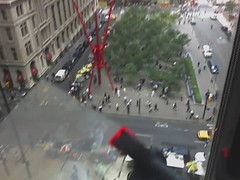
Watching “window” by bill shannon
Originally uploaded by swan lake samba girl via mobile.
This was so cool! Review to come. Definitely try to go if you can!
Okay, now that I’m back at my desk I can write more. Bill Shannon’s “Window” is the last of the works shown as part of the Lower Manhattan Cultural Council’s “Sitelines” series (consisting of site-specific dance performances) in its “River to River Festival” for this year. (“River to River” takes place downtown each summer). The two others I was able to see, I blogged about here and here.
I really really liked “Window.” Bill Shannon is a disabled dance / conceptual artist who uses crutches. (If you’re in L.A. right now, he is one of the performers included in the David Michalek “Slow Dancing films” exhibit.) Here he and three other men — one wearing black pants, top and hood, one wearing all white, and one dressed in a business suit — performed break-dance and hip-hop out on Liberty Park Plaza while Shannon, skateboarding on crutches, zoomed around on the streets surrounding the park. At points Shannon would skate into the park and dance, very well mind you, on the crutches.
There were two sets of audiences: the random passersby in the park and on the street who got caught up in all the commotion; and us, those who RSVP’d to the event through lmcc’s website and were escorted into the 8th floor of the high-rise at 140 Broadway, where, amongst the bemused real-estate brokers who regularly inhabit the office, watched the scene down below through the window. A couple of camera people outside filmed the performances by Shannon and the three others and those films were projected live onto four screens inside, where we stood. One screen was set up in such a way that it would reflect on the ceiling, where you got kind of an upside-down version of what was going on outside. The filmmakers also played with the projections a bit so that the colors of the dancers’ clothing would change, or, at points, the dancers would be projected onto a different background; at times the images looked rather 3D. So, you had your choice of watching what was actually going on outside through the window, or the way it was projected onto the screen, as intermediated by the filmmakers.
They also had speakers set up inside, which played a variety of hip hop, techno and pop music. Shannon had headphones bearing a small microphone so he danced to the music and interacted with us through the mike.
I preferred watching what was actually going on through the window, partly because, Liberty Park being so big and crowded, everytime I took my eyes off of Shannon, I lost him. I also found it more interesting seeing how normal everyday besuited business people and tourists, not expecting to see a show — and a rather odd one at that (I didn’t see any speakers down there so assumed they couldn’t hear the music and only saw a bunch of guys rocking out to silence), interacted with him. Of course this being New York, most pretended not to notice him at all, although you could kind of see them spying him out of the corner of their eyes. They didn’t have the roads blocked off and at one point I thought he may be hit by a large white van barrelling down Liberty Street, but the driver thankfully saw the crazy guy bopping around on crutches whilst skateboarding and slowed to a stop. “Whoaaa” Shannon sang over the speakers.
At the beginning, Shannon looked up at us and called out, “How do you put rhythm into a city? How do you make a city come alive?” while clapping his hands above his head and shaking his hips to the percussion like a rock star. There was something at first eery but eventually comforting about watching him rockingly skateboard around what was once a triage unit, the construction site that was once Ground Zero and before that the World Trade Center diagonally behind him.
Let The Countdown Begin!
It’s that time of half year again 🙂 As of yesterday, it’s six weeks ’til City Center season!!!!! 😀 😀 😀
Also, last night was Martha Graham‘s opening night at the Joyce Theater in Chelsea. I didn’t go, but am eagerly awaiting reviews from those who did. I will be going later this week. I can’t wait! If you like, read Gia’s preview of this foundational American dance company’s comeback.
Day of Merce and Frustration!
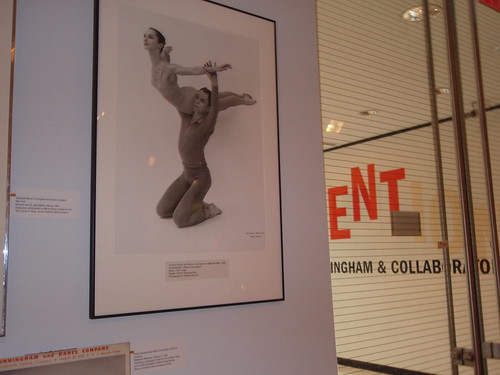
Yesterday I went to the Merce Cunningham exhibit at the New York Performing Arts Library at Lincoln Center. At noon there was a short, live, four-person performance of solos and duets right in the lobby. All dancers — two male, two female — wore blue unitards and the music sounded somewhat like the ocean. At times the dancers looked a bit like they were swimming. Of course it was abstract, but that’s what I got out of it.
I then headed into the exhibit, which was really pretty cool. I’m embarrassed to admit it, but this was my first experience with Cunningham (aside from the time Winger Tony Schultz and I saw him in the audience, wheelchair-bound, at another modern dance performance). Embarrassing to admit since he’s only one of the founding fathers of dance in this country! The exhibit was pretty comprehensive and very entertaining. They had videos of several of his works, all performed in the last ten years, but some choreographed far earlier. Cunningham himself danced mainly in the 40s and 50s. He is still choreographing, but of course no longer dancing.
The videos were my favorite part of the exhibit. They had several screens mounted on the wall, you took a chair hooked up to earphones and selected the music from whichever screen you wished to concentrate on. I actually found all screens mesmerizing and it was hard to focus on only one at a time. Funny thing, though, you really didn’t need to. The music (oftentimes sounds — of waterfalls, birds, people talking, etc.) seemed not to matter at all; you could have selected any soundtrack and watched any one of the screens. This, to me, marked Cunningham the complete opposite of Mark Morris, whose choreography is his rendition of that particular musical piece in motion. Also in contrast to how I personally felt watching Morris’s Mozart Pieces on PBS, Cunningham’s choreography was so engaging, I actually didn’t care what the sound was like.
My favorite video was called “How to Pass, Kick, Fall and Run” which was accompanied not by music but by Cunningham and another man, named David Vaughn, reading bits of text to the audience. At times their voices would overlap so you couldn’t even really make out the words, at times you could and the text was very humorous, and at times you just couldn’t pay attention to the text because the moving bodies were just so mesmerizing, even though they weren’t doing anything tremendously virtuostic. One passage, read by Vaughn, told of a man who gave a lecture on how to attend a lecture. He instructed attendees to listen, which they couldn’t do if they were taking notes. One woman was taking notes. The man next to her told her she was not supposed to take notes. She quickly read over her notes and said to the man, “that’s right. I’m not supposed to take notes; I’ve got that written right here.” The audience laughed like crazy. Throughout the reading of the text, the dancers, wearing colorful sweaters over plain black leotards, would jump, hold each other and bounce, kick playfully, scamper across the stage, then do slower prettier arabesques, sometimes with an awkwardly bent standing leg. The movements kind of did and didn’t correspond to the text. If you watched it a couple of times, it did, in a way. For example, at one point Vaughn began a brief vignette in which two women went to a women’s business meeting, and at that point two female dancers would wrap arms around each other and hop on one leg around in a circle, then let go of each other and both hopped toward the front of the stage. Kind of goofy-looking, but then a man emerged and they began a complicated, serious, lift sequence with him. Is a business meeting silly, serious, or both at times? I don’t know. But I found the process of watching the piece a few times and arriving at different conclusions each time rather fun and invigorating. It was also cool to recognize one of the dancers, Holley Farmer, who was in the David Michalek films.
Then, they had tons of pictures of the company performing, from 1945 up through the present, another film showing an interview with Cunningham, numerous costumes some of which were quite colorful and interesting-looking to put it mildly (one was a leotard with aluminum cans taped to the legs! — wish I would have seen that piece!), a bunch of musical scores and choreographer’s notes (the latter of which looked like heiroglyphics to me and made me wonder how in the world choreographers notate a work to preserve it), and some posters by such great artists as Jasper Johns and Andy Warhol promoting the company on tour and at home.
Top pic is of Carolyn Brown dancing with Cunningham himself in the company’s early days, which was interesting to me since I’d recently seen her speak about her new memoir about dancing with Merce, at Jacob’s Pillow (in that picture that I linked to above, from the previous blog entry, she is the woman in the white dress). It was quite a long time ago that she had danced with him and, wow, was she was a striking beauty back then.
Anyway, for people in NYC, I urge you to check it out. It’s a real history lesson, a fun informative trip through time, since Cunningham is such a foundational figure in dance in this country. It closes on October 13th, so you still have some time.
I recently bought a new camera with more pixels, a more powerful zoom, and motion control (so as to take better photos of all the lovely ballroom dancing I will soon be viewing, like tomorrow!) Hopefully, the pics will be better than before (the picture in this entry is better than previous ones, right!). But I’m having trouble uploading from my new software to my Plogger. Spent a good deal of the day trying to figure it out to no avail. It has no problem uploading the pics from my former camera software (which it seems is incompatible with the new camera). Argh, I HATE technology — just can’t figure things out! So, for the time being anyway, I’m using my Flickr account to upload new pictures. I created a link down at the bottom of the blogroll to my Flickr page, which is likely where I’ll end up putting the pictures from the dance competition I’m about to head off to… Have to go pack!
Oh, and my TAC headache seems to be officially over, for now anyway. Yay! Thank you so much, you guys for your concern 🙂 I really appreciate it 🙂
Merce cunningham dancers @ library
Merce cunningham dancers @ library
Originally uploaded by swan lake samba girl via mobile.
Crappy cell phone pic of merce cunningham dance company yesterday in the library lobby. Short but intriguing.
A Little Overwhelmed!
Each day yet more of the splendid Fall Season’s offerings flood my mailbox. So exciting! But a little nervewracking, given all the things I have to order tickets for! This is why I so love NY though — that unique combination of intoxicating stimulation and potentially migraine-inducing excess… (or in my case, TAC-headache-inducing excess … am trying to tell myself I do NOT feel one coming on, but am armed with meds just in case…)
Well, I guess this is what the holiday is for, to breathe deeply, lounge around, rest up for the happy hubbub to come 🙂 Happy Labor Day, everyone, have a long and relaxing weekend!