Knowing how well I like ABT soloist Kristi Boone, photographer Jade Young sent me her new headshot. (He did Marcelo‘s and Veronika‘s as well). I think it’s gorgeous!

Knowing how well I like ABT soloist Kristi Boone, photographer Jade Young sent me her new headshot. (He did Marcelo‘s and Veronika‘s as well). I think it’s gorgeous!
I knew there was a reason I loved her Juliet so much:
”Watching movies gave me ideas. Dancers tend to exaggerate on stage because they want to make sure that everyone sees their emotions through the movements, but in movies, the acting is very subtle and realistic. I think it’s important to find a balance. You can’t overact just because you want the viewer in the back to notice you, but then you can’t control your feelings too much either,” Seo said, adding that she loved the original play by Shakespeare because the lines were so romantic. She added that such sentiment is ”hard to find these days.”
Later, she says:
”Ballet is art. I may be just dancing, but I’m dancing inside a beautiful set with beautiful music, and that is what makes ballet a synthetic art form. I want to be recognized as an artist. An artist who danced, who appreciated music and understood art.”
Here’s the rest of this sweet interview in the Korean Times.
ABT’s Max Beloserkovsky and Irina Dvorovenko at Roberto Cavalli on Fashion’s Night out last Thursday night. Via Opera Chic. I love how Irina’s standing. I love the front foot, how she’s showing off her gorgeous instep. Irina could so be a model…
This is a most interesting pairing, and one I hadn’t thought of before. One of my NYCB favorites, Sebastien Marcovici, and ABT’s Michele Wiles will dance the Black Swan pdd this weekend in Miami at the International Ballet Festival. It’ll be their first time as a partnership. Apparently, they both take class with David Howard here in NY and he thunk it up. Wish I could be there… There’s a lot going on this weekend.
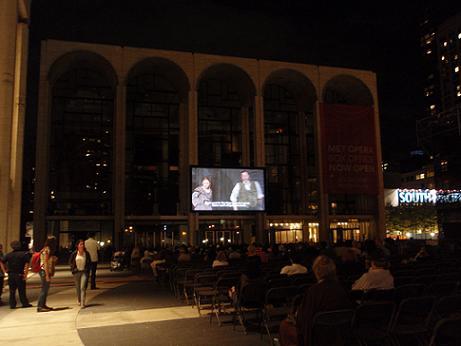
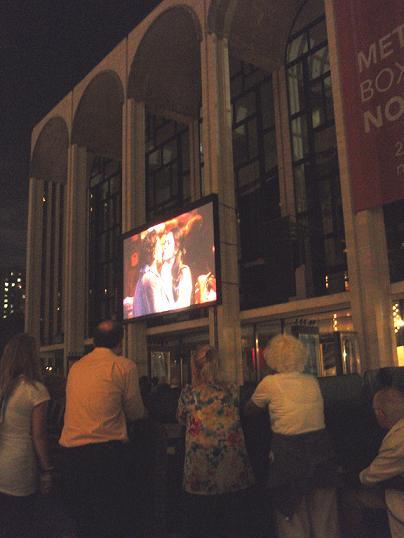
For the past few evenings I’ve been partaking of the Met Opera’s outdoor Summer HD Festival on Lincoln Center Plaza. The first night I went was Benjamin Britten’s Peter Grimes. It was on a week night and the plaza was about half full. I’d bought a sack pique-nique dinner from Bar Boulud across the street — which was delic by the way (chilled gazpacho soup, baguette of brie and fresh fig spread, waffle chips, bittersweet chocolate tart, and bottle of Pellegrino). But when I took a seat in the back and began to unwrap my brown bag I realized what a commotion I was making, how dead silent it was. I waited until a noisy helicopter buzzed around above us for a few seconds to tear into my sandwich. I absolutely loved the quiet, but figured it must be because this opera was so serious and esoteric — only true opera-manes would go.
But then last night, Puccini’s far more popular La Boheme was the same. Plaza was packed. I mean, every single seat was taken (both of the fold-out variety set up by the event organizers and make-shift seats like construction cones aligning Avery Fisher Hall), there was hardly a square foot of ground to stand on all the way to the street — people were even camped out atop the temporary Koch Theater ticket trailer (until police came around telling them to get down). But once the music began, there was the same dead silence. Everyone stared up and the screen, completely captivated. It was even quiet around the food and liquor stands, where people were basically whispering their orders. Children (the few that were there) behaved, dogs (the many that were there) behaved. Well, dogs usually behave in a crowd, actually… But even the little kids seemed to know it was important to try to concentrate on the screens.
The noisiest part of the evening was when South Pacific, showing next door at the Vivian Beaumont, let out. But once the theater-goers realized there was something important going on out on the Plaza, they shushed each other and ventured up to watch — in total silence — as well.
Such a complete contrast with some of the outdoor dance festivals — Lincoln Center Out of Doors, the Downtown Dance Festival, site-specific summertime events, sometimes SummerStage. I’ve heard from several people now that the Saratoga Performing Arts Center where NYCBallet has their summer season, is much the same, making me honestly not all that excited to go up there. I mean, kids are running around, parents yelling, people talking to their friends at the same pitch as if they were in a noisy bar, people unwrapping food, opening soda cans, popping gum.
So what gives? Do people just think opera is mainly about music and so to enjoy it everyone must be able to hear it above all else, whereas dance is more visual — so you can make all the noise want and not bother people because they can still see? Maybe it’s about the children — people are much less inclined to bring small kids to the opera, but they somehow think their two-year-old is going to have a deep appreciation of Balanchine or Karole Armitage or classical Indian dance. Maybe they equate outdoor dance performances with outdoor social dance events like Midsummer Night’s Swing, where you’re hardly going to disturb social dancers by talking. Or maybe there’s something about a big ole screen being up there.
I wonder if it would be different if ABT would have a summer HD festival and show outdoor broadcasts of some of the spring season’s ballets. Probably not… although the crowds were pretty quiet for the David Michalek Slow Dancing exhibit two years ago (once Midsummer Night Swing ended anyway)…
Anyway, tonight (Saturday) is Mark Morris’s Orfeo ed Euridice. I mean Gluck’s Orfeo ed Euridice but Morris produced and choreographed. We’ll see how it goes when there’s some dance involved… The Met outdoor HD festival continues through Monday night, ending with Anthony Minghella’s production of Puccini’s Madame Butterfly.
Thanks to Anne for finding this.
on Dance Channel TV. He talks with Los Angeles critic Lewis Segal about his injuries, his return to the stage, the meaning of classical dance, his role models, his work in Center Stage, and his future. Pretty good interview.

My new balletomane friend (who I met this past ABT season), Marie Mutsuki Mockett, has a book due out at the end of September. It’s her debut novel, Picking Bones From Ash (published by prestigious indie house Graywolf), and so far it’s received a couple of great reviews. Go Marie!
It’s the story of two women, a mother and daughter, one Japanese, the other Japanese-American, and it takes place between Japan (past and present) and San Francisco. I haven’t read it yet but can’t wait! I love novels that examine gender across cultures and generations, and it looks like it has a fair amount of suspense to boot.
For those who missed it last night (as I did; was out watching this excellent albeit very disturbing film), here is a clip of Anna Wintour’s David Letterman appearance last night. I love how he gets her to talk about Devil Wears Prada and how real the character is who’s allegedly based on her, when it’s so obvious she really doesn’t want to go there. Hehe, go Dave. No seriously, Ms. Wintour was spotted several times at ABT during the recent Met season so we like her for that reason alone. Plus, DWP is fiction…
She does seem a lot more nervous than I’d expect, and a lot younger.
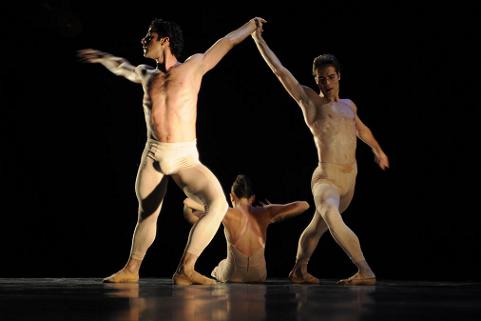
Philip was really sweet and sent me some pictures taken by his friend, Kokyat, of the Morphoses / Martha Wainwright performance Saturday night in Central Park. Above are my three favorites from ABT and NYCB respectively: Marcelo Gomes, Gonzalo Garcia and Tiler Peck (seated). They’re dancing Christopher Wheeldon’s Fool’s Paradise.
It was a fun night. For people unfamiliar with Martha Wainwright’s music, she’s kind of a folksy, bluesy, country mix. So, the dances, mostly choreographed by Wheeldon, a couple by Edwaard Liang, complemented that with lots of wavy-armed, lyrical, softly jazzy, almost social-dance-like movement, with ruffly dresses for the women and open t-shirts, casual vests and buttoned Oxfords with ties for the men.
Here’s a photo by Andrea Mohin of the NYTimes, of Bleeding All Over You, chor by Liang and set to Wainwright’s song. Teresa Reichlen is in the middle, surrounded by Jason Fowler and Adrian Danchig-Waring of NYCB. See Mohin’s slide-show here.
Here’s another favorite of mine by Mohin from the NYTimes slide show, of Gonzalo Garcia and Tiler Peck in Love is a Stranger (set to Wainwright’s re-interpretation of the Annie Lennox hit). This was one of my favorite dances of the evening because, well I love both these two, and it kind of reminded me of when they danced Other Dances together at NYCB this season.
And my other favorite from that slide show, of Rory Hohenstein dancing a solo in Far Away, the first piece of the night.
I don’t know if it was Craig Salstein and the wine or the promise of seeing Marcelo in the second act or what, but everyone seemed to have an extra glow or something; everyone seemed to dance so much better than I’ve ever seen them before — particularly Hohenstein. He was really fluid, really beautiful in this dance.
See more photos in the Times slide show here. And read the accompanying review by Sir Alastair in which he gets just a bit caught up in the spelling of the word “Whither.” I don’t see that anyone has blogged about the review, but it’s certainly making its way around via email because of that paragraph. It’s like the critics are becoming part of the performance…
Anyway, Marcelo danced in the last two ballets — Wheeldon’s well-regarded Fool’s Paradise, and Tears of St. Lawrence (a new collaboration between Wheeldon and Liang). Paradise was set to recorded music by Jody Talbot (the only non-Wainwright music of the night) and Tears to Wainwright’s song of the same name.
Marcelo danced the opening pas de deux in Paradise with Tiler Peck and I feel like I saw things anew and like I was more connected to and moved by some of the twisted, unique, two-body shapes just by seeing a dancer I connect with in the part — his covering her ears, his bowing down to her in arabesque… No one could make the arabesques Marcelo was making, and there were several parts where he and another male dancer — at the beginning Gonzalo — would frame the women with those arabesques and Marcelo’s raised leg was always significantly higher. I always love Gonzalo, and it could just have been my seeing him next to Marcelo, but he didn’t seem as stretched-out Saturday night. His extensions weren’t as heavenly as they usually are. Actually, there was nothing in any of the ballets that really brought out the qualities that make Gonzalo Gonzalo. No Mercurial Manoeuvers, no Hallelujah Junction, no MNS Oberon, no Other Dances, no Concerto DSCH where he could fly all over stage and charm you to death. He doesn’t excel as well at the slower, pretzel-shape pas de deux-heavy dances. Well, it’s not that he doesn’t excel, it’s just that his personality doesn’t have the chance to shine. I want Wheeldon to choreograph something high-flying for him and put it in the Morphoses program 🙂
Back to Paradise: I have to say, upset as I was over not being able to see the dancers up close, I was able to see the patterns better from sitting back in the sky box. Wheeldon and Liang both came back there and stood beside us to get a view of the overall, so I guess Susan and I ended up in the kind of ideal Balanchinian viewing area. From there I really could better appreciate the patterns and the look of the whole.
For all the “whither wather” goofiness, one of Macaulay’s lines in the afore-linked-to review really resonated with me: “I like the control with which Mr. Wheeldon keeps making you pay attention, but I can’t get interested in these dances as thought or drama.” I think that’s what prevents me from getting entirely into a Wheeldon ballet (at least his ballets for Morphoses; some of his ballets for NYCB have been far more dramatic or expressionistic); I feel like I need to come away from a work of art with something other than just a beautiful image. I need more in order to keep thinking about the piece over and over again, which is the effect I want a work of art to have on me.
But I’ll keep trying with Wheeldon — I’m sure if I liked Mercurial Manoevers and the After the Rain pdd, other dances of his will eventually grow on me. Especially if he uses my favorite dancers more often 🙂
Here are some more Kokyat photos of Fool’s Paradise:
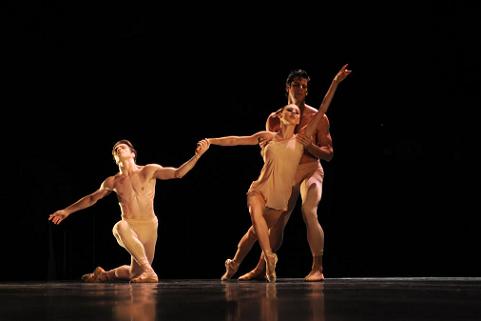
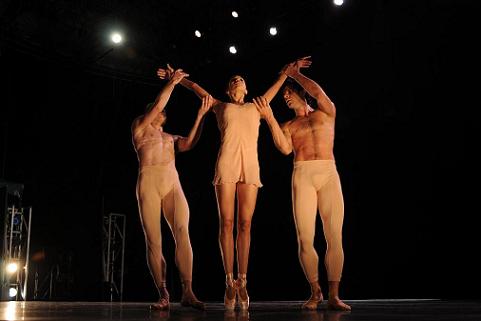
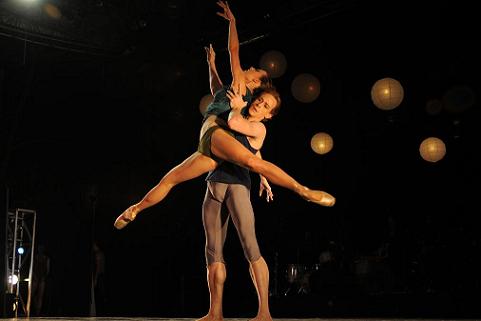
And here are some of Tears of St. Lawrence:
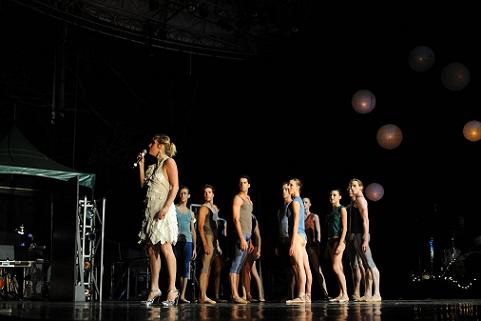
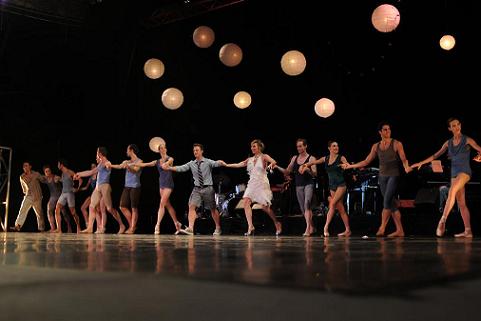
Cast taking a bow, with Wainwright and Wheeldon in center. Look how cute they are 🙂
As I said earlier, there was a lot of music and it almost felt like a music concert with some dance thrown in, but, like others have mentioned, I’m glad the program exposed Wainwright fans to dance. Toward the end, Wheeldon came up onstage and introduced the dancers the way Wainwright introduced her band. He called his dancers “his band” and jokingly noted this wasn’t often done in the dance world. At one point, he remarked to Wainwright that he thought she might dance some and she responded, “Oh … no … oh, I don’t know… I could lie down and let people do things to me?” Everyone laughed. “Maybe it could be you,” she tacked on. “Ah, I don’t think it would be me,” he said after a long pause. He seemed a bit embarrassed. It was cute.
Anyway, thank you again to Philip for letting me use some of Kokyat’s photos. Definitely visit Philip’s blog where he has several posts filled with more gorgeous photos. The photos begin with this post (keep clicking on previous posts titled “Starry Night” to see more).
So last night I went to Christopher Wheeldon’s Morphoses at Central Park’s SummerStage, who were performing to live music by Martha Wainwright. Of course I would have gone no matter, but hearing that my favorite, Marcelo Gomes, was guest-performing with the company, made it all the more urgent.
Anyway, Morphoses events are often very well-attended and there was a bit of a mix-up with my tickets — they’d issued me a guest, rather than press pass and so my friend and I got ousted from the section up front. I understand these things happen, especially with very popular dance companies and it wouldn’t have been a big deal if I could see well at long distances at night (and if I hadn’t helped others get in whose tickets weren’t mixed up….) But whatever, I could deal I thought, even though I felt like a total loser.
So, my friend and I walked to the back dejectedly. But, then, when we got all the way to the back, it ended up our tickets weren’t for the reserved risers but for the skybox, a tent-covered, elevated section that put us far above the standing crowd. And in that elevated section, sat (among others) ABT soloist and one of my favorite dancers, Craig Salstein! He was sitting next to a really cute dancer-looking guy who turned out to be Marcelo’s bf 😀 Then a waitress came by serving us free wine and I knew this was THE place to be, not down there on the ground with those earthlings! I still couldn’t see tremendously well, but I can always see Marcelo from wherever I am and I kind of felt better being with the ABT peeps anyway.
So my friend Susan and I ended up chatting with Craig and Marcelo’s friend throughout the show and they are the sweetest guys! Craig seemed so different than he is onstage! For people who don’t know him, he’s the type of dancer who always gets the bravura roles that require a big personality, and very good acting (not to mention dance) skills, like Mercutio in R&J and the bespectacled nerdy guy who can nevertheless dance up a storm in Taylor’s Company B, and the poor guy who gets girls tossed at him from every which way in Tharp’s Baker’s Dozen, etc. etc. So because he has such a way with comedy I expected him to be cracking jokes every five seconds and acting all clownish and all. But he wasn’t like that at all – -he was really serious and calm, albeit gregarious and easy to talk to. I told my friends, who I went out with afterward, the same and one said, “well, he can’t be Mercutio ALL the time; he’d go crazy.” True.
He’d just got back from vacation (in Italy, where he saw “Roberto Bolle and Friends” — hmmm, didn’t know there was a “Roberto Bolle and Friends”!), and was sporting a serious tan. We talked about ABT’s upcoming season at Avery Fisher Hall and Italy and his choreography and how much I liked it and how great Marcelo is and what I tweet about (you, tossing your mandolin into the wings instead of Jared Matthews’s hands during R&J I said; he seemed bemused) and other chit-chat. Fun fun fun to meet a favorite dancer and another favorite’s boyfriend 🙂
Okay, I’m running off to another Morphoses performance today and have to get going but will write about the actual show tonight or tomorrow morning. Obviously Marcelo was god, Martha Wainwright was good but to me it was too much about her — too much music, almost a music performance with some dancing thrown in — highlights were Edwaard Liang’s premiere and Wheeldon’s Fools’ Paradise (which I saw anew thanks to Marcelo), Tiler Peck, Gonzalo Garcia, a duet between Maria Kowroski and Jared Angle, Wendy Whelan, Rory Hohenstein, a funny joke by Wainwright about lying down and having people do things to her and Wheeldon’s somewhat embarrassed response, and did I mention Marcelo Gomes…
Wow — exciting night Monday night when Tulsa Ballet, a small but well-regarded company founded by members of the legendary Ballet Russes and currently run by Naples-born Marcello Angelini, opened its Joyce season. The company, from Tulsa, Oklahoma, hasn’t performed in New York for 25 years and it was their first time in Manhattan. The governor and first lady of OK were there, along with the mayor of Tulsa, and other government officials. A Japanese TV station also covered the event (the troupe is very multi-national; many dancers are from Asian countries), and Oberon, our friend Susan, and I were interviewed by them outside during the first intermission. ABT dancer Arron Scott was interviewed outside as well, after the show. I desperately wanted to walk over there and listen in on what he was saying, but didn’t have the nerve…
Anyway, there were three dances on the program: Sir Kenneth MacMillan’s Elite Syncopations, Nacho Duato’s Por Vos Muero, and a newish dance from 2008 by Young Soon Hue called This is Your Life.
The dance that most captivated me was the first, MacMillan’s, which I guess isn’t surprising since he’s my favorite full-length story ballet choreographer. I hadn’t seen this shorter piece though. In terms of the movement, it’s typical MacMillan with the bravura leaps and turns and inventive partnering dominated by sweeping, crazy-hard-looking lifts. But I didn’t completely understand the character of the dance. It’s set to Scott Joplin and other American ragtime music but it’s performed by what appear to be commedia dell’arte characters, dressed in almost clownish costumes. See photo above.
See also this video, of an excerpt performed by the Royal Ballet, Darcey Bussell introducing it and then performing in one of the main duets. There wasn’t a band in the Tulsa version though — the music was recorded.
You get a sense from the video what the whole was like. The choreography is comical, complex and brilliant. And the Tulsa dancers did very well with it — particularly the acting. Definitely a very lively troupe. I got the sense that this would look very different performed by a company like ABT or the Royal on the large Met stage, but I thought the Tulsa dancers did a very good job with a very (despite the humor) difficult-looking ballet.
Next on was Duato’s Por Vos Muero
I also really liked this piece. The movement was modern (no pointe shoes): grounded, sharp-lined and expansive. The music consisted of popular Catalonian tunes from the 15th and 16th centuries, with a poem read (in Spanish; Duato is Spanish and his company is based in Madrid) by Spanish music star Miguel Bose (at least he was a star, in a heart-throbbish sort of way when I took Spanish in high school and college 🙂 ) The dance began on a contemporary note, with dancers dressed in simple nude leotards, then took on a historical flavor, the dancers now in dark costumes evocative of the era of the music. The themes (I think) were love and death; it was overall spiritual and mainly dark, with a few lighter moments interspersed throughout, like the one above, when two men playfully slide a woman between them, and she ends up near the edge of the stage and smiles out to the audience, resting her elbows casually on the floor, her chin in her hands. The two men lift their legs, bent at the knee, as if framing her like a picture.
The third piece, This is Your Life, is named after the American TV show (which I never saw). I have to agree generally with Gia Kourlas on this one. The characters first address the audience, telling you their stories of woe, but they’re mostly caricatures, like the flamboyant gay hairdresser dressed in a woman’s wig, and the businessman who wants to break free of his parents’ expectations and become an actor. The dancing parts are set mostly to Astor Piazzolla’s rich Tango music and much of them are Tango-based, portions of them on pointe. Normally I’d be into a ballroom / ballet mix, but the movement here, the combinations, were nothing I hadn’t seen before, and, honestly, I had a hard time getting over the stereotyped characters. This is a dance that may well get a different reception elsewhere though.
Tulsa Ballet performs at the Joyce through August 15th. Go here for more info. And go here and here for other, very different perspectives on the program.