Sara Mearns Was Gorgeous in Swan Lake, But Overall Production Was Lacking


Last week was Sara Mearns week for me (well, for many New York ballet fans, I suspect). On Tuesday night, she made her debut as the Siren in NYCB’s Prodigal Son. (I’m still awaiting photos and will post as soon as I receive them!) Sean Suozzi danced the lead role. He did very well, but she just always stands out to me whatever she is in – particularly the story ballets. She was the best, most tantalizing, sinister, seductive, all around captivating Siren I’ve ever seen. The way she whipped that cape in between her legs, wrapping it around each one, the way she’d bend her knees slowly into a second-position plie while on point, basically squatting over the son’s head in a suggestive but also sinister manner, the way she’d raise her hand behind her head with the wrist bent and the fingers splayed to indicate her triumph over the son’s will, even just the way she’d walk out onstage on pointe, tiptoeing all around him – everything, every movement was in service of the character and was an integral part of the character’s story. I often feel like I’m seeing steps with other dancers. Just steps. The pas de deux between the son and the siren contains some of Balanchine’s oddest-looking choreography- especially those lifts – ‘here, stand on my knees, wrap your legs around my neck and let me carry you around like that,’ etc. I imagine it would feel very odd and foreign doing some of that, which of course was the point. It’s supposed to look warped and off-kilter. Everyone has mastered those steps, but to me, Mearns makes it the most deliciously warped. I love her.

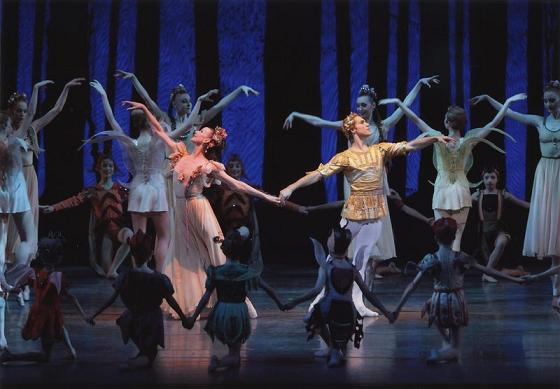
Then, on Friday night, the company premiered their Swan Lake (Peter Martins version), and she danced the lead. (Photo above by Paul Kolnik, from Playbill Arts.)

In sum, I loved her; I wasn’t in love with the production. I went with several friends, two of whom don’t regularly go to the ballet, and that seemed to be the consensus. Everyone was excited to see Mearns dance again, but not to see that production. She was wonderful for all the same reasons I’ve written about before – she’s like a Veronika Part to me; she does such a full job of developing character, she brings you so fully into her world, you feel all of her pain with her. But of course she’s also an excellent dancer. She has a way of arching her back so, of working her arms and hands so, of extending her leg so high in arabesque, of extending her line so beautifully and making such full shapes – it’s a cliche, but her adagio / White Swan is just breathtaking. It almost makes you want to cry, and one of my friends did!

But she excels in the Black Swan / allegro role as well – not so much because she can do athletic feats like Gillian Murphy or Natalia Osipova (there were “just” a bizillion fouettes during the pas de deux, not a bizillion fouettes divided by multiple pirouettes and wild swan-like port de bras thrown into it all) but because she can do that all perfectly fine while still making it all about the character. When she does a series of lifts with Jared Angle where she spreads her legs into a straddle split in the air above his head, it’s just so wicked! And even at the beginning of the Black Swan, when she makes her entrance and presents her hand to the queen – it’s clear she’s up to no good. But she also doesn’t overdo it. She’s conniving and sinister but with a sweet face.

But the rest of the production: Jared’s an excellent partner, that’s clear. Mearns was way off her center of gravity in much of the White Swan partnering, and he securely held her balance, freeing her up to make those gorgeous shapes, and to act it all out the way she so brilliantly does. But in his own dancing, he just, like practically all dancers these days, goes for the cliche. It all looks so fake. I don’t believe he’s in love with her, or that he’s ever longing for what he doesn’t have, and that he’s devastated when she leaves him in the end. It’s all her sorrow and longing alone. So the performance was so unbalanced. I wish so much I could see her dance this with Marcelo Gomes, who really brings Prince Siegfried’s internal conflicts to life like no one else.

The other major issue I have with this production is the costumes – the costumes and the sets. I always forget about them until I see the ballet again, and, especially when I go with friends. My friends Friday night really found it hard to look beyond those costumes. For some reason, I kept thinking of the Flinstones, my friend, Marie, called them Jackson Pollack on speed or something to that effect (I haven’t read her review yet but will after I finish this post), and the others we went with just couldn’t stop talking about the brash colors. I remember my friend in the fashion industry saying of the Romeo and Juliet costumes (Per Kirkeby designed sets and costumes for both Martins productions) that the colors needed to be muted; these brash, bright, almost neon colors made the characters look like cartoons. Same with the Swan Lake costumes. Cartoonish is NOT what you want to go for in serious ballets like this.

Also, the RACISM. This is another thing I hate to admit I often forget about until I see the ballet again with a friend, and the friend is horrified at the fact that a black man is playing the evil character. Must von Rothbart always be danced by Albert Evans or Henry Seth? Are we not living in the year 2011? I mean, this is a huge reason why young people are so turned off from the ballet. And none of the very educated critics ever seem to be calling Martins on this. What’s up with that? Seriously? I think once you go to the ballet a lot you begin to forget about these things, you become immune to them. Which is horrible. But really, asking your audience to associate black men with evil is a horrible insult to that – probably very educated – audience.

Another problem here: Faycal Karoui (the conductor) was seriously on speed. He was flying through the first half. The poor dancers couldn’t even express the story. They really had to rush falling in love. If I’d never have seen this ballet before (and there were probably some such people there due to the Natalie Portman film), I don’t know if I would have gotten much out of the White Swan pas de deux. And that’s kind of an important part of this ballet…

All other dancers did well – I particularly liked Ana Sophia Scheller and Anthony Huxley (filling in for Sean Suozzi as Benno) in the first act Pas de Trois, and, in the second act, Abi Stafford and Joaquin DeLuz in the Divertissement Pas de Quatre, and Antonio Carmena in the Neapolitan Dance – but everyone did very well (those were just the ones who stood out to me). Oh and I loved Daniel Ulbricht throughout as the Jester. With his immense skill at jumps and turns – and combo jumping turns – and his comical sensibilities, he is perfect for such a role, as he is for Puck in Midsummer Night’s Dream – my favorite roles for him.

But I have to say, I was floored when none of the other dancers came out and took bows at the end of the production. Why? Whose idea was that? Only Mearns and Angle and Evans took bows. I realize the dancers are all very hard-working and probably needed to get home to get sleep for the next day’s matinee. But this severely cut Mearns’s bow and curtain calls short. It reduced the celebratory aspect of a production well done. Worse, it also really makes it look like none of the other dancers cared about Mearns, and about the production. It made it look like the company is not really a company of dancers who all work together and support each other. I’ve honestly never seen such a thing before. I’ve seen it where dancers who only dance during the first act will take their bows and curtain calls after the first act and not at the end of the whole, but the dancers who danced in the last act always come out for their bows at the end. Anyway, it really stood out to me. What did other people think?

Here is my friend Marie’s write-up.
Janie Taylor Debuts in Millepied’s “Why Am I Not Where You Are” Etc.

I’ve been remiss in my New York City Ballet posts! Last week I saw two programs: one featuring three dances to three different violin concertos – Peter Martins’s Barber Violin Concerto, Robbins’ Opus 19 / The Dreamer, and Balanchine’s Stravinsky Violin Concerto. And the other program was another in the “See the Music” series but was also dedicated to Santiago Calatrava, who designed sets for all three of the ballets performed – Benjamin Millepied’s Why Am I Not Where You Are (pictured above, photo by Paul Kolnik), Christopher Wheeldon’s Estancia (pictured below, photo also by Kolnik), and Mauro Bigonzetti’s Luce Nascosta, all of which premiered last season and which I wrote about here, here, and here.

Calatrava was in the theater, and after encouragement by Peter Martins, he rose and took a bow.

Then, as with the first “See the Music” program, before the performance began, the orchestra pit rose and conductor Faycal Karoui gave a humorous little explanation of various parts of the Thierry Escaich score from Millepied’s Why, the first ballet performed.

These explanations are really interesting to me, I have to say. I only took one classical music class in college and now wish I’d taken more. Karoui talked about how there were four main parts to the score: a waltz, a tango, a disco, and a final climactic part, and he talked about the differences in tempo between them, and between them and a typical waltz, tango, etc.. He also talked about how the ballet has a central male character (danced very well by Sean Suozzi – in top picture, being carried by the group of men), and how you can hear that central character’s theme – or voice – throughout each section of the music. But the voice changes with each section: at first, he’s shy and mysterious (and his voice in the first section is portrayed by a violin solo), then as the orchestra grows sharper and stronger in the second, tango, section, so did the character, etc.

When we got to the “disco” section (it sounded nothing like disco to me but just slightly more mechanical and percussive than the preceding sections), Karoui really began rocking out as he led the orchestra. It was like he was actually dancing in a disco, and I nearly cracked up. I’m not sure if that’s what he normally does down in that pit – if he regularly starts to embody the music literally like that, or if he was just being a goof for the audience. He didn’t seem to be hamming it up at that point, though – oddly – so who knows. Anyway, he is very entertaining and I find his musical explanations very educational as well. What more can you ask than to be both entertained and educated, right?

Anyway, Janie Taylor debuted in the Millepied. She was supposed to have debuted when the ballet did last season but she was out with injury and so Kathryn Morgan had filled in. Character-wise I thought she played it the same as Morgan. Except with Morgan it seemed to have a West Side Story feel to it; with Janie it was darker and more La Valse-like. Both were tragic, but in a different way; Kathryn’s character seemed more innocent. Anyway, this was my second time seeing the ballet and it grew on me. It’s very dramatic, not a dull moment in the whole thing, and you’re really on the edge of your seat, both because of the intensity of the music – maintained throughout each section – and the dramatic story of the poor innocent guy who’s drawn into another world by his enchantment by this ethereal creature, only to get trapped and ultimately destroyed, along with her.

To me, Sara Mearns and Amar Ramasar, with their bravura roles, largely stole the show – I think I remember thinking the same last time. She with those crazy fast chaine turns all around stage that almost make you sickly dizzy, and he with his virtuosic leap sequence – they are kind of the sinister characters, seducing Suozzi but also the audience.

Then came Estancia, and it was my first time seeing Ana Sophia Scheller and Adrian Danchig-Waring (pictured above) in the leads. I’m not a huge fan of this ballet – well, I like the ensemble sections, particularly the dancing and taming of the “horses” – but I nearly fall asleep during the middle, romance part, where city boy wins country girl over. I think it’s just the choreography in that middle section (that I found relatively bland) that slows it down – along with the music – but I liked Scheller and Danchig-Waring just as much as the first pair of leads – Tiler Peck and Tyler Angle. In fact, they seemed to fit the roles a bit more. Scheller reminded me of the main character of Agnes de Mille’s Rodeo and there was something more sweetly, playfully tomboyish about her look than Peck’s. And Danchig-Waring perfectly suited the city boy trying to woo her. He acted his part very well. And his movement is always very sharp. Andrew Veyette and Georgina Pazcoquin as the horses who are eventually tamed, were fabulously entertaining.

And lastly was Bigonzetti’s Luce Nascosta (picture at left by Kolnik), which I’ve seen now three times and which I like but think is too long. I missed seeing Craig Hall in the middle section that seems to be softer and looser than the other sections, where the movement is more marked by those extreme shapes with the flexed hands, splayed fingers, and angular balances and slides on pointe. Hall seems to have the ability to move in a more undulating, kind of serpentine way than most of the others and it seems to me to suit that middle section well.

In the previous program, I loved Megan Fairchild again as the “modern” dancer in Barber Violin Concerto, and, as always, Gonzalo Garcia as “the dreamer” in Robbins’ Opus 19!

MORE BEAUTIES


So, toward the end of last week I saw two more casts of Sleeping Beauty in New York City Ballet’s production. Above are the beautiful Kathryn Morgan as Aurora and Tyler Angle as her Prince Desire (Paul Kolnik is the photographer). Below are some photos of the other couple I saw, Tiler Peck (both she and Kathryn were making their Aurora debuts), with Gonzalo Garcia, albeit not from this ballet.


(in Four Bagatelles, photo by Paul Kolnik)


(and in the Christopher Wheeldon / Martha Wainwright collaboration over the summer, photo from NYTimes by Andrea Mohin; I like this photo because I think it shows each of their personalities well).

And then last week, I saw Ashley Bouder and Andrew Veyette.

I’ve been thinking about who I thought was best in what role but it’s actually really hard to do that. I honestly ended up liking everyone, though there were definite differences.

I do have a lot to say about Gonzalo Garcia though. I LOVED him as Prince Desire — he really melted me, he really completely stole the show that night and I feel like I’m not ever going to like anyone quite as well in that role now. I mean, you just have to see him in a classical ballet, as the romantic lead, and you realize why San Francisco audiences were so upset when he left SFB for NYCB a couple years ago. Some of those SFBallet fans were really devastated when he left. And I think it’s been such a puzzle to those fans that New Yorkers haven’t really fallen for him the same way. And I think it’s because he hasn’t had the chance to shine because NYCB is so Balanchine-heavy. He needs roles where he can act and become a character. He’s such the quintessential romantic prince.

You can really tell how differently he’s trained than the other NYCB dancers, who’ve nearly all come from SAB and been trained on Balanchine’s non-actable abstract ballets. I felt like with Gonzalo I was seeing someone from ABT — mainly Angel Corella (in terms of the body type, dramatic style and boyishly handsome face). The way he’d hold onto the music, draw it out while it crescendos, by for example in the vision scene holding out a finger to the princess and then leaning back, then looking out to the audience — not AT the audience but in the audience’s direction — to show how enthralled he is, how much he wants to catch her, all before then turning and running toward her. The other two — Tyler and Andrew — they didn’t do all that. They just kind of looked toward her standing more and more toward the tips of the toes, ready to run toward her when the music told them to. Gonzalo’s way was so much more Petipa and Tchaikovsky and Bolshoi and Romantic Russian and all that, and it might all seem overly melodramatic to audiences who aren’t used to that. But that’s what I’m used to with ABT — and that kind of stuff makes me swoon!– so that’s why I think I loved him so much. But I’m wondering what others who saw this cast thought?

And Gonzalo just knows what’s expected of him, as the prince. Later, when he went to do that crazy series of jetes, he was rested up and ready and he nailed them like I’ve never seen him nail anything. I’ve never seen his legs straighter, in perfect splits, and the whole way around the perimeter of the stage, without tiring. And it’s like he knew that was a very important part, and he had to do them perfectly because that’s just what the romantic hero does — that’s the way he shows his love for the princess, and that he’s worthy of her. The other two obviously took them seriously (because they’re crazy hard, you have to take them seriously), but it just was more of a difficult feat, instead of having the same meaning. You know what I mean? Like he looked out all across the stage wistfully, and then he just took off flying around it. It gave it a different meaning than just flying around.

It makes me wonder though if contemporary audiences understand that, or appreciate it. Or whether they prefer for the emotion to look more “natural”? I’m not saying Gonzalo was better than the other two, just different.

I wonder what Joaquin De Luz was like, since he’s not SAB trained either. Did anyone see him?

As far as partnerships, Kathryn and Tyler were my favorites. Tyler had a few flubs on some of his solo variations (but I still love him!), but he was always the perfect partner, he was always solid when supporting her. And the series of fish dives in the wedding pas de deux were some of the most breathtaking I’ve ever seen. Her legs were pointing completely up toward the ceiling! Magnificent! And the final hands-free fish dive was picture perfect.

I liked all of the Aurora interpretations, but they were different too. Kathryn was the most princess-like, the most regal, though that may just be the way she looks. She just kind of looks like royalty! Ashley and Tiler seemed more “real girlish”ย  – all smiles and sweetness and awe at the world and their cute suitors.

The rose adagios were all near perfect. (ABT’s Sarah Lane is still the queen of the balances to me — it seems like she could hold them for hours.) Kathryn had the most absolutely gorgeous extensions. Do I have to giggle every time Robert Fairchild comes out leading the cavalcade of suitors? I loved Craig Hall as the “African prince,” – I don’t know what exactly stood out about him but something did. And even though it wasn’t a dancing role, I loved Henry Seth as the King; he acted it really well. Chase Finlay was lovely as Gold in the wedding scene – -he’s a really beautiful dancer with exquisite lines. Everyone’s talking about him being the next romantic lead. I loved tiny Erica Pereira as the fairy of eloquence and Ana Sophia Scheller as the fairy of courage, thought Faye Arthurs and Adrian Danchig-Waring were brilliant as The White Cat and Puss in Boots, and Daniel Ulbricht is the quintessential gymnastic court jester.

And there’s NEVER been a better Carabosse than Georgina Pazcoguin! Nor has there ever been (or, perhaps, could there be) a better Lilac Fairy than Sara Mearns. I love how she arches her back so luxuriously and opens up her chest. And the rich, full-out port de bras. Such beautiful expansiveness, that, with her beatific face, makes her perfect for this angelic role. She reminds me of Veronika Part.

Okay, that’s all I can think of, for now!

This week begins the Swan Lakes. I’ve never seen Peter Martins’ version, so I’m really excited. In particular, I’ve heard wonderful things about Maria Kowroski as Odette and I’m psyched for Stephen Hanna’s debut as Prince Siegfried!

NEW YORK CITY BALLET’S SLEEPING BEAUTY IS THOROUGHLY CAPTIVATING FROM START TO FINISH


This past week, New York City Ballet began its two-week run of Sleeping Beauties. I saw the opening night performance, with Ashley Bouder (above with Damian Woetzel, in Paul Kolnik photo) in the lead. She danced opposite Andrew Veyette, as Prince Desire. Both did really, a near-perfect job (just because nothing’s ever completely perfect!). Really, I don’t know what more you could ask for, although I’m waiting to write my full review on the production until later this week, after I’ve seen two more casts: Kathryn Morgan as Aurora and Tyler Angle as PD (with Janie Taylor as the Lilac Fairy!), and then Tiler Peck and Gonzalo Garcia as the leads.

I love NYCB’s production — a lot more than ABT’s — and I can’t really figure out why. In NYCB’s there’s really never a dull moment — there’s no boring court dancing, just all the wondrous ballet, the very intricate and complicately awe-inducing variations for the various faeries (Sara Mearns was gorgeous as Lilac Fairy — in photo below by Paul Kolnik, as were Amanda Hankes, Lauren King, Rebecca Krohn, Erica Pereira, and especially Ana Sophia Scheller as Fairies of Tenderness, Vivacity, Generosity, Eloquence, and Courage respectively), the fun “wedding scene” with all the cute virtuosity-driven duets for the fairy tale characters (once again, loved Sean Suozzi last week — here as Puss in Boots, and Stephanie Zungre as his partner the White Cat; loved Tiler Peck and Daniel Ulbricht as Bluebird and Princess Florine, loved Henry Seth as the Wolf but not sure why they had a little girl dance Little Red Riding Hood…), the “jewels” starring Stephen Hanna :), and of course the beatific Grand Wedding Pas De Deux between Bouder and Veyette.

I don’t know, there’s just never a dull moment: you go from the Rose Adagio with all the virtuosic balances for Aurora (and the handsome cavaliers), to the richly choreographed fairy variations (that seemed to me more Balanchine than Petipa), to the drama of Carabosse’s arrival with her creepy minions and the frightening spell she casts, to the sweet Vision scene, to the quick Awakening (nothing in this production is long and drawn out; each scene gets right to the point), to the Wedding with the entertaining guests, and ending with the beautiful pas de deux between Beauty and the Prince.

I can’t figure out what exactly is different between this version and the others I’ve seen before, but honestly, this hasn’t been one of my favorite story ballets. So I was just really floored by how captivating NYCB’s production was. I can’t wait to see a few more this week. NYCB is good at story ballets! If you’re in NY and you can make it sometime this week, do go!


NEW YORK CITY BALLET OPENS THEIR WINTER SEASON WITH MIDSUMMER NIGHT'S DREAM & GERSHWIN

New York City Ballet opened their Winter 2010 season last week with rotating performances of Balanchine’s Midsummer Night’s Dream, and a two-ballet program of his Who Cares?, set to Gershwin music, and Peter Martins’ Naive and Sentimental Music.

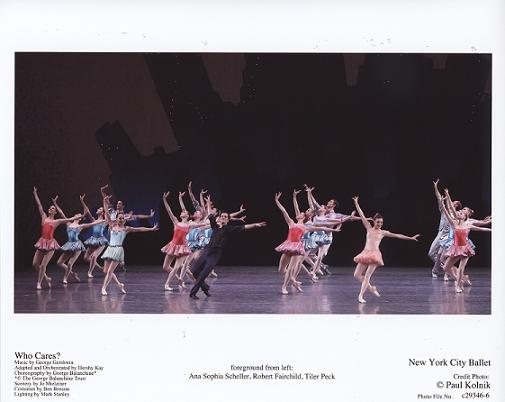
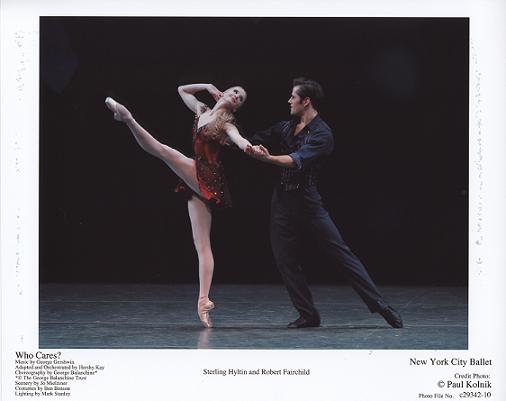
I LOVED Who Cares?! (photos above — of Robert Fairchild and Sterling Hyltin, and of the whole cast — by Paul Kolnik.) I’d only ever seen the pas de deux before and didn’t even realize the whole was comprised of a whole slew of Gershwin songs, some danced by the ensemble, some by only the women, others by only the men, with solos and pas de deux mixed in. I particularly loved Tiler Peck’s duet with Robbie Fairchild in The Man I Love. She has such a clean, beautiful line and she’s so expressive and so engaging. She can make a story out of anything. And of course Fairchild is always the perfect romantic male lead ๐Ÿ™‚ Crowd went wild over his and Ana Sophia Scheller’s duet to Embraceable You as well as Scheller’s My One and Only solo. Such a fun ballet — I’m going back for more this week.

Also shown in that program was Martins’s new Naive and Sentimental Music, set to John Adams’ score of the same name. I wrote about that ballet when it premiered here and posted pics of it here. Seeing it again evoked a bit of Balanchine’s Jewels, particularly the lovely lyrical white section (my favorite) and the sexy red.

One little thing I have to say: this ballet was created on and is danced only by principals but Adrian Danchig-Waring danced in last week’s production as well, and he is still a soloist (I think he may have been replacing Amar Ramasar, who must be injured because he was replaced a few times over the week…) Anyway, I realize NYCB is top heavy at the moment, but I think Danchig-Waring definitely needs to be next in line for a promotion!

And earlier in the week I saw the best EVER cast ofย  Midsummer Night’s Dream. I finally got to see my Gonzalo Garcia as Oberon ๐Ÿ˜€ (photo above by Paul Kolnik, of Garcia as Oberon and Darci Kistler as Titania). I’d missed him in this role at the end of last season. He did very well – -not only with the dancing — particularly that crazy fast scherzo — but also, and less expected for me, with the acting. I thought he’d be a sweet, glowingly endearing Oberon, but, no, he was a pissy, demanding fairy king — just as much as Andrew Veyette last season (cutely pissy and demanding though!) He wanted Titania’s servant boy and he wasn’t letting her say no to him. Only thing regarding the dancing — his legs don’t seem to be as flexible as they once were. It seems like he may have injured an adductor muscle, or else he’s built up so much thigh muscle or something — but his legs when he jumps are not making perfect splits. But his upper body is so fluid and graceful and he exudes such charm that he’s still the perfect lyrical male dancer nonetheless.

Titania was the beautiful Sara Mearns (headshot by Paul Kolnik — a new headshot for her, right?)– and she was the best Titania I’ve personally seen. Oh she’s such a beautiful dancer! She throws herself so fully into every move she makes. If Garcia is the ideal male lyrical dancer she is the ideal female – they were so perfect together.

And I’m so glad Stephen Hanna is back at NYCB (still annoyed with the Billy Elliot directors for not making good enough use of him on Broadway). He was Titania’s cavalier and his pas de deux with Mearns was the best Titania / Cavalier pdd I’ve ever seen. He’s so big and strong — which certainly amps up the romance factor — and his numerous tour jetes just have so much power. Honestly I often get bored during that pdd and just want Oberon to return, but not with Hanna’s cavalier!

And new to the cast of human characters who get their hearts messed with by a mischievous Puck (Troy Schumacher) was Janie Taylor, as Helena. She is another one who excels at story dances, always delving into a character and making clear to the audience what’s going on in her mind. She’s pathetically, endearingly funny from the time she enters the stage all forlorn over Demetrius, to her being completely bewildered by Lysander’s sudden attraction to her, to her searching the forest madly for Demetrius, to her cat-fights with Hermia, etc. She really brought out the humor.

In the section where I was sitting, there were at least three large groups of people you could tell had never seen the ballet before — nor likely the play; they didn’t seem familiar with the story. But they were laughing hysterically throughout the whole thing and were really awed by the dancing, and by some of the tricks (like Puck’s being pulled up to the ceiling via harness at the end). That’s when you can tell with a story ballet that the cast really brought it to life, when the newcomers are enthralled.

GONZALO GARCIA IS A ROCK STAR AND JANIE TAYLOR A GRACEFUL MURDERER


Those are my friend, Judy’s terms in the title, by the way! Friday night at New York City Ballet was one of the most exciting in recent memory. The dancers were all excellent, the ballets fun, the audience pumped (okay, a little over-pumped in places!) It was just one of those nights to remember. It was an all-Robbins program, consisting of four of his most diverse, but liveliest dances: Glass Pieces, The Cage, Other Dances, and The Concert.

First, of all, Wendy Whelan appears to be out with a minor injury, so it was announced before curtain rose that Janie Taylor would be dancing the lead in The Cage. If anyone heard some psycho girl shout “Yay!!!” — sorry. Didn’t mean for it to echo like that… ๐Ÿ™‚

Glass Pieces is always enjoyable with that rhythmic music, especially in the first and last sections with the intense strings and pulsating drums respectively, the dancers in the first walking across stage as “normal people,” every once in a while a “dancer” appearing and turning and /or jumping ‘dancer-like’ across stage — the most visible of whom is Tyler Angle. I can watch this ballet endless times just to see him in that first section. He’s beautiful in that golden unitard, and always breathtaking no matter what he’s doing.


The second, adagio section, was danced by Maria Kowroski and Philip Neal. Maria nailed this section like I’ve never seen anyone do before. Her body is of course so long and thin and she’s got such spidery limbs, she can really make wicked lines. I don’t know what the dance means, but every form she made was so pronounced and so full of intent, she was just mesmerizing.


Then, Janie’s Cage! Sometimes you just know that no matter who’s done the role in the past — Tanaquil Le Clercq — whoever — this is just the best; no one’s ever going to outdo that and no one no how has done better before. That’s how I felt Friday night watching Janie. It’s like this role was made for her, even though literally it wasn’t. It’s like she’s very mindful of how each shape she’s making is going to look from every vantage point in the house. You can tell how much she worked at this and thought about it. Maybe it comes from being a visual artist as well (she’s a cartoonist and a costume designer).

Anyway, The Cage is the heartwarming (not) story of a colony of female ants – or some kind of insect — who, like black widows, kill their male counterparts, after mating. (Where did Robbins get the idea? Ballet’s from 1951. Hmmm.) Janie was absolute wicked splendid perfection; she just looked like a spidery-limbed little arachnid as her tiny waify body descended on poor big muscly Sebastien, digging her tentacles into his sides, slapping and clawing him all about. And the way she’d flick her wrists and make those insect-like shapes with her hands at such speed and with such perfect definition, it looked like she was metamorphosing into some creaturely other right before your eyes. It was really rather terrifying.

At one point — either she’s on top of him or him on her, I think it’s the former since she’s killing him — their bodies each curve out from the other to make this big hollow O shape, and it looks like one of those human limb-eating plants (what’s the name?…) Crazy beautifully creepy! Of course the drama is that Janie’s the “novice” here and she doesn’t want to eat this man because she kind of falls for him, but she has to for group acceptance. The way she shows that, wanting to reject the rites, by caving in from her center, collapsing into herself, then rolling herself into a ball and letting the male bug hold her — is stunning as well.

Teresa Reichlin is the ideal Madame of the colony, or whatever you want to call her. Her long legs just beat the air on those battemants, like she is the queen and you don’t question her. I can’t find many pictures, but here is Wendy Whelan talking about the ballet, with some clips of it.


Then was Other Dances, starring (really, a very apt word) Tiler Peck and Gonzalo Garcia. This is a gorgeous ballet, full of sweetness and romance and virtuosic dancing with high leaps and jumps and spins and all, originally made for Baryshnikov and Natalia Makarova. I can’t imagine this one being done better either. Both dancers have such endearing stage presences. Tiler Peck is really growing on me — her obvious love for the music, her playful phrasing, her sweetness and freshness and innocent charm. She was beautiful on those overhead lifts where she lay on her side, her arm behind her head, looking down at him. And Gonzalo’s in love with his audience, and you can tell. He says in this article that he’s naturally shy, but he’s also a natural performer. As I said on Twitter, at the beginning of his second solo, two girls screamed “I love you!” Very very unusual for NYCB! “What is he, a rock star?” Judy asked me. Apparently. Gonzalo is turning NYCB into ABT ๐Ÿ™‚ What is it about these Spanish men?…


Tiler and Gonzalo work very well together. There was some weirdness between him and Ana Sophia Scheller, but these two are a very good partnership. I think they’re friends too — I see them together on the street sometimes. They danced the virtuosic leads in Donizetti Variations two days earlier and were equally stellar. I’m told he had a big fan base in San Francisco, where he came from. Well, he’s won me over. Ariel, who came with me on Donizetti day (and who comes with me to NYCB rather frequently), took one look at the program and said, “Wow, they have Gonzalo dancing a lot these days.” I said, “Yeah, particularly when I happen to have tickets. Funny that.”

And the evening ended with the comical The Concert, which Judy loved, as I knew she would. It’s cute and funny and no one does up the humor like Sterling Hyltin as the sweetly goofy music lover who can’t dance her way out of a paper bag, and Andrew Veyette and Gwyneth Muller as the cutely warring husband and wife. Andrew even took curtain calls with his ‘obnoxious husband’s’ pipe gripped firmly between his teeth.

The other highlight of the week to me was Balanchine’s Stravinsky Violin Concerto, danced spectacularly by Robert Fairchild, who I’m positive I will never ever tire of seeing. He’s got to be one of the hardest working young men in ballet these days and it really shows. He’s becoming a real David Hallberg. His movements are so precise and everything is so well-articulated. He bends from the waist more than anyone else (that I can see) and that gives him so much breadth and expansiveness. And he’s always making some sort of statement, even in abstract ballets, particularly in abstract ballets.

I love this Stravinsky choreography as well. There are so many stand-out moments, you just can’t mention them all. I love the part where the man of the first couple (here, the aforesaid Robert the spectacular) stands over the ballerina and turns her, or rolls her. She bends underneath him so he looks like her shadow. If this is the same ballet, I felt like Robert leaned in closer to her before and held his arms around her waist, held her more closely, and almost put his head on her back, and it looked so romantic, so tender and loving. It just melted me. He didn’t do that either night I saw him dance this this week. He still turned (or rolled her — don’t know what to call it) brilliantly, but I feel like someone told him not to lean in and make it tender like that. But I want him to do that again! Unless it’s another ballet I’m thinking of … is it? Does anyone know what I’m talking about??

I also love the rather acrobatic choreography for the second couple — first night I saw it danced by Maria Kowroski and Sebastien Marcovici, second night by Amar Ramasar and Kaitlyn Gilliland (filling in — and doing very well — for Wendy Whelan and Albert Evans). I love how she does backbends and handstands over and around him and he just looks at her with amazement, and follows.

Finally, I really liked Liebslieder Walzer earlier this week, which I wrote shortly about here. I know some think it’s slow, and it wasn’t very popular when Balanchine first showed it in 1960, but I really prefer the choreography here to that in his more popular Vienna Waltzes, which is mainly straight ballroom. The choreography is more complex here, and revealing of character. One man (the night I saw it, it was Jared Angle –who looked sharper and more gentlemanly than ever to me) circles around his lady and she circles the opposite way on the inside of him. It’s a lovely effect and I think it shows they are going in opposite directions, not meeting mentally. The couple danced by Sebastien and Janie seemed the most romantic, at one point approaching one another while making expansive circles with their arms as they entered into an embrace. I do agree with Sir Alastair, though, that the couples need to work on their differentiation from one another in order to amp up the drama. It’s choreographically beautiful though and I hope they keep doing it in future seasons – -maybe not with the equally slow and somber Les Noces though!

(By the way, that program — Liebeslieder and Noces — program 8 — is showing twice more this week and I found it not really to be a program for newcomers to ballet. I brought my friend, Jonathan (who I haven’t seen since law school, don’t want to say how many years ago now ๐Ÿ™‚ ) and if he wasn’t an opera fan who could latch onto the chorals (which feature heavily in both dances on the program), I fear he might have been bored. I think you have to really be into the intricacies of choreography to appreciate it. If you’re new to ballet, or bringing someone new, see Programs 9 and 10 this week — both containing more dramatic, lively dances.)

NEW YORK CITY BALLET: JANIE’S DSCH, KATHRYN’S SCOTCH AND MORE VIEWINGS OF PREMIERES


I can see how ballet is so addictive, especially to those with dance training who’ve either danced the roles they see onstage or pick up choreography on sight. It’s so interesting to see different dancers perform the same roles, to see what they can each do with something, where they can take it. A ballet can look completely different depending on cast.

Janie Taylor recently debuted as the female lead in Ratmansky’s Concerto DSCH and I absolutely loved her. I thought she brought a certain vulnerability, delicateness, and romantic touch (both big and small “r”)to the role and as such created a poignant centerpiece to this ballet that is mainly full of fast, frolicking fun. She was perfect partnered with Tyler Angle, who gives everything an emotional, Romantic quality. There’s one point where the girl bourrees (tip toes) backward from the guy and he steps toward her in a series of lunges, arms outstretched. It was rather heart-grabbing when Janie and Tyler did that. It was like Tyler was reaching for her with all his might, but she just kept falling away from him, telling him no, it couldn’t be.

The original cast for the romantic couple was Wendy Whelan and Benjamin Millepied, and when I saw them perform it again a few days ago, I looked for that part. I almost didn’t see it until Wendy had bourreed practically into the wings. Benjamin, instead of reaching toward her with all his power, bent his knees and performed those walking lunges close to the ground, kind of bouncing up with every step forward. His arms were still outreached but the deep kneed, close to the ground walks gave it overall a more playful feel, or perhaps like he was looking up to Wendy, his supreme ballerina. Wendy’s of course such an icon in the ballet world and she’s stronger and less vulnerable and delicate than Janie and so it just had a kind of man worshiping woman instead of a boy trying desperately to hang on to his love feel.

Ashley Bouder has been out with an injury so Ana Sophia Scheller is filling in for her in the main allegro ballerina part, still dancing alongside Joaquin de Luz and Gonzalo Garcia.


There seemed to be a slight bit of drama going on between Scheller and Garcia at first — I don’t know what it was — he was his usual sexily mischievous, charismatic self and she seemed nervous and holding back a bit (albeit not with Joaquin), but hey, drama is always fun ๐Ÿ™‚ I think that has been all worked out though. The last time I saw them dance this together they were right on. She appears to be a lovely dancer and I’d like to see more of her.

I’ve also seen two very different casts in Scotch Symphony: the first Benjamin with Jenifer Ringer, the second Robert Fairchild and Kathryn Morgan. This is a sweet Balanchine ballet, telling the story of a young kilt-clad Scotsman lost in the Highlands who becomes completely smitten with an ethereal goddess dressed in Romantic tutu. He keeps trying to reach her but is thwarted right and left by a group of Scottish guards. Finally, they meet and dance a lovely pas de deux.

My friend, Alyssa, now has a huge crush on Benjamin. I don’t know how it happened; we were standing in line at the box office to pick up tickets one night and he was talking on the overhead screen, likely about his new ballet (I’m not sure because the sound was off) and Alyssa became mesmerized by his face. “That’s the guy who recently premiered a new ballet,” I said. “Oh, he’s a choreographer? He’s cute!!” Then when we got inside and were looking at the Playbills she screamed, “look, the cute guy is dancing!”


Afterward at dinner all she could talk about was how other dancers (like Daniel Ulbricht, who we saw in Tarantella that evening) were great jumpers and technically perfect and all, but Benjamin just brought so much more to the dance. “He was just so … so… he was perfect in everything he did, but he wasn’t just perfect, he was… ” she waxed unable to come up with the right word. It was Ethan all over again (whom she fell for after seeing at Martha’s Vineyard merely introducing his Stiefel and Stars and saying he was unable to dance because of the knee operations).

I nodded. He does have a certain beneath-the-surface charm (Benjamin that is), and he is a very good dancer, always coming through with those ever so challenging fast-paced Balanchine roles.

But of course I was dying to see Robert Fairchild in the same role, with Kathryn Morgan as his ethereal love object. They were so beautiful together. She’s just so angelic, and he always dances with such passion and boundless amounts of energy, and of course he’s always got that boyish charm that he’s had since debuting in Romeo two years ago at age 19 but that I don’t think is every going to go away. He’s such a hard-working young guy, you can tell — he puts everything he has into his dancing. He had a tiny fumble coming out of a jump and had to check himself with a couple extra steps to secure his footing (but he didn’t fall), and at one point he was a bit too far from Kathryn during a supported arabesque penchee and she couldn’t get her leg all the way up in the air. But, to me, honestly, when a dancer makes a blunder it only makes him or her all the more endearing, more human.


(Robert Fairchild, Kathryn Morgan)

I loved Tiler Peck in Tarantella — another role that usually belongs to Ashley Bouder, but Tiler brought a certain freshness and wit to this cutesy extreme high-speed dance. Ashley usually brings a sexy, flirtiness to it; Tiler was more sweet and smart. I like both, and, again, it shows dancers often make the dance.


Daniel Ulbricht (photo above by Paul Kolnik), as always, delivered on the technical and difficult athletic aspects of the dance — the high jumps the turns and all. Audiences always go absolutely wild over him. I personally like Joaquin de Luz a bit better (in this and the other roles he dances — he and Daniel usually alternate) because he delivers on the virtuosity as well but he makes it more about the character. At the end, the boy here steals a kiss from the girl. With Daniel, the high jumps and theatrics are the dance, the kiss is just a little reward at the end; with Joaquin the whole thing is about that kiss, the mad leaps and spins and turns with the tamborine are simply leading up to it. But audience do go completely wild over Daniel.


(Tiler Peck)

I saw the new ballets once again — Benjamin Millepied’s Quasi Una Fantasia and Jiri Bubenicek’s Toccata, and both grew on me. Funny, but I sat in orchestra this time for both — first time I was looking down from the first ring side, and it’s really interesting how different the ballets look from different vantage points — especially the Millepied. Looking down from above, this ballet really seemed to evoke a flock of birds, at times sinister and foreboding. Looking at it straight on, it was still unsettling — with that haunting Gorecki score — but at times the dancers resembled insects reminiscent of Robbins’s The Cage, and later, just figures — one weak and somewhat broken, the other strong — moving in various groupings. My friend Michael and I both noticed how he’d make various groupings or formations with the dancers — phalanxes, Michael called them. Sir Alastair had noted the same, saying he likely got the ability to work a large ensemble like that from Balanchine. I don’t always notice such things until someone points it out — I’m usually more focused on the theme, what the choreographer is trying to evoke, or make me think and feel.

I wish I had a picture of what the dance looked like from above. Overall, I think I still see Hitchkockian birds ๐Ÿ™‚

I still don’t know exactly what Toccata is about but I love how there is a great deal of really intense partnering, sometimes several duets happening at once, the dancers by turns pushing and pulling, sliding, strugging with and embracing each other, and I love how at points the bodies just kind of mesh into one another, just melt into each other. It’s really kind of sexy in its own way. I love Robert Fairchild in these kinds of abstract roles. As I think I’ve said before, he always makes a little character out of a role no matter how abstract, and he dances with such expansiveness. With that and his immense charisma he devours the whole stage.


(Robert Fairchild and Georgina Pazcoguin in Toccata, by Paul Kolnik, from Oberon’s Grove)

I’m also liking Maria Kowroski much better. I heard she is taking acting lessons and it shows. Every little step is meaning something, saying something, a little quip perhaps, a little retort, to her partner (who has often been Sebastian Marcovici these days) and to the audience. I particularly liked her in Balanchine’s modernist Movements for Piano and Orchestra and his sweet, more classical Chaconne. Huge kudos to Sebastien in the latter for doing some really intensely fast footwork and really nailing it all. He is a large guy and that’s not easy. A friend told me afterward he thought Sebastien looked a bit “heavy” in the role, and I can definitely see that — a smaller dancer would have looked much lighter and more frolicking and playful — where Sebastien brings more virility and power and intensity — but, again, what makes ballet so addictive is the different bodies, different strengths, different personalities, different interpretations.

NEW YORK CITY BALLET SPRING SEASON BEGINS! (PROGRAMS 1 AND 2)


NYCB’s Spring season began on Tuesday and I spent much of the weekend at the Koch theater. Friday night was my first time seeing Balanchine’s Divertimento No. 15, (set to Mozart), which Arlene Croce called one of his greatest ballets, and I can see why, particularly with all the complex, richly detailed variations. The ballet begins with an Allegro section danced by the whole ensemble, the women entering the stage first. But I have to say I felt like the dance properly began when the three male leads — Tyler Angle, Amar Ramasar, and Andrew Veyette– came onstage, particularly Angle and Veyette (I prefer Ramasar in the more dramatic roles but he always has a charisma that draws your eye). With the exception of Sterling Hyltin, who is becoming one of my favorite ballerinas, the men just stood out more. At one point, after executing a step perfectly on beat, Andrew looked out at the audience and flashed a knowing, mischievous grin that made me and my friend (and those around us) giggle, and that set the tone of the whole night for me.

Though all of the women seemed to keep time with the fast-tempo and execute all the intricacies of that insanely quick-footed choreography, Sterling’s dancing had the most dash and flair.

Continue reading “NEW YORK CITY BALLET SPRING SEASON BEGINS! (PROGRAMS 1 AND 2)”