For the Love of Duke


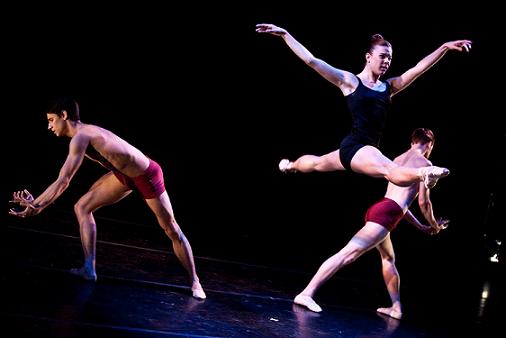
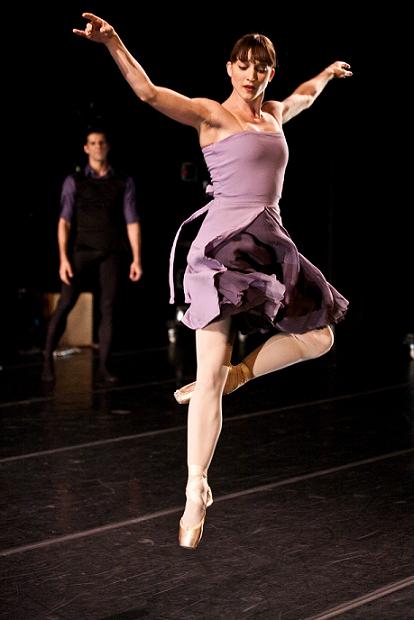
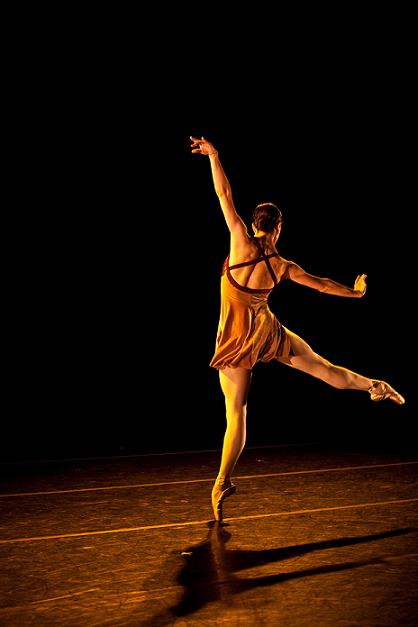
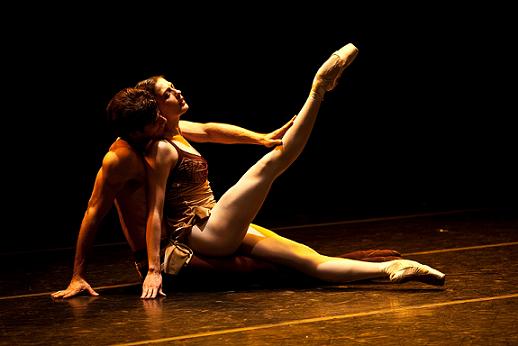
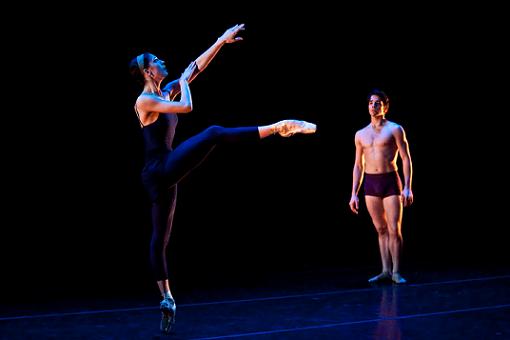
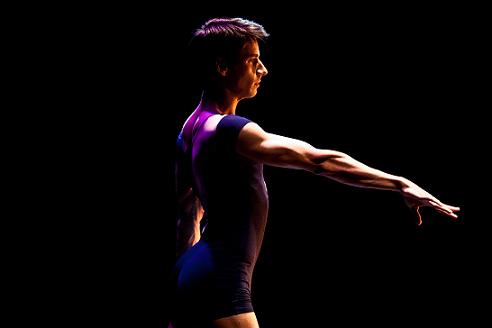
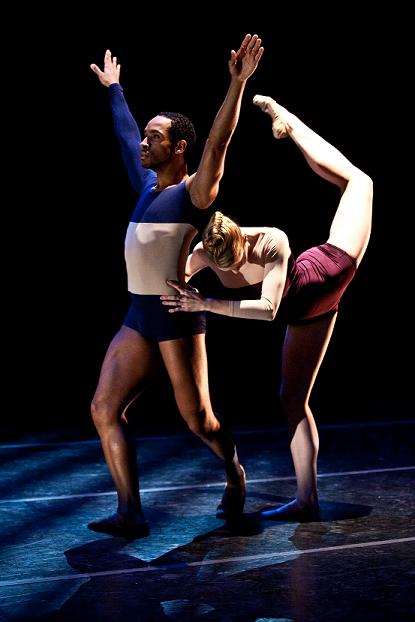
On Friday night Susan Stroman’s For the Love of Duke premiered at NYCB. Photos above by Paul Kolnik. Top: Tiler Peck, Sara Mearns, and Amar Ramasar; bottom: Mearns and Ramasar. Stroman is primarily a Broadway choreographer (I think her most famous work is probably Contact), and it shows both in her ballets’ strengths and limitations.

For the Love of Duke is divided into two parts. In the first, entitled “Frankie and Johnny … and Rose,” Tiler Peck and Amar Ramasar are Johnny and Rose, a couple in love. They perform a lovely lyrical pas de deux. Then along struts Sara Mearns – Frankie – and Johnny’s attentions are completely lost on her, to the disappointment of Rose. Johnny and Rose are snuggling on a bench together, and when Frankie comes prancing along, Johnny pushes Rose right off the bench, behind it, as if to hide her. Then he does a snazzier dance with Mearns / Frankie, she disappears, and he’s back with Rose … until Frankie comes strutting along again. And so on. At one point, Rose becomes the seductress, and Johnny pushes Frankie off the back of the bench. It was cute, and everyone danced spectacularly, but it got a bit old to me after a while.

The second part – “Blossom Got Kissed” – Stroman had actually choreographed before, creating it for NYCB in 1999. I liked this one better. Both parts, by the way, are choreographed to Duke Ellington and Billy Strayhorn, which is where the title of the whole comes from. Anyway, “Blossom” begins with a bunch of girls all dressed in sassy, jazzy red sitting on a bench tapping their feet to Ellington’s rhythm. Along comes Savannah Lowery as Blossom, dressed in a frilly ballet tutu. She sits alongside them on the bench and tries to tap with them. But she has no rhythm and is horribly off. Then they stand and do a jazzy dance, and, again, she tries to join, but just can’t get the hang of it. She is simply too classical ballet. Lowery was hilarious though and it was funny to see her continually try to get the rhythm and technique of jazz dance right by taking a foot and pounding it down flat on the floor. Then, a group of tux-clad men come along and do some swing dancing with the red-clad women. Blossom again tries hard to fit in but just can’t. Finally, a musician in the band (which was onstage), in the person of Robert Fairchild, comes out from the back of the stage, orders the music changed, and does a sweet lyrical ballet pas de deux with her.

I feel like I’ve seen “Blossom” before because Lowery’s hilarious flat-footedness looked familiar. I liked it better than the first part because to me it was funnier, and the story went a little further.

I think Stroman is very good at creating a story through dance, and that’s what I like about her. You can tell she’s not really a ballet choreographer though. Compared to the first two pieces of the night – Ratmansky’s Concerto DSCH and Wheeldon’s Polyphonia – the actual dance just wasn’t that rich. Still, I think she complemented the program well. It can never hurt to include in an evening of ballet a cute narrative dance with music that’s not usual ballet fare.

As always, I loved Concerto DSCH. Ratmansky was in the audience. I felt the music was played a bit too fast though (conductor was Ryan McAdams, Elaine Chelton the pianist). It looked like Ashley Bouder had a slight mishap, though I’m not sure because I was busy watching Joaquin DeLuz do a sequence of crazy fast steps into a somersault at the speed of light. Andrew Veyette again replaced Gonzalo Garcia, who I am really missing. I hope he’s okay. Veyette is doing a fine job as one of the two playful guys in blue, but there’s this repeating series of throws – where they each kind of propel the other into the air, and I love how Garcia always gets such height when he bounces off the other two.

Tyler Angle replaced Benjamin Millepied, and did wonderfully. I always notice things with Tyler that I haven’t noticed before – like how when he and the girl in green (Wendy Whelan) make their entrance, he’s spinning her around and around, and she looks like she’s hanging on to him for dear life. It kind of sets the tone of their relationship. I always notice the music much more when he dances as well.

Christopher Wheeldon’s Polyphonia is definitely one of my favorites of his. I love the musicality of it, and the originality of the combinations. It’s set to ten piano pieces by Ligeti, who, the program notes, developed micropolyphony – a type of music involving sustained dissonant chords that shift slowly over time. You can really see that “micropolyphony” in the dancing, as the sets of dancers (eight all together, divided into four pairs) begin dancing together in a line but each pair doing something completely different. Then, they eventually come together and dance in unison, but then they drift apart again later. There’s some very clever, almost humorous partnering throughout, but particularly in the second movement, Arc-en-ciel, Etudes pour piano, danced by Maria Kowroski and Jared Angle. I haven’t seen this ballet as often as I would like to. I was going to say I wish he’d include this one more often in Morphoses programs, and then I remembered

Last Week at New York City Ballet


Last week I went to two performances of NYCB – opening night and Thursday night’s “See the Music” program – and to two of the free all-day Balanchine events on Saturday. First, I’ll talk about the last two since I found them so informative. The free studio talk on Saturday afternoon – Balanchine’s birthday – was moderated by Sean Lavery (former NYCB principal dancer, now ballet master), and included Sterling Hyltin (in Paul Kolnik photo above with Robert Fairchild), Chase Finlay, and Jenifer Ringer. Lavery asked the dancers to talk about their first Balanchine ballets, their favorites, and what drew them to NYCB. Hyltin named as her favorite Duo Concertant (pictured above) which I’d just seen her dance on opening night. She said she liked the syncopated movement, the he goes and I go kind of back and forth movement conversation with her partner, and with the musicians. I really liked it too. The violinist and pianist are onstage (the music is Stravinsky), and I like the interaction between the dancers and the musicians, and between the two dancers, and I like the sharp, angular movement. She seemed particularly animated when I saw it. I love Robert Fairchild and think he’s such a sharp, masculine mover with a presence that commands your attention without meaning to – he kind of reminds me of a less cocky Ethan Stiefel – but she seemed so happy to be dancing this piece that she stood out to me more. It was nice to hear her talk about it.

But what I really loved was the School of American Ballet class taught by Peter Martins. He interacted cutely with the students, particularly “Cyrus,” (at least I think that was his name…) a tall, long-limbed young man who I think will soon be in the company. Cyrus didn’t always do everything perfectly (at least in Martins’s eyes) but he had a charming presence and a great leading-man physique and you can tell he works hard.

Martins had the class demonstrate ballet basics – beginning with the five positions, and they showed us a perfect fifth position (with the toes of the front foot touching the heel of the other and vice versa). More interestingly, he had the class show us the difference between a Balanchine hand and a classical ballet hand. I’d always noticed there was a difference but couldn’t figure it out exactly. God gave us five fingers, Balanchine had said, so we shouldn’t hide two of them. The Balanchine hand shows all five fingers, the classical ballet one only three (with the ring finger and pinky held so that they are hidden from view behind the middle finger).

Martins also had the students show us how Balanchine’s fourth position differed from others’. In Balanchine’s the back leg is straight; in all others’ the back leg is bent. Martins didn’t go into any functional explanation for this – just said “here, we think it looks better.” But I thought about it and thought, wow, it must be hard to take off in a jump for example with the back leg straight. And then I realized that’s partly why Balanchine’s choreography always looks so fluid, like one step leading right into another, without a lot of stopping to build up to a big athletic feat – a big jump or series of turns. Other companies – like the Russians, like the Bolshoi – are all about preparing so that you can do something astounding. So they’re all about the building up.

This was mentioned in the studio talk as well. Lavery also talked about how fluid Balanchine’s movement was, and how, for example, in a lift, a guy would pick up a girl, then take two steps, and put her down rather than walk all over stage with her hoisted above his head. Balanchine wanted her to come up, then down right again, because that was more fluid, rather than have her head bobbing around up there while the guy was running all around with her.

Martins also demonstrated the bows. At City Ballet, he said, we just do them as such, and the girls did a little curtsy with the back leg slightly bent, without going down on one knee. Making fun of the dramatic Swan Lake bows, Martins went all the way down on one knee, exclaiming, “Yes, yes, I know I’m good!!!” while putting his head down, forehead nearly touching the floor, and raising his arms up in back of him like wings, fingers pointed toward the ceiling. It was hilarious.

Anyway, here are a couple more photos of opening night:


Above: Ashley Bouder in Valse-Fantaisie, and below, the cast, including Andrew Veyette, in the same (all photos by Paul Kolnik)


I liked Balanchine’s Valse-Fantaisie (Veyette replaced Joaquin DeLuz – but don’t know why because DeLuz danced Concerto DSCH two nights later) but I really loved the first of the evening, Walpurgisnacht Ballet. I’d never seen Walpurgisnacht before and it’s funny but I always seem to love the Balanchine ballets that are the least often performed. This was really beautiful. It’s from Gounod’s Faust, and features a group of women (and only one man – here Charles Askegard) in deep red dresses, their hair down in the second half as the music increases in tempo so that there’s almost kind of a hedonistic madness in the mood – and the footwork is so intensely complicated and fast fast fast. Wendy Whelan even made a tiny little flub, which I’ve never seen her do before. Crazy! And breathtaking!

And the evening ended with The Four Temperaments. I’ve said before and I’ll complain again that I still don’t understand why everyone goes on about how brilliant this one is. To me, there are supposed to be four temperaments, and the ballet is divided accordingly into four variations after the theme: melancholic, sanguinic, phlegmatic, and choleric. But they all seem to be the same to me. The dance seems one-note throughout so that after the first variation, I’m waiting for it to end. I’ll keep seeing it though, perhaps performed by a variety of companies if I have the chance, and will keep looking for the nuances…

“See the Music” night opened with Faycal Karoui’s discussion of Mozartiana, Tchaikovsky’s homage to / riff on Mozart, which made me appreciate Tchaikovsky even more. Then that piece was danced – by Maria Kowroski, Daniel Ulbricht, and Tyler Angle. Tyler stood out to me. As always, he dances with so much meaning, so much intention, and so much expansiveness. He’s a really beautiful dancer.

Then came Ratmansky’s Concerto DSCH, danced by Wendy Whelan, Ashley Bouder, Joaquin DeLuz, Andrew Veyette (replacing this time Gonzalo Garcia), and Benjamin Millepied. Oh, Natalie Portman was there, albeit late – she came in with a friend after Karoui’s lecture and right before Mozartiana was performed. Then, she left right after Concerto DSCH, after Millepied was done performing, and before the last piece. I thought it was a shame she missed Sara Mearns in the last dance, but a Twitter friend said she had a movie premiere that night, so I guess she needed to leave early for that.

Anyway, as usual, Millepied did not stand out to me, and I couldn’t stop thinking of seeing Tyler Angle in that role before and the way he lunges romantically toward the main girl, making it clear how much he yearns for her. Millepied’s knees nearly touch the ground in his deep steps toward her and it just looks like a dance step, not like anything evoking a specific emotion. As always I loved Bouder and DeLuz in the fast, playfully firtatious three-some part. I missed Garcia – where is he? I hope not injured! – but thought Veyette did a fine job in his stead.

And the evening ended brilliantly with Sara Mearns and Charles Askegard dancing the ballet leads in Balanchine’s Cortege Hongrois, while Rebecca Krohn and Sean Suozzi just as brilliantly danced the folksy Hungarian leads. I really love that dance and it made me all the more eager to see Mearns in Swan Lake!

On both nights, I went with my friend, author Maria Mutsuki Mockett. She writes an author blog but has been attending the ballet much more frequently and is now blogging a lot about ballet as well. She’s an excellent writer, so please check out her blog!

This Week at New York City Ballet

I hope everyone had a nice holiday weekend, and happy belated Martin Luther King Day!

Tonight begins the Winter season at NYCB. Highlights for the season will be a world premiere by Susan Stroman on January 28th, and Peter Martins’ Swan Lake in February. I highly recommend seeing Sara Mearns as Odette / Odile (White Swan / Black Swan), especially if you are a new dance-goer in search of a good Swan Lake after seeing the Black Swan film. The Martins production is very modern, and very accessible to contemporary audiences, and Mearns is a beautiful dancer who manages to excel at both roles. Her swan queen is very human, with great emotional depth. She has a way, like ABT’s Veronika Part, of making you feel like you’re inside her character’s world, going through everything right along with her. She’s not just a great ballerina, but a compelling actress, in other words. And her black swan is a thrill. Here’s what I wrote about her last year. I’m not sure yet which days she’ll dance, but casting should be announced very soon. All of the ballerinas will be good (and I’ll need to see Ashley Bouder’s this year!), but try hard not to miss Mearns.

My recommendations for this week are:

January 18 (tonight), opening night, early 7:30 curtain
It’s a mixed rep program including Walpurgisnacht Ballet, Duo Concertant, Valse-Fantaisie, and one of Balanchine’s most revered works, The Four Temperaments.

Thursday night, January 20th, 8 p.m.
Another night of mixed rep: Mozartiana, Concerto DSCH, and Cortege Hongrois. The special things about this evening are that it’s another in the excellent See the Music series, and Millepied is dancing Ratmansky’s DSCH (one of my favorites of Ratmansky’s). Plus, will be interesting to see if there’s any kind of crowd increase for Millepied now after all the fanfare. Also SLSG favorite Tyler Angle is debuting in Mozartiana.

Friday night, January 21st 8 p.m.
Sara Mearns will debut in Concerto DSCH. Also showing are Robbins’ well-loved Dances at a Gathering, and Walpurgisnacht again.

Saturday, January 22nd, all day.
It’s an all-day celebration of George Balanchine, in honor of his birthday. In addition to the regular matinee and evening performances (all Balanchine of course), there’s a movie at 10:30 a.m., a studio talk in the afternoon, and a performance by students at the School of American Ballet at 6 p.m. The movie, studio talk and performance by SAB students are all free but require tickets. Everything takes place in the Koch Theater at Lincoln Center. For more info on the Saturday events, click on the link below.

Continue reading “This Week at New York City Ballet”

SLSG’s Dance Highlights of 2010

Instead of trying to remember which were my favorite performances of the year, I’m just going back through my blog archives from January of this year and linking to the most memorable posts. More fun that way! A lot happened in a year…

January

Pacific Northwest Ballet made their debut at the Joyce; it was my first time seeing them live.

The Post‘s Page 6 announced that you know who and you know who are dating, and the ridiculous homewrecker attacks began.

Baryshnikov and Annie Liebovitz starred in a very cool Louis Vuitton ad.

February

I totally fell for New York City Ballet’s Sleeping Beauty.

…and Mark Sanchez 🙂

I found myself quoted in Colin Jarman’s book, Dancing With the Quotes.

I also fell for Sara Mearns’s Odette in Peter Martins’s Swan Lake.

On a personal note, my former judge, the esteemed Honorable Sylvia Pressler, passed away.

The Kings of Dance came to town.

Morphoses shocked the ballet world by announcing that Christopher Wheeldon was leaving the company.

March

My friend’s organization, Art for Change, held a benefit for Haiti after the earthquake.

Rasta Thomas’s Bad Boys of Dance announced that Danny Tidwell and SYTYCD’s Jacob Karr were joining the company.

Corella Ballet Castilla y Leon finally made their NYC debut!

I found myself actually getting press for liking Kate Gosselin – or for not hating Kate Gosselin rather – on Dancing With the Stars.

I fell for Keigwin + Company’s Runaway.

I was delighted to receive an email from NYCB ballerina Yvonne Borree’s aunt regarding of all things, my novel.

April

I had my first experience as a dance writer panelist! Thank you, Marc, from TenduTV!

Tiler Peck appeared on Dancing With the Stars in a Travis Wall routine, which everyone was so excited about. But it ended up amounting to not a whole lot…

Roberto Bolle danced a naked Giselle, in Italy of course.

May

New York City Ballet opened their spring season with premieres of Millepied’s Why Am I Not Where You Are and Ratmansky’s Namouna, both of which I liked, though Ratmansky’s had to grow a bit on me.

Baryshnikov returned to the stage.

I greatly enjoyed ABT’s new production, Lady of the Camellias, though most critics panned it.

June

ABT celebrated Alicia Alonso’s 90th birthday with three all-star Latin American casts (plus Natalia Osipova) dancing in Don Quixote.

Yvonne Borree gave her farewell performance at NYCB.

Bill T. Jones won a Tony for best choreographer for Fela!

Philip Neal gave his farewell performance at NYCB.

Natalia Osipova was mugged right outside of Lincoln Center.

Two of the greatest ballerinas in Europe – Osipova, and Alina Cojocaru – gave back to back Sleeping Beauty performances at ABT.

Albert Evans gave his farewell performance at NYCB.

Tap great Savion Glover made headlines by voicing his annoyance with Alastair Macaulay’s NY Times criticism of him – onstage, during a show.

Conductor Maurice Kaplow gave his farewell performance with NYCB.

Darci Kistler officially ended the era of the Balanchine-trained dancer with her farewell performance with NYCB.

July

Carlos Acosta announced his retirement from ballet and his foray into modern dance.

Alex Wong, probably the second greatest contestant ever on SYTYCD was injured and unable to finish the show.

My friend, Taylor Gordon, was profiled as a freelance ballet dancer in a New York Times article 🙂

Alvin Ailey American Dance Theater’s beloved Denise Jefferson passed away.

Nilas Martins retired from NYCB oddly sans fanfare, sans criticism, sans a performance.

August

I interviewed tWitch about his role in the movie Step It Up. Fun fun interview!

I had a blast covering Ailey Camp.

I nearly fell over when Wendy Perron, esteemed E-I-C of Dance Magazine recommended Swallow on Twitter!

September

NYCB began their excellent “See the Music” series.

October

I loved Ashley Bouder’s Serenade.

Emerging Pictures’s awesomely exciting Ballet in Cinema series began with the Bolshoi’s Flames of Paris.

This cool new Lincoln Center-area street art sprouted up.

One of my favorite posts of the year, though it received no comments, was about Anne Fortier’s novel, Juliet. I jokingly daydreamed about it being made into a film, and which of my favorite ballet stars might take the lead.

November

ABT made an historic visit to Cuba and oh how I wished I could have gone with them.

I think I was the only person in the entire dance world to sympathize with Bristol Palin on Dancing With the Stars.

I had a blast covering New York So You Think You Can Dance auditions.

All of a sudden Black Swan was everywhere.

Nearly fell over again upon hearing Riccardo Cocchi and Yulia Zagoruychenko took the world Latin ballroom title – making them the first U.S. couple ever to do so.

December

My take on SugarPlumpGate.

Black Swan finally premiered which I didn’t love but was happy to have ballet brought back into the spotlight.

I was in awe of Alvin Ailey’s 50-dancer Revelations, staged in honor of the 50th anniversary of that dance. I also loved several other dances in their City Center season – Ailey’s Cry, Ronald K. Brown’s Dancing Spirit, and Geoffrey Holder’s The Prodigal Prince – just to name a few.

Robert Wilson / Roberto Bolle’s Perchance to Dream exhibit in Chelsea was a lot o’ frightening fun.

ABT’s new Nutcracker premiered, which I really enjoyed, almost as much as the Bolshoi’s.

Portman and Millepied revealed they are now engaged and expecting.

I had great fun, despite the crazy snowstorm, going down to Wall Street and covering Judith Jamison’s ringing of the closing bell at the NYSE.

Pretty busy year.

Happy New Year, everyone!

Judith Jamison to Ring NYSE Closing Bell on December 27th

Apparently it’s dance season at the New York Stock Exchange! Tomorrow morning, a NYCity Ballet Sugar Plum fairy will ring the opening bell (word in the Twittersphere is that that Sugar Plum will be Ashley Bouder). And now it’s just been announced that Judith Jamison will ring the closing bell on Monday, December 27th. This will be in honor of Alvin Ailey American Dance Theater’s final week at City Center and Jamison’s final year as Artistic Director, and in celebration of the 50th anniversary of Ailey’s Revelations. Jamison will be joined by incoming Artistic Director Robert Battle (photo above of the two of them by Andrew Eccles), AAADT dancers, and several other company members. The closing bell ringing will take place at 4:00 p.m. on the 27th and can be viewed live on the NYSE’s website: nyse.com.

Benjamin Millepied’s “Plainspoken”

Last Thursday was NYCB’s Fall gala, during which they presented the New York City premiere of Benjamin Millepied’s Plainspoken (photo at left, of Teresa Reichlen and Sebastien Marcovici, by Paul Kolnik; the ballet originally premiered in Wyoming this August), along with Robbins’ fabulous homage to Fred Astaire and Rita Hayworth, I’m Old Fashioned, and Balanchine’s Tarantella and Western Symphony.

The evening began with the orchestra pit rising and the always lively Faycal Karoui leading the orchestra in a rendition of Leonard Bernstein’s Candide Overture. I love that movable orchestra pit – best thing, in my opinion, about the recent renovations to the Koch Theater.

I was hoping there would be introductions and short speeches, including one by Sarah Jessica Parker, who served as honorary chair for the after-performance party. But no such luck – I guess because it wasn’t the beginning of the season, like galas usually are. I didn’t even get to see Parker come down the red carpet, there were so many paparazzi blocking my view. I certainly heard her though – or, rather, the paparazzi, as they screamed her name like she was the Messiah. I didn’t recognize anyone else. Lots of good-looking people perfectly coiffed and dressed in black tie but no one I recognized. I didn’t see Natalie Portman, though I heard she was there. I never recognize famous people, though. I’m really bad that way.

Anyway, I’m Old Fashioned was, as always, enjoyable, albeit too long. No dance-maker needed an editor more than Jerome Robbins in my opinion- and Tyler Angle stood out to me in his solos and duets with Maria Kowroski. But my favorite part of the evening was the second half of the post-intermission, when Ashley Bouder and Daniel Ulbrich just nailed Balanchine’s super fast-paced bravura-heavy duet, Tarantella (Ulbrich smacked the tambourine so hard one of the little metal things came flying off) and then Sara Mearns just astounded me in the last section of Western Symphony. How in the world does she stand on pointe, on her own unsupported by a male dancer, and lift her other leg in the air into a perfect split, into practically a six o’clock penchee? How how how? She and Charles Askegard really put on a show as tart-y saloon dancer and cowboy. She is really just unbelievable.

Okay, so onto Plainspoken. Well, sometimes I like Millepied, and sometimes the work just falls a bit flat to me. I didn’t much care for this one, though I’ve liked his last several ballets for ABT and NYCB. This was very abstract, no story that I could find, and I’m just not a fan of purely abstract ballets that I can’t find any story in whatsoever. It was a ballet for four couples: Sterling Hyltin and Tyler Angle, Teresa Reichlen and Amar Ramasar, Jennie Somogyi and Sebastien Marcovici, and Janie Taylor and Jared Angle (the last were generally my and my friend’s favorite pair – I think because Janie always brings something dark to her roles, there’s always something beneath the surface with her even if you can’t put your finger on what it is). The couples sometimes changed partners though, and there would be different-sized groupings.

The music was by Pulitzer prize-winning composer David Lang – it was a commissioned score – but to me the music here wasn’t nearly as rich as, for example, that used by Morphoses recently. This was mainly strings and piano and each section seemed emotionally the same. There didn’t seem to be a lot of contrast between the movements or a build-up toward the end. The sections were each differently lit – by a different color and a background curtain that would rise and lower to reveal more or less light than the section before. But the set was nothing very dramatic and the different colors didn’t, for me at least, evoke a different mood.

Movement-wise, there seemed to be a swimming theme. At various points the dancers would sit on the floor and make motions evocative of swimming – sweeping arms through the air, paddling legs – backward, then forward, then all dancers lying on their backs with their feet in the air like a synchronized swim team. At other points, the women would be carried somewhat Chaconne-like across the stage. I remember a slide characterizing Janie’s section, and she made it seem as if she was being taken by the men who slid her, against her will, across the floor.

I also have in my notes that the movement toward the beginning, in the first section, was a combination of robotic and more casual walks, kind of like the ensemble walking across the back of the stage in the second part of Robbins’s Glass Pieces. This kind of movement was interspersed with the swimming-like motions. In later sections, dancers seemed to run in place.

Oh, and during Janie’s section, there was a point where the men all picked her up and hoisted her high above them, like in MacMillan’s Manon or the Balanchine ballet where the woman is carried around the whole time by a group of men and the lone man on the floor keeps reaching up for her (sorry, can never remember the name of that ballet). My friend loved this part, and I did as well, but couldn’t really figure out how it played into the rest of that section.

In general, my first impressions of this ballet were: some interesting movement reminiscent of other ballets that didn’t seem to add up to much and didn’t really make me feel anything.

At the end, Millepied, Lang and the costume designer (Karen Young) and lighting designer (Penny Jacobus) took the stage for a bow. The applause seemed more polite than hearty (in contrast to the crazy applause Wheeldon always gets!), but that could just be me projecting my own thoughts onto everyone else.

What about you guys? I saw some mentions on Facebook of people liking it. Who else saw it and what did you think?

NYCB Brings Back “The Magic Flute” and Ashley Bouder Astounds in “Serenade”

On Thursday evening, New York City Ballet performed for the first time since 1982 Peter Martins’s The Magic Flute (pictured below – both photos by Paul Kolnik). But first on was Balanchine’s Serenade, with Rebecca Krohn (in the photo at left, the ballerina the farthest left) debuting in the role of the “angel.” Jenifer Ringer (center) was the “lost girl,” and Ashley Bouder (on the right) the dancer who dominates the first section.

Every time I see this ballet I see something new and though she wasn’t debuting in the role, this was my first time seeing Ashley Bouder. She completely blew me away and brought to life a “character” I never really even noticed before. I use quotes because of course Balanchine insisted that this is a story-less ballet and he didn’t create any such characters, but over time viewers have come to create their own story and now, for example, everyone calls the ballerina whose actions seem to bless and save the woman who falls and seems distraught over a man, the “dark angel.” Anyway, I realized for the first time when I saw Ashley dance that her character is supposed to be the A-student, the one who can do all the astounding feats and just flies all over the stage in those jetes. I kept thinking of Natalia Osipova. Wow. That’s always been my least favorite part of the ballet – that “class section” at the beginning; I always long for the final, more poetic part when what can most be read as a story takes place, with the angel and a male figure representing to me blind justice save the tragic woman’s soul.

Anyway, for the first time I really didn’t want the first part to end. Ashley was just so spellbinding. It wasn’t just that her jetes were so stunning though; it was that she created a character who ate up the stage, but not out of competitiveness and need for attention, but simply because she was so good she couldn’t help it. That’s what her dancing conveyed to me anyway, and then I couldn’t take my eyes off her.

Rebecca Krohn did very well in her debut as the angel. Only thing was that she was so much shorter than tall Ask la Cour (in photo above) that when followed him from behind with her hands wrapped around his eyes, she really had to stretch.

Jonathan Stafford also made his debut in this ballet, as the “distraught girl’s boyfriend,” if you want to call him that. I thought he danced very well, but I think I personally prefer Charles Askegard in this role because I see that man as tantalizing her, tormenting her, and responsible for her downfall, and there is just something innately cocky about Askegard. Jonathan Stafford is too sweet 🙂

Okay, so The Magic Flute. NYCB as I said hasn’t performed this in a while and it’s kind of obvious why: it just doesn’t seem to fit at all in their repertoire. It was a short story ballet filled with slapstick and cutesy characters. It was danced very well – and Megan Fairchild and Andrew Veyette are two of the company’s best actors and they did in my mind as much as could possibly be done it. Everyone did well, actually, and it seems the dancers enjoyed the opportunity to do something they never get a chance to.

The story bears no relation whatsoever to the Mozart opera. It’s the story of a farm girl (Megan) who likes a peasant boy (Andrew) but she is betrothed to this incredibly hilariously dorky older man, the town’s Marquis (played well by Adam Hendrickson).This is where most of the slaptick comes in – in trying to seduce them the Marquis falls all over the village women, goes to kiss Megan’s hand but ends up with Andrew’s, literally falls all over poor Megan, etc. etc. Eventually, a strange hooded character indicates to the peasant boy that everything will be all right, he will get the girl, but he must watch for something to fall from the sky. That something is a flute, which comes bearing a huge sign for all the audience to see: “If you play this flute, people will dance against their will.” Audience cracked up at this of course.

So, Andrew grabbed the flute and tried it out on his friends, realizing it works! I have to say Andrew’s flute playing was very believable. Of course the flutist is in the orchestra pit but damn did it look like Andrew was making that music!

So, now every time the Marquis tried to grab Andrew and toss him off Megan, Andrew would starting playing the flute and the Marquis would start hopping around like a madman. Angry at his lack of control, he pulls his men on peasant boy, eventually tries to get the court involved, and soon everyone is madly hopping about. There’s no choreography for the uncontrollable dancing – everyone just hops about punching the air at random. Eventually everything works itself out and Andrew and Megan end up happily together.

The costumes were cute and the sets were very well done (it was suggested at intermission that ABT might want to hire set designer David Mitchell for their productions), I’m just not sure this ballet really belongs at NYCB. But it’s nice for a change.

The program ended with Balanchine’s patriotic Stars and Stripes set to Sousa. Savannah Lowery had the lead in the second section – the “second campaign” – and she fell during her stage entrance. It looked like just a slip but then she didn’t dance her part full out at all – jetes were very low and she looked very concerned going on pointe. It soon became clear she’d really hurt herself when she didn’t return for her solo seconds later. The company didn’t have time to replace her with another ballerina right then, so the corps members just kind of looked on and sweetly smiled as they stood still during what should have been Lowery’s solo. It was kind of like that experimental Jerome Bel film where the camera focuses solely on the corps members while the Swan Lake music swells.

Anyway, by the end, after the fourth campaign when all campaigns return, she’d been replaced by trooper Gwyneth Muller, who my companion noticed seemed not to have much makeup on. There probably aren’t too many emergencies like this where a dancer who thinks she’s done for the night (she’s played Megan’s mother in The Magic Flute) but hasn’t yet left the building has to get in costume and run back out onstage for a main solo! Anyway, she did well. I hope Savannah’s okay though.

New York City Ballet’s First Fall Season Opening Night


Tuesday night, New York City Ballet opened its very first fall season with performances of Balanchine’s Serenade, Peter Martins’s Grazioso, and Jerome Robbins’s The Four Seasons. First, before the performance began, Peter Martins came out and introduced each of the principal dancers, who came out onstage one by one, and said this season would be a celebration of them. Tiler Peck in particular was wearing this really gorgeous silky fuchsia dress. Martins said all principals were there except for Benjamin Millepied, who was doing something movie-related “en France,” he said with a funny faux Euro accent. Everyone laughed and gave the dancers a huge round of applause. The house was packed and it was clear how thrilled the company’s many fans are with there being a fall season this year. Martins made fun of himself for being so into toasts and said that during intermission, we’d all be given be given free champagne to toast the principals. Which we were – very fun!

The part of the performance I was mainly looking forward to was Janie Taylor’s debut in Serenade (above headshot and Serenade photo by Paul Kolnik) as the main ballerina. As usual with her, she completely made the ballet her own. I thought the ballet had a somewhat dark element with her, that I’ve never seen before. When she first ran out onstage, late for class, instead of looking like she was all frantic about being late because she’d been held up by a boy, it looked like she was running from something – from him. That man was Charles Askegard and when he danced the middle waltz part with her, the huge size difference between them added to the sense of foreboding, that she was fragile, he was pushing her around, and she’d eventually be hurt by him. At certain parts, it was literally like he was pulling her along. When he lifted her and she raised her legs in a split, it looked almost like she was trying to get away from him. Sara Mearns was the angel and Ask La Cour was the man who I call “blind justice” who take care of Taylor when she falls, and it was interesting how much the two male leads and two female leads looked alike. I almost got Taylor and Mearns mixed up at parts, thinking they were taking on the other’s role. And the end when the men raise Taylor up like pallbearers and she is carried off by them, arching her back, arms outstretched  – so hauntingly beautiful. It reminded me a bit of Balanchine’s La Valse.

I was also looking forward to Martins’s Grazioso, in which three handsome men – Gonzalo Garcia, Andrew Veyette and Daniel Ulbrich – vie for Ashley Bouder’s attention with their bravura moves. I don’t think this ballet has been performed since it premiered a few seasons ago. And I loved it all over again. I love how each guy has his own personality – Garcia is the romantic, Veyette is the manly man one, and Ulbrich is the one with all the high jumping tricks. And Bouder really played the tart, looking at each of them up and down at points kind of lasciviously, really trying to choose. The guy next to me was really giggly over it.

And the evening ended with Robbins’ The Four Seasons, which itself ends with a lovely tribute to fall.

This whole season the Koch theater will open an hour early. The promenade overlooking Lincoln Center Plaza will be open for cocktails, the gift shop will be open, and, for the rest of this opening week, there will also be live jazz performed by the NYCB Orchestra one hour before performance time. They have the promenade and mezzanine area done up nicely, with big plush chairs. Also taking place the rest of this week will be a “meet the artists” session whereby, beginning at 6:45 p.m. in the first ring of the auditorium, the principals dancers will be available to chat with ticket holders. There’s also a photo exhibition of the dancers by photographer HenryLeutwyler on display in the theater throughout the season.

Tomorrow night will be the first of seven “See the Music” performances which will provide a look inside NYCB’s 62-piece orchestra. At the beginning of each performance, Peter Martins and musical director Faycal Karoui will briefly discuss the program’s music, followed by the orchestra performing an excerpt of one of the ballet scores. The subject of tomorrow night’s discussion will be Eduoard Lalo’s score for Ratmansky’s Namouna: A Grand Divertissement, which premiered last season. Additional “See the Music” programs are Sept. 26 matinee, January 20, Feb. 1, Feb. 19 matinee, May 25 and June 11.

WAYNE MCGREGOR’S OUTLIER


Some photos of the new ballet, which premiered last Friday at NYCB, by Paul Kolnik. Top is of Wendy Whelan and Craig Hall, bottom is of cast with Gonzalo Garcia and Sterling Hyltin front and center.

I liked Outlier if mainly because it provided something different for New York audiences, and the dancers seemed to love dancing it, perhaps to be challenged by a different movement vocabulary. Music was to Thomas Ades and was generally sharp and made for an unsettling vibe, which the movement complemented. Cast was all principles: in addition to Hyltin, Garcia, Whelan, and Hall, there were Ashley Bouder, Maria Kowroski, Tiler Peck, Adrian Danchig-Waring, Joaquin De Luz, Robert Fairchild, and Amar Ramasar. Dancers mainly danced in male / female pairs and movement was intentionally awkward, with lots of sharp, angular lines,  jutting, hyper-extended limbs, at times rubbery-looking as a foot would go from pointed to flexed in a split second, and there were lots of kind of sliding motions in the upper body, which is uncharacteristic of ballet – classical anyway. The whole thing felt alien, ominous, something seriously awry.

Maria Kowroski, Wendy Whelan, and Robert Fairchild shone, as I think they have the bodies most suited to this kind of movement. The audience gasped audibly and some laughed in astonishment when, at one point, Maria Kowroski did an arabesque penchee with her lifted leg in attitude and she swung her leg up so fast and with such force (intentionally) that she looked like she was completely jointless. Then she wrapped her bent knee around her partner’s head — I think it was Amar but can’t remember for sure. She looked like a spider. And Robert Fairchild is really becoming one of the greatest male dancers around – at least that I know of. He can do anything and with such precision, not to mention massive amounts of stage presence.

Lighting (by Lucy Carter) was really cool as well, starting out a bright red, with an almost kaleidoscopic image on the back wall,then turning cream-colored and solid, and creating at times rather ominous shadows that highlighted the bizarre movement.

My main problem with the whole was that it didn’t really seem to go anywhere. A story never seemed to take hold and the movement and overall feeling you had remained the same throughout. Maybe I just need to see it again though.

Outlier was shown with two other, completely different ballets – Balanchine’s beautiful Serenade in which Kaitlyn Gilliland really moved me, and his Cortege Hongrois, with Sara Mearns dancing the part of the classical ballerina to splendid perfection with the very capable Jonathan Stafford as her partner, and Sean Suozzi and Rebecca Krohn ever entertaining as the Hungarian folk dancing duo.

AVI SCHER & DANCERS' FIRST FULL SEASON A SMASHING SUCCESS

Here are some photos of Avi Scher’s first full season at Alvin Ailey theater, sent to me by the amazing ABT dancer-turned-photographer Matt Murphy. Visit Matt’s blog, and his photographer website.

Savannah Lowery (from NYCB) who, for the first time, completely blew me away, flying over Ralph Ippolito (also from NYCB) and Eric Tamm (from ABT), in Touch.

Ashley Bouder (NYCB principal), who replaced Sara Mearns, who had a minor foot injury. Marcelo Gomes (ABT principal, of course!) in the background. This was my second favorite piece of the evening, Utopia. It was interesting because as much as I love Sara Mearns and was disappointed I wouldn’t be seeing her, I couldn’t imagine this role being formed on anyone other than Ashley. There was so much quick-footed, high-spirited allegro dancing and Ashley is the queen of allegro. She and Marcelo were perfect together. She replaced Sara last minute and I can’t believe how quickly she learned that dance because the choreography was, like all of Avi’s choreography, rather complex and original.

Marcelo in Mystery in the Wind, my favorite ballet of the evening. It was a neoclassical piece (Avi’s style ranges between neoclassical — like Balanchine — and contemporary), that reminded me a bit of Apollo, a bit of La Bayadere, with a main love story between Marcelo and Veronika Part, and three female dancers doing solo parts, and kind of acting as muses. In addition to Marcelo and Veronika I really loved watching Abi Stafford in this (I linked to her NYCB profile since I don’t have a picture of her for Saturday night). She had several solos, some of which were kind of sweetly folksy / flirtatiously tango-y, combined with these crazy fast balletic chaine spins across and around the perimeter of the stage. She did really well and she looked really beautiful. I brought my friend Alyssa with me, who doesn’t know much about ballet, and she said she could tell right away who all the big principals were (and she was correct in her guesses)– and Abi immediately caught her eye.

Marcelo again.

Veronika Part in that same piece. She was beautiful, it goes without saying. Every single part of her body makes such a perfect shape, my friend said, and she was so wholly into the character and the music (which is completely typical of Veronika!).

Marcelo and Veronika in Mystery again. I loved the central pas de deux – so sexy and passionate!

Another of my favorites: the “Our Love’s Defense” duet from Little Stories, with NYCB’s Christian Tworzyanski and, again, the kick-ass Savannah Lowery. Savannah has a very athletic body, she’s very muscular and toned, and she looked so good in these athletic costumes and in some of Avi’s more heavy-hitter choreography. (In this piece she and Christian have this fun, sexy wrestling match/ lovers’ quarrel.) I think more of the modern choreographers when they do work for NYCB should use her – Benjamin Millepied and Jorma Elo, etc. I think modern ballet suits her body and dance strengths more than Balanchine — I really felt like she came alive to me as an artist in Avi’s work like never before. And she’s a very good actor as well!

Veronika in Touch.

And with ABT’s Arron Scott in the same.

NYCB’s Ralph Ippolito in No Matter What. Ippolito is a corps member of NYCB and I’d never noticed him before, but he really stood out to me here. He’s very intent in everything he does, and he’s very good at using his body, his limbs, to express, to make meaningful, evocative shapes.

Ja’Malik and Victoria North in No Matter What.

The theater was completely packed on Saturday night, opening night, and I’m told it was the same at yesterday’s matinee, despite it being Easter. There’s one last performance of this short season tonight, at 8p.m. that I heard is pretty sold out as well. How excellent for this young choreographer!

Here are some of the many other reviews: Oberon’s Grove, the NY Times, Dance View Times.

MORE BEAUTIES


So, toward the end of last week I saw two more casts of Sleeping Beauty in New York City Ballet’s production. Above are the beautiful Kathryn Morgan as Aurora and Tyler Angle as her Prince Desire (Paul Kolnik is the photographer). Below are some photos of the other couple I saw, Tiler Peck (both she and Kathryn were making their Aurora debuts), with Gonzalo Garcia, albeit not from this ballet.


(in Four Bagatelles, photo by Paul Kolnik)


(and in the Christopher Wheeldon / Martha Wainwright collaboration over the summer, photo from NYTimes by Andrea Mohin; I like this photo because I think it shows each of their personalities well).

And then last week, I saw Ashley Bouder and Andrew Veyette.

I’ve been thinking about who I thought was best in what role but it’s actually really hard to do that. I honestly ended up liking everyone, though there were definite differences.

I do have a lot to say about Gonzalo Garcia though. I LOVED him as Prince Desire — he really melted me, he really completely stole the show that night and I feel like I’m not ever going to like anyone quite as well in that role now. I mean, you just have to see him in a classical ballet, as the romantic lead, and you realize why San Francisco audiences were so upset when he left SFB for NYCB a couple years ago. Some of those SFBallet fans were really devastated when he left. And I think it’s been such a puzzle to those fans that New Yorkers haven’t really fallen for him the same way. And I think it’s because he hasn’t had the chance to shine because NYCB is so Balanchine-heavy. He needs roles where he can act and become a character. He’s such the quintessential romantic prince.

You can really tell how differently he’s trained than the other NYCB dancers, who’ve nearly all come from SAB and been trained on Balanchine’s non-actable abstract ballets. I felt like with Gonzalo I was seeing someone from ABT — mainly Angel Corella (in terms of the body type, dramatic style and boyishly handsome face). The way he’d hold onto the music, draw it out while it crescendos, by for example in the vision scene holding out a finger to the princess and then leaning back, then looking out to the audience — not AT the audience but in the audience’s direction — to show how enthralled he is, how much he wants to catch her, all before then turning and running toward her. The other two — Tyler and Andrew — they didn’t do all that. They just kind of looked toward her standing more and more toward the tips of the toes, ready to run toward her when the music told them to. Gonzalo’s way was so much more Petipa and Tchaikovsky and Bolshoi and Romantic Russian and all that, and it might all seem overly melodramatic to audiences who aren’t used to that. But that’s what I’m used to with ABT — and that kind of stuff makes me swoon!– so that’s why I think I loved him so much. But I’m wondering what others who saw this cast thought?

And Gonzalo just knows what’s expected of him, as the prince. Later, when he went to do that crazy series of jetes, he was rested up and ready and he nailed them like I’ve never seen him nail anything. I’ve never seen his legs straighter, in perfect splits, and the whole way around the perimeter of the stage, without tiring. And it’s like he knew that was a very important part, and he had to do them perfectly because that’s just what the romantic hero does — that’s the way he shows his love for the princess, and that he’s worthy of her. The other two obviously took them seriously (because they’re crazy hard, you have to take them seriously), but it just was more of a difficult feat, instead of having the same meaning. You know what I mean? Like he looked out all across the stage wistfully, and then he just took off flying around it. It gave it a different meaning than just flying around.

It makes me wonder though if contemporary audiences understand that, or appreciate it. Or whether they prefer for the emotion to look more “natural”? I’m not saying Gonzalo was better than the other two, just different.

I wonder what Joaquin De Luz was like, since he’s not SAB trained either. Did anyone see him?

As far as partnerships, Kathryn and Tyler were my favorites. Tyler had a few flubs on some of his solo variations (but I still love him!), but he was always the perfect partner, he was always solid when supporting her. And the series of fish dives in the wedding pas de deux were some of the most breathtaking I’ve ever seen. Her legs were pointing completely up toward the ceiling! Magnificent! And the final hands-free fish dive was picture perfect.

I liked all of the Aurora interpretations, but they were different too. Kathryn was the most princess-like, the most regal, though that may just be the way she looks. She just kind of looks like royalty! Ashley and Tiler seemed more “real girlish”  – all smiles and sweetness and awe at the world and their cute suitors.

The rose adagios were all near perfect. (ABT’s Sarah Lane is still the queen of the balances to me — it seems like she could hold them for hours.) Kathryn had the most absolutely gorgeous extensions. Do I have to giggle every time Robert Fairchild comes out leading the cavalcade of suitors? I loved Craig Hall as the “African prince,” – I don’t know what exactly stood out about him but something did. And even though it wasn’t a dancing role, I loved Henry Seth as the King; he acted it really well. Chase Finlay was lovely as Gold in the wedding scene – -he’s a really beautiful dancer with exquisite lines. Everyone’s talking about him being the next romantic lead. I loved tiny Erica Pereira as the fairy of eloquence and Ana Sophia Scheller as the fairy of courage, thought Faye Arthurs and Adrian Danchig-Waring were brilliant as The White Cat and Puss in Boots, and Daniel Ulbricht is the quintessential gymnastic court jester.

And there’s NEVER been a better Carabosse than Georgina Pazcoguin! Nor has there ever been (or, perhaps, could there be) a better Lilac Fairy than Sara Mearns. I love how she arches her back so luxuriously and opens up her chest. And the rich, full-out port de bras. Such beautiful expansiveness, that, with her beatific face, makes her perfect for this angelic role. She reminds me of Veronika Part.

Okay, that’s all I can think of, for now!

This week begins the Swan Lakes. I’ve never seen Peter Martins’ version, so I’m really excited. In particular, I’ve heard wonderful things about Maria Kowroski as Odette and I’m psyched for Stephen Hanna’s debut as Prince Siegfried!