Nikolaj Returns!: And The Guggenheim Will Live-Stream His Royal Danish Ballet


Nikolaj Hubbe, former beloved NYCB principal of course, will be returning to NY with the Royal Danish Ballet, of which he is now the artistic director. The company will be performing over the summer, but first, they’ll be showcased at the Guggenheim, in a Works & Process event, on March 20th and 21st. He’ll be one of the panelists, talking about the rep the company will be performing – ballets by the founder of RDB August Bournonville, by Jorma Elo and by Hubbe himself – with excerpts from those dances performed. The event is already sold out, so the Guggenheim is generously live-streaming both nights free on their ustream channel. Again, as with other W&P live-streams, you can participate in an online chat on the aforesaid ustream channel, and you can also follow discussions on Twitter, using hashtag #RDB or by following @worksandprocess.

For more info on the program and on the company, click on the link below.

Above image from here.

Continue reading “Nikolaj Returns!: And The Guggenheim Will Live-Stream His Royal Danish Ballet”

NATALIA OSIPOVA AND HERMAN CORNEJO’S LA SYLPHIDE


Monday night, I saw the Bolshoi’s Natalia Osipova guest-star with ABT in their production of La Sylphide. I wrote a little about her and more about Herman Cornejo, at the bottom of my prior post. Just to reiterate, if you ever want to see pure excellence, do see Herman Cornejo in something — anything. He is just pure, unmitigated, supreme, excellence!


August Bournonville’s La Sylphide is the story of a Scotsman, James (Cornejo), who is engaged to be married to a woman named Effie, but is seduced by a sylph (Osipova), who no one but he can see. Gurn, a young man in love with Effie, sees James talking and dancing to the air, and tries to warn everyone that he thinks James has gone mad. But people ignore him. An old witch-like lady, Madge (think MacBeth) prophesies that Gurn will marry Effie. Later, when the wedding party guests perform a fun Scottish folk dance, James continues to be taunted / haunted by the sylph who flies through the air. James chases her but she flies out the window. Later, James is on the verge of marrying Effie, even holding up to her the wedding ring, when the sylph plucks it right from his hand and flies out the window. He chases after her into the forest, her lair. Effie collapses into tears and Gurn leads the groomsmen in search of the missing groom.

The second Act takes place in the forest. The sylph seduces James with food, drink, and dance, but every time he tries to touch her she flies away. James wanders the forest, upset about the sylph’s elusiveness. He happens upon Madge and her mates who are concocting a poisonous brew in which they are soaking a scarf. He tells Madge of his troubles and she tells him the scarf is magic; if he wraps it around the sylph’s wings, he can have her. James takes it. When he next sees the sylph, he seduces her with the scarf’s beauty. She flies toward it, delighted and excited, as he waves it around. But once he wraps it around her wings, she slowly dies.

James, brokenhearted, falls into unconsciousness, as the wedding procession of Gurn and Effie is heard in the distance and the sister sylphs carry the sylphide to heaven.

Neither the story nor choreography are as grand and memorable as Giselle, and I’d written before that I was stunned by Osipova’s athletic prowess but not really moved by her Giselle. Here, I thought that, though I didn’t like the choreography as much, her playful, sky-high jumps made much more sense in this story. Here, she’s not human, she’s not of this world. She’s both a faery and a figure in a man’s dream. So, her unearthly high springing jumps went along with that; they were believable within the story. She is a really beautiful dancer and can certainly jump like no one’s business, but I wished she would have been a bit more tantalizing and playfully vexing, the way Janie Taylor was in Robbins’ The Dreamer. Not like a vixen or an evil spirit; I just mean more forcefully refusing to leave him alone, making him realize what a dull life he’s leading; how he longs for something more. Just like in Giselle, she seemed to be dancing on her own, not really working opposite a partner. It’s probably really hard, though, when there are language barriers, and I think both times either she or her partner (David Hallberg, and Herman) filled in for someone else last minute.

I thought Herman did an excellent job of showing how tormented he was by her, and how confused he was about what to do, how frustrated he was about his life. And his super-charged solo variation expressed that. No one jumps like him. No one. No one turns like Angel Corella and no one jumps like Herman Cornejo. He opened that variation with the best tour jete I’ve ever seen, and I knew — the whole audience knew judging by the gasps — we were in for something huge. Then onto all the high jumps with the fluttering beats of the feet. Everything he does is marked by sheer perfection — perfect sharpness, perfect precision, perfect control, perfect line, perfect clarity, perfect enunciation, beyond perfect height, beyond human height. He’s a god!

My problem with this choreography is that there’s not enough for him to do. And I got really frustrated. I didn’t want that variation to end. Nor did I want Daniil Simkin’s (as Gurn) solo variation to end. There wasn’t enough for him to shine in his either. He had a few kicking jumps, but I need for him to do so much more; Daniil’s too great of a dancer as well! Daniil was hilarious, though, when he imitated to the guests James’s bizarre actions, his weird dancing to the air. In addition to being a superb bravura dancer, he’s a very lively actor too.

On before La Sylphide was Paul Taylor’s light, lyrical Airs. I’m going to write about this more after I’ve seen it a couple more times this weekend, but I love watching ABT dancers do Paul Taylor! I hope no one takes offense and I love Paul Taylor’s dancers, but ABT just brings so much more to “modern dance” than a modern dance company. They bring poetry. Paul Taylor is American modern, and when his dancers dance him it looks celebratory, celebratory of humankind and of the dancing spirit, like something you’d like to get up on stage and do with them. It’s participatory, inviting. Of course you know if you’ve ever tried how hard, how impossible it actually is to dance like them without loads of training. But when you see ABT dancers dance that’s obvious from the get-go. It’s not celebratory and participatory, it’s elevated, awe-inducing dance, dance as an art. You know what I mean? All of the dancers were excellent — particularly Kristi Boone and Misty Copeland, but I loved Arron Scott the most because he so exemplified what I said above: outwardly he looked just like a Paul Taylor dancer, but he starts to move and he’s just so much more!


AMERICAN BALLET THEATER OPENING NIGHT!

p5182145

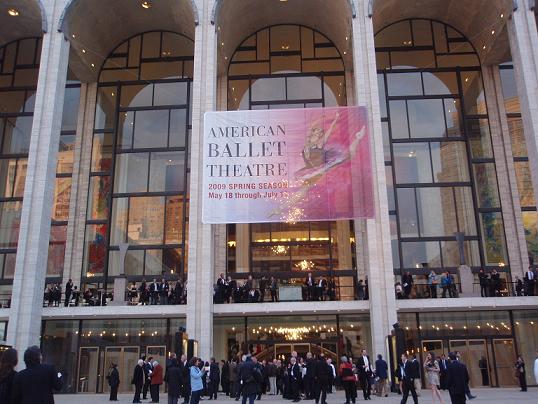
Yay, the season has offically begun! This picture was taken during intermission; that’s why it doesn’t look that crowded. I was sprinting in, nearly late, as usual, so didn’t have time to snap some pics before the performance but fortunately it was still light outside during intermission.

Anyway, Michelle Obama (who served as one of the gala’s honorary chairs) looked smashing in a sleek dark grey sleeveless, knee-length dress with tiny black ruffles lining the bottom. I’m sure there will be beaucoup des pictures seeing as how many blasted camera people there were; I’ll be sure to steal some when they’re posted on all the society websites ๐Ÿ™‚ (Oh, look, here it is in the NYTimes already)


It was just about the craziest thing I’ve seen on the Met Opera stage: after Veronika Part’s mouthwatering Mozartiana opened the show, artistic director Kevin McKenzie came out and thanked everyone who needed thanked — all the donors, designer Caroline Herrera who funds the gala, etc., and Senator Chuck Schumer came out and gave a little talk about the importance of funding for the arts, etc. Then, Schumer disappeared behind the curtain and moments went by. Everyone kind of looked around at each other like “what’s going to happen next?!”

Soon, the curtain was pulled back to allow some people to carry out a podium with a banner “American Ballet Theater” draped over its front. The doors to the lobby opened and a flock of people bearing weapon-sized cameras blasted in. Several men dressed in black promptly rose from their aisle seats and followed the flock of weapon-camera-bearers to the front of the aisle, near the stage. Caroline Kennedy was announced. She came out, everyone applauded, and she mentioned that the school of ballet associated with ABT, the Jacqueline Kennedy Onassis School, would be performing on the Met Opera stage for the first time ever tonight. Everyone ooohed and aaahed. Then, she announced First Lady Michelle Obama.

The curtain pulled back again and out she came. Of course everyone gave a standing ovation. She smiled radiantly, then, after a moment, directed us to be seated. Then she gave a short speech. It was a little hard to focus on what she was saying with everyone — both professional photographers and audience members with cell phone and digital cameras alike — flashing away as they were, but she talked about the necessity of the Arts for a culture to flourish, the importance of arts education, etc. Then she introduced the Jacqueline Kennedy Onassis School students.

As soon as she disappeared behind the curtain, the auditorium remained still pending the exit of the flock of pro camera wielders. It’s funny because there were all these non-dance writers in the press section. You could hear the sighs of relief, the sinking down into the chairs, and the putting away of pens and paper — and cell phones, which they’d used to light their writing paper during Mrs. Obama’s speech, which would have been extremely annoying had it not been for all the flashing bulbs anyway. But it made me wonder how they’d ever survive as performing arts critics! I mean, who needs light to see to write!

Anyway, the students were excellent. They performed Le Defile (The Procession) by Raymond Lukens. There were three large groups of them, in three levels — the very little ones, a medium-age / level group, and the older, very advanced ones. The choreography was basically a showcase of classical ballet steps, much like a very advanced ballet class — jumps, jumps with changing feet, jumps with changing feet that went on forever performed by a set of advanced boys (which drove the audience to wild applause), jetes, chaine turns, multiple pirouettes, fouttes, etc., and then a bit of partnering. It gave the students a chance to show what they could do — and the advanced ones could do a great deal! Extremely impressive, and great fun.

Then on were Xiomara Reyes and Herman Cornejo doing an excerpt from August Bournonville’s La Sylphide. This was the most dramatic I think I’ve ever seen Xiomara. I was sitting in the back of the orchestra and she really projected. She was really sweet. And Herman as always amazed with his virtuosity, his jumps, his razer-sharp precision, his astounding clarity of line.

The corps in both this, La Sylphide, and Swan Lake, later in the evening, were absolutely amazing, by the way. Not a head arched back more than the others, not a leg raised higher. They were all so on. When they work together like that, in perfect unity; it’s really visually breathtaking.

Then was Balanchine’s Tchaikovsky Pas de Deux danced by Ethan Stiefel and Gillian Murphy. Ethan and his strutting around stage, taking his own good time after their duet and before beginning his solo, making the conductor wait for him! And his high jumps with all miraculously many beats of the feet. I wished my friend Alyssa could have come so she could see he’s not just Mr. Sexy; he’s a superb dancer. And Gillian was radiant, and a perfect foil with her speed-of-light chaine turns. They enjoyed a long, slow kiss during the curtain call. The audience went mad!

Then was the hunt scene from Sylvia danced by Michele Wiles followed by a piece d’occasion (the first of two of the night), by Alexei Ratmansky, for Nina Ananiashvili, called Waltz Masquerade. It was set to the Waltz from Aram Khachaturian’s Masquerade Suite and it was cute and comical. She was dressed in this long, red dramatic, Carmen-like dress with a sexy black lace overlay on the top. There were four tuxedoed men, each bearing a gold candlelabra, one at each corner of the stage. These men turned out to be: Jose Carreno at the front left corner; Marcelo Gomes, at back left; Angel Corella back right; and a blonde on the front right who I initially thought was David Hallberg (I was sitting FAR back from the stage!) until the fun began and he shook his head about like a sassy mop and I realized DH just does not have enough goofball in him to do such a thing, even if he tried. So, I decided it was either Ethan or Maxim Beloserkovky. Anyway, Nina’s character was supposed to be dancing about the stage in a melodramatic solo — but it was purposefully melodramatic, and so comical. Like a silly, cartoon version of an upcoming swan song, really, which, is of course, what’s coming up for her later in the season (and will be much more sobering when it does). At one point, she just passionately crashes to the ground and remains there, in a heap. Nothing happens. The men, obviously her servants, start looking at each other like, what now? They shrug, slowly walk over to her. Then, Marcelo starts imitating her melodramatic dance, but far more cartoonishly, and of course it’s hilarious. The others join in. Max (I think it was Max, not Ethan) does his thrashing hair thing. I couldn’t see facial expressions but I assume they were making fun of their master. Then she wakes up, catches them, and they’re sent back to their posts.

After intermission was the balcony pas de deux from MacMillan’s Romeo and Juliet, danced by Marcelo and Diana Vishneva. At first, Diana approaches her balcony with all the drama of a ballerina playing Juliet, rather than Juliet herself. I rolled my eyes. This is what I don’t like about her. She’s an excellent dancer but she’s all about the pomp and circumstance and not about the character. Maybe it’s a Russian thing, but I don’t see that in Veronika Part or Irina Dvorovenko. Anyway, she eventually lightened up, thankfully, and I felt like I was watching not a prima ballerina being a prima ballerina but Juliet herself, falling hopelessly in love. When she runs around him one foot solid on the ground, the other on pointe, it’s so girlish, so real yet so poetic. Those are the best — I don’t know what to call them — runs around kneeling Romeo — that I’ve ever seen — not even Alessandra Ferri’s were that sweet. Still, I felt some of the lifts lacked the beauty and magic ofย  those Marcelo and Julie Kent do together when they dance this scene. I don’t feel she dances that well with a partner; she’s more into herself. Marcelo’s leaps around the stage and big high passionate jumps were thrilling. He got some good bravos for those.

Then were Paloma Herrera and Max Beloserkovsky in the Act II pas de deux from Swan Lake. I was hoping it’d be the Black Swan pdd, but no. I guess the program was pretty bravura-heavy already. I don’t see him dance much, but Max is really quite good. He’s really a character and he’s the perfect Prince Siegfried, regal yet vulnerable and tragically in love. And he’s a good partner.

Then was the mad fun of Le Corsaire, with Irina Dvorovenko, David Hallberg as Conrad, and Angel Corella as Ali. Except something happened at the beginning and I hope David’s okay. The tallest guy in the entire opera house had to sit in front of me and I was trying to navigate my way around his enormous head just as a bunch of people up front went “Oooooooh!” When I was finally able to see the stage, Irina was standing in front of David, face toward the audience. She didn’t seem to have any particular expression on her face, but, then, I was light years away from her. Then David did an assisted pirouette with her and everyone applauded, so it must have been a lift that didn’t quite happen or something. Anyway, I hope he’s okay; I know his shoulder sometimes comes out of socket. Anyway, all seemed to be fine after that: all three were brilliant. Of course. Angel astounded, as always, and I started giggling during his first solo and couldn’t stop all the way through the second. I love Irina. She was radiant. She did those continuous turning kicks on pointe like they were nothing. She has the drama and the virtuosity when needed and the always beautiful, graceful lines. And David’s leaps all over the stage were magnificent. I could see this goofy ballet over and over and over again, as long as no one gets hurt ๐Ÿ™‚ Angel did not leap out from behind the curtain during curtain call, sadly.

Then there was another piece d’occasion. Herbie Hancock played piano, onstage, while first Jose Carreno, then Stella Abrera, danced to his music. This was cute and comical as well, and kind of reminiscent of Jerome Robbins’s Other Dances or Suite of Dances, where the dancer(s) connect mainly with the musician. At one point, Hancock went nuts with the keys, obviously way too fast to be danceable, and Jose stopped in his tracks, looked over at him, and lifted his hands, like what gives, dude? He sat down near the base of the piano and just rested. The same happened with Stella. She danced, then stopped and gave Hancock a look when he began another little virtuoso section. She finally sat down beside him on the piano bench, and eventually, he ended on a romantic note, she snuggling next to him softly, sweetly.

The evening ended with the finale of Balanchine’s Theme and Variations. The leads were danced by Sarah Lane and Daniil Simkin. It was a nice way to end the program, but with the likes of Simkin, I wondered why they only did that group finale, where he and Sarah are basically leading a processional, instead of some of the earlier bravura parts with all the corkscrew turns for the man. An opening night gala performance is meant at least in part to showcase the dancers doing what they do best, and he is best at the bravura stuff, not leading processionals.

Anyway, the whole night, as usual, was magic. Saw Sigourney Weaver and Kelly Ripa in the audience.

Oh, for my Dancing With the Stars readers, I taped the show, but for lord knows what reason it was somehow muted. I have no idea how on earth I managed to do such a thing, but it was pretty amusing watching the show in pure silence — no words, no music. Needless to say, I’ll have to watch online tomorrow.

But now, dead tired, must sleep. Goodnight.

ETHAN STIEFEL AND LARRY KEIGWIN AT GUGGENHEIM


Last night the Guggenheim Museum’s Works and Process event centered on Ethan Stiefel’s new dean-ship of the University of North Carolina School of the Arts (which is both a high school and now a university as well). Stiefel is of course a famous ABT principal, star of both Center Stage movies, and ran the summer program Stiefel and Students / Stiefel and Stars, out on Martha’s Vineyard, which my friend Alyssa and I went to a couple of years ago. It was hosted by blogger / dance writer and photographer (and former ABT dancer and NC School of the Arts alum) Matt Murphy, and also included choreographer Larry Keigwin (artistic director of Keigwin + Company), who was the recipient of the school’s first residency under Stiefel.

It was a fun evening. Discussion centered around Ethan’s decision to take on the position, in light of the fact that he’s still dancing (he’d had several surgeries on both knees, knew he wanted to do something like this at some point but stressed about when was proper time to do it), his new schedule (now waking at 6:30 — as opposed to 11 am when he use to wake as a dancer — to take class, then teach a couple of classes, then do all manner of administrative / financial / directorial things – -not easy tasks in light of current economic crisis, and still try to find time for his own rehearsals), and just generally his teaching and directorial aesthetics (he’d come up with eight “initiatives” to instill a culture and sense of identity in the school, the last of which Matt read — which was to encourage students to be inspired by both art and life.) Gia Kourlas has a good article in the Times that summarizes all of this as well.

Keigwin joined Matt and Ethan for the last quarter or so of the panel, and he spoke about his residency, how he’d choreographed a new work both on the students and his own company simultaneously, what it was like to work with students, and what it was like to be out of NY. I’d never heard him speak before and he’s very personable, fun, and chatty with a good sense of humor (which doesn’t surprise me — his work is largely humorous and accessible as well). He talked about the company being beyond thrilled with the washing machines and the cooking space (if you don’t get out of New York much, this kind of surprise happens!) and so enjoyed performing a lot of domestic activities. He was cute! And Ethan was his usual self — his completely understated, deadpan style of talking oozing with sexiness and manly charm. Before introducing one of his students’ performances — of the Four Cygnets in Swan Lake — he explained the girls wouldn’t have the swans’ usual hairpieces: “We got a lot going on and … we just didn’t get that done in time,” he said with a smile and a shrug. Somehow the way he said it just gave everyone the giggles, which, honestly, often happens when the man speaks.

Anyway, we saw Tangled Tango, a modern piece by Dianne Markham, a contemporary choreographer at the school, the pas de deux and coda from Le Corsaire, which Ethan staged, the Four Cygnets from Swan Lake staged by Nina Danilova, and August Bournonville’s The Jockey Dance, also staged by Ethan.

Finally, we ended with Keigwin’s Natural Selection (a modern piece), which totally blew me away. The Keigwin was based on Darwin, survival of the fittest and all that, and was so stunning, filled with very difficult partnering, lifts, students crawling around on the floor, clawing at the ground and each other, lashing out, really having at each other. (So, not quite his usual humorous piece) A guy crawled around with a girl wrapped around him, underneath him. At one point, it slowed, several dancers huddled around each other in a group, each kind of resting, momentarily, putting his / her ear to the back in front of them, perhaps comforting the other, perhaps trying to determine whether his / her heart was still beating, lungs still rising, to determine whether they’d “won”. Then a girl came rushing at them, climbed right over the huddle and jumped right onto the wall in back of them. Someone crawled after her and pushed her back to the ground. Keigwin’s signature move then ensued: a group of male dancers lifted her and she bent sideways, and ran alongside the back wall. The audience was wowed. But more importantly, I think, it was such a wonderful piece for students. I mean, what better way to teach them partnering, how to work with each other, how to be dramatic, how to make the meaning of a work come alive. I loved it!


My other favorites were: the Four Cygnets — whoa, that was PERFECTLY done! Those girls — Tessa Blackman, Maya Joslow, Amy Saunder, and Lauren Sherwood — should be so proud of themselves; and Le Corsaire ๐Ÿ™‚ — but of course I’m a sucker for that kind of bravura dancing. I was really afraid, holding my breath the whole time with that one — I mean that stage is soooo small for all that leaping and those insanely high lifts. The two dancers — Claire Kretzschmar and Kristopher Nobles (who looked like a young Gillian Murphy and Jose Carreno respectively!) did splendidly on their own. I couldn’t help but giggle during Nobles’s huge, stage-encompassing leaps and Kretzschmar’s beautiful continuous fouettes and the gorgeously high lifts — all wonderfully executed — except because of said miniscule stage, her hand almost took a light out on one such spectacular lift. There was a tiny bit of fumbling on some of the partnering — the assisted pirouettes and the promenade, but I was actually glad for the audience to understand how insanely hard those things are. People think that’s the easy stuff — and the lifts are the hard parts — but the assisted pirouettes and promenades, when the girl is totally off her center of gravity and the guy has to help keep her centered, are some of the hardest aspects of partnering. Now maybe Met orchestra peeps will not be so confused when the young dance students in family circle go wild for Marcelo the great’s ten bizillion one-handed turns with Julie Kent ๐Ÿ™‚

Here’s a video of the Four Cygnets, here’s some classic Corsaire (they didn’t do all of this insanity, but you get the idea), and here is The Jockey Dance (it was performed last night by two boys, Devin Sweet and Shane Urton).

The Jockey Dance was fun too — one of those dances that looks deceptively easy, but you can tell is really hard, with all the bouncing jumps, playful competitiveness– using a whip no less, and fast footwork.

Gillian Murphy (ABT prima ballerina, Ethan’s girlfriend, and NC School of the Arts alum) was there too. Poor thing had to sit in the critics’ section! Luckily Sir Alastair was not there… The program repeats tonight, but is sold out.

New York City Ballet’s Tribute To Nureyev and New Lee Ballet


Last Thursday (Balanchine’s birthday), New York City Ballet celebrated with a tribute to Nureyev and the premiere of a ballet, Lifecastingย  by young choreographer Douglass Lee.

The evening began with two films of Nureyev, the first of him dancing on PBS’s The Bell Telephone Hour (do wish they still had that show!) with Maria Tallchief in the pas de deux of August Bournonville’s Flower Festival in Genzano.ย  After the little film tribute, out came Kathryn Morgan and Allen Peiffer who danced just that. I really get so much out of seeing the same thing danced twice back to back — I love it when Christopher Wheeldon will do that at Morphoses or when City Ballet does it with a tribute to Robbins, or, like here, Nureyev — and will show a clip of someone rehearsing a dance, and then the dancers come out and do it for real. You get different artistic versions of the same movement patterns, maybe a less polished then more polished version, you kind of remember the movement and see it through the dancers’ eyes as s/he struggles to perfect the same set of steps.

Anyway, interestingly, when I first saw these dancers doing the same steps, I thought, how much would I NOT want to be poor Allen Peiffer right now! To be compared to Nureyev like that!

Continue reading “New York City Ballet’s Tribute To Nureyev and New Lee Ballet”