Tyler!


I’m in the midst of another crazy busy dance weekend (well, dance and books), but wanted to say two things. First, here’s my latest HuffPost piece, on SYTYCD’s first round of eliminations.

Second, I went to NYCB’s “Here and Now” program again I’d loved it so much the first time, and, between OLTREMARE and Ratmansky’s new CONCERTO DSCH, have completely fallen for Tyler Angle. I’ve definitely noticed him before, of course (and have to laugh now at my shock on seeing him cast as Tybalt in Martins’ Romeo + Juliet last year; how he’s grown in that time — I can’t imagine him having any problem dancing that character now). But for some reason just Thursday I realized how much he really brings to a ballet. I’d always been in such sugar shock after Andrew Veyette’s incredible bravura solos in OLTREMARE that I don’t think I paid much attention to what followed shortly thereafter (Maria Kowroski’s and Tyler’s softer, slower duet, where husband tries desperately to have an intimate moment with his wife who’s still too shocked and beleagered for such things) but the way he lifts his hands in the air and pulls in his rib cage just as her foot meets his chest in an effort to keep him off of her, and his expression of utter dismay, shows how it feels to be so shunned by her, and it’s heartbreaking. You feel such sorrow for this poor, gentle pilgrim man who’s trying so hard in vain to bring peace to his wife.


Then, he took over for Benjamin Millepied (who appears to be injured) in the new Ratmansky, dancing the part of Wendy Whelan’s lover. For me, he became, with Wendy, the centerpiece of that ballet, whereas before it was the rollicking threesome in blue and their playful bravura-heavy pas de trois. The way he loved her, the way he just floated with her around stage in elation when they were together, the way he turned back longingly toward her as his friends pulled him away — it was like Romeo and Juliet and you didn’t know what was coming next; you just wanted to know what was going to happen with the lovers while Joaquin and Ashley and Gonzalo were jesting about. I thought he brought out more emotion in Wendy as well.

Also, quickly, because I have to get going (back to NYCB!) but there was a new cast for Martins’s RIVER OF LIGHT, and they were brilliant. In particular tiny Erica Pereira and the much larger Jonathan Stafford were stunning. He’d pick her up and raise her above his head and off to the side, alternating sides, a few times in each direction, and every time, he’d let go with the farthest arm, only holding her up in the air by the waist with one palm. There were audible gasps in the audience and they got huge applause at the end. Amar Ramasar was a man in black this time and he looked just like a panther the way he’d slide sideways, eating up the stage. This ballet in general really grew on me. I love the music — all that percussion that at times is so sharp and a bit foreboding but it kind of goes along with the off-kilter, geometrics of the piece, and, striking as it is, the music never overpowers the dancing.

Also, I finally saw Cedar Lake last night. Review to come…

A New Tharp and A Revived (And Brilliant) Etudes

Yesterday I finally had the chance to check out the new Twyla Tharp ballet at ABT. Overall, I thought there were exciting parts, and I recognized a lot of elements from her other work, but the sum of the parts didn’t really add up to a compelling whole. I also thought it was very well acted and danced by my favorite 😀 But more on that in a minute. First, let me talk a bit about “Etudes,” which I LOVED, and which was on first.

“Etudes,” by Harald Lander of the Royal Danish Ballet, made in 1948, was a radiant celebration of ballet. It started with very young dancers likely from the Jacqueline Kennedy School of Ballet associated with ABT, then curtains went down and rose again to reveal a set of older dancers warming up at the barre. There were three barres set up in a kind of half-pentagon that opened out toward the audience. The lighting was dark except for a white light shined on their legs. They simply did warm up tendus (points of the toe) to front, out to side, then rondes (circlings of the floor with the leg), then swinging kicks, etc. Basic warm-up vocabulary. But they were all in perfect unison and each set of several dancers pointed, swung, rondeed, etc. in a different direction, making for a mesmerizing effect. At times it looked like a Rockettes routine.

Later, tutued ballerinas, more advanced and ready to learn performance technique, came out and did their own warm-up, the lights making their black puffed-skirts looking almost like upside-down ladies’ wigs from afar. It made for a really cool visual effect. Soon, the barres were taken away and, like in a real class, the floor work began. One set of dancers performed a series of high jumps in place, then began flying across the stage in a diagonal line, doing grand jetes, the men eventually doing barrel turns around its perimeter (my favorite 🙂 ).


A prima ballerina, in my version, Irina Dvorovenko — a role perfect for her- emerged in splendid white tutu accompanied by two men, one (Cory Stearns) her princely danseur noble, the other (Jared Matthews) a more bravura type (who performs high, thrilling jumps, fast turns, etc.) — all three the main ingredients of classical ballet. They danced a perfect pas de trois, and at times from my vantage point in the middle orchestra, Irina looked like a tiny china doll atop a child’s music box. She was sheer perfection and the quintessential classical prima ballerina. I like Cory and Jared but don’t think either has the star power, at least at this point (they are both still young) to be her equal.

At first I thought how much more thrilling the ballet would have been with someone like David Hallberg in the princely role and Angel Corella or Herman Cornejo as the virtouso. And then I realized they all would have completely stolen the show. The focus, in this man-centric company, should be on the ballerina for a change! And Irina is the perfect ballerina for that focus.

Anyway, who ever knew simple classical ballet vocabulary, a celebration of the dance from class to performance, could be so captivating? But it was. And the audience ate it up right along with me and went nuts with applause, so I know it wasn’t just me. A great introduction to the thrill and beauty of the art form for people new to ballet, IMO.


Now, onto the new Tharp. First, I must say I am beyond overjoyed whenever I get to see either Marcelo Gomes or Jose Carreno onstage, and both had major parts in this ballet, so I was basically on ecstasy 🙂 And of course they both danced marvelously, Marcelo, I think, to an extent saving the ballet with his dramatic skills.

Tharp named it “Rabbit and Rogue,” but it could have been named Everything Tharp But the Kitchen Sink. As in her “In the Upper Room,” at times the dancers appeared to emerge right out of the woodwork, the dark back lighting making the back seem wall-less. There was the pretend playful boxing from that ballet, the poor little fellow who humorously gets beat up by his girl from “Baker’s Dozen,” the balletic vocabulary fighting for space with social dance from “Deuce Coupe.” It’s like she just combined several of her ballets into one.

Anyway, from what I can make of the story-line, it’s something like this: Rogue (Marcelo) and Rabbit (Sascha Radetsky) play-fight with each other, over what I’m not entirely sure, but I think it’s who has the better dance style. Rogue is more modern, moves with more angularity, virility, and solid form; Rabbit is more soft and wiggly, moves in more of a jazzy, not-a-care-in-the-world manner. Rogue as danced by Marcelo seemed more competitive (but in a cutely jocular way) with Rabbit than Rabbit did with Rogue; Rabbit seemed to care less about Rogue’s little jabs and taunts. But this could have been because Marcelo is more of an actor than Sascha…

Anyway, a pair called The Rag Couple (the excellent Kristi Boone, and Cory Stearns again — he must have been tired at the end of the day!) dressed in snazzy black, dance a sexy little number composed of swingy, jazzy elements and a little ballet. I guess they are supposed to represent sinners or denizens of the underworld. The corps emerge dressed in black. Marcelo returns (he and Sascha are also dressed in black unitards with a silver stripe down the side) and dances alone but seems to compete with the corps for attention. At one point, he shuffles off the stage into the wings shrugging and extending a hand outward toward the corps as if indicating he’s given up trying to compete with them and they can have our full attention. Of course the way Marcelo does this is hilarious.

There was a group of four women, probably aged between about 45 and 80 — perhaps a group of sisters taking their mother to the ballet– sitting behind me and the three younger women loved Etudes but the older woman complained it wasn’t her thing; she liked more of a story. When Marcelo made this action, she laughed and shouted I think a little louder than she meant to, “now, this is more my thing!” Her “daughters” giggled and shushed her.

Later, the corps disappear during one of Marcelo’s and Sasha’s alternating solos, only to emerge (again from the wall-less back, as if straight out of the air) now dressed in shiny silvery white. This entourage is led by Jose Carreno (:)) and Maria Riccetto, dancing a pair of characters the program notes call The Gamelan Couple, who dance beautifully together, their vocabularly all ballet. Except it’s not classical ballet. He keeps doing fish dives with her, but with his butt to the audience so you can only see her legs peeking out from behind him. So it’s backwards. (In a way, perhaps Etudes was an ideal ballet to show before this one, since one esteems the classical, the other questions it a bit). This couple represents to me a heavenly ideal, which reminded me again of “Deuce Coupe,” as if it’s the ballet couple who are pure and the social dancers who are cool and fun but a little wild and perhaps bastardize the form a bit. Maybe. Anyway, eventually a group of four — two women, two men — emerge and try to partner each other, sometimes successfully, sometimes not.


Poor Craig Salstein, reprising his “Baker’s Dozen” role as the hapless little fellow, who tries to dance with his partner, the normally sweet Sarah Lane. He’d rather tango, but she’d rather ballet (if I can use that as a verb), and they fight and the poor little guy ends up getting beat up a bit by his lady. Eventually, he gives in and dances a very off pas de deux with her, throwing her up in the air like a rag doll. It’s hilarious the way Craig does it; only he can pull it off.

Later, Marcelo returns doing his competitive thing, Sascha comes back, does his dance, more ensemble work,, etc. At one point, Craig holds his hands up in the air looking toward the heavens and mimics, “why me, God, why me?” then shakes his head, helplessly. It’s now apparent he’s the angel sent down to earth to teach Marcelo and Sascha how to behave like proper dancers and stop the ridiculous bickering. Apparently part of their coming together is to learn to partner women because they’ve both been dancing alone throughout and suddenly Craig throws Misty Copeland at them, they throw her around a bit between each other, partnering her weirdly, but I guess not dropping her on her head or anything hugely untoward. Eventually, everyone is happy. They have proven they are good partners who can share the spotlight with a woman, like the perfect Jose can with Maria. (I am probably projecting all manner of my own crap into this, but I don’t know what else to make of this ballet, although I have to say, I’m liking it more the more I’m trying to interpret it). In the end, Marcelo and Sascha shake hands and wave to the audience and all is well; angel Craig has saved the day. The score, by Danny Elfman, was riveting; at times I kind of felt like I was in a Danny Elfman movie, the way the ballet created kind of an over-the-top alternative universe / fantasy world.

By the way, on my way to the store for ice cream afterward, I overheard a young woman talking on her cell phone pronounce Misty “kick ass,” which she was, as always.


Reviews have really been mixed. My “colleague” at HuffPost, Patricia Zohn, liked it, Sir Alastair did not, Philip found both good and bad in it. Anyone else?

Cedar Lake Blog Reader Discount

If you’re in New York and you haven’t already read about it on the other dance blogs, Cedar Lake Contemporary Ballet is offering a steep 50% discount to blog readers for the rest of their season. Their unique studio, built out of a former warehouse and artist’s studio, is located in west Chelsea, in the gallery district, and I highly recommend checking them out; they’re a very original contemporary ballet company. And, I mean, $15 is basically the price of a movie ticket these days! They are really very cool for doing this. I haven’t seen their most recent season but hope to make it over there sometime this week if I can fit it into my INSANE schedule. To take advantage of their offer, go here and use code “blog15”. The deal is only on through June 15th. To read other bloggers’ accounts of opening night go here, here, here, and here.

Exhausted!

I know I will be bored out of my mind come August, but right now with ABT and NYCB in season, the Judson Movement Research Festival underway, Alvin Ailey’s decision to have a week at Brooklyn Academy of Music in celebration of their 50th anniversary year, and the start of So You Think You Can Dance, I’m throughly exhausted! Why does everything have to happen at once?

After the fiasco of Tuesday afternoon, I spent a wonderful night at NYCBallet — one of the best I’ve had. The program was “Here and Now” and centered on the newest works on the company’s rep, a kind of celebration of the 21st Century in ballet thus far. My main reason for going was the premier of a new ballet by Alexei Ratmansky, but the whole evening was magical, likely in part because I sat up front, very close to the stage, my favorite little perch 🙂

I really liked the new Ratmansky, titled “Concerto DSCH,” and set to music by Russian composer Dmitri Shostakovich, whose scores Ratmansky often uses. To be honest, I wish I could see a new work, especially an abstract one, a few times before writing about it, because, as I realized upon re-viewing “Oltremare” here and “Unfold” at Alvin Ailey, you miss so much the first time around just trying to take it all in. You need repeated viewings to get things right and to get a fuller sense of the work. That’s why film critics see the films they review three, four, and five times. But that’s not possible with dance because each performance is so expensive to produce. Anyway, as I feel like I should always say upon seeing a new piece, these are my first impressions but they may well change completely or become more nuanced on repeated viewings.

The musical score Ratmansky used here was very upbeat and lively and, made in 1957 for Shostakovich’s young son, Maxim, “displays the composer’s optimist energy after the repressions of the Stalinist era,” as the program notes say. The optimism and lightness was very evident, as there didn’t seem to be a downbeat turn the whole way through — either in the dance or the music. The dancers are all dressed in what appear to be 19th Century-style bathing suits, and they kind of frolic with each other on what I imagine to be a beach. There’s a corps who kind of chooses a main dancer to follow, cutely mimicking his or her every move. One threesome — danced by the always brimming over with virtuosity Ashley Bouder, one of my NYCB favorites Joaquin De Luz (one of the few who manages to combine spectacular athleticism with artistry), and the charismatic Gonzalo Garcia — is particularly playful as the dancers literally bounce off of each other, each lifting and tossing one another — including Ashley who did quite well getting the much larger and muscly Garcia off the ground. Soon, a slightly softer, slower section ensues, including a sweet duet by the in-love Wendy Whelan and Benjamin Millepied. The threesome return, each trying to outdo the other in a competition-like series of bravura, jump- and turn-heavy solos. And, after another couple of duets by the lovers, the whole thing, all characters included, comes to a happy climax, ending with this crazy, hilarious, almost statue-like lift by the threesome at the front of the stage, Joaquin on top of the other two, holding a finger up in the air, as if to say either “wait a minute” or, as Philip interpreted, “I’m number one.” In all, the ballet’s not tremendously profound but it is great fun and brings home how exciting sheer kinetic energy and virtuosity can be. It kind of reminded me of Jorma Elo’s “Slice to Sharp” made on the company earlier, but with more of a story-line. I definitely want to see it again.

Also on the program was Peter Martins’s “River of Light,” 10 years old and the oldest of these ballets, which I’d never seen before. I found it fantastically weird, with three pairs of dancers, each pair comprised of one male one female, all in simple solid-colored unitards, one couple in red, one in white, and one in black. The dancers made various geometric-looking shapes with each other, performing very difficult-looking lifts (one of the dancers fell at one point, but didn’t seem to be hurt). The dancers put so much energy into the piece, regardless of the geometric focus, there was a kind of passionate abandon to it as well. The score was composed by Charles Wuorinen (who was the youngest composer to have won the Pulitzer), and Martins choreographed the ballet for him 10 years ago as a 60th birthday present. Wuorinen returned this year, now his 70th birthday, to conduct the piece, which was really cool. Sweet tribute.


I realized throughout the night I am really beginning to like Sterling Hyltin. She was in the Martins as well as Wheeldon’s “Rococo Variations,” which I’d seen before and wrote about earlier, here. Sitting so up close you can really focus on the dancers, and I realized how perfect her form always is. Even if her back leg isn’t up as high in an arabesque as the other dancer who often shared the stage with her Tuesday night (Sara Mearns), her lines are perfectly clear, and she has so much energy combined with fluidity. Her arms are so graceful. It’s not always about who can lift their leg the highest. And her feet are really beautiful — I forgot what it’s called (but know it has a name; one of my teachers told me), but she has turned-out ankles that give her legs so much gorgeous shaping. What is that called?…

Anyway, I also appreciated this time around the intricate patterned footwork in “Rococo Variations,” which I think I’d overlooked the first time I saw it. It’s a sweet ballet for two couples but it has a lot of variation in the steps that is, as the woman sitting next to me remarked, dizzyingly engrossing.

Finally, Oltremare, which premiered last season and which I wrote about here grew on me. This modern-style ballet contains some of the most difficult lifts I think I’ve ever seen, and the dancers perform them brilliantly. And talk about raw emotion and angst. The dancers perfectly convey the experience of leaving one’s country and becoming an immigrant in another. It makes me think of the beginning of Middlesex, when all the main characters are boarding the ship to flee the burning of Smyrna and come to the new world, with all of the horror of what they’d just experienced, sadness and anger at being displaced, and fear and trepidation for what the future will bring. I still think Oltremare is a tiny bit too one-note, and the mid-section still stood out to me as awkward and somewhat cartoonish where they’re all folk dancing, but so fast and furiously that it looks like they’re on Speed. But I also realized on this viewing that Bigonzetti may have wanted it this way; that he was trying to convey that they’re all trying so very hard to keep their pasts, their culture, that they’re trying so hard to be happy about this new life, that they’re on overdrive. I liked Maria Kowroski much better this time. I love the way she used her legs like tentacles to keep her partner at bay. Those legs never end — she’s like a spider!


And last night I went to see Alvin Ailey at BAM. They’re not normally in season — and it was really odd seeing them in the midst of all the ballets! — but they’re having a special week in Brooklyn in honor of their 50th Anniversary celebrations going on all throughout the year.


I’d seen all the works on the program before: Twyla Tharp’s very 80’s hugely energetic, crazy lift-heavy “Golden Section”; Robert Battle’s beautifully haunting, otherworldly “Unfold” which, as I said, really grew on me even more (here’s a short video excerpt); Camille A. Brown’s cute, humorous “The Groove to Nobody’s Business” which makes me giggle (and whose first part reminds me of Fat Albert) more each time I see it; and of course the classic “Revelations” which I can’t count how many times I’ve seen but seem to see something new every time.


I also love listening to the audience react, and, as I said in a comment on my previous post about audience interactions, the audience here was vocal throughout the entire thing. They clapped and shouted “yeah!” not only during moments when dancers performed an amazing feat — like the jetes in Sinner Man and Alicia Graf’s beautiful turning develope in Fix Me Jesus — but just at the start of a section with which they were familiar, when the dancers at times hadn’t even appeared on stage yet. They were just cheering because they knew what was coming and had seen it before and been moved. The audience overall seemed so into the dancing. They cheered and hooted wildly after every piece and gave a standing ovation at the end. The company is only in NY through the end of the week, so if you’re here and want to see this or the other program — which includes a revival of “Masekela Language,” Mr. Ailey’s work about apartheid, go here for tickets. Or, for more info about the dances, call 212-514-0010 and press the appropriate buttons.

Are American Audiences or Productions the Problem?

So Angel quite nicely bookended my trip to Blackpool, which I’ll be writing more about — I’m doing a fuller report of the festival for Explore Dance and will definitely link to it when it’s up. This is ballet month in NY and I just don’t want to get behind on my ballet writing!

I haven’t seen much of Angel and I realize how much I’m missing. He danced Prince Siegfried in ABT‘s Swan Lake last night opposite the legendary Nina Ananiashvili as Odette / Odile. I was really looking forward to Nina’s Swan — and she was very beautiful; had lovely liquid arms which looked like she was moving through water, and at one point when she did a series of turns, fluttering about all the while, she really looked like she was about to fly away. Her beautiful feathery expressiveness made for one of the best Odettes I’ve ever seen. She was also very dramatic and acted the role well. I could see her trying to tell the prince of her plight and I felt her misery.

But as usual with the men of ABT, they stole the show. First Angel, who was the perfect boyish prince at the start not wanting to choose a wife and grow up, then turning into the mature, tragic hero who falls in love with Odette but allows himself to be seduced by her evil counterpart. Angel is one of the most charismatic dancers; he has these enormous powers of projection, he’s able to reach everyone sitting everywhere in that massive opera house. I don’t know how but he does it. And his dancing was, as always, spectacular. He did a series of fouettes / pirouettes and went so fast he was a blur. I’ve never seen that before from anyone. Those turns elicited the only, I felt, genuine moment of applause from the audience, which I’ll get to in a minute.

And then, OMG, BLAINE! Blaine blew me right away! He danced the prince’s friend, who initially gives him the bow and arrow to go swan-hunting, and who has a few solos and pas de trois with the town women. He had such height on his jumps, and his form was sheer perfection. I couldn’t believe it was him. I’ve seen him excel at the more modern work the company does in the fall season, but never really at classical. But last night made me think he’s ready for larger roles. His acting was decent, I still think he needs to work on it a bit more, but his dancing is nothing short of superb.

I sat next to a man who writes for that website Ballet Co. He was really nice, introduced me to the press room and its free beverage service! (Apollinare would never go in there!) Said they used to have wine but now only sodas. Anyway, we were talking about the best dancers in each role and he said he found Veronika Part to be the best Odette / Odile, which made me all the sadder I had to miss her because of Blackpool. Anyway, I mentioned that I was really sad she was leaving ABT and the writer told me knew about that interview she gave in which she said she was leaving but he was told by ABT people she’s still on, at least for the foreseeable future. I hope hope hope he’s right. Please let him be right, please Veronika, don’t leave!!

So, the dancing last night was excellent, but the production … hmm. I don’t have much to compare these productions to, to be honest. Most of the classical ballets I’ve been introduced to through ABT, so those are the only productions I know and have nothing to compare them to. They seem fine to me — I care much more about breathtaking dancing and moving portrayals than sets and costumes, etc., but I know critics think too many story elements are taken out, which I kind of agree with, but don’t know what needs to be put back in exactly. Sir Alastair in his review of David and Michelle’s Swan kind of mentioned in passing that, though the dancing was stunning, this production lacked the necessary pathos and tragedy. But he didn’t really go into detail as to why.

At Blackpool I was talking with my friend who’s a ballet fan as well, and who is half Viennese, half Japanese, and she said there’s just something lacking in the American ballet. She couldn’t really say what but just that in Europe the productions are so much more grandiose, so much more thrilling, and celebratory of dance. As I was sitting there last night I began to wonder if it’s not the audience interaction with the production — or lack thereof in the case of the US — that she’s reacting to. Sometimes it’s just the noises made by your neighbors that makes you sit up and take notice of something and I feel like oftentimes American audiences are just dead, like they’re just there to be “cultured” and aren’t really engaged. Last night, all throughout Blaine’s breathtaking jumps not one word, not one clap. When the solo or pdd was finished and the dancers stood and bowed before the audience, people politely clapped, but not during the dancing, with the exception of Angel’s vision-blurring turns. And I feel like Angel’s such a star, people clap because he’s Angel and they know whatever he does is deemed “great”; when it’s someone unexpected people are too sleepy to take notice.

I remember when I was in St. Petersburg 10 years ago now, I went to a Swan Lake at the Maryinsky. There wasn’t a moment of silence throughout the entire thing. People were cheering, clapping, literally screaming throughout — even when a dancer wasn’t doing anything particularly spectactular, people were going completely nuts. I remember being just as entertained by the crazed audience as the actual dancing. And in that Born to Be Wild video of Jose Carreno dancing in Cuba, it’s the same thing.


What is it about these formerly Communist countries where people value art so highly? Is it because they’ve been so deprived? I know ticket prices are significantly, significantly cheaper, and there’s inexpensive sparkling wine in the lobby — the ballet is just more of a celebration there.

I don’t know — what do people think: half asleep audiences who don’t know how to appreciate art, or lacking productions, or both? I just know it’s not the dancing.

Angel Gets Better Every Year


I don’t mean to make him sound like fine wine or something, but it’s just unbelievable how he gets better and better each time I see him perform this role. I linked to this before, but here’s a YouTube of him doing the first of Ali’s solos. During the second intermission, after the solos, two older women in the cocktail line were saying he’s no different than Baryshnikov. “He’s every bit as good; it’s just like seeing him again,” one declared. Unfortunately, I missed the era of Baryshnikov here, but I can’t possibly imagine anyone better than Angel. I love all three of the solos, but I love the jetes and the fouette sequence of the second two most. I love hearing all the screams emanating from the balcony when he bends his knee and snakes his body up and down mid-pirouette. I only wish he would have done his flying leap of a curtain call. He only came out once, not giving people enough time to pelt him with bouquets! I guess it was Wednesday and the crowd wasn’t as wild as normal, or maybe he was feeling under the weather… you can never tell it from his dancing of course. Oh, and he looks exactly the same as before — same straight charming boyish hair, no longish, wavy Julio-esque perm like in his new headshot 🙂 Anyway, he made the night, obviously!

Along with Jose of course. Jose danced Lankendem, owner of the harem. For those who don’t know this ballet, Le Corsaire, originally choreographed by Joseph Mazilier for the Paris Opera Ballet in 1856 but shortly thereafter re-choregraphed by Petipa for the Kirov / Mariinsky Ballet of St. Petersburg, is cutely corny. It’s about a pirate, Conrad, who falls in love with a slave girl, Medora, and his quest to help her escape and be with him. It’s a favorite among balletomanes because of all its bravura dancing from the two leads, Ali (Conrad’s slave), Gulnare (Medora’s friend), and Lankendem. Jose somehow manages to make his Lankendem so lovable. He’s a bad slave-driver who will stop at nothing to keep Medora in his clutches, and you just want to cry out “noooo,” when Conrad’s pirates surround him on the ground, spears in hand. Poor little Jose! He did brilliantly too with his bravura solo (which is actually my favorite because of the barrel turns 🙂 )

So, Marcelo and Paloma, who were supposed to dance Conrad and Medora, were replaced by Irina Dvorovenko and Cory Stearns, a member of the corps, who I think was dancing his first big part. I always love Irina, and I never see her much since she doesn’t often dance with Marcelo. I guess sometimes it’s good that Marcelo’s out (though I’m not sure why they were replaced last night), because it gives me a chance to see other dancers once in a while 🙂 Irina is probably the most dramatic, the best actress of all of ABT’s ballerinas and I love her for it — she projects to the entire audience, including people up in the nosebleeds, she makes it obvious through facial expressions what her character wants without relying too much on pantomime (with which many newcomers to ballet are unfamiliar), and she’s so expressive with her body, so clear in her intentions. If you’re bringing someone new who’s never seen that ballet before, you want her in the lead; she makes the most sense of everything and brings her character’s dramatic conflict most to life. Well Julie Kent does too, as does Veronika Part (who, horribly sadly, is leaving ABT at the end of this season), but people like to dump on Irina, and there’s no reason to, dammit!

So, Cory. He was good. His dancing was excellent — perfect, grand jetes, great height, great lines, very energetic (though I think he got a little tired by the end). He is a tall man with long legs, kind of David Hallberg-esque, though not as high-waisted. If this was his first time in a big role, I think he did a very good job. My only thing was that I felt his Conrad was a little too severe. He scared me at points, getting a little too aggressive in trying to get Medora away from Lankendem. At times he seemed more like a villain than a hero. But he’ll definitely grow artistically.

Oh and another thing that blew me away — one of the Odalisques was breathtaking. She did a crazy series of chaine turns and pirouettes and really blew me away (as well as my next-seat neighbor who clapped like nuts!) I’m not completely sure whether it was Simone Messmer or Renata Pavam, but one of them knocked me out.

Oh, I’m sad; this is my only Corsaire since I’m leaving tonight. It continues through the rest of the week, the Swan Lake is next week (breaks my heart that I’m going to have to miss Veronika Part‘s Swan; I’ll still be in England — someone tell me how it is!), and the following week is the new Twyla Tharp, which I’ll be back for and about which I’m very excited. If you’re in New York, go here for more info / tickets.

Okay, gotta go finish packing! I definitely plan to mobile-blog from Blackpool, and may computer-blog as well if I can find a secure wireless connection. I’ll post all the pictures when I return!

Dancing With the Stars Finale and Dance Times Square Showcase

I don’t have a lot of time to write since I have a bizillion and a half things to do before Blackpool (which I leave for in two days!), so I’ll be brief. I thought DWTS’s season finale was the best ever. The remaining three are all really good, far better than prior contestants, and they have their own cute strengths.

Cristian has definitely improved the most, of these three and of any contestant ever, I think. He’s 1000% improved from the way he was dancing at the beginning of the season and that is what this show is about — a normal person / non-dancer learning to dance well. At the beginning of the show I remember his limbs looking like spaghetti, totally out of control, no shaping or definition to his upper body, and he was dancing Latin too far up on his toes, had no grounding, and it just didn’t look right. Now all that is nearly gone. His hips are now near perfect, he’s much more weighted, his arms are not flailing out of control, and he has much better definition throughout his body. He’s still not a pro male dancer, but he’s just about the closest thing to a pro without being one, especially for someone who started out so poorly. I’m just so proud of him 😀 I feel like HE won the opening number, not Kristi. And I don’t care if his freestyle lifts were not as fancy as Jason’s; not only did he do extremely well with them, but they were lovely and complemented the choreography and music. Why does he need to raise her above his head just for the sake of showing he can? An overhead lift wouldn’t have added anything to their routine; it would have been out of place in fact since the music was kind of fluid and fast. I just can’t stop smiling whenever Cristian is on the floor.

And, regarding his injury: I know, people say it’s wrong that he’s still dancing, but, honestly, right or wrong, I know many professionals who dance with an injury so they can finish out the season, then have their surgery. And many pro ballroom dancers will dance with an injury if they’ve made a commitment to their student, to do a competition or a student showcase. I’m not saying it’s right, but I feel like in a way his problem is pretty typical and shows what a lot of dancers go through and the risks they take.

I love Jason, but as much as I love his personality both on the dance floor and in the practice segments, he doesn’t do equally well at Standard and Latin the way Cristian does. That’s another huge plus for Cristian — it’s very hard to do well at both. I really liked his freestyle though. Edyta choreographed something perfect for him. Like Carrie Ann said, who knew Jason could be funky like that! It was like a downplayed hip hop and it looked perfect on him.

And, hehehe, he is a ballerino! Those breathtaking overhead lifts were something right out of Petipa! I love it! Soon he’ll be as obsessed with ballet as he is with ballroom! But I think, not being a man and never lifting someone over my head like that, the lifts he did were actually harder than ballet lifts where the danseur carries the ballerina across the floor, because Edyta had him turning in place repeatedly at the same time. That’s damn hard because not only are you lifting, you’re making yourself sickly dizzy by spinning. I know as the girl getting myself into a lift, maintaining a position in the air and then getting spun around like that, you just want to throw up when you land; they’re incredibly hard. So, major kudos to him.

I love Kristi and she was once my idol. I don’t know, I feel like I’m not as impressed with her as I was at the beginning of the show. She’s nearly flawless, but she is not without flaws, and now for some reason I just want to compare her to someone like Karina Smirnoff, and she comes up lacking. It’s well-known by now that she knows how to dance and I think I’m probably just being too hard on her because I want perfection. Her legs don’t come together perfectly in Cha Cha, her lines in her upside-down split lifts were not as perfect as Juliana’s, and she doesn’t have the polish and the perfect technique the pro dancers do and that seems to be all I can focus on. Maybe it’s that Mark is such a show-off and he’s outdancing her. When I heard him talking about trying to do a back flip during practice sessions, I thought, WHY, WHY do you have to go and do something like that! But when I saw it, it wasn’t so bad since he lifted her so many times and made her look great and she had a lot of tricks herself. So, it was even, not like it was all about him. She is the best; it’s just that I relate more to the other two because they’re normal people like me who learned throughout the show to dance ballroom wonderfully…

On a very related note, the Dance Times Square showcase last night was so much fun, I can’t even begin to describe. It’s like seeing a DWTS show live, except with far more student performers of all ages, of all shapes and sizes, of all levels of dance ability, all doing their best. And those are combined with all pro showcases of course. They’re the best studio for putting on these kinds of things for their students.

It was really packed this time. In addition to all the regulars, and the students’ friends and family, there were many many more — either who came to see Pasha & Anya or who were from media outlets. I know there were people from Entertainment Tonight there and Tony mentioned a couple of other news shows too that I can’t remember. There were also talent agents there.

And Sabra and Cameron from So You Think You Can Dance were there! They sat right behind me and Sabra laughed hysterically at Tony and Melanie’s opening jokes and then SCREAMED with applause throughout. She cracked me up. If you’re ever performing you WANT her in the audience!

I sat in the press section toward the front, next to one of the ET crew and he was remarking throughout how amazing he thought this was. And his remarks were genuine. I truly don’t think he’d ever seen anything like it before. You’re sitting down there, the press people are all serious and make you a bundle of nerves even if you are just writing about the event yourself and not performing in it, and then the people up in the balcony (the regulars and friends and family) are up there screaming, wildly cheering on the dancers, calling out their names, making the dancers even laugh at times. And the press people are aghast. “I can’t believe this! This is the most amazing thing I’ve ever seen!” ET guy said.

When a couple of senior amateurs danced a cute little Mambo (this is rare; it’s almost always one pro dancing with one amateur), and they were cute, but obviously didn’t do any spectuacular tricks or quick-footed dancing, the audience all started clapping along with the music and cheering for them. The audience made their own fun time, in other words, by really getting into it.

And Elaine. Whenever she was onstage, Elaine stole the show. I know her and can tell she was nervous at the beginning of her first routine. She stumbled a bit and nearly tripped Jacob, her partner, and someone shouted from the balcony, “Dont hurt him, Elaine!” She laughed and it really calmed her nerves. Completely cracked ET guy up. “I’ve never seen anything like this,” he said for the umpteenth time. Elaine’s so cute and she’s a really good dancer for not learning until well into adulthood and then having the limitations of age. Jacob did several lifts with her — ET guy went nuts — and in one routine she did a series of chaine turns (two-footed traveling turns done in a line) practically all the way across the floor. “Unbelievable, simply unbelievable!” ET guy shouted.

(Elaine is on the right, Claire on the left — I’ll talk about her in a minute. This is on our Dance Times Square outing to see the SYTYCD tour).

I don’t have time to go into all of the routines, but my favorites were Susan Washburn (a longtime student there) and Michael Choi’s hilarious “Sex Bomb” (all the routines by the way were medleys — the music consisted of one song but with different musical artists’ interpretations — one slower and more dramatic, one sped up, one hip-hop-y, etc. So, there would be several dance styles within one song — Cha Cha, disco-y Hustle, a slower Rumba or Bolero, etc. — It was really a clever idea for a showcase — Melanie’s of course. At the beginning, Melanie addressed the crowd, explained the theme of the evening, then said, “I know, this is a rather ingenious idea right? I mean, it’s usually me who comes up with the themes of the showcases, but this time I have to say it was … oh, hehe, it was me again,” she said with a faux blush. The crowd was hysterical). Anyway, of the student showcases, I also loved everything David Johnson was in — he’s an older man, and his schtick was to be so taken with his young female pro that he kind of followed her around aimlessly, trying hard to imitate her and be the perfect partner. It was cute and he acted it all so well, the audience was just screaming in applause. I liked a sultry sexy tango cha cha, etc. by Krysta Gonzales, who you can tell has dance background, and Nazarie Salcedo’s infectious smile makes everything she does a delight to watch. I liked so many though, I just don’t have time to go into them!

Claire Gaines (in the picture above) also performed with her teacher, Jacob Jason. She was also in “Gotta Dance” (she is the one with the mike in the second picture here) and she brought her team of NetSationals with her! They did a little swing / hip hop and the crowd ROARED!

Of course Pasha & Anya performed! They did three routines, which made me very happy — I thought they’d only do one at the very end, but they danced throughout. Their first was a gorgeous medley danced to “Indissoluble.” I don’t even know how to describe it. It was by turns sexy, romantic, bone-chillingly intense, passionate, heated. The dance style was based on Rumba and had some Samba (my favorite part was a series of Samba rolls, but with their faces cheek to cheek, so it looked far more sultry and passionate than normal Samba rolls) and even some Tango, but it really was not ballroom. It was more contemporary. It was just beautiful Dance. It was like something I’ve never seen from them and I was really proud of them for pushing themselves and trying something new, outside regular ballroom. It really could have been in a big dance gala, like when you see those tango companies perform in the 21st Century Stars of Ballet galas or something. It made me think ballroom can and will take new directions and become a real performance art.

They also did a gorgeous Paso that took my breath away. Pasha and his cape 😀 And they ended with a beautiful Rumba in which Anya wore her black Blackpool dress from the year they placed second in Rising Star. My favorite dress of hers, EVER… (middle and right pictures here)

Maybe it was just the lights, but she seems to be wearing her hair lighter now, which I like. Now, it’s a light brown. I think dirty blonde is her natural color (and my favorite for her); she’d dyed it for SYTYCD. She also seems to have got a light, wavy perm. Pasha looks the same 🙂

It’s always beyond wonderful to see them again, but I always get so sad, and I left the theater feeling like I was going to cry. I don’t know why.

Oh one more thing, Karen and Matt Hauer, another pro couple who compete in the American Rhythm section at national competitions, performed a few numbers. Karen completely blew me away. She has grown by leaps and bounds in the past couple of years since I first saw her dance. Her movement is so fierce, so fluid, so amazing. Her upper body isolations, which you can really see in the slower dances, the way she rounds her shoulders, contracts her rib cage, you can trace the muscular ripple from her shoulders all the way down to her hips centimeter by centimeter. And she’s dancing with such passion, such intensity. She honestly reminded me of Karina Smirnoff. I was just enthralled.

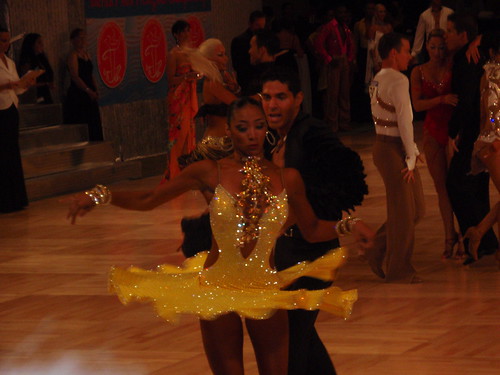
Here are a couple of pictures I took of them at earlier competitions:
Okay, I have talked too long. I’m never going to be ready for Blackpool!

Tonight

I’m gonna be a little late in posting on “Dancing With the Stars” tonight since I will have to tape it and wait to watch until after I return from seeing …


perform (along with my fellow amateur friends!) at Dance Times Square‘s biannual professional / student showcase. Always makes me sad I’m not up there with them, but it’s something I look forward to watching every six months anyway. At least it’s a lot less stressful in the audience…

Also, tonight is opening night for my favorite dancers on earth. I can’t be there, obviously, but will be later this week for a crazy Corsaire starring


Too much going on! Too much!

Russian Roots and French Cuisine at New York City Ballet

Ballet season has officially begun in New York! So, I have spent the last two nights at NYCB.


Wednesday night’s program was called “Russian Roots” and last night’s “French Cuisine” — I’m loving these titles, which are named after the nationalities of the composers to whose music Jerome Robbins, the American choreographer they’re honoring this season, choreographed his works.

So, the Russians:

First on on Wednesday night was “Andantino,” a short duet, by turns cute and flirty, and soft and romantic, set to Tschaikovsky’s First Piano Concerto, Second Movement.


It was danced by Joaquin De Luz, whom I’m very happy to see again — he’s been out for a while, I heard with an injury — and Megan Fairchild. No one dances with Megan like Joaquin, and I love how he can give a thrilling bravura performance that is still artistic. He can jump fast and leap high but you’re not just watching spectacular athletic feats; he makes everything part of the character of the dance.


Next was one of my favorites of the night, “Opus 19 / The Dreamer,” set to music by Sergei Prokofiev. I like Prokofiev so much I think because his music is full of dramatic tension, it can be very unsettling. It can go from dulcet and mellifluous to angst-filled and foreboding in just a few measures. In this piece a man, danced here by the very charismatic Gonzalo Garcia, looks rather lost but enchanted, trying to find his way to … somewhere … amidst a chorus of dancers, all in blue, who resembled to me at times, I guess because of the blue backdrop, Matisse’s painting “The Dance.”


Eventually Wendy Whelan emerges as their somewhat mischievous leader and he has some interesting pas de deux with her. She seems at times to help him, at times to taunt him. The end is, as Deborah Jowitt says in her program notes, “enigmatic,” as they fall in each other’s arms, but not necessarily in a romantic way. She could be holding him up, he’s so exhausted. I felt there was a lot to this piece and there’s no way you can thoroughly comprehend it on one viewing. It’s the kind of dance you need to see again and again and every time you’ll find something more than you saw before.

Oh, also, at the beginning of each evening, they’re showing a clip of Robbins working with a dancer or dancers on one of the pieces performed in that night’s program. Wednesday night they showed Robbins working with a dancer (who’s name I didn’t get — he looked like Baryshnikov but had a completely American accent) on Opus 19, and they repeated a section over and over again. When Garcia did that section you immediately recognized it and got so much more out of it. It was kind of funny trying to discern how well, Garcia, who’s far too young to have ever worked with Robbins, did as Robbins had instructed the other dancer. I personally think he did well with the traveling steps, but the lunges were not entirely there 🙂 But I wish there would be more of this in the ballet world in general — allowing audiences to witness process.


Next on was “Piano Pieces,” my other favorite of the evening, set again to Tschiakovsky. This work reminded me of one of Robbins’ masterpieces, “Dances at a Gathering.” It opens with an ensemble performing a cute Russian peasant-like polka dance, then the charming Antonio Carmena has an impish, quick-paced, high-jumping solo that looks near impossible to perform but of course he breezily pulls it off, followed by the first duet, “The Reverie” in which a man seems to try to comfort a day-dreaming woman. Next, Carmena returns for another frisky solo, followed by another couple, danced by some of my favorites Amar Ramasar and Abi Stafford, who do a flirty, Don Quixote-esque, Spanish-flavored pas de deux that I loved. Then there are some solos by each of the pas de deux dancers, some dreamy, some searching, some soft and forelorn, some high-spirited, and in the end, Carmena leads the whole cast in a final, fun, folkish polka.


All I can say is whenever Amar Ramasar, Abi Stafford, and Kathryn Morgan are onstage, I become completely emotionally involved in their worlds. Amar pulls you in in large part through his superb dramatic abilities — he’s a great actor. He’s a great dancer too, but often it’s his facial expressions combined with the way he moves that make me unable to take my eyes off him. The other two, I don’t know what they have (and I don’t always even recognize Abi right off the bat since from afar she looks like a lot of the other dancers, but I do once she gets into her solo!), but they just have a kind of expressiveness, everything they do has such thought and purpose behind it, it really pulls you in and compels you to stay with them. They’re both so young too; it’s amazing they have so much artistry this early on. I also feel this way about Andrew Veyette, but more in the Robbins ballets, which he strongly excels at, than Balanchine.


Anyway, last on was Les Noces, a dramatic ballet with a narrative storyline choreographed to Igor Stravinsky. This is a ballet I have a feeling many will roll their eyes at because there’s not a whole lot of pointe and traditional balletic movement, but I liked it. It was very very intense. It depicts the wedding of two young Russian peasants, a ceremony that seems to make marriage something more to be feared than enamored, like a very painful rite of passage. The aforementioned Kathryn Morgan is the poor young bride, Allen Peiffer her very teenage-looking groom. There is a chorus onstage, in back of the dancers, who sing beautifully. The piece begins when Kathryn’s assistants load bundles of wrapped-up cord atop her shoulders, and, at the banging start of the music, a soprano screams out, as Kathryn releases each bundle her mouth open imitating the soprano, in immense fear and agony. The whole thing proceeds this way, with this same emotional undercurrent. Much of the folk dancing by the men consists of flexed-footed, bent-kneed jumps up and down, their weight creating a thump as they land. It’s a perfect portrayal of masculine aggression and seems to forebode the wedding night.

Andrew Veyette danced the part of the groom’s father here, and, as I said above, I think he is such the quintessential Robbins dancer. While most others look a little uncomfortable with some of the non-balletic movement — like these loud, weighty, thumping Russian peasant jumps, or the modern jazzy moves from New York Export Opus Jazz and the bravado swaggering walks of West Side Story Suite — he looks perfectly at home.

I generally liked better Russian night, but briefly, “French Cuisine” consisted of “Mother Goose: A Fairy Tale For Dancers” set to Maurice Ravel music (who, embarrasingly, I actually thought was American because some of his musical flourishes can sound a bit Sousa-esque), Robbins’ very well-known “Afternoon of a Faun” to Claude Debussy, “Antique Epigraphs” set to the same composer, and “In G Major” again to Ravel.

In “Mother Goose” dancers in work-out clothes — leotards and tights — don different kinds of theatrical hats, as if they are play-acting a fairy-tale just for the fun of it. The story begins with a tutu-ed Sleeping Beauty being cursed to a life of sleep after pricking her finger while jumping rope. In her dreams, dancers enact three fairytales, Beauty and the Beast (Beauty was danced again by mesmerizing Kathryn Morgan), Hop o’ My Thumb, and “Empress of the Pagodas.” Eventually, Prince Charming wakes Sleeping Beauty and all is happy in the make-believe world the fooling-around dancers have constructed.


“Afternoon of a Faun” was originally choreographed by Nijinsky, but in his version, which takes place in a forest, a male faun is smitten by several wickedly enchanting nymphs. Robbins re-set the ballet in a dance studio. It begins with a male dancer fawning over his own reflection in the mirror, which looks out toward the audience (so the dancer is actually looking out at you, but seeing his own reflection, which he, amusingly, adores). A female dancer then enters, equally taken with her own reflection. Part of their self-interest lies of course in their being dancers, who are of necessity looking at themselves in the mirror to correct technique flaws, but I also see a lot of narcisissm. Jowitt says in her Playbill notes there is no self-absorption, but I see it. I think Robbins is perhaps saying a certain amount of self-obsession with one’s physicality is necessary to being a dancer? Anyway, I actually think this piece is quite funny, as you watch the dancers, so absorbed with their own reflections suddenly notice another person is present and manage throughout the course of the ballet to engage in a kind of contact with that other. This was danced by the bewitching Janie Taylor, whom I love but seem to hardly ever see, and Damian Woetzel, who will be retiring later this season.


“Antique Epigraphs” consisted of several women, all dressed in nude-colored body-stockings covered with brilliant-sheened, diaphanous, ankle-length tunics. The dancers usually danced as a unit, often in sync, but at times would break off into a solo or duet. It looked very Greek, hence the name, I guess. This shortish piece really resembled a painting, or a group of Greek statues come to life. It retained that air of pieces of artwork come to life.


Finally, last night ended with “In G Major” a work from 1975, whose main appeal to me was the jazzy movement combined with the costumes and set, designed by the artist Erte. The background set is simple but stunning in its sharp lines. It depicts a sun, clouds and ocean waves, so the dancers are clearly at the beach. Their Roaring 20s-style beach clothes are dress swimsuits with the cute little skirts, which bear sharp large horizontal lines, some red, some blue (except for the main female lead, which is solid white); the men’s costumes bear wavy lines, as you can see above. The dancing, often in pairs, is evocative of Twenties-style jazz and Swing, like a celebratory frolic on the beach.

In closing, I just have to say, hehehe, I think NYCB is becoming a bit like ABT — when star principal dancer Wendy Whelan, who danced the female lead here, made her entrance some people began clapping. But this is not customary at a non-star-driven company like NYCB, so others, confused, clapped, but then didn’t know if they were supposed to but felt like they should follow the others’ lead… It was hilariously confusing. People should just clap, IMO!

Anyway, much more ballet to come in the following weeks 🙂

Cool Stuff I Have to Miss

I’m getting ready to go on a much needed vacation (yay!) but will unfortunately have to miss the following big exciting things:

David Hallberg performing with American Ballet Theater at the Guggenheim’s Works and Process program on May 4th and 5th;

Alvin Ailey II at the Joyce. This is Alvin Ailey’s studio company. I’ve never seen them before but am dying to;

Marcelo (my favorite) guesting with New York City Ballet in Robbins’ “Fancy Free” on May 4th;

The 100th episode of Dancing With the Stars.

If anyone sees any of these, please do let me know how it went so I can experience vicariously… 🙂

"I Haven’t Seen it in 30 Years and I Could Go Another 30 Before Seeing it Again"


Overheard in the ladies’ room at the New York City Ballet tonight, followed by laughter, and “you said it!” and “just a little self-indulgent, wouldn’t you say?!” and “full of every pretentious cliche there is,” and “well, the next one’s a lot better, it’s REAL BALLET, I PROMISE!” The last quote was followed by a chorus of “oh yes”s. I’ve never heard the ladies room that animated. Ever. This was all in response to Jerome Robbins‘ “Watermill.” Poor Mr. Robbins; no wonder the first performance of this ballet in 1972 was greeted with boos.


I initially agreed with the “pretentious” woman, although I felt a bit differently about it after reading eminent dance scholar Deborah Jowitt‘s write-up on the piece in the program notes. Which is one of the functions of great critics and writers — to make the public understand and appreciate a work that seems undecipherable and hence aggravating.

Speaking of dance critics, I sat next to Alastair Macaulay tonight! (For those who don’t know, he is the newish chief dance critic of the NYTimes) It made me unbelievably nervous actually. But I don’t know why. He was very pleasant; he hardly wrote anything at all, and when he did he was very quiet about it and I only knew he was writing because I was trying to pay close attention to what he noticed … although his pen usually seemed to be going when nothing was really happening onstage. Anyway, he was reading a copy of the New York Review of Books and he had a Haruki Murakami book in his bag, which was more overstuffed even than mine.


Back to “Watermill.” Well, here’s what happens: a man (here, the wonderful Nikolaj Hubbe, formerly with NYCB but now directing the Royal Danish Ballet and returning for a guest turn) is onstage wearing a robe. Also onstage are three big wheat stacks and a waterfall and quarter moon in the background. We go through an entire day, the moon slowly filling in to signify approaching night, then disappearing to show daylight, then returning to quarter moon – twilight. And this symbolizes the stages of the man’s life. I think. As the piece begins, Nikolaj looks very slowly at his surroundings, and as a Japanese bamboo flute sounds in the background, he looks around, mesmerized by that sound and longing to find its source, to follow it. He disrobes, now wearing only white underwear. Soon, a group of men bearing colorful lanterns atop long bamboo poles cross the stage; the man doesn’t seem to notice. They are followed by another group of men carrying colorful paper kites cut in the shape of birds and a dancer emerges and performs a very feathery, birdlike, solo. He was actually my favorite part of the whole thing — the “bird / man.” I think he was my favorite because he was the only one who had much movement, or at least non-extreme slow-motion movement. Soon he disappears and a group of warrior-like men bearing what look like spears emerge and taunt Nikolaj, who for the most part resists them. After a while they leave and a woman appears wearing a robe. Nikolaj is very taken with her. She disrobes, wearing a modern black bathing-suit, unwraps her hair which is up in a towel, and brushes her hair. As I said, the entire thing unfolds as if in extreme slow-motion. It must take a full 10-15 minutes for the woman to disrobe, shake her hair out and begin to brush it. Eventually Nikolaj resists her and lies down and falls asleep, while another man emerges and performs a duet with her evocative of copulation. He leaves, she leaves, and a person wearing a lion’s mask comes out and does a frightening dance. Nikolaj sleeps the whole time. Later women come out to harvest the wheat, waking Nikolaj. They give him two long stalks of wheat and he holds them above his head, like spears, like a god, then waving them around, making various shapes with them, symbolizing what I’m not exactly sure. He does this for maybe ten minutes, staring up at the stalks like they hold the key to the meaning of the universe. It keeps going like this, slowly slowly SLOWLY. Even Sir Alastair got shifty in his seat. More people come out, some moving in ways that some in the audience, judging by the sounds around me, thought laughable. And finally the moon goes back to the way it was at the beginning of the piece and we know it’s over. I’d say it got polite applause, along with lots of rolling eyes and angry bathroom talk.

Anyway, according to Jowitt, during the 60s Robbins had become fascinated with Japanese Noh drama, characterized as “ceremonious, slow-moving, poetic plays in which every spare action imprints itself on the viewer’s mind as indelibly as a brushstroke in a master’s calligraphy.” Her explanation made me better appreciate what he was aiming for but something tells me I would have liked a good Noh play better. Robbins’ drama just didn’t make sense to me — I couldn’t even figure out what country or era we were in: Lion man, bird-like man, warrior men, a woman wearing a bathrobe and swimsuit and hair toweled up like something out of the American 50s, people harvesting wheat… I’d love to see a Noh play now but I feel like for the extreme slow-moving actions to leave an indelible imprint, they have to be recognizable. I have to know why he’s waving those wheat stalks around above his head for me not to forget its image.

I mean, let me just contrast this ballet to a short film I recently saw at the Tribeca Film Festival. It was a Spanish-language film called “So Beautiful” and in it a woman in her late sixties / early seventies, overweight, skin sagging, age spots, is at the beach. She brings a picture of herself and a beau in her youth, sets it up on a little table next to her umbrella, pulls a champange glass and a small bottle of champagne out of an ice box along with crackers topped with smoked salmon and cream cheese, pours the champagne, drinks, eats, etc. A young woman approaches her and asks her to watch her bag, which the older woman agrees to do. But time passes, the young woman never returns and the older woman is ready to leave. Eventually, the older woman begins to leaf through the bag, finding typical young woman things — makeup, inexpensive costume jewlery, a condom, some loose change. As the older woman goes through the bag her facial expressions reflect her reminiscing on her own youth. The film is about 15 minutes long, and it has virtually no real “action” except for the two or three seconds it takes the young woman to ask the older woman to watch the bag. But it was unbelievably mesmerizing to watch the older woman’s face register happy memories, even just watching her look out at a fisherman as she eats her salmon crackers and sips her champagne made you think about what she might have been thinking watching that man. It made you think about the aging process, cycles of life, youth and beauty… it nearly made me cry and I have to say it had more impact than I think any of the full-length films I saw.

Maybe it’s silly to compare a movie with a ballet, but I know I wasn’t the only one not enthralled with Robbins here! Plus, Tribeca’s on my mind since today was the last of my films … 🙁 (more about the movies later).

Anyway, the other ballet tonight was Robbins’ “The Four Seasons” which I wrote about here. It’s a cute enough ballet, based on opera with caricatures that symbolize the four seasons, but it’s not my favorite. I just have to say, the nano-second Kathryn Morgan appeared onstage I saw her and couldn’t take my eyes off her, and she didn’t have a lead role here. I wish they’d give her more big roles. This entire NYCB season, which began this week, is devoted to Robbins, so all programs will be Robbins-heavy, which I’m looking forward to, since, tonight’s program aside, I’m a big fan of his.