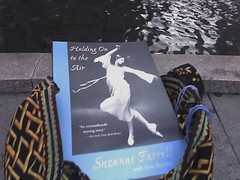
What What What?

Okay, what bumblehead recommended this movie?! I have got to stop doing this — going to see a movie or play based on the fact that there’s supposed to be some miniscule amount of dancing. (Did the same with Gypsy, knowing only that the production I was to see contained original Jerome Robbins choreography and therefore expecting West Side Story, not realizing “choreography” can sometimes mean simply placement of actors on a stage). Someone — I think it was Dance Magazine in one of their e-newsletters — mentioned that the brilliant Desmond Richardson was to be in this movie (Julie Taymor’s “Across the Universe” — could they have come up with just a slightly more imaginative title??), which, according to the credits, he was, but I have no idea where. Probably in the one scene that looked like it was trying incredibly hard to be something out of The Wall, with cartoonish block-headed military goons doing some kind of group number that looked like it required people slightly more skilled with body movement than actors, but cannot under any circumstances be called dance. Why someone of Desmond’s stature would take on something that amounted to extra work I have no idea.

Anyway, lack of dance and the beautiful Desmond aside, this movie in a word sucked. It was full of cliches, bad acting, an utterly boring and predictable narrative, cheesy cameos (could anyone make Bono look creepier than Taymor), and renditions of the greatest songs of our time that somehow, obscenely sucked the life right out of them (the sole exception to this being “Let it Be” which begins with a young African American boy cowering in the entrails of a burned-out car during a race riot and climaxes with a black choir belting out the lyrics during the slain boy’s funeral).

The only way I made it through the whole thing was this guy. I guess you can’t really blame actors for crappy material; perhaps the fact Joe Anderson gave all the scenes he was in an actual heartbeat attests to his skill. I’ll have to see more of him. Dana Fuchs‘s Janis Joplin-esque diva was fun at the start but somehow began to drain you, likely because of the predictability of her character. I enjoyed her performance far more in the original, off-Broadway play, “Love, Janis.”

Interestingly, there’s a split-second Butoh sequence during one of the Vietnam scenes that failed only semi-miserably because of, once again, the cliched way in which it’s used. Of course, unlike with real Butoh, the dancers here are all women instead of a combo of sexes since male nudity in movies might spook the fifteen-year-old straight boy who it’s assumed is their main patron, or maybe his parents, or whoever … the powers that be who need to maintain for whatever reason the sexist, homophobic status quo. Anyway, I guess kudos to Taymor for even trying to inject a bit of multiculturalism into her film.

The twenty-somethings in my audience cheered wildly at the film’s end, so maybe it’s just that I am just too old for it 🙂 What gets me is, gasp and moan though these young people did during the scenes involving the Vietnam war and the violent police crackdown on campus protesters, do these people see any relevance whatsoever to what is going on in the world today? What’s the difference between the 60s and today? No baby-boom-produced generation gap? Is it because those who are serving in the current war are largely not white and from middle-class families?

So, to the young people who happen to read my blog: perhaps you will really enjoy this movie. If you do see it, though, please please please please please think when you see those aforementioned scenes of all the people coming home in body bags today. Just because they are black and Latino and working-class, unlike the characters in the film, they are still human.

Ohhh, Vaidotas Vaidotas Vaidotas!

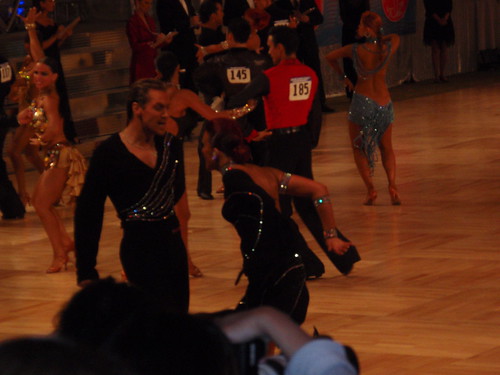
I know, it doesn’t exactly have the ring of “Oh, Marcelo Marcelo Marcelo!” does it? Hehe, oh we so love our Eastern European dancers and their ever so fun names (and their ingenuousness at not even thinking to Americanize them…)! But, though he looks nothing like him, Vaidotas Skimelis (whom I’ve been on about here and there throughout the comp) actually kind of reminds me of my favorite ballet dancer, mainly because of their large sizes and the kind of virility that almost naturally entails. I mean, large bone structure is difficult with Latin because speed is so important to the style — and certainly Vaidotas’s jive will never look anything like winner Max Kozhevnikov’s. But still, I like his size — as I do Marcelo’s — there’s something so sexy and romantic about a big hunk of a guy, right 🙂 Plus, difference is good! Who wants all the dancers to look the same whether it’s Latin or ballet — boring, I say!
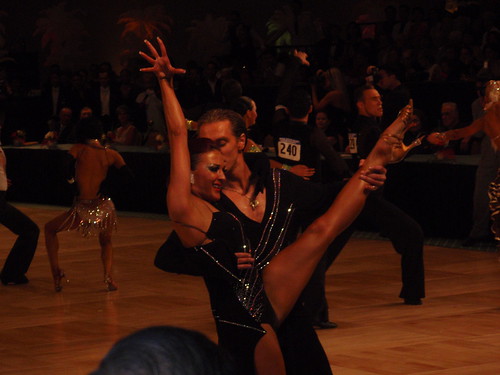
One of the not horrible things about Pasha and Anya leaving (at least for now) the competition world is that it made room for Vaidotas and his lovely plum-haired partner, Jurga Pupelyte, to be seen, to make it to the top ranks, where they most definitely belong. I only wish he didn’t live in California! As one of the only non-tiny Latin dancers, he’d be perfect size-wise for me as a teacher. But of course I shouldn’t even be thinking of private lessons because they are too expensive! So, good rather that he lives all the way out in California…

Anyway, here are a few more pics of my favorite couples and other stuff I did in Florida:
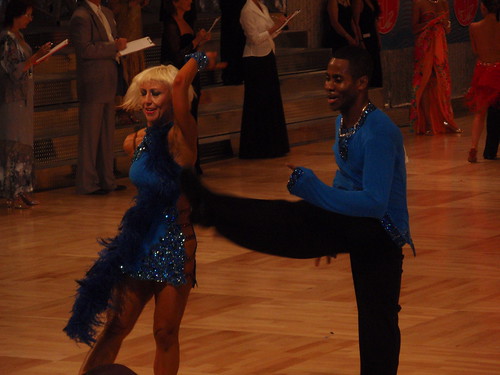
Emmanuel Pierre Antoine and Julia Gorchakova, a super fun couple with creative routines and great show quality whom I wanted to take American Rhythm, but who ended up placing third.
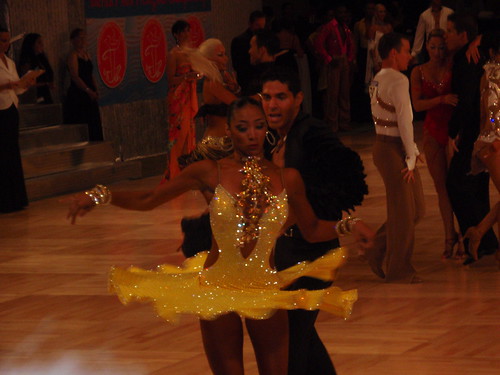
Matt and Karen Hauer, semifinalists in American Rhythm and second-place finishers in the National Mambo championships, who teach at my former studio. He does do a mean Mambo, I think second only to Jose DeCamps’s, and they’re young and in love and cute and their dancing reflects all that 🙂
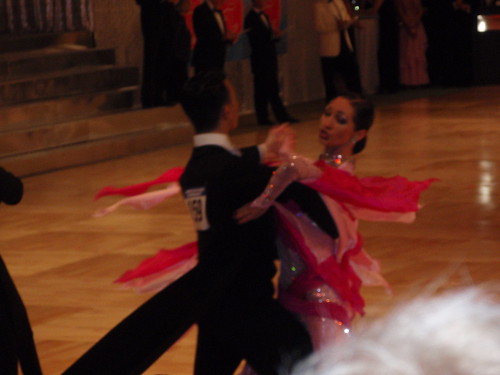
America’s sweethearts, Anna Mikhed and Victor Fung, second-place, as always, in International Standard. Okay, they may not be as perfect technique-wise as Jonathan Wilkins and Katusha Demidova, but they’re the king and queen of charm, those two.
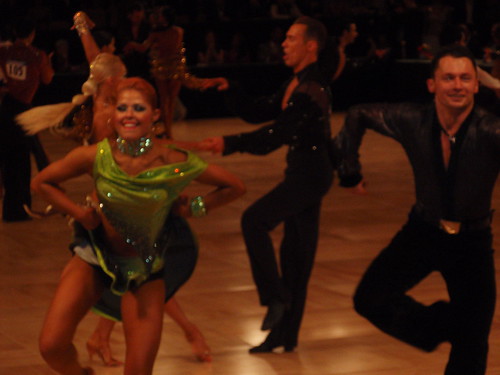
The adorable Anna Trebunskaya (from Dancing W/ Stars) and her new partner, Pavlo Barsuk. They placed sixth in the finals, which is excellent for them.

Hehe, am I a paparazzi in the making or what? Here’s her hubby Jonathan Roberts (the brown-haired guy here, also of DWTS) intently watching her. She’d look out in the audience for him and he’d give her a little wave and a wink and she’d smile like she was on cloud nine. So cute!
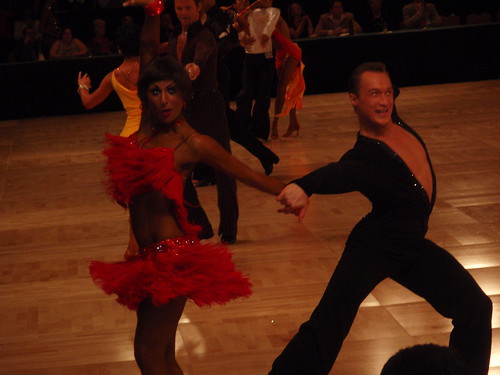
Very sexy Latin couple that I like a lot, Nikolai Shpakov and Tatiana Banko. Friends keep telling me Nikolai (who resides in NY) would be a good teacher for me … But of course I am not listening since I can’t afford ballroom lessons anymore…
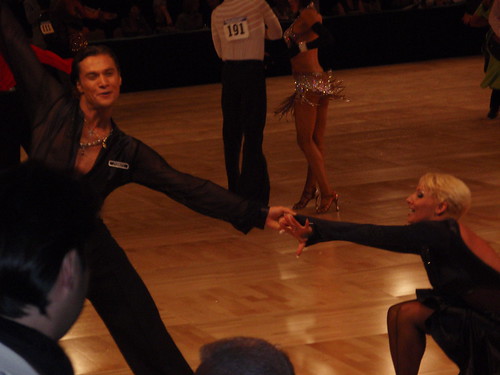
Aw, the just-displaced now former National Latin champs Andrei Gavriline and Elena Kruychkova. They are an immensely good couple and no one flies across that dance floor like Andrei. He’s truly beautiful to watch; so slender and light-footed his feet sometimes look inches above the parkay. And I certainly don’t think it’s impossible for them to get their title back at some point in the future; I just think others need to be given a chance as well. And this was simply Max and Yulia’s year.
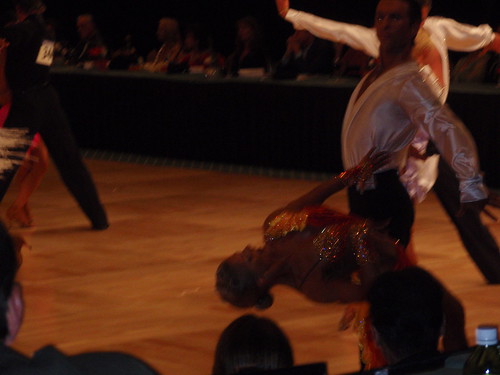

Speaking of the new champs… look at Yulia’s gorgeous arch! How is she even supporting herself like that?
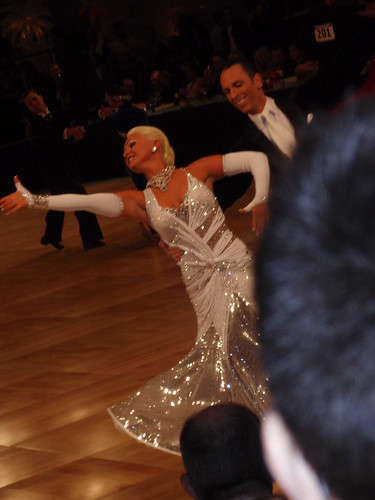
An American Smooth couple I like, Eulia Baranovsky and Stephen Dougherty. I actually thought they’d win, but they placed fourth or fifth. So, I was off on that! I think that couples like these two and the winners J.T. Damalas and Tomasz Mielnicki are bringing the life back into what was becoming a rather staid and boring style. The Smooth championships, placed between Latin heats though they were, were actually really exciting to me for once.
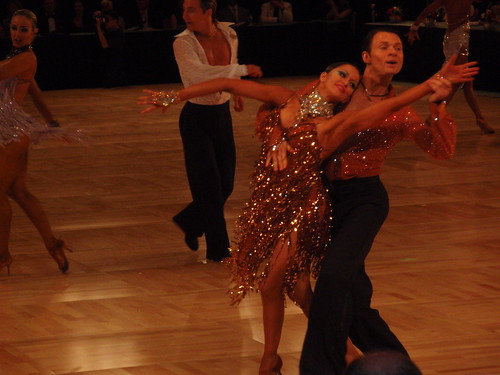
Another Latin couple, Andrei Strinedko and Olga Kinnard, who caught my eye big time this comp. A lot of women wearing these shiny gold dresses this year… What I really love about this photo though is that they are doing my very favorite Latin dance step in all of life, a Samba roll in shadow position. From here, they’ll arch far back together in beautiful unison, then they’ll bend way forward from the waist and then back again making a circle with their upper bodies while doing a hip-rolling side step across the dance floor. It’s hard because you have to be in perfect harmony or you’ll step all over each other’s feet or bop him in the crotch with your butt or whack him upside the face with your arm (I know all of this because…) , but gorgeous when done properly 🙂
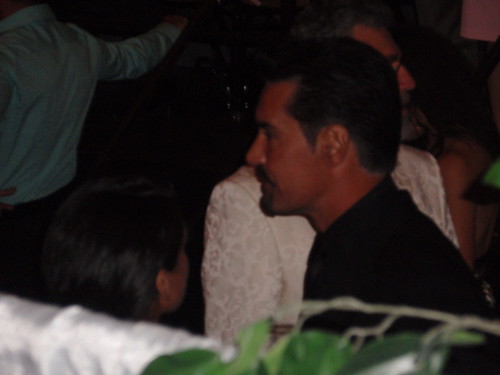
Another proud paparazzi photo of mine 🙂 This is Nick Kosovich who designs the dresses for Dancing W/ Stars (and he appeared in the show a couple of seasons ago — partnered Tatum O’Neal). When he was on the show I thought he was a bit nerdy-looking, but after seeing him in person at the last few competitions, I realized how good-looking this man actually is. Tall dark and handsome Aussie! He’s retired from competition but at Blackpool did this James Bond-styled showcase with his partner, who I’m pretty sure is his wife 🙁 and they really blew me away, which is highly odd since they’re Standard dancers. Anyway, the fact that he is so gorgeous makes my former stupid “breast” experience with him all the more embarrassing… (he was the “Austrailian guy” / “LeNique guy” — as I later found out — in this post).
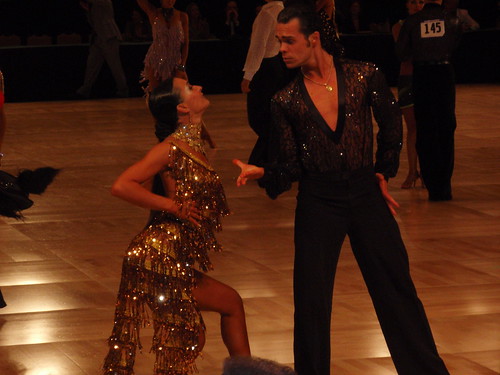
More Latin favorites of mine — Delyan Terziev and Boriana Deltcheva, who placed third, moving up a whole three notches from last year! Good for them; they’ve been working very hard and they deserve it. To me, this couple is one of the most artistic. She moves just like a spider and she’s just bewitching. She kind of reminds me of a Latin, raven-haired version of ballerina Janie Taylor, with her kind of ethereal, goddess-like sexiness.
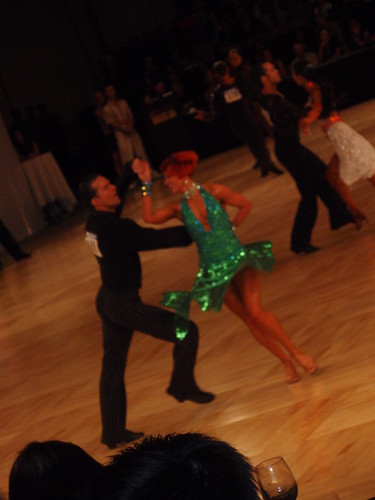
Andrej Skufca and Katarina Venturini from Slovenia who competed in the Open-to-the-World Latin category on Saturday night. This is the competition I was hoping my favorites Slavik Kryklyvyy and Sergey Surkov would participate in, as they did last year, but oh well. Andrej and Katarina (4th in the world in Latin, right behind Slavik & partner Elena) were the only top couple to compete, so it was rather boring; they easily took first. For some reason, Max & Yulia didn’t stay and compete in this category, like they did last year. Not sure what happened. Maybe they were too tired. I hope no one was injured … that’s happened before in competition, couples injured during last-minute practice. Anyway, I loved Katarina’s bright emerald dress. Looked spectacular with her carrotty hair (which I personally love, though I know that opinion is most definitely not shared by all 🙂 )
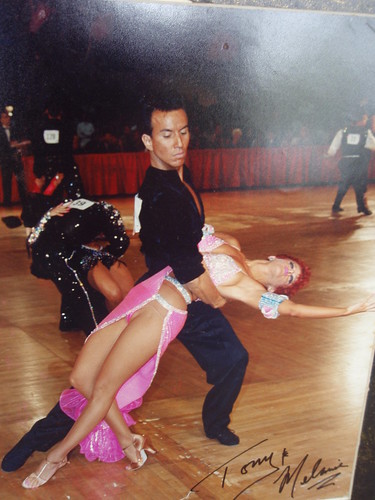

Look who this is!! They had the hallway leading down to the ballroom lined with blown-up pictures of former champions. This one’s of Tony Meredith and Melanie Lapatin (choreographers from SYTYCD) in their heyday, circa 1995! Look how young he is — such a little cutie!
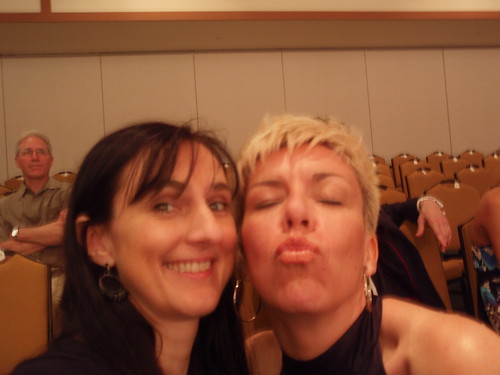

Ewwwwww!!!! It was some ungodly hour of the morning and comps were still going on (judging by the rows behind us, I think many departed the ballroom already, save us insane diehards) and I, not being a late night owl, am half dead here, no makeup and flat as a pancake hair thanks to the lovely Florida humidity. Plus the angle gives me a quintuple chin. Oh well. Michele, my roommate for the comp, is being herself 🙂

Okay, I am almost done, I swear. I took one day off from comp-spectating and went to Epcot Center. I’ve never been to Disney World though, growing up in Phoenix, went often to nearbyish Disneyland as a child. So, of all of the parks, I chose Epcot because I figured, not to sound like a dork, but I so loved the “It’s a Small World” ride at Disney as a kid, I figured I’d have the most patience and respect for one that introduces children to the world beyond our borders. But I found it disappointing, and this picture epitomized why. It was so Disney-fied — the cartoons completely overtook the exhibits. Everything was so cheesy, not at all educational. “Viva Donald”?? Great way to introduce kids to a foreign language. Maybe I’m misremembering things and my child’s mind over-glorified them, but, a bunch of silly dolls though they were, that Small World ride really made me promise myself that I’d go to Argentina, Holland, Spain, etc. one day. The dolls were so sweet and their costumes so beautiful. And everyone singing that song in their native language sounding so mellifluous — definitely made me so curious to hear more (and I did take a ridiculous amount of foreign language classes in high school and college). And who wouldn’t be enthralled with Africa by that nutty laughing hyena! I don’t know, maybe if I went on that ride again, I’d feel differently, but it definitely gave me an appreciation for foreign culture as a child. I can’t imagine this doing the same at all. Kids are too busy laughing at the stupid cartoon characters, and the adults buying all the horrendously cheesy souvenirs.

A great celebration of Italian culture for sale. It was like you paid $75 just to be able to buy a bunch of souvenirs. I don’t get it…
This guy demonstrating how to extract pearls from oysters in the Japanese souvenir shop was okay. Demo was interesting and the guy pretty flamboyant.

Returning to NY. Could they have blurted over the loudspeaker one more time at the Orlando airport that the alert level had been raised to orange / four, and we were all to exercise great caution in leaving bags unattended, etc. And then there had to be some crazy hurricane off the coast of North Carolina. I’m a nervous flyer man! Fellow fearful flyers have recommended Valium, but I don’t like drugs. I much prefer alcohol. In case of emergency, you can always talk yourself out of being drunk; not the same if knocked out cold by prescription medication! This wine, by Best Cellars, was pretty good.

Anyway, okay I’m done, I’m done! Thanks for humoring me and my ballroom fetish, you guys 🙂

A Little Overwhelmed!

Each day yet more of the splendid Fall Season’s offerings flood my mailbox. So exciting! But a little nervewracking, given all the things I have to order tickets for! This is why I so love NY though — that unique combination of intoxicating stimulation and potentially migraine-inducing excess… (or in my case, TAC-headache-inducing excess … am trying to tell myself I do NOT feel one coming on, but am armed with meds just in case…)

Well, I guess this is what the holiday is for, to breathe deeply, lounge around, rest up for the happy hubbub to come 🙂 Happy Labor Day, everyone, have a long and relaxing weekend!

Why No Contemporary Nureyevs?

So, I thought the documentary last night on PBS was rather so-so; it was okay I guess as far as PBS documentaries go 🙂 First 40 minutes dragged, but second half was far better, mainly because it was about his defection. I remember reading an interview with Baryshnikov years ago — I now have no idea where or when it was — but he was asked why he decided to defect and he basically said, “mmm, dunno, seemed like the thing to do?” I was so disappointed. I’m sure he just couldn’t talk about it, but how could you not have some kind of answer for something like that? Even if you just say, “I really don’t want to talk about it.” So I’m very happy that here they focused on Nureyev’s defection, even using his French friend who witnessed it to re-enact the whole thing.

I love how the filmmakers dwelt on the aftermath too — the KGB’s plan to try to break poor Rudik’s legs, their attempts to destroy his first performance in the West by screaming and shouting and throwing dangerous objects at him onstage. Wow. And how he had to go into hiding. And how the government wholly erased his presence in Russia, preventing information about him leaking into the country through the newspapers, destroying the careers of his friends and family. How some friends missed him dearly — one said he was “the bright spot” in her life, such a thing coming only once a lifetime, and even that if one is lucky. How others felt he was hugely dishonorable (for leaving the country that made him, as if it was the country and not he himself), an abandoner of his family and friends. The film doesn’t make it obvious, but he had to live with all of that. Some journalists have argued that the documentary only shows Nureyev in maturity, on his good days, neglecting to show the occasional nastier side of him. If you were constantly made to feel like a horrible person for turning your back on your country, your ill mother, wreaking destruction on your friends and family, all for wanting to live an honest life, you’d probably have some anger inside of you too.

Anyway, the first part is too slow I think mainly because there are too many interviews. It’s confusing who all of the people are, and many are not that animated (unlike most of the funny characters in the very good documentary Les Ballets Russes). Perhaps they could have filmed in more meaningful places, like with the French guy in the airport? Just having them sit there yapping away was a bit boring. I found his school chum entertaining though — the white-haired guy who talked about all the times Rudik would make him practice, would make him do the parts of the ballerina so he could practice lifts 🙂 For those who somehow can’t tell from his dancing alone, such anecdotes reveal that this was someone who ate, breathed, and slept his art.

By far the best parts of the film are all the footage of the great one in action — both that amateurly taken in his youth by his German friend, the ever intriguing Teja Krempke (could we please hear how he died — I know it was “under mysterious circumstances,” but where was he found, etc.?), and formal footage taken of his later performances with his “soul mate” Margot Fonteyn. For people who missed the film (it’ll be shown again late Saturday night), it’s definitely worth getting through the boring interview segments to get to that footage.

But watching him dance, I can’t help but get upset that there’s no one even remotely like him today. He danced with such fierce, inflamed passion, with such glorious recklessness, with such hunger — forget those insanely fast chaine turns and crazy high barrel turns that don’t look humanly possible — just look at the intensity in his eyes that permeates his entire body, even in those small pieces from Pierrot Lunaire and Giselle. I feel that there’s no one today who comes even close, who has the courage to do something novel like dance on demi-pointe like he did (and now everyone does). I think you have to have starved to have that kind of hunger. And today’s young ballet dancers — I feel like many of them don’t know the meaning of those words. And, forget art, their greatest ambitions are to construct the perfect MySpace page so they can engage in childish chatter with each other.

Remember Remember Remember!!!!

to watch tonight, Wenesday, PBS at 9 pm. DO NOT MISS IT! Under any circumstances! This is the greatest dancer EVER. Plain and simply. Unarguably. In the world. EVER.

If you wish to do some advance reading, everyone but everyone on the web is talking:

Apollinaire in Newsday

Apollinaire’s blog

James Wolcott from Vanity Fair (scroll down to last couple paragraphs; he also quotes extensively New York Sun’s Joel Lobenthal on some important things the production left out)

journalist and author Tobi Tobias

New York Times

the inscrutably angry LA Times’s Lewis Segal (what in the ballet world has made that man so mad? By the way, are people just ignorning him these days? Am I the only idiot letting him get to me?)

New Yorker’s Joan Acocella

My fellow blogger Art (through whom I found the blasted Segal article that nearly made me cry — thanks a lot, Art 😉 )

Ballet Talk talkers (focusing mostly on Nureyev’s gorgeous, cat-like demi-pointe that Segal has such issues with)

and I’m sure many many others who escaped my limited web-surfing attention span :S

Please please watch the program. No matter how deficient the documentary may be, this man’s life was so uber fascinating and his dancing so sublime you’re bound to be completely enthralled, there’s simply no way around it! This film covers his early years before he became hugely famous in the West — so, while he was in the Kirov Ballet up through his decision to defect. So basically, lots of footage of Russia 😀

C’mon, he was the original Pasha 🙂 I know, I know, I’ve offended everyone and their dog with that … I simply mean of course that for people who have fallen in love with dance through SYTYCD, there’s a whole lot more where that came from 🙂

Okay?! Wednesday night 9 p.m. PBS. Discussion to follow!


Brief Snapshots From Downtown Dance Festival

I’m exhausted from spending the weekend down at the lower tip of the island watching other people dance (how does that happen?), so this is going to be short (word-wise at least). The Downtown Dance Festival took place during lunch hour each day last week at Chase Manhattan Plaza in the Financial District, then moved for the weekend to a nice little outdoor amphitheater in Battery Park. I wasn’t able to see all of the dance companies (nearly 20 in all), but here are some highlights from what I did see.

First, sorry, but I simply must bombard people with just a couple more photos of Quorum Ballet, who performed again Saturday in Battery Park. They were really so lovely… so, just, HOT for lack of a better word 🙂


I wrote in my last post on them that their lifts looked a bit “trick-happy” and on watching again I think that might be in part because the lead female dancer, Theresa da Silva, would often look out into the audience and choose someone to flirt with, which seemed to happen most often while she was airborne. Very interesting, and something I haven’t really seen in concert dance before, only in ballroom comps and some club acts. Anyway, their next performance in NY will be February 13th at the Tribeca Performing Arts Center. I urge everyone in the city to check them out!


I also liked the Ashley Browne / Kinetic Project. Some very sweet duets with fun, pop music from Jill Scott, Mos Def, and Fiona Apple.


Ms. Bne is a choreographer I could really see working on SYTYCD. I really wish they would open the show up to other choreographers besides the same ole Mia Michaels and Wade Robeson. I mean, keep them, but instead of having them choreograph something practically every week, let the country see some of this other awesome talent!


Another favorite, Vissi Dance Theater. I loved them! Their mission statement reads, “Vissi is committed to art that explores moral and social issues… Vissi seeks to speak to the human condition, lift the spirit, ask questions, celebrate the joy of life and reflect the truths of human nature.” I felt they did that splendidly. This piece above, danced by four women, reminded me a bit of Alvin Ailey’s Cry with its upbeat celebration of womanhood, and was kind of a combo of modern dance with disco / hustle, to music by Macy Gray and Jocelyn Brown.


Their second piece, named “Melbabcd,” was a combo of all kinds of stuff — modern, hustle, hip hop, Latin, African, you name it. Great fun, as dance that makes you think and has social relevance can often be 🙂 This one kind of reminded me of Bill T. Jones with its very colorful cast of characters. I’d love to see more full-length work by this company.

The choreographer, Courtney Ffrench, by the way, is another whom I can really see peppering up SYTYCD with some romping group numbers. C’mon Nigel, expand those horizons!

Another highlight:


Gallim Dance Group. This piece is from “Snow” based on the novel by Orhan Pamuk and choreographed by Andrea Miller (yet another who could inject that aforesaid pop-fest with a blast of brain power). This was a haunting piece, like I imagine the book to be (okay, admitting I haven’t read it here!). The women bent their bodies every which way, inched forward, ran backward — the movement was beautiful but juxtaposed with musical lyrics like “question democracy…” became chilling. A Juilliard grad formerly with Ohad Naharin’s Batseva, which I’ve enthusiastically blogged about before, Miller’s mission is to “explore issues such as feminity, power, community and solitude.” Gallim will be performing at Dance Theater Workshop in Chelsea in September. See them there if you can.

On Sunday, we were treated to Darshana Jhaveri Manipuri Dance who came all the way from India, and who specialize in bringing the classical Indian dance, Manipuri, to contemporary audiences. So sweet, so lovely, and so educational.

This guy BLEW ME AWAY. He had this amazingly intense look of concentration the whole time. Sometimes when a performer has that look in his or her eyes, you’re almost mesmerized just by the face. He beat the hell out of this double sided drum, as well as another that required a stick, later on. Not only did he play those drums, he danced while playing. And not only did he dance, he did these continuous barrel turns at whiplash speed. The entire audience sat there open-mouthed.


And here he is barrelling all over stage with the other, larger drum. Between turns, he made beautifully intricate gestures with that drumstick. At one point, he put the drum down on the center of the stage and did repeated turns around it, beating it with the stick after each rotation, and managing somehow to hit the stick on the drum right in time with the lightening-fast music. Talk about the necessity of great speed and precision on those turns — if a turn was off, you wouldn’t just see it, you’d hear it. It was breathtaking, and I can’t tell you how much respect I now have for this classical Indian dance form.

Okay, I can’t write anymore. I do have a few more pictures of the whole festival, along with the Sitelines performance series, in my photoalbum, here.

Speaking of Sitelines, Apollinaire and Eva Yaa Asantewaa are having a very interesting discussion of the Macaulay NYTimes review of the Reggie Wilson / Andreya Ouamba work I wrote of earlier. Eva’s review of the piece puts me to shame — she saw all kinds of things I hadn’t thought of — do read it! I do have thoughts on the subject of socio-cultural meaning in dance and whether the choreographic duo’s mission statement should have been confined to grant application writing, as Macaulay argues, but am far too exhausted to formulate them now…

In The Company of Beautiful People: Quorum Ballet At the Downtown Dance Festival


Nice thing about New York in August is that there are lots of outdoor art festivals offering free viewings. I of course have been attending as many of the little dance performances as I can. Many are by very small companies, and the works are brief. Here’s a troupe that caught my eye yesterday, Quorum Ballet from Lisbon, Portugal, who performed at Chase Plaza as part of the Downtown Dance Festival organized by Battery Dance Company.


Their movement style was what I’d call contemporary ballet mixed with modern — no toe shoes but some lovely balletic lifts — and in one piece I saw a smidgeon of Flamenco. Music was mainly poppy with a fun, solid beat.


Beautifully sexy movement, and I don’t think I’ve ever seen such a gorgeous group of dancers! It’s a small, very new company founded only in 2005, by choreographer and dancer Daniel Cardoso,


(how much does he look like Herman or Joaquin 🙂 — jumps not unlike them too!), who, along with lead dancer Theresa da Silva, was previously affiliated with seminal modern dance company Martha Graham. (The two are pictured above and below, in “Kismet,” my favorite, and the piece that, at least in its solo parts, reminded me of a balletic flamenco).


Here are some more pics from their other pieces:


My only qualm was that some of their lifts looked a bit too “trick-y” as in, you kind of felt like drum rolls should be preceeding them, similar to what I’ve seen at many of the exhibition dancesport competitions I’ve been to. Suits some people’s tastes but not mine, and I don’t think this company really intended for them to be that way, although maybe they felt they were playing to an audience unaccustomed to dance and felt like they should play up the showy aspects. And some of the lifts seemed a bit out of sync with the style. For example, the “bluebird” lift above (where da Silva is balancing on Cardoso’s shoulder, back arched), a typical ballet lift, seemed to me a bit at odds with the flamenco-y flavor of that dance. I would rather have seen more original parterning, specific to the dance style, such as that employed by Mimulus, which I wrote about earlier. But the solo and ensemble work were just gorgeous.

Cardoso had some beautiful pelvic and ribcage isolations going on. Very Latin 🙂


Okay, that’s all for now. Will likely be more to come depending on whatever else strikes my fancy in the next few days … 🙂

NOOOOOOOOO!!!!!


I’m so upset. Last night in the mail I received my New York City Ballet brochure announcing the company’s Winter / Spring season and noticed right off that the photo of Carousel featured not the usual Seth Orza (my favorite NYCB dancer!!!) and Kathryn Morgan (together below, in photo by Paul Kolnick, taken from Explore Dance.com), but instead Damian Woetzel and Tiler Peck. In fact there were no pictures anywhere of Seth! Unheard of! I frantically searched the roster and his name was nowhere to be found!@#&^%! Philip had told me earlier that word had it Seth was leaving NYCB for Pacific Northwest Ballet in Seattle, but I told Philip to shut up and stop spreading base lies! Ohhh, now it appears he was right… I don’t get it. Seth was just promoted to soloist. And he was a favorite of all the critics — New Yorker’s Joan Acocella and even Alastair Macaulay from the Times who likes hardly anyone. You don’t leave New York under those circumstances! You just don’t! And he and Kathryn look so adorable together. Just look at them in the two pics below. (bottom one is taken from New Yorker, accompanying Acocella article). Who’s Kathryn going to dance with now? And who’s going to be Swan Lake Samba Girl’s favorite now?! Come on man! I was just starting to really love NYCB because of him. It’s not fair! Release him, Peter Boal!


In slightly less devastating news, Ms. Acocella writes in this week’s New Yorker that PBS will broadcast a bio-documentary on Rudolf Nureyev, to air in NY on August 29th. I should be excited, given that he’s my favorite dancer of all time. But it’s hard to work up sufficient enthusiasm when I’m just so sad sad sad I’ll never see my favorite NYCBer dance live again, at least on a regular basis.

Mark Morris, Mozart, and Full-Length Concert Dance on TV

Over the weekend, I watched Mark Morris’s Mozart Dances, filmed for TV and shown as part of PBS’s Live From Lincoln Center. I actually watched the tape I made of it three times, plus I’d also seen it live last year. Doug Fox was very disappointed with the televised filming; visit his blog for some interesting commentary. Also, as I’d linked to earlier, read Apollinaire’s article for more on the filming aspect of the program, and an interview with the filmmaker.

Before turning to the filming, I briefly want to give my two cents on the dance itself. I’m not a huge fan of contemporary Mark Morris. I’ve skimmed Joan Acocella’s book on him and wish like anything I would have been able to see Strip Tease and some of his earlier, more iconoclastic work from the 80s when he was a young upstart. Now, it seems like he’s toning it down. My first thought on seeing the program was that it was too slow and repetitive, making it long-winded and a bit tedious. But each time I watched, I liked it more and more and saw more of the things Acocella had written about, just in subtler form. (Go here for her current New Yorker article on this piece). One of the ways in which the dance is broken down is by gender, as Alastair Macaulay noted in the Times. The first movement is danced almost entirely by women, the second by men, the third by both together. In the first, the women, as Macaulay also noted, look very weighted and “flat footed.” The men in the second act (my favorite), in contrast, look light and feathery. This is the opposite of course of classical ballet, where the ballerina on pointe looks poetic floating about in the air and the grounded man is her support, her connection to the earth. So to an extent this is the usual Morris turning those gender assumptions on their heads.

And he does it well: during the part of the first act’s piano concerto where the music sounds like a lullaby, the women, wearing these almost dominatrix-looking black costumes — black bra and underwear with diaphonous black chiffon gown hanging from the bottom of the bra to the knee — do not tiptoe around in a circle all willowy and delicate, but brashly stomp forward, arms swinging front to back as if in a march. Hardly the maternal ideal. During the men’s portion, at one point, the men, wearing blousy, billowing white shirts, dance in a circle as well. But their dance is quite different; it’s light and lyrical, poetic, like a Balanchine ballet. But where Balanchine would have pretty ballerinas with long flowing blonde hair bouncing around, playfully holding hands with each other, raising arms, and inviting a dancer through their arc, Morris’s dancers do the same but the whole look is altered because they are men. Or is it? What is femininity and why does gender matter in dance? Maybe it doesn’t. And I love Joe Bowie, the main soloist in the men’s section. I love that the man who, at least to me, represents Mozart himself is an urbane black guy dressed in hipply ripped black conductor’s jacket and black spandex bike shorts. Morris definitely challenges gender and race assumptions, though it’s rather pathetic that they still need to be challenged. And the costumes were simply superb.

Also, Morris is known for being a very “musical” choreographer, meaning what exactly? He works with the music well? To me, his dance is almost a contradiction of the music. His dancers’ movement is very modern, yet the music is obviously classical. Also as Macaulay notes, Mozart has a lot of beautiful lyrical flourishes in his compositions. Morris doesn’t seem to follow those by creating his own lyrical poetic flourishes; the dancing instead is rather intentionally mundane, earthy. There’s no virtuosity either (big leaps, multiple pirouettes and fouette turns, etc.) Which is part of why Morris doesn’t thrill me. Cool costumes, evocativeness and assumption-questioning aside, to me the whole thing generally dragged and there didn’t seem to be any climactic arcs or discernable overall themes.

Interestingly Morris says during his interview segment of the show, that he doesn’t like “poses;” he finds the steps in between poses to be “the dancing.” I guess that’s what I’m missing here. Of course that’s what Ballet and Latin are all about, so call me shallow, or bun-brain or Latin girl or whatever, but I’m for the poses. Of course getting from one pose to another easily is what dancing is all about and it’s necessary to make smooth transitions. [In my own dancing I concentrate so much on the pose — the arabesque (one leg lifted in back), the develope (slow, unfolding delicate kick), or how my body looks in position in a lift, that I forget to think about getting into the position in the first place. The result: I look like crap on my way into a lift, etc. But I think this is common among students / amateurs, and I’m learning… :)] In any event, watching my Morris tape a few times, though, the dance has grown on me a lot, so maybe if I kept watching it would continue to do more for me.

So, the film aspect. Funny but I felt the exact opposite of Doug. I didn’t think the camera did enough, had enough of a point of view. I was glad that, for once during a full-length concert dance performance, someone didn’t simply plop a tripod at the edge of the stage and hit ‘record’; the camera-operator actually had an opinion, told the viewer where to look. The camera would at times home in on one dancer, either his or her entire body or just torso, then would pan out to the ensemble. At times it would follow a dancer or smaller group of dancers, excluding perhaps things happening at the other end of the stage. These were all reasons Doug gave for disliking it; I felt that this was too rarely done, and when done was still too lacking in focus. When the camera homed in on a dancer’s upper body, it did a half-assed job; if you want to humanize the dancer, make people relate to him or her, get a close up of the person’s face. It doesn’t have to stay there long, but a few close-ups go a long way. The eyes are the window to the soul, you know.

And you can’t just focus the camera in and out without playing with angles. Everything here was a straight shot. Forgive me, by the way, for not knowing correct film terminology; I know what I mean, but don’t know if I am expressing it right because I have no film-making (only extensive film-viewing 🙂 ) background. For example, when some of the dancers were doing pirouettes, do a close-up of that dancer and angle the camera so that it’s focusing on the dancer at a diagonal. It makes the dancer look superhuman, like s/he has miraculous balance and it’s really cool. And, like with those little wrist-flourishes the dancers were doing, home up really closely and find a better shot — maybe of the wrist coming toward the camera — to make it look multi-dimensional or something. And, as I said, unfortunately, there were no big jumps and leaps here, but if there were, have the camera underneath the dancer. This emphasizes the majesty of the height and showcases the dancer’s musculature. Generally, it always heroizes the subject to have the camera focused upward at him / her — so this could have been done at any point, with pirouettes, etc. Conversely, if you want to highlight a dancer’s vulnerability, create poignancy or sympathy, do the opposite and place the camera at a downward angle on top of him or her. Also, it would be cool to have, like in those highly successful Anaheim Ballet videos on YouTube, the camera directly behind or immediately next to the dancer so that the viewer would be given a sense of what the dancer sees, during, for example, fast pirouettes.

Of course none of this could be done with the Morris the way it was constructed. To do any of the above, the choreographer would have to work very closely with the filmmaker discussing the most effective correlation of movement and film angles. It would change the entire choreography. This piece was meant for the stage; Morris meant for the audience to come to its own conclusions about its meaning and evocation. He specifically tells us during the interview segment (which I loved — in a way those interviews were the best part), that he directs his dancers not to make any decisions about the emotion of the movement — if a movement is fast, dance it fast, not happy; if it’s slow, dance it slowly, not sad. So, he certainly wouldn’t want the filmmaker intruding on the audience’s turf either. Which is largely why this didn’t work for me. You can’t effectively film a play made for theater for the same reasons you can’t film a dance made for the stage. You can obviously create a film version of a play, a film version of a dance, but they are versions, not the same exact thing placed on film. Film is a completely different animal than live theater and it must be treated as such for it to be effective, exciting, and garner a good-sized audience.

I mean, I’m glad that this film exists and that I have it taped; I can now watch it repeatedly and gain more appreciation for Morris. I’m just saying that I doubt that anyone new to dance was blown away by it, unlike with SYTYCD. Did anyone else see it?

A few final thoughts. Doug was also annoyed by the film’s flashing to musician Emmanuel Ax, playing piano, or to the conductor. I actually liked this because I felt it gave the viewer an idea of the whole performance with all of its various elements. The conductor and musicians are part and parcel of a live performance. Plus, I loved the music so much, I wanted to see who was responsible for it! I also liked the interviews with Ax and Morris. I like that Ax mentioned that he had a camera on the piano so he could see the dancers as well. Sometimes, when I’m at the ballet and I’m lucky and have a seat up close and central where I get a good view of the conductor, I like watching how he relates to the dancers, if at all. Sometimes it seems that the conductor doesn’t even look up onstage, which can result in music played way too fast, not giving the dancers sufficient time to get where they need to go or to act something out fully in a dramatic ballet. And the interview with Morris: it’s always fun to hear a choreographer talk about his work. Always! I also liked the behind-the-curtain shots, though I don’t know if anyone noticed them but me. I love how some of the dancers just collapsed after that curtain went down! And, when Sam Waterson (did his voice seem shaky and nervous or was it just me?) gave his opening remarks, it was prior to the curtain going up, so we got to see dancers warming up and talking and planning, maybe giving each other little pep talks. That was quite fun too!

I would have liked to have seen some interviews with the dancers as well. One of the reasons these shows — SYTYCD and Dancing With the Stars — are so popular (I know, some of us have had this discussion before with America’s Ballroom Challenge), is that the competitors are portrayed as not ‘just’ dancers, but real people to whom everyone can relate. Little background stories are given — where the dancers are from, how they fell in love with dance, etc., little interviews, little clips of them in rehearsal trying to learn choreography, sometimes struggling with it (again, something we all can relate to), having their own hurdles to overcome — it’s all part of what makes the dancers, and therefore the dance, come alive to us. Mark Morris after all isn’t performing, his dancers are! They could have at least had interviews with Bowie and Lauren Grant, the two main soloists, or we could have heard the dancers talking with Morris during the segment where he is shown instructing them.

Okay, that’s all I can think of, for now…