Sneak Peek of ABT’s New Nutcracker

The Guggenheim just sent me the above video, which is of their Works & Process event a few weeks ago that I’d attended and written about a bit here, featuring excerpts of ABT’s upcoming Nutcracker at BAM. It starts December 22nd – getting excited!

Also, yesterday I attended a screening of the Royal Ballet’s Nutcracker, as part of Emerging Pictures’ Ballet in Cinema High Definition film series in theaters across the country. I’ll write about it soon. They put on a very good, very different Nutcracker!

MELANIE LAPATIN AND BENJI SCHWIMMER STAR IN "LEADING LADIES"


So excited! I’ve been hearing about this ballroom-based movie Melanie LaPatin has a role in for a while now and it’s finally being released. It stars SYTYCD season three winner Benji Schwimmer as well.

Here’s the synopsis:

“Nothing matters more to the Campari family than ballroom dancing. When star daughter Tasi reveals she’s pregnant, larger-than-life stage mom Sheri reluctantly turns to her other daughter, Toni, to win the upcoming dance competition. But Toni’s a little distracted since she’s fallen madly in love with Mona. Now Toni is under pressure to pull it together, train for the dance, and find the courage to publicly declare her exciting new love. Packed with astounding dance sequences and an infectious pop soundtrack, Leading Ladies is alternately outrageous and touching, and sure to please everyone from film buffs to dance lovers to Hairspray fans.”

So far it’s hit several film festivals, and if you’re in New York, it’ll be showing at BAM on August 29th. There will also be a pre-showing Q&A with directors Erika Randall Beahm and Daniel Beahm. It’s at 7 p.m.

Visit BAM’s website for more details on the August 29th showing. And here’s the movie’s site for updates on when it’ll premiere nationwide.

Melanie is a natural actress, and this sounds like the perfect role for her (I’ve often imagined her in the Patti LuPone Gypsy role). And will be fun to see Benji on the big screen too. I can’t wait :)

AMERICAN BALLET THEATER’S NEW NUTCRACKER SEASON AT BAM

pb302363

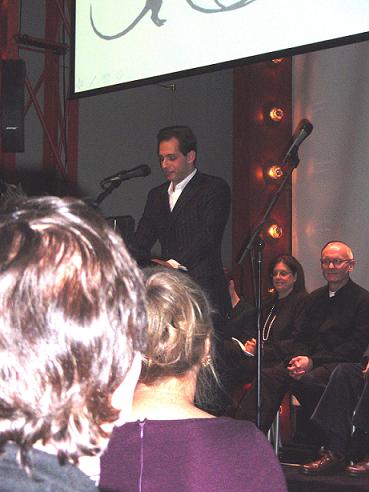
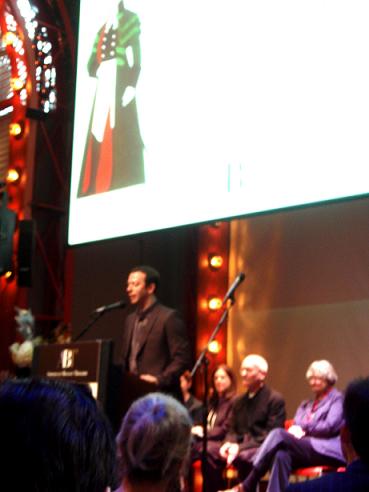
Yesterday morning at the Brooklyn Academy of Music, ABT announced their plan to hold an annual Nutcracker season at BAM. Above is SLSG favorite, soloist Craig Salstein, enthusiastically speaking to the crowd. He was the only dancer to address the crowd; David Hallberg was there too but stood in the back the whole time. A group of young dancers from the Jacqueline Kennedy Onassis School of Ballet (associated with ABT) was there as well — they’ll be dancing in the party scenes when the production opens next year, on December 23, 2010. For the first year, the season will be two weeks, but after that the company hopes to have a longer run.

pb302361

ABT resident choreographer Alexei Ratmansky will be choreographing.


Here’s a slightly better picture of him, by Fabrizio Ferri. Someday I will get a pro camera, I swear!

This was the first time I’d heard Ratmansky speak. He is very soft-spoken and has a heavy Russian accent and seemed to know what he wanted to say but struggled a bit to get the words out in English. And he makes the same grammatical mistakes as Pasha and Baryshnikov (mainly leaving out articles — there are no definite or indefinite articles in Russian — a, an, the — so they tend to leave those out: “…is great score,” etc.) I think English must be the hardest language to learn, especially for Russians. I know Russian is the hardest language I ever tried to learn…

Anyway, Ratmansky seemed shy and soft-spoken but genuinely excited, especially when talking about Tchaikovsky’s score, which he called the greatest ballet music ever written. I felt vindicated 🙂

But Brooklyn Borough President Marty Markowitz really kind of stole the show with his little speech. He was so out of place in this crowd of rather gentle artists with that booming Brooklyn-accented voice! He of course praised ABT’s decision to hold the season in Brooklyn, then told Ratmansky he should move to the borough since it boasts the greatest Russian population in the U.S. He also called Brooklyn the dance capital of New York (in terms of studio space — which leads to the great number of companies rehearsing there), which is in turn the creative capital of the U.S. These politicians do kind of know how to make their constituencies proud. After bemoaning the fact that the last time ABT was in Brooklyn was before Baryshnikov defected, he called the ABT / BAM plan “a grand jete into the future for Brooklyn.”

The project is expected to cost $5 million and is being partly funded by David A. Koch (yes, of the Koch Theater — he’s matching dollar for dollar donations up to $2.5). ABT also plans to perform community outreach, particularly in Brooklyn schools, including pre-performance workshops for the children, attendance at dress rehearsals, and dance classes.

The rest of the production team includes Jennifer Tipton, lighting designer extraordinaire, and Richard Hudson, an award-winning theater designer, who will design costumes and scenes. Below are some of his sketches:


A FALL SMORGASBORD: CATHERINE GALLANT, EMIO GRECO, WILLIAM FORSYTHE, AND LUCINDA CHILDS

Reviewed by Christopher Atamian

In the past month I attended four very different performances that were all interesting for different reasons.  Readers will forgive me for giving brief overviews of each rather than the more in-depth analysis that they undoubtedly deserve, but lack of time and deadlines preclude me from doing them full justice!


On September 26, I had the pleasure of seeing Catherine Gallant/Dance present a series of rarely performed works at the Joyce Soho.  (Photo above of Gallant/Dance performing Isadora Duncan taken from Moving Arts Project.) These included works by Gallant herself, as well as José Limon, Isadora Duncan and Anna Sokolow.  Gallant’s company is rather unique because it is composed of dancers of all ages and body types—it was refreshing to see older women on stage (as in over 30!).  While they may not always have had the same power and lift as their younger counterparts, they displayed a welcome maturity, elegance and presence.  This was particularly true in the sublimely wistful 16 Waltzes Op. 39, choreographed in 1903, also referred to as “the many faces of love.”  Set to Brahms waltzes and as performed by Loretta Thomas, Eleanor Bunker, Michelle Cohen, Francesca Todesco, Marie Carstens and Gallant, the piece lulled the viewer into an almost blissfully intoxicated state.  It was also refreshing to see Anna Sokolow’s 1953 Lyric Suite, set to music by Alan Berg performed by Francesca Todesco, Eleanor Bunker, Michelle Cohen and Chriselle Tidrick.  Another highlight of the evening was the athletic Kristen Foote, a member of Jose Limón, interpreting Isadora Duncan’s Revolutionary (ca 1920-1924), with music by Alexandre Scriabin.  Foote displayed remarkable strength, vitality and grace in this simple but powerful piece.  That she could capture with each step and arm thrust the spirit of the October Revolution and spirit us, the audience, away to a Russia so distant in time and place, is a tribute to this remarkable young performer.  While one or two of the other pieces presented were arguably a bit lackluster, my only regret was that a larger audience hadn’t attend the performance, for Gallant is a historian and choreographer, a dancer and archeologist of dance history who brings to the stage pieces that we might never otherwise see.  We owe her a small debt for her good work and taste.


Emio Greco (photo above by Jean Pierre Moran) came to the Joyce in late September to present the second in his Dantesque trilogy, popopera[purgatorio]. I’ve already written a review of the performance for Dance Magazine which should be out in a few months so I won’t go into any detail here.  While I understand the issues that some critics may have had with the performance, Greco’s intellectual take on dance, the offbeat look of the dancers themselves, as well as the original, spasmodic movement vocabulary were interesting enough to me, although it wasn’t necessarily the most memorable show of the year. All told, the dancers gave a sexy, brassy performance. They also wielded and played the electric guitar-one for each dancer–with some panache.


I was rather surprised by the generally enthusiastic reviews of William Forsythe’s cacophonous mess Decreation (photos above by Julieta Cervantes) at BAM (October 7-10).   I am a huge fan of BAM, of their New Wave Festival and of William Forsythe who is obviously one of our great choreographers-in fact some of the most exciting performances that I have seen in the past years have been choreographed by Forsythe, including an outstanding Juilliard Spring Repertory Concert performance some years back of Limb’s Theorem III which included a wonderful, young Riley Watts contorting his body in the most fantastic ways, an amazing rotating globe and choreography that made the dancers appear almost super-natural or alien in their physicality.  But try as hard as I could, I couldn’t find anything noteworthy about Decreation, which is based on an essay by Canadian writer Anne Carson that examines lives unraveled by love: Sappho, Simone Weil and Marguerite Porete, a medieval mystic who was burned at the stake for not renouncing the views that she expounded in her book The Mirror of Simple SoulsDecreation begins with Dana Caspersen re-enacting a nasty spat with a past lover while George Reischl repeats her speech in German: they are both barely understandable and contort, grab at shirt, face and body in such visually unappealing ways that they look like two inmates in an insane asylum-perhaps an apt metaphor for something or other, but what is the relation to a failed relationship?  That it drives you mad? That’s it’s just exasperatingly distorting to the soul? And every time Reischl screams out “It’s a spiel” (so what’s new, love’s a game?) I wanted to reach out and well, slap him. At another point in the performance a women grabs her breasts with one hand and her crotch with the other, hanging on to her private parts as she is sandwiched between two male counterparts.  Decreation came off as a questionable mix of dance theatrical elements and surreal or post-modern theater-oh yes, and occasionally someone actually moved, as if to remind the audience that they were at a dance performance.  Certainly this work is complex, but in an abstruse and frankly ugly way: everyone on stage contorts in such odd and unappealing ways and David Morrow’s soundtrack is so grating that you aren’t quite sure how to enter the piece as a viewer. Forsythe received a standing ovation from a few people in the audience which proves, I suppose the old adage de gustibus non est disputandum. (Of the reviews that I have read so far only Tobi Tobias had the courage to call a spade a spade-so I will link to her review here, and to be fair, to Roslyn Sulcas’ altogether more positive New York Times review)


Finally, a redeeming, exquisite Lucinda Childs performance at the Joyce on October 6.  The highlight of the night was Childs’ Dance (photo above by Nathaniel Tilleston), which was accompanied by Sol Lewitt’s wonderful film projected onto a translucent screen, so that one could watch the dancers performing live with the original 1979 filmed performance simultaneously juxtaposed over them.  While this staging doesn’t work as well in a small theater like the Joyce, the dancers were simply exquisite as they performed relatively simple but quick steps (sideways jumps and turning jumps in arabesque) over and over again, mostly in straight lines, changing direction here or there, making absolutely exquisite patterns that have been likened elsewhere to Persian rug designs.  At first the execution seems almost identical, as do the dancers costumed in identical unisex black outfits, but each one actually added his or her own idiosyncratic head tilt or subtle interpretation. It’s not easy to choreograph to music as purposefully repetitious and as fast-paced as Phillip Glass but the dancers acquitted themselves famously, as if floating on a seemingly effortless ethereal cloud for close to an hour.  It was refreshing to see work of such distinction and quality: one felt transfixed as one should by great art.  (Childs, almost seventy, also danced a brief piece with less success, but how nice to see her up there anyway!)

{A random aside:  After another recent performance, I was discussing Ulysses Dove and his remarkable Red Demon with another dance critic (Dove passed away from AIDS in 1996) and about the past twenty years of choreography.  She gently reminded me that the generation that we lost to AIDS in the 80s and 90’s has left a large hole in our choreographic heritage-between older choreographers and the debatable quality of much of what we now see in contemporary dance.  I will go one step forward and say that while I am all for free expression and believe that anyone who wants to should try his or her hand at choreography, that we have way too many people of middling talent presenting dances today-which is neither good for dance nor for its reputation with the general public.]

TONIGHT IS ALMOST HERE!: ABT AT AVERY FISHER AND FORSYTHE AT BAM


Finally, ABT’s Contemporary season is here; it opens tonight at Avery Fisher Hall, at Lincoln Center, with premieres by choreographers Azsure Barton, Alexei Ratmansky and Benjamin Millepied (pictured above, left to right). Plus, there’s a special addition — a performance of Michel Fokine’s Ballets Russes classic, The Dying Swan, by SLSG favorite Veronika Park! (top photo, by Jade Young)


Another important dance event that opens tonight is William Forsythe’s company performing the U.S. premiere of his Decreation, at Brooklyn Academy of Music. Unfortunately, their performances are the exact same nights as ABT’s shortened season so most big dance fans are probably going to be at Lincoln Center for the next few days. But Forsythe is a very important choreographer and I strongly encourage all New Yorkers to try to make it out to BAM for at least one of the perfs between tonight and October 10th.

There’s a post-performance talk with Forsythe tomorrow night at BAM (October 8), and another talk between Forsythe and philosopher Alva Noe about consciousness as a kind of dance at the New York Public Library the following day. I find Forsythe to be brilliant and it’s always fascinating to hear him talk.

JULIETTE BINOCHE AND AKRAM KHAN BRING IN-I TO BAM


Last night In-I, the collaboration between French actress Juliette Binoche and British dancer / choreographer Akram Khan, opened at BAM, and of course I was there. She’s one of my favorite actresses and I’d been wanting to see this since it premiered at Sadlers Wells in London a year ago. New York is the last stop on their tour.

I loved it, despite its imperfections (and I largely agree with Judith Mackrell’s early review). But I loved it, partly because I just love her period, and partly because, for me, it ended up creating a new respect for both interpretive art forms, dance and acting.

This collaboration (Binoche has virtually no dance training and Khan no acting) made me remember back when, what seems like light years ago now, Baryshnikov and Mark Morris founded their company, White Oak Dance Project. For opening night they were collaborating with Yo-Yo Ma and I really wanted to go. I tried to use this as a selling point in convincing my friend, who loved classical music, to go with me. I’ve always had this stupid habit of stating the over-obvious and, in elaborating, I said to her, “Baryshnikov will be dancing and Yo-Yo Ma will be playing the cello.” She burst out laughing. “Well I hope it’s not the other way around!” she said. Then we got to joking around about how entertaining it would be if Yo-Yo Ma danced and Baryshnikov played the cello. I said I’d actually really like to see that. She said she wouldn’t — it may be a fun experiment for them to do in a garage or something, but to put before an audience?…

I still wonder how that would come off — Baryshnikov bending over a cello and Ma jumping around a stage.

Anyway, I thought this collaboration (hard to know what to call it; it was mostly dance with some spoken word –the two talk to each other onstage and address the audience in monologues, so maybe it’s “dance-theater”) was more than an experiment in two artists from different worlds trying on each others’ shoes. It had a storyline; it was about the life of a relationship — from youthful fantasizing evolving into mature passion, getting sick of each others’ bad habits (there’s a very funny scene where he keeps leaving the toilet seat down and getting it all wet when he pees and she wants to kill him over it), fighting, misunderstanding, eventually accepting and even learning to delight in the difficulty of it all, as part of life. I have to say I understood the through-line of the drama through her. She gave the piece its emotional core.

He is a brilliant dancer and I loved watching him move. It was apparent she has very little dance training — she doesn’t have the expansiveness and breadth in her movement or the precision and sharpness of a lifelong professional dancer — but I love her for trying, because I think it shows how blasted hard dance is no matter how hard you work at it (and you can tell she worked very very hard). And I love that she was not a very skilled dancer, the piece was mainly dance, and still so much of what I understood and got out of it was due to her performance.

The best parts I thought were where each performer was in his / her own element. Judith Mackrell (link above) likes the beginning, where Binoche’s character is sitting in a movie theater and sees Khan, he dances about and she becomes infatuated with him. That scene works well because she’s sitting and watching him, while telling the audience how she feels about him, and he’s moving. There’s another scene later on – -my favorite in the whole thing — where they’ve just gotten into a vicious fight. She stomps off behind the back screen and he begins this really riveting solo where he writhes on the ground, gets up and contorts his body, flings arms, head and torso every which way in utter emotional agony, then does a deep back arch, literally bending over backward to please her. About halfway through the solo she walks back out onstage and sees him. As she approaches him, her expression changes; she slowly realizes how much their fight has tormented him and she feels remorse. You can see all that on her face alone. His movement and her facial expression compellingly conveyed each character’s inner turmoil.

There’s another part where he delivers a monologue to the audience. He just stands at the edge of the stage and talks to us, telling us about a youthful romance he had in which he fell in love with a girl who was not the same religion as he. He tells his priest and the priest withdraws a huge knife and holds it against his throat, telling him having the girl means his soul will die and asking him if that’s what he wants. Khan spoke too fast and sometimes jumbled his lines but at one point he started punching the air with his right fist when he spoke in the voice of the priest, and he started pointing shakily toward the audience with his other hand when he talked in what I felt was the inner voice of his boyhood self. Sometimes these motions were back to back — the fist violently but with a dancer’s control punching the air, then the trembling index finger. Once he kind of got into a groove with it, it was really mesmerizing — especially when combined with his extreme sideways leans when confronted with the imaginary knife at the neck. He was expressing himself far better with his arms and neck than with his words and I kind of wished at that point, he would just have had a voice-over do all of his spoken word so that he could focus on using his body to express himself.

Conversely, I kind of wished for her that she didn’t have so much movement so she could have focused on her words and her facial expressions and wordless gestures (actors obviously do use their bodies as instruments of expression, but it’s to create subtext — little ticks that a normal person would do that show that person’s character; totally different from dance). You can tell how hard she worked if you’ve tried to learn dance as an adult. She had several very difficult things — a couple of high lifts, fast travelling chaine turns. You can see how she worked to get those turns right — her spotting was very good and she held her body steady and balanced with her footing while still trying to get sufficient speed. The fact that she was still able to chaine toward him, into him, with meaning, with intention (she often laughed, sometimes playfully, sometimes tauntingly) while focusing on getting difficult movement right was really amazing. But if she didn’t have those crazy spins to contend with in the first place, how much more depth she could have conveyed. And ditto for a lift, where he sits her atop his shoulder and walks along the back screen. She stretches out her arms and closes her eyes and traces the screen with her shoulders and hands, a look of ecstasy crossing her lips. But she has to worry about maintaining position atop his small shoulder, of tightening her muscles so she can hold herself up there, limiting, I felt, how far she could go emotionally.

Anyway, I could think of more things to say but I think I should stop, at least for now — particularly since it’s now evening and my allotted time for me to work on my novel. Suffice it to say, this collaboration really made me think how, similarities aside, fundamentally different the two art forms are, and made me respect each more. I do think dancers could highly benefit from more acting classes because I think for many theater-goers, that’s ultimately what moves them — body movement alone doesn’t always make complete sense. But more on this later…

In-I continues at BAM through September 20th.

 

JULIETTE BINOCHE IS COMING TO NEW YORK


Very excited. One of my favorite actresses will be dancing at BAM’s Harvey Theater from September 15-21 with Akram Khan in their collaborative work, in-i (post-show talk with her and Khan is on Sept.17). I’d actually blogged about this a while back after seeing it reviewed in the English papers, so I’m very glad they are finally bringing this show to the US. Here’s a sampling of how it was received in the UK.

And, to coincide with the dance tour, BAM Cinematek is having a downright mouthwatering retrospective of her films. It begins with her latest movie, Paris, on September 11th. Following that 7pm screening, she’s to give an audience Q&A with the film’s director Cedric Klapisch. (Only prob with the retrospective: BAM doesn’t appear ever to be screening The Unbearable Lightness of Being…)

Also on September 11th, earlier that evening, at 6pm (I honestly don’t know how she’s going to fit all of this in…), she’s scheduled to be in uptown Manhattan at the Barnes & Noble Lincoln Square to talk about and sign copies of her new book, Portraits – In Eyes. (Binoche is currently taking a year-long hiatus from her acting career to fulfill other artistic passions — dance, poetry, and painting). This time B&N is making clear up front seating inside the little glass-encased area is primarily for book buyers.

All of this is exceedingly cool for Binoche fans, like me 🙂


PINA BAUSCH DIES OF CANCER


Oh my gosh you guys, I just heard about this on PinballPeople. I’m so shocked. I didn’t even know she was sick (apparently she was only diagnosed with cancer days ago). I’m so upset. We’re never going to have any new work from her again. I didn’t see enough of her. I’m sorry, this is so much more shocking to me than the deaths last week… She was just at BAM a few months ago and she seemed fine.

Here is a good piece on Bausch by Guardian’s Judith Mackrell. Here is the Bausch archive on YouTube.

I was just reading a group of tributes to David Foster Wallace in the Sonora Review last night and now I’m thinking this loss is on that level. This is one of those artists we will all suffer without, whether you’re aware of it or not. This is huge.

EXPERIMENTAL DAY


Last Thursday I spent the afternoon at the Tribeca Film Festival watching a series of intriguing experimental shorts (some far better than others of course), and the evening at Brooklyn Academy of Music watching Trisha Brown Dance Company, whose program included a couple of pieces that are experimental, or at least were when they were created.

The reason I’d chosen the Human Landscapes series of shorts at Tribeca was that I expected most of the films to be about the landscape of the body — so kind of related to dance. But, except for two – -maybe three — all were about cityscapes — human interaction with urban environments with the focus on the latter, which I didn’t mind because I love cities.

The film that most caught my eye in the program listing was Chop Off by M.M. Serra, about a man, performance artist R.K., who sees self-amputation as an art form. At first I thought “amputation” was metaphorical, but, no no, the film revealed it was actually quite literal.

Continue reading “EXPERIMENTAL DAY”

BATSHEVA’S MAX


Wednesday night I went to see the popular Israeli dance troupe, Batsheva Dance Company, at Brooklyn Academy of Music. My main experience with Batsheva has been taking a Gaga Class (artistic director and choreographer Ohad Naharin’s unique movement training) by Gaga-trained dancers at Cedar Lake Studios, and then seeing that company perform Naharin’s DecaDance ( a collection of his works over the past 10 years). This was the first time I’ve ever seen a piece by Naharin on his own dancers.

Maybe because I loved DecaDance so much (see above link), I was a bit disappointed with Max. The dancers are absolutely incredible with what all they can do with their bodies — making distinct, highly evocative gestures, then changing to another gesture at immense speed, bending and contorting their bodies into impossible-looking shapes, throwing themselves to the floor, insanely fast high battemants, etc. etc. — and you can really see how much Gaga technique, taken over a period of time, can allow you to move. My problem was more with the overall piece. It didn’t seem to go anywhere, just seemed to be the same extremely intense movements — sometimes evoking horror, sometimes prayer for forgiveness or peace, sometimes shock, with brief moments of tenderness, attempts to connect to one another, thrown in.

Naharin made the soundscape himself (under the pseudonym Maxim Waratt), and it was very intense. At times a deep-voiced man would sing in Hebrew (I think), his guttural crooning creating at times a threatening, portending feel, at times a bluesy one, similar to Leonard Cohen. At other times, the sound would resemble an ambulance siren, an earthquake, a whistle, raindrops or a leak — some kind of falling water, sometimes a person breathing heavily, at times there would be utter silence.

Continue reading “BATSHEVA’S MAX”