
WHY ARE OUTDOOR CROWDS SO MUCH MORE RESPECTFUL OF THE OPERA THAN DANCE?

p9032296

p9042301

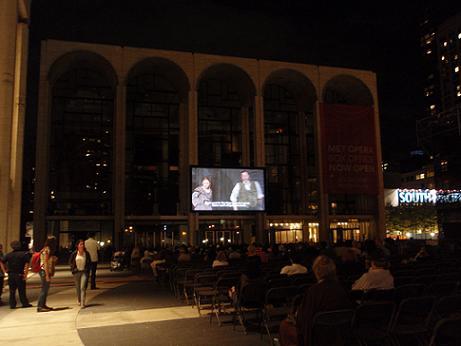
For the past few evenings I’ve been partaking of the Met Opera’s outdoor Summer HD Festival on Lincoln Center Plaza. The first night I went was Benjamin Britten’s Peter Grimes. It was on a week night and the plaza was about half full. I’d bought a sack pique-nique dinner from Bar Boulud across the street — which was delic by the way (chilled gazpacho soup, baguette of brie and fresh fig spread, waffle chips, bittersweet chocolate tart, and bottle of Pellegrino). But when I took a seat in the back and began to unwrap my brown bag I realized what a commotion I was making, how dead silent it was. I waited until a noisy helicopter buzzed around above us for a few seconds to tear into my sandwich. I absolutely loved the quiet, but figured it must be because this opera was so serious and esoteric — only true opera-manes would go.

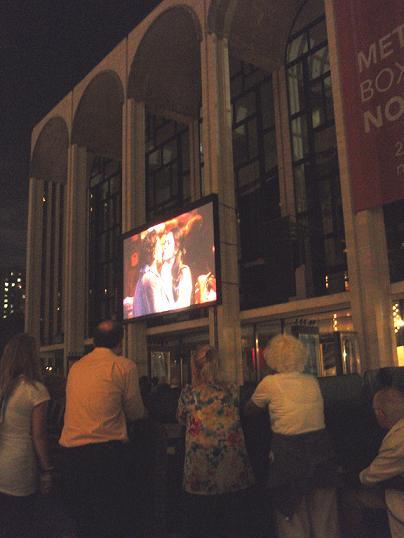
But then last night, Puccini’s far more popular La Boheme was the same. Plaza was packed. I mean, every single seat was taken (both of the fold-out variety set up by the event organizers and make-shift seats like construction cones aligning Avery Fisher Hall), there was hardly a square foot of ground to stand on all the way to the street — people were even camped out atop the temporary Koch Theater ticket trailer (until police came around telling them to get down). But once the music began, there was the same dead silence. Everyone stared up and the screen, completely captivated. It was even quiet around the food and liquor stands, where people were basically whispering their orders. Children (the few that were there) behaved, dogs (the many that were there) behaved. Well, dogs usually behave in a crowd, actually… But even the little kids seemed to know it was important to try to concentrate on the screens.

The noisiest part of the evening was when South Pacific, showing next door at the Vivian Beaumont, let out. But once the theater-goers realized there was something important going on out on the Plaza, they shushed each other and ventured up to watch — in total silence — as well.

Such a complete contrast with some of the outdoor dance festivals — Lincoln Center Out of Doors, the Downtown Dance Festival, site-specific summertime events, sometimes SummerStage. I’ve heard from several people now that the Saratoga Performing Arts Center where NYCBallet has their summer season, is much the same, making me honestly not all that excited to go up there. I mean, kids are running around, parents yelling, people talking to their friends at the same pitch as if they were in a noisy bar, people unwrapping food, opening soda cans, popping gum.

So what gives? Do people just think opera is mainly about music and so to enjoy it everyone must be able to hear it above all else, whereas dance is more visual — so you can make all the noise want and not bother people because they can still see? Maybe it’s about the children — people are much less inclined to bring small kids to the opera, but they somehow think their two-year-old is going to have a deep appreciation of Balanchine or Karole Armitage or classical Indian dance. Maybe they equate outdoor dance performances with outdoor social dance events like Midsummer Night’s Swing, where you’re hardly going to disturb social dancers by talking. Or maybe there’s something about a big ole screen being up there.

I wonder if it would be different if ABT would have a summer HD festival and show outdoor broadcasts of some of the spring season’s ballets. Probably not… although the crowds were pretty quiet for the David Michalek Slow Dancing exhibit two years ago (once Midsummer Night Swing ended anyway)…

Anyway, tonight (Saturday) is Mark Morris’s Orfeo ed Euridice. I mean Gluck’s Orfeo ed Euridice but Morris produced and choreographed. We’ll see how it goes when there’s some dance involved… The Met outdoor HD festival continues through Monday night, ending with Anthony Minghella’s production of Puccini’s Madame Butterfly.

A SIMPLE SYMPHONY at New York City Ballet


Last night Ariel and I went to the premiere of a new ballet by Melissa Barak, A Simple Symphony, at NYCB. It was really lovely and not at all what I was expecting! The program they included it in was entitled “21st Century Movement” and it was an evening of abstract ballets with lots of sharp, angular motion. But Barak’s ballet was very beautifully Balanchine, very classical — or neo-classical — with the ballerinas dressed in pretty Romantic pink-skirted tutus with pink and white striped form-fitting bodices designed by Barak herself.

Suited to its title and set to music by Benjamin Britten, it was simple in a Balanchinian sense, generally storyless and without lots of drama, but with an underlying complexity in the steps and rhythms, and not at all without emotion. At one point, several men partner several women, all of them doing assisted pirouettes for a really beautiful visual effect, with all the skirts flying about in the same direction at the same time. There was lots of bouncing on pointe for the women, then the men would respond with turning jumps into the air, followed by bouncing on the landing foot, the other foot held back in arabesque.

The main couple was danced charmingly by Sara Mearns and Jared Angle. But as always, it’s Jared’s brother, Tyler, who blew me away. Everything he does is in such perfect form. Ditto for Robert Fairchild, who stole the show in the first piece, Jorma Elo’s Slice To Sharp.

Anyway, at the end, Barak came out onstage for a bow, as is customary with premieres. She looked so cute in this gorgeous white baby doll dress, empire-waisted with the area below the high waistline lined with fringe, and high-heeled silver Cinderella-like slipper-sandals. I wondered if she’d designed her outfit too!

Read Philip’s interview with Barak here.

The rest of the evening consisted of abstract very modern ballets that are not always to my liking 🙂 On first was Slice To Sharp, as I mentioned, which does hold my attention with all its lightening-speed quick-footedness and high-jumping, fast-turning theatrics, mainly performed by Joaquin De Luz. I don’t know if I’ve never seen Robbie Fairchild before in this ballet or not, but he danced on a different level from everyone else, made me understand like never before the ballet’s title as his arms sliced propeller-like through the air with razor sharpness and exactitude.

Also shown were Peter Martins’s Hallelujah Junction, set to piano music by John Adams, played on two pianos. The stage was so wondrously lit I couldn’t think of much else besides those pianos. They were set up on a platform at the back of the stage, back to back, and the back of the stage was all dark except the golden light made by the lights over the sheet music. Some dancers were dressed all in white — including the main, angelic couple, Janie Taylor and Sebastien Marcovici — others all in black — including the kind of devilish fast-footed character danced by Andrew Veyette. I’d need to see it again for the themes, but the shades of light and the way Martins used color were really stunning.

The evening ended with Christopher Wheeldon’s Mercurial Manoeuvres, which I thought I’d seen before but hadn’t. I have to say, I’m not always on the same page as Wheeldon, but I was very pleasantly surprised and I’d love to see this one again. Like the others, and as its name suggests, it was full of quick-footed dancing and interesting visuals — bright red costumes on some combined with lush red curtains at various points, dancers weaving between them sinuously, Gonzalo Garcia kind of the main elfish character full of innocuous mischief.

I found the music really interesting as well — Dmitri Shostakovich’s Piano Concerto No. 1 in C minor, for a trumpet and piano, neither instrument secondary to the other, both fighting for prominence but in kind of a teasing way. At one point, the trumpet sounds very sexy, and the couple then dancing, Abi Stafford and Tyler Angle, give their partnering a kind of Argentine tango twist. Later the more calming, harmonious violins sweep in, and a female dancer is picked up by several men who carry her about the stage, raising, then dipping her romantically (or, if you prefer, pashmina-like, ala Kenneth MacMillan’s Manon, except here it’s sweet, not seductive).

Afterward, we ended up at P.J. Clarke’s. Again. This time we saw Timothy Hutton eating up front with several friends. I was excited but Ariel had no idea who he was! I tried to think of movies he was in but, ridiculously, all I could come up with was Taps, and something about a Snowman, which were two of his first. Don’t know why I thought first of those and not all the rest!