Kurt Froman on Training Natalie Portman to Dance


But his funniest, most interesting words are about Mila Kunis:

“Mila, and I mean this in the best way, she is such a loud-mouthed kind of broad. You know exactly where you stand with her, if she’s not happy with something. All she wanted to do is smoke cigarettes and drink coffee, where it was like, “Come on Mila, we’ve got to work!” And Natalie was like completely the opposite, in a way. She never complained once…

“Mila was the further behind in terms of training. She’s not — she doesn’t have a really good sense of her body, she’s not really a dancer or whatever.”

It’s funny, but I know exactly what he means about not having a good sense of your body… something I never knew about myself until I started trying to to dance.

Anyway, this is from an interview in Front Row Magazine, by Peter Simek, with Kurt Froman (former NYCB dancer- turned – Movin’ Out lead dancer and choreographer for Billy Elliot on Broadway.) Apparently, the interview with Froman was originally published around the time the movie came out, but these excerpts didn’t make the final cut. Simek decided to publish them now in light of the current who danced what controversy. Btw, you all probably already know this, but Sarah Lane gave an interview to 20/20 about said issue. Froman gave the interview a long time ago, without knowledge that this would become a controversy, so it has the air of truth. Scroll down to the bottom to read exactly what he said about Portman.

But I also find it really interesting what he said about training Kunis. At least at the beginning, their intention was to make her like a real Odile – marked by virtuosity. Froman choreographed while Millepied was busy with a prior commitment and that’s what he was trying to go for with Kunis – to make her as believable as a virtuoso as possible. But then when Millepied returned, he changed everything, making Kunis’s character more about her sex appeal, and her sexual comfort level with herself (as opposed to Odette / Portman’s lack thereof). So then they added things like Kunis’s dancing with her hair down, being so comfortable with herself that she didn’t care about messing up, etc., and they took out the virtuosity. This, he said, was okay because it went along far better with what Aronofsky wanted than what Froman had been trying to train her to do. I just find that interesting, because that was one of the parts of the film where I had the hardest time suspending disbelief – that the company director would seriously consider replacing the lead with a seemingly ditzy girl who thought it was funny when she couldn’t do a series of turns without nearly falling over. Of course everyone keeps pointing out that the movie wasn’t about dance but about sexuality, madness, etc. And they’re right. It’s just interesting to me that initially the film seemed to be a little more about the actual ballet than it ended up. Makes me wonder if things were changed after everyone realized how impossible it was to make a couple of very good actresses believable as high-level ballerinas.

Sorry this is all I’ve been blogging about lately! It’s definitely not all I care about. But I’ve returned to practicing law and so am now trying to juggle three things: my job, my book, and this blog. I apologize if it’s slow going from time to time. I definitely plan to cover as much NYCB and ABT as I can this summer!

NEW YORK CITY BALLET OPENS THEIR WINTER SEASON WITH MIDSUMMER NIGHT'S DREAM & GERSHWIN

New York City Ballet opened their Winter 2010 season last week with rotating performances of Balanchine’s Midsummer Night’s Dream, and a two-ballet program of his Who Cares?, set to Gershwin music, and Peter Martins’ Naive and Sentimental Music.

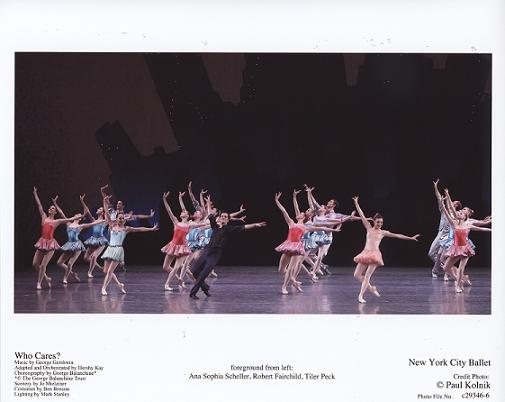
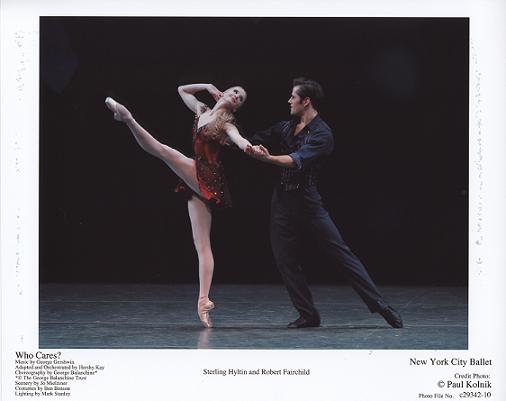
I LOVED Who Cares?! (photos above — of Robert Fairchild and Sterling Hyltin, and of the whole cast — by Paul Kolnik.) I’d only ever seen the pas de deux before and didn’t even realize the whole was comprised of a whole slew of Gershwin songs, some danced by the ensemble, some by only the women, others by only the men, with solos and pas de deux mixed in. I particularly loved Tiler Peck’s duet with Robbie Fairchild in The Man I Love. She has such a clean, beautiful line and she’s so expressive and so engaging. She can make a story out of anything. And of course Fairchild is always the perfect romantic male lead 🙂 Crowd went wild over his and Ana Sophia Scheller’s duet to Embraceable You as well as Scheller’s My One and Only solo. Such a fun ballet — I’m going back for more this week.

Also shown in that program was Martins’s new Naive and Sentimental Music, set to John Adams’ score of the same name. I wrote about that ballet when it premiered here and posted pics of it here. Seeing it again evoked a bit of Balanchine’s Jewels, particularly the lovely lyrical white section (my favorite) and the sexy red.

One little thing I have to say: this ballet was created on and is danced only by principals but Adrian Danchig-Waring danced in last week’s production as well, and he is still a soloist (I think he may have been replacing Amar Ramasar, who must be injured because he was replaced a few times over the week…) Anyway, I realize NYCB is top heavy at the moment, but I think Danchig-Waring definitely needs to be next in line for a promotion!

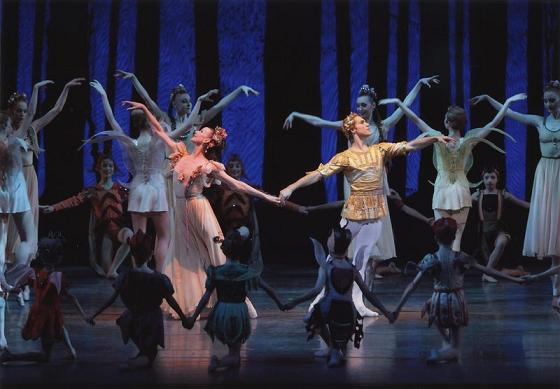
And earlier in the week I saw the best EVER cast of  Midsummer Night’s Dream. I finally got to see my Gonzalo Garcia as Oberon 😀 (photo above by Paul Kolnik, of Garcia as Oberon and Darci Kistler as Titania). I’d missed him in this role at the end of last season. He did very well – -not only with the dancing — particularly that crazy fast scherzo — but also, and less expected for me, with the acting. I thought he’d be a sweet, glowingly endearing Oberon, but, no, he was a pissy, demanding fairy king — just as much as Andrew Veyette last season (cutely pissy and demanding though!) He wanted Titania’s servant boy and he wasn’t letting her say no to him. Only thing regarding the dancing — his legs don’t seem to be as flexible as they once were. It seems like he may have injured an adductor muscle, or else he’s built up so much thigh muscle or something — but his legs when he jumps are not making perfect splits. But his upper body is so fluid and graceful and he exudes such charm that he’s still the perfect lyrical male dancer nonetheless.

Titania was the beautiful Sara Mearns (headshot by Paul Kolnik — a new headshot for her, right?)– and she was the best Titania I’ve personally seen. Oh she’s such a beautiful dancer! She throws herself so fully into every move she makes. If Garcia is the ideal male lyrical dancer she is the ideal female – they were so perfect together.

And I’m so glad Stephen Hanna is back at NYCB (still annoyed with the Billy Elliot directors for not making good enough use of him on Broadway). He was Titania’s cavalier and his pas de deux with Mearns was the best Titania / Cavalier pdd I’ve ever seen. He’s so big and strong — which certainly amps up the romance factor — and his numerous tour jetes just have so much power. Honestly I often get bored during that pdd and just want Oberon to return, but not with Hanna’s cavalier!

And new to the cast of human characters who get their hearts messed with by a mischievous Puck (Troy Schumacher) was Janie Taylor, as Helena. She is another one who excels at story dances, always delving into a character and making clear to the audience what’s going on in her mind. She’s pathetically, endearingly funny from the time she enters the stage all forlorn over Demetrius, to her being completely bewildered by Lysander’s sudden attraction to her, to her searching the forest madly for Demetrius, to her cat-fights with Hermia, etc. She really brought out the humor.

In the section where I was sitting, there were at least three large groups of people you could tell had never seen the ballet before — nor likely the play; they didn’t seem familiar with the story. But they were laughing hysterically throughout the whole thing and were really awed by the dancing, and by some of the tricks (like Puck’s being pulled up to the ceiling via harness at the end). That’s when you can tell with a story ballet that the cast really brought it to life, when the newcomers are enthralled.

NYCBALLET OPENING NIGHT: NEW MARTINS’ NAIVE & SENTIMENTAL MUSIC A SUCCESS!


New York City Ballet officially opened its 2009-10 winter season last night, with a performance and black tie gala dinner. The performance included Alexei Ratmansky’s Concerto DSCH (above photo of that ballet — dancers are Ana Sophia Scheller, Gonzalo Garcia, and Joaquin De Luz — by Paul Kolnik, taken from NYTimes), stars of the Paris Opera Ballet Aurelie Dupont and Mathias Heymann dancing the central pas de deux from Balanchine’s “Rubies,”


(photo taken from Kulturkompasset; Dupont is center, Heymann is holding the hand of another dancer).

And then the evening finished off with the world premiere of artistic director Peter Martins’ Naive and Sentimental Music, set to John Adams’ (brilliant) score of the same name (I’ll post photos when I receive them).

But first, there was a short film of the reconstruction of the inside of the Koch Theater (still can’t help but think of it as the State Theater…) while the orchestra played Tchaikovsky’s Sleeping Beauty overture (as it turned out, the perfect music to highlight the comically sped-up but ultimately awe-inducingly huge renovation process). Highlights of the renovated theater are — most importantly and coolly — the orchestra pit with a floor that can rise to stage-level (! — and this is how the orchestra played the overture), and two aisles now carved into the orchestra seating section. (Before, orchestra section had no aisles — so, though this is how Balanchine wanted it, apart from being extremely hard getting to a middle seat, it was a fire hazard).

Anyway, after the mandatory thank-you speeches by Peter Martins and David Koch (who funded the renovation), came the  Ratmansky. The fun frolicking threesome in blue (top photo) were danced by Joaquin De Luz, Gonzalo Garcia and Ashley Bouder (all three brilliantly on, Bouder thankfully back from an injury), and the adagio couple in green were Benjamin Millepied and Wendy Whelan (photo below). I think this was danced better than I’ve ever seen it done before — it could have been because I was so excited to see Bouder return, or because the dancers are all beginning-of-season fresh… but this is by far Ratmansky’s best, imo — it’s got the most complex structure and original movement.


(photo by Paul Kolnik, taken from Danza Ballet)

Next were the POB couple, who danced “Rubies” brilliantly — not only with precision and clarity but with great exuberance as well. One thing I meant to say earlier about La Danse (the Wiseman film about the POB) and forgot, was that the POB dancers are all so trained to make meaning out of every little thing they do — every step, every gesture, no matter how small. You have to have some kind of thought in your mind whatever you do. (This is not what Balanchine taught his dancers; he taught them simply to do his steps and those would contain everything the audience needed to know.) I feel that this allows POB dancers to bring a certain passion and humanity to all of the works they do — I noticed that from performance footage from that film as well as from last night.

And third came the highlight — for me anyway — of the night: the new Peter Martins’ ballet. The John Adams music was absolutely gorgeous — rich, many-layered, complex, intense, varied and structured into many sections — some lighter, many heavier, evocative, etc. etc. Beautiful! Oftentimes music like that overpowers the dancing, but not here.

In a short film shown before the dance (methinks Martins is taking after Wheeldon here with these little introductory films), Adams says the title refers to the difference between musicians whose music was fresh and original (the “naive” composers — like Mozart, he says) and those whose music was meant to speak to the past, to convey a sense of history, music that kind of carried the weight of the world on its shoulders so to speak (the “sentimental” — which he considers Beethoven). You could really see that in the music — some of it lighter, much of it weightier. Martins said in the film he tried to evoke that visually through dance, and I think he did so successfully — there’s a lighter, adagio section with dancers dressed in pristine white, another light but fast section with dancers in red, and then the more intense, almost severe sections with dancers in blues and deep greens and black.

Though most sections are danced in ensemble, Martins created the ballet for the principals only. This created an interesting dynamic, because, except for the middle section with the three pairs of dancers in white, almost all roles had equal weight — and yet practically all of the dancers stood out. It was an overload of star power!

And, though some sections seemed a slight bit underrehearsed (or maybe it was just that the footwork was so difficult and fast), everyone shone since Martins highlighted each dancer’s strengths: Maria Kowroski and Sara Mearns as lyrical women in white, Sterling Hyltin and Teresa Reichlin as kind of sharp-edged, sassy women in fiery red, Andrew Veyette and Daniel Ulbrich at the high-jumping bravura guys in black, there were some jazzy moves for Amar Ramasar, etc. etc.

Oh and I just love Tyler Angle 🙂 He partnered Yvonne Borree and I don’t think I’ve ever seen her so at ease and so fluid! She looked really beautiful. Nice also to see Stephen Hanna back from Billy Elliot! He partnered Darci Kistler in the white section.

It’s a rather long ballet but I was thoroughly engrossed and can’t wait to see it again. I hope they keep it in the rep.

Okay, that was the gala. Now onto the Nuts. Regular season begins in January.

ABT OPENING NIGHT GALA FALL 2009: THREE PREMIERES IN BLACK AND WHITE, AND WOOD


Photo of Veronika Part in The Dying Swan, taken from Vogue; photos of the three premieres coming as soon as I receive them.

After ABT‘s fall season opening night gala performance last night, the really wonderful James Wolcott and Laura Jacobs took friend Siobhan and me out for dinner at Shun Lee (I’d never been there — but wow, excellent excellent food!) and when Laura asked me if I was going to write about the performance, I kind of rolled my eyes and said, “I’ll try!” We all agreed that dance is absolutely the hardest art form to review, especially on seeing a dance for the first time. Let alone THREE dances seen for the first time. With visual art you can stand there all day and examine at it, with music you have recordings and scores, film critics generally see a movie several times before writing a review. With dance you have one chance — often one split mili-second — to remember a half an hour or so of movement, images, patterns, structure, costumes, music, lighting — everything. It’s impossible. Since starting this blog I have so much more respect for dance critics.

Anyway, there were three premieres last night: Seven Sonatas by Alexei Ratmansky, One of Three by Aszure Barton, and Everything Doesn’t Happen at Once by Benjamin Millepied. Also on the bill was a performance by Veronika Part of Fokine’s The Dying Swan. ABT performed, for the first time, in Lincoln Center’s Avery Fisher Hall, a concert hall not accustomed to housing dance performances. (ABT usually holds its fall season in City Center, but changed venues because of City Center’s renovation plans.)

I’m going to be seeing each premiere a couple more times this season and prefer to write after I’ve seen each more than once. But since the season is so short (it ends October 10, this Saturday), I’ll write something up front. These are only first impressions though, and I’ve found I see so many more things with repeated viewings.

Honestly, everything kind of blended together for me. Part of this was because of the sparseness of the Avery Fisher stage — there were no sets, no wings, no curtains — so dancers warmed up onstage before us, giving each piece a kind of Cabaret-like feel; and part of it was because costumes for each piece were all black and white. I remember lots of black, lots of white and the hardwood of that stage.

1) Ratmansky’s Seven Sonatas was performed to Domenico Scarlatti music by three male-female couples: David Hallberg and Julie Kent, Herman Cornejo and Xiomara Reyes, and Gennadi Saveliev and Stella Abrera. Costumes were all white — flowing dresses for the women, classical tights and 18th-Century tops for the men. The movement was a combination of classical and modern and, though the ballet was generally story-less, each couple seemed to have a little narrative: Cornejo and Reyes were the young, playful couple, Herman full of high jumps with many beats of the feet that really wowed the crowd and Xiomara dizzying rapid multiple turns. At one point Herman did this crazy turn in the air, landed on his back, and caught her. Crowd went wild.

Abrera and Saveliev seemed to be a more mature couple, perhaps in mourning. It seemed Abrera was a woman, possibly a mother, who’d lost a child or something — Saveliev seemed to be trying to console her and keep her from self-destructing. It seemed like she kept trying to break free of him and reach out to some invisible thing.

I’m not sure what Hallberg and Kent were meant to represent except maybe a modern couple — they seemed to have the most modern movement. David appeared to be trapped in a box and he kept pushing out; he had a lot of quick movement with fast stops in different directions and a lot of it in parallel — not turned-out — position. Julie had a lot of sharp, staccato movement. They could’ve also been a courting couple: at one point, David was on one knee and he invited Julie to run at him and jump on him. When she did, he took her into this lovely lift. It’s sweet and many in the audience lightly laughed.

The ballet was broken into duets and solos and bookended by two ensemble movements, the first pretty and lyrical, the latter more chaotic as they all perform their very different movement motifs at once, some trying on others’ movement styles — everyone does the staccato arm patterns for a while, etc. At the end, the women lay on the floor and the men wrapped their bodies over them.

One other thing: our David Hallberg is sporting longish hair these days 🙂 I think it looks good, and fun for a change! Funny thing is, he’s so beautiful and glamorous, I tend to get jealous if him, even though he’s a man… which I guess should be kind of odd…

2) Barton’s One of Three was set to Maurice Ravel’s Violin Sonata in G and danced by a whole slew of tuxedoed men, and three women — Gillian Murphy, Misty Copeland, and Paloma Herrera. Why is it that women choreographers tend to use men so much more! (And female dance-writers tend to focus on male dancers 🙂 — is this feminist?)

Anyway, the piece begins with Cory Stearns walking out dressed in a tux and black jazz shoes. He does a little solo and his movements are all modern, angular, which contrasted in an intriguing way with the tux. I don’t know if it was his being a bit weirded out by the curtainless stage (which forced him to walk out in the dark with all of us watching) or whether it was part of the character, but he seemed to have this loopy smile in the beginning, that was really rather endearing. I chatted with a friend during intermission and she felt just the same.

Anyway, soon Cory was joined by more tuxedoed men, and then by Gillian, who came prancing out in a long white cocktail gown with her radiant red hair tied back into a sleek twist. The men would kind of veer toward her, sideways, their bodies leading their heads in, to me, a rather amusing way. Gillian’s character was very haughty, very glam and posh and she acted like she was ordering the men around with her little finger. The men often seemed led by their bodies, moving first with the back, or at times one leg would take a step, the rest of the body reluctant to follow (I noticed that most with Jared Matthews, who I thought was dancing at his best last night). I found this a very interesting movement motif.

Misty Copeland was the lead character in the second movement. She wore a short black and white dress, her costume and character more flirty and wild. But same thing — she seemed to kind of taunt her tuxedoed men.

And third movement was led by Paloma, wearing a black lacey top and black pants. She smiled a lot more than Misty and Gillian, but she seemed to move in a slinky, sexually-empowered way, like a tanguera.

Now that I think about it, though there were many more men here, the women seemed to have all the power. Fun!

3) Next on was Part’s Dying Swan, which was really poignant, as I knew it would be. It’s a very short piece, but it’s funny how the ballerina can really do it however she wants to; I just saw Diana Vishneva perform this in the Fall For Dance Festival and her Dying Swan was very different. Whereas Diana spent most of the time on her toes, bourreeing, Veronika spent more time on the floor, one leg stretched out before her (like in above picture), then rising again to her toes for one more breath. Diana’s swan seemed to flutter about more, like she was fighting death, she lay down only at the very end. Veronika kept holding her arms up in front of her, her wrists bent and her hands cupped over, as if to foreshadow what would happen to her body. In general, Veronika’s swan accepted and approached death more gracefully or willingly, but Diana’s, with that broad wingspan, at times really looked strikingly birdlike. I don’t know if I can say I liked one interpretation better than the other — both were breathtaking and both very poignant.

Did anyone else see both swans?

4) And the program ended with Millepied’s Everything Doesn’t Happen at Once, set to David Lang music that was at times mellifluous and at times cacophonous or eerie. He used a large group of dancers but Marcelo Gomes, Isabella Boylston and Daniil Simkin had the main parts and so stood out the most (and Kristi Boone shone in a smaller role).

There was a lot going on here — both in the music and in the dance, and I felt that, unlike with Millepied’s earlier piece for ABT — From Here on Out — composed to music by Nico Muhly (who was in the audience) — in this one the movement kept up, didn’t let the music outshine it. The stage is set up to resemble — at least to me — a pool. Dancers would gather around it and watch the people dancing in the lit-up center. At the beginning there seemed to be a swimming motif, with large, rounded arm movements resembling breaststrokes. Movement is also evocative of birds as well though, and some of the same lifts were present as in Millepied’s recent work for NYCB, where the women are perched on the men’s shoulders, their arms outstretched sideways.

In the middle part, Marcelo and Isabella have a rather haunting solo. The ballet is generally story-less but as far as I could make out any narrative, it appeared she was sort of struggling against him. He seemed very careful and gentle with her (in sharp contrast to a later, more hostile duet he has with the super-strong Kristi Boone, who seemed to be either Isabella’s competitor or her double), but she — Isabella — nevertheless kept trying to push away from Marcelo as he held her. The duet ends with them walking toward the back of the stage holding hands, connected, but her body is lunging as far as possible away from his. A rather warped relationship.

Then there’s a rather amusing section where bravura dancer Daniil Simkin is struggling with a bunch of women. He tries to break free of them but then he keeps throwing himself into their arms, making them catch him in these rather breathtaking group lifts — one of them ending in a perfect split in the air. And he has a bunch of crazy multiple pirouettes that had the audience audibly gasping. It all went with his character though, who seemed rather crazed, like he may have just escaped from an asylum or something. I kept wondering who else was ever going to be able to perform that role…

I didn’t go to the gala party but in addition to Muhly, I saw Alessandra Ferri in the audience, one of the Billy Elliots, and apparently Natalie Portman was there.

Anyway, I’ll write more at the end of the season, when I’ve seen these new dances a few more times. Here is Haglund’s review.

BILLY ELLIOT’S STEPHEN HANNA RETURNS TO NEW YORK CITY BALLET


Stephen Hanna is returning to NYCB this winter season. Apparently he’s going to be listed as a guest for the upcoming season, but he’s resuming his principal rank. He leaves the Billy Elliot Broadway cast at the end of this month.

I’ll be excited to see him on the NYCB stage again, especially since the Billy Elliot production, ridiculously, didn’t give him enough to do.


His Billy Elliot replacement hasn’t yet been determined.


BILLY ELLIOT — WHERE WAS STEPHEN HANNA!!!


I finally got around to seeing Billy Elliot on Broadway. I’d resisted for a while since I’m not a fan of musical theater — at all — but my friend Mika had an extra ticket and talked me into going with her (by telling me there was a lot of dancing) 🙂 And she was right — there was. Unbelievably, I actually liked it!

It follows the movie pretty closely, is the story of a boy from a working-class town in Northeast England who, amidst a miners strike his father and older brother are involved in, falls in love with ballet after mistakenly happening in on a dance class — he’s only supposed to be returning some boxing mitts to their proper place but the teacher sees him and asks him to join class, which he does begrudgingly. Once he realizes he’s pretty good at the turns, etc., he’s a goner. Of course his father believes that ballet is for pansies and, besides, the family doesn’t have the money for expensive lessons and admission to the Royal Ballet Academy and all that, but of course it all works itself out throughout the course of the play.

There was a lot of dancing — not only in obvious places like the dance classes and audition, but in the scenes between the striking miners and their clashes with police — in full riot gear, present to protect Scabs — and the ballet students, and Billy. It was really well orchestrated. Go here to see some great performance photos.

I also loved the actor who played Billy’s father, Gregory Jbara. He’s of course the most dynamic character in the whole thing since he’s got a lot of gender prejudices and class issues to overcome, and when he does finally begin to change, to support his son, he really makes you want to cry.

There are three Billy’s — the one on my night was Trent Kowalik, who was pretty good as well. As a dancer he excels at turns. But of course what I was waiting for the whole time was Stephen Hanna, (former) New York City Ballet principal dancer, who plays the older Billy. I was a bit disappointed in the way they used him though. The film ends with the grown-up Billy doing a portion of Matthew Bourne’s Swan Lake, so I was expecting that. But they completely cut it! And I was so upset! I waited all night to see Stephen Hanna do that! Instead they had this rather corny scene in the middle (pictured above) where the little Billy is having a dream and he dances with the image of who he will become — Stephen Hanna. At first it’s nice — they both do some turns and jumps in tandem, and eventually some partnering with Stephen lifting Kowalik into some lovely little fish dives. But then Hanna straps Kowalik into a harness and for about the final third of the piece, the damn harness carries Kowalik all around stage — it’s like circus tricks, not dance!

After that I kept waiting and waiting for more Stephen, but the only other time we see him is in a non-dance scene with the father. It’s actually a pretty funny scene and Hanna’s able to utilize his acting skills — and he’s pretty good, except that he falls back into an American accent at the end of his last line 🙂 . It’s at the Royal Ballet Academy where Billy is about to try out. Billy’s gone back to change and the father’s left in the hallway alone — still trying to get over his homophobia / fear of male ballet dancers, when along comes Hanna (and then you knew why they needed such a big, muscly dancer), for a smoke. Hanna’s dressed in a blousy 18th Century-style top and tights, so when he takes out a smoke and strikes a nonchalant pose it’s rather funny. Then he starts doing some developpes (slow lift of one leg, with bent knee, into full extension of that leg), lifting his leg right in Jbara’s direction, exposing his crotch. Jbara looks like he’s going to have a heart attack and the audience is cracking up. It ends with Hanna warning Jbara to support his son lest he may lose him to his dream, and the father listens.


But no dancing in that scene. So, I was waiting and waiting until the end, and then, curtain call after curtain call, and dance-within-curtain-call after dance-within-curtain-call and it just never happened. Hanna also plays one of the regular strikers and so is dressed for the final dance scene in his construction boots and all, so I’m thinking maybe he just didn’t have time to do a costume change. But then just have another actor / dancer do those scenes — you certainly don’t need a NYCB principal-caliber dancer for that! — and leave Hanna to the ballet! Argh! I realize Hanna took the role knowing what it would entail, but they really could have used him to much better effect, showing audiences what male ballet dancers are really capable of, and what the future Billy will be like.

Anyway, overall I did enjoy it — for those very well choreographed dance scenes I mentioned above and for the actors, particularly Jbara. It’s worth seeing if you get the chance.