NEW YORK CITY BALLET OPENING NIGHT GALA: NAMOUNA AND WHY AM I NOT WHERE YOU ARE


All photos by Paul Kolnik. Top two are of Benjamin Millepied’s new Why am I not where you are, and bottom two are from Alexei Ratmansky’s new Namouna: A Grand Divertissement.


Sorry I’m late with this post — I had serious internet problems over the weekend and they’d better not continue today or I may kill someone from Time Warner. Anyway, Thursday night was the opening night of New York City Ballet’s Spring / Summer season, and there were two world premieres: first Millepied’s Why am I not where you are, followed by Ratmansky’s Namouna, A Grand Divertissement.  I thought both were good and entertaining, if nothing earth shattering. And maybe it’s just that I’m getting to the point where I’ve seen so much ballet but it seems that everything is a combination of several other things, which isn’t bad. Millepied’s kept me more engrossed, only because Ratmansky’s was just too long.

Millepied’s reminded me by turns of Balanchine’s La Valse (which everyone seems to have thought), Robbins’s West Side Story, and even Balanchine’s version of Swan Lake, particularly where Siegfried frantically tries to find Odette through the swarm of swans who run around her in circles, frighteningly, creating a kind of hurricane.  It seemed there were also parts of the White Swan pas de deux between Sara Mearns (who danced gorgeously, as always), and her “love interest” Amar Ramasar. There even seemed thematically to be elements of Angelin Preljocaj.

The main character is Sean Suozzi who, wearing all white, seems to be a lost in time, or a human searching for other earthlings and who runs into this lot of ethereal creatures all dressed in colorful Romantic tutus. But instead of being beautifully beguilingly ethereal, they are more frightening, like aliens. There’s a very modern set by architect Santiago Calatrava (who collaborated with many of the choreographers who are premiering ballets this season and to whom the season is devoted — he was toasted by Peter Martins at the beginning of the evening), that to me gave the sense that someone — either Suozzi or the others — were from another place. Music, by Thierry Escaich, is unsettling as well. Suozzi falls for Kathryn Morgan, but in their initial pas de deux Morgan can’t see him. She seems to be blind to him. But he tries. The group of men do a kind of intense West Side Story dance, and eventually, Suozzi manages successfully to fit in, to become one of them, as is made clear by Ramasar’s giving him several articles of colorful clothing (a la La Valse) to don. Afterward, he dances again with Morgan but now it is he who cannot see her. Soon, the others swarm around her, violently plucking pieces of her tutu off. Eventually she’s the one wearing nothing but white undergarments, and she’s left devastated, alone and alienated. It was intense and enthralling and I definitely want to see it again, perhaps with Janie Taylor in the female lead (she withdrew due to injury).

Ratmansky’s reminded me of a cross between Branislava Nijinksa’s Les Biches and his own Concerto DSCH with elements of Balanchine’s Midsummer Night’s Dream thrown in. It’s harder to describe than the Millepied because there wasn’t much of a through story, just abstract portions combined with smaller stories that didn’t seem to merge into a larger whole. It’s set to really lovely music by Eduoard Lalo, which in places sounded like Glass’s In the Upper Room. I can’t remember the whole thing but Robert Fairchild is this guy dressed in white sailor garb. At one point, he happens upon some women dressed in 1930s beachy-seeming clothes and wearing hair caps and kind of taunting him with their humorously sexy cigarette smoking. Jenifer Ringer did a fabulous job of playing the main cigarette-bearing “taunter.” She’d puff in his face and he’d look enraptured but confused. Later, a group of people run toward him, carrying a passed-out Ringer and one man bows at Fairchild, as if for forgiveness. The other women haughtily puff on at the front of the stage. Everyone laughed. This cigarette girl part was my favorite. Then, there were some bravura parts for Daniel Ulbricht, dressed in kind of Puck-ish Midsummer Night‘s garb and doing the same high jumping, running through the air leaps as Puck. If I can remember correctly he was accompanied by some cutely impish female elfs, in the form of Abi Stafford and Megan Fairchild. There are sections where a lot of women in long yellow dresses do various port de bras and rather humorous (to me anyway) jumps in place a la Concerto DSCH, and toward the end Wendy Whelan emerges and is this kind of bride for Fairchild. They do a pas de deux filled with lots of classical ballet lifts and then they get married and supposedly live happily ever after.

I liked the Ratmansky and would be happy to see it again if it weren’t so blasted long! It felt like it went on for about an hour and a half! Before seeing it, I recommend taking a walk at intermission to stretch your legs, and go to the bathroom!
FALL FOR DANCE ’09 PROGRAM 2

Highlights of Program 2, which I saw last night, were Morphoses and Tangueros Del Sur.


I was wandering around the lounge beforehand and ran into a couple of old friends from my first ballroom studio, Paul Pellicoro’s Dancesport. Always fun to catch up with old friends — especially since one of them belonged to my swing team and I shared with her my first ever lovely competition experience. Anyway, little did we know then, but one of our former tango teachers was in the show! Ivan Terrazas! I was so proud; he was absolutely electrifying (along with the rest of the Tangueros)!

Sir Alastair had gone on and on about this troupe — led by Natalia Hills and Gabriel Misse — when he saw them at the Vail Dance festival recently, and rightly so! Oh my gosh, that was the most astounding tango I’ve ever seen! The piece was called Romper el Piso and was mainly tango but with some footwork and rhythms from other Latin dances like Samba and a little bit of Cha Cha thrown in — but all danced with tango aesthetics. There were duos and trios, both mixed-sex and same-sex. The choreography was original and enlightening and the dancing so polished, precise, lightning fast, sharp, passionate, everything you can imagine in a tango, in a dance. I really hope some of you can see them tonight.

Afterward, my friend Alyssa and I hung out in the lounge. When we left we were a little tipsy (c’mon, the wine is $2!) and I kind of tripped over nothing on the way out, causing us to both burst out laughing. One of the cute tango guys said to us, “tranquilo, tranquilo!” but very flirtatiously 🙂

All photos above by Carlos Furman, courtesy of City Center.


The other knockout performance of the night — for me — was Softly As I Leave  You, choreographed by Lightfoot Leon and performed by the stunning Drew Jacoby, who is now one of my favorite female dancers (Alyssa’s as well) and Rubinald Pronk, performing on behalf of Morphoses. Christopher Wheeldon was in the audience and he got mobbed during intermission 🙂

It was the best thing I have ever seen by Morphoses — more Lightfoot Leon, Mr. Wheeldon, please please!

It’s set to a combo of music by Bach and Arvo Part (including the Part section all New Yorkers are now so familiar with, from Wheeldon’s After the Rain pdd), and begins with the statuesque Ms. Jacoby standing inside a box opening out to the audience, contorting herself to fit within its confines, struggling to break free, making the most mesmerizing shapes with her body. Then, in the second movement, Mr. Pronk comes out and they dance an, at times somber, at times peaceful, duet. Then, in the third (with the After the Rain music), they continue dancing together, but now come to a closure; he ends up in the box, she slowly walks behind it, disappearing offstage.

To me, this was about the human need for connection or the struggle between wanting to be alone and wanting to be with another. Alyssa saw it as someone being held back by something and struggling to overcome that; she was moved by the change of positions between the two dancers. Or, as the title suggests, I guess it can be about a woman leaving a man. The most compelling of these abstract duets Wheeldon is known for (either choreographing himself or including in his Morphoses programs) I think allow for that kind of interpretative range, while giving the viewer enough that they can really latch onto something and let their imaginations go with it.

The above photo of Jacoby and Pronk, by Erin Baiano (courtesy of City Center), is not from this piece.

Also on Program 2 was Martha Graham’s sweet ode to spiritual and human love, Diversion of Angels. Nice to see some of the Graham dancers, who are beginning to become familiar to me, again.

And closing the program was Noces by Dutch choreographer Stijn Celis, performed by Les Grand Ballets Canadiens de Montreal.

1

2

32

This was Program 2’s tribute to Ballets Russes. Branislava choreographed the original Les Noces, and there have been several versions since (Jerome Robbins’, Pascal Rioult’s). It was danced to Stravinsky’s choral score (which he created for Ballets Russes), but with some remixing too (I think). The music seemed to be longer, and there seemed to be some German language in the score, which sounded like it was from a Broadway show like Cabaret (but not Cabaret exactly). The program doesn’t seem to note any addition to the Stravinsky though so I may well have been hallucinating.

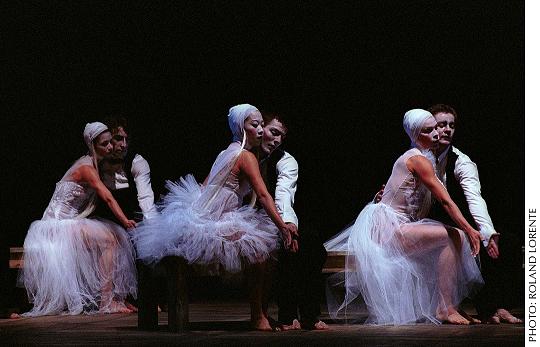
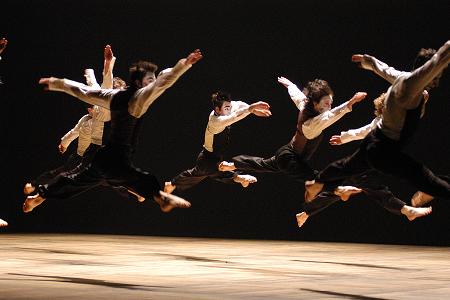
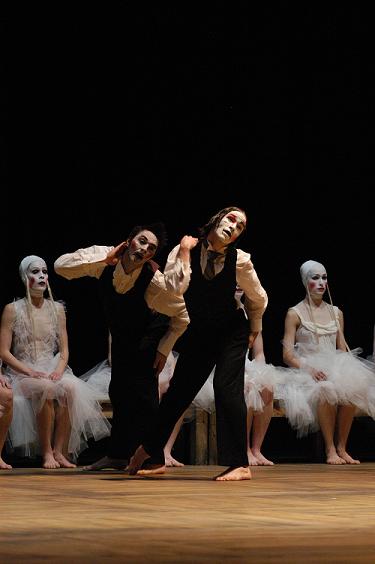
The dance (and the Stravinsky music) depicts a Russian peasant wedding and it’s very Rite of Spring-like — more focused on the sexual rite of passage, the consummation, and the rather forced marriage rituals than love or anything weddings evoke for us today. In the Celis (as well as Rioult) version, there isn’t a single man and woman but a group of men and women undergoing the marriage ceremony. The women here are dressed in sexy white bridesgowns, the skirts short and much of the material see-through mesh. The women have white-powdered, very made-up faces that look almost clownish, as do the men, who are dressed in tuxes. Alyssa thought their make-up looked zombie-like, like they’re walking dead. The movement is very frenetic, with lots of thrashing about, and the group consummation scene would have been comical, as the women bounced around on the men’s laps, if it wasn’t so violent.

I’ll be interested to see what the critics and other viewers say of this –whether it gets dismissed as gaudy “Eurotrash” or whether people take it more seriously as a commentary on ritual (or something else). I do think it worked as an homage to Ballets Russes because from what I know of that legendary company, they seemed to have been very cutting-edge, going far out to push ballet to its extremes, even if it induced a lot of eye rolling.

Big kudos to the dancers though for performing that long, near-continuous frenetic movement.

Photos of Les Grands Ballets Canadiens de Montreal courtesy of City Center.

STAND IN LINE FOR FALL FOR DANCE TICKETS AND LET MONICA BILL BARNES ENTERTAIN YOU


I think this is pretty funny. Fall For Dance tickets go on sale this Sunday, September 13th, at 11:00 a.m. In the past crowds have been known to line up beginning at 4 a.m. (this festival is popular), and the line’s been known to wend its way practically all around midtown. Well, this year, festival participant Monica Bill Barnes (above, on the left), a modern / experimental dancer and choreographer, is going to entertain the queued-up crowd from 10-11 Sunday morn. She and her dancers can be rather amusing.


These pics are from a site-specific performance of hers I saw last summer downtown and wrote about here.

Also, during the festival there will be three free, open-to-the-public talks in City Center’s Studio 5 (which is upstairs, I think on the 5th floor). All three talks will be about the legacy of the Ballets Russes (in honor of their centenary this year).

The first, on September 23rd at 6:30 p.m. will be a discussion with three original members of the legendary troupe: Frederic Franklin, Raven Wilkinson and Eleanor D’Antuono and will be moderated by Robert Greskovic, author and dance critic for the Wall Street Journal.

The second, on Sept. 25th, same time, will be about how BR’s collaborations with clothes designers, painters, and musicians of the day created lasting change for the dance world. Panelists include Christopher Wheeldon, Alexei Ratmansky, Juliet Bellow and Simon Morrison and the moderator is Lynn Garafola, a dance historian at Barnard.

The third, on October 3rd, same time, will be about BR’s influence on today’s choreography. Panelists are choreographers Nicholas Leichter, Robert Johnson, Mark Dendy, and Virginia Johnson and the moderator is Wendy Perron, the editor-in-chief of Dance Magazine.

Speaking of Ballets Russes, one final reminder: if you haven’t yet seen the fantastic exhibit at the New York Public Library for the Performing Arts, at Lincoln Center, you only have until September 12th to do so. They’ve got videos of Baryshnikov dancing Balanchine’s Prodigal Son, of Anna Pavlova, of Fokine’s Les Sylphides, of Branislava Nijinska’s Les Noces, of original BR choreographer Leonid Massine instructing Joffrey dancers on reconstructing his Parade, they’ve got original costumes and poster designs by Picasso, letters and diary entries by Diaghlev, etc. etc. etc. Definitely worth seeing.