Brief Update & Review of Peter Martins / Paul McCartney Collab at NYCB

Hey everyone,

Just a brief update since this motel’s wifi is expensive and not secure: but I now have a car (a cute little Toyota Prius – used) as well as an apartment in LA that I love but that unfortunately won’t be ready for move in for two more weeks. Which means I’m back in Phoenix for the next two weeks, shuffling around between family who have space for me and who aren’t allergic to Rhea and pet-friendly motels. Once I’m settled in to my new place – which, again, I LOVE!!! – I will most definitely resume regular blogging.

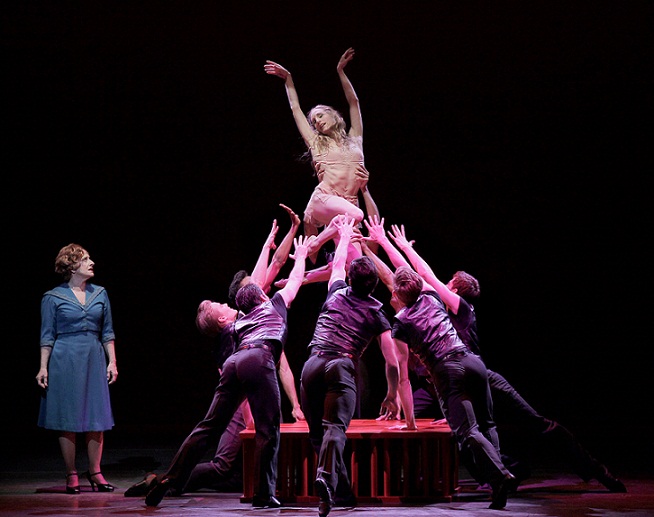
In the meantime, I did see the much spoken about new Peter Martins / Paul McCartney collaboration – Ocean’s Kingdom – at New York City Ballet when it premiered a couple weeks back. NYCB has sent me some pictures but I don’t have time to post them now. I will soon! I liked but didn’t love the ballet. I thought the story-line was simplistic and not very compelling and didn’t love the choreography, although there were some good pas de deux between Sara Mearns and Robert Fairchild – the lovers. I very was impressed with Paul McCartney’s ability to create such a rich orchestral score – really lovely. I thought Mearns, Fairchild, Amar Ramasar, and Georgina Pazcoguin all danced very well. Ramasar, who as most of you know is non-white, danced the part of the bad guy… So sigh on that. But he danced very well. For the most part, I wasn’t in love with the costumes, designed by Stella McCartney, except Pazcoguin’s, which was lovely and worked well. I kept worrying Mearns’s was going to come off, an idea my male friend liked and wished would have come to fruition. It didn’t; at least not the night we saw it.

McCartney was in the audience and gave a big wave to the audience when Martins introduced him. He has big, big hair! He doesn’t look his age at all. Martins toasted him not with champagne but with a cup of tea. Alec Baldwin was sitting right behind him in the audience. I don’t recall seeing any other celebs there but I’m sure there were oodles.

Anyway, as I said, I promise to post pictures of that ballet as well as some others from the beginning of the season that City Ballet has sent to me as soon as I’m home and have a secure (and free) internet connection. This afternoon is Charles Askegard’s farewell performance, which I unfortunately won’t be able to see. I hope to see his new company tour LA though, soon soon soon!

Thank you so much for continuing to read my blog, everyone, when I’ve been too busy to post much lately! I very greatly appreciate everyone’s support through this rather huge transition in my life. Thank you again, and will talk soon!
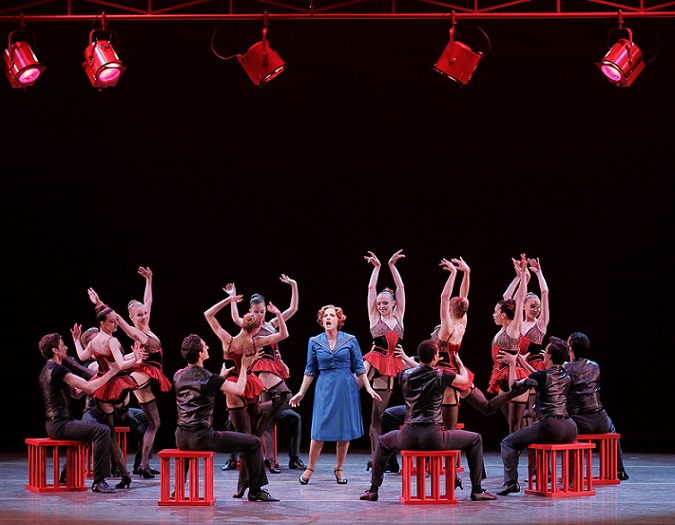
NYCB Spring Gala with SEVEN DEADLY SINS Premiere

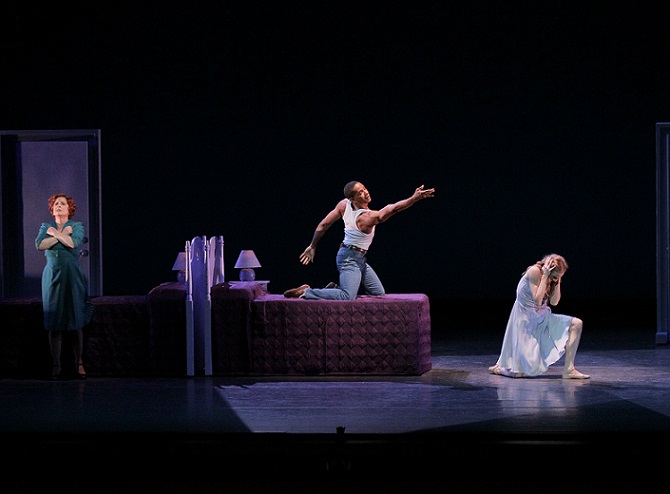
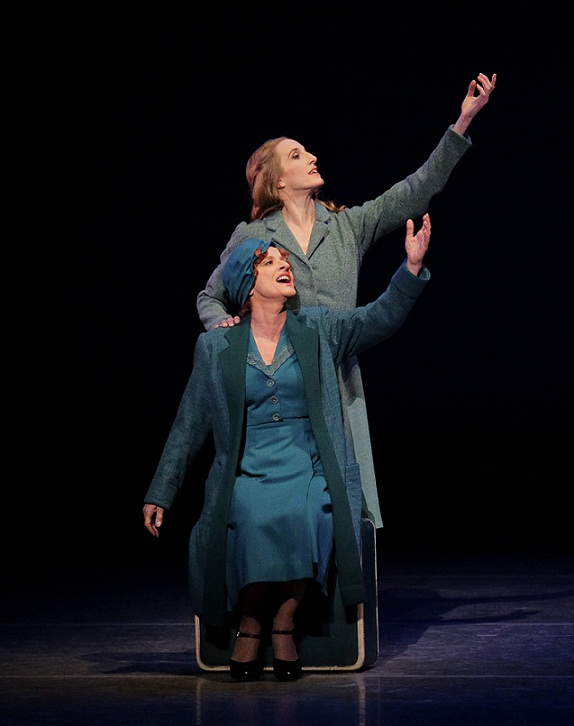
Here are some photos, all by Paul Kolnik, of Lynne Taylor-Corbett’s play-ballet, The Seven Deadly Sins, which premiered last night at New York City Ballet’s Spring gala performance. Above is Patti LuPone, who guest-starred with the company (performing the singing role of course!) and Wendy Whelan, who danced the lead. The top photo is from the “Prologue” of the play-ballet (or ballet chante as the program calls it).

This is from the second part: “Pride”: Patti LuPone and cabaret dancer ensemble.

Also from “Pride.” Wendy Whelan is in the middle.

And this is from sixth part, “Lust,” probably my favorite over all. Craig Hall and Wendy Whelan are the dancers in the photo. Craig Hall and Sara Mearns (who danced the role of “Latina Diva” in the “Anger” section, and who I don’t have a picture of unfortunately), most stood out to me, as well as Vincent Paradiso as the Count in the “Greed” section. I think those dancers most stood out – at least Mearns and Paradiso – because they seem to have some kind of acting training. Maybe they don’t, maybe they’re just natural actor-types, but the more actor-ly you are, I think the easier this kind of role would be. Wendy Whelan said in an interview with Roslyn Sulcas in the New York Times that she was used to expressing herself with her body and her lines, that she was used to Balanchine’s dictum “don’t act, don’t think, just dance,” and that she found this kind of role challenging. As much of a NYCB star as she is, and as stunning as she is in Wheeldon and Balanchine’s more modern, angular-lined ballets, I just wonder if she was mis-cast for something like this.

Which isn’t to say that she didn’t dance very well last night. She danced a really beautiful pas de deux with Craig Hall, which is what made “Lust” my favorite section. And LuPone sang in a gorgeously powerful voice. The dancing was all superb. But something just didn’t work to me.

Balanchine choreographed the original Seven Deadly Sins, set to libretto and score by Bertolt Brecht and Kurt Weill, in 1933. The Balanchine version was revived in 1958. According to the Times article linked to above, both the original version and revivals received very good reviews. Since the Balanchine version appears to be largely lost now, and Peter Martins wanted to revive the ballet, he commissioned new choreography from Taylor-Corbett.

Maybe it was that the new choreography didn’t really express the story, which follows Anna, a woman whose various life experiences each represent one of the sins. It wasn’t really a full story, but one composed of scenes, each of which dramatized a sin (and LuPone and Whelan portray different aspects of Anna). But, I didn’t feel the scenes always worked well at doing that. For example, in my favorite section, “Lust,” I thought the Hall/Whelan bedroom scene was really beautiful, very romantic, but nothing said lust, as in sinful lust, to me. I almost felt like Whelan’s Anna had a loveless relationship with her husband, danced by Allen Peiffer, and she was really in love with Hall, and her leaving her husband and running into Hall’s arms was an urgently needed escape.

In my other favorite section, “Anger,” Sara Mearns is a kind of sexy, but rather humorously so, Copacabana dancer. She gets angry at Whelan’s Anna for something – I’m not quite sure what – maybe Anna stole her lover or took over Mearns’ role as head diva, drawing too much attention to herself…  Anyway, Mearns twists her face into a look of utter anger, then points at Whelan, who runs off crying and is then stripped down to her underwear by a group of men. But I thought it was done rather cartoonishly. So it was more funny and cute to me than a dramatic representation of the tragic consequences of anger.

In the “Greed” section, a count and a senator vie for something and end up in a duel, both of them getting killed. But it didn’t have any tragedy or pathos to me. Instead, it felt a bit like Balanchine’s Slaughter on Tenth, which made me want to giggle – probably the fact that it was Paradiso playing the role of the Count.

I don’t know. I guess I was expecting something with more tragedy and pathos and weight, and I felt like I saw a version of Slaughter on Tenth but without a through story-line. Maybe that was the intent. I’m going to see it again over the weekend, and maybe my opinion will change.

Did anyone else see it yet? I’m interested to hear what others think. Has anyone seen the Balanchine version?

After intermission,

— here’s my photo of the promenade – Balanchine’s Vienna Waltzes was performed beautifully.

Photo by Paul Kolnik.

All of the dancers were very good, but I particularly liked Megan Fairchild and Joaquin DeLuz in the fast-footed, playful scene in the forest, “Fruhlingsstimmen,” and Maria Kowroski and Charles Askegard in the last, beautifully ballroom-y section, “Der Rosenkavalier.”

New York City Ballet’s First Fall Season Opening Night


Tuesday night, New York City Ballet opened its very first fall season with performances of Balanchine’s Serenade, Peter Martins’s Grazioso, and Jerome Robbins’s The Four Seasons. First, before the performance began, Peter Martins came out and introduced each of the principal dancers, who came out onstage one by one, and said this season would be a celebration of them. Tiler Peck in particular was wearing this really gorgeous silky fuchsia dress. Martins said all principals were there except for Benjamin Millepied, who was doing something movie-related “en France,” he said with a funny faux Euro accent. Everyone laughed and gave the dancers a huge round of applause. The house was packed and it was clear how thrilled the company’s many fans are with there being a fall season this year. Martins made fun of himself for being so into toasts and said that during intermission, we’d all be given be given free champagne to toast the principals. Which we were – very fun!

The part of the performance I was mainly looking forward to was Janie Taylor’s debut in Serenade (above headshot and Serenade photo by Paul Kolnik) as the main ballerina. As usual with her, she completely made the ballet her own. I thought the ballet had a somewhat dark element with her, that I’ve never seen before. When she first ran out onstage, late for class, instead of looking like she was all frantic about being late because she’d been held up by a boy, it looked like she was running from something – from him. That man was Charles Askegard and when he danced the middle waltz part with her, the huge size difference between them added to the sense of foreboding, that she was fragile, he was pushing her around, and she’d eventually be hurt by him. At certain parts, it was literally like he was pulling her along. When he lifted her and she raised her legs in a split, it looked almost like she was trying to get away from him. Sara Mearns was the angel and Ask La Cour was the man who I call “blind justice” who take care of Taylor when she falls, and it was interesting how much the two male leads and two female leads looked alike. I almost got Taylor and Mearns mixed up at parts, thinking they were taking on the other’s role. And the end when the men raise Taylor up like pallbearers and she is carried off by them, arching her back, arms outstretched  – so hauntingly beautiful. It reminded me a bit of Balanchine’s La Valse.

I was also looking forward to Martins’s Grazioso, in which three handsome men – Gonzalo Garcia, Andrew Veyette and Daniel Ulbrich – vie for Ashley Bouder’s attention with their bravura moves. I don’t think this ballet has been performed since it premiered a few seasons ago. And I loved it all over again. I love how each guy has his own personality – Garcia is the romantic, Veyette is the manly man one, and Ulbrich is the one with all the high jumping tricks. And Bouder really played the tart, looking at each of them up and down at points kind of lasciviously, really trying to choose. The guy next to me was really giggly over it.

And the evening ended with Robbins’ The Four Seasons, which itself ends with a lovely tribute to fall.

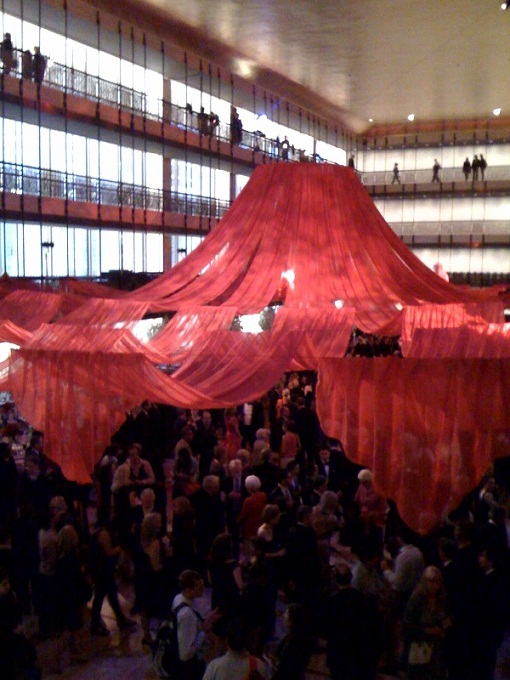
This whole season the Koch theater will open an hour early. The promenade overlooking Lincoln Center Plaza will be open for cocktails, the gift shop will be open, and, for the rest of this opening week, there will also be live jazz performed by the NYCB Orchestra one hour before performance time. They have the promenade and mezzanine area done up nicely, with big plush chairs. Also taking place the rest of this week will be a “meet the artists” session whereby, beginning at 6:45 p.m. in the first ring of the auditorium, the principals dancers will be available to chat with ticket holders. There’s also a photo exhibition of the dancers by photographer HenryLeutwyler on display in the theater throughout the season.

Tomorrow night will be the first of seven “See the Music” performances which will provide a look inside NYCB’s 62-piece orchestra. At the beginning of each performance, Peter Martins and musical director Faycal Karoui will briefly discuss the program’s music, followed by the orchestra performing an excerpt of one of the ballet scores. The subject of tomorrow night’s discussion will be Eduoard Lalo’s score for Ratmansky’s Namouna: A Grand Divertissement, which premiered last season. Additional “See the Music” programs are Sept. 26 matinee, January 20, Feb. 1, Feb. 19 matinee, May 25 and June 11.

AN ERA ENDS: DARCI KISTLER GIVES HER LAST PERFORMANCE WITH NYCB


Yesterday afternoon marked the end of an era as Darci Kistler, the last dancer to be hired, trained, and made into a star by George Balanchine, gave her last performance with New York City Ballet, where she’s danced for the past 30 years. Kistler, originally from Riverside, California, began studying at Balanchine’s School of American Ballet in 1976, was hired to dance with the company in 1980, and was made into a principal in 1982, at 17 years of age. She remains the youngest principal ever at NYCB.

It was a huge event, needless to say — practically every critic and blogger was there, longtime donor patrons were greeting each other right and left (and there was a party for them afterward). The house was completely packed, and the plaza was filled with people asking if anyone had a ticket for sale.

The program consisted of Balanchine’s Monumentum Pro Gesualdo and Movements for Piano and Orchestra, the Titania / Bottom pas de deux from his Midsummer Night’s Dream, his Danses Concertantes, and the beautiful final act of Peter Martins’s Swan Lake (which almost made me cry, and I don’t think I’m the only one).


Monumentum Pro Gesualdo and Movements for Piano and Orchestra is an abstract leotard ballet in two parts that Balanchine set to Stravinsky. I always prefer the second part, which its flirtatiousness, its angular lines and sharp shapes, to the more lyrical first part. Darci danced that second part with Sebastien Marcovici, and the first part with Charles Askegard. I’d only ever seen Maria Kowroski in the female lead in this ballet and it was interesting seeing another body in the role. Kistler danced it more smoothly lyrical and her edges were more rounded, but she played it up really well, really “acted” it, like she was really responding to Marcovici’s movement and he to hers, as if they were in conversation.

That Titania / Bottom pas de deux is one of my favorite parts of Balanchine’s Midsummer Night and I’m glad she chose it. She was sweetly hilarious as she fell head over heels for Henry Seth’s ‘donkey persona’ after both had spells cast on them by the mischievous Puck.

Danses Concertantes was the only ballet she didn’t dance; it was danced well by Megan Fairchild and Andrew Veyette.


And the program ended with the last act of Martins’s version of Swan Lake. The Martins is one of the only versions of this ballet I know of that doesn’t have some kind of happy ending, and it was really fitting here, this being the most bittersweet of farewells. In Martins’s version, Odette and Prince Siegfried can’t be together because he has been unfaithful to her with Odile. So the ballet ends with her bourreing backward, away from his outstretched arms, into her flock of swans, who envelop her. Jared Angle’s Siegfried continues reaching out toward her, in sorrowful outstretched lunges, but he’s unable to reclaim her. She literally retreats into the wings, and metaphorically returns to her ethereal, otherworldly place. So poetic, and so fitting for a prima ballerina retirement. And so sad…


All photos by Paul Kolnik. (Bottom photo I scanned from an earlier program)

MAURICE KAPLOW’S FAREWELL PERFORMANCE WITH NYCB


Thursday evening longtime New York City Ballet principal conductor Maurice Kaplow gave his final performance with the company. I had never been to a conductor’s farewell before, and, of course, part of what made this extra sensational was that the newishly mobile orchestra pit (photo above) was raised to stage level for part of the program.

There were four pieces in the program: Melissa Barak’s recently premiered Call Me Ben (the only piece Kaplow didn’t conduct), which was followed by Euryanthe, the Barber Violin Concerto, and ending with Western Symphony.

Euryanthe was only an orchestral piece – no dancing, by Carl Maria von Weber. When Kaplow first took the podium, everyone cheered, which grew into a standing ovation as the orchestra pit rose. One thing I didn’t realize (we’ve only seen the pit rise once before, during the first NYCB program following the Koch theater’s renovations last year) was that the conductor can’t stand at the podium while the pit is rising and falling; he must step down into the musicians’ area. When the pit was finally level with the stage and he climbed up to the podium, he looked out toward the applauding audience and took a grateful bow. Euryanthe was really beautiful, with a lovely, almost sentimental (given the occasion) violin section, followed by an exciting drum-heavy climax. It was nice to see the orchestra for once, and to be able to focus on the music.

Peter Martins’s Barber Violin Concerto really blew me away. I’d never seen it before, and I have to say it’s now one of my favorites of his.


Pictured from front to back: Megan Fairchild, Sara Mearns, Jared Angle, and Charles Askegard. There are two couples in this piece – one a classical ballet pair, the other a modern dance duo, and at first they dance each with their rightful partner, then the two members of the modern couple break apart and dance with the opposite sex ballet dancer. When I interviewed So You Think You Can Dance’s Billy Bell a while back, he’d laughingly said something to me I found funny, that as a hopeful choreographer he sought to “break” ballet dancers, meaning he wanted to get them to loosen up, not be so rigid and controlled with such straight, upright posture, and get them to really move. This piece reminded me of that. At first Sara Mearns’s classical ballerina in pretty satin pointe shoes wants nothing to do with this crazed barefoot Jared Angle, but eventually she realizes he’s not so bad and they do a quite nice pas de deux together.

Same with Megan Fairchild and Charles Askegard, except choreographically they were more fun, and Megan totally blew me away and made me think she is really a modern dancer. She was the most compelling person onstage and I couldn’t take my eyes off her, despite the fact that one of my big favorites, Sara Mearns, was up there with her. Megan looked like a real Paul Taylor dancer but even more stunning. Her character really taunted Charles Askegard’s classical danseur, jumping on his back, wrapping her flexed feet around his middle, darting in between his legs, really kind of climbing all over him. He looked tormented, then eventually relented and they danced a pas de deux together too. Interestingly, people giggled throughout this part – where Megan’s modern girl is taunting Charles’s classical man –  and the critic next to me who’d seen the ballet many times before said he’s never heard people laugh at that section, that he didn’t think it was supposed to be amusing but more raw. Maybe it was because of their size difference — Charles Askegard is the tallest dancer in the company (I think he’s 6’4) and Megan’s this tiny little thing who looks rather doll-like. I found it cute and flirtatious and now I don’t think I’d like it if I saw it done more raw, though I’d love to see other dancers do it. I’d love to see this ballet again.

Also, as the title of the piece would imply, there’s a really beautiful violin solo (played by Arturo Delmoni), where the violin almost sounds like a human voice.

Last on was Balanchine’s Western Symphony. Andrew Veyette danced the male “Rondo” role and after seeing Robert Fairchild in this role last week I thought I’d never be able to see another dancer do that part. But, whoa, Veyette completely floored me. He was on fire as he kicked his heels up high in the air, sexily do-se-doed toward Teresa Reichlen (who was stunning as well as the female lead in that section), then whipped her off into the wings where he pretend kissed her. She’ taller than he is and at first I thought they weren’t a good match, but they kind of played up their height differences. I loved it.

As usual during the curtain call, the maestro came out onstage and took a bow. But of course this time he didn’t merely motion down toward the orchestra, directing the applause at them, but took the stage alone, and, like the retiring dancers, was greeted by a row of dancers bearing bouquets. Eventually, the entire orchestra came up bearing flowers as well. Peter Martins came out onstage and hugged him. Very sweet. Then, Martins led the orchestra (joined by the audience) in singing “Happy Birthday,” so apparently it was Kaplow’s birthday as well. He’s been with the company for 20 years. I’ll miss seeing him in the house.

Photos by Paul Kolnik.

NYCB: A DIFFERENT DREAMER, A BRILLIANT HALLELUJAH JUNCTION AND A SWAN LAKE DEBUT


I spent all of Saturday at New York City Ballet, watching both matinee and evening performances like the obsessive I am 🙂 Highlight of the daytime performance was Jerome Robbins’s 1979 ballet, Opus 19 / The Dreamer in which Robert Fairchild and Janie Taylor made their NYC debuts in the lead roles. This is only my second time seeing this ballet — the first was a season or two ago when the main parts were danced by Gonzalo Garcia and Wendy Whelan. (Robbins created the ballet on Baryshnikov and Patricia McBride). My research has revealed that critics don’t consider this to be a major Robbins ballet; Arlene Croce seems not to have written a word about it. Audiences seem to adore it though, me included.

Funny but the first time I saw it, I thought the main male character was a “dreamer” in the sense of being an idealist. Wendy seemed to represent Gonzalo’s ideal. And there often seems to be a kind of charmingly airy, carefree, “head in the clouds” quality to Gonzalo’s dance persona.

Robert was more solid and sharp and weighty than Gonzalo. In his beginning solo, he’d slice through the air with his arms and legs, stretch an arm out, hand bent up, as if to be pushing out against something, or stopping something from getting too close to him. What that something is isn’t entirely clear. It seemed more like he was a literal dreamer, someone lost in a dream that was neither entirely pleasant nor unpleasant, something he kind of wanted to escape from but was drawn to as well. And Janie — I love her! — was all tantalizing, bewitching, taunting little mischief-maker haunting his subconscious, not leaving his psyche a moment’s peace. Whenever she was onstage, she completely captivated — both him and us. Even when she’d collapse in his arms, he’d struggle to straighten her up again. He’d lovingly wrap his arms around her; she’d be out of them in a split second. It was very different from the way Wendy danced, if I remember correctly. I wonder how Patricia McBride did it.

I read a review of a dancer who performed the male lead in the 80s. The writer — Jack Anderson — said the dancer — Jeffrey Edwards — looked like a thinker, very introspective. I always love watching Robert — I think he is one of the most fascinating movers around. I’m not sure if what I saw here was introspection or more like inner turmoil. He was definitely lost in himself — he doesn’t even seem to notice all the lavender-clothed dancers flitting about him, didn’t seem to notice anyone until Janie came darting by and commanded his attention. I guess it seemed more like he was lost in his own angst, haunted by his dreams, than lost in his thoughts or his art. But it would be hard, I’d think, to embody introspection.

They don’t seem to be performing this ballet a lot, but I’d love to see Tyler Angle dance the part as well.

Also during the day was Chaconne, which I’m growing to love more and more — particularly the first pas de deux where the man lifts the ballerina and she has her arms out to the sides and does these large, sweeping steps forward, every few beats lightly tickling the floor with one toe shoe, and it looks like she is flying — and Vienna Waltzes, which, probably ridiculously for me since I’m a ballroom dancer, honestly just kind of bores me. The choreography’s not very intricate or compelling (odd for Balanchine) — it’s mostly straight-forward waltzing, which I can only watch for so long. There’s a middle section composed of high-energy allegro ballet which was danced very theatrically by Yvonne Borree and Benjamin Millepied. That section seriously kept me from falling asleep.

Highlights from the evening program were Peter Martins’s Hallelujah Junction, Joaquin De Luz in Donizetti Variations, and Sebastien Marcovici’s debut as Prince Siegfried in Balanchine’s Swan Lake. I hadn’t seen this cast of Hallelujah before — it was Sterling Hyltin, Gonzalo Garcia, and Daniel Ulbricht. This cast wasn’t so dramatic, so romantic, so intent on telling a little story, as other I saw (Marcovici, Taylor, Veyette), but seemed more focused on simply making the music visual — and they did so to fascinating effect. I greatly enjoyed just sitting back and watching all that brilliantly fast-paced, razor-sharp movement — Gonzalo with his sexy impish bouyancy (he’s not really a small man but somehow he seems like he’s always airborne; I think he’d make a great Sleeping Beauty Bluebird), Sterling with her Russian ballerina-high extensions that she does with incredible speed, and Daniel for his intense precision. This is the best I think I’ve ever liked Daniel Ulbrich before. He didn’t just jump inhumanly high; he really nailed very difficult-looking, intricate footwork and he did so with such sharpness and tautness. If he’d only be given more than just jumping guys parts, he can show that he can actually dance extremely well.

Sebastien danced Siegfried with great passion, expectedly. Balanchine really eviscerated the man’s part in his version of the ballet but Sebastien went as far as he possibly could with it. At one point, one of the corps swans in the back row fell and of course the audience had to go “ooooooohhhhhhh,” but he didn’t let it faze him as his Siegfried searched desperately among the swans for his beloved Odette. He had a minor flub on one of the many traveling turn jump thingys but no big deal. It was heartbreaking when Wendy bourreed back away from him and he reached out to her like she was taking his life with him as she went. Also, I love the black and white plastic swans swimming in the little stream at the beginning and end, but the people working them should just make sure the white swan appears at the right time! One time Wendy wasn’t fully into the wings yet when her swan form began sailing across the stage and Charles Askegard’s Prince Sig didn’t know where to run — the swan or Wendy. This time it was a little late and Sebastien kind of had to go searching upstream for her 🙂

Balanchine’s Donizetti Variations was danced brilliantly by Joaquin De Luz and Megan Fairchild. But what I really love about Joaquin isn’t his bravura dancing but his dramatic abilities — how he interacts with the other dancers. Even when dancing a storyless ballet, he’ll look at the others as they do their thing, shoot them a cocky grin — or a genuine smile — and do his thing, his steps a clever or comical response to theirs.

Also on this program was the newish ballet by Melissa Barak, A Simple Symphony – -my second viewing of that. She does borrow from Balanchine, but her choreography also has its own wit, which you notice on multiple viewings. Like Balanchine, the drama is in the actual choreography — every little flex or softening of the wrist meaning something. At one point, the ensemble of ballerinas all turn their hands and flex their wrists, and it looks like they’re cutely shrugging their shoulders. It’s such a pretty ballet with such mellifluous music though, sometimes you don’t want to focus on the choreography; you just want to sit back and enjoy the loveliness of it all.

TWO WORLD PREMIERES — QUASI UNA FANTASIA AND TOCCATA — AT NEW YORK CITY BALLET GALA


Last night I went to New York City Ballet’s Spring season gala. I always love galas but they’re especially exciting when they showcase world premiere dances. In this case, there were two such premieres, along with the world premiere of a new piece of music set to one of the ballets.

First things first: I missed most of the red carpet events, unfortunately, since the program began early (so as to make time for the after-show dinner, which I am far too poor to attend). And shame on me for mismanaging time like that — that Waiting For Godot experience from two years ago was too much fun. I did get there just in time to see the paparazzi flashing away at (Sex & the City author) Candace Bushnell and (NYCB principal) Charles Askegard. Sweet Charles soon stepped aside to let his wife bask in the glory all on her own. She looked radiant. I was jealous.

Continue reading “TWO WORLD PREMIERES — QUASI UNA FANTASIA AND TOCCATA — AT NEW YORK CITY BALLET GALA”

New York City Ballet Season Finale and Wrap Up With Response to Sir A


So, Sunday marked the end of New York  City Ballet’s winter season. I was honestly in a blue funk all day yesterday, which shows, I guess, that I am really beginning to love this company since I’ve normally only gotten so sad over ABT and Alvin Ailey.

Sunday was a one-day only program, the All-American Season Finale, which included Robbins’s Glass Pieces, Martins’s Hallelujah Junction, and Balanchine’s Tarantella and Stars and Stripes. Tarantella (this is the only time it showed this season) is always fun, with its cute Neapolitan peasant boy-tries-to-get-girl caricatures, lightening-charged footwork, and series of bravura solos for both man and woman, all performed with a tambourine. I was completely out of breath after watching Joaquin de Luz fly across the stage and ultimately steal a kiss from Megan Fairchild. Joaquin is not just a dancing virtuoso but a dramatist as well and his characters are always these virile, sexed-up, but charming, innocuous men. I really love him.

Glass Pieces and Hallelujah Junction also really grew on me. I don’t know if it was Maria Kowroski or what, but the  slower, more adagio section of Glass Pieces was very compelling this time, and it really spiced up the last man-centric, drum-beating, section as well. At first I wasn’t a huge fan of Maria Kowroski, but either she has improved or she has really grown on me. I always thought she had an excellent dancer body, but now she is using it in a much more expressive way, really to say something. The only thing I’m not in love with choreography-wise in Glass Pieces is in the last section, how the men come jogging out, hands powerfully punching the air, doing their ‘man things’ to the booming drums, and then the women daintily slink in to the sound of the flutes. Corny.

I was able to watch more than just the mesmerizing lighting in Hallelujah Junction this time. I love the movement theme –toward the beginning — of the landing a jump or phrase on releve and then swiftly lowering the ankle to the floor. On Andrew Veyette it looked kind of teasing but in a sinister way, like the slicing of a knife. There is something very sinister in general about Andrew Veyette, very virile in a threatening way, which makes him perfect for the devious man dressed in black here.

And I love how Sebastien Marcovici, the man in white, kind of Janie Taylor’s saviour, would powerfully jete across stage after him, threatening him, banishing him. Sebastien and Janie are such the romantic couple, in part because they work so well together and in part because of their respective sizes. Someone very knowledgeable in the dance world told me they thought he’d been working out a lot, trying to build muscle. I do think he seems to have become more muscular lately, especially his legs. Building muscle often decreases the muscle’s flexibility and he doesn’t seem to make a perfect split on a jete like some of the others, but I still think it’s so romantic that he’s so much larger than little Janie; he can just sweep her off the floor and scoop her up into his arms — aw 🙂

The program notes state that Stars and Stripes, the somewhat cheesily patriotic but excellently danced Balanchine ballet, was shown at presidential tributes, like that of Kennedy and Johnson, and at Nelson Rockefeller’s NY gubernatorial inauguration. It’s so weird to me to think of that, though I could see it performed back then. But now? At President Obama’s inauguration? It just doesn’t seem like it would fit. It would seem kind of anachronistic, sadly…

Anyway, the talk of the ballet world lately has been Sir Alastair’s New York Times season wrap-up.

Taylor Gordon, my friend and fellow blogger / dance writer, says, “whether you agree with him or not, it boggles me that one person has the power to say these things in basically the one print medium dance criticism has left. Ouch.”

Macaulay basically takes the women of NYCB to task, saying none of them really command authority like true ballerinas,

Continue reading “New York City Ballet Season Finale and Wrap Up With Response to Sir A”

DAVIDSBUNDLERTANZE!


Say that five times in a row 🙂 (

Last Wednesday, my friend Judy and I went to NYCB for their Founding Choreographers II program, which included two by Balanchine — Ballo della Regina, and Robert Schumann’s Davidsbundlertanze (it’ll be a miracle if I don’t misspell it at some point), and Jerome Robbins’s Glass Pieces.

My favorite was the middle one (whose name translates to “Dances of the League of David” — Schumann’s imaginary society of artists organized to combat Philistinism), and it’s becoming one of my favorites of Balanchine’s in general, though many people can’t stand it and think it moves way too slowly. Made in 1980 and one of Balanchine’s last works, it’s meant to depict the mid-19th Century composer Schumann’s relationship with his wife, a pianist named Clara Wieck, and his ensuing mental breakdown, which led to a suicide attempt, followed by institutionalization.

There are four couples who seem to me to depict various stages of the same relationship — one is older and more mature, another is young, hot-headed and full of passion, another frolicking and playful, and the last and most pathos-ridden somewhere in between, full of loving and longing but pockmarked with fateful misunderstandings and missed connections, generally standing I think for the tragic impossibility of true human connection.

Continue reading “DAVIDSBUNDLERTANZE!”

New York City Ballet: Founding Choreographers I


Tuesday night I went to see New York City Ballet’s Founding Choreographers I program (I know, I’m very late; it’s been a nasty week of migraines and sanity-destroying upstairs neighbors — more on the latter later).

It was a good, varied program. First on were two short abstract but very musical “leotard ballets” by Balanchine, both set to Stravinsky, that went together nicely (though they were choreographed years apart), Monumentum Pro Gesualdo and Movements for Piano and Orchestra. The pieces are mainly abstract and play with geometrical shapes and configurations, and there’s a bit of cute “Egyptian” styling in the flexed hand and feet gestures, and the ballets really give the dancers the chance to show off their musicality, especially the second, fast-paced one. I’m liking Maria Kowroski (in the top picture with Charles Askegard) better and better. She was very charismatic. Even though the ballets were story-less, she was kind of playing a part, and it really drew your attention to her. Askegard was really on too.

The second piece, Robbins’ Dances at a Gathering (pictured second, up top) was what I really went for. It was Kathryn Morgan’s debut in the ballet. She was very good, but who really ended up standing out to me was Sara Mearns. She danced her part in a way that really reminded me of ABT’s artiste supreme Julie Kent in Robbins’ similar but shorter, more virtuosic version, Other Dances. Mearns, like Kent, really connected with the music — not just like she was dancing to the music but with it; it, rather than the male dancer, became her partner. I remember in Other Dances when Kent girlishly lifted her shoulders and a big, joyful grin sweetly overcame her face when the onstage pianist first put his fingers to the keys. Sure Angel was there too, but the music is what made her dance, he was secondary. Robbins has I think three (that I know of) of these dancers-interacting-with-musicians dances: this one, Other Dances, and Suite of Dances, danced by a solitary man to/with an onstage cellist.

The problem to me with Dances at a Gathering is that there’s so much, it’s just too long, and you lose the quality and the mood that are so prevalent in the other two. Instead of one dancer connecting with a musician, or a duo with each partner connecting in his and her own particular way, here there’s a multitude of dancers, each trying to do that throughout the l-o-n-g dance. Every time I see it, I’m in love with it until about half-way through when it starts to drag. Then there’ll be another section that draws me in, and then another section that drags, then another section that drags, then another that begins to draw me in again where I begin to think, gee if there weren’t all those sections earlier that dragged, this one would be quite engaging, but by this point, I just want the damn thing to end already. And I know I’m not the only one who felt that way. You can feel the whole audience shifting in their seats. You can hear the heavy breathing. Someone needs to seriously edit that ballet!

Anyway, that said, I also really liked Benjamin Millepied. He dashed around the stage as if he were desperately searching for someone or something he’d lost. There was a longing and a quiet urgency to his performance that was really quite poignant.


See principal Megan Fairchild talk about that ballet (and see excerpts) here.

Last on was Balanchine’s Stars and Stripes, the high-speed, super-energetic ballet danced to John Philip Sousa’s marching band music that today looks kind of goofy in its hyper-patriotism. At first you want to roll your eyes at what seem to be a cheesy series of Rockette-like high kicks and formation changes and almost circus-like high jumps and stage-traversing turning jetes in the soldier section, but then you realize that in 1958, when it premiered, it was still kind of a point at which America was becoming acquainted with ballet, with the movements and with the Petipa structure — the wondrous in sync ensemble work, the pas de deux with the breathtaking lifts, the solos with their athletic jumps for the man, fouettes and fast chaine turns for the woman. As eye-rolling as this ballet may now be, if you look at it with a historical eye it was very original in its celebratory Americanization of the classical.