
I NEED MORE CHAOS!

p6022193

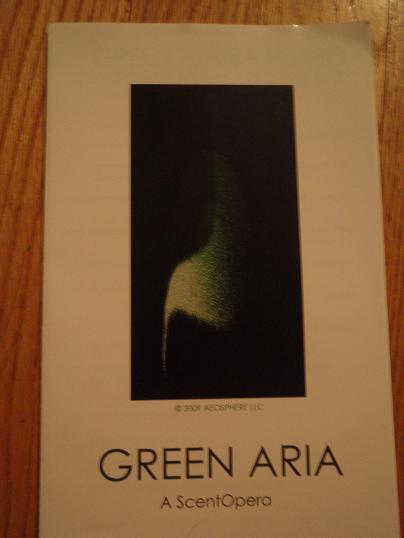
On Monday afternoon, I went to this novel opera, Green Aria: A Scent Opera, at the Guggenheim. It was their last Works & Process program of the season. Going in, I had no idea what to expect, knowing only that there was no singing, only scents (by Christophe Laudamiel) and music (by Valgeir Sigurdsson and that fabulously crazy Nico Muhly) and that the opera’s characters were various smells. It was really so interesting and I wish they would expand it (this one is only half an hour long) and show it in more venues so that more people could see it.

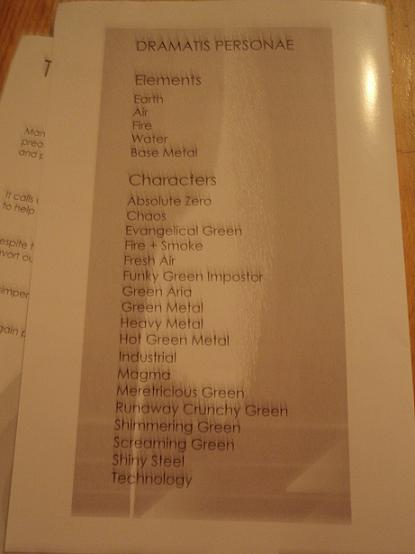
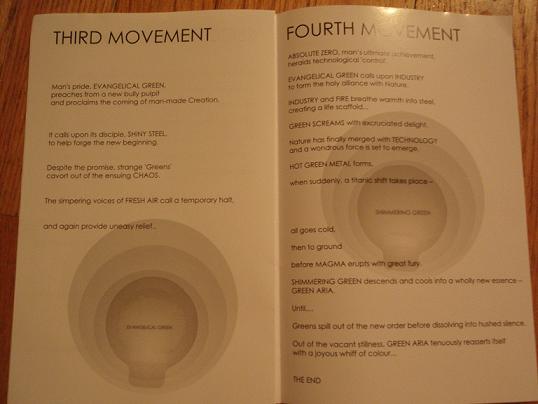
The basic story (by Stewart Matthew) is: nature is corrupted by industrialism and technology must find a way to save it, to create new fresh air. The five basic elements (Earth, Air, Fire, Water, and Base Metal) are the core characters, with other characters named things like Funky Green Impostor, Green Metal, Evangelical Green, Screaming Green, Shimmering Green, Chaos, Absolute Zero, etc. Here’s a full list of the Dramatis Personae from the back of the little Playbill they made:
p6022197

In the auditorium they set up little tubes (which looked like microphones) at each seat. You could adjust your tube, but they blasted in enough scented air that you really didn’t need to be sitting too close to it. They told us to breathe normally, not to sniff like a police dog (which of course most of us were inclined to do anyway). The tubes at each seat were necessary, Laudamiel told us, because if scented air was just blown into the auditorium in whole, it could take up to 50 seconds for the scents to spread to everyone. It would be impossible then to coordinate the scents with the music, or for everyone to have the same experience at the same time.

p6012187

p6012183

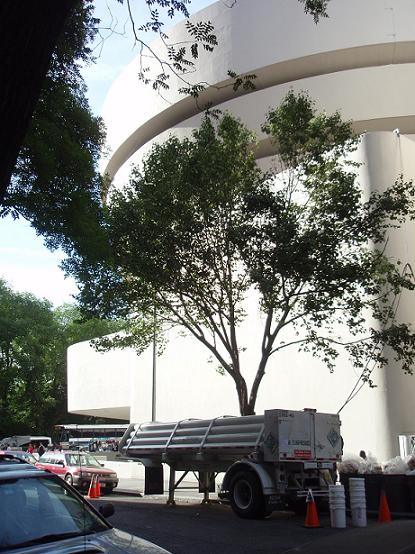
The scents were “stored” in this gigantic compression tank parked outside of the Guggenheim.

I thought since I have chronic sinus issues and a deviated septum and all, I might not get the same effect as everyone else, but it wasn’t a problem for me at all. Laudamiel’s scents (he’s worked as a perfumer for Ralph Lauren and other designers) were all very strong. They were mainly earthy because of the nature of the opera: Earth smelled like freshly mowed grass, Green Aria was like a dewy field, Evangelical Green was like grass mixed with sweet perfume, Shimmering Green yet sweeter. The sweetness and the grassiness didn’t always mix well, I think intentionally — Evangelical and Shimmering Greens were meant to be overly preachy, a surfeit, an excess, not authentic.

And you’d think the way people perceive smell would be subjective, but I think everyone pretty much despised / was horrified by Funky Green Impostor, who smelled very gassy, very foul, like gas combined with rotten eggs. Others I disliked were Fire, who smelled like 9/11 to me and Shiny Steel, who smelled very metallic but with a sweetness that just didn’t mix right.

By far my favorite somehow (besides simple Earth, and Green Aria) was Chaos. Chaos, according to the Playbill, was supposed to create “strange greens” which would  make Chaos seem bad. But Chaos was not the least bit foul-smelling to me! To me Chaos smelled like tropical fruit punch, or bubble gum. It was the only non-earthy scent. The Playbills they gave us had various sample scents, but Chaos was not there! I want my Chaos!

p6022195

p6022196

I’d said earlier that Muhly was the ideal composer for scent, but now that I’m remembing the whole opera, I’m realizing that that music, those sounds, were a large part of how I interpreted the scents. You knew when Funky Green Impostor was on his way by the sounding of harsh notes — at first faint, like he was just approaching — and then you knew when you’d be hit with some very threatening whiffs by the swelling of those chords. And you also knew when sweet, sunshine-y scents would be on their way when the music became mellifluous and Mozart-like. There’d be a fight, you’d smell the characters duking it out, the scents all mixed but at various points one or another rising above the rest — stinky, then perfume-like, then the freshly mowed grass, more sweet surfeit, etc. — and you knew when good had triumphed when it sounded like the end of a Tchaikovsky ballet followed by the dewy fields. I honestly never realized how strong my auditory senses were, what powerful effect sound could have, until I heard Muhly’s work.

Read Anthony Tommasini’s NYTimes review for far better descriptions of the music than I can provide 🙂

This was a fascinating experience, what I live in NY for.

DAY OF THE UNEXPECTED: AN OPERA WHOSE CHARACTERS ARE SMELLS & A TUDOR-ESQUE STORY BALLET BY RATMANSKY


I had a crazy day. This afternoon I went to the Guggenheim to see this new ScentOpera — an opera told entirely through music and smell (each seat had a little microphone that blew the scents into your face) — which I’ll write about soon. Suffice it to say it was very interesting and I think Nico Muhly has found his niche: composing for smell — because, unlike with dance, his music most definitely did not overpower these whiffs at all, at least not as created by perfumier Christophe Laudamiel. I nearly passed out from “Funky Green Impostor.”

Anyway, more about that soon.

Tonight was the premiere of ABT‘s new resident artist Alexei Ratmansky’s first ballet for the company — a night for which many have been waiting ever so eagerly. For those not up on the ballet-world gossip: Mr. Ratmansky (from the Ukraine, and former artistic director of the Bolshoi) initially was rumored to be contemplating taking the resident choreographer position at NYCB. Then he didn’t and everyone was depressed because Christopher Wheeldon was leaving to start his own company and everyone really liked Ratmansky and wanted to see more of his work stateside. Then, next thing everyone hears is that he’s accepted the same from ABT, making everyone happy but confused — NYCB is known for being more daring and contemporary in its repertoire; ABT sticks more to the traditional classical story ballets. Ratmansky,who was leaving the Bolshoi because he wanted more of a challenge (the Bolshoi’s rep is akin to ABT’s), seemed a better fit for NYCB.

Anyway, I was expecting tonight something along the lines of Concerto DSCH or something he’s done for NYCB (which is all that I’ve seen by him): a contemporary Balanchine-esque ballet without a linear narrative but with a discernible theme and with original, clever, thought-provoking choreography. Instead, On the Dnieper (the Dnieper is a river in the Ukraine), set to Prokofiev’s music of the same name, is a story ballet that I found to be about three parts Tudor, one part Robbins (with some of the fight scenes).

It’s the story of Sergei (danced by Marcelo Gomes), a young soldier who returns home, after war, to his fiance Natalia (Veronika Part), only to realize he no longer loves her but is attracted to Olga (Paloma Herrera), a flighty, flirtatious local girl who is betrothed to another man (David Hallberg). After a brief encounter, Olga falls for Sergei and begins to doubt her love for her fiance. One evening at a party, Olga dances with her fiance and Sergei becomes jealous and challenges the fiance to a fight. Sergei is felled, and Natalia rescues him — picks him up, cleans him off. But soon Olga is back. Natalia, after trying desperately and unsuccessfully to win Sergei back, heartbroken, does what she knows she must for the man she loves — helps him escape with Olga.

It reminded me of Antony Tudor because there’s a lot of drama — albeit without all the heavy psychology — a lot of hurt, wounded tragic characters with broken dreams, unrequited love, painful sadness that just reverberates through the whole auditorium. And the characters each seem to have a way of moving unique to them: Marcelo’s Sergei jumps back and forth a lot with lots of beats of the feet — as if he can’t decide whom to choose, what to do, as if he’s torn.

David Hallberg’s fiance is rather borderline psychopathic, highly impassioned (to make an understatement) but almost frighteningly controlling of Paloma’s Olga. After the way David had described his character on the Winger, I was expecting a reprisal of his “friend” in Tudor’s Pillar of Fire or his R&J Paris – -vulnerable and hurt but proud and trying to bear his pain noblely in a way that made me want Juliet to leave Romeo for him. That’s not what we got at all! Our first viewing of him is slicing madly through the air at Paloma and her friends as if to say, stop everything, I’m here. Besides the jumps and aggressive arms, he has a lot of crazy fast footwork throughout. At one point, when his jealousy is getting the better of him, he starts shuffling his feet so fast, he actually looks down at them, stunned, like he really can’t control them. A way out-of-control Fred Astaire.

Paloma is all about the fickle, flirtatious girlish jumps. And Veronika is more adagio, and she keeps extending her arms both to one side, then laying her head on that shoulder as if an expression of her loyalty and devotion to Sergei. Later, when she realizes he’s drawn to another woman, this movement looks more like a prayer that he’ll return to her. Veronika is heartbreaking and she’s the emotional centerpiece to the ballet. You really want to cry for her at the end.

I think it’s a good ballet — a little slow in places, but generally compelling and with meaningful movement that echos the characters’ desires and actions. It just surprised me that it wasn’t what I’m used to from him. I think after seeing so much NYCB, I’m becoming so enamored of Balanchine and non-narrative contemporary rep of the kind he’s done on that company. I hope that not all of the work he’ll do for ABT will be story ballets. I hope he will do some Concerto  DSCH and Russian Seasons and Dreams of Japan-like ballets for ABT as well. ABT’s dancers are so brilliant; it’s fascinating watching what they can do with those kinds of movement-heavy, dramatically open-ended kinds of dances.

Also on the program — which I’ll write more about after seeing the other casts — were Balanchine’s Prodigal Son (danced tonight by Herman Cornejo, replacing Ethan Stiefel, who’s still out with an injury), and James Kudelka’s Desir. Desir is about several different relationships — mostly couples — about sexual angst, romance, fighting, etc. I liked parts of it but not all (I’ll write more about it after more viewings), but what really floored me was a beautifully romantic pas de deux with sweeping lift after sweeping lift performed by Cory Stearns and Isabella Boylston. I’ve never really seen Isabella before and Cory I have but not much, and he’s definitely never stood out as much as he did tonight. Those lifts looked hard and he didn’t tire one bit. He was the ideal strong male partner, showing her off, making her look beautiful, giving her such gorgeous height, sweeping her up through the air, without being the least bit show-off-y himself. He was all about her and they both shone. They were breathtaking. And I’m definitely not the only one who thought so. The audience went wild with applause when they took their bows. They got even more applause than Gillian Murphy and Blaine Hoven! (who were excellent as the angst-ridden couple who eventually gets it together in the end). I’m glad Kevin McKenzie gives young dancers these kinds of chances to stand out.

More soon on the rest of the ballets, and hopefully some pictures as well.