
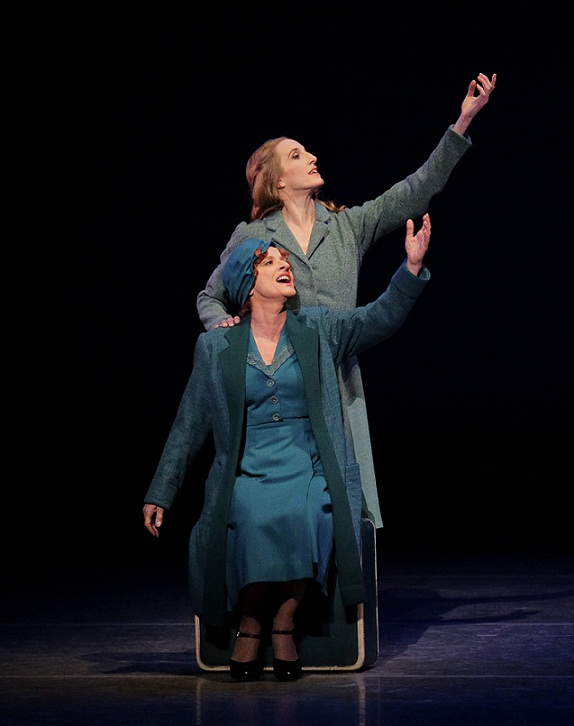
NYCB Spring Gala with SEVEN DEADLY SINS Premiere

Here are some photos, all by Paul Kolnik, of Lynne Taylor-Corbett’s play-ballet, The Seven Deadly Sins, which premiered last night at New York City Ballet’s Spring gala performance. Above is Patti LuPone, who guest-starred with the company (performing the singing role of course!) and Wendy Whelan, who danced the lead. The top photo is from the “Prologue” of the play-ballet (or ballet chante as the program calls it).
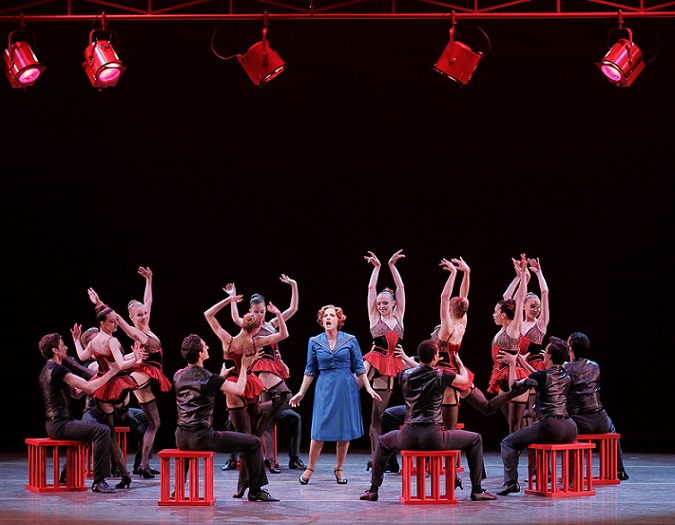
This is from the second part: “Pride”: Patti LuPone and cabaret dancer ensemble.
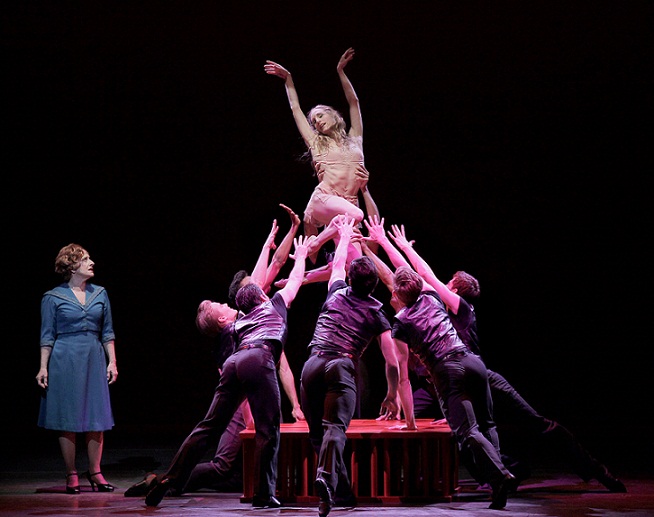
Also from “Pride.” Wendy Whelan is in the middle.
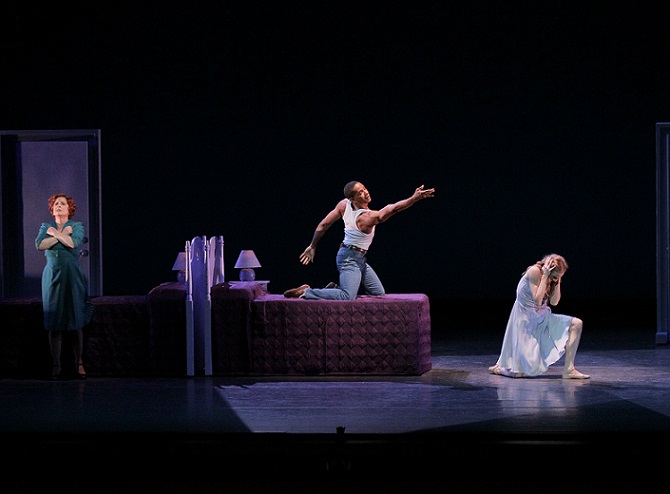
And this is from sixth part, “Lust,” probably my favorite over all. Craig Hall and Wendy Whelan are the dancers in the photo. Craig Hall and Sara Mearns (who danced the role of “Latina Diva” in the “Anger” section, and who I don’t have a picture of unfortunately), most stood out to me, as well as Vincent Paradiso as the Count in the “Greed” section. I think those dancers most stood out – at least Mearns and Paradiso – because they seem to have some kind of acting training. Maybe they don’t, maybe they’re just natural actor-types, but the more actor-ly you are, I think the easier this kind of role would be. Wendy Whelan said in an interview with Roslyn Sulcas in the New York Times that she was used to expressing herself with her body and her lines, that she was used to Balanchine’s dictum “don’t act, don’t think, just dance,” and that she found this kind of role challenging. As much of a NYCB star as she is, and as stunning as she is in Wheeldon and Balanchine’s more modern, angular-lined ballets, I just wonder if she was mis-cast for something like this.

Which isn’t to say that she didn’t dance very well last night. She danced a really beautiful pas de deux with Craig Hall, which is what made “Lust” my favorite section. And LuPone sang in a gorgeously powerful voice. The dancing was all superb. But something just didn’t work to me.

Balanchine choreographed the original Seven Deadly Sins, set to libretto and score by Bertolt Brecht and Kurt Weill, in 1933. The Balanchine version was revived in 1958. According to the Times article linked to above, both the original version and revivals received very good reviews. Since the Balanchine version appears to be largely lost now, and Peter Martins wanted to revive the ballet, he commissioned new choreography from Taylor-Corbett.

Maybe it was that the new choreography didn’t really express the story, which follows Anna, a woman whose various life experiences each represent one of the sins. It wasn’t really a full story, but one composed of scenes, each of which dramatized a sin (and LuPone and Whelan portray different aspects of Anna). But, I didn’t feel the scenes always worked well at doing that. For example, in my favorite section, “Lust,” I thought the Hall/Whelan bedroom scene was really beautiful, very romantic, but nothing said lust, as in sinful lust, to me. I almost felt like Whelan’s Anna had a loveless relationship with her husband, danced by Allen Peiffer, and she was really in love with Hall, and her leaving her husband and running into Hall’s arms was an urgently needed escape.

In my other favorite section, “Anger,” Sara Mearns is a kind of sexy, but rather humorously so, Copacabana dancer. She gets angry at Whelan’s Anna for something – I’m not quite sure what – maybe Anna stole her lover or took over Mearns’ role as head diva, drawing too much attention to herself…  Anyway, Mearns twists her face into a look of utter anger, then points at Whelan, who runs off crying and is then stripped down to her underwear by a group of men. But I thought it was done rather cartoonishly. So it was more funny and cute to me than a dramatic representation of the tragic consequences of anger.

In the “Greed” section, a count and a senator vie for something and end up in a duel, both of them getting killed. But it didn’t have any tragedy or pathos to me. Instead, it felt a bit like Balanchine’s Slaughter on Tenth, which made me want to giggle – probably the fact that it was Paradiso playing the role of the Count.

I don’t know. I guess I was expecting something with more tragedy and pathos and weight, and I felt like I saw a version of Slaughter on Tenth but without a through story-line. Maybe that was the intent. I’m going to see it again over the weekend, and maybe my opinion will change.

Did anyone else see it yet? I’m interested to hear what others think. Has anyone seen the Balanchine version?

After intermission,
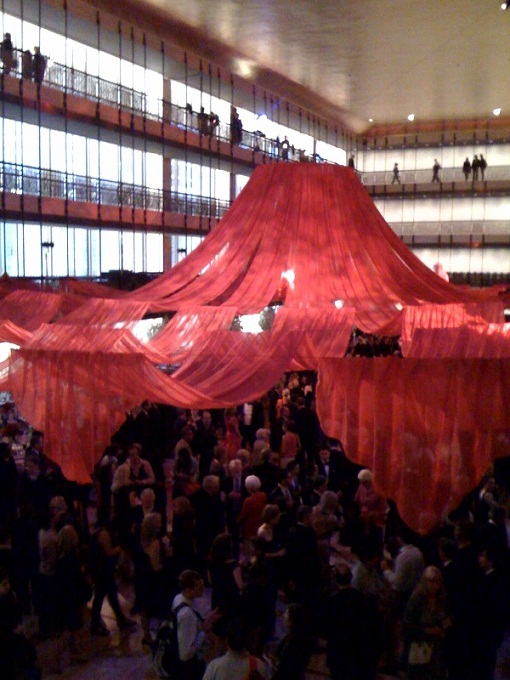
— here’s my photo of the promenade – Balanchine’s Vienna Waltzes was performed beautifully.

Photo by Paul Kolnik.

All of the dancers were very good, but I particularly liked Megan Fairchild and Joaquin DeLuz in the fast-footed, playful scene in the forest, “Fruhlingsstimmen,” and Maria Kowroski and Charles Askegard in the last, beautifully ballroom-y section, “Der Rosenkavalier.”

Janie Taylor Debuts in Millepied’s “Why Am I Not Where You Are” Etc.

I’ve been remiss in my New York City Ballet posts! Last week I saw two programs: one featuring three dances to three different violin concertos – Peter Martins’s Barber Violin Concerto, Robbins’ Opus 19 / The Dreamer, and Balanchine’s Stravinsky Violin Concerto. And the other program was another in the “See the Music” series but was also dedicated to Santiago Calatrava, who designed sets for all three of the ballets performed – Benjamin Millepied’s Why Am I Not Where You Are (pictured above, photo by Paul Kolnik), Christopher Wheeldon’s Estancia (pictured below, photo also by Kolnik), and Mauro Bigonzetti’s Luce Nascosta, all of which premiered last season and which I wrote about here, here, and here.

Calatrava was in the theater, and after encouragement by Peter Martins, he rose and took a bow.

Then, as with the first “See the Music” program, before the performance began, the orchestra pit rose and conductor Faycal Karoui gave a humorous little explanation of various parts of the Thierry Escaich score from Millepied’s Why, the first ballet performed.

These explanations are really interesting to me, I have to say. I only took one classical music class in college and now wish I’d taken more. Karoui talked about how there were four main parts to the score: a waltz, a tango, a disco, and a final climactic part, and he talked about the differences in tempo between them, and between them and a typical waltz, tango, etc.. He also talked about how the ballet has a central male character (danced very well by Sean Suozzi – in top picture, being carried by the group of men), and how you can hear that central character’s theme – or voice – throughout each section of the music. But the voice changes with each section: at first, he’s shy and mysterious (and his voice in the first section is portrayed by a violin solo), then as the orchestra grows sharper and stronger in the second, tango, section, so did the character, etc.

When we got to the “disco” section (it sounded nothing like disco to me but just slightly more mechanical and percussive than the preceding sections), Karoui really began rocking out as he led the orchestra. It was like he was actually dancing in a disco, and I nearly cracked up. I’m not sure if that’s what he normally does down in that pit – if he regularly starts to embody the music literally like that, or if he was just being a goof for the audience. He didn’t seem to be hamming it up at that point, though – oddly – so who knows. Anyway, he is very entertaining and I find his musical explanations very educational as well. What more can you ask than to be both entertained and educated, right?

Anyway, Janie Taylor debuted in the Millepied. She was supposed to have debuted when the ballet did last season but she was out with injury and so Kathryn Morgan had filled in. Character-wise I thought she played it the same as Morgan. Except with Morgan it seemed to have a West Side Story feel to it; with Janie it was darker and more La Valse-like. Both were tragic, but in a different way; Kathryn’s character seemed more innocent. Anyway, this was my second time seeing the ballet and it grew on me. It’s very dramatic, not a dull moment in the whole thing, and you’re really on the edge of your seat, both because of the intensity of the music – maintained throughout each section – and the dramatic story of the poor innocent guy who’s drawn into another world by his enchantment by this ethereal creature, only to get trapped and ultimately destroyed, along with her.

To me, Sara Mearns and Amar Ramasar, with their bravura roles, largely stole the show – I think I remember thinking the same last time. She with those crazy fast chaine turns all around stage that almost make you sickly dizzy, and he with his virtuosic leap sequence – they are kind of the sinister characters, seducing Suozzi but also the audience.

Then came Estancia, and it was my first time seeing Ana Sophia Scheller and Adrian Danchig-Waring (pictured above) in the leads. I’m not a huge fan of this ballet – well, I like the ensemble sections, particularly the dancing and taming of the “horses” – but I nearly fall asleep during the middle, romance part, where city boy wins country girl over. I think it’s just the choreography in that middle section (that I found relatively bland) that slows it down – along with the music – but I liked Scheller and Danchig-Waring just as much as the first pair of leads – Tiler Peck and Tyler Angle. In fact, they seemed to fit the roles a bit more. Scheller reminded me of the main character of Agnes de Mille’s Rodeo and there was something more sweetly, playfully tomboyish about her look than Peck’s. And Danchig-Waring perfectly suited the city boy trying to woo her. He acted his part very well. And his movement is always very sharp. Andrew Veyette and Georgina Pazcoquin as the horses who are eventually tamed, were fabulously entertaining.

And lastly was Bigonzetti’s Luce Nascosta (picture at left by Kolnik), which I’ve seen now three times and which I like but think is too long. I missed seeing Craig Hall in the middle section that seems to be softer and looser than the other sections, where the movement is more marked by those extreme shapes with the flexed hands, splayed fingers, and angular balances and slides on pointe. Hall seems to have the ability to move in a more undulating, kind of serpentine way than most of the others and it seems to me to suit that middle section well.

In the previous program, I loved Megan Fairchild again as the “modern” dancer in Barber Violin Concerto, and, as always, Gonzalo Garcia as “the dreamer” in Robbins’ Opus 19!

PETER MARTINS’ NEW "MIRAGE"


Photos by Paul Kolnik. Top: Robert Fairchild and Kathryn Morgan under Santiago Calatrava’s magnificent set; bottom: Erica Pereira and Anthony Huxley.

Earlier this week NYCB put on its last premiere of the season, artistic director Peter Martins’s Mirage. The ballet is set to music by Finnish composer Esa-Pekka Salonen, which was commissioned especially for this ballet, as was another set by architect Santiago Calatrava. Before the performance Mr. Martins and Mr. Salonen were awarded Letters of Distinction from the American Music Center for this ballet.

To be honest, I was kind of preoccupied with something and will need to see the ballet again to focus my attention more fully, but at first glimpse I found the music to be rich (Salonen actually conducted the orchestra for this ballet only)- particularly the violin parts (the violin soloist, Leila Josefowicz took a bow with the dancers at the end and received huge, well-deserved applause) and the Calatrava set to be awesome. Choreographically, I was particularly struck with an image that kept recurring where a man partnering a woman would hold her out to his side, and she’d begin facing the audience with her back leg up in arabesque, her arms outstretched like a plane, then would slowly rotate underneath her partner’s arm and end up facing the ceiling. The theme seemed to be aviation, flight, birds maybe, and I found that particular movement pattern to be original and compelling, and, judging by the “ooohs!” in the audience whenever it happened, I’m thinking I’m not alone.

There were three main pairs: Robert Fairchild (filling in for an injured Chase Finlay) and Kathryn Morgan, Jennie Somogyi and Jared Angle, and Erica Pereira and Anthony Huxley, and an ensemble. Everyone danced really well. I’m always particularly struck by Robert Fairchild and his brilliant, full-out lines.

The set, though, kind of stole the show in my opinion. It began as a bird-like structure with outstretched wings at the back of the stage behind the dancers. Throughout the ballet it slowly changed form, rising and moving above them, then lowering its “wings” until it resembled a crab’s claw, then closing into a circle, then opening back up again and rotating so that now its front piece, resembling a beak, looked out at the audience, as if the giant bird was preparing to fly out at us. I found myself entranced by that huge, ever-changing structure. And its movement seemed to coordinate well with the music, which was at times eerie, at times more mellifluous, and then would soar into a climax. I’m just not as sure that the choreography was as accordant, and that’s why I need to see this ballet again.

Also on the program were Balanchine’s moving Prodigal Son, starring Joaquin De Luz as the prodigal and Maria Kowroski as the siren, and the fun and flashy Western Symphony in which Rebecca Krohn, Craig Hall, Robert Fairchild, and Sara Mearns stood out. Such a fun ballet with those crazy cowboys and saloon girls, and the Tombstone-like set made me homesick for Arizona. I had to make myself Mexican food for a late-night snack.

WAYNE MCGREGOR’S OUTLIER


Some photos of the new ballet, which premiered last Friday at NYCB, by Paul Kolnik. Top is of Wendy Whelan and Craig Hall, bottom is of cast with Gonzalo Garcia and Sterling Hyltin front and center.

I liked Outlier if mainly because it provided something different for New York audiences, and the dancers seemed to love dancing it, perhaps to be challenged by a different movement vocabulary. Music was to Thomas Ades and was generally sharp and made for an unsettling vibe, which the movement complemented. Cast was all principles: in addition to Hyltin, Garcia, Whelan, and Hall, there were Ashley Bouder, Maria Kowroski, Tiler Peck, Adrian Danchig-Waring, Joaquin De Luz, Robert Fairchild, and Amar Ramasar. Dancers mainly danced in male / female pairs and movement was intentionally awkward, with lots of sharp, angular lines,  jutting, hyper-extended limbs, at times rubbery-looking as a foot would go from pointed to flexed in a split second, and there were lots of kind of sliding motions in the upper body, which is uncharacteristic of ballet – classical anyway. The whole thing felt alien, ominous, something seriously awry.

Maria Kowroski, Wendy Whelan, and Robert Fairchild shone, as I think they have the bodies most suited to this kind of movement. The audience gasped audibly and some laughed in astonishment when, at one point, Maria Kowroski did an arabesque penchee with her lifted leg in attitude and she swung her leg up so fast and with such force (intentionally) that she looked like she was completely jointless. Then she wrapped her bent knee around her partner’s head — I think it was Amar but can’t remember for sure. She looked like a spider. And Robert Fairchild is really becoming one of the greatest male dancers around – at least that I know of. He can do anything and with such precision, not to mention massive amounts of stage presence.

Lighting (by Lucy Carter) was really cool as well, starting out a bright red, with an almost kaleidoscopic image on the back wall,then turning cream-colored and solid, and creating at times rather ominous shadows that highlighted the bizarre movement.

My main problem with the whole was that it didn’t really seem to go anywhere. A story never seemed to take hold and the movement and overall feeling you had remained the same throughout. Maybe I just need to see it again though.

Outlier was shown with two other, completely different ballets – Balanchine’s beautiful Serenade in which Kaitlyn Gilliland really moved me, and his Cortege Hongrois, with Sara Mearns dancing the part of the classical ballerina to splendid perfection with the very capable Jonathan Stafford as her partner, and Sean Suozzi and Rebecca Krohn ever entertaining as the Hungarian folk dancing duo.

WATCH NY EXPORT OPUS JAZZ WEDNESDAY NIGHT ON PBS!


Tomorrow night, Wednesday, March 24th, at 8:00, the new film made by New York City Ballet dancers Ellen Bar and  Sean Suozzi, along with directors Henry Joost and Jody Lee Lipes, will air nationally on PBS.

I was sent a preview tape but I’d rather wait until everyone has a chance to see it to discuss. It’s about an hour long. The first 45 minutes is a movie of current New York City Ballet dancers dancing the original choreography of Jerome Robbins’s 1958 dance New York Export: Opus Jazz. The dance is really like an abstract version of Robbins’ more popular West Side Story suite — same jazzy rhythms, same jazzy movement, but without a clear linear narrative. The dance made its first televised appearance on the Ed Sullivan Show to popular acclaim. But it’s since kind of fallen out of the repertoire, with Robbins’ other ballets being more often performed. Critics have said this piece doesn’t really have the timelessness or genius of his other work, like West Side Story.

Anyway, the NYCB dancers have done something very cool: instead of just filming the dance in a studio, as it originally appeared on Ed Sullivan, they’ve filmed the same dance sequences at various locations around New York City – and not touristy ones, but “real” locales. It’s fun!

I’m interested to know what people think not just of the filming (which I find very clever) but of the choreography itself and the extent to which it’s dated. I think it’s interesting how you can kind of see the origins of hip hop. And I love the music, by Robert Prince. My favorite scene is still the balletic pas de deux between Craig Hall and Rachel Rutherford on the pre-redeveloped Highline. But yours may be different.

The second part of the program is a series of interviews with some of the people involved in this production as well as those who knew Robbins, and there are some clips of the original Ed Sullivan Show performance. Definitely worth watching. Go here for more info on the movie, and go here for your local schedule.

MORE BEAUTIES


So, toward the end of last week I saw two more casts of Sleeping Beauty in New York City Ballet’s production. Above are the beautiful Kathryn Morgan as Aurora and Tyler Angle as her Prince Desire (Paul Kolnik is the photographer). Below are some photos of the other couple I saw, Tiler Peck (both she and Kathryn were making their Aurora debuts), with Gonzalo Garcia, albeit not from this ballet.


(in Four Bagatelles, photo by Paul Kolnik)


(and in the Christopher Wheeldon / Martha Wainwright collaboration over the summer, photo from NYTimes by Andrea Mohin; I like this photo because I think it shows each of their personalities well).

And then last week, I saw Ashley Bouder and Andrew Veyette.

I’ve been thinking about who I thought was best in what role but it’s actually really hard to do that. I honestly ended up liking everyone, though there were definite differences.

I do have a lot to say about Gonzalo Garcia though. I LOVED him as Prince Desire — he really melted me, he really completely stole the show that night and I feel like I’m not ever going to like anyone quite as well in that role now. I mean, you just have to see him in a classical ballet, as the romantic lead, and you realize why San Francisco audiences were so upset when he left SFB for NYCB a couple years ago. Some of those SFBallet fans were really devastated when he left. And I think it’s been such a puzzle to those fans that New Yorkers haven’t really fallen for him the same way. And I think it’s because he hasn’t had the chance to shine because NYCB is so Balanchine-heavy. He needs roles where he can act and become a character. He’s such the quintessential romantic prince.

You can really tell how differently he’s trained than the other NYCB dancers, who’ve nearly all come from SAB and been trained on Balanchine’s non-actable abstract ballets. I felt like with Gonzalo I was seeing someone from ABT — mainly Angel Corella (in terms of the body type, dramatic style and boyishly handsome face). The way he’d hold onto the music, draw it out while it crescendos, by for example in the vision scene holding out a finger to the princess and then leaning back, then looking out to the audience — not AT the audience but in the audience’s direction — to show how enthralled he is, how much he wants to catch her, all before then turning and running toward her. The other two — Tyler and Andrew — they didn’t do all that. They just kind of looked toward her standing more and more toward the tips of the toes, ready to run toward her when the music told them to. Gonzalo’s way was so much more Petipa and Tchaikovsky and Bolshoi and Romantic Russian and all that, and it might all seem overly melodramatic to audiences who aren’t used to that. But that’s what I’m used to with ABT — and that kind of stuff makes me swoon!– so that’s why I think I loved him so much. But I’m wondering what others who saw this cast thought?

And Gonzalo just knows what’s expected of him, as the prince. Later, when he went to do that crazy series of jetes, he was rested up and ready and he nailed them like I’ve never seen him nail anything. I’ve never seen his legs straighter, in perfect splits, and the whole way around the perimeter of the stage, without tiring. And it’s like he knew that was a very important part, and he had to do them perfectly because that’s just what the romantic hero does — that’s the way he shows his love for the princess, and that he’s worthy of her. The other two obviously took them seriously (because they’re crazy hard, you have to take them seriously), but it just was more of a difficult feat, instead of having the same meaning. You know what I mean? Like he looked out all across the stage wistfully, and then he just took off flying around it. It gave it a different meaning than just flying around.

It makes me wonder though if contemporary audiences understand that, or appreciate it. Or whether they prefer for the emotion to look more “natural”? I’m not saying Gonzalo was better than the other two, just different.

I wonder what Joaquin De Luz was like, since he’s not SAB trained either. Did anyone see him?

As far as partnerships, Kathryn and Tyler were my favorites. Tyler had a few flubs on some of his solo variations (but I still love him!), but he was always the perfect partner, he was always solid when supporting her. And the series of fish dives in the wedding pas de deux were some of the most breathtaking I’ve ever seen. Her legs were pointing completely up toward the ceiling! Magnificent! And the final hands-free fish dive was picture perfect.

I liked all of the Aurora interpretations, but they were different too. Kathryn was the most princess-like, the most regal, though that may just be the way she looks. She just kind of looks like royalty! Ashley and Tiler seemed more “real girlish”  – all smiles and sweetness and awe at the world and their cute suitors.

The rose adagios were all near perfect. (ABT’s Sarah Lane is still the queen of the balances to me — it seems like she could hold them for hours.) Kathryn had the most absolutely gorgeous extensions. Do I have to giggle every time Robert Fairchild comes out leading the cavalcade of suitors? I loved Craig Hall as the “African prince,” – I don’t know what exactly stood out about him but something did. And even though it wasn’t a dancing role, I loved Henry Seth as the King; he acted it really well. Chase Finlay was lovely as Gold in the wedding scene – -he’s a really beautiful dancer with exquisite lines. Everyone’s talking about him being the next romantic lead. I loved tiny Erica Pereira as the fairy of eloquence and Ana Sophia Scheller as the fairy of courage, thought Faye Arthurs and Adrian Danchig-Waring were brilliant as The White Cat and Puss in Boots, and Daniel Ulbricht is the quintessential gymnastic court jester.

And there’s NEVER been a better Carabosse than Georgina Pazcoguin! Nor has there ever been (or, perhaps, could there be) a better Lilac Fairy than Sara Mearns. I love how she arches her back so luxuriously and opens up her chest. And the rich, full-out port de bras. Such beautiful expansiveness, that, with her beatific face, makes her perfect for this angelic role. She reminds me of Veronika Part.

Okay, that’s all I can think of, for now!

This week begins the Swan Lakes. I’ve never seen Peter Martins’ version, so I’m really excited. In particular, I’ve heard wonderful things about Maria Kowroski as Odette and I’m psyched for Stephen Hanna’s debut as Prince Siegfried!

FILM OF NEW YORK EXPORT OPUS JAZZ COMING TO PBS


Remember the film version of Jerome Robbins’s New York Export: Opus Jazz that NYCBallet dancers Ellen Bar and Sean Suozzi had planned — and begun — to make in 2007? If not, I wrote about it here and here when a completed scene (pictured above) that was filmed in Manhattan’s High Line starring Rachel Rutherford and Craig Hall had been shown at NYCB and the Guggenheim.

Well, as of August 24, 2009, filming has resumed thanks to WNET (New York’s PBS station), who has acquired the film for its excellent Great Performances: Dance in America series.

The team — which consists of Bar, Suozzi, and filmmakers Henry Joost, Jody Lee Lipes, Matt Wolf and Anna Farrell — is currently scouting locations to shoot the remaining four movements of the 28-minute ballet (the film will consist of the ballet, interspersed with documentary coverage and narratives of the dance’s characters and their background stories). Each danced movement is to be filmed in a different part of the city (to capture NY’s different moods) and will be danced by NYCB dancers.

WNET plans on a broadcast sometime in the Spring of 2010. I’m really hoping it shows on other local PBS stations outside of New York as well, please please PBS — so everyone else can see it! This is the first Robbins ballet to be filmed since West Side Story. I will keep you updated on times and stations, and you can check the project’s Website and Facebook page as well.

In the meantime, here’s a trailer:


TWO WORLD PREMIERES — QUASI UNA FANTASIA AND TOCCATA — AT NEW YORK CITY BALLET GALA


Last night I went to New York City Ballet’s Spring season gala. I always love galas but they’re especially exciting when they showcase world premiere dances. In this case, there were two such premieres, along with the world premiere of a new piece of music set to one of the ballets.

First things first: I missed most of the red carpet events, unfortunately, since the program began early (so as to make time for the after-show dinner, which I am far too poor to attend). And shame on me for mismanaging time like that — that Waiting For Godot experience from two years ago was too much fun. I did get there just in time to see the paparazzi flashing away at (Sex & the City author) Candace Bushnell and (NYCB principal) Charles Askegard. Sweet Charles soon stepped aside to let his wife bask in the glory all on her own. She looked radiant. I was jealous.

Continue reading “TWO WORLD PREMIERES — QUASI UNA FANTASIA AND TOCCATA — AT NEW YORK CITY BALLET GALA”

NEW YORK CITY BALLET SPRING SEASON BEGINS! (PROGRAMS 1 AND 2)


NYCB’s Spring season began on Tuesday and I spent much of the weekend at the Koch theater. Friday night was my first time seeing Balanchine’s Divertimento No. 15, (set to Mozart), which Arlene Croce called one of his greatest ballets, and I can see why, particularly with all the complex, richly detailed variations. The ballet begins with an Allegro section danced by the whole ensemble, the women entering the stage first. But I have to say I felt like the dance properly began when the three male leads — Tyler Angle, Amar Ramasar, and Andrew Veyette– came onstage, particularly Angle and Veyette (I prefer Ramasar in the more dramatic roles but he always has a charisma that draws your eye). With the exception of Sterling Hyltin, who is becoming one of my favorite ballerinas, the men just stood out more. At one point, after executing a step perfectly on beat, Andrew looked out at the audience and flashed a knowing, mischievous grin that made me and my friend (and those around us) giggle, and that set the tone of the whole night for me.

Though all of the women seemed to keep time with the fast-tempo and execute all the intricacies of that insanely quick-footed choreography, Sterling’s dancing had the most dash and flair.

Continue reading “NEW YORK CITY BALLET SPRING SEASON BEGINS! (PROGRAMS 1 AND 2)”