ABT etc.


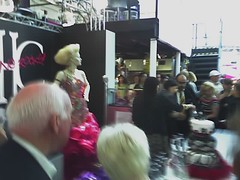
Sadly, today is my last ABT performance of the fall season. I’ve been to two others in the last week that I haven’t had time to write about, but will do a wrap-up soon. Finally got a picture of Citizen (above) that shows the costumes I was going on about pretty well. And below is Company B, probably my favorite dance overall of this season, or at least one of my favorites.

Did you guys see Center Stage: Turn it Up last night? What did you think? There’s a discussion going on in the comments section of this post.

Okay I am off to my last ABT performance… Oh, don’t forget to turn back your clocks today, you guys. My main clock (that I rely on) automatically turned itself back an hour last week, since that was the old daylight savings time, and I was almost late for a performance…

CITIZEN, World Premiere at ABT

Last night at American Ballet Theater was the world premiere of a new ballet, Citizen, by Lauri Stallings. Stallings definitely knows how to hold an audience’s attention by creating spectacle, and I’m hoping ABT sends me some photos soon, because there was a lot to see. In the meantime, I will describe.

First, big kudos to ABT for putting on something so completely contemporary, so experimental. The company has a reputation for being a bit conservative and I’m not sure you could get farther from Swan Lake or Don Quixote!


So, the curtain was raised to the sound of falling rain. The background was open — it looked like walling was removed — to reveal pipes and such. The back stage doors were fully visible to the audience, and, at points, people dressed in plainclothes walked in and out. David Hallberg was heavily made up and dressed in a bright, richly textured-looking corset, over a skin-toned mesh undershirt and skin-tight resplendent silver tights that stopped at the knees. The costumes were really brilliant (and on more than one level this dance reminded me of Jorma Elo. In terms of the movement, it reminded me of his Brake The Eyes, my favorite of his works, and in terms of the marvelous costumes, it reminded me of his Close to Chuck, his last commission for ABT.)

Blaine Hoven was dressed in hippy-style, flared-bottom silvery pants and a mesh top with a shiny white satin-looking tie. Paloma Herrera, the main ballerina, wore sequined halter top and short shorts. Of the two other ballerinas in the piece — Isabella Boylston and Nicola Curry — one wore a ratty, netted dress, and the other a ruffled white top and I think short sequined pants. Everything was in greys, silvers, and whites. The elaborate costuming (by April McCoy) — suggesting heavily made-up veneers, false masks that we all put on perhaps — made for a stark contrast with the completely open, mundane setting.

Honestly, I found the costumes so stunning, I need to see this dance again; I paid too much attention up front to the clothes and too little to the movement!

Soon, music began — stringed instruments creating an atmosphere of sad nostalgia. The dancers moved robotically, or like puppets, like they were being controlled from above, perhaps like some citizens are? Movement was intentionally awkward, arms jutted out elbow-first, legs flicked out by the knee, pelvises stuck up and out as a dancer bent over, and at points they would walk in short staccato Charlie Chaplinesque steps, with turned-out feet, like clowns. At one point, Paloma bourreed on her tip-toes toward David, resembling the doll in The Nutcracker. Not a real ballerina, a toy version. At times they’d make circular patterns above their heads with their arms, ballet-like, but the movement was anything but fluid. They were all more like dancer dolls, false replicas.

At one point, all the people working in the wings — technicians, the sound gals — came out, dressed in regular streetclothes. They just kind of stood behind the dancers, looking out at the audience. The violins stopped and the lights went on, shining out on us. But the dancers didn’t seem to be breaking “the fourth wall” — they kept going on with their thing; it was only the technicians who confronted the audience, returning our gaze. I couldn’t tell if the technicians were supposed to be participants in the actual dance, or if their presence was supposed to suggest this was a dress rehearsal — “all the world’s a stage” – like, or all the world’s a dress rehearsal, rather. Soon, the lights went down again, the techies left, people walked back out the back stage door, and the sound of raindrops resumed as before, this time with glitter falling from the sky. “The show” resumed.

Robotic as the dancers moved, they were also very human, or trying to be, struggling to seek connection. David would walk his Charlie Chaplin walks toward Paloma, but she’d dart away; he’d put his nose to her face as if trying to know her by taking in her smell, like a dog. But struggle as they did, there was never a real connection. This movement, this following one another, seeking one another out, continued to the end, when Paloma crawled away from the rest of the crowd, toward the front of the stage, and made her way practically to the edge of the orchestra pit. The curtain slowly fell, and right before it landed on her, a hand reached out and pulled her back in. So, maybe they did connect in the end.

It did make me think of the world we, as citizens, inhabit. How much our actions are controlled by others, even in a (so-called) democracy. How much of our actions and the faces we put on are false, but how we’re still fundamentally human and yearning for connection.

I’m not sure if this is what she was getting at, but I’d love to hear others’ takes! It’s showing again this weekend and next.

The program was nicely varied: in addition to the Stallings, were Tharp’s sassy, frolicking Baker’s Dozen, Tudor’s sadly beautiful Leaves are Fading, and Theme and Variations, Balanchine’s super-charged homage to Imperial Russia replete with majestic Tchaikovsky, glittery tutus and tiaras, and brilliant, high-jumping twisty turns.

If anyone sees the Stallings, let me know what you think.

Just Say "No" To Minimalism, Please!


So, last night I went to the Guggenheim primarily to see this Works & Process combination dance / fashion program, “A Two Part Affair — Ballet and Modern Meet Uptown.” I was really looking forward to it because, unlike the other W & P programs, which are more of a preview of an upcoming show, this was a performance only to be shown at the museum. Two choreographers — one, Pam Tanowitz, from the Modern world; the other, Brian Reeder, from Ballet — collaborated to form a kind of hybrid dance form.

Also exciting was that Jillian Lewis, from Project Runway, did the costumes. She, along with Tanowitz and Reeder, spoke about the production on a panel moderated by dance writer Robert Greskovic (who is actually a pretty funny guy — who knew! — cracking jokes right and left, making fun of himself for being so out of it as to not know who Lewis was 🙂 I probably shouldn’t admit it but neither did I :S — I just don’t watch enough TV…)

Anyway, the program, as its name implied, consisted of two parts: the first danced to Renaissance music; the second to modern composers like Charles Wuorinen (creator of the upcoming operatic version of Brokeback Mountain), Philip Glass, and Lou Harrison. This second part, I far preferred to the first, though to be honest, I thought most of it was pretty eh… pretty, but just nothing that really blew me away, either costume- or choreography-wise.

I feel like we’re currently in the midst of a rather unfortunate period of Minimalism. Choreography consisted mainly of ballerinas tip-toe-ing around, taking very small steps, men and the sole female Modern dancer doing these small side-sweeping steps, sometimes with flexed feet, sometimes pointed. Once in a while there’d be a leg slightly raised and a very small waist-high lift, but overall there was nothing spectacular, nothing the least bit dramatic about the movement. I think choreographers still need to tell a kind of story with the movement, even if it’s not a full narrative but of the Balanchine (“whenever a man and woman are onstage together, there’s a story) variety. I just didn’t see that here — dancers kind of partnered at random with one another, broke into a short solo, but there didn’t seem to be anything to it that you could hook onto.
And the costumes — well, here are some more pictures so you can see for yourselves:


So, as you can see, all of the men’s costumes consisted of pink or blue diaphanous t-shirts and tights with cut-outs that were also see-through in places. The female dancers all wore leotards with exterior underwire bra; the two ballerinas sassy little striped tutus and the Modern woman a lacey thing that wrapped around her neckline feather boa-like. But the tutus and boa were worn only in the first, Renaissance section; they were taken off for the modern.

I mean, Lewis was likely going for sexy– she said she wanted to focus on the body, highlight the human form — but to me, I guess that’s just been done before. Plus, she used such light colors and mundane-looking fabrics, the costumes just kind of almost weren’t even there. And, even including tutus and boa, they just didn’t seem to fit at all in the context of the Renaissance. I then remembered seeing David Hallberg dance earlier at the Guggenheim in a fabulous Christian Lacroix. He left out the delicious candy-apple velvet jacket, but here are some pics he took of himself in the tights. I mean, hello — THIS is what we need to spice up Ballet, I say! I say away with minimalism; bring back Lacroix!

Anyway, I really did appreciate the concept of this program; I think collaborations can be very fruitful and lead to innovation and creativity. Back to the dancing for a moment, I really just think the choreographers needed some more time. There was one point during the second, modern, part where Roman Zhurbin (center, in the bottom picture) held his arms out and each ballerina grabbed on. He lifted, walked slowly around stage carrying the two of them. To me, it was beautifully reminiscent of Balanchine’s Apollo. At center stage was one of the male modern dancers in a kind of Martha Graham-esque pose, body bent over forward, foot flexed back, seeming to carry a non-existent world atop his arched-over shoulders. So, also Apollo-like, yet fundamentally Modern in form. It was like a double-sided Apollo. I feel like they should have gotten rid of everything else, used this stunning moment as a starting point.

I think the rest of it was kind of too hybrid. They didn’t use the Ballet dancers to show the beauty and poetry of the dance form; ballerinas were going on pointe and Zhurbin would point instead of flex his foot at times, but that doesn’t really mean anything. It just looked like a very watered-down form of Ballet. And then both Zhurbin and the female ballet dancers had these very muscular bodies — particularly Zhurbin (aka Ballet god! — never noticed that before; ABT is really under-using him…), and the Modern dancers were more thin, almost a bit scrawny in comparison. But of course there’s a reason for that — Ballet requires great use of the legs, the thigh muscles for those huge jumps and the calves for pointe work. And the upper body is so developed for spectacular overhead lifting. If you don’t show some of that difference in the movement, I think the bodies end up looking a little weirdly unbalanced…

One final thing: writer Claudia La Rocco didn’t see the program, unfortunately, but here’s an interesting discussion she and her commenters started about Ballet’s current kind of identity crisis and how costuming fits into that.

More Parsons (With Update at the Bottom)


I was only recently introduced to Parsons Dance a few months ago, through the Maria de Buenos Aires tango operita that Philip had invited me to. So, their Joyce season, currently underway, gave me the perfect opportunity really to see what choreographer David Parsons is all about, since, in celebration of his company’s 20-year anniversary, it presented basically a compilation of his greatest hits.


Overall, I liked them well enough to want to see them again, but not enough to fall head over heels in love the way I did with, say, Alvin Ailey. There are two programs, consisting of six dances apiece, with only “Caught,” which seems to be Mr. Parsons’s masterpiece, repeating in both. So, I’ll start with that one. This is a short piece which I described in my earlier post. On first viewing, as I said, I could understand why the audience went completely beserk with mad applause over it, but I found it a bit gimmicky. On second viewing, those feelings solidified. On my second night, I also realized that, when the sole dancer, again the wonderful Miguel Quinones, began doing the grand jetes around the stage’s perimeter and the strobe lights started flickering, it was only at the beginning of the leaps that he was actual jumping; soon he was pulled up by a cord emanating from the ceiling and merely carried around stage like a masculine Tinkerbell while the lights flashed. So, it’s not that he appears to be flying because he’s such a great jumper and perfectly coordinates his leaps with the lighting engineer; rather, he appears to be flying because the whole set-up is a trick. I guess I can still see why people think it’s cool, but I think it’s kind of cheating. Also, I’d originally thought, wow, Quinones (or whoever dances the role) must really have focus in order to be able to do those huge leaps with those insanely distracting lights. But now that I know he’s not really doing the work I thought he was, it’s less amazing.

Anyway, moving on. I liked Program A much better than Program B. Going in order, my first favorite was “Sleep Study.” This is a cutely humorous piece in which the dancers, dressed in pajamas, feign being on the verge of falling asleep, but tired as they are, only one man can actually do so. The others roll over each other and sit atop each other in playfully amusing ways. At one point a woman sits on top of a lying man, her back and his head to the audience, and as he bops up and down to the music, they create a funny, shape-shifting Pilobolus-like sleepless creature. It was highly relatable — who hasn’t had a night where they just couldn’t get to sleep no matter how tired they were? — and many of the moves and shapes created by the dancers were simultaneously simple and original.

I also liked “Nascimento,” which is not so shocking for me since it’s choreographed to music by Brazilian composer Milton Nascimento. Actually, Parsons used this composer in two works, this one and “Nascimento Novo,” a later-choreographed piece on Program B, and the first, “Nascimento,” — a sunny, happy celebration of Samba and other Brazilian rhythms that was nevertheless rooted in balletic partnering and movement — was my favorite. For one thing, the costumes in the first (by Santo Loquasto, who is fast becoming my favorite costume designer) composed of cheery reds and oranges and yellows well complemented the lighthearted theme, and the flowing sundresses for the women accentuated the quick, lively turns and lifts. In the second, “Nascimento Novo,” whose music I found to be lovely but choreography less original and more bland, the costumes (whose designer isn’t named in the program) were boring white tops and gray bottoms that didn’t move well (pictured below).


I also liked “Kind of Blue,” a bluesy ensemble piece set to Miles Davis’s “So What,” and “In the End,” a carefree ensemble work set to music from the Dave Matthews Band, whose choreography was a combination of jazz and contemporary ballet. Finally, I liked “Bachiana” from Program B, a sprightly, energetic, baroque dance set to Bach’s “Orchestral Suites” that reminded me of Mark Morris or Paul Taylor. The choreography was fast and creative, and the dancers really shined performing the intricate-patterned, fast-paced footwork. “Union,” pictured up top, was the antithesis, a long, balletic, adagio dance for the whole group consisting of some beautiful lifts, but I felt this one lacked structure and didn’t seem to go anywhere special. “Brothers,” pictured in the middle, was, as the name implies, a short dance for two men, examining the nature — at times competitive and argumentative, at times loving — of brotherhood. It had its moments and some of the choreography was original, but it just didn’t really blow me away. “Shining Star,” an upbeat disco-y piece set to Earth, Wind & Fire closed Program B. I think my problem with this dance, perhaps unfairly, stemmed from the fact that in recent seasons I’ve seen something very similar from Alvin Ailey that I felt was far more sophisticated. It’s obviously unfair to compare a production by a monied, behemoth company with resources galore to something by a much smaller one, but it wasn’t really the sets and costumes and greater number of dancers that set things so apart; it was more, I felt, that Ailey’s choreography was more varied. By the end of my second night at Parsons, I felt that if I saw the lift where a woman stands on a man’s bent leg and reaches out away from him, I was really going to lose it.

Dancers who stood out to me were the aforementioned Miguel Quinones (whom Parsons, rightly, used a lot), Patty Foster (who, with her endless energy, lovely lines, commitment to doing everything full-out, and charisma – and oh yeah, her small size 🙂 reminded me of Lauren Grant from Mark Morris); Malvina Sardou; and Kevin Ferguson (the latter two of whom just stood out to me for some reason I can’t entirely put my finger on).

Despite my rather lukewarm review, this is a company worth seeing once or twice and Mr. Parsons has a very loyal following. And, from that following, here’s another perspective.

Okay, off to see David at the Guggenheim!!!

Update: After having an email exchange with a friend over “Caught” I am now not completely sure whether the dancer was suspended by a wire. The reason I thought he was was that I was sitting close to the stage and, as Quinones ran off into the wings following the end of the piece, I thought I saw a large black pocket on the back of his pants, right below his waist, perfect for housing a wire, which I figured he must have somehow dismembered before exiting. Also, sitting so close to the stage, I thought I could see, albeit at whip-lightening speed, the spaces between the flashing lights when he never came down to the floor. It could have been an optical illusion though. But why then the black thing smack on his butt? My friend swears he’s seen the piece numerous times in ceiling-less settings where there would be no way to connect a wire. Funny, because after seeing it the second time I thought it was common knowledge that he was suspended and I was a dork for not getting it the first time, but now I’m confused. Has anyone else seen this dance???

Petipa is the New Black

“‘What color would you say this is?’ Lana asked, handing her the pump. ‘Not quite turquoise.’

‘Oh I’d say Bluebird. Very franco-russe, very Petipa.'”

Hehehehe, I’m really enjoying this novel, Women About Town, by dance critic, Vanity Fair contributing editor and novelist Laura Jacobs. One of the main characters, Lana obviously, is a dance critic, and it’s so fun reading about her world. At times kind of frighteningly competitive and at times sweet. Dance critics so live, breathe, sleep (and shop!) dance, sometimes more so I think even than the dancers… Anyway, can you imagine going shopping with your girlfriend and speaking about the clothing and colors in ballet terms? I love it — can totally see me and Ariel doing such a thing, when she moves to NY 🙂 Probably with us, it’d be more like, ‘whoa, that’s Tybalt yellow!’

Survived First Dance Class in Four Months!

Okay, how come I always look like an ass in ballet class, but a ballerina in all the other styles of dance I take? Tonight, I took my first dance class in four months now (yikes) — a beginner Flamenco class at 92nd St. Y. Seriously, in lieu of the beautiful palmas (fluidly wrist-bending Latin / Indian hand movements that are one of the three basic elements of the dance), I did the perfect port de bras (balletic arm movements). I mean, I’m sure they wouldn’t have looked like perfect port de bras in ballet class, but they sure did in Flamenco. No matter how much Latin I take, for some reason I always have the tendency to turn my wrists inward so that my palms are toward my body (as in ballet), rather than turned out, away from it, as they usually are in Latin. It’s ridiculous.

And damn do those castanets require patience! We only did basic taps, but tapping the pinkie finger, then the ring, then the middle, then the pointer, then moving to the left hand in a continuous one-two-three-four-five rhythm, faster and faster and faster was so unbelievably trying on my nerves, for some reason. I had to keep shaking my hands like I was shaking off a bug or something. And keeping my arms up in the air was a bit painful, embarrassingly. I am just a bit out of shape here 🙁 And forget trying to coordinate the castanet taps with the wrists with the arms with the foot toe / heel stomps (my favorite part — gets rid of some real aggression :D)… forget it! This dance is so hard. It’s not athletically hard in the way ballet is, but it requires maximum coordination that I don’t have!

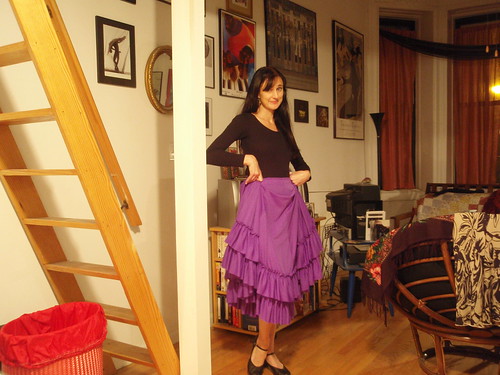
I’ll probably stick with it anyway; it’s good for me 🙂 Unfortunately, the teacher has a strict dress code — all black — so I can’t wear my pretty purple Flamenco skirt (above). Don’t really understand this — I took a Flamenco class at Ballet Hispanico months ago and wore the skirt to Paso Doble classes at two different ballroom studios and no one’s ever had a problem with the color. It cost $75 too, so I have no intention of buying another one in black. My black ballroom skirt will have to do, though it doesn’t have the pile of ruffles at the bottom so is not going to look wholly right for Flamenco… I just always pride myself on being different, so was rather pleased with myself for finding such a color.

I’ll never forget the first dance class that blew me completely to Heaven, made me feel like I was experiencing a whole new level of humanity, made my heart race: it was basic ballroom Samba with Roula Giannopolu at DanceSport studio. I remember I was squealing when I came out of there, practically crippled with blisters, my classmates trying to steady me and asking if I was okay. “What kind of music was that?” I screamed out demandingly, collapsing on the lobby sofa. No one knew and Roula had sprinted off to her next class. “That was like ballet and African and Latin and just the whole world!” I cried, flailing about. I haven’t had that same exact experience since and I so long for that feeling again. I think I may sign up for group ballroom classes next month. I like the solitary Latin dance classes I’ve taken — Brazilian Samba at Alvin Ailey and now Flamenco. But ballroom’s really where my heart is.

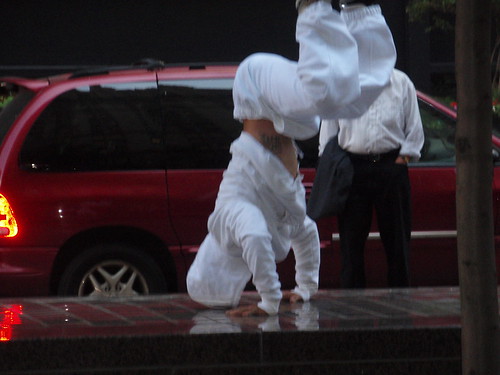
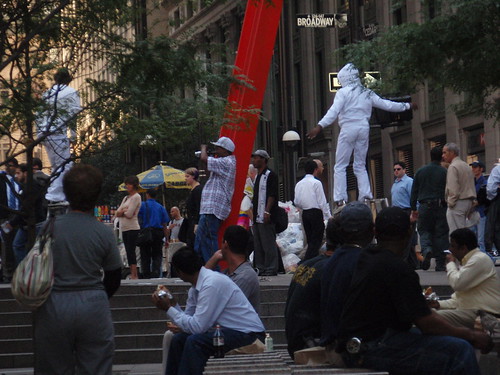
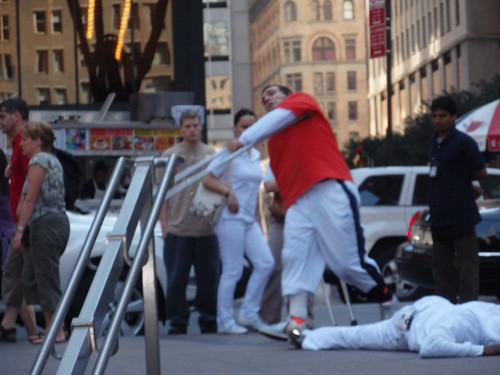
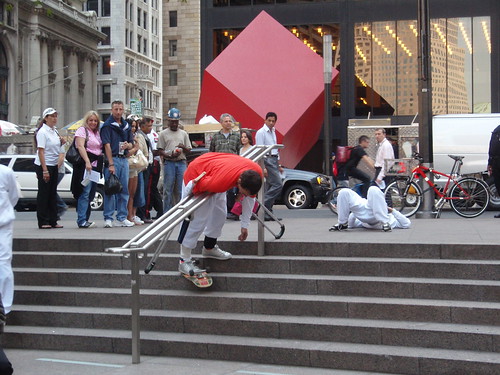
Anyway, on another note, here are some more pictures I took today during my lunch hour of the Bill Shannon “Window” site-specific dance performance that I blogged about at the beginning of the week. It was funny seeing it down on Liberty Plaza this time, after having watched from the high-rise before. I had thought when I was inside looking down that people were trying to be good New Yorkers and avoid any weirdish person making a “scene,” but being down there with the people, I realized that the area the dance was performed in was so vast, without music, it was actually pretty hard even to notice. You had to really seek him and his dancers out to see him. Dance is also so music-dependent I realized. Upstairs we had the music blasting from the speakers to accompany the movement we saw out on the plaza. It really got you into it, made you move a little yourself. Being down there with no speakers, the movement just didn’t have the same meaning, it wasn’t as fun, it wasn’t as noticeable, it wasn’t as “performancey” which I guess was the point…

One of Shannon’s break-dancers.

The guys in white are the performers. It might be apparent, it might not.

This is Shannon himself, on the crutches. I didn’t notice him zooming around on the skateboard this time; he used it more as a prop than a vehicle, unless I just arrived a bit late and missed that part of it.


On, and another thing, at one point a woman walked up to him while he was on the ground break-dancing. I guess because he had the crutches, she thought he was hurt and tried to help him up! He spoke with her a bit, but with all the city noises, I couldn’t possibly hear what they were saying. I wonder whether he went along with her, told her what was really going on, or if I just completely misunderstood the whole interaction and she was actually part of the performance!

Two New Champions Crowned In American; Same Ole Same Ole for International: Manhattan DanceSport Championships 2007

Very exciting (but very tiring) weekend, nearly all of which was spent at this, the biggest and best of all local (ie: Mid-Atlantic region) competitions! Thanks to the retirements of the two top couples in American Smooth and American Rhythm, we now have two new champions in those divisions. Above are the new champs of Smooth, Eulia Baranovsky and Steven Doughtery. Below are the newly crowned King and Queen of Rhythm, Joanna Zacharewicz and Jose DeCamps.

So often with Ballroom competitions, the same people win over and over and over again, making the dancing itself always spectacular but the results a complete bore if not outright annoyance (if your favorite happens not to be the one who ad nauseam places first). So this year’s dual retirements (Ben and Shalene Ermis in Smooth, and now permanent DANCING WITH THE STARS fixtures Tony Dovolani and Elena Grinenko in Rhythm), made for a couple of very nail-bitingly intense nights all the way up to the 1:00 a.m. trophy presentations.

Above is, awww, my personal faves for Rhythm, second-place couple Emmanuel Pierre-Antoine and his new partner, Julia Gorchakova. Actually, Rhythm this year was a particularly loony soap opera. Ever since I first began coming to this competition, three years ago now, I’ve noticed the Rhythm championship is by far the most raucous of all four categories. Especially during the last of the Rhythm dances, Mambo, when the crowd is just going wild screaming and cheering on their favorite couples so loudly, you can hardly hear the music.

(If you know nothing of Ballroom, and actually care to know :), let me just briefly lay out the blueprint of an American competition: There are four main categories (each of which includes separate competitions for professionals, amateurs, and pro/ams, where students compete with their teachers — the kind I used to do when I still had a bank account 🙂 ):

1) American Smooth (couples compete in 4 dances: Waltz, Foxtrot, Tango, and Viennese Waltz);

2) American Rhythm (5 dances: Cha Cha, Rumba, Swing, Bolero, and Mambo);

3) International Standard (5 dances: Waltz, Slowfox, Viennese Waltz, Tango, and Quickstep); and

4) International Latin 🙂 (5 dances: Cha Cha, Samba, Rumba, Paso Doble, and Jive).

So, back to the Rhythm drama. The crowd favorite has been, for a long time, this couple (pictured below in last year’s National competition: Emmanuel Pierre-Antoine and Joanna Zacharewicz):


For whatever reason, and I don’t want to get into gossip over who initiated and why, they broke up. And with that break-up, fan loyalties were torn asunder, oh no! Emmanuel teamed up with former, longtime Rhythm champion Julia Gorchakova, who, with her former partner, retired a couple of years ago but apparently came out of retirement just for him. And Joanna managed to snag the very cute and rather celebrity-esque, Jose DeCamps, who formerly danced with probably the most famous of the DWTS pro dancers, Cheryl Burke. I haven’t seen Jose before and I’m thinking he retired after Cheryl began her TV stint, and likewise emerged from retirement for Joanna, but I’m not completely sure; he may just have been partnerless.

Well, my heart was with Emmanuel, for reasons I’ll get to in a second, but I just have to say I can completely see why Jose has the fan base he does. He just exudes safe, strong, warm Latin guy, kinda like a certain favorite ballet dancer 🙂

But my loyalties must remain with Emmanuel! Before he left my old studio, I took a few lessons with him, and he was one of the best, most technique-focused teachers I’ve ever had. I wrote about this before (but it was before anyone ever read my blog 🙂 ), but he used to do this thing where he’d start us out with a completely boring salsa basic. I guess just having seen so much ballet, I’m always trying to “fly” as he calls it; I have no connection with the floor basically. It looks like ballet dancers are connecting with the air, not the ground, especially the ballerinas, so that was my aim of course. “Woman! The only reason you’re still upright is because you’re so light!” he’d cry out in his Haitian accent when I’d try a double spin and nearly fall. “All dancers know where the floor is at all times; even ballet dancers,” he’d rant on. Then, he’d close his eyes take me into a closed hold (guy’s right hand on girl’s back shoulder blade, girl’s left hand on top of his shoulder and free hands clasped together) and tell me to visualize myself connecting with the floor. And the freaky thing is, he’d have this uncanny way of being able to tell how well I was mentally connecting to the floor just by feeling my frame. He could honestly tell, with his eyes closed, whether my mind as wandering (thinking, for ex., ‘can’t we do something beyond a stupid salsa basic’), or whether I was concentrating on the floor beneath my feet. And he was always right on the mark about where my mind was. Weird. Anyway, in addition to being an excellent teacher, he’s a genuinely nice guy. He always goes out of his way to say hello to me at all the big competitions, even though he is really a kind of “star” in the ballroom world, and he’d always tell me I did well in a showcase (though I knew it wasn’t true!) Oh, and he’s also an amazingly awesome dancer! Focused on technique though he is in his own lessons, he really puts on a show like no one else. His choreography is so mad fun, his style so wild, he and Joanna were often called upon to perform showdances, for example, on last year’s America’s Ballroom Challenge, and last season’s DWTS.

And what a riotious show-down it was Sunday night! Both Jose and Joanna and Emmanuel and Julia really danced their hearts out. As my friend pointed out to me, the judges’ faces kept seesawing between the two, stopping to focus on absolutely no one else on the floor. “How are they going to decide who comes in third, fourth, and fifth?” she said.

The fun / intensity / melodrama — however you prefer to see it — of this competition is that it’s the biggest in the area, and one in which all of the top couples compete. Many see it as a forecast of what’s going to happen — who’s going to take tops — at Nationals in Florida, coming up in September.

No surprises in International-Style.

Andrei Gavriline and Elena Kruychkova won in International Latin.

And the always glorious Jonathan Wilkins and Katusha Demidova in Standard. My favorite Standard couple has long been Victor Fung and Anna Mikhed, below.


But, actually, the more I see of Jonathan and Katusha, the more I hear Jonathan lecture on the art of Ballroom dance at Blackpool and the way his love of the sport / art really shines through, and the more I really watch them closely and realize their technical brilliance, the more he really is growing on me. I think sometimes, Englishmen can seem distant and aloof at first. But he really does seem to appreciate his fans and the applause they get, weaker than that received by Victor and Anna. And his dimpled Ralph Fiennes smile is starting to be a familiar staple of my whole ballroom experience, an essential part of that world that just whisks me away whenever I go to these big competitions. And the more I see them dance, I do see why, though Victor and Anna are the king and queen of charm, the more I understand why Jonathan and Katusha are number one in the country for several years in a row now and practically number one in the world. Some of the things they do, while not so flashy, are very difficult. I love it when he takes her out to the center of the floor during Waltz and they’ll do reverse turns for over a minute. Those are not only absolutely beautiful, but so hard to sustain that momentum and maintain that precise footwork for so long — far longer than the other couples — without getting dizzy, especially for the woman since you really have no way of spotting, and you’re just turning and turning and turning.

Okay, Latin, the other melodrama, this one never-ending:

Above is the eternally second-place couple, Max Kozhnevnikov and the absolutely divine Yulia Zagorouychenko, by far the crowd favorite, which, believe me, becomes all too obvious with the loud, rather nasty boos of disappointment when Max and Yulia are called runners-up. I always feel sorry for Andrei and Elena when that happens, because the crowd is booing, by extension, their winning. Funny thing is: while the U.S. judges continuously mark Andrei and Elena number one, the World judges repeatedly place Max and Yulia well above Andrei and Elena. In fact, Max and Yulia made finals at Blackpool this year. The U.S. judges insist Andrei and Elena’s technique is perfect and will say no more. But the World judges insist otherwise, showing, excuse me, but how full of absolute dog crap ballroom judges can be.

Anyway, for me, my ideal partership (of the American couples anyway) would actually be Andrei with Yulia. I’ve honestly never seen anyone (of the Americans anyway) move the way Andrei does. He is a tall thin man who just flies across that floor seemingly at lightening speed, light as a feather, and his hips, legs, and feet just a blur. He used to give privates at my studio, and before I knew who he was, I saw him show a student a backwards three Cha chas– a very rudimentary, first-level step. I’d never seen anyone do a basic step like that. My heart dropped. I realized then good dancing is not about fancy steps, but about the way the basics are executed. I remember thinking, wow, this guy should compete. Stupid. Then, I saw him on the cover of Dancesport mag and realized, dur, he’s the national champion. My problem with his partnership with Elena (his wife) is that, a former gynmast, she’s so teeny tiny; he must be nearly a foot taller. Not only do they look a bit odd together, but sometimes it throws them off. Last year at the Ohio Star Ball (aka: “America’s Ballroom Challenge” in its televised incarnation), they lost a normally easily-maintained connection, likely because his arm was just too high to hold her properly.

And Yulia! Yulia Zagorouychenko is probably my favorite of all female Latin dancers, excepting Karina Smirnoff who (also now a mainstay on DWTS), hasn’t competed in a while. Not to sound silly, but to me, Yulia is like the Alessandra Ferri of Latin — she’s a true artist. She moves in wholly unique ways, creating shapes with her body that are completely her own. She’ll go nearly on pointe in those open-toed sandals in Rumba, thrusting her hips foreward and rounding her shoulder blades so that she looks, cooly, like a cobra or something. I worry that she’s going to get serious bone spurs on her toes by the time she’s in her thirties with that on pointe on a hard-wood floor in open-toed shoes, but right now it looks absolutely gorgeous. I feel that sometimes Max, as much of a little cutie as he is, and as creative as he is with their choreography, just doesn’t really share her artistic brilliance.

So, it’s funny because, well, at one point on Saturday night, the two couples were dancing very closely to one another. I think the dance was Rhumba. I was focused on the couple right in front of me, another favorite, the breathtaking Delyan Terziev and Boriana Deltcheva, when all of a sudden the crowd began going wild. I looked further out onto the floor to see that Andrei and Max had exchanged partners– particularly cute, and demonstrating very good sportsmanship given the rivalry. Max went to dip Elena and she jumped up and wrapped both legs around his back. Lifts are strictly forbidden in non-showcase competition, but of course it was a moment of goofiness, and therefore, forgiven. Silly as she was trying to be, I was amazed at how good they actually looked together; their small bodies were a perfect match for each other. And then I looked at Andrei and Yulia — he was doing this crazy dip with her and it looked so amazingly stunning. Then she stood up and placed her arms around his neck. She’s a lot taller than Elena and they looked absolutely gorgeous together. Powerhouse couple that would be!

Anyway, here are some more highlights:


Delyan and Boriana, as I mentioned above, one of my favorites artistically. They’re a tall, thin, long-limbed couple and their Rhumba looks almost Balletic. She looks like an inky black spider!

They’re at the same level as my dear beloved Pasha and Anya (who didn’t compete, as they are a little busy with something else at the moment!!!), the two usually duke it out for fourth or fifth place — way too low for both couples. Strange how I always seem to champion the underdogs…

A Smooth couple I like, J.T. Damalas and Tomasz Mielnicki. They always dance with a lot of pizazz, and always do a very sexy foxtrot. I think they placed third. She makes her own dresses, and she usually comes up with something just bedazzling. How gorgeous is that color!!! (Sorry for all the zombie-looking eyes, by the way. I need a new camera!)

Matt and Karen Hauer, a sweet, newlywed Rhythm couple. They started off their Mambo routine very cutely: he took one look at her and broke into a series of small jumps, as if to say how wowed he was at her. She watched in amusement, then he grabbed her hand and they took off.

Another shot of Jose DeCamps and Joanna Zacharewicz in Rhythm. Jose really is a charmer.

Katusha’s little sister, Anna Demidova and her partner, Igor Mikushov, who placed first in Amateur Standard. They competed in Blackpool as well, and placed very high there too. Promising future those two.

The always lovely (and very photogenic) Anna Trebunskaya (if name sounds familiar, she too has danced with stars; that sports star Jerry Rice, to be exact). She has a new partner, Pasha Barsuk (oh no, another “Pasha and Anna”!!) and they did very well for a new partnership, placing 5th in Latin. Good for her 🙂

One last thing: the throng of spectators was absolutely huge, as you can kind of see here with onlookers anxiously awaiting Victor and Anna’s slowfox. Latin was about ten times worse than Standard though; you really could hardly move on Saturday night, and I’m sure the crowd standing, of necessity since there was nowhere else to go, around the exit, was a borderline fire hazzard. Blackpool was crazy packed this year too. Attendees at ballroom competitions used to consist mainly of friends and family (and the few students) of the competitors, a crowd that could easily fit at the several tables encircling the dance floor. But the more popular dancesport is becoming, the more of a spectator sport it really is. I think they’re going to need to find a new venue for some of those more popular competitions and put up some serious risers. At least for Latin…

Anyway, here are more photos in the album. It’s not finished yet, as I have yet to match some names with faces, and some names are horrifically misspelled, so please bear with me until the weekend when I have more time for fix-ups.