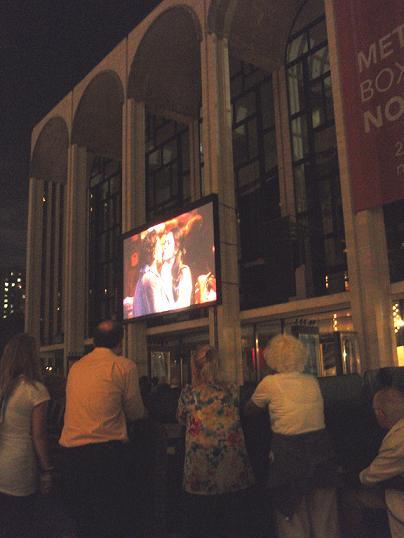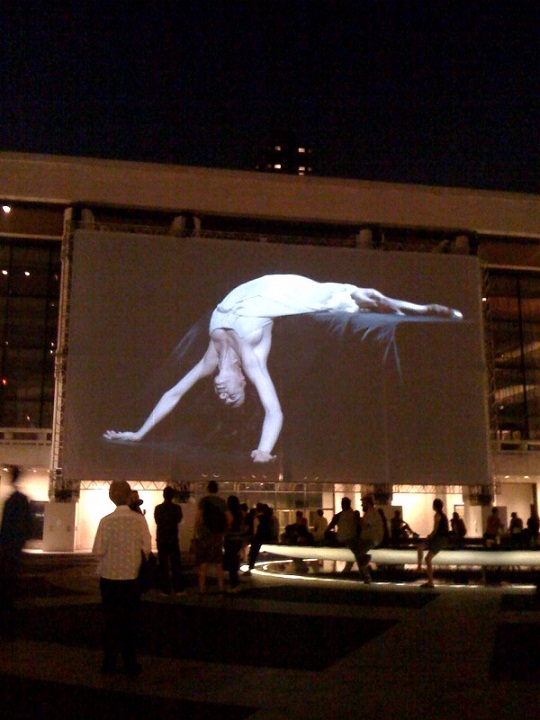
PORTRAITS IN DRAMATIC TIME on Lincoln Center Plaza

Here are some photos I took of David Michalek’s current installation, Portraits in Dramatic Time, shown nightly on the facade of the Koch Theater at Lincoln Center Plaza. Above is (SLSG favorite) ballerina Alessandra Ferri, apparently in the ending scene from Romeo and Juliet. Commissioned for the Lincoln Center Festival, Portraits is similar to Michalek’s earlier installation from a few summers ago, Slow Dancing, which I wrote about here.
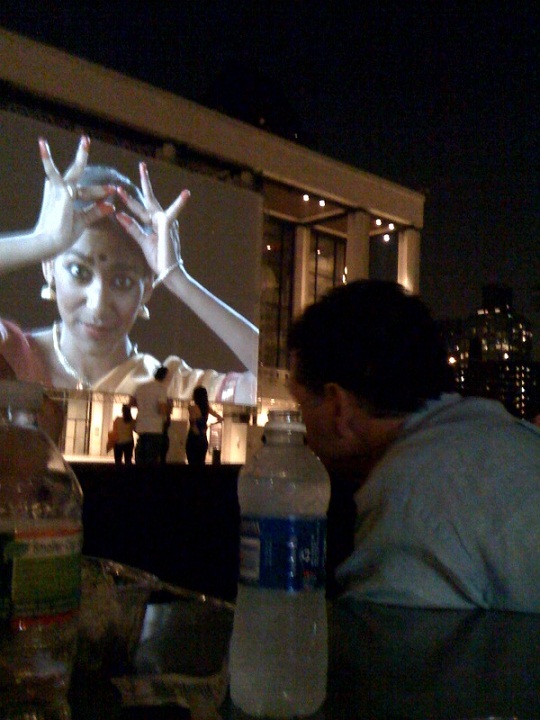
Unlike Slow Dancing, the only two dancers (at least that I’ve seen) in Portraits are Ferri and classical Indian dancer, Savitry Nair, above. To me, Nair was the most mesmerizing, I think because of the intricate (and to me exotic) movements she was making with her hands, but also because of the intensity of her eyes. Patti Lupone (below) was a close second.
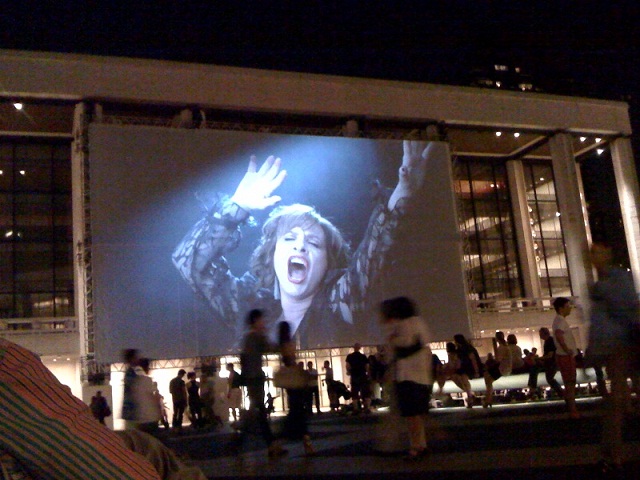
Besides the two dancers and one diva, the others seemed to be all theater actors. Like, Slow Dancing, Michalek filmed the actors in a short scene, then slowed the movement way way down for greater dramatic effect. At least that was the intent. I’ve only watched a couple times, and plan to go more, but, as with Slow Dancing, I have mixed feelings. I think Portraits may be able to attract a larger audience than Slow Dancing due to the greater fame of the stars filmed, and Michalek did for the most part choose dramatic scenes, such as the one below of Alan Rickman throwing a glass of water in anger.
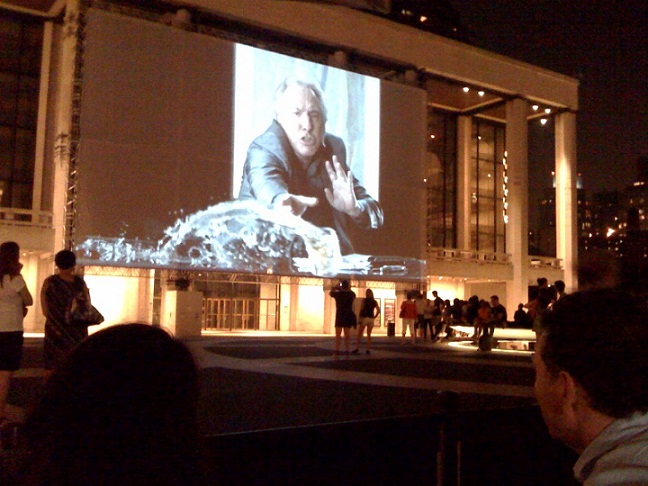
Not all of the scenes are quite as action-packed. You’re often looking more at the intricate changes in facial muscles as the actors go from one emotion to the next. I felt like watching Marianne Jean-Baptiste read a letter and Lili Taylor converse with her daughter provided real lessons in acting.

But in other scenes, even if there was some kind of drama, I didn’t always understand what it was about, or the characters’ relation to one another, and consequently I failed to be as captivated by the mini narrative as I would have liked.
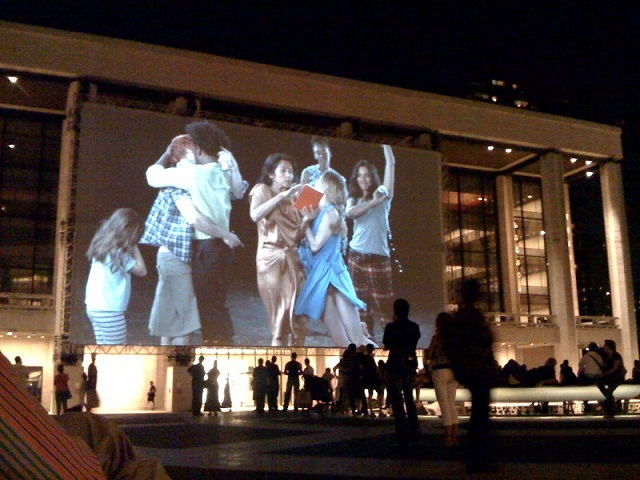
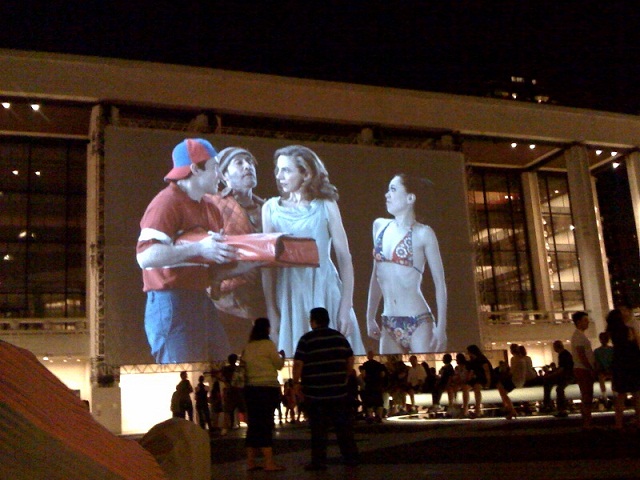
Watching and listening to others on the Plaza, I felt like I wasn’t alone in that thought. The big screen captures your attention but oftentimes fails to keep it. Of course I really wanted to shout at people who were only glancing at Alessandra before passing!

I said this with Slow Dancing, and I’m pretty sure these films are moving faster than the original Dancing films, but I still think they’re going just a bit too slowly. It would also provide variety to rotate more between performer-types – like dancer, actor, diva, dancer, actor diva, etc. But as I said, I saw mostly actors here. I also noticed, though, that there are many performers listed on the show’s website that I didn’t see, and I’ve gone on two different nights so far and have seen many repeats, so I don’t know if all of the listed performers are appearing right now…

Anyway, imperfections aside, it’s always wonderful to have something to go to Lincoln Center for and now that ballet season is over, it can be depressing around there. So I’m very thankful for this installation. Perfect for summertime, sitting near the fountain or at the little cafe in front of Avery Fisher Hall, sipping wine or eating Gelato. This is the best part of living in NYC, imo.

Portraits shows nightly through the end of July. For more info, go here and here.
WHY ARE OUTDOOR CROWDS SO MUCH MORE RESPECTFUL OF THE OPERA THAN DANCE?

p9032296

p9042301

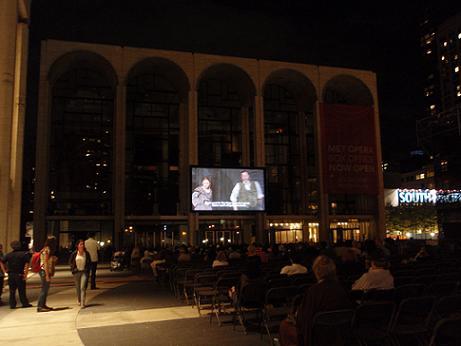
For the past few evenings I’ve been partaking of the Met Opera’s outdoor Summer HD Festival on Lincoln Center Plaza. The first night I went was Benjamin Britten’s Peter Grimes. It was on a week night and the plaza was about half full. I’d bought a sack pique-nique dinner from Bar Boulud across the street — which was delic by the way (chilled gazpacho soup, baguette of brie and fresh fig spread, waffle chips, bittersweet chocolate tart, and bottle of Pellegrino). But when I took a seat in the back and began to unwrap my brown bag I realized what a commotion I was making, how dead silent it was. I waited until a noisy helicopter buzzed around above us for a few seconds to tear into my sandwich. I absolutely loved the quiet, but figured it must be because this opera was so serious and esoteric — only true opera-manes would go.

But then last night, Puccini’s far more popular La Boheme was the same. Plaza was packed. I mean, every single seat was taken (both of the fold-out variety set up by the event organizers and make-shift seats like construction cones aligning Avery Fisher Hall), there was hardly a square foot of ground to stand on all the way to the street — people were even camped out atop the temporary Koch Theater ticket trailer (until police came around telling them to get down). But once the music began, there was the same dead silence. Everyone stared up and the screen, completely captivated. It was even quiet around the food and liquor stands, where people were basically whispering their orders. Children (the few that were there) behaved, dogs (the many that were there) behaved. Well, dogs usually behave in a crowd, actually… But even the little kids seemed to know it was important to try to concentrate on the screens.

The noisiest part of the evening was when South Pacific, showing next door at the Vivian Beaumont, let out. But once the theater-goers realized there was something important going on out on the Plaza, they shushed each other and ventured up to watch — in total silence — as well.

Such a complete contrast with some of the outdoor dance festivals — Lincoln Center Out of Doors, the Downtown Dance Festival, site-specific summertime events, sometimes SummerStage. I’ve heard from several people now that the Saratoga Performing Arts Center where NYCBallet has their summer season, is much the same, making me honestly not all that excited to go up there. I mean, kids are running around, parents yelling, people talking to their friends at the same pitch as if they were in a noisy bar, people unwrapping food, opening soda cans, popping gum.

So what gives? Do people just think opera is mainly about music and so to enjoy it everyone must be able to hear it above all else, whereas dance is more visual — so you can make all the noise want and not bother people because they can still see? Maybe it’s about the children — people are much less inclined to bring small kids to the opera, but they somehow think their two-year-old is going to have a deep appreciation of Balanchine or Karole Armitage or classical Indian dance. Maybe they equate outdoor dance performances with outdoor social dance events like Midsummer Night’s Swing, where you’re hardly going to disturb social dancers by talking. Or maybe there’s something about a big ole screen being up there.

I wonder if it would be different if ABT would have a summer HD festival and show outdoor broadcasts of some of the spring season’s ballets. Probably not… although the crowds were pretty quiet for the David Michalek Slow Dancing exhibit two years ago (once Midsummer Night Swing ended anyway)…

Anyway, tonight (Saturday) is Mark Morris’s Orfeo ed Euridice. I mean Gluck’s Orfeo ed Euridice but Morris produced and choreographed. We’ll see how it goes when there’s some dance involved… The Met outdoor HD festival continues through Monday night, ending with Anthony Minghella’s production of Puccini’s Madame Butterfly.

TWO WORLD PREMIERES — QUASI UNA FANTASIA AND TOCCATA — AT NEW YORK CITY BALLET GALA


Last night I went to New York City Ballet’s Spring season gala. I always love galas but they’re especially exciting when they showcase world premiere dances. In this case, there were two such premieres, along with the world premiere of a new piece of music set to one of the ballets.

First things first: I missed most of the red carpet events, unfortunately, since the program began early (so as to make time for the after-show dinner, which I am far too poor to attend). And shame on me for mismanaging time like that — that Waiting For Godot experience from two years ago was too much fun. I did get there just in time to see the paparazzi flashing away at (Sex & the City author) Candace Bushnell and (NYCB principal) Charles Askegard. Sweet Charles soon stepped aside to let his wife bask in the glory all on her own. She looked radiant. I was jealous.

Continue reading “TWO WORLD PREMIERES — QUASI UNA FANTASIA AND TOCCATA — AT NEW YORK CITY BALLET GALA”

Splendid Night at NYCB: 20th Century Music Masters Program


Wednesday night was one of the most enjoyable nights I’ve had at New York City Ballet. I’m totally in love with Balanchine’s La Valse. I wrote about it here when Miami City Ballet performed it and it grew on me immensely when I saw it on NYCB. My friend, Judy, fell head over heels for it too — I think she was the first person in the whole theater to begin clapping (when the curtain began going down admist the swirling Viennese waltzing couples, the group of men carrying Janie Taylor’s limp body high above their heads, pall-bearer-like).


It’s such an intoxicating ballet, with the gorgeously bedazzling, mid-calf-length tulle (which fashion industry person Judy tells me is called “tea length” or is it “t-length” or “tee-length”?) — deep maroon for the waltzing women, bride-white for main character Janie. Janie and Sebastien (who played the leads, pictured in top photo) and Tyler Angle all gave the whole thing such a tragic pathos. When Janie was waltzing with the “devil-character” — a frightening Philip Neal (just about the most intensely captivating I’ve ever seen him) and getting swirled and whirled and tossed madly about, she did these gorgeously elaborate back kicks on the fast third step, when he lifted her high into the air, almost tossing her like a rag doll. It added greatly to the crazed momentum.


It was really Tyler Angle who blew me away though. (See Times article on him by Claudia La Rocco here). He danced one of the waltzing men, prone to romanticism, who gets swept away by the seductive atmosphere, kind of a foreshadowing of what will happen to Janie’s character. At one point, he falls to the floor, and just sits in the middle of the stage, unable to lift himself of out this dream, but doing this fabulously expansive port de bras, waving his arms all about dreamily all the time kneeling, while the women twirl around him, their skirts flying, and couples whiz by him, through him actually, almost ghost-like as they separate their waltzing bodies from one another just enough pass their connected arms right over his head. Somehow his swan-like arms narrowly manage to miss them. It’s really brilliant.

I was sitting really close to the stage this time (third row!) and picked up on so many things like this that I’d missed before, when I was just taking in the whole spectacle. Such a beautiful ballet.


Also on was Jerome Robbins’ West Side Story Suite, which is always a load of fun and I’m always floored by Andrew Veyette’s booming but melodious voice as the leader of the Jets, and Georgina Pazcoguin as the sexy salsera Anita. I love how Robbins uses dance style to separate the gangs from one another and identify each’s prevailing ethos: the Jets wear white and are Swingers performing crazy aerials, the Sharks wear red and are fast-dancing, hip-swaying Saleros.

Also performed was Balanchine’s Stravinsky Violin Concerto, a story-less leotard ballet. I love how sitting so close up you can see the dancers’ facial expressions, as well Balanchine’s delectably intricate choreography. At one point, while a main couple is dancing, several women line the back of the stage and stand in place, but they don’t stand still; they flex their wrists and splay their fingers and turn their hands back and forth to the beat. It creates a kind of twinkling star-like effect on the main couple. At another point, the men stand to the sides of the main dancers and simply do port de bras. It creates kind of a fluid, beatific effect, like they’re blessing the couple. I feel like a lesser choreographer wouldn’t have done anything with them, would just have had them standing around while the soloists dance. But Balanchine adds these little details that really make the dance.

Wendy Whelan was, again, very intense and striking (and we saw her and her husband, photographer and filmmaker David Michalek, after the performance, at P.J. Clarke’s, which was fun!) And Robert Fairchild: just, all I can say is show-stealer, naughty little show-stealer!!


“That’s Romeo,” I said to Judy.