HELP!


Okay, just one more post before I settle down for the weekend.

Next week is going to be pure insanity. Practically every single Giselle cast at ABT is a must-see. Retiring ballerina Nina Ananiashvili is dancing her last two Giselles Monday (with Marcelo Gomes) and Friday (with Jose Carreno); Tuesday Diana Vishneva dances the lead (whom many critics consider best in the role); Wednesday matinee David Hallberg and Maria Riccetto make their debuts; Wednesday night Veronika Part dances the Queen of the Wilis with Irina Dvorovenko in the lead; Thursday night La Scala superstar Roberto Bolle makes his debut as the newest company principal; Saturday matinee Herman Cornejo dances Albrecht; and Saturday night is visiting Bolshoi ballerina Natalia Osipova in the lead. (By the way, Saturday night casting has recently been changed to David Hallberg as Albrecht, dancing in place of the apparently still-injured Ethan Stiefel.)

Across the plaza at New York City Ballet, the newish ballet Lifecasting by Douglas Lee (which is your only chance to see Ashley Bouder dance this season) shows on Wednesday night, Friday night, and the Sunday matinee along with the critically acclaimed Christopher Wheeldon ballet, Mercurial Manoeuvres (one of my personal favorites of his). And their always fun Dancers’ Choice program is on Sunday night. (Visit Oberon for more deets on that).

I had also wanted to see Jennifer Muller’s The Works 35th Anniversary program at the Joyce in Chelsea but just don’t know if I’m going to be able to pull it off.


Also, the following week, on Tuesday, June 16 from 5:30-7 pm, Roberto Bolle (photo from here) will be at Rizzoli Bookstore (on 57th Street between 5-6th Avenues) signing copies of his book (of photos of him dancing at La Scala).

Happy weekend, everyone!

DAY OF THE UNEXPECTED: AN OPERA WHOSE CHARACTERS ARE SMELLS & A TUDOR-ESQUE STORY BALLET BY RATMANSKY


I had a crazy day. This afternoon I went to the Guggenheim to see this new ScentOpera — an opera told entirely through music and smell (each seat had a little microphone that blew the scents into your face) — which I’ll write about soon. Suffice it to say it was very interesting and I think Nico Muhly has found his niche: composing for smell — because, unlike with dance, his music most definitely did not overpower these whiffs at all, at least not as created by perfumier Christophe Laudamiel. I nearly passed out from “Funky Green Impostor.”

Anyway, more about that soon.

Tonight was the premiere of ABT‘s new resident artist Alexei Ratmansky’s first ballet for the company — a night for which many have been waiting ever so eagerly. For those not up on the ballet-world gossip: Mr. Ratmansky (from the Ukraine, and former artistic director of the Bolshoi) initially was rumored to be contemplating taking the resident choreographer position at NYCB. Then he didn’t and everyone was depressed because Christopher Wheeldon was leaving to start his own company and everyone really liked Ratmansky and wanted to see more of his work stateside. Then, next thing everyone hears is that he’s accepted the same from ABT, making everyone happy but confused — NYCB is known for being more daring and contemporary in its repertoire; ABT sticks more to the traditional classical story ballets. Ratmansky,who was leaving the Bolshoi because he wanted more of a challenge (the Bolshoi’s rep is akin to ABT’s), seemed a better fit for NYCB.

Anyway, I was expecting tonight something along the lines of Concerto DSCH or something he’s done for NYCB (which is all that I’ve seen by him): a contemporary Balanchine-esque ballet without a linear narrative but with a discernible theme and with original, clever, thought-provoking choreography. Instead, On the Dnieper (the Dnieper is a river in the Ukraine), set to Prokofiev’s music of the same name, is a story ballet that I found to be about three parts Tudor, one part Robbins (with some of the fight scenes).

It’s the story of Sergei (danced by Marcelo Gomes), a young soldier who returns home, after war, to his fiance Natalia (Veronika Part), only to realize he no longer loves her but is attracted to Olga (Paloma Herrera), a flighty, flirtatious local girl who is betrothed to another man (David Hallberg). After a brief encounter, Olga falls for Sergei and begins to doubt her love for her fiance. One evening at a party, Olga dances with her fiance and Sergei becomes jealous and challenges the fiance to a fight. Sergei is felled, and Natalia rescues him — picks him up, cleans him off. But soon Olga is back. Natalia, after trying desperately and unsuccessfully to win Sergei back, heartbroken, does what she knows she must for the man she loves — helps him escape with Olga.

It reminded me of Antony Tudor because there’s a lot of drama — albeit without all the heavy psychology — a lot of hurt, wounded tragic characters with broken dreams, unrequited love, painful sadness that just reverberates through the whole auditorium. And the characters each seem to have a way of moving unique to them: Marcelo’s Sergei jumps back and forth a lot with lots of beats of the feet — as if he can’t decide whom to choose, what to do, as if he’s torn.

David Hallberg’s fiance is rather borderline psychopathic, highly impassioned (to make an understatement) but almost frighteningly controlling of Paloma’s Olga. After the way David had described his character on the Winger, I was expecting a reprisal of his “friend” in Tudor’s Pillar of Fire or his R&J Paris – -vulnerable and hurt but proud and trying to bear his pain noblely in a way that made me want Juliet to leave Romeo for him. That’s not what we got at all! Our first viewing of him is slicing madly through the air at Paloma and her friends as if to say, stop everything, I’m here. Besides the jumps and aggressive arms, he has a lot of crazy fast footwork throughout. At one point, when his jealousy is getting the better of him, he starts shuffling his feet so fast, he actually looks down at them, stunned, like he really can’t control them. A way out-of-control Fred Astaire.

Paloma is all about the fickle, flirtatious girlish jumps. And Veronika is more adagio, and she keeps extending her arms both to one side, then laying her head on that shoulder as if an expression of her loyalty and devotion to Sergei. Later, when she realizes he’s drawn to another woman, this movement looks more like a prayer that he’ll return to her. Veronika is heartbreaking and she’s the emotional centerpiece to the ballet. You really want to cry for her at the end.

I think it’s a good ballet — a little slow in places, but generally compelling and with meaningful movement that echos the characters’ desires and actions. It just surprised me that it wasn’t what I’m used to from him. I think after seeing so much NYCB, I’m becoming so enamored of Balanchine and non-narrative contemporary rep of the kind he’s done on that company. I hope that not all of the work he’ll do for ABT will be story ballets. I hope he will do some Concertoย  DSCH and Russian Seasons and Dreams of Japan-like ballets for ABT as well. ABT’s dancers are so brilliant; it’s fascinating watching what they can do with those kinds of movement-heavy, dramatically open-ended kinds of dances.

Also on the program — which I’ll write more about after seeing the other casts — were Balanchine’s Prodigal Son (danced tonight by Herman Cornejo, replacing Ethan Stiefel, who’s still out with an injury), and James Kudelka’s Desir. Desir is about several different relationships — mostly couples — about sexual angst, romance, fighting, etc. I liked parts of it but not all (I’ll write more about it after more viewings), but what really floored me was a beautifully romantic pas de deux with sweeping lift after sweeping lift performed by Cory Stearns and Isabella Boylston. I’ve never really seen Isabella before and Cory I have but not much, and he’s definitely never stood out as much as he did tonight. Those lifts looked hard and he didn’t tire one bit. He was the ideal strong male partner, showing her off, making her look beautiful, giving her such gorgeous height, sweeping her up through the air, without being the least bit show-off-y himself. He was all about her and they both shone. They were breathtaking. And I’m definitely not the only one who thought so. The audience went wild with applause when they took their bows. They got even more applause than Gillian Murphy and Blaine Hoven! (who were excellent as the angst-ridden couple who eventually gets it together in the end). I’m glad Kevin McKenzie gives young dancers these kinds of chances to stand out.

More soon on the rest of the ballets, and hopefully some pictures as well.

NEW YORK CITY BALLET: JANIE’S DSCH, KATHRYN’S SCOTCH AND MORE VIEWINGS OF PREMIERES


I can see how ballet is so addictive, especially to those with dance training who’ve either danced the roles they see onstage or pick up choreography on sight. It’s so interesting to see different dancers perform the same roles, to see what they can each do with something, where they can take it. A ballet can look completely different depending on cast.

Janie Taylor recently debuted as the female lead in Ratmansky’s Concerto DSCH and I absolutely loved her. I thought she brought a certain vulnerability, delicateness, and romantic touch (both big and small “r”)to the role and as such created a poignant centerpiece to this ballet that is mainly full of fast, frolicking fun. She was perfect partnered with Tyler Angle, who gives everything an emotional, Romantic quality. There’s one point where the girl bourrees (tip toes) backward from the guy and he steps toward her in a series of lunges, arms outstretched. It was rather heart-grabbing when Janie and Tyler did that. It was like Tyler was reaching for her with all his might, but she just kept falling away from him, telling him no, it couldn’t be.

The original cast for the romantic couple was Wendy Whelan and Benjamin Millepied, and when I saw them perform it again a few days ago, I looked for that part. I almost didn’t see it until Wendy had bourreed practically into the wings. Benjamin, instead of reaching toward her with all his power, bent his knees and performed those walking lunges close to the ground, kind of bouncing up with every step forward. His arms were still outreached but the deep kneed, close to the ground walks gave it overall a more playful feel, or perhaps like he was looking up to Wendy, his supreme ballerina. Wendy’s of course such an icon in the ballet world and she’s stronger and less vulnerable and delicate than Janie and so it just had a kind of man worshiping woman instead of a boy trying desperately to hang on to his love feel.

Ashley Bouder has been out with an injury so Ana Sophia Scheller is filling in for her in the main allegro ballerina part, still dancing alongside Joaquin de Luz and Gonzalo Garcia.


There seemed to be a slight bit of drama going on between Scheller and Garcia at first — I don’t know what it was — he was his usual sexily mischievous, charismatic self and she seemed nervous and holding back a bit (albeit not with Joaquin), but hey, drama is always fun ๐Ÿ™‚ I think that has been all worked out though. The last time I saw them dance this together they were right on. She appears to be a lovely dancer and I’d like to see more of her.

I’ve also seen two very different casts in Scotch Symphony: the first Benjamin with Jenifer Ringer, the second Robert Fairchild and Kathryn Morgan. This is a sweet Balanchine ballet, telling the story of a young kilt-clad Scotsman lost in the Highlands who becomes completely smitten with an ethereal goddess dressed in Romantic tutu. He keeps trying to reach her but is thwarted right and left by a group of Scottish guards. Finally, they meet and dance a lovely pas de deux.

My friend, Alyssa, now has a huge crush on Benjamin. I don’t know how it happened; we were standing in line at the box office to pick up tickets one night and he was talking on the overhead screen, likely about his new ballet (I’m not sure because the sound was off) and Alyssa became mesmerized by his face. “That’s the guy who recently premiered a new ballet,” I said. “Oh, he’s a choreographer? He’s cute!!” Then when we got inside and were looking at the Playbills she screamed, “look, the cute guy is dancing!”


Afterward at dinner all she could talk about was how other dancers (like Daniel Ulbricht, who we saw in Tarantella that evening) were great jumpers and technically perfect and all, but Benjamin just brought so much more to the dance. “He was just so … so… he was perfect in everything he did, but he wasn’t just perfect, he was… ” she waxed unable to come up with the right word. It was Ethan all over again (whom she fell for after seeing at Martha’s Vineyard merely introducing his Stiefel and Stars and saying he was unable to dance because of the knee operations).

I nodded. He does have a certain beneath-the-surface charm (Benjamin that is), and he is a very good dancer, always coming through with those ever so challenging fast-paced Balanchine roles.

But of course I was dying to see Robert Fairchild in the same role, with Kathryn Morgan as his ethereal love object. They were so beautiful together. She’s just so angelic, and he always dances with such passion and boundless amounts of energy, and of course he’s always got that boyish charm that he’s had since debuting in Romeo two years ago at age 19 but that I don’t think is every going to go away. He’s such a hard-working young guy, you can tell — he puts everything he has into his dancing. He had a tiny fumble coming out of a jump and had to check himself with a couple extra steps to secure his footing (but he didn’t fall), and at one point he was a bit too far from Kathryn during a supported arabesque penchee and she couldn’t get her leg all the way up in the air. But, to me, honestly, when a dancer makes a blunder it only makes him or her all the more endearing, more human.


(Robert Fairchild, Kathryn Morgan)

I loved Tiler Peck in Tarantella — another role that usually belongs to Ashley Bouder, but Tiler brought a certain freshness and wit to this cutesy extreme high-speed dance. Ashley usually brings a sexy, flirtiness to it; Tiler was more sweet and smart. I like both, and, again, it shows dancers often make the dance.


Daniel Ulbricht (photo above by Paul Kolnik), as always, delivered on the technical and difficult athletic aspects of the dance — the high jumps the turns and all. Audiences always go absolutely wild over him. I personally like Joaquin de Luz a bit better (in this and the other roles he dances — he and Daniel usually alternate) because he delivers on the virtuosity as well but he makes it more about the character. At the end, the boy here steals a kiss from the girl. With Daniel, the high jumps and theatrics are the dance, the kiss is just a little reward at the end; with Joaquin the whole thing is about that kiss, the mad leaps and spins and turns with the tamborine are simply leading up to it. But audience do go completely wild over Daniel.


(Tiler Peck)

I saw the new ballets once again — Benjamin Millepied’s Quasi Una Fantasia and Jiri Bubenicek’s Toccata, and both grew on me. Funny, but I sat in orchestra this time for both — first time I was looking down from the first ring side, and it’s really interesting how different the ballets look from different vantage points — especially the Millepied. Looking down from above, this ballet really seemed to evoke a flock of birds, at times sinister and foreboding. Looking at it straight on, it was still unsettling — with that haunting Gorecki score — but at times the dancers resembled insects reminiscent of Robbins’s The Cage, and later, just figures — one weak and somewhat broken, the other strong — moving in various groupings. My friend Michael and I both noticed how he’d make various groupings or formations with the dancers — phalanxes, Michael called them. Sir Alastair had noted the same, saying he likely got the ability to work a large ensemble like that from Balanchine. I don’t always notice such things until someone points it out — I’m usually more focused on the theme, what the choreographer is trying to evoke, or make me think and feel.

I wish I had a picture of what the dance looked like from above. Overall, I think I still see Hitchkockian birds ๐Ÿ™‚

I still don’t know exactly what Toccata is about but I love how there is a great deal of really intense partnering, sometimes several duets happening at once, the dancers by turns pushing and pulling, sliding, strugging with and embracing each other, and I love how at points the bodies just kind of mesh into one another, just melt into each other. It’s really kind of sexy in its own way. I love Robert Fairchild in these kinds of abstract roles. As I think I’ve said before, he always makes a little character out of a role no matter how abstract, and he dances with such expansiveness. With that and his immense charisma he devours the whole stage.


(Robert Fairchild and Georgina Pazcoguin in Toccata, by Paul Kolnik, from Oberon’s Grove)

I’m also liking Maria Kowroski much better. I heard she is taking acting lessons and it shows. Every little step is meaning something, saying something, a little quip perhaps, a little retort, to her partner (who has often been Sebastian Marcovici these days) and to the audience. I particularly liked her in Balanchine’s modernist Movements for Piano and Orchestra and his sweet, more classical Chaconne. Huge kudos to Sebastien in the latter for doing some really intensely fast footwork and really nailing it all. He is a large guy and that’s not easy. A friend told me afterward he thought Sebastien looked a bit “heavy” in the role, and I can definitely see that — a smaller dancer would have looked much lighter and more frolicking and playful — where Sebastien brings more virility and power and intensity — but, again, what makes ballet so addictive is the different bodies, different strengths, different personalities, different interpretations.

I WANT TO DO FISH DIVES WITH MARCELO


So ABT is in the midst of its week-long Balanchine-Tchaikovsky program, which began last night, after Monday’s opening night gala. I’ve gone to both performances thus far, last night’s and this afternoon’s.

Last night I was seated next to Irlan Silva — ABT studio company dancer, and movie star! (actually, I’d noticed his dancing before the movie; I was only drawn to the movie because it was about Brazil, and only when I was sitting there during the Tribeca Film Festival did I realize I’d seen one of the documentary’s subjects before!) Anyway, he seemed really polite and quiet, but then he applauded and hooted loudly during dancer bows, so is obviously very supportive. I like seeing dancers at performances; Julio Bocca wasn’t right about everyone when he said young people are too into their cell phones these days to watch and learn. And, today I saw Ashley Bouder (of New York City ballet), sitting in the front orchestra.

Also last night, on the way in I saw Laura Jacobs. I wanted to thank her for sending me an advance copy of her new novel, but she appeared to be engaged in conversation and I didn’t want to interrupt. I didn’t see her husband, but I assume Mr. Wolcott was there at some point since this was Veronika Part’s first full performance of the season, and as principal ballerina!

Anyway, first on was Allegro Brillante, danced by Ethan Stiefel and Gillian Murphy. Today it was danced by Xiomara Reyes and Daniil Simkin. I noticed both in this and in the two Mozartianas that I saw that there seems to be a difference between the way Russians and Americans (Latin Americans included) dance Balanchine.

Continue reading “I WANT TO DO FISH DIVES WITH MARCELO”

AMERICAN BALLET THEATER OPENING NIGHT!

p5182145

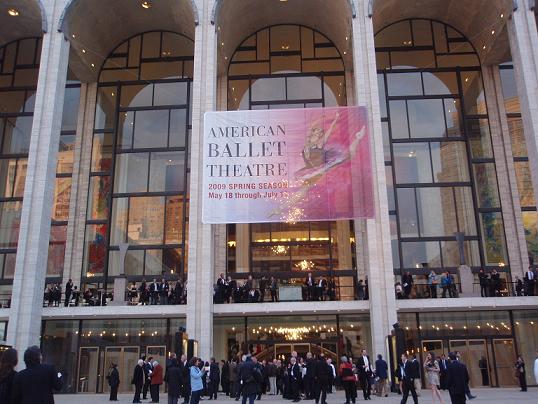
Yay, the season has offically begun! This picture was taken during intermission; that’s why it doesn’t look that crowded. I was sprinting in, nearly late, as usual, so didn’t have time to snap some pics before the performance but fortunately it was still light outside during intermission.

Anyway, Michelle Obama (who served as one of the gala’s honorary chairs) looked smashing in a sleek dark grey sleeveless, knee-length dress with tiny black ruffles lining the bottom. I’m sure there will be beaucoup des pictures seeing as how many blasted camera people there were; I’ll be sure to steal some when they’re posted on all the society websites ๐Ÿ™‚ (Oh, look, here it is in the NYTimes already)


It was just about the craziest thing I’ve seen on the Met Opera stage: after Veronika Part’s mouthwatering Mozartiana opened the show, artistic director Kevin McKenzie came out and thanked everyone who needed thanked — all the donors, designer Caroline Herrera who funds the gala, etc., and Senator Chuck Schumer came out and gave a little talk about the importance of funding for the arts, etc. Then, Schumer disappeared behind the curtain and moments went by. Everyone kind of looked around at each other like “what’s going to happen next?!”

Soon, the curtain was pulled back to allow some people to carry out a podium with a banner “American Ballet Theater” draped over its front. The doors to the lobby opened and a flock of people bearing weapon-sized cameras blasted in. Several men dressed in black promptly rose from their aisle seats and followed the flock of weapon-camera-bearers to the front of the aisle, near the stage. Caroline Kennedy was announced. She came out, everyone applauded, and she mentioned that the school of ballet associated with ABT, the Jacqueline Kennedy Onassis School, would be performing on the Met Opera stage for the first time ever tonight. Everyone ooohed and aaahed. Then, she announced First Lady Michelle Obama.

The curtain pulled back again and out she came. Of course everyone gave a standing ovation. She smiled radiantly, then, after a moment, directed us to be seated. Then she gave a short speech. It was a little hard to focus on what she was saying with everyone — both professional photographers and audience members with cell phone and digital cameras alike — flashing away as they were, but she talked about the necessity of the Arts for a culture to flourish, the importance of arts education, etc. Then she introduced the Jacqueline Kennedy Onassis School students.

As soon as she disappeared behind the curtain, the auditorium remained still pending the exit of the flock of pro camera wielders. It’s funny because there were all these non-dance writers in the press section. You could hear the sighs of relief, the sinking down into the chairs, and the putting away of pens and paper — and cell phones, which they’d used to light their writing paper during Mrs. Obama’s speech, which would have been extremely annoying had it not been for all the flashing bulbs anyway. But it made me wonder how they’d ever survive as performing arts critics! I mean, who needs light to see to write!

Anyway, the students were excellent. They performed Le Defile (The Procession) by Raymond Lukens. There were three large groups of them, in three levels — the very little ones, a medium-age / level group, and the older, very advanced ones. The choreography was basically a showcase of classical ballet steps, much like a very advanced ballet class — jumps, jumps with changing feet, jumps with changing feet that went on forever performed by a set of advanced boys (which drove the audience to wild applause), jetes, chaine turns, multiple pirouettes, fouttes, etc., and then a bit of partnering. It gave the students a chance to show what they could do — and the advanced ones could do a great deal! Extremely impressive, and great fun.

Then on were Xiomara Reyes and Herman Cornejo doing an excerpt from August Bournonville’s La Sylphide. This was the most dramatic I think I’ve ever seen Xiomara. I was sitting in the back of the orchestra and she really projected. She was really sweet. And Herman as always amazed with his virtuosity, his jumps, his razer-sharp precision, his astounding clarity of line.

The corps in both this, La Sylphide, and Swan Lake, later in the evening, were absolutely amazing, by the way. Not a head arched back more than the others, not a leg raised higher. They were all so on. When they work together like that, in perfect unity; it’s really visually breathtaking.

Then was Balanchine’s Tchaikovsky Pas de Deux danced by Ethan Stiefel and Gillian Murphy. Ethan and his strutting around stage, taking his own good time after their duet and before beginning his solo, making the conductor wait for him! And his high jumps with all miraculously many beats of the feet. I wished my friend Alyssa could have come so she could see he’s not just Mr. Sexy; he’s a superb dancer. And Gillian was radiant, and a perfect foil with her speed-of-light chaine turns. They enjoyed a long, slow kiss during the curtain call. The audience went mad!

Then was the hunt scene from Sylvia danced by Michele Wiles followed by a piece d’occasion (the first of two of the night), by Alexei Ratmansky, for Nina Ananiashvili, called Waltz Masquerade. It was set to the Waltz from Aram Khachaturian’s Masquerade Suite and it was cute and comical. She was dressed in this long, red dramatic, Carmen-like dress with a sexy black lace overlay on the top. There were four tuxedoed men, each bearing a gold candlelabra, one at each corner of the stage. These men turned out to be: Jose Carreno at the front left corner; Marcelo Gomes, at back left; Angel Corella back right; and a blonde on the front right who I initially thought was David Hallberg (I was sitting FAR back from the stage!) until the fun began and he shook his head about like a sassy mop and I realized DH just does not have enough goofball in him to do such a thing, even if he tried. So, I decided it was either Ethan or Maxim Beloserkovky. Anyway, Nina’s character was supposed to be dancing about the stage in a melodramatic solo — but it was purposefully melodramatic, and so comical. Like a silly, cartoon version of an upcoming swan song, really, which, is of course, what’s coming up for her later in the season (and will be much more sobering when it does). At one point, she just passionately crashes to the ground and remains there, in a heap. Nothing happens. The men, obviously her servants, start looking at each other like, what now? They shrug, slowly walk over to her. Then, Marcelo starts imitating her melodramatic dance, but far more cartoonishly, and of course it’s hilarious. The others join in. Max (I think it was Max, not Ethan) does his thrashing hair thing. I couldn’t see facial expressions but I assume they were making fun of their master. Then she wakes up, catches them, and they’re sent back to their posts.

After intermission was the balcony pas de deux from MacMillan’s Romeo and Juliet, danced by Marcelo and Diana Vishneva. At first, Diana approaches her balcony with all the drama of a ballerina playing Juliet, rather than Juliet herself. I rolled my eyes. This is what I don’t like about her. She’s an excellent dancer but she’s all about the pomp and circumstance and not about the character. Maybe it’s a Russian thing, but I don’t see that in Veronika Part or Irina Dvorovenko. Anyway, she eventually lightened up, thankfully, and I felt like I was watching not a prima ballerina being a prima ballerina but Juliet herself, falling hopelessly in love. When she runs around him one foot solid on the ground, the other on pointe, it’s so girlish, so real yet so poetic. Those are the best — I don’t know what to call them — runs around kneeling Romeo — that I’ve ever seen — not even Alessandra Ferri’s were that sweet. Still, I felt some of the lifts lacked the beauty and magic ofย  those Marcelo and Julie Kent do together when they dance this scene. I don’t feel she dances that well with a partner; she’s more into herself. Marcelo’s leaps around the stage and big high passionate jumps were thrilling. He got some good bravos for those.

Then were Paloma Herrera and Max Beloserkovsky in the Act II pas de deux from Swan Lake. I was hoping it’d be the Black Swan pdd, but no. I guess the program was pretty bravura-heavy already. I don’t see him dance much, but Max is really quite good. He’s really a character and he’s the perfect Prince Siegfried, regal yet vulnerable and tragically in love. And he’s a good partner.

Then was the mad fun of Le Corsaire, with Irina Dvorovenko, David Hallberg as Conrad, and Angel Corella as Ali. Except something happened at the beginning and I hope David’s okay. The tallest guy in the entire opera house had to sit in front of me and I was trying to navigate my way around his enormous head just as a bunch of people up front went “Oooooooh!” When I was finally able to see the stage, Irina was standing in front of David, face toward the audience. She didn’t seem to have any particular expression on her face, but, then, I was light years away from her. Then David did an assisted pirouette with her and everyone applauded, so it must have been a lift that didn’t quite happen or something. Anyway, I hope he’s okay; I know his shoulder sometimes comes out of socket. Anyway, all seemed to be fine after that: all three were brilliant. Of course. Angel astounded, as always, and I started giggling during his first solo and couldn’t stop all the way through the second. I love Irina. She was radiant. She did those continuous turning kicks on pointe like they were nothing. She has the drama and the virtuosity when needed and the always beautiful, graceful lines. And David’s leaps all over the stage were magnificent. I could see this goofy ballet over and over and over again, as long as no one gets hurt ๐Ÿ™‚ Angel did not leap out from behind the curtain during curtain call, sadly.

Then there was another piece d’occasion. Herbie Hancock played piano, onstage, while first Jose Carreno, then Stella Abrera, danced to his music. This was cute and comical as well, and kind of reminiscent of Jerome Robbins’s Other Dances or Suite of Dances, where the dancer(s) connect mainly with the musician. At one point, Hancock went nuts with the keys, obviously way too fast to be danceable, and Jose stopped in his tracks, looked over at him, and lifted his hands, like what gives, dude? He sat down near the base of the piano and just rested. The same happened with Stella. She danced, then stopped and gave Hancock a look when he began another little virtuoso section. She finally sat down beside him on the piano bench, and eventually, he ended on a romantic note, she snuggling next to him softly, sweetly.

The evening ended with the finale of Balanchine’s Theme and Variations. The leads were danced by Sarah Lane and Daniil Simkin. It was a nice way to end the program, but with the likes of Simkin, I wondered why they only did that group finale, where he and Sarah are basically leading a processional, instead of some of the earlier bravura parts with all the corkscrew turns for the man. An opening night gala performance is meant at least in part to showcase the dancers doing what they do best, and he is best at the bravura stuff, not leading processionals.

Anyway, the whole night, as usual, was magic. Saw Sigourney Weaver and Kelly Ripa in the audience.

Oh, for my Dancing With the Stars readers, I taped the show, but for lord knows what reason it was somehow muted. I have no idea how on earth I managed to do such a thing, but it was pretty amusing watching the show in pure silence — no words, no music. Needless to say, I’ll have to watch online tomorrow.

But now, dead tired, must sleep. Goodnight.

ETHAN STIEFEL AND LARRY KEIGWIN AT GUGGENHEIM


Last night the Guggenheim Museum’s Works and Process event centered on Ethan Stiefel’s new dean-ship of the University of North Carolina School of the Arts (which is both a high school and now a university as well). Stiefel is of course a famous ABT principal, star of both Center Stage movies, and ran the summer program Stiefel and Students / Stiefel and Stars, out on Martha’s Vineyard, which my friend Alyssa and I went to a couple of years ago. It was hosted by blogger / dance writer and photographer (and former ABT dancer and NC School of the Arts alum) Matt Murphy, and also included choreographer Larry Keigwin (artistic director of Keigwin + Company), who was the recipient of the school’s first residency under Stiefel.

It was a fun evening. Discussion centered around Ethan’s decision to take on the position, in light of the fact that he’s still dancing (he’d had several surgeries on both knees, knew he wanted to do something like this at some point but stressed about when was proper time to do it), his new schedule (now waking at 6:30 — as opposed to 11 am when he use to wake as a dancer — to take class, then teach a couple of classes, then do all manner of administrative / financial / directorial things – -not easy tasks in light of current economic crisis, and still try to find time for his own rehearsals), and just generally his teaching and directorial aesthetics (he’d come up with eight “initiatives” to instill a culture and sense of identity in the school, the last of which Matt read — which was to encourage students to be inspired by both art and life.) Gia Kourlas has a good article in the Times that summarizes all of this as well.

Keigwin joined Matt and Ethan for the last quarter or so of the panel, and he spoke about his residency, how he’d choreographed a new work both on the students and his own company simultaneously, what it was like to work with students, and what it was like to be out of NY. I’d never heard him speak before and he’s very personable, fun, and chatty with a good sense of humor (which doesn’t surprise me — his work is largely humorous and accessible as well). He talked about the company being beyond thrilled with the washing machines and the cooking space (if you don’t get out of New York much, this kind of surprise happens!) and so enjoyed performing a lot of domestic activities. He was cute! And Ethan was his usual self — his completely understated, deadpan style of talking oozing with sexiness and manly charm. Before introducing one of his students’ performances — of the Four Cygnets in Swan Lake — he explained the girls wouldn’t have the swans’ usual hairpieces: “We got a lot going on and … we just didn’t get that done in time,” he said with a smile and a shrug. Somehow the way he said it just gave everyone the giggles, which, honestly, often happens when the man speaks.

Anyway, we saw Tangled Tango, a modern piece by Dianne Markham, a contemporary choreographer at the school, the pas de deux and coda from Le Corsaire, which Ethan staged, the Four Cygnets from Swan Lake staged by Nina Danilova, and August Bournonville’s The Jockey Dance, also staged by Ethan.

Finally, we ended with Keigwin’s Natural Selection (a modern piece), which totally blew me away. The Keigwin was based on Darwin, survival of the fittest and all that, and was so stunning, filled with very difficult partnering, lifts, students crawling around on the floor, clawing at the ground and each other, lashing out, really having at each other. (So, not quite his usual humorous piece) A guy crawled around with a girl wrapped around him, underneath him. At one point, it slowed, several dancers huddled around each other in a group, each kind of resting, momentarily, putting his / her ear to the back in front of them, perhaps comforting the other, perhaps trying to determine whether his / her heart was still beating, lungs still rising, to determine whether they’d “won”. Then a girl came rushing at them, climbed right over the huddle and jumped right onto the wall in back of them. Someone crawled after her and pushed her back to the ground. Keigwin’s signature move then ensued: a group of male dancers lifted her and she bent sideways, and ran alongside the back wall. The audience was wowed. But more importantly, I think, it was such a wonderful piece for students. I mean, what better way to teach them partnering, how to work with each other, how to be dramatic, how to make the meaning of a work come alive. I loved it!


My other favorites were: the Four Cygnets — whoa, that was PERFECTLY done! Those girls — Tessa Blackman, Maya Joslow, Amy Saunder, and Lauren Sherwood — should be so proud of themselves; and Le Corsaire ๐Ÿ™‚ — but of course I’m a sucker for that kind of bravura dancing. I was really afraid, holding my breath the whole time with that one — I mean that stage is soooo small for all that leaping and those insanely high lifts. The two dancers — Claire Kretzschmar and Kristopher Nobles (who looked like a young Gillian Murphy and Jose Carreno respectively!) did splendidly on their own. I couldn’t help but giggle during Nobles’s huge, stage-encompassing leaps and Kretzschmar’s beautiful continuous fouettes and the gorgeously high lifts — all wonderfully executed — except because of said miniscule stage, her hand almost took a light out on one such spectacular lift. There was a tiny bit of fumbling on some of the partnering — the assisted pirouettes and the promenade, but I was actually glad for the audience to understand how insanely hard those things are. People think that’s the easy stuff — and the lifts are the hard parts — but the assisted pirouettes and promenades, when the girl is totally off her center of gravity and the guy has to help keep her centered, are some of the hardest aspects of partnering. Now maybe Met orchestra peeps will not be so confused when the young dance students in family circle go wild for Marcelo the great’s ten bizillion one-handed turns with Julie Kent ๐Ÿ™‚

Here’s a video of the Four Cygnets, here’s some classic Corsaire (they didn’t do all of this insanity, but you get the idea), and here is The Jockey Dance (it was performed last night by two boys, Devin Sweet and Shane Urton).

The Jockey Dance was fun too — one of those dances that looks deceptively easy, but you can tell is really hard, with all the bouncing jumps, playful competitiveness– using a whip no less, and fast footwork.

Gillian Murphy (ABT prima ballerina, Ethan’s girlfriend, and NC School of the Arts alum) was there too. Poor thing had to sit in the critics’ section! Luckily Sir Alastair was not there… The program repeats tonight, but is sold out.