COMPUTER CRASH!

Just as I was about to send the final version of my novel off to the publisher my computer crashed. My wonderful friend Mika allowed me to use hers for the day. But since I don’t know how long my laptop is going to have to spend in the hospital, blogging might be intermittent for the next few days.

In the meantime, I’ll try to tweet via my cellphone.


As soon as I return, more on this year’s Fall For Dance Festival, as well as my thoughts on William Forsythe’s Decreation which I recently saw at BAM. I normally really like Forsythe, but I felt you had to have read the Anne Carson essay (of the same name) that the work is based on in order to understand it. Did anyone in NY see it? (photo by Andrea Mohin from NY Times review.)

FALL FOR DANCE ’09 PROGRAM 2

Highlights of Program 2, which I saw last night, were Morphoses and Tangueros Del Sur.


I was wandering around the lounge beforehand and ran into a couple of old friends from my first ballroom studio, Paul Pellicoro’s Dancesport. Always fun to catch up with old friends — especially since one of them belonged to my swing team and I shared with her my first ever lovely competition experience. Anyway, little did we know then, but one of our former tango teachers was in the show! Ivan Terrazas! I was so proud; he was absolutely electrifying (along with the rest of the Tangueros)!

Sir Alastair had gone on and on about this troupe — led by Natalia Hills and Gabriel Misse — when he saw them at the Vail Dance festival recently, and rightly so! Oh my gosh, that was the most astounding tango I’ve ever seen! The piece was called Romper el Piso and was mainly tango but with some footwork and rhythms from other Latin dances like Samba and a little bit of Cha Cha thrown in — but all danced with tango aesthetics. There were duos and trios, both mixed-sex and same-sex. The choreography was original and enlightening and the dancing so polished, precise, lightning fast, sharp, passionate, everything you can imagine in a tango, in a dance. I really hope some of you can see them tonight.

Afterward, my friend Alyssa and I hung out in the lounge. When we left we were a little tipsy (c’mon, the wine is $2!) and I kind of tripped over nothing on the way out, causing us to both burst out laughing. One of the cute tango guys said to us, “tranquilo, tranquilo!” but very flirtatiously 🙂

All photos above by Carlos Furman, courtesy of City Center.


The other knockout performance of the night — for me — was Softly As I Leave  You, choreographed by Lightfoot Leon and performed by the stunning Drew Jacoby, who is now one of my favorite female dancers (Alyssa’s as well) and Rubinald Pronk, performing on behalf of Morphoses. Christopher Wheeldon was in the audience and he got mobbed during intermission 🙂

It was the best thing I have ever seen by Morphoses — more Lightfoot Leon, Mr. Wheeldon, please please!

It’s set to a combo of music by Bach and Arvo Part (including the Part section all New Yorkers are now so familiar with, from Wheeldon’s After the Rain pdd), and begins with the statuesque Ms. Jacoby standing inside a box opening out to the audience, contorting herself to fit within its confines, struggling to break free, making the most mesmerizing shapes with her body. Then, in the second movement, Mr. Pronk comes out and they dance an, at times somber, at times peaceful, duet. Then, in the third (with the After the Rain music), they continue dancing together, but now come to a closure; he ends up in the box, she slowly walks behind it, disappearing offstage.

To me, this was about the human need for connection or the struggle between wanting to be alone and wanting to be with another. Alyssa saw it as someone being held back by something and struggling to overcome that; she was moved by the change of positions between the two dancers. Or, as the title suggests, I guess it can be about a woman leaving a man. The most compelling of these abstract duets Wheeldon is known for (either choreographing himself or including in his Morphoses programs) I think allow for that kind of interpretative range, while giving the viewer enough that they can really latch onto something and let their imaginations go with it.

The above photo of Jacoby and Pronk, by Erin Baiano (courtesy of City Center), is not from this piece.

Also on Program 2 was Martha Graham’s sweet ode to spiritual and human love, Diversion of Angels. Nice to see some of the Graham dancers, who are beginning to become familiar to me, again.

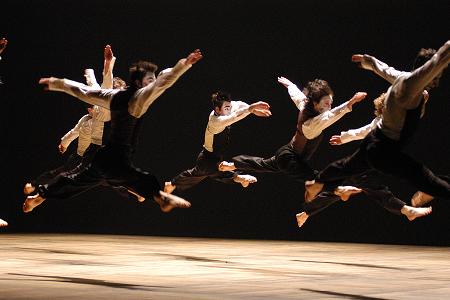
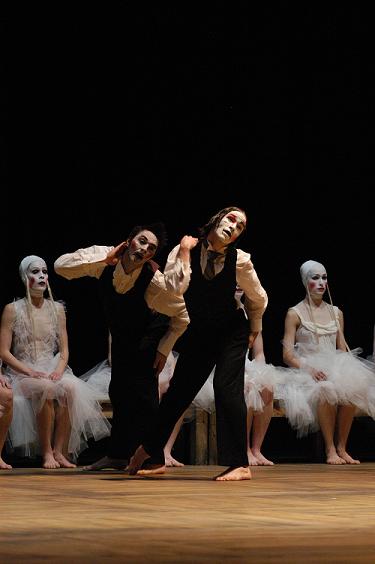
And closing the program was Noces by Dutch choreographer Stijn Celis, performed by Les Grand Ballets Canadiens de Montreal.
1

2

32

This was Program 2’s tribute to Ballets Russes. Branislava choreographed the original Les Noces, and there have been several versions since (Jerome Robbins’, Pascal Rioult’s). It was danced to Stravinsky’s choral score (which he created for Ballets Russes), but with some remixing too (I think). The music seemed to be longer, and there seemed to be some German language in the score, which sounded like it was from a Broadway show like Cabaret (but not Cabaret exactly). The program doesn’t seem to note any addition to the Stravinsky though so I may well have been hallucinating.

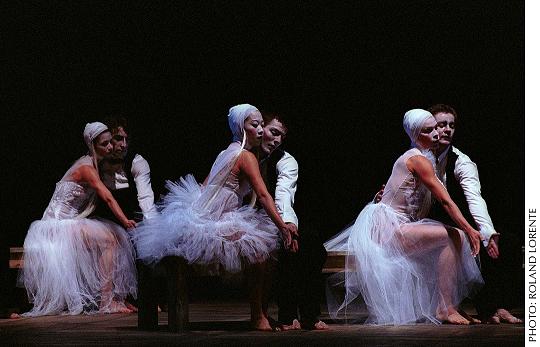
The dance (and the Stravinsky music) depicts a Russian peasant wedding and it’s very Rite of Spring-like — more focused on the sexual rite of passage, the consummation, and the rather forced marriage rituals than love or anything weddings evoke for us today. In the Celis (as well as Rioult) version, there isn’t a single man and woman but a group of men and women undergoing the marriage ceremony. The women here are dressed in sexy white bridesgowns, the skirts short and much of the material see-through mesh. The women have white-powdered, very made-up faces that look almost clownish, as do the men, who are dressed in tuxes. Alyssa thought their make-up looked zombie-like, like they’re walking dead. The movement is very frenetic, with lots of thrashing about, and the group consummation scene would have been comical, as the women bounced around on the men’s laps, if it wasn’t so violent.

I’ll be interested to see what the critics and other viewers say of this –whether it gets dismissed as gaudy “Eurotrash” or whether people take it more seriously as a commentary on ritual (or something else). I do think it worked as an homage to Ballets Russes because from what I know of that legendary company, they seemed to have been very cutting-edge, going far out to push ballet to its extremes, even if it induced a lot of eye rolling.

Big kudos to the dancers though for performing that long, near-continuous frenetic movement.

Photos of Les Grands Ballets Canadiens de Montreal courtesy of City Center.

FALL FOR DANCE ’09 PROGRAM 1


I’m on a tight schedule with my book rewrites, but here are some of the highlights of the Fall For Dance Festival (Program 1) thus far.

It’s always a delight to see Paul Taylor’s hilarious Offenbach Overtures with the would-be ballet dancers tripping all over each other, the muscly men first dueling then making up and swinging their way offstage in each others’ arms, the female cabaret dancers comically warring for attention. I was happy to see SLSG favorite Michael Apuzzo in my cast (he’s not in the photo above unfortunately, as he wasn’t in the first night’s cast) — he’s always very dramatic, full of character, and I noticed he had the highest, most straight-legged jetes as he and the other guys went sailing offstage at one point.

I was at this performance with my friend, Michael, and we hung out for a while in the lounge afterward (where they have $2 wine and beer and $4-$5 plates of food). I’m very shy, but I always seem to have really outgoing friends, and Michael went up to a woman with a bouquet and asked her what it was for — something along those lines. It turned out she was in Paul Taylor, and once I knew that, I recognized her as the striking Parisa Khobdeh, Michael’s partner (Michael Apuzzo that is, and partner in Offenbach that is). I then realized a bunch of the Paul Taylor dancers were hanging out in the lounge (except for that Apuzzo!) — so the FFD brochures  are not lying about the “come mingle with the dancers” parts of the adverts for the post-performance parties in the lounge.


Anyway, the other highlight of Program 1 was B/olero performed by the highly respected Israeli company, Batsheva, choreographed by their artistic director, Ohad Naharin, and set to the familiar Maurice Ravel music. Except this was a remix — at times the music would be slowed so that it would sound somewhat warped. The music would also veer from speaker to speaker, so it was like the sound was traveling around the auditorium.

Well, there are many Boleros around and Naharin’s was a more minimalist one in terms of the action, but not the emotion. It was a duet for two women dressed in black dresses. At times their movement was basic, at times still, at times spastic and chaotic, at times sexual and almost kinky, and at many times hypnotic. A common motif was the swinging back and forth of the arms, mechanically, like the arms of a clock, the rest of the body still. I always feel with his work that I have to see it several times to get the full effect, and I wished I could have seen this one again.


In celebration of the centennial of Ballets Russes, every night at FFD one company performs a piece on honor of that legendary company. Program 1’s was the Boston Ballet’s rendition of Nijinksy’s original Afternoon of a Faun. This was a real treat for me, as I’d never seen the Nijinsky version live and in full before. I’d only ever seen it on tape or, if I remember correctly, only the faun version (without the nymphs) performed by Royal Ballet star Johan Kobborg with the Kings of Dance.

Anyway, Nijinsky’s version is from 1912 and you can really imagine how shocking it must have been in its day, with the faun so overtly sexual, so taken with the nymphs, he ends up masturbating with a cloth left by one, which he recovers, takes up to his little rock perch, places it on the ground and begins rubbing his groin into it. You still don’t see much of that today onstage (at least not in ballet), so I think it’s still somewhat risque. And yet the faun, at least as portrayed by Altankhuyag Dugaraa, is so sweet and so endearing, and you feel for him after those nymphs tease him and you’re happy for him when he retrieves that cloth. I would so love to see a clip of Nijinsky in this. I would also love to see his Rite of Spring some day; I don’t think it’s been performed for eons though, I think because the choreography hasn’t really been preserved, sadly.


And completing Program 1 was Savion Glover, which I wrote about briefly in my previous post.

See the rest of Andrea Mohin’s NY Times slide show of Program 1 here.

STAND IN LINE FOR FALL FOR DANCE TICKETS AND LET MONICA BILL BARNES ENTERTAIN YOU


I think this is pretty funny. Fall For Dance tickets go on sale this Sunday, September 13th, at 11:00 a.m. In the past crowds have been known to line up beginning at 4 a.m. (this festival is popular), and the line’s been known to wend its way practically all around midtown. Well, this year, festival participant Monica Bill Barnes (above, on the left), a modern / experimental dancer and choreographer, is going to entertain the queued-up crowd from 10-11 Sunday morn. She and her dancers can be rather amusing.


These pics are from a site-specific performance of hers I saw last summer downtown and wrote about here.

Also, during the festival there will be three free, open-to-the-public talks in City Center’s Studio 5 (which is upstairs, I think on the 5th floor). All three talks will be about the legacy of the Ballets Russes (in honor of their centenary this year).

The first, on September 23rd at 6:30 p.m. will be a discussion with three original members of the legendary troupe: Frederic Franklin, Raven Wilkinson and Eleanor D’Antuono and will be moderated by Robert Greskovic, author and dance critic for the Wall Street Journal.

The second, on Sept. 25th, same time, will be about how BR’s collaborations with clothes designers, painters, and musicians of the day created lasting change for the dance world. Panelists include Christopher Wheeldon, Alexei Ratmansky, Juliet Bellow and Simon Morrison and the moderator is Lynn Garafola, a dance historian at Barnard.

The third, on October 3rd, same time, will be about BR’s influence on today’s choreography. Panelists are choreographers Nicholas Leichter, Robert Johnson, Mark Dendy, and Virginia Johnson and the moderator is Wendy Perron, the editor-in-chief of Dance Magazine.

Speaking of Ballets Russes, one final reminder: if you haven’t yet seen the fantastic exhibit at the New York Public Library for the Performing Arts, at Lincoln Center, you only have until September 12th to do so. They’ve got videos of Baryshnikov dancing Balanchine’s Prodigal Son, of Anna Pavlova, of Fokine’s Les Sylphides, of Branislava Nijinska’s Les Noces, of original BR choreographer Leonid Massine instructing Joffrey dancers on reconstructing his Parade, they’ve got original costumes and poster designs by Picasso, letters and diary entries by Diaghlev, etc. etc. etc. Definitely worth seeing.

FALL FOR DANCE 2009


It’s September — happy September everyone — and for New Yorkers that means Fall For Dance is just around the corner. Tickets go on sale 11 a.m. September 13th, so time to get thinking about what all you want to see. For people unfamiliar with this festival (which this year takes place from September 22 – October 3), three to four companies perform each night and tickets are only $10 a piece per night. A great opportunity for first-time dance-goers. Tix sell out out at the speed of light, though, so have your computer turned on and your browser pointing here by above said time on above said date.

In celebration of the centennial of Ballets Russes, many of the participating companies are performing BR classics like Nijinsky’s Afternoon of a Faun and Fokine’s Dying Swan and Spectre de la Rose. There are also several lectures in the City Center studio centered around BR and its influence today. Go here for the schedule and more info.


EXPERIMENTAL DAY


Last Thursday I spent the afternoon at the Tribeca Film Festival watching a series of intriguing experimental shorts (some far better than others of course), and the evening at Brooklyn Academy of Music watching Trisha Brown Dance Company, whose program included a couple of pieces that are experimental, or at least were when they were created.

The reason I’d chosen the Human Landscapes series of shorts at Tribeca was that I expected most of the films to be about the landscape of the body — so kind of related to dance. But, except for two – -maybe three — all were about cityscapes — human interaction with urban environments with the focus on the latter, which I didn’t mind because I love cities.

The film that most caught my eye in the program listing was Chop Off by M.M. Serra, about a man, performance artist R.K., who sees self-amputation as an art form. At first I thought “amputation” was metaphorical, but, no no, the film revealed it was actually quite literal.

Continue reading “EXPERIMENTAL DAY”

Fall For Dance Finale


So, Fall For Dance wrapped up nicely; there were really no pieces on the last night’s program that I didn’t like. First on was the Aspen Santa Fe Ballet’s production of a Twyla Tharp dance I’d never seen, SWEET FIELDS, from 1996, which seemed to me a bit unlike her usual fare. It was joyous, spiritual, very lyrical, with dancers dressed in white flowing cloth, moving to Shaker hymnals. The one section that was very ‘Tharp-y’ was filled with breathtaking group lifts: at one point a group of men held one man up high above their heads, they suddenly released him and he rolled down, falling almost bungie-jump-like nearly to the floor, until they caught him at the very last second. The audience collectively gasped then applauded wildly.


Second on was San Francisco Ballet dancing Jerome Robbins’ lovely, ballroom-y IN THE NIGHT set to melodious Chopin played by an onstage pianist. The dance consists of three duets performed by three different couples — one the wondrous Yuan Yuan Tan (whom I’ve heard so much about; and she definitely lived up to her reputation!) with Ruben Martin; the second by Sofiane Sylve (who used to dance with New York City Ballet) and Tiit Helimets; and the third by the celebrated Cuban dancer Lorena Feijoo and Pierre-Francois Vilanoba. Tan and Martin represented a more mature, in love couple, their dancing very flowing and elegant, Sylve and Helimets I wasn’t sure about because to be honest I didn’t feel all that much from their dancing, and Feijoo (who’s a real firecracker) and Vilanoba (who kind of played her straight man, appearing humorously unable to figure her out, to foresee her antics, her wild jumps into his arms) the fun, young couple whose relationship centered around rather cutely played out sexual angst. The audience had a lot of fun, giggling throughout, particularly at Feijoo and Vilanoba.

I have to say, San Francisco Ballet, who are currently celebrating their 75th Anniversary, was a lovely company; they brought Robbins to life for me in a way I’ve seldom seen, and I look forward to seeing more of them at City Center later in the season.


Third was popular Spanish choreographer Nacho Duato’s Compania Nacional De Danza performing his COR PERDUT, a Gypsy-esque male / female duet between two likely lovers, each often running after the other playfully, then turning more serious, the man eventually picking up the woman, sweeping her off the ground, twirling her about. Very sweet theme, and the music — Turkish and sung in Catalan — was gorgeous.


And closing out the festival was Paul Taylor Dance Company’s popular ESPLANADE, set to Bach and choreographed by Taylor in 1975. This was a lot of fun; as dancers ran around stage, whizzing about narrowly missing each other, played hopscotch with each other’s bodies laid out on the floor log-like, and finally flew across stage taking a flying leap into each other’s arms, the crowd went nuts with applause, giving a standing ovation.

Fun, but very tiring, 10 days…

Here is Claudia La Rocco’s review of the last program in the Times.

Woo hoo, the orchestra pit!!

Woo hoo, the orchestra pit!!

Originally uploaded by swan lake samba girl via mobile.


T-Mobile

The best night of Fall For Dance thus far, imo. 1) The Suzanne Farrell Ballet performing a little-known Balanchine work and appearing in New York for the very first time; 2) brilliant Modern dancer Talia Paz in a poignant, desperate, evocative solo titled simply Love; 3) the equally poignant, evocative, and at times desperate The Light Has Not the Arms to Carry Us by the Kate Weare Company; 4) The Lombard Twins from Argentina (whom I’d seen earlier dancing with Rasta Thomas’s Bad Boys of Dance) doing an original hip hop / theatre / “street” dance to Tango master Astor Piazzola, played wonderfully by a full onstage band; and 5) the excellent Afro-Modern Garth Fagan Dance company performing his 1978 celebration of the African origins of dance. He put me in such a good mood, I’d have danced home if the weather wasn’t so nasty.

At molyvos awaiting fall for dance

At molyvos awaiting fall for dance

Originally uploaded by swan lake samba girl via mobile.


T-Mobile

What kind of person orders a second glass of wine during a Recession?

Anyway, FFD was good / decent tonight. I especially liked: Houston Ballet’s production of Tchaikovsky Pas De Deux — wonderfully lively dancers (Sara Webb and Connor Walsh) who brilliantly brought both Balanchine and Tchaikovsky to life; BeijingDance/LDTX’s Cold Dagger, which I found nicely enigmatic and visually arresting in places; and The New 45 by Richard Siegal / The Bakery, a company I will most definitely be looking up the next time I am in Berlin. Full review coming soon…