NYCBALLET OPENING NIGHT: NEW MARTINS’ NAIVE & SENTIMENTAL MUSIC A SUCCESS!


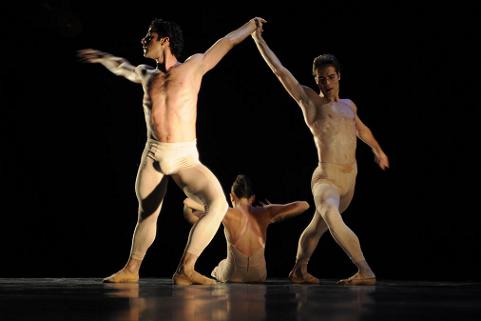
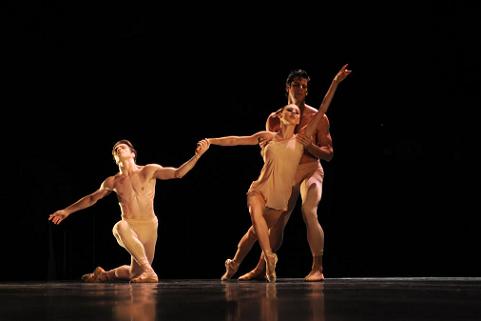
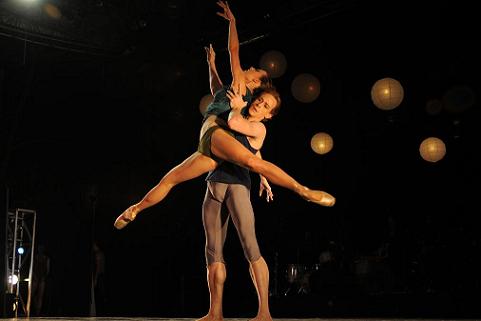
New York City Ballet officially opened its 2009-10 winter season last night, with a performance and black tie gala dinner. The performance included Alexei Ratmansky’s Concerto DSCH (above photo of that ballet — dancers are Ana Sophia Scheller, Gonzalo Garcia, and Joaquin De Luz — by Paul Kolnik, taken from NYTimes), stars of the Paris Opera Ballet Aurelie Dupont and Mathias Heymann dancing the central pas de deux from Balanchine’s “Rubies,”


(photo taken from Kulturkompasset; Dupont is center, Heymann is holding the hand of another dancer).

And then the evening finished off with the world premiere of artistic director Peter Martins’ Naive and Sentimental Music, set to John Adams’ (brilliant) score of the same name (I’ll post photos when I receive them).

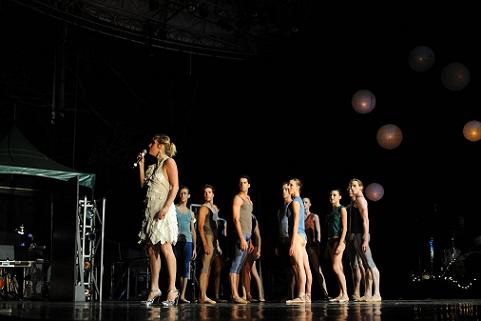
But first, there was a short film of the reconstruction of the inside of the Koch Theater (still can’t help but think of it as the State Theater…) while the orchestra played Tchaikovsky’s Sleeping Beauty overture (as it turned out, the perfect music to highlight the comically sped-up but ultimately awe-inducingly huge renovation process). Highlights of the renovated theater are — most importantly and coolly — the orchestra pit with a floor that can rise to stage-level (! — and this is how the orchestra played the overture), and two aisles now carved into the orchestra seating section. (Before, orchestra section had no aisles — so, though this is how Balanchine wanted it, apart from being extremely hard getting to a middle seat, it was a fire hazard).

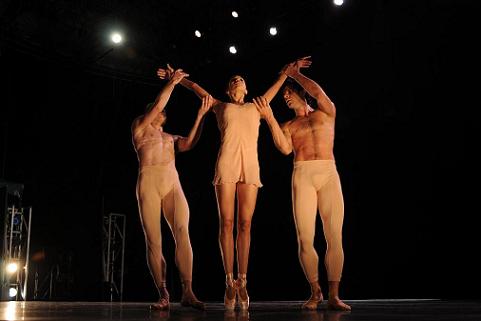
Anyway, after the mandatory thank-you speeches by Peter Martins and David Koch (who funded the renovation), came theΒ  Ratmansky. The fun frolicking threesome in blue (top photo) were danced by Joaquin De Luz, Gonzalo Garcia and Ashley Bouder (all three brilliantly on, Bouder thankfully back from an injury), and the adagio couple in green were Benjamin Millepied and Wendy Whelan (photo below). I think this was danced better than I’ve ever seen it done before — it could have been because I was so excited to see Bouder return, or because the dancers are all beginning-of-season fresh… but this is by far Ratmansky’s best, imo — it’s got the most complex structure and original movement.


(photo by Paul Kolnik, taken from Danza Ballet)

Next were the POB couple, who danced “Rubies” brilliantly — not only with precision and clarity but with great exuberance as well. One thing I meant to say earlier about La Danse (the Wiseman film about the POB) and forgot, was that the POB dancers are all so trained to make meaning out of every little thing they do — every step, every gesture, no matter how small. You have to have some kind of thought in your mind whatever you do. (This is not what Balanchine taught his dancers; he taught them simply to do his steps and those would contain everything the audience needed to know.) I feel that this allows POB dancers to bring a certain passion and humanity to all of the works they do — I noticed that from performance footage from that film as well as from last night.

And third came the highlight — for me anyway — of the night: the new Peter Martins’ ballet. The John Adams music was absolutely gorgeous — rich, many-layered, complex, intense, varied and structured into many sections — some lighter, many heavier, evocative, etc. etc. Beautiful! Oftentimes music like that overpowers the dancing, but not here.

In a short film shown before the dance (methinks Martins is taking after Wheeldon here with these little introductory films), Adams says the title refers to the difference between musicians whose music was fresh and original (the “naive” composers — like Mozart, he says) and those whose music was meant to speak to the past, to convey a sense of history, music that kind of carried the weight of the world on its shoulders so to speak (the “sentimental” — which he considers Beethoven). You could really see that in the music — some of it lighter, much of it weightier. Martins said in the film he tried to evoke that visually through dance, and I think he did so successfully — there’s a lighter, adagio section with dancers dressed in pristine white, another light but fast section with dancers in red, and then the more intense, almost severe sections with dancers in blues and deep greens and black.

Though most sections are danced in ensemble, Martins created the ballet for the principals only. This created an interesting dynamic, because, except for the middle section with the three pairs of dancers in white, almost all roles had equal weight — and yet practically all of the dancers stood out. It was an overload of star power!

And, though some sections seemed a slight bit underrehearsed (or maybe it was just that the footwork was so difficult and fast), everyone shone since Martins highlighted each dancer’s strengths: Maria Kowroski and Sara Mearns as lyrical women in white, Sterling Hyltin and Teresa Reichlin as kind of sharp-edged, sassy women in fiery red, Andrew Veyette and Daniel Ulbrich at the high-jumping bravura guys in black, there were some jazzy moves for Amar Ramasar, etc. etc.

Oh and I just love Tyler Angle πŸ™‚ He partnered Yvonne Borree and I don’t think I’ve ever seen her so at ease and so fluid! She looked really beautiful. Nice also to see Stephen Hanna back from Billy Elliot! He partnered Darci Kistler in the white section.

It’s a rather long ballet but I was thoroughly engrossed and can’t wait to see it again. I hope they keep it in the rep.

Okay, that was the gala. Now onto the Nuts. Regular season begins in January.

PARIS OPERA BALLET STARS TO DANCE IN NYCBALLET OPENING NIGHT


How funny — I was just going on in my last post about how I fell in love with the Paris Opera Ballet through Frederick Wiseman’s currently-showing film La Danse, and now I receive news that two etoiles with that company — Aurelie Dupont (in photo above, taken from Bailarinas) and Mathias Heymann — will be performing with New York City Ballet in their opening night gala, on November 24th. In exchange, NYCB’s Ashley Bouder and Gonzalo Garcia (both SLSG faves) will perform with Paris Opera Ballet, on November 12th. Both couples will dance the “Rubies” section of Balanchine’s Jewels.

Additionally, NYCB’s opening night performance will include Alexei Ratmansky’s Concerto DSCH (my personal favorite of his) and a premiere by Peter Martins set to John Adams music and starring all of the company’s principal dancers.


Photo of DSCH by Paul Kolnik, from NYTimes.

NYCB’s Nutcracker season begins the Friday following opening night, November 27th. Visit the website for tix and info.

Most exciting though about the dancer exchange. I’ve never seen Heymann perform live and I’ve only seen Dupont dance Trisha Brown, not full-out ballet.

Here are a couple videos of Heymann I found on YouTube: first as Bluebird in Sleeping Beauty and second in a contemporary solo:

And here is Dupont as Kitri in Don Q:

Sorry, you guys, I’m just so into videos these days!

MORE ON AMERICAN BALLET THEATER’S AVERY FISHER SEASON


Daniil Simkin and cast in Benjamin Millepied’s Everything Doesn’t Happen at Once in Gene Schiavone photo, courtesy of ABT; all photos by Gene Schiavone (except for Arron Scott headshot below and bottom picture).

Just to let people know, as the photos shows above, the guy who was flinging himself into the group lifts in the first cast of the Millepied was Daniil Simkin; in the second cast it was Arron Scott (below). The program notes only gave a special mention to the two dancers doing the pas de deux and a lot of people were asking who the main soloist was.


Anyway, here are a few more reviews:

Here is James Wolcott on opening night gala (and our fab Shun Lee dinner afterward πŸ™‚ ), here is Apollinaire Scherr’s FT review; and here are more of Apollinaire’s thoughts on her blog, Foot in Mouth. I’m surprised there aren’t more reviews — this was a pretty big season, with three world premieres — but that’s all I can find at the moment. (Update: Robert Greskovic’s WSJ review just went up; thanks to Meg for letting me know.)

Re the Wolcott write-up: I forgot to mention the models — Iman and Veronica Webb, who, instead of A.D. Kevin McKenzie, thanked the gala sponsors and introduced the program — screwing up Benjamin Millepied’s name. It wouldn’t have been such a big deal if they wouldn’t have been so giggly over it. It seemed like they were reading their notes for the first time and were really unprepared. I really don’t know how to pronounce his name either — I’ve always said the last two syllables to rhyme with plie (without the “l”) but have been told that’s wrong. But damn did ABT get a lot of press for signing them on. Just Google “ABT Fall 2009 Season” and it’s all about Iman.


(Gillian Murphy, Cory Stearns and Eric Tamm in Aszure Barton’s One of Three)

Anyway, I saw four of the six programs, saw the Ratmansky and the Millepied ballets four times and the Barton three, and they each grew on me the more I saw them. The Saturday matinee was my last performance and I found it by far the best. I felt like the dancers were finally comfortable with the new dances, knew what they were all about, and really made them meaningful. I described the ballets here.

Oh and regarding SanderO’s comment on that earlier post: yes, I do need to see the story in the dance. The dancer and choreographer won’t pull me in at all if they don’t each tell me some sort of story. That doesn’t mean the ballet has to be a traditional full-length dramatic novel or something with a clearly defined beginning, middle, and end, inciting incident, rising action with crises 1,2, and 3, climax and resolution, etc etc. but there needs to be some kind of story; there needs to be some intention in the abstraction. A lot of critics use the word “evocative” — a dance needs to be evocative of something, and I just mean the same thing. If there isn’t something meaningful going on, there’s no reason for me to see it. I can appreciate the neat geometric patterns and pretty images, but that’s not enough to make me go.

Anyway, I saw more in Millepied’s Everything Doesn’t Happen at Once on further viewings. At first I thought it was kind of everything but the kitchen sink the way Apollinaire kind of describes, but after several viewings I saw more of an evolutionary, battle of the sexes theme throughout, which becomes a more literal battle by the end. The piece starts with the stage looking swimming-pool like with the dancers making broad strokes with their arms. The stage gets over-crowded and eventually someone in charge — looking rather conductor-like, kind of throws his arms up and dismisses everyone.

Then, there’s a pas de trois (two men one woman), which becomes a double pas de trois (same), which turns into the central pas de deux (man-woman). Throughout there seems to be struggle going on — in the pas de trois the men kind of manipulate the woman around, until she’s practically on her side. In the central pas de deux is in places tender, in places more angsty as if the girl is trying to get away from the guy or fight him in some way, and he is struggling to hang onto her.

By the end, the scene has evolved into a kind of battlefield with marching music and the ballerinas doing those Balanchinian marches en pointe. Except they’re more unsettling than cutesy, like in Balanchine. This is the part where Daniil / Arron gets tossed into the crowd, throws himself with wild abandon at the groups of men, who catch him mid-split, then gets caught up with a bunch of grabbing girls.

Interestingly, the audience laughed when this role was danced by Simkin — I think because he is small and a bit long-haired and it kind of looked like he was afraid he’d be taken for one of them and was trying like hell to assert his masculinity. (I think it would have worked better had the girls been chasing him and then he flings himself into the groups of guys rather than the other way around, but not a big deal).

But no one laughed when it was Arron. It looked far more serious with him in the role — it looked like he was practically getting raped by that rabid group of girls.

Also I noticed with Arron that after the rabid group of girls leaves him alone, he kind of internalized the tauning; there was now an invisible fist punching him all about. It really looked like he was getting beaten up by that thing. But the fist was invisible so it was like he’d been driven mad. It was very unsettling, and I think, with the music and the rest of the action, this feeling is more of what Millepied was going for — not all the high air flips, crazy long spins, and windmill jumps that Simkin is known for and did here. Simkin’s character made the end of the ballet more playful than battle-like.

There’s also a short section where there’s all this marching music and there’s more centerstage chaos with all 24 dancers out there at once and suddenly a group of dancers standing at one corner break into partners and go waltzing through the crowd. But it’s really short-lived, like even courtship is a battle.

I don’t know — that’s what I saw on further inspection. But I could be making it all up. It’s kind of fun with abstract ballets (the ones that have a lot going on in them anyway) to make up your own story. I mean, the way dances get made anyway, as I learned at a Guggenheim event last night featuring ABT’s efforts to adapt ballets to different stages (including this small one in AF Hall, meant for concerts), is that things get changed depending on space, depending on the logistics of the stage, depending on dancers. Whoever knows if the end product is what the choreographer originally had in mind anyway.

I don’t think Millepied’s was a perfect ballet — I found a lot of the bird-like patterns from his recent NYCB ballet, Quasi Una Fantasia, to be out of place here – he didn’t need all that; he should have focused more on the battle — but I found his the darkest, the most thematically clear and the most absorbing.


Stella Abrera and Gennadi Saveliev in Alexei Ratmansky’s Seven Sonatas.

The Ratmansky grew on me, as did the Barton. On the last day, Michele Wiles danced the main female character (in the long white ballgown) in the Barton and I loved her. She gave the character a real story. When she comes out onstage she is all bitchy and glamorous, but Michele it’s really an act; she is seeking attention from the main man (in that cast Blaine Hoven) while trying to maintain her haughty demeanor so as not to be shown up by him if he dismisses her. At one point, she extends her arm out to him, as if he’s supposed to kiss it but he turns and runs offstage. She crumbles. It’s heartbreaking.

I also really loved Craig Salstein, Jared Matthews and Daniil Simkin in Barton’s second cast (Matthews and Simkin alternated parts opposite Salstein). They danced a section in the second part and all three made it clear (Salstein most so) that they were in a little competition for the girl’s attention. The girl (Luciana Paris), meanwhile, was just dancing on her own, in her own world, paying them no mind at all. It was hilarious.

But back to Michele Wiles for a minute: a wonderful ABT patron gave me her ticket for a company class, which she couldn’t attend, and Michele seemed so sweet — smiling out and waving at people during the class and even during warm-up.

Also, can some choreographer please please please create a little solo or some kind of dance just for Gillian Murphy! Please! During that company class, during the center floor work when the dancers divided into groups and did turns in a diagonal down the center, Gillian blew everyone completely away. She was like a tornado. But a technically perfect tornado! Everyone in my section literally began to laugh and shake their heads in amazement. She needs something to showcase her technical brilliance and athletic prowess. C’mon ABT!

Each of the dancers brought their own special thing to the Ratmansky. Christine Shevchenko (an up and coming corps member) was gorgeous with the role created by Julie Kent (danced opposite David Hallberg). She was more lyrical than Julie, with flowing, expressive arms that resembled Natalia Makarova in Other Dances. Julie’s arms were more staccato. Hee Seo, who completely blew me away as well, did a combination of the two — by turns feathery and lyrical, and modern and staccato. Alexandre Hammoudi and Jared Matthews both danced David’s original part and they were very different than David. Both connected with their ballerinas much more — when they were left alone onstage they clearly looked about for her, wondering where she was, then accepting they were alone and falling into their solo.

David Hallberg. I can never get enough David Hallberg. He didn’t look around for his ballerina when she left him, but when she returned to the stage, he danced well with her. But when she was offstage, she was out of sight, out of mind with him — he was too busy making Ratmansky’s movement wholly his own. He seems to be a rapidly maturing artist, playing with the music, playing with rhythm, giving some things more emphasis than others. When I first saw him dance this role I thought his “character’s” movement was more modern than classical, but I think that was just because of the way he did one section where he keeps pushing out with his hands, like he’s stopping the air, or stopping something from getting too close. He slowed down that movement a lot, really emphasizing the arms, and then did some ensuing footwork at the speed of light, whereas the others did everything in equal measures -so it didn’t have the same look.


Jared Matthews and Maria Riccetto in Some Assembly Required, photo by Rosalie O’Connor.

ABT also put on Clark Tippet’s Some Assembly Required from 1989, a male-female pas de deux evoking a lovers’ quarral replete with difficult-looking angst-filled lifts, struggling pushes and pulls, then more tender making up. It went on a bit too long; some middle parts that were repetitive could have been taken out, but the cast I saw — Jared Matthews and Maria Riccetto did very well with it. Jared is dancing and dramatizing better than ever before, imo.

And the company also did Robbins’ Other Dances, another male-female pas de deux (this one pretty famous) that was choreographed on Baryshnikov and Makarova. I saw both casts — Marcelo Gomes and Veronika Part, and David Hallberg and Gillian Murphy. I liked both — although I think I honestly prefer Tiler Peck and Gonzalo Garcia’s at NYCB. Gonzalo has a smaller body, more like Baryshnikov’s, and I think some of the gestures — like the placing the hand behind the head, kind of primping, looked sweetest on him. Ditto for Tiler. David is dancing very aggressively these days. He’s making the absolute most of every movement — it can be stunning at times, and at times it seems a bit overdone, which it seemed to me a tad here.

I also think that joke on the Kirov dancers getting dizzy and losing their footing because they don’t spot-turn doesn’t come across as such to new audiences. When Marcelo and Gonzalo did it, many in the audience honestly thought the dancers screwed up for real, not on purpose. David really didn’t do the joke because he’s a cheat πŸ™‚ I’m kidding — he did, but he spun, stopped, got dizzy, shook himself out of it, and started the next phrase all in the blink of an eye, so you didn’t even notice he “got lost.”

Gillian was good but it didn’t seem to be a dance that showcased her talents to their fullest. I’ll say it again — I really think she is the most athletic and technically one of the best female dancers in the world and she desperately needs more roles that prove that!


JUDGING A BOOK BY ITS COVER

scan0005

Sorry posting has been kind of lame over the past week. I’m working really hard on finishing the final read-throughs of my novel and, as always, it’s more involved than I expected. I have several exciting Fall For Dance programs still to write about — a puppet-performed Petrushka, Bronislava Nijinska’s Les Biches, the fabulous Trocks, Dance Brazil’s unique capoeira / samba / modern blend, Tiler and Gonzalo πŸ˜€ , the best Afternoon of a Faun (involving two fauns actually) I’ve ever seen — this is by far the best FFD Festival I can remember — and I plan to write about it all at the end of the weekend or early next week; after, hopefully, I’ve finished my rewrites.

In the meantime, above is my final cover. Took me forever to okay something I was happy with. At first I was going to go with this one:

scan0006

But then I had dinner with a gay male friend, who said of this bottom one, “Okay. This looks like it’s about a girl who goes around New York giving blow jobs.”

Which my novel is NOT about! I sought others’ opinions — nearly drove all of my friends crazy — and most people agreed that, since it’s about a young woman with a disorder, the cover should indicate that. It’s just that the disorder she develops is due in part to her moving into the city — a city she feels largely alienated by — and so it’s partly about her ability to make her own home here. Which is why I thought an arty cityscape would work.

But apparently not with this title!

breakfast-at-tiffanys

I’d gotten the idea for the arty cityscape cover from my favorite Breakfast at Tiffany’s edition.

I also love this cover, for Charles Jackson’s The Lost Weekend:

the-lost-weekend-lg

This is as large as I could blow it up, but it’s one of my very favorite covers. I’d asked my design team to come up with something similar (with a woman looking into the abyss), and they couldn’t. I showed a friend and she kind of burst out laughing and told me I’d need to hire an artist to make me something wholly original if I wanted something approaching it. I have that Lost Weekend edition (which I found at a rare bookstore in Durham, NC) and the cover is an actual piece art — it’s actually painted onto the cover, which is made of a sturdier material than regular covers — the result being that once the years go by and the cover ages, you literally can’t open the book without breaking it. So, the irony is that that book is unreadable; it must simply sit on my bookshelf facing out, to showcase the piece of visual art that it’s now solely become.Β  In any event, even if I did want a book that could only be enjoyed for its cover, I don’t have the money to hire my own artist.

But I think my design team came up with something that works anyway.

My biggest problem with having a photo of a woman on the cover is that I was afraid it’d be taken for Chick-lit, a moniker I think every female writer has some kind of issue with, or at least thinks about. I thought an illustration would make it look like it’s about art — which it partly is: one of the protagonist’s friends is an artist and he’s an important character. And I thought a photo of a woman would alienate male readers. But then a friend who works as an artistic director of a magazine said illustrations don’t sell; you gotta have a photo, which she insisted was pertinent to books as well as magazines (and she has two published books of her own out). She’s one of four or five people (as I said, I drove all of my friends stark raving nuts) who helped me come up with the idea for my final cover.

…which I’m happy with — I think it hints at what the book is about and is dramatic and somewhat provocative without being over the top. I just hope it doesn’t alienate potential male readers. But then, as practically everyone I know (of both sexes) have told me ad nauseam, men don’t read anyway — especially fiction; women read and Chick-lit sells. So just embrace it.

Anyway, there are many other issues involved in the whole Chick-lit quandary, and in book cover art, but I’ve blabbered for too long. Have to get back to my rewrites… And I need to go out for my Friday cupcake.

Have a good weekend everyone!

MARTHA WAINWRIGHT, MORPHOSES, AND MARCELO IN THE PARK

copy-of-pic-17

Philip was really sweet and sent me some pictures taken by his friend, Kokyat, of the Morphoses / Martha Wainwright performance Saturday night in Central Park. Above are my three favorites from ABT and NYCB respectively: Marcelo Gomes, Gonzalo Garcia and Tiler Peck (seated). They’re dancing Christopher Wheeldon’s Fool’s Paradise.

It was a fun night. For people unfamiliar with Martha Wainwright’s music, she’s kind of a folksy, bluesy, country mix. So, the dances, mostly choreographed by Wheeldon, a couple by Edwaard Liang, complemented that with lots of wavy-armed, lyrical, softly jazzy, almost social-dance-like movement, with ruffly dresses for the women and open t-shirts, casual vests and buttoned Oxfords with ties for the men.

Here’s a photo by Andrea Mohin of the NYTimes, of Bleeding All Over You, chor by Liang and set to Wainwright’s song. Teresa Reichlen is in the middle, surrounded by Jason Fowler and Adrian Danchig-Waring of NYCB. See Mohin’s slide-show here.


Here’s another favorite of mine by Mohin from the NYTimes slide show, of Gonzalo Garcia and Tiler Peck in Love is a Stranger (set to Wainwright’s re-interpretation of the Annie Lennox hit). This was one of my favorite dances of the evening because, well I love both these two, and it kind of reminded me of when they danced Other Dances together at NYCB this season.


And my other favorite from that slide show, of Rory Hohenstein dancing a solo in Far Away, the first piece of the night.

I don’t know if it was Craig Salstein and the wine or the promise of seeing Marcelo in the second act or what, but everyone seemed to have an extra glow or something; everyone seemed to dance so much better than I’ve ever seen them before — particularly Hohenstein. He was really fluid, really beautiful in this dance.

See more photos in the Times slide show here. And read the accompanying review by Sir Alastair in which he gets just a bit caught up in the spelling of the word “Whither.” I don’t see that anyone has blogged about the review, but it’s certainly making its way around via email because of that paragraph. It’s like the critics are becoming part of the performance…

Anyway, Marcelo danced in the last two ballets — Wheeldon’s well-regarded Fool’s Paradise, and Tears of St. Lawrence (a new collaboration between Wheeldon and Liang). Paradise was set to recorded music by Jody Talbot (the only non-Wainwright music of the night) and Tears to Wainwright’s song of the same name.

Marcelo danced the opening pas de deux in Paradise with Tiler Peck and I feel like I saw things anew and like I was more connected to and moved by some of the twisted, unique, two-body shapes just by seeing a dancer I connect with in the part — his covering her ears, his bowing down to her in arabesque… No one could make the arabesques Marcelo was making, and there were several parts where he and another male dancer — at the beginning Gonzalo — would frame the women with those arabesques and Marcelo’s raised leg was always significantly higher. I always love Gonzalo, and it could just have been my seeing him next to Marcelo, but he didn’t seem as stretched-out Saturday night. His extensions weren’t as heavenly as they usually are. Actually, there was nothing in any of the ballets that really brought out the qualities that make Gonzalo Gonzalo. No Mercurial Manoeuvers, no Hallelujah Junction, no MNS Oberon, no Other Dances, no Concerto DSCH where he could fly all over stage and charm you to death. He doesn’t excel as well at the slower, pretzel-shape pas de deux-heavy dances. Well, it’s not that he doesn’t excel, it’s just that his personality doesn’t have the chance to shine. I want Wheeldon to choreograph something high-flying for him and put it in the Morphoses program πŸ™‚

Back to Paradise: I have to say, upset as I was over not being able to see the dancers up close, I was able to see the patterns better from sitting back in the sky box. Wheeldon and Liang both came back there and stood beside us to get a view of the overall, so I guess Susan and I ended up in the kind of ideal Balanchinian viewing area. From there I really could better appreciate the patterns and the look of the whole.

For all the “whither wather” goofiness, one of Macaulay’s lines in the afore-linked-to review really resonated with me: “I like the control with which Mr. Wheeldon keeps making you pay attention, but I can’t get interested in these dances as thought or drama.” I think that’s what prevents me from getting entirely into a Wheeldon ballet (at least his ballets for Morphoses; some of his ballets for NYCB have been far more dramatic or expressionistic); I feel like I need to come away from a work of art with something other than just a beautiful image. I need more in order to keep thinking about the piece over and over again, which is the effect I want a work of art to have on me.

But I’ll keep trying with Wheeldon — I’m sure if I liked Mercurial Manoevers and the After the Rain pdd, other dances of his will eventually grow on me. Especially if he uses my favorite dancers more often πŸ™‚

Here are some more Kokyat photos of Fool’s Paradise:

copy-of-pic-1-1

copy-of-pic-2-1

And here are some of Tears of St. Lawrence:

copy-of-pic-16-11

copy-of-pic-6-21

copy-of-pic-20-1

Cast taking a bow, with Wainwright and Wheeldon in center. Look how cute they are πŸ™‚

As I said earlier, there was a lot of music and it almost felt like a music concert with some dance thrown in, but, like others have mentioned, I’m glad the program exposed Wainwright fans to dance. Toward the end, Wheeldon came up onstage and introduced the dancers the way Wainwright introduced her band. He called his dancers “his band” and jokingly noted this wasn’t often done in the dance world. At one point, he remarked to Wainwright that he thought she might dance some and she responded, “Oh … no … oh, I don’t know… I could lie down and let people do things to me?” Everyone laughed. “Maybe it could be you,” she tacked on. “Ah, I don’t think it would be me,” he said after a long pause. He seemed a bit embarrassed. It was cute.

Anyway, thank you again to Philip for letting me use some of Kokyat’s photos. Definitely visit Philip’s blog where he has several posts filled with more gorgeous photos. The photos begin with this post (keep clicking on previous posts titled “Starry Night” to see more).

CRAIG SALSTEIN TO THE RESCUE


So last night I went to Christopher Wheeldon’s Morphoses at Central Park’s SummerStage, who were performing to live music by Martha Wainwright. Of course I would have gone no matter, but hearing that my favorite, Marcelo Gomes, was guest-performing with the company, made it all the more urgent.

Anyway, Morphoses events are often very well-attended and there was a bit of a mix-up with my tickets — they’d issued me a guest, rather than press pass and so my friend and I got ousted from the section up front. I understand these things happen, especially with very popular dance companies and it wouldn’t have been a big deal if I could see well at long distances at night (and if I hadn’t helped others get in whose tickets weren’t mixed up….) But whatever, I could deal I thought, even though I felt like a total loser.

So, my friend and I walked to the back dejectedly. But, then, when we got all the way to the back, it ended up our tickets weren’t for the reserved risers but for the skybox, a tent-covered, elevated section that put us far above the standing crowd. And in that elevated section, sat (among others) ABT soloist and one of my favorite dancers, Craig Salstein! He was sitting next to a really cute dancer-looking guy who turned out to be Marcelo’s bf πŸ˜€ Then a waitress came by serving us free wine and I knew this was THE place to be, not down there on the ground with those earthlings! I still couldn’t see tremendously well, but I can always see Marcelo from wherever I am and I kind of felt better being with the ABT peeps anyway.

So my friend Susan and I ended up chatting with Craig and Marcelo’s friend throughout the show and they are the sweetest guys! Craig seemed so different than he is onstage! For people who don’t know him, he’s the type of dancer who always gets the bravura roles that require a big personality, and very good acting (not to mention dance) skills, like Mercutio in R&J and the bespectacled nerdy guy who can nevertheless dance up a storm in Taylor’s Company B, and the poor guy who gets girls tossed at him from every which way in Tharp’s Baker’s Dozen, etc. etc. So because he has such a way with comedy I expected him to be cracking jokes every five seconds and acting all clownish and all. But he wasn’t like that at all – -he was really serious and calm, albeit gregarious and easy to talk to. I told my friends, who I went out with afterward, the same and one said, “well, he can’t be Mercutio ALL the time; he’d go crazy.” True.

He’d just got back from vacation (in Italy, where he saw “Roberto Bolle and Friends” — hmmm, didn’t know there was a “Roberto Bolle and Friends”!), and was sporting a serious tan. We talked about ABT’s upcoming season at Avery Fisher Hall and Italy and his choreography and how much I liked it and how great Marcelo is and what I tweet about (you, tossing your mandolin into the wings instead of Jared Matthews’s hands during R&J I said; he seemed bemused) and other chit-chat. Fun fun fun to meet a favorite dancer and another favorite’s boyfriend πŸ™‚

Okay, I’m running off to another Morphoses performance today and have to get going but will write about the actual show tonight or tomorrow morning. Obviously Marcelo was god, Martha Wainwright was good but to me it was too much about her — too much music, almost a music performance with some dancing thrown in — highlights were Edwaard Liang’s premiere and Wheeldon’s Fools’ Paradise (which I saw anew thanks to Marcelo), Tiler Peck, Gonzalo Garcia, a duet between Maria Kowroski and Jared Angle, Wendy Whelan, Rory Hohenstein, a funny joke by Wainwright about lying down and having people do things to her and Wheeldon’s somewhat embarrassed response, and did I mention Marcelo Gomes…

MIDSUMMER NIGHT’S DREAMS


Last week, I saw two Midsummer Night’s Dreams at New York City Ballet. This was my first time ever seeing Balanchine’s version of the ballet and it was really sweet. It follows the Shakespeare pretty closely: Theseus, Duke of Athens is to be wed to Amazonian queen Hippolyta and Hermia is to be wed to Demetrius. But Hermia doesn’t love Demetrius, she loves Lysander, but her father insists she obey him and marry Demetrius. She and Lysander elope and wander the forest. But first, Hermia informs her friend Helena of her plans. But Helena is in love with Demetrius, a love he doesn’t return. He is in fact quite rude to her. So she decides to try to win his favor by telling him of Hermia and Lysander’s plan of escape.

Meanwhile in the land of the fairies, King Oberon and Queen Titania are fighting because Titania refuses to give Oberon her boy servant, which Oberon badly wants. So Oberon arranges for his friend, the devious Puck, to apply a magical potion to Titania’s eyes while she’s asleep that will make her fall in love with the first person she sees on awaking. After turning a man from the wedding entertainment troupe into an ass, Puck applies the potion to Titania and arranges for her to fall in love with the man/donkey when she awakes, which she does.


Angry about Demetrius treating Helena badly, Oberon also instructs Puck to put the potion on Demetrius’s eyes so that he will fall in love with Helena. But Puck mixes up Demetrius with Lysander and Lysander falls in love with Helena, to Hermia’s obviously great dismay. The two women fight, and the two men fight over Helena. Puck eventually realizes his mistake, rights his wrong, and Demetrius ends up with Helena, Lysander with Hermia. Eventually, he changes the entertainer back into a human and Titania and Oberon make up, she giving him the servant.

The story’s told entirely in the first act, the second consists only of a celebratory divertissement of a three-way wedding between Theseus and Hippolyta, Lysander and Hermia, and Demetrius and Helena.

On my first night seeing this, Faye Arthurs and Abi Stafford most stood out to me as Helena and Hermia respectively. Abi in particular danced with more emotion that I’ve ever seen before from her. I really felt sorry for her when Lysander ran off with Helena and she ran through the forest, searching desperately for her lost love, and scared like a child. Sometimes she disappears to me in the story-less Balanchine or Robbins ballets, which makes me think maybe she needs more roles like this, where she can really delve into a character, because she really blew me away. I haven’t seen much of Faye Arthurs, but she was really hair-pullingly tormented by Demetrius. I really felt for her too. Give these two wonderful women more acting roles, Mr. Martins!

My first Oberon was Antonio Carmena, who danced the role very very well.


There’s a very difficult Scherzo (a humorous section of music with a typically very fast tempo) with lots of high jumps with the fluttering bird-like beats of the feet and multiple turns, and he pulled it off very well. He was a rather nice Oberon, seeming to ask Maria Kowroski’s spectacular Titania nicely for the boy-servant and for Puck to commit his mischief (rather than to demand those things of them).

Andrew Veyette was my Oberon the second night I saw the ballet and I loved his interpretation. Andrew’s a more virile dancer and he made all the demands Antonio’s Oberon did not. Overall, Veyette was probably my favorite dancer in the whole two nights.


Andrew’s Oberon was a deliciously pissed off fairy god, a real match for Teresa Reichlen’s stunning Titania and Daniel Ulbricht’s over-the-top Puck, directing the two of them all around this way and that. Daniel Ulbricht as Puck was of course an excellent jumper, as always — and he did these moves where it looked like he was running in the air. Others do more of a cute scampering hop, but he’s able to really run in the air because he attains such height on those jumps. He’s a true gymnast, you can tell from his body when he’s not in tights! But critics have noted that he tends to take over, make Puck the central figure of this ballet when he dances it. Not here. At least not in my mind. Andrew’s Oberon was most definitely the main character. He has too much virility and command to ever let anyone else take over, whatever he’s dancing.

One other thing about Ulbricht: audiences really seem to love him. I’m not a sucker for the high jumps and the pyrotechnics unless they’re necessary to character (though, looking back, I admit I was more of a sucker for that kind of thing when I first started watching ballet). I think audiences go completely wild for that though and I think they expect him to be cast as Puck and when he’s not, they feel cheated. When it was announced he’d be subbing for an injured Sean Suozzi the audience went wild with applause, making me feel sorry for Suozzi. If I was Peter Martins, I’d try to cast Ulbricht as Puck for every single performance, if possible, so as not to upset audiences. Seriously.

Robert Fairchild, making his Lysander debut Thursday night, was cute in the role, as always, as was Sterling Hyltin as Hermia. And Henry Seth was a cutely funny Bottom. He had the slurred-footed “donkey” moves a little more down pat than Adrian Danchig-Waring on the previous night, and you could practically see through his donkey head his hilarious inner conflict over whether to go for that grass or the beautiful Titania.

Savannah Lowery really stood out to me Thursday night as the huntress Amazonian queen Hippolyta. She did her multiple whipping fouette turns like no one’s business. She’s a very strong dancer. An excellent performance.

And Jared Angle did really well as the leading man in the divertissement adagio, which he danced Thursday night with Jenifer Ringer. He strikes me as a very good, very caring partner who will really take care of his lady. And he’s well cast in these noble roles, like his brother Tyler. I think Sebastien Marcovici is likewise a very good partner and he always makes sure he saves his woman before worrying about himself. He worked very hard Wednesday night in that divertissement adagio and big huge kudos to him. The ballerina he was partnering was having a real struggle with her nerves out there — it was visible, and I felt very sorry and nervous for her. It made me wonder whether there’s anything dancers can take for their nerves, to calm them down without making them so relaxed their dancing suffers? I don’t know, is there? Anyway, there are lots of very good, strong male partners in New York City Ballet.

Ariel and I thought we spotted actor Jeff Goldblum in the audience on Wednesday night.

MICHAEL TO THE RESCUE!: TERESA REICHLEN, JANIE TAYLOR AND TYLER ANGLE STAND OUT IN FINAL MIDSUMMER CAST


Yesterday was stressful. Had to make a hard hard choice: whether to spend the matinee at New York City Ballet watching three of my favorite dancers — Gonzalo Garcia, Tyler Angle, and Janie Taylor — make their debuts in Midsummer Night’s Dream, or at American Ballet Theater seeing Hee Seo debut as the title character in La Sylphide, with one of my favorite ABT dancers, David Hallberg opposite her. (Review coming very soon, along with earlier Sylphide cast, and two Midsummer casts — yes, I’m behind behind behind!)

I’d actually contemplated running back and forth across the Plaza, like I know some have done in times past, but the running times for the first acts were totally different and there was no way I was going to be able to see Gonzalo’s Oberon in Midsummer and then make it to the Met in time for David and Hee in the first act of Sylphide. So, I chose my David, and the lovely debuting Hee. Ever so thankfully I talked my friend, author Michael Northrop, into covering the goings on across the Plaza.

p6202228

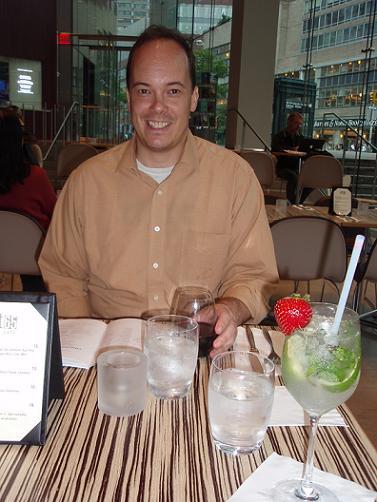
Afterwards, over drinks and food at the Alice Tully Hall Cafe (they have half-priced specialty drinks from 3-6 pm! And not watered-down at all! I nearly passed out after two sips of that mojito in front of me πŸ™‚ ), he told me that Gonzalo did just fine with that crazy high-flying scherzo for Oberon in the first act (I knew he would!), and that he really liked Teresa Reichlin as Titania and Janie and Tyler in the second act divertissement, which received a lot of applause, which I can just imagine! He also agreed to write a little review, which I’ll post in a minute. (If you don’t know the story of Midsummer, read about it here — Balanchine pretty closely follows the Shakespeare).

p62022292

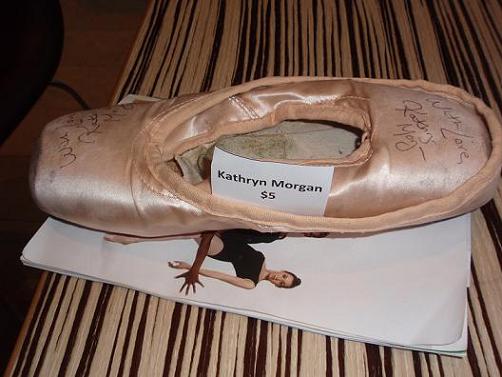
But first, it being Michael’s last day at NYCB this season, he browsed the gift shop, and ended up with a pair of Kathryn Morgan toe shoes. He told me (and, apparently the amused gift shop attendant) he figured she wasn’t going to be $5 for much longer πŸ™‚ I guess their shoes cost a certain amount according to their status: principal ballerina shoes are $30, soloists are $15 and corps members $5. I didn’t know all this. I’ve never wandered over to the toe shoes section. I initially wondered why, then realized, oh, my favorite dancers don’t usually wear toe shoes. Sorry to be lewd, honestly, but I then couldn’t help but wonder — just because of that crazy strong mojito that nearly put me on the floor — why they don’t sell other kinds of used dancewear that my favorites *do* wear, alongside the toe shoes. Sorry! But can you imagine? Total alternate universe.

Anyway, here is Michael’s review:

At Dunkin’ Donuts, they sell munchkins 25 at a time. That’s about how many you get at New York City Ballet’s A Midsummer Night’s Dream, as well. The squadron of young dancers from SAB added a nice dose of fun and energy to a matinee that already had plenty of both on Saturday.

Daniel Ulbricht didn’t dance the role of Puck, so instead of gravity-defying antics, we just got antics. Corps member Troy Schumacher was announced as a late sub for soloist Sean Suozzi in the role, and there were some disappointed Ohhs around me. The thought: We’re getting the third string. Schumacher did an excellent job, though. He moved with an appropriately sprightly energy and showed a nice touch with the comedic moments. When he realized his magical matchmaking mistake, you could almost hear the “D’oh!”

Teresa Reichlen was fantastic as Titania, displaying just the right balance of regal, playful, and otherworldly for a fairy queen. And Robert Fairchild, a very busy man this season, excelled in yet another role (albeit in a ridiculous Prince Valiant costume) as Lysander. His put-upon love interest was once again Sterling Hyltin. The leads from NYCB’s Romeo + Juliet both showed they can handle Shakespeare’s comedy as well as his tragedy. Hyltin, for example, dialed up a slightly manic quality to great effect.

And Balanchine’s choreography tells the entire story in Act I, leaving Act II free for the divertissement. A quick wedding march and then Janie Taylor and Tyler Angle were center stage. They brought down the house.

Angle is a strong presence, but he defers so gracefully and lifts so effortlessly that he never soaks up more than his share of the spotlight. I noticed that when he partnered Tiler Peck in Mercurial Manoeuvres, and again on Saturday. Janie Taylor was both a delicate vision and a physical wonder, sometimes in turns, sometimes simultaneously. It’s a complete oxymoron in print, but she pulled it off onstage. Amazing.

The final scene was especially poignant for me, because I knew this was the last performance I’d see this season. Fireflies flickered around Puck against the dark backdrop of, yes, a midsummer night. It was the kind of night you don’t want to end, and the kind of season.

And here is Oberon’s (I mean Philip’s) review of the same cast.

And this just in! Another review (I’m interested in what he says of Gonzalo Garcia) — the one (by a pro critic who doesn’t say things are good when they’re not, and with great detail and specificity) that I’ve been waiting for πŸ™‚ I knew Gonzalo’d nail it! I knew he’d be brilliant! I knew it!


TONIGHT AT NEW YORK CITY BALLET


Top to bottom: Ashley Bouder and Robert Fairchild in Lifecasting, Tiler Peck in Mercurial Manoeuvres, and Maria Kowroski and Philip Neal in Slaughter on 10th. All photos by Paul Kolnik, courtesy of NYCB.

My friend Michael (whose novel is reviewed in the New York Times Book Review this Sunday, woo hoo!!!) and I saw this program Wednesday night. It was one of my favorites at NYCB and I think his as well. (Well, he loves Ashley and I love Mr. F. so it was a given we’d be melted into our seats by the end of Lifecasting).

But we were also both blown away for the first time by Wheeldon’s Mercurial Manoeuvres, I think because Tyler Angle plus Tiler Peck equals serious magic… Oh my gosh, Tiler Peck really made that ballet. I can’t wait to see her again tonight. She was just everything and more. Unfortunately Tyler won’t be partnering her (he’s my favorite male partner, along with Marcelo Gomes at ABT); she’ll be partnered instead by Adrian Danchig-Waring, a dancer who I am not all that familiar with but am excited to see. Also, heinously, my love Gonzalo Garcia (who owns the lead in this) is not dancing tonight; instead it’s Joaquin De Luz, who, yes yes, I’m sure will be spectacular as well πŸ™‚ It will be interesting to compare, as I so love to do…

Casts are the same for Lifecasting with the aforesaid mesmerizing Robert Fairchild and Ashley Bouder, and Slaughter on 10th, starring Maria Kowroski and her legs, Philip Neal and his tap shoes, and Vincent Paradiso and his gangster persona! I’ll write more about this program after I see it again tonight.

GONZALO GARCIA IS A ROCK STAR AND JANIE TAYLOR A GRACEFUL MURDERER


Those are my friend, Judy’s terms in the title, by the way! Friday night at New York City Ballet was one of the most exciting in recent memory. The dancers were all excellent, the ballets fun, the audience pumped (okay, a little over-pumped in places!) It was just one of those nights to remember. It was an all-Robbins program, consisting of four of his most diverse, but liveliest dances: Glass Pieces, The Cage, Other Dances, and The Concert.

First, of all, Wendy Whelan appears to be out with a minor injury, so it was announced before curtain rose that Janie Taylor would be dancing the lead in The Cage. If anyone heard some psycho girl shout “Yay!!!” — sorry. Didn’t mean for it to echo like that… πŸ™‚

Glass Pieces is always enjoyable with that rhythmic music, especially in the first and last sections with the intense strings and pulsating drums respectively, the dancers in the first walking across stage as “normal people,” every once in a while a “dancer” appearing and turning and /or jumping ‘dancer-like’ across stage — the most visible of whom is Tyler Angle. I can watch this ballet endless times just to see him in that first section. He’s beautiful in that golden unitard, and always breathtaking no matter what he’s doing.


The second, adagio section, was danced by Maria Kowroski and Philip Neal. Maria nailed this section like I’ve never seen anyone do before. Her body is of course so long and thin and she’s got such spidery limbs, she can really make wicked lines. I don’t know what the dance means, but every form she made was so pronounced and so full of intent, she was just mesmerizing.


Then, Janie’s Cage! Sometimes you just know that no matter who’s done the role in the past — Tanaquil Le Clercq — whoever — this is just the best; no one’s ever going to outdo that and no one no how has done better before. That’s how I felt Friday night watching Janie. It’s like this role was made for her, even though literally it wasn’t. It’s like she’s very mindful of how each shape she’s making is going to look from every vantage point in the house. You can tell how much she worked at this and thought about it. Maybe it comes from being a visual artist as well (she’s a cartoonist and a costume designer).

Anyway, The Cage is the heartwarming (not) story of a colony of female ants – or some kind of insect — who, like black widows, kill their male counterparts, after mating. (Where did Robbins get the idea? Ballet’s from 1951. Hmmm.) Janie was absolute wicked splendid perfection; she just looked like a spidery-limbed little arachnid as her tiny waify body descended on poor big muscly Sebastien, digging her tentacles into his sides, slapping and clawing him all about. And the way she’d flick her wrists and make those insect-like shapes with her hands at such speed and with such perfect definition, it looked like she was metamorphosing into some creaturely other right before your eyes. It was really rather terrifying.

At one point — either she’s on top of him or him on her, I think it’s the former since she’s killing him — their bodies each curve out from the other to make this big hollow O shape, and it looks like one of those human limb-eating plants (what’s the name?…) Crazy beautifully creepy! Of course the drama is that Janie’s the “novice” here and she doesn’t want to eat this man because she kind of falls for him, but she has to for group acceptance. The way she shows that, wanting to reject the rites, by caving in from her center, collapsing into herself, then rolling herself into a ball and letting the male bug hold her — is stunning as well.

Teresa Reichlin is the ideal Madame of the colony, or whatever you want to call her. Her long legs just beat the air on those battemants, like she is the queen and you don’t question her. I can’t find many pictures, but here is Wendy Whelan talking about the ballet, with some clips of it.


Then was Other Dances, starring (really, a very apt word) Tiler Peck and Gonzalo Garcia. This is a gorgeous ballet, full of sweetness and romance and virtuosic dancing with high leaps and jumps and spins and all, originally made for Baryshnikov and Natalia Makarova. I can’t imagine this one being done better either. Both dancers have such endearing stage presences. Tiler Peck is really growing on me — her obvious love for the music, her playful phrasing, her sweetness and freshness and innocent charm. She was beautiful on those overhead lifts where she lay on her side, her arm behind her head, looking down at him. And Gonzalo’s in love with his audience, and you can tell. He says in this article that he’s naturally shy, but he’s also a natural performer. As I said on Twitter, at the beginning of his second solo, two girls screamed “I love you!” Very very unusual for NYCB! “What is he, a rock star?” Judy asked me. Apparently. Gonzalo is turning NYCB into ABT πŸ™‚ What is it about these Spanish men?…


Tiler and Gonzalo work very well together. There was some weirdness between him and Ana Sophia Scheller, but these two are a very good partnership. I think they’re friends too — I see them together on the street sometimes. They danced the virtuosic leads in Donizetti Variations two days earlier and were equally stellar. I’m told he had a big fan base in San Francisco, where he came from. Well, he’s won me over. Ariel, who came with me on Donizetti day (and who comes with me to NYCB rather frequently), took one look at the program and said, “Wow, they have Gonzalo dancing a lot these days.” I said, “Yeah, particularly when I happen to have tickets. Funny that.”

And the evening ended with the comical The Concert, which Judy loved, as I knew she would. It’s cute and funny and no one does up the humor like Sterling Hyltin as the sweetly goofy music lover who can’t dance her way out of a paper bag, and Andrew Veyette and Gwyneth Muller as the cutely warring husband and wife. Andrew even took curtain calls with his ‘obnoxious husband’s’ pipe gripped firmly between his teeth.

The other highlight of the week to me was Balanchine’s Stravinsky Violin Concerto, danced spectacularly by Robert Fairchild, who I’m positive I will never ever tire of seeing. He’s got to be one of the hardest working young men in ballet these days and it really shows. He’s becoming a real David Hallberg. His movements are so precise and everything is so well-articulated. He bends from the waist more than anyone else (that I can see) and that gives him so much breadth and expansiveness. And he’s always making some sort of statement, even in abstract ballets, particularly in abstract ballets.

I love this Stravinsky choreography as well. There are so many stand-out moments, you just can’t mention them all. I love the part where the man of the first couple (here, the aforesaid Robert the spectacular) stands over the ballerina and turns her, or rolls her. She bends underneath him so he looks like her shadow. If this is the same ballet, I felt like Robert leaned in closer to her before and held his arms around her waist, held her more closely, and almost put his head on her back, and it looked so romantic, so tender and loving. It just melted me. He didn’t do that either night I saw him dance this this week. He still turned (or rolled her — don’t know what to call it) brilliantly, but I feel like someone told him not to lean in and make it tender like that. But I want him to do that again! Unless it’s another ballet I’m thinking of … is it? Does anyone know what I’m talking about??

I also love the rather acrobatic choreography for the second couple — first night I saw it danced by Maria Kowroski and Sebastien Marcovici, second night by Amar Ramasar and Kaitlyn Gilliland (filling in — and doing very well — for Wendy Whelan and Albert Evans). I love how she does backbends and handstands over and around him and he just looks at her with amazement, and follows.

Finally, I really liked Liebslieder Walzer earlier this week, which I wrote shortly about here. I know some think it’s slow, and it wasn’t very popular when Balanchine first showed it in 1960, but I really prefer the choreography here to that in his more popular Vienna Waltzes, which is mainly straight ballroom. The choreography is more complex here, and revealing of character. One man (the night I saw it, it was Jared Angle –who looked sharper and more gentlemanly than ever to me) circles around his lady and she circles the opposite way on the inside of him. It’s a lovely effect and I think it shows they are going in opposite directions, not meeting mentally. The couple danced by Sebastien and Janie seemed the most romantic, at one point approaching one another while making expansive circles with their arms as they entered into an embrace. I do agree with Sir Alastair, though, that the couples need to work on their differentiation from one another in order to amp up the drama. It’s choreographically beautiful though and I hope they keep doing it in future seasons – -maybe not with the equally slow and somber Les Noces though!

(By the way, that program — Liebeslieder and Noces — program 8 — is showing twice more this week and I found it not really to be a program for newcomers to ballet. I brought my friend, Jonathan (who I haven’t seen since law school, don’t want to say how many years ago now πŸ™‚ ) and if he wasn’t an opera fan who could latch onto the chorals (which feature heavily in both dances on the program), I fear he might have been bored. I think you have to really be into the intricacies of choreography to appreciate it. If you’re new to ballet, or bringing someone new, see Programs 9 and 10 this week — both containing more dramatic, lively dances.)

NYCB: A DIFFERENT DREAMER, A BRILLIANT HALLELUJAH JUNCTION AND A SWAN LAKE DEBUT


I spent all of Saturday at New York City Ballet, watching both matinee and evening performances like the obsessive I am πŸ™‚ Highlight of the daytime performance was Jerome Robbins’s 1979 ballet, Opus 19 / The Dreamer in which Robert Fairchild and Janie Taylor made their NYC debuts in the lead roles. This is only my second time seeing this ballet — the first was a season or two ago when the main parts were danced by Gonzalo Garcia and Wendy Whelan. (Robbins created the ballet on Baryshnikov and Patricia McBride). My research has revealed that critics don’t consider this to be a major Robbins ballet; Arlene Croce seems not to have written a word about it. Audiences seem to adore it though, me included.

Funny but the first time I saw it, I thought the main male character was a “dreamer” in the sense of being an idealist. Wendy seemed to represent Gonzalo’s ideal. And there often seems to be a kind of charmingly airy, carefree, “head in the clouds” quality to Gonzalo’s dance persona.

Robert was more solid and sharp and weighty than Gonzalo. In his beginning solo, he’d slice through the air with his arms and legs, stretch an arm out, hand bent up, as if to be pushing out against something, or stopping something from getting too close to him. What that something is isn’t entirely clear. It seemed more like he was a literal dreamer, someone lost in a dream that was neither entirely pleasant nor unpleasant, something he kind of wanted to escape from but was drawn to as well. And Janie — I love her! — was all tantalizing, bewitching, taunting little mischief-maker haunting his subconscious, not leaving his psyche a moment’s peace. Whenever she was onstage, she completely captivated — both him and us. Even when she’d collapse in his arms, he’d struggle to straighten her up again. He’d lovingly wrap his arms around her; she’d be out of them in a split second. It was very different from the way Wendy danced, if I remember correctly. I wonder how Patricia McBride did it.

I read a review of a dancer who performed the male lead in the 80s. The writer — Jack Anderson — said the dancer — Jeffrey Edwards — looked like a thinker, very introspective. I always love watching Robert — I think he is one of the most fascinating movers around. I’m not sure if what I saw here was introspection or more like inner turmoil. He was definitely lost in himself — he doesn’t even seem to notice all the lavender-clothed dancers flitting about him, didn’t seem to notice anyone until Janie came darting by and commanded his attention. I guess it seemed more like he was lost in his own angst, haunted by his dreams, than lost in his thoughts or his art. But it would be hard, I’d think, to embody introspection.

They don’t seem to be performing this ballet a lot, but I’d love to see Tyler Angle dance the part as well.

Also during the day was Chaconne, which I’m growing to love more and more — particularly the first pas de deux where the man lifts the ballerina and she has her arms out to the sides and does these large, sweeping steps forward, every few beats lightly tickling the floor with one toe shoe, and it looks like she is flying — and Vienna Waltzes, which, probably ridiculously for me since I’m a ballroom dancer, honestly just kind of bores me. The choreography’s not very intricate or compelling (odd for Balanchine) — it’s mostly straight-forward waltzing, which I can only watch for so long. There’s a middle section composed of high-energy allegro ballet which was danced very theatrically by Yvonne Borree and Benjamin Millepied. That section seriously kept me from falling asleep.

Highlights from the evening program were Peter Martins’s Hallelujah Junction, Joaquin De Luz in Donizetti Variations, and Sebastien Marcovici’s debut as Prince Siegfried in Balanchine’s Swan Lake. I hadn’t seen this cast of Hallelujah before — it was Sterling Hyltin, Gonzalo Garcia, and Daniel Ulbricht. This cast wasn’t so dramatic, so romantic, so intent on telling a little story, as other I saw (Marcovici, Taylor, Veyette), but seemed more focused on simply making the music visual — and they did so to fascinating effect. I greatly enjoyed just sitting back and watching all that brilliantly fast-paced, razor-sharp movement — Gonzalo with his sexy impish bouyancy (he’s not really a small man but somehow he seems like he’s always airborne; I think he’d make a great Sleeping Beauty Bluebird), Sterling with her Russian ballerina-high extensions that she does with incredible speed, and Daniel for his intense precision. This is the best I think I’ve ever liked Daniel Ulbrich before. He didn’t just jump inhumanly high; he really nailed very difficult-looking, intricate footwork and he did so with such sharpness and tautness. If he’d only be given more than just jumping guys parts, he can show that he can actually dance extremely well.

Sebastien danced Siegfried with great passion, expectedly. Balanchine really eviscerated the man’s part in his version of the ballet but Sebastien went as far as he possibly could with it. At one point, one of the corps swans in the back row fell and of course the audience had to go “ooooooohhhhhhh,” but he didn’t let it faze him as his Siegfried searched desperately among the swans for his beloved Odette. He had a minor flub on one of the many traveling turn jump thingys but no big deal. It was heartbreaking when Wendy bourreed back away from him and he reached out to her like she was taking his life with him as she went. Also, I love the black and white plastic swans swimming in the little stream at the beginning and end, but the people working them should just make sure the white swan appears at the right time! One time Wendy wasn’t fully into the wings yet when her swan form began sailing across the stage and Charles Askegard’s Prince Sig didn’t know where to run — the swan or Wendy. This time it was a little late and Sebastien kind of had to go searching upstream for her πŸ™‚

Balanchine’s Donizetti Variations was danced brilliantly by Joaquin De Luz and Megan Fairchild. But what I really love about Joaquin isn’t his bravura dancing but his dramatic abilities — how he interacts with the other dancers. Even when dancing a storyless ballet, he’ll look at the others as they do their thing, shoot them a cocky grin — or a genuine smile — and do his thing, his steps a clever or comical response to theirs.

Also on this program was the newish ballet by Melissa Barak, A Simple Symphony – -my second viewing of that. She does borrow from Balanchine, but her choreography also has its own wit, which you notice on multiple viewings. Like Balanchine, the drama is in the actual choreography — every little flex or softening of the wrist meaning something. At one point, the ensemble of ballerinas all turn their hands and flex their wrists, and it looks like they’re cutely shrugging their shoulders. It’s such a pretty ballet with such mellifluous music though, sometimes you don’t want to focus on the choreography; you just want to sit back and enjoy the loveliness of it all.

TWO WORLD PREMIERES — QUASI UNA FANTASIA AND TOCCATA — AT NEW YORK CITY BALLET GALA


Last night I went to New York City Ballet’s Spring season gala. I always love galas but they’re especially exciting when they showcase world premiere dances. In this case, there were two such premieres, along with the world premiere of a new piece of music set to one of the ballets.

First things first: I missed most of the red carpet events, unfortunately, since the program began early (so as to make time for the after-show dinner, which I am far too poor to attend). And shame on me for mismanaging time like that — that Waiting For Godot experience from two years ago was too much fun. I did get there just in time to see the paparazzi flashing away at (Sex & the City author) Candace Bushnell and (NYCB principal) Charles Askegard. Sweet Charles soon stepped aside to let his wife bask in the glory all on her own. She looked radiant. I was jealous.

Continue reading “TWO WORLD PREMIERES — QUASI UNA FANTASIA AND TOCCATA — AT NEW YORK CITY BALLET GALA”