KANDINSKY’S BLUE RIDER IN PERFORMANCE AT COLUMBIA U


Over the weekend I saw the second of the two experimental performances sponsored by the Guggenheim in celebration of the museum’s current Kandinsky exhibit. (The first was the Isabella Rossellini reading / light show I wrote about earlier). This one, which took place at Columbia University’s Miller Theater, sought to honor the ideals of the early 20th Century Kandinsky-led Blue Rider movement, which advocated the bringing together of visual, music, and literary artists to produce art that would engage all of the senses.

So, this production, The Blue Rider in Performance, combined poetry/opera libretti, music, dance, and paintings and other visuals. During the first half of the program, soprano Susan Narucki sang libretti by various composers including Arnold Schoenberg, Thomas de Hartmann, Arthur Lourie, and Anton Webern, while Sarah Rothenberg (who also conceived and directed the show), played piano.

Both women were brilliant. I also loved the images projected onto the back wall during the singing and piano playing. Sometimes a vibrant full-blown painting by Kandinsky would appear, at other times the wall would go blank and a black line would slowly begin wending its way across that wall — a painting in progress. At other times, there would be no painting, but instead a kind of light show of shadow play of what was happening onstage. The lights would catch Rothenberg as she played. She’d sometimes appear rather ghostlike, sometimes macabre, sometimes threatening, as she’d hunch over her piano, creating a rather wicked shadow, while swaying her body rather violently about as her hands flew back and forth across the keys, producing an equally violent-sounding melody.


I didn’t know that much about Kandinsky, and so, after these performances did some research. Art  historians and critics have used his painting, The Blue Rider (above), to show how he used color. Kandinsky was considered the father of abstract art. He wasn’t as interested in painting figures realistically as he was evoking an emotional response in the viewer through color and shadow – -blue being the color of spirituality to him. In the image above, your eye is drawn to the movement of the rider. But the movement is depicted through a series of colors– the blue of his jacket is lighter than that cast on the ground by his shadow — rather than specific details. Is he carrying a child in his arms or not? It’s not really clear. But you get the sense that the rider is moving very fast toward something; you feel an urgency.

I felt that as well with the way they used the lights to shadow Ms. Rothenberg as she played piano. You couldn’t see details in her movement, which was illuminated in large shadows on the back wall, but she was moving across that keyboard madly, her movements blending into one another. She looked like a mad scientist at times. The sometimes chaotic melody, along with these shadows, combined to create this feeling of frenzy, or of being haunted by something.


In the second half of the program, the piano was removed and the Brentano String Quartet took the stage and played Schoenberg’s String Quartet No. 2 in F-sharp minor, Op. 10 (Arnold Schoenberg was a member of the Blue Rider Group as well). During the first part of this second half, four dancers from Armitage Gone! Dance performed choreography by former “punk ballerina” Karole Armitage. Opera Chic informs that Schoenberg wrote this piece during a rather trauma-filled period in his life, when his wife left him for another man – an artist Schoenberg had hired to teach him to paint — then returned home, upon which the artist committed suicide and destroyed all of his artwork.

The four dancers — two male, two female — in broad strokes portrayed this story, the two women initially beginning as companions, then fighting, breaking into couples with the two men. The couples would mirror each other — one would struggle, performing tension-filled lifts and supported stretches, while the other would be more at peace with one another. Then it would change. At one point, one of the couples was engaged in this really sadly beautiful statue-like embrace where the woman leaned toward the man, putting her weight into his chest, seemingly needing him, while he, considerably taller than she, rested one elbow atop her shoulder, and held his hand to his forehead, as if his mind was full of turmoil, trying to decide what to do about her. It was such a mesmerizing pose, especially with the way they held it for a considerable time, I almost couldn’t take my eyes off of them to watch the other couple dance.

During the second half, the dancers exited and the soprano returned. So there wasn’t a whole lot of dance. But, despite that, I really enjoyed these two experimental performances the Guggenheim put on. More please!

The Kandinsky exhibit continues through mid-January.
 

LEVELS OF NOTHINGNESS STARRING ISABELLA ROSSELLINI

levels-of-nothingness-exh_ph01

levels-of-nothingness-exh_ph02

levels-of-nothingness-exh_ph03

levels-of-nothingness-exh_ph04

Photos above courtesy of the Guggenheim Museum.

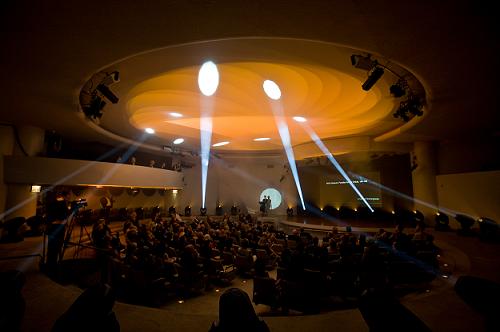
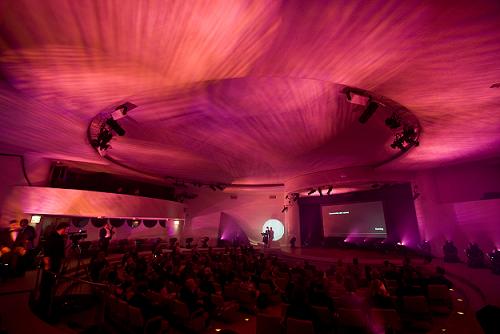
Over the weekend, I went to see a spoken word / light performance by Mexican artist Rafael Lozano-Hemmer called Levels of Nothingness, at the Guggenheim, as part of their Works & Process series. The work was inspired by Kandinsky’s Yellow Sound. (There is currently a large Kandinsky exhibit in the Guggenheim, in celebration of the museum’s 50th anniversary). Wassily Kandinsky is considered the father of abstract art, he used color extensively to evoke inner states, and he believed in the convergence of all art forms — painting, sound, movement. Yellow Sound is basically a compilation of his notes describing his ideas for an theatrical piece or an opera in which color and lighting played a large role.

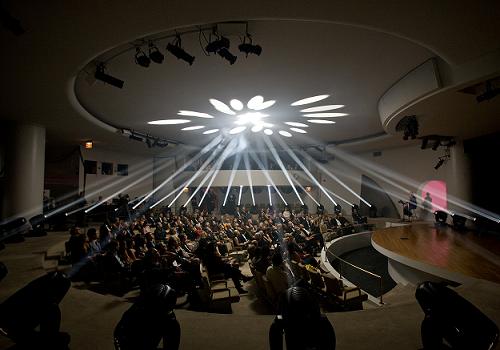
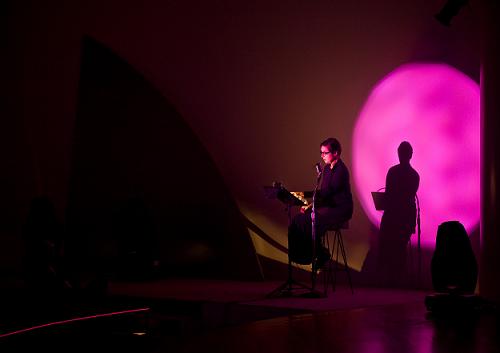
So, starting from that idea, Lozano-Hemmer (and co-writer Brian Massumi) constructed an interactive installation in which a system of lights would respond to spoken words. Actress Isabella Rossellini read the words, which were quotes from various philosophical texts about perception and color (interestingly, all texts were by non-Newtonian thinkers, who believed, in contrast to Newton, that one’s perception of color was subjective.) Basically, a computerized microphone analyzed Rossellini’s voice, taking into account her: pitch, wavelength, amplitude, intensity, speed, accent, intonation, and speech patterns. That information triggered robotic lights (these rather cute little R2D2-looking guys which were set up to surround the stage and perimeter of the auditorium) to create various light effect, such as those used in a rock concert — fly-aways, bump cues, color chases, ballyhoos, builds and flash-throughs — I don’t know what all of those things are but figure there may be theater-people reading who do!

Anyway, the effect was interesting but not really what I was expecting. Go here to see a clip of it; scroll down about halfway through the article until you see the video on the left side — on the video, you can click on the little box in the right-hand corner to enlarge the video to fit your entire computer screen.

It’s very cool to be sure, but it seemed more orchestrated than I was expecting. For example, every time Rossellini began on a new piece of text, she’d wait a few seconds for the machines to all re-adjust and prepare for that segment. So with each text there would be a specific light pattern: a white-based kaleidoscope one on the ceiling, a yellow-based one, a red light would light up behind her and go off and on as her voice stopped and started, sometimes there would be a multiplicity of lights all shining up at the ceiling making circles of light in multiple colors, etc. But they weren’t all happening at once. Each quote was set up to show one kind of pattern and then the lights would blink on and off or move around in the kaleidoscope according to her voice. It’s hard to explain, but watch that video if you want to see what I mean.

Afterward, the audience got to test it, which was fun. The host walked around with a microphone and let various people speak into it, reading from text projected on the back wall. Everyone was behaved and no one did crazy voices or spoke really loudly or anything so the lights were kind of mild as well. What I (and another woman, who asked) really wanted was for several different people to say the exact words side by side to see how the lighting design was different for each voice. But the system wasn’t set up to do that. At one point, Lozano-Hemmer re-read the same text an audience member had just read, and there did seem to be a subtle different in the lights, but I needed to see more of that to compare.

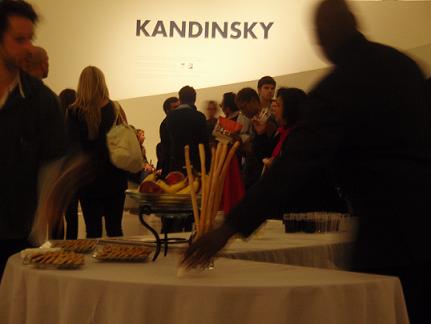
Anyway, after the performances, the Guggenheim hosts these little cocktail hours where you can meet the artists.

p9202312

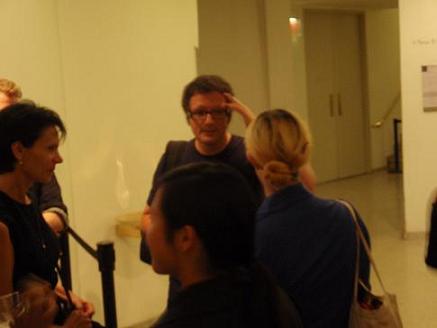
Here is Lozano-Hemmer speaking with some of the attendees. I couldn’t find Rossellini. Sorry so blurry — I hate flashing in people’s faces.

p9202308

Well, anyway, the Guggenheim seems to have replaced their tray-loads of mini sandwiches with these rather long bread sticks. Probably a wise idea to get rid of the mini sandwiches because, as James Wolcott has noted, people go downright mad for those things, nearly killing each other in the stampede toward the food tables. You’d think none of these people eat for a month before a Guggenheim Works & Process event just so they can load up on “free” (if you subtract the $30 you paid for the ticket) little cucumber and mayonnaise squares. Could never figure out what gives with that?

Anyway, the bread sticks are tasty, and surprisingly filling, but when I went to put one to my mouth I realized how blasted long they were — it was like eating a baton. You had to really hold the end of the breadstick out quite a distance from your mouth. It was rather amusing watching all these people standing around with a glass of wine in one hand, holding a bread stick up in the air with another! For a moment they looked like cigarette holders and the whole scene looked a bit Breakfast at Tiffany’s.

DANNY TIDWELL ET AL IN FIRE ISLAND DANCE FESTIVAL

Here’s a nice video of clips from the Dancers Responding to AIDS performances, which took place during the Fire Island Dance Festival in July. Watch for Danny around the 1.43 and 3.24 marks. You can also spot Keigwin + Company (in the towels) and members of Cedar Lake Contemporary Ballet (around the 1.38 and 3.11 marks), as well as others whom I didn’t recognize. Anyone recognize the classical ballet dancers? They’re good! What a gorgeous setting.

Video via SYTYCDism.

Speaking of Larry Keigwin: I’d really really really wanted to see this at the Guggenheim — his new piece set to Steve Reich’s Pulitzer-prize-winning score from 2007, Double Sextet. Unfortunately I was horribly sick with a cold-turned sinus infection-turned several days-long TAC attack and just couldn’t make it. Anyway, Keigwin and ballet choreographer Peter Quanz each created dances to the same piece of music. Their creations, which were performed by members of their dance companies, varied greatly, showing the different interpretations and approaches dance artists can take to one piece of music. In addition to the Macaulay review in the NYTimes (which I linked to above), here is fellow blogger Evan’s take (with lots of pictures).

ABT, LARRY KEIGWIN, AND DANCES INSPIRED BY KANDINSKY AT GUGGENHEIM THIS FALL


The Guggenheim Museum has just released its Works & Process events schedule for the fall and there’s some good stuff coming up.

On October 11 and 12 ABT will give a program, entitled, The Art of Adaptation, in which dancers will perform portions of the company’s upcoming contemporary season, held this year at Avery Fisher Hall, and panelists will discuss how they’re adapting work for a non-dance venue. (The company is performing at Avery Fisher this year because City Center, where they usually have their fall season, is going to be temporarily closed for remodelling). It hasn’t yet been revealled who the dancers or moderators will be, but I’ll let you know when I do!

On September 23 and 25 there will be a new dance / music commission inspired by artist Vasily Kandinsky’s Blue Rider Almanac of 1912, performed at the Miller Theater at Columbia University. Music is by the Brentano String Quartet, soprano Susan Naruki, and pianist Sarah Rothenberg; the dancing will be by Armitage Gone! Dance. This, along with a couple of art installations in the museum and another music piece, is commissioned in conjuction with a Kandinsky retrospective to show in the main museum.

On September 11 and 12, young choreographers Larry Keigwin and Peter Quanz are each showing a piece they’ve made to Steve Reich’s Pulitzer-winning Double Sextet. Dancers will be from Keigwin + Company and the Royal Winnipeg Ballet. Reich will participate in the panel discussion on the 12th.

And, finally, on October 24 and 25, Shen Wei Dance Arts will perform in celebration of the company’s 10th anniversary and Shen Wei will discuss his creative process.

There are other, non-dance events as well, including a talk on “Sex Stress and Music,” a world premiere by composer Charles Wuorinen, and a spoken word performance inspired by Kandinsky’s Yellow Sound (1912) in which actress Isabella Rossellini will read and Mexican artist Rafael Lozano-Hemmer will generate an array of colors from the sound of her voice. Very cool-sounding!

The schedule’s not yet on line but it’ll be here when it is.

I NEED MORE CHAOS!

p6022193

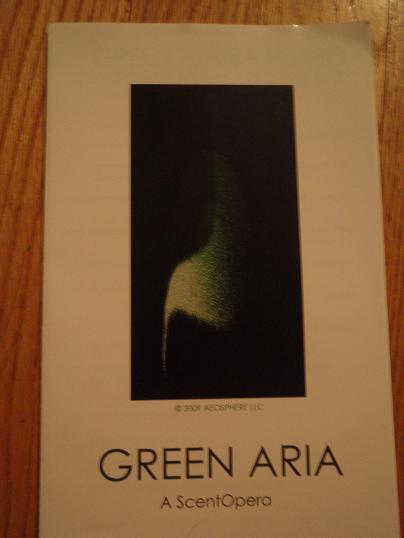
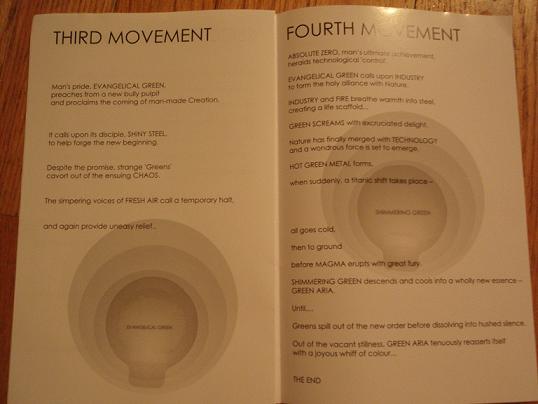
On Monday afternoon, I went to this novel opera, Green Aria: A Scent Opera, at the Guggenheim. It was their last Works & Process program of the season. Going in, I had no idea what to expect, knowing only that there was no singing, only scents (by Christophe Laudamiel) and music (by Valgeir Sigurdsson and that fabulously crazy Nico Muhly) and that the opera’s characters were various smells. It was really so interesting and I wish they would expand it (this one is only half an hour long) and show it in more venues so that more people could see it.

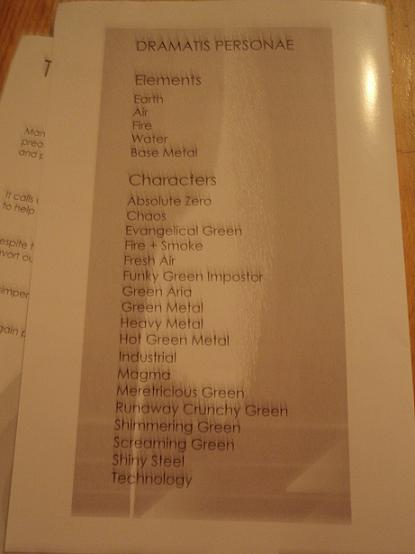
The basic story (by Stewart Matthew) is: nature is corrupted by industrialism and technology must find a way to save it, to create new fresh air. The five basic elements (Earth, Air, Fire, Water, and Base Metal) are the core characters, with other characters named things like Funky Green Impostor, Green Metal, Evangelical Green, Screaming Green, Shimmering Green, Chaos, Absolute Zero, etc. Here’s a full list of the Dramatis Personae from the back of the little Playbill they made:

p6022197

In the auditorium they set up little tubes (which looked like microphones) at each seat. You could adjust your tube, but they blasted in enough scented air that you really didn’t need to be sitting too close to it. They told us to breathe normally, not to sniff like a police dog (which of course most of us were inclined to do anyway). The tubes at each seat were necessary, Laudamiel told us, because if scented air was just blown into the auditorium in whole, it could take up to 50 seconds for the scents to spread to everyone. It would be impossible then to coordinate the scents with the music, or for everyone to have the same experience at the same time.

p6012187

p6012183

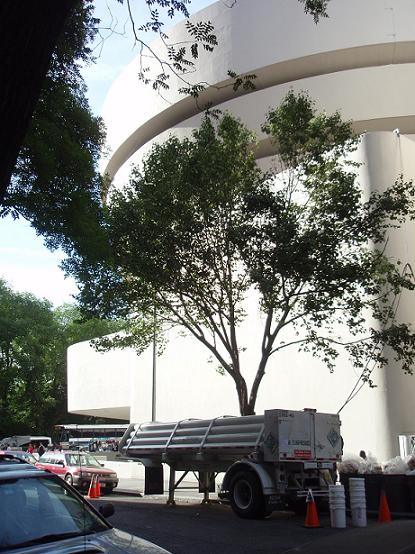
The scents were “stored” in this gigantic compression tank parked outside of the Guggenheim.

I thought since I have chronic sinus issues and a deviated septum and all, I might not get the same effect as everyone else, but it wasn’t a problem for me at all. Laudamiel’s scents (he’s worked as a perfumer for Ralph Lauren and other designers) were all very strong. They were mainly earthy because of the nature of the opera: Earth smelled like freshly mowed grass, Green Aria was like a dewy field, Evangelical Green was like grass mixed with sweet perfume, Shimmering Green yet sweeter. The sweetness and the grassiness didn’t always mix well, I think intentionally — Evangelical and Shimmering Greens were meant to be overly preachy, a surfeit, an excess, not authentic.

And you’d think the way people perceive smell would be subjective, but I think everyone pretty much despised / was horrified by Funky Green Impostor, who smelled very gassy, very foul, like gas combined with rotten eggs. Others I disliked were Fire, who smelled like 9/11 to me and Shiny Steel, who smelled very metallic but with a sweetness that just didn’t mix right.

By far my favorite somehow (besides simple Earth, and Green Aria) was Chaos. Chaos, according to the Playbill, was supposed to create “strange greens” which would  make Chaos seem bad. But Chaos was not the least bit foul-smelling to me! To me Chaos smelled like tropical fruit punch, or bubble gum. It was the only non-earthy scent. The Playbills they gave us had various sample scents, but Chaos was not there! I want my Chaos!

p6022195

p6022196

I’d said earlier that Muhly was the ideal composer for scent, but now that I’m remembing the whole opera, I’m realizing that that music, those sounds, were a large part of how I interpreted the scents. You knew when Funky Green Impostor was on his way by the sounding of harsh notes — at first faint, like he was just approaching — and then you knew when you’d be hit with some very threatening whiffs by the swelling of those chords. And you also knew when sweet, sunshine-y scents would be on their way when the music became mellifluous and Mozart-like. There’d be a fight, you’d smell the characters duking it out, the scents all mixed but at various points one or another rising above the rest — stinky, then perfume-like, then the freshly mowed grass, more sweet surfeit, etc. — and you knew when good had triumphed when it sounded like the end of a Tchaikovsky ballet followed by the dewy fields. I honestly never realized how strong my auditory senses were, what powerful effect sound could have, until I heard Muhly’s work.

Read Anthony Tommasini’s NYTimes review for far better descriptions of the music than I can provide 🙂

This was a fascinating experience, what I live in NY for.

DAY OF THE UNEXPECTED: AN OPERA WHOSE CHARACTERS ARE SMELLS & A TUDOR-ESQUE STORY BALLET BY RATMANSKY


I had a crazy day. This afternoon I went to the Guggenheim to see this new ScentOpera — an opera told entirely through music and smell (each seat had a little microphone that blew the scents into your face) — which I’ll write about soon. Suffice it to say it was very interesting and I think Nico Muhly has found his niche: composing for smell — because, unlike with dance, his music most definitely did not overpower these whiffs at all, at least not as created by perfumier Christophe Laudamiel. I nearly passed out from “Funky Green Impostor.”

Anyway, more about that soon.

Tonight was the premiere of ABT‘s new resident artist Alexei Ratmansky’s first ballet for the company — a night for which many have been waiting ever so eagerly. For those not up on the ballet-world gossip: Mr. Ratmansky (from the Ukraine, and former artistic director of the Bolshoi) initially was rumored to be contemplating taking the resident choreographer position at NYCB. Then he didn’t and everyone was depressed because Christopher Wheeldon was leaving to start his own company and everyone really liked Ratmansky and wanted to see more of his work stateside. Then, next thing everyone hears is that he’s accepted the same from ABT, making everyone happy but confused — NYCB is known for being more daring and contemporary in its repertoire; ABT sticks more to the traditional classical story ballets. Ratmansky,who was leaving the Bolshoi because he wanted more of a challenge (the Bolshoi’s rep is akin to ABT’s), seemed a better fit for NYCB.

Anyway, I was expecting tonight something along the lines of Concerto DSCH or something he’s done for NYCB (which is all that I’ve seen by him): a contemporary Balanchine-esque ballet without a linear narrative but with a discernible theme and with original, clever, thought-provoking choreography. Instead, On the Dnieper (the Dnieper is a river in the Ukraine), set to Prokofiev’s music of the same name, is a story ballet that I found to be about three parts Tudor, one part Robbins (with some of the fight scenes).

It’s the story of Sergei (danced by Marcelo Gomes), a young soldier who returns home, after war, to his fiance Natalia (Veronika Part), only to realize he no longer loves her but is attracted to Olga (Paloma Herrera), a flighty, flirtatious local girl who is betrothed to another man (David Hallberg). After a brief encounter, Olga falls for Sergei and begins to doubt her love for her fiance. One evening at a party, Olga dances with her fiance and Sergei becomes jealous and challenges the fiance to a fight. Sergei is felled, and Natalia rescues him — picks him up, cleans him off. But soon Olga is back. Natalia, after trying desperately and unsuccessfully to win Sergei back, heartbroken, does what she knows she must for the man she loves — helps him escape with Olga.

It reminded me of Antony Tudor because there’s a lot of drama — albeit without all the heavy psychology — a lot of hurt, wounded tragic characters with broken dreams, unrequited love, painful sadness that just reverberates through the whole auditorium. And the characters each seem to have a way of moving unique to them: Marcelo’s Sergei jumps back and forth a lot with lots of beats of the feet — as if he can’t decide whom to choose, what to do, as if he’s torn.

David Hallberg’s fiance is rather borderline psychopathic, highly impassioned (to make an understatement) but almost frighteningly controlling of Paloma’s Olga. After the way David had described his character on the Winger, I was expecting a reprisal of his “friend” in Tudor’s Pillar of Fire or his R&J Paris – -vulnerable and hurt but proud and trying to bear his pain noblely in a way that made me want Juliet to leave Romeo for him. That’s not what we got at all! Our first viewing of him is slicing madly through the air at Paloma and her friends as if to say, stop everything, I’m here. Besides the jumps and aggressive arms, he has a lot of crazy fast footwork throughout. At one point, when his jealousy is getting the better of him, he starts shuffling his feet so fast, he actually looks down at them, stunned, like he really can’t control them. A way out-of-control Fred Astaire.

Paloma is all about the fickle, flirtatious girlish jumps. And Veronika is more adagio, and she keeps extending her arms both to one side, then laying her head on that shoulder as if an expression of her loyalty and devotion to Sergei. Later, when she realizes he’s drawn to another woman, this movement looks more like a prayer that he’ll return to her. Veronika is heartbreaking and she’s the emotional centerpiece to the ballet. You really want to cry for her at the end.

I think it’s a good ballet — a little slow in places, but generally compelling and with meaningful movement that echos the characters’ desires and actions. It just surprised me that it wasn’t what I’m used to from him. I think after seeing so much NYCB, I’m becoming so enamored of Balanchine and non-narrative contemporary rep of the kind he’s done on that company. I hope that not all of the work he’ll do for ABT will be story ballets. I hope he will do some Concerto  DSCH and Russian Seasons and Dreams of Japan-like ballets for ABT as well. ABT’s dancers are so brilliant; it’s fascinating watching what they can do with those kinds of movement-heavy, dramatically open-ended kinds of dances.

Also on the program — which I’ll write more about after seeing the other casts — were Balanchine’s Prodigal Son (danced tonight by Herman Cornejo, replacing Ethan Stiefel, who’s still out with an injury), and James Kudelka’s Desir. Desir is about several different relationships — mostly couples — about sexual angst, romance, fighting, etc. I liked parts of it but not all (I’ll write more about it after more viewings), but what really floored me was a beautifully romantic pas de deux with sweeping lift after sweeping lift performed by Cory Stearns and Isabella Boylston. I’ve never really seen Isabella before and Cory I have but not much, and he’s definitely never stood out as much as he did tonight. Those lifts looked hard and he didn’t tire one bit. He was the ideal strong male partner, showing her off, making her look beautiful, giving her such gorgeous height, sweeping her up through the air, without being the least bit show-off-y himself. He was all about her and they both shone. They were breathtaking. And I’m definitely not the only one who thought so. The audience went wild with applause when they took their bows. They got even more applause than Gillian Murphy and Blaine Hoven! (who were excellent as the angst-ridden couple who eventually gets it together in the end). I’m glad Kevin McKenzie gives young dancers these kinds of chances to stand out.

More soon on the rest of the ballets, and hopefully some pictures as well.

ETHAN STIEFEL AND LARRY KEIGWIN AT GUGGENHEIM


Last night the Guggenheim Museum’s Works and Process event centered on Ethan Stiefel’s new dean-ship of the University of North Carolina School of the Arts (which is both a high school and now a university as well). Stiefel is of course a famous ABT principal, star of both Center Stage movies, and ran the summer program Stiefel and Students / Stiefel and Stars, out on Martha’s Vineyard, which my friend Alyssa and I went to a couple of years ago. It was hosted by blogger / dance writer and photographer (and former ABT dancer and NC School of the Arts alum) Matt Murphy, and also included choreographer Larry Keigwin (artistic director of Keigwin + Company), who was the recipient of the school’s first residency under Stiefel.

It was a fun evening. Discussion centered around Ethan’s decision to take on the position, in light of the fact that he’s still dancing (he’d had several surgeries on both knees, knew he wanted to do something like this at some point but stressed about when was proper time to do it), his new schedule (now waking at 6:30 — as opposed to 11 am when he use to wake as a dancer — to take class, then teach a couple of classes, then do all manner of administrative / financial / directorial things – -not easy tasks in light of current economic crisis, and still try to find time for his own rehearsals), and just generally his teaching and directorial aesthetics (he’d come up with eight “initiatives” to instill a culture and sense of identity in the school, the last of which Matt read — which was to encourage students to be inspired by both art and life.) Gia Kourlas has a good article in the Times that summarizes all of this as well.

Keigwin joined Matt and Ethan for the last quarter or so of the panel, and he spoke about his residency, how he’d choreographed a new work both on the students and his own company simultaneously, what it was like to work with students, and what it was like to be out of NY. I’d never heard him speak before and he’s very personable, fun, and chatty with a good sense of humor (which doesn’t surprise me — his work is largely humorous and accessible as well). He talked about the company being beyond thrilled with the washing machines and the cooking space (if you don’t get out of New York much, this kind of surprise happens!) and so enjoyed performing a lot of domestic activities. He was cute! And Ethan was his usual self — his completely understated, deadpan style of talking oozing with sexiness and manly charm. Before introducing one of his students’ performances — of the Four Cygnets in Swan Lake — he explained the girls wouldn’t have the swans’ usual hairpieces: “We got a lot going on and … we just didn’t get that done in time,” he said with a smile and a shrug. Somehow the way he said it just gave everyone the giggles, which, honestly, often happens when the man speaks.

Anyway, we saw Tangled Tango, a modern piece by Dianne Markham, a contemporary choreographer at the school, the pas de deux and coda from Le Corsaire, which Ethan staged, the Four Cygnets from Swan Lake staged by Nina Danilova, and August Bournonville’s The Jockey Dance, also staged by Ethan.

Finally, we ended with Keigwin’s Natural Selection (a modern piece), which totally blew me away. The Keigwin was based on Darwin, survival of the fittest and all that, and was so stunning, filled with very difficult partnering, lifts, students crawling around on the floor, clawing at the ground and each other, lashing out, really having at each other. (So, not quite his usual humorous piece) A guy crawled around with a girl wrapped around him, underneath him. At one point, it slowed, several dancers huddled around each other in a group, each kind of resting, momentarily, putting his / her ear to the back in front of them, perhaps comforting the other, perhaps trying to determine whether his / her heart was still beating, lungs still rising, to determine whether they’d “won”. Then a girl came rushing at them, climbed right over the huddle and jumped right onto the wall in back of them. Someone crawled after her and pushed her back to the ground. Keigwin’s signature move then ensued: a group of male dancers lifted her and she bent sideways, and ran alongside the back wall. The audience was wowed. But more importantly, I think, it was such a wonderful piece for students. I mean, what better way to teach them partnering, how to work with each other, how to be dramatic, how to make the meaning of a work come alive. I loved it!


My other favorites were: the Four Cygnets — whoa, that was PERFECTLY done! Those girls — Tessa Blackman, Maya Joslow, Amy Saunder, and Lauren Sherwood — should be so proud of themselves; and Le Corsaire 🙂 — but of course I’m a sucker for that kind of bravura dancing. I was really afraid, holding my breath the whole time with that one — I mean that stage is soooo small for all that leaping and those insanely high lifts. The two dancers — Claire Kretzschmar and Kristopher Nobles (who looked like a young Gillian Murphy and Jose Carreno respectively!) did splendidly on their own. I couldn’t help but giggle during Nobles’s huge, stage-encompassing leaps and Kretzschmar’s beautiful continuous fouettes and the gorgeously high lifts — all wonderfully executed — except because of said miniscule stage, her hand almost took a light out on one such spectacular lift. There was a tiny bit of fumbling on some of the partnering — the assisted pirouettes and the promenade, but I was actually glad for the audience to understand how insanely hard those things are. People think that’s the easy stuff — and the lifts are the hard parts — but the assisted pirouettes and promenades, when the girl is totally off her center of gravity and the guy has to help keep her centered, are some of the hardest aspects of partnering. Now maybe Met orchestra peeps will not be so confused when the young dance students in family circle go wild for Marcelo the great’s ten bizillion one-handed turns with Julie Kent 🙂

Here’s a video of the Four Cygnets, here’s some classic Corsaire (they didn’t do all of this insanity, but you get the idea), and here is The Jockey Dance (it was performed last night by two boys, Devin Sweet and Shane Urton).

The Jockey Dance was fun too — one of those dances that looks deceptively easy, but you can tell is really hard, with all the bouncing jumps, playful competitiveness– using a whip no less, and fast footwork.

Gillian Murphy (ABT prima ballerina, Ethan’s girlfriend, and NC School of the Arts alum) was there too. Poor thing had to sit in the critics’ section! Luckily Sir Alastair was not there… The program repeats tonight, but is sold out.

Doesn’t Dance, Like All Art, Come From the Soul?


Sunday evening I attended another Works & Process event at the Guggenheim. These programs are so fantastic — they’re designed to kind of make the average person an insider, to give you a behind-the-scenes view of how art or cultural programming is created. Anyway, this one was on female choreographers and American Ballet Theater. Unbenownst to me (and most I think), ABT in conjunction with Altria has set up the Women’s Choreography Project, whose mission is to encourage more young women to venture into choreography — an excellent aim given that there are so startlingly and inscrutably few female choreographers, at least in ballet.

The women participants whose work we saw were: Gemma Bond, Misty Copeland, Nicole Graniero, Elizabeth Mertz, and Xiomara Reyes — all ABT ballerinas, and all, except Xiomara and Misty, members of the corps de ballet. (Xiomara is a principal and Misty a soloist.) It’s not a given or a demand of course that these ballerinas will necessarily become choreographers, but the program, led by Stephen Pier, exists for them to explore their talents, ultimately decide whether choreography is for them. It will be interesting to see, if programs like these proliferate, if it leads to more women dancemakers.

Anyway, it was really interesting watching Pier work with the women, but, to be honest, a bit confusing. At the beginning, Pier defined choreography for the audience as the movement of bodies through time and space. “That’s all,” he said. Then, he had Gemma Bond demonstrate a phrase she’d been working on.  She walked to the middle of the stage, smiling bashfully, and did a short, abstract lyrical segment. Then, Pier told her to focus on the back wall, to look at the shape of three windows, the lights coming through them, their geometry, and some writing on the wall underneath them (which I think was something like a dedication to whoever funded the auditorium, in small letters).

Bond used her hand to shield her eyes from the stage lights, and squinted up toward the windows. We all turned around, followed her gaze to the back of the room. She then laughed, shrugged her shoulders, and gamely re-performed the phrase. “It’s the same thing,” said the woman next to me. But I didn’t think it was. I thought she used the stage a little more; the pattern was now more horizontal than vertical, which went along with the three, horizontally aligned windows. She did exactly what was asked of her, I thought. Then Pier asked her, “well, what are you going to do with that red light coming out from the middle window?” She looked back at the windows, focused for a moment on the middle one, then, seemingly concentrating hard, repeated the phrase again. This time it was the same horizontal pattern as before, but now she stepped forward in the middle, kind of punctuating the movement with a little dot, making both vertical and horizontal use of the stage. “Now, that’s different,” said the lady next to me.  I agreed, but thought this difference was far more subtle than the last.

It was really interesting, but I think we were all intrigued because we knew exactly what was going on, what the choreographer was using to guide her. If we didn’t, I think it would just have been three slightly different patterns with no real meaning.

Pier then gave the women a pair of opposites to work with: fast and slow, light and dark, sharp and soft. All chose sharp and soft, except for renegade Misty, who chose freedom and constraint — which wasn’t one of Pier’s categories! (At one point, he asked each what they found hardest about the project and Misty said it was keeping within the rules. I love her!) Anyway, I looked deeply at the dances, trying hard to concentrate, to see the contrasts, but couldn’t always find them.

But as I was watching this, I was thinking of what I’d seen earlier in the day — the rehearsal footage of Alvin Ailey choreographing on his dancer Donna Wood Sanders, which I wrote about here. How he told her, you’re a prisoner, you can’t escape, you’re struggling, trying, let me see that. And this dance, Masekela Langage, about a group of people living under systematized racial oppression, was obviously very close to his heart.

I realize Pier was only giving these women exercises, that he wasn’t saying this was all there was to choreography. At least I hope that’s what he meant. He had said choreography was only about the movement of bodies through time and space. Is that all? I couldn’t help but get the feeling that Ailey’s world was so different from that of a lot of contemporary ballet, where it’s all about geometric patterns, interesting shapes, use of space, use of different rhythms, and not so much about creating something from the heart. I mean, literary writers and artists have to create because they have something to tell the world, something they find deeply meaningful. Although this was obviously only a glimpse into their process, I didn’t get the sense that these women were being encouraged to explore their visions of the world and learn to make movement that emanates from that place. It makes me wonder how most contemporary choreographers work — if they’re just thinking of light and shadow and abstract oppositions and geometry; if they’re not concerned with trying to tell us something.

Anyway, I have to say Xiomara (photo up top) completely blew me away with her work. She danced a lyrical balletic piece, but it had a kind of hippy-ness to it, a kind of swaying Gyspy-like, Latin feel. She danced with so much emotion. Her facial expressions almost reminded me of a flamenco dancer’s. I’ve never seen her dance like that before. I feel like perhaps she’s someone who’s better at dancing her own work than classical ballet. And perhaps she’d be good at creating work for other contemporary ballet dancers like her. Maybe she’ll be our next female ballet choreographer?

They also showed pieces by women who’ve choreographed for ABT: Lauri Stallings (whose Citizen I wrote about here) and Aszure Barton, whose work I’d never seen before and really loved. ABT II (the studio company, comprised of teenaged dancers) performed her Barbara, a sweet ballet that didn’t really have one single linear narrative, but had a lot of little subplots involving cutely intriguing characters.


On an endnote, Irlan Silva  — whoa! Methinks he is going to be in the main company soon…