PURO DESEO, PNB AT THE GUGGENHEIM, BALANCHINE LEOTARDS AND ROBBINS & ASTAIRE


Photo of Luciana Achugar’s Puro Deseo, from NYTimes, taken by Chad Batka.

You guys, I am really sorry but there are several things I’ve seen lately that I don’t have time to write about. So, I’m linking to other writers’ reviews. The first is Luciana Achugar’s exploration of the occult, Puro Deseo, which premiered recently at the Kitchen. I generally agree with NYTimes’ Gia Kourlas that Achugar needs to go a bit deeper with this piece, but this is a strong start, and parts of the performance I found very compelling, such as when, toward the beginning, Achugar is wearing a large black cape and moving back and forth in a diagonal pattern across the stage, and every time she backs up, toward a light projector, she casts an ominous shadow that eventually eats up the entire theater. Very cool lighting effect that achieved the result she was aiming for. At points her partner, Michael Mahalchick, would contort his body in ways that were both creepy and unsettling but also ultimately human. At times her movement would mirror his, and at times she’d react off of him, sometimes writhing on the ground seemingly in erotic pleasure. This is what I thought needed to be developed a little further – the connection between eroticism and the occult, but regardless, ever since Tere O’Connor’s Nothing Festival a couple of years ago, Achugar has become one of my favorite experimental artists and I always love seeing her new work.

Second, is Pacific Northwest Ballet’s Works & Process event at the Guggenheim over the weekend. I loved seeing James Moore and Carla Korbes again, and especially Seth Orza. Moore’s performance of a beginning excerpt of Balanchine’s Prodigal Son, and Korbes and  Orza dancing an excerpt from Balanchine’s Apollo were, to me the highlights of the evening. But here is Oberon with far more detail on the evening than I can provide right now.

Also, last week I saw two NYCB programs – one comprised of some of Balanchine’s most famous leotard ballets (Symphony in Three Movements is always a favorite of mine, especially in contrast with Concerto Barocco), and an evening of Robbins during which I was blown away, once again, by Gonzalo Garcia as the poetic figure in his Opus 19 / The Dreamer. And, call me a goof (because everyone else seems to hate it), but I always love to see Robbins’ I’m Old Fashioned, with the dancers performing a balletic interpretation of Fred Astaire and Rita Hayworth as a movie excerpt of the latter two dancing plays on a screen erected at the back of the stage.  Anyway, here is Macaulay on the Balanchine program and Roslyn Sulcas on the Robbins.

Review coming soon of Wayne McGregor’s new Outlier, although I said some of what I have to say already on Twitter. I’m actually really enjoying tweeting about performances. I find Twitter a useful device for paring down sentences to the essentials. Of particular use to verbose people like me anyway 🙂
DANNY TIDWELL ET AL IN FIRE ISLAND DANCE FESTIVAL

Here’s a nice video of clips from the Dancers Responding to AIDS performances, which took place during the Fire Island Dance Festival in July. Watch for Danny around the 1.43 and 3.24 marks. You can also spot Keigwin + Company (in the towels) and members of Cedar Lake Contemporary Ballet (around the 1.38 and 3.11 marks), as well as others whom I didn’t recognize. Anyone recognize the classical ballet dancers? They’re good! What a gorgeous setting.

Video via SYTYCDism.

Speaking of Larry Keigwin: I’d really really really wanted to see this at the Guggenheim — his new piece set to Steve Reich’s Pulitzer-prize-winning score from 2007, Double Sextet. Unfortunately I was horribly sick with a cold-turned sinus infection-turned several days-long TAC attack and just couldn’t make it. Anyway, Keigwin and ballet choreographer Peter Quanz each created dances to the same piece of music. Their creations, which were performed by members of their dance companies, varied greatly, showing the different interpretations and approaches dance artists can take to one piece of music. In addition to the Macaulay review in the NYTimes (which I linked to above), here is fellow blogger Evan’s take (with lots of pictures).

I NEED MORE CHAOS!

p6022193

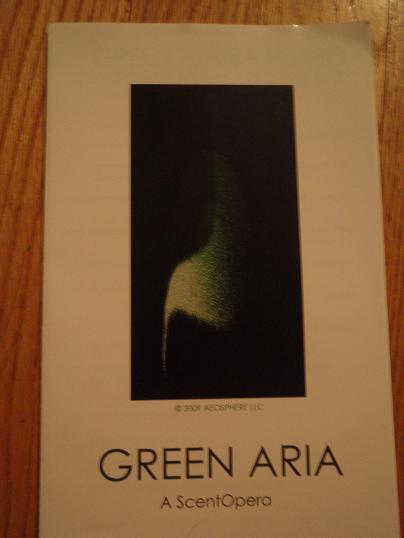
On Monday afternoon, I went to this novel opera, Green Aria: A Scent Opera, at the Guggenheim. It was their last Works & Process program of the season. Going in, I had no idea what to expect, knowing only that there was no singing, only scents (by Christophe Laudamiel) and music (by Valgeir Sigurdsson and that fabulously crazy Nico Muhly) and that the opera’s characters were various smells. It was really so interesting and I wish they would expand it (this one is only half an hour long) and show it in more venues so that more people could see it.

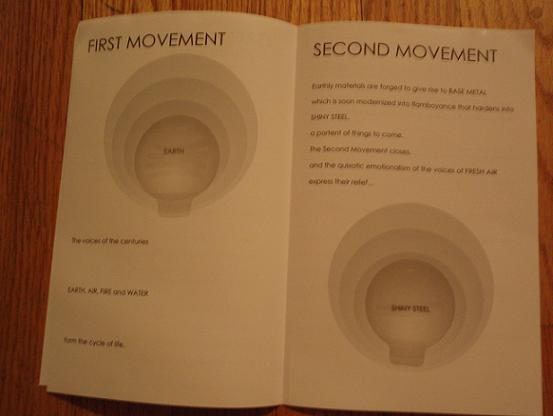
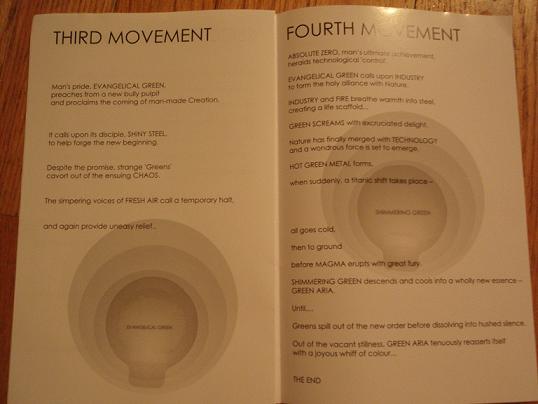
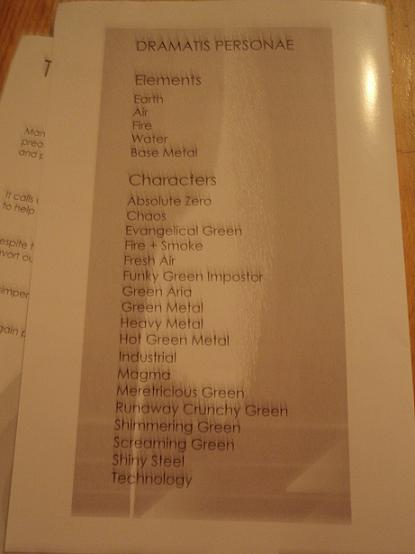
The basic story (by Stewart Matthew) is: nature is corrupted by industrialism and technology must find a way to save it, to create new fresh air. The five basic elements (Earth, Air, Fire, Water, and Base Metal) are the core characters, with other characters named things like Funky Green Impostor, Green Metal, Evangelical Green, Screaming Green, Shimmering Green, Chaos, Absolute Zero, etc. Here’s a full list of the Dramatis Personae from the back of the little Playbill they made:

p6022197

In the auditorium they set up little tubes (which looked like microphones) at each seat. You could adjust your tube, but they blasted in enough scented air that you really didn’t need to be sitting too close to it. They told us to breathe normally, not to sniff like a police dog (which of course most of us were inclined to do anyway). The tubes at each seat were necessary, Laudamiel told us, because if scented air was just blown into the auditorium in whole, it could take up to 50 seconds for the scents to spread to everyone. It would be impossible then to coordinate the scents with the music, or for everyone to have the same experience at the same time.

p6012187

p6012183

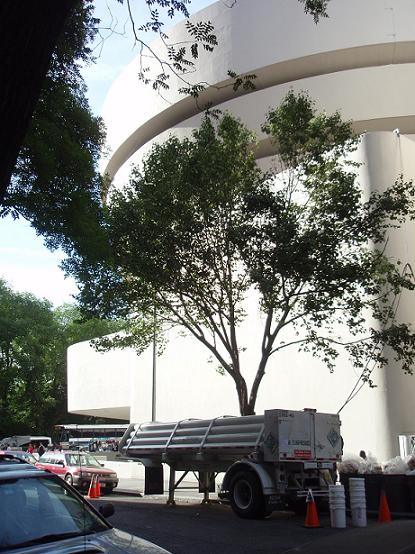
The scents were “stored” in this gigantic compression tank parked outside of the Guggenheim.

I thought since I have chronic sinus issues and a deviated septum and all, I might not get the same effect as everyone else, but it wasn’t a problem for me at all. Laudamiel’s scents (he’s worked as a perfumer for Ralph Lauren and other designers) were all very strong. They were mainly earthy because of the nature of the opera: Earth smelled like freshly mowed grass, Green Aria was like a dewy field, Evangelical Green was like grass mixed with sweet perfume, Shimmering Green yet sweeter. The sweetness and the grassiness didn’t always mix well, I think intentionally — Evangelical and Shimmering Greens were meant to be overly preachy, a surfeit, an excess, not authentic.

And you’d think the way people perceive smell would be subjective, but I think everyone pretty much despised / was horrified by Funky Green Impostor, who smelled very gassy, very foul, like gas combined with rotten eggs. Others I disliked were Fire, who smelled like 9/11 to me and Shiny Steel, who smelled very metallic but with a sweetness that just didn’t mix right.

By far my favorite somehow (besides simple Earth, and Green Aria) was Chaos. Chaos, according to the Playbill, was supposed to create “strange greens” which would  make Chaos seem bad. But Chaos was not the least bit foul-smelling to me! To me Chaos smelled like tropical fruit punch, or bubble gum. It was the only non-earthy scent. The Playbills they gave us had various sample scents, but Chaos was not there! I want my Chaos!

p6022195

p6022196

I’d said earlier that Muhly was the ideal composer for scent, but now that I’m remembing the whole opera, I’m realizing that that music, those sounds, were a large part of how I interpreted the scents. You knew when Funky Green Impostor was on his way by the sounding of harsh notes — at first faint, like he was just approaching — and then you knew when you’d be hit with some very threatening whiffs by the swelling of those chords. And you also knew when sweet, sunshine-y scents would be on their way when the music became mellifluous and Mozart-like. There’d be a fight, you’d smell the characters duking it out, the scents all mixed but at various points one or another rising above the rest — stinky, then perfume-like, then the freshly mowed grass, more sweet surfeit, etc. — and you knew when good had triumphed when it sounded like the end of a Tchaikovsky ballet followed by the dewy fields. I honestly never realized how strong my auditory senses were, what powerful effect sound could have, until I heard Muhly’s work.

Read Anthony Tommasini’s NYTimes review for far better descriptions of the music than I can provide 🙂

This was a fascinating experience, what I live in NY for.