Jacob’s Pillow Dance Festival Will Receive National Medal of Honor From Obama Today at 1:45


Today at 1:45 p.m ET, Ella Baff, director of Jacob’s Pillow Dance Festival (which is an excellent summer festival – loved it the year I was able to go), will receive the National Medal of Honor from President Obama. It will be live-streamed on the White House’s website, here.

Other recipients include James Taylor, Harper Lee, and Meryl Streep. Does this mean Harper Lee will make a rare public appearance to receive her award as well?

Click on the link below to read the entire Jacob’s Pillow press release with info about the festival, the award, and prior recipients.

Above photo of Flamenco Revolution performing on the Pillow’s Inside/Out stage, by Kristi Pitsch.

Continue reading “Jacob’s Pillow Dance Festival Will Receive National Medal of Honor From Obama Today at 1:45”

Jacob’s Pillow Announces 2011 Season With Highlights Including Annie Liebovitz Exhibit and POB

Jacob’s Pillow, the summer dance festival that takes place in the Berkshires, has announced this year’s season. Highlights (to me) include a summer-long dancer photo exhibit by Annie Liebovitz and the Paris Opera Ballet. I don’t have much time to write today, so am including the whole press release here. Click on the link below to view it.

Continue reading “Jacob’s Pillow Announces 2011 Season With Highlights Including Annie Liebovitz Exhibit and POB”

TONY NOMINATIONS


They were announced yesterday and Bill T. Jones’s Fela! received many! And rightly so. If you haven’t seen this brilliant musical, definitely do go. I wrote about it here. Also, Bill T. Jones is to receive the Jacob’s Pillow Dance Award at this summer’s festival; he’ll be there in person to collect it at their opening night gala in June.

Memphis (the musical Danny Tidwell danced in) also received a few noms. I wrote about that show here and here.

The Tonys air on on June 13.

Photo of Fela! cast by Monique Carboni.

GARTH FAGAN DANCE

Roslyn Sulcas just reminded me that I am missing Garth Fagan Dance, currently at the Joyce Theater. I may try to go later in the run, but since they’re only on through Nov. 1 and since I’m so busy right now, I might not make it.

Anyway, here are a couple of clips I thought you all might enjoy. First is one of my favorites of his, From Before, and second is from Griota New York, which they performed at the Jacobs Pillow Festival last year.

Dance and Sex and "Family"

I love this post by Counter Critic. Jacob’s Pillow (the esteemed summer dance festival held in Massachusetts) accepted his friend’s work but then asked her to delete some parts because the venue at which the company was to perform was deemed “for family.” CC covers all the bases: what is “family,” why accept a work then ask the artist to censor herself, why are adults even so hysterical over their children hearing the word “sex,” etc. Taylor mentioned she was attending a discussion tonight held as part of the New York Fringe Festival on issues involved in gearing dance performances to “families.” I wonder if this kind of thing will be discussed…

Grupo Corpo at BAM

Friday night I was finally able to see the Brazilian dance troupe, Grupo Corpo, live. I’ve seen videos, and have heard so much about them, through Brazilian friends. So, I’ve been wanting to see them for a while, and I was very happy when they finally came to Brooklyn.

Founded in 1975, the troupe, from the Brazilian province of Belo Horizonte, combines ballet with different forms of Brazilian dance and cultural influences — African, Latin, Native American, Portuguese etc. I saw two pieces, “Benguele” and “Breu”, both choreographed by resident choreographer and co-founder, Rodrigo Pederneiras.

I liked the first, “Benguele” best. I saw it as a celebration of the cultural stew that is contemporary Brazil, melding a variety of movement — West African, Samba, capoeira, Portuguese folk, and even jazz — and a variety of sound, from folksy acoustic guitars to orchestral strings, to, my favorite, pulsating African drums. The running theme was a person trying to make his or her way across the stage, or a people trying to find their home, perhaps the result of a diaspora. The dancers moved back and forth and back and forth across stage with a variety of movement. The most common “walk” was the body bent way over at the waist, the arms hanging down, the hands almost touching the floor, almost dragging along it. But the lower body moved to the beats, which gave the walk a definite style and rhythm. So, although the person looked tired and world-weary, bent over from old age or a life of intense, perhaps slave labor, he continued on, like nothing was going to stop him from finding his destination.

At other times, people would move across the stage sideways, knees deeply bent, in a deep lunge. They were very animalistic, looking at times like crabs, at times like insects, and at times like jaguars or panthers. Sometimes, dancers would suddenly dart up from these crouched positions, legs kicking out, like a martial artist fighting his way out of a bad situation but with style and grace, intellect, and artistry — the super-charged, acrobatic capoeira. Some would nearly fly across stage in a quick jazzy skip. Some would slither in loose, pelvic rotating forward samba walks, or side-stepping samba voltas.

There’s nothing more fun, by the way, than recognizing a move! I see now why ballet is so popular amongst people with ballet training. It’s really interesting to see others do a step you’ve struggled with yourself, or to see a choreographer’s unique take on that step.

At times two people would dance together, trotting across the stage happily in a waltzy, swingy pas de deux, illustrating the position social dance has held in Brazilian culture.

At the end, all movement seemed to meld together, like it was blended into one continuous rhythm. The backdrop became a series of vertical stripes, each color represented, and each dancer wore different-colored sashes criss-crossed over his or her torso, a rainbow medley.

The second piece, “Breu,” I liked less than “Benguele,” but it was still good. In this piece, all dancers were dressed in zebra-striped or almost blindingly checkered costumes that at times looked imprisoning like a straight-jacket, at times intriguingly geometric like a compelling architectural model. This piece was much more obviously violent than the first, as dancers thrashed against each other, threw themselves down to the ground, kicked and pushed each other.


At other times, they would refrain from going at each other, to lie down or stand in a row, making various visual shapes with their geometric-patterned bodies. But the movements in line or on the ground would still be fraught with intense emotion. And soon the thrashing pas de deux would return. The Playbill notes that this work was intended to “evoke the dark times in which we live” and to show “the violence and brutality encountered in daily life.” I definitely saw those, but didn’t think it really progressed; it seemed too one note to me.

Another thing I noticed is that most of the members seemed to be white, though there were a couple of black male dancers. I’ve never been to Brazil (yet!) but thought it was a very mixed race society. My friend, Alyssa, and I had noticed the same of Mimulus, when we saw them at Jacob’s Pillow over the summer. Not a criticism or anything; just something I found curious. It’s the same here, of course, with most of the large professional dance companies, especially the ones specializing in ballet. I just wonder if the underlying reasons for that are the same.

Anyway, I really enjoyed Grupo Corpo, especially the wonderful Benguele, and will definitely look forward to more by them!

Me, and Bad Boys :)

First, my review of NYCBallet’s “Traditions” and “Balanchine’s World” programs is up on ExploreDance.com. I talked about the ballets in more depth than I did in my blog post; in particular, ballerina Maria Kowroski. Plus there are better pictures 🙂

Second, Maria (of A Time To Dance, not Maria Kowroski) has some interesting info on Rasta Thomas. Apparently, he is bringing his Bad Boys of Dance, which I wrote about when the just-formed company premiered at Jacob’s Pillow Dance Festival over the summer, to DC. Also, Rasta has been named Artistic Director of a dance company there called Echo Park Contemporary Ballet. Lucky DCers!

My Best of 2007 in Dance

It’s already the second day of 2008 (Happy New Year everyone!) and I’m just now getting my best of last year up; sorry so late! I was tagged by Jen & Jolene, so I’ll formulate my “best of” as a response to their survey:


1) Best Performance of the Year: I had many favorites, but I guess overall I’ll have to say Alessandra Ferri’s farewell performance with ABT in Romeo & Juliet at the Met. She was my favorite ballerina for many years and I’m still missing her. Plus, I was introduced to La Scala’s Roberto Bolle, who guest performed 😀

2) Best Male Performer of the Year: Definitely Clifton Brown of Alvin Ailey!


3) Best Female Performer of the Year: I thought a lot about this, and I know I’m mixing dance genres, but I’m going to say Yulia Zagoruychenko. She had a damn good year. She, with Max Kozhevnikov, made the Latin finals at Blackpool this year, being the only US couple to do so, then, later in the year, went on to displace the several-year-long U.S. National champs to win that title. At the end of the year, she survived a partner change and went on to win her first competition with him, Riccardo Cocchi. She is adored by many both nationally and internationally and she is very deserving of her hard-won success. Go Yulia and Riccardo!


4) Best New Discovery of the Year: This is too hard because there were so many dancers and choreographers whom I was introduced to this year who aren’t necessarily new to the scene, but just to me! List includes: choreographers Camille A. Brown, Luca Veggetti, Luciana Achugar, Kyle Abraham, and Robert Battle; composer Nico Muhly; dancers Kirven Boyd, Antonio Douthit and Yannick LeBrun (all of Alvin Ailey — the last I forgot to mention in my last post on AA; fortunately Susan reminded me in her comment!), and Roberto Bolle (who was new to me this year); Brazilian troupe Mimulus; Nora Chipaumire of Urban Bush Women (pictured above this number) at the Jacob’s Pillow Dance Festival; the Jacob’s Pillow Dance Festival itself (it’s been around for aeons, but I had my first experience there this year). That’s all I can think of for now, but I’m sure I’ll think of bizillions of people I forgot later…

5) Best Regional / Local Performance of the Year: I think this is more of a theater question since there’s usually a big distinction between regional theater and a Broadway show, or a company who tours, but, since physically it was “local,” I’ll say NYCB’s spring season opening night. It was just too much fun watching all those celebrities walk down that red carpet and overhearing goofy crowd comments, and then writing about it all (although my mother was aghast at me for my using the word “whores” in my blog title!)

6) Best Performance in a Non-Traditional Venue: This is a toss-up between the wonderful “Accounting For Customs” performed on the steps of the US Customs House, and the super fun and impossible-to-tear-yourself-away-from Lincoln Center ‘drive-in,’ David Michalek’s “Slow Dancing” films.


7) Favorite Televised Theater Event: I didn’t really have a favorite in this category (since the only thing I saw fitting it was Mark Morris’s “Mozart Dances” on PBS which I didn’t care for), so I’ll just state my favorite dance TV show, which was SO YOU THINK YOU CAN DANCE. Duh.


8) Biggest Dance Obsession: Alvin Ailey, Alvin Ailey, Alvin Ailey. Again, if you’ve read my blog over the past several weeks, Duh 😀

9) Most Likely To Be The Next Big Thing: Eee. Hard! So hard to predict. But I’m going to name a few: ABT’s Blaine Hoven and Vitali Krauchenka,


Kirven Boyd and Antonio Douthit at Alvin Ailey,


Craig Hall at NYCB,


choreographer Camille A. Brown…


Again, I’m sure I’m leaving people out…

10) Most Anticipated Performance Of 2008: Eee, another tough one. There are so many things I’m looking forward to this year. I guess the biggest is going to be Blackpool. Since the current decade-long Latin champs retired last year, there will be a new Latin winner, which is really exciting to me since it’s my favorite event there. I’m hoping for Slavik Kryklyvyy and Elena Khvorova,


I’m also looking forward to Twyla Tharp’s new ballet that ABT will premiere in the Spring at the Met,


And I’m looking forward to Nikolaj Hubbe’s farewell performance with NYCB (he is returning to Denmark). Not that I’m looking forward to bidding him farewell, but to the show NYCB will put on in his honor.

Okay my brain is tired now. If anyone else wants to add their “best ofs” in a comment here or on their own blog, please do so!

Day of Merce and Frustration!

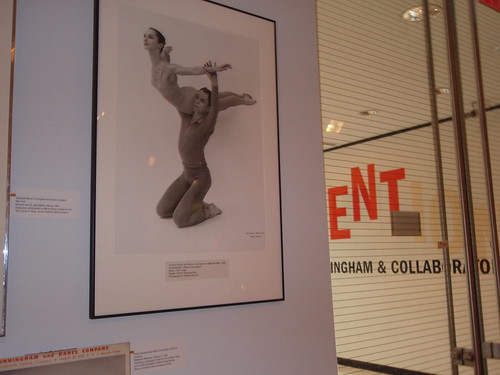
Yesterday I went to the Merce Cunningham exhibit at the New York Performing Arts Library at Lincoln Center. At noon there was a short, live, four-person performance of solos and duets right in the lobby. All dancers — two male, two female — wore blue unitards and the music sounded somewhat like the ocean. At times the dancers looked a bit like they were swimming. Of course it was abstract, but that’s what I got out of it.

I then headed into the exhibit, which was really pretty cool. I’m embarrassed to admit it, but this was my first experience with Cunningham (aside from the time Winger Tony Schultz and I saw him in the audience, wheelchair-bound, at another modern dance performance). Embarrassing to admit since he’s only one of the founding fathers of dance in this country! The exhibit was pretty comprehensive and very entertaining. They had videos of several of his works, all performed in the last ten years, but some choreographed far earlier. Cunningham himself danced mainly in the 40s and 50s. He is still choreographing, but of course no longer dancing.

The videos were my favorite part of the exhibit. They had several screens mounted on the wall, you took a chair hooked up to earphones and selected the music from whichever screen you wished to concentrate on. I actually found all screens mesmerizing and it was hard to focus on only one at a time. Funny thing, though, you really didn’t need to. The music (oftentimes sounds — of waterfalls, birds, people talking, etc.) seemed not to matter at all; you could have selected any soundtrack and watched any one of the screens. This, to me, marked Cunningham the complete opposite of Mark Morris, whose choreography is his rendition of that particular musical piece in motion. Also in contrast to how I personally felt watching Morris’s Mozart Pieces on PBS, Cunningham’s choreography was so engaging, I actually didn’t care what the sound was like.

My favorite video was called “How to Pass, Kick, Fall and Run” which was accompanied not by music but by Cunningham and another man, named David Vaughn, reading bits of text to the audience. At times their voices would overlap so you couldn’t even really make out the words, at times you could and the text was very humorous, and at times you just couldn’t pay attention to the text because the moving bodies were just so mesmerizing, even though they weren’t doing anything tremendously virtuostic. One passage, read by Vaughn, told of a man who gave a lecture on how to attend a lecture. He instructed attendees to listen, which they couldn’t do if they were taking notes. One woman was taking notes. The man next to her told her she was not supposed to take notes. She quickly read over her notes and said to the man, “that’s right. I’m not supposed to take notes; I’ve got that written right here.” The audience laughed like crazy. Throughout the reading of the text, the dancers, wearing colorful sweaters over plain black leotards, would jump, hold each other and bounce, kick playfully, scamper across the stage, then do slower prettier arabesques, sometimes with an awkwardly bent standing leg. The movements kind of did and didn’t correspond to the text. If you watched it a couple of times, it did, in a way. For example, at one point Vaughn began a brief vignette in which two women went to a women’s business meeting, and at that point two female dancers would wrap arms around each other and hop on one leg around in a circle, then let go of each other and both hopped toward the front of the stage. Kind of goofy-looking, but then a man emerged and they began a complicated, serious, lift sequence with him. Is a business meeting silly, serious, or both at times? I don’t know. But I found the process of watching the piece a few times and arriving at different conclusions each time rather fun and invigorating. It was also cool to recognize one of the dancers, Holley Farmer, who was in the David Michalek films.

Then, they had tons of pictures of the company performing, from 1945 up through the present, another film showing an interview with Cunningham, numerous costumes some of which were quite colorful and interesting-looking to put it mildly (one was a leotard with aluminum cans taped to the legs! — wish I would have seen that piece!), a bunch of musical scores and choreographer’s notes (the latter of which looked like heiroglyphics to me and made me wonder how in the world choreographers notate a work to preserve it), and some posters by such great artists as Jasper Johns and Andy Warhol promoting the company on tour and at home.

Top pic is of Carolyn Brown dancing with Cunningham himself in the company’s early days, which was interesting to me since I’d recently seen her speak about her new memoir about dancing with Merce, at Jacob’s Pillow (in that picture that I linked to above, from the previous blog entry, she is the woman in the white dress). It was quite a long time ago that she had danced with him and, wow, was she was a striking beauty back then.

Anyway, for people in NYC, I urge you to check it out. It’s a real history lesson, a fun informative trip through time, since Cunningham is such a foundational figure in dance in this country. It closes on October 13th, so you still have some time.

I recently bought a new camera with more pixels, a more powerful zoom, and motion control (so as to take better photos of all the lovely ballroom dancing I will soon be viewing, like tomorrow!) Hopefully, the pics will be better than before (the picture in this entry is better than previous ones, right!). But I’m having trouble uploading from my new software to my Plogger. Spent a good deal of the day trying to figure it out to no avail. It has no problem uploading the pics from my former camera software (which it seems is incompatible with the new camera). Argh, I HATE technology — just can’t figure things out! So, for the time being anyway, I’m using my Flickr account to upload new pictures. I created a link down at the bottom of the blogroll to my Flickr page, which is likely where I’ll end up putting the pictures from the dance competition I’m about to head off to… Have to go pack!

Oh, and my TAC headache seems to be officially over, for now anyway. Yay! Thank you so much, you guys for your concern 🙂 I really appreciate it 🙂

Flouting Genre Boundaries and Stereotypes of Stereotypes (and Just Creating a Fun Time!): Bad Boys of Dance and Mimulus at Jacob’s Pillow

Okay, here are my reviews, finally. Sorry it took so long!

The word Dance can be political, as I’ve discovered lately. A certain TV show combined with a current local exhibit (which is, sob sob, no longer local) have caused a bit of a stir here over what constitutes dance, and who, if anyone owns its definition. I thought when I left my job at night to go to my ballroom studio or a ballet performance I was leaving the world of politics behind 🙂 Don’t get me wrong: I’m very glad people are becoming more aware of diversity in dance and are thinking and speaking more critically about it, but if you’re a lover of both ballet and Latin, you can feel kind of caught in the middle sometimes.

Anyway, this is all by way of saying how wonderful it was to get away for a couple of short days and head up to Jacob’s Pillow, the oldest dance festival in the country now celebrating its 75th Anniversary with a host of diverse dance programs ranging from ballet to social to hip hop to world dance. The festival, which this year includes 21 companies from four continents and 10 countries, takes place in the idyllic Berkshire Hills on a farm that dance pioneer Ted Shawn bought in 1931 to house his Men Dancers, a company he created to showcase male talent, foster respect for dance as a suitable occupation for men, and combat stereotypes of male dancers as effeminate (which we know nothing about these days right!! — oh and thanks so much you guys for those excellent comments on my homophobia post!). The farm also served during the 1850s as a safe house on the Underground Railroad. With this history, it’s only fitting then that the festival, the only one to be declared a National Historic Landmark, encompass as it does the virtues of democracy, internationalism, and diversity. For a powerful, personal account of the history of the land and the festival from the perspective of one of last year’s dancers, go here.

So, I saw Mimulus, a Brazilian social / contemporary troupe on Wednesday night, and Rasta Thomas‘s Bad Boys of Dance, created with a nod (but just a nod!) to Shawn’s Men Dancers, on Thursday.

Okay, first Mimulus:

So fun! Their program, entitled “Do Lado Esquerdo De Quem Sobe” which translates from the Portuguese to “On the Left-Hand Side of Those Who Go Up,” was a splendid blend of social Latin and “contemporary” dance. Since I know there’s some confusion over what “contemporary” means — and I don’t profess to know myself — I’ll just say that to me it’s ballet without toe shoes or the themes and ‘pyrotechnics’ of classical ballet (like the 10,000 fouette turns performed by women or big walloping barrel turns all around the circumference of the stage done by men). And, to me, contemporary is not “modern” because modern has a certain look and feel to it — perfectly parallel, almost inwardly pointed toes, Martha Graham-ish arms appearing to emanate directly from the back as if they’re wings, etc. etc. Modern is interesting, but it has a certain quality about it to me that is dated, the same way modern art or modernist literature (Picasso, Matisse, Virginia Woolf, James Joyce, etc.) has a time period. Although… the woman who taught our modern dance class at the Pillow taught us a routine she learned from Urban Bush Women, which is not dated… So, okay, I don’t really know anything about all of this nomenclature, but contemporary dance to me (and the way I’m using it here) means updated, modernized ballet that can easily be blended with other dance forms like social Latin (as in Mimulus) or jazz and hip hop and gymnastics (as in Bad Boys) to create new movement that contemporary audiences can identify with and relate to.

Okay, back to Mimulus… I love this company, from their name to the title of their program to their blend of dance styles! A “mimulus” is a genus of fauna known as the “monkey flower,” which, supposedly when squeezed, resembles a monkey. It is also, in medicinal folklore, a remedy for fear, any fear, so long as it’s named. The title of their piece, as they explain, refers to “those who go up the hills, who go up through history, who go up the body” (the heart, they point out, is located on the left side of the body). It has literal meaning: on the left-hand side of Ituiutaba Street in Belo Horizonte, Brazil, there is a group of sheds in which company members gather each day to practice, and to follow “the pulse of the city, stretching and shrinking in its confusing occupation of urban spaces.” The left also has political meaning, as the group aims to “construct and deconstruct, subvert, re-read dance and life.” Slavery was abolished in 1888 in Brazil, making it longer-lasting there than elsewhere. Social dance and music served to integrate newly freed slaves into the culture, which was then already a blend of Portuguese and indigenous peoples, resulting first in Choro, an eclectic, urban form of music and dance, then Samba (yay!!!), the national dance, a mix of African, Latin, and European. I feel like, ironically, and maybe I’m totally wrong about this, but from the people I’ve met and films and videos I’ve seen, it seems that, though slavery lasted longer in Brazil than here and elsewhere, there’s more integration there. Here for example, whites are not integrated at all with Native Americans, who remain confined to their reservations..

Anyway, I’m not sure I saw all the “subversion” and “deconstruction” and “re-reading dance and life” that they referred to in the program, but what I did see I loved nonetheless! What I definitely liked about Mimulus was that the combination of contemporary and Latin social dance worked so very well for me. There was just enough abstraction and enigma in the contemporary, balletic movement and the use of some of the props — giant rubber bands, shoes, plastic bags — to keep me curious and wondering what the piece was all about, while the Latin social dance — movement understandable to me and to most, I’d think — created an atmosphere of fun flirtiness, romance, harmony, elegant partnership, and just overall happy togetherness. The social dances themselves were all merged together into a unique blend of samba, salsa, tango, and even American-based swing. There would be several couples dancing this melange of Latin and American social dances, and then a balletic couple would emerge performing more abstract, lyrical movements with beautiful lifts, etc. But the social and balletic actually melted together here, rather than being on some kind of continuum. To me, this contrasted with, for example, Twyla Tharp’s Deuce Coupe from 1973, in which a classical ballerina, dancing on pointe would be center stage, surrounded by dancers doing more swingy jazzy movement, then the poppy social dance of the time. Tharp, I thought, was saying, classical ballet is my origin, the basis for all dance, but there are other, more popular forms of dance I’m interested in as well that stem from ballet, and they can all take up space on the stage at once. But here, it was as if the contemporary was more part and parcel of the social.

The running theme of the piece was symbolized by shoes: at the beginning, there are several pairs of unfilled lyrical shoes setting on the edge of the stage. Dancers would put them on, take them off, dance barefoot, dance with one foot bare the other shoed, and one dancer (usually male) would, at points, lift a female dancer who ran along the side of the stage, creating foot impressions right onto the set! These sets were really cool too. Symbolizing Brazilian urban architecture, at first they looked like they were made of some kind of boring, mundane metal. But you soon realized, when the dancers leaned against them (either from the front or back of the stage), or walked against them, they were completely pliable, so were actually made of silver-colored styrofoam or something. At one point, dancers from the wings would throw little blocks at the dancers onstage, and when the playfully humorous “block tossing” ended, you’d see little missing squares from the back wall, creating very interestingly abstract designs. The dancers offstage were clearly running along behind the set, taking blocks from it, then running into the wings and throwing them at the dancers onstage. So, architecture, as public space, is made for, and reflects, the needs of the community, and it grows and evolves right along with it.

And, regarding the shoes: when newly-freed slaves walked for the first time as free people, the program notes, shoes were a symbol of freedom, of status. Even if shoes were not constructed to fit the wearer’s feet correctly, they hung from the owner’s shoulder, a symbol of consumption. I’m not sure if the trajectory of the shoes, unworn, then worn by some, then taken off and worn by another, then one pair shared between a couple, then taken off and the foot freed, etc. completely made sense, but it was evocative and funny and fun to try to figure out. And all of the beautiful partner dancing was a delight!

At one point, as I noted in my photo essay, a male dancer took out a plastic bag (the same kind inserted into our programs), then, with a music-less background, rubbed it, creating beats of sound for the center-stage sambista to dance to. He motioned for us to do the same with our bags. Who knew what a plastic bag could do?! To me, this said that dance in Brazil, and anywhere, stems from the people, along with sound. One doesn’t need an orchestra or stereospeakers to create music; danceable music can easily be human-made right on the spot.

Okay, on to Bad Boys of Dance, which we saw, first in snippets at an outdoor production on Wednesday afternoon, then in whole in the Doris Duke theater on Thursday night. What fun, as I knew it would be 🙂 Like Mimulus, the multi-cultural, multi-ethnic, very multi-talented group blended ballet with contemporary social dances — here not ballroom, but jazz, hip hop, capoeira / martial arts, gymnastics, and, as danced by guest artists, the cute Argentinian Lombard twins, bluesy tap and hip hop. The four-man group is led by probably the most famous contemporary dancer with ballet origins, Arab-American heartthrob Rasta Thomas. The others include Filipino-Canadian Bennyroyce Royon (a Winger contributor without whom I wouldn’t have heard of the group – thanks Bennyroyce!); Bryan Arias, a ballet dancer from Puerto Rico; and Broadway and competitive dancer Robbie Nicholson. Here are some pictures from their outdoor performance (which I posted in the album but am posting again here because I can’t help myself 🙂 ):

This was such a fun, juicy hodge-podge of dance that, like Mimulus, interfused together well. It was such a medley of movement it’s a little hard to describe, with most of the pieces containing within themselves several different types of dance. There was a lot of contemporary ballet (most of the men have extensive ballet training). But the ballet was combined, to fun, thrillingly unpredictable effect with gymnastics, capoeira / martial-arts-like movement, jazz, hip hop and even silly poppy social dances, like — I kid you not — in a piece choreographed by the dancers themelves, the Macarena! To be honest, I thought that was a bit corny, but Alyssa ate it right up! The mood would go from cutely funny to raucous and brazen to silly to beautifully serene and lyrical, to bluesy, to fast-paced, to techno and robotic- looking and so on. At one point, ballet’s classical vocabulary might be ridiculed (along with opera, as in “Figaro”, that piece choreographed by the dancers themselves that included Macarena), but in the next breath, ballet’s beauty and grandeur would be upheld. My favorite pieces were “Steel Visions,” a fast-paced jazzy number choreographed by Darrell Moultrie and set to Astor Piazzolla music; Robert C. Jeffrey’s “Heartbreak on Repeat,” a bluesy, beautifully lyrical piece danced by all, but containing a solo by Rasta that left me and Alyssa nearly on the floor; and “Take 4” choreographed by dancer Bennyroyce Royon, a fun, fast, rhythmic, at times techno and robotic-like, very imaginative combination of ballet, hip hop and jazz. I was also blown away by the guest artists, the very hot Martin and Facundo Lombard — “the Lombard Twins” — from Argentina who were able somehow to combine hip hop, swingy blues and tap dance to mad fun, very sexy effect.

The funny thing is, what led me to the production, I have to confess, was the troupe’s name 🙂 I am such a sucker for those crazy sky-high leaps and jumps and turn / jump / leaps, etc. that only male dancers are capable of 🙂 Sorry, I can’t help it!!! But, besides the very first, very short number, in which Rasta did some of those aforesaid leaps from the classical ballet Le Corsaire — and then it’s only to show what the night is NOT going to consist of — no such thing existed here. I felt like, personality-wise there was a certain cockiness (albeit cute) to the Lombard twins that seemed very male, but, other than that, this program didn’t really showcase any type of dance strengths that were essentially male. Which ended up being brilliant.

Unfortunately, I never got a chance to see any archival footage of Shawn’s original Men Dancers, but, according to the resident Pillow scholar, Philip Szporer, who wrote a little note of commentary on the program, Shawn’s purpose with his troupe was, as I said above, to counter the then stereotype of male dancers as effeminate. So he often showed his male dancers in heroic, athletic poses, going out of his way to depict them as macho and ruggedly virile.

But here, there was no goofy crazy he-man posturing, no ‘look at me, I am man, I can lift my fellow man high above my head and toss him clear across the floor,’ no crazy stage-length leaps; it was just a bunch of guys dancing, dancing really really well. So, maybe Rasta is making fun of stereotypes with his naming of the troupe? Maybe his “Boys” are “Bad” because they don’t give a crap how they’re perceived; they’re dancers and they should be accepted as such, nothing more nothing less. It’s like he’s giving a big ‘screw you’ to all the homophobes. And how much do we love him for that!!! At the end, he has an emcee introduce the dancers by name, as if they’re heavyweight champions: “Ladies and gentlemen, weighing in at — pounds, from the Philippines is Bennyroyce Royon,” etc. It’s hilarious. And don’t get me wrong, what Szporer calls “the swoon factor” is most definitely there; if female dancers would have performed the same roles, Alyssa and I wouldn’t have been drooling all over the floor like we were, but we still would have been awed at the eclecticism, the excitingly unpredictable versatility, the talent.

Just a little note on Mr. Thomas, for people unfamiliar with him: I guess it makes perfect sense that this program was such a mouthwateringly savory stew of contemporary dance since Rasta himself is virtually a one-man amalgam of different dance genres. After being told by doctors he’d never walk properly following a horrible car accident at age 2, he threw himself first into martial arts, winning bizillions of black belt titles, then gymnastics, placing in the junior Olympics. When his plethora of championships led to serious cockiness problems 🙂 , his father threatened to take his hubris down a notch by forcing him into a tutu. Not one to resist a challenge, Thomas took his first ballet lesson. At first, he hated it, but admitted that after he reached puberty and began to take an interest in girls, that all changed. After going on to, of course, win a bunch of ballet competitions, Thomas danced with Kirov Ballet, then began guesting at a slew of prestigious ballet companies. But he’s most known as the star of Twyla Tharp’s Broadway hit, “Movin’ Out,” and as an actor in the Patrick Swayze film “One Last Dance.” Anyway, Thomas now says he loves ballet, it’s his heart and soul, but its vocabulary is limited and there’s only so much you can do with it. The classics are at least 50 years old now, he says. He’s hungry for more.

I guess I both agree and disagree with him about ballet having limits. While certain classics’ ability to speak to the human condition, to provide poetry for the soul, to entertain and move audiences, make them timeless, like a Shakespeare play, ballet, like literature, will die as an art, will become only a historical artifact if the classics are relied on too heavily and there’s never anything new. But new doesn’t mean that balletic movement has to be abandoned, that it can’t be expanded, its vocabulary broadened, and its boundaries with other forms of dance tested to bring new meaning and vigor to the dance form. Isn’t that what he did here???

I’m sorry this ‘review’ goes on and on and on — they give you so much info at the Pillow — with their elaborate program notes, pre-show lectures by resident Pillow scholars and post-show talks with the artists themselves, there’s just so much you wanna talk about! Sorry!

For Ms. Dunning’s much more compact and far less sprawling take on these programs, go here for Mimulus, and here for Bad Boys.

Bot Attack!

Sorry my website’s been up and down and up and down and up and down for the past day, you guys! I’ve been told by my web guy there’s been a “bot attack” on my server’s company. What’s a bot attack??!! Welcome to the 21st Century! Anyway, if the bots stop attacking I promise to get my Mimulus and Bad Boys reviews out today! I know Jennifer Dunning at NYTimes beat me to Mimulus… Grrrrr……