
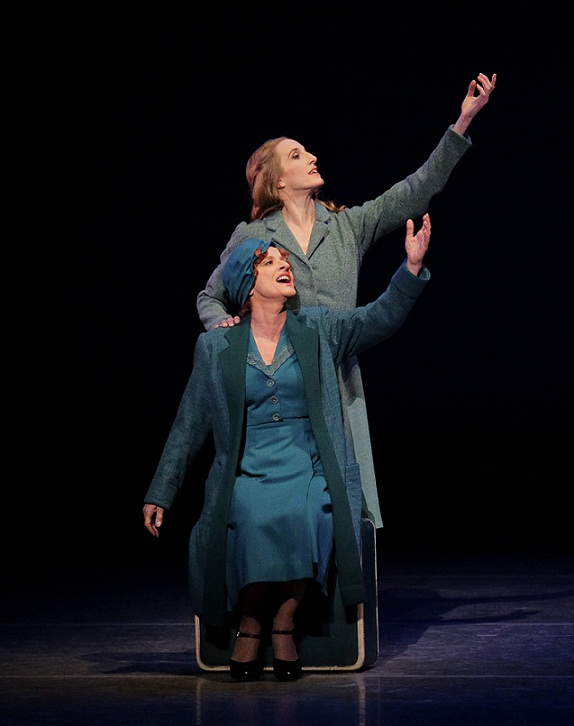
NYCB Spring Gala with SEVEN DEADLY SINS Premiere

Here are some photos, all by Paul Kolnik, of Lynne Taylor-Corbett’s play-ballet, The Seven Deadly Sins, which premiered last night at New York City Ballet’s Spring gala performance. Above is Patti LuPone, who guest-starred with the company (performing the singing role of course!) and Wendy Whelan, who danced the lead. The top photo is from the “Prologue” of the play-ballet (or ballet chante as the program calls it).
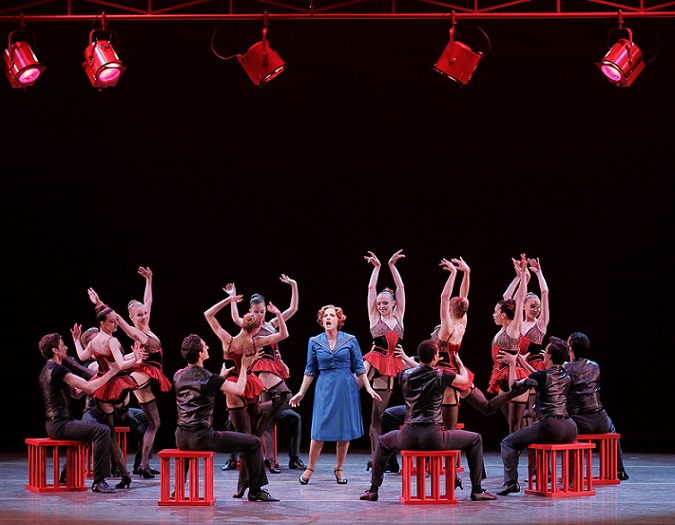
This is from the second part: “Pride”: Patti LuPone and cabaret dancer ensemble.
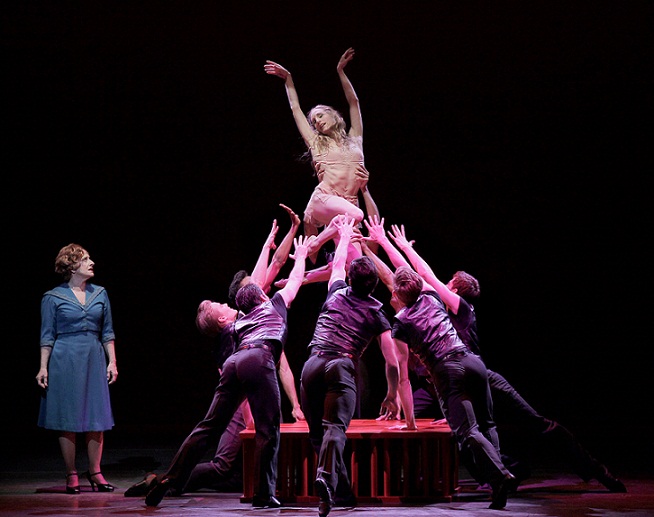
Also from “Pride.” Wendy Whelan is in the middle.
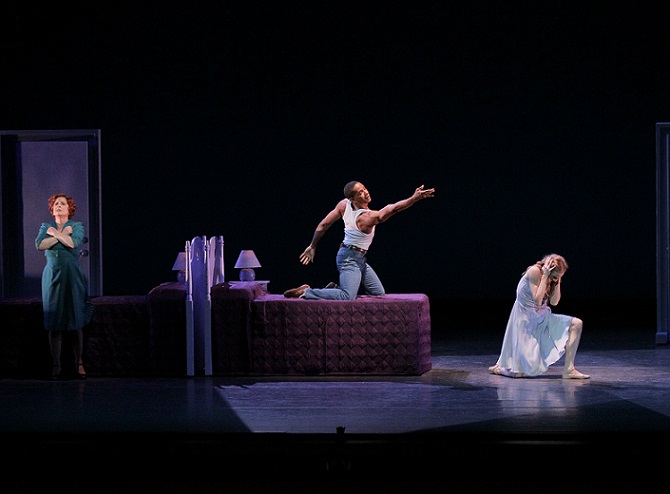
And this is from sixth part, “Lust,” probably my favorite over all. Craig Hall and Wendy Whelan are the dancers in the photo. Craig Hall and Sara Mearns (who danced the role of “Latina Diva” in the “Anger” section, and who I don’t have a picture of unfortunately), most stood out to me, as well as Vincent Paradiso as the Count in the “Greed” section. I think those dancers most stood out – at least Mearns and Paradiso – because they seem to have some kind of acting training. Maybe they don’t, maybe they’re just natural actor-types, but the more actor-ly you are, I think the easier this kind of role would be. Wendy Whelan said in an interview with Roslyn Sulcas in the New York Times that she was used to expressing herself with her body and her lines, that she was used to Balanchine’s dictum “don’t act, don’t think, just dance,” and that she found this kind of role challenging. As much of a NYCB star as she is, and as stunning as she is in Wheeldon and Balanchine’s more modern, angular-lined ballets, I just wonder if she was mis-cast for something like this.

Which isn’t to say that she didn’t dance very well last night. She danced a really beautiful pas de deux with Craig Hall, which is what made “Lust” my favorite section. And LuPone sang in a gorgeously powerful voice. The dancing was all superb. But something just didn’t work to me.

Balanchine choreographed the original Seven Deadly Sins, set to libretto and score by Bertolt Brecht and Kurt Weill, in 1933. The Balanchine version was revived in 1958. According to the Times article linked to above, both the original version and revivals received very good reviews. Since the Balanchine version appears to be largely lost now, and Peter Martins wanted to revive the ballet, he commissioned new choreography from Taylor-Corbett.

Maybe it was that the new choreography didn’t really express the story, which follows Anna, a woman whose various life experiences each represent one of the sins. It wasn’t really a full story, but one composed of scenes, each of which dramatized a sin (and LuPone and Whelan portray different aspects of Anna). But, I didn’t feel the scenes always worked well at doing that. For example, in my favorite section, “Lust,” I thought the Hall/Whelan bedroom scene was really beautiful, very romantic, but nothing said lust, as in sinful lust, to me. I almost felt like Whelan’s Anna had a loveless relationship with her husband, danced by Allen Peiffer, and she was really in love with Hall, and her leaving her husband and running into Hall’s arms was an urgently needed escape.

In my other favorite section, “Anger,” Sara Mearns is a kind of sexy, but rather humorously so, Copacabana dancer. She gets angry at Whelan’s Anna for something – I’m not quite sure what – maybe Anna stole her lover or took over Mearns’ role as head diva, drawing too much attention to herself…  Anyway, Mearns twists her face into a look of utter anger, then points at Whelan, who runs off crying and is then stripped down to her underwear by a group of men. But I thought it was done rather cartoonishly. So it was more funny and cute to me than a dramatic representation of the tragic consequences of anger.

In the “Greed” section, a count and a senator vie for something and end up in a duel, both of them getting killed. But it didn’t have any tragedy or pathos to me. Instead, it felt a bit like Balanchine’s Slaughter on Tenth, which made me want to giggle – probably the fact that it was Paradiso playing the role of the Count.

I don’t know. I guess I was expecting something with more tragedy and pathos and weight, and I felt like I saw a version of Slaughter on Tenth but without a through story-line. Maybe that was the intent. I’m going to see it again over the weekend, and maybe my opinion will change.

Did anyone else see it yet? I’m interested to hear what others think. Has anyone seen the Balanchine version?

After intermission,
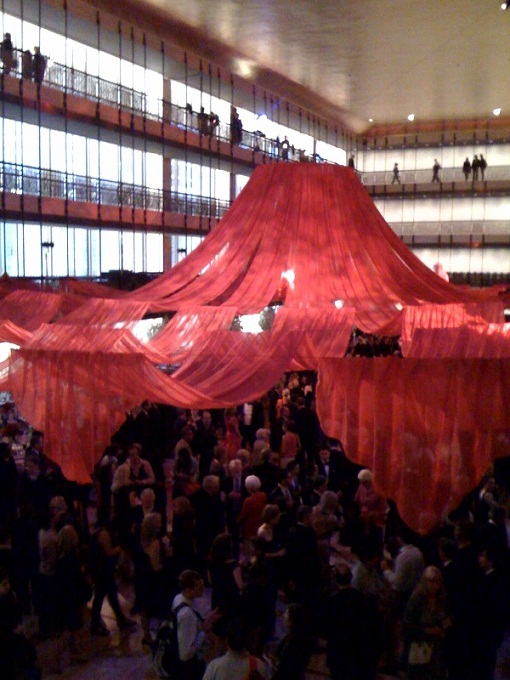
— here’s my photo of the promenade – Balanchine’s Vienna Waltzes was performed beautifully.

Photo by Paul Kolnik.

All of the dancers were very good, but I particularly liked Megan Fairchild and Joaquin DeLuz in the fast-footed, playful scene in the forest, “Fruhlingsstimmen,” and Maria Kowroski and Charles Askegard in the last, beautifully ballroom-y section, “Der Rosenkavalier.”

Sara Mearns Was Gorgeous in Swan Lake, But Overall Production Was Lacking


Last week was Sara Mearns week for me (well, for many New York ballet fans, I suspect). On Tuesday night, she made her debut as the Siren in NYCB’s Prodigal Son. (I’m still awaiting photos and will post as soon as I receive them!) Sean Suozzi danced the lead role. He did very well, but she just always stands out to me whatever she is in – particularly the story ballets. She was the best, most tantalizing, sinister, seductive, all around captivating Siren I’ve ever seen. The way she whipped that cape in between her legs, wrapping it around each one, the way she’d bend her knees slowly into a second-position plie while on point, basically squatting over the son’s head in a suggestive but also sinister manner, the way she’d raise her hand behind her head with the wrist bent and the fingers splayed to indicate her triumph over the son’s will, even just the way she’d walk out onstage on pointe, tiptoeing all around him – everything, every movement was in service of the character and was an integral part of the character’s story. I often feel like I’m seeing steps with other dancers. Just steps. The pas de deux between the son and the siren contains some of Balanchine’s oddest-looking choreography- especially those lifts – ‘here, stand on my knees, wrap your legs around my neck and let me carry you around like that,’ etc. I imagine it would feel very odd and foreign doing some of that, which of course was the point. It’s supposed to look warped and off-kilter. Everyone has mastered those steps, but to me, Mearns makes it the most deliciously warped. I love her.

Then, on Friday night, the company premiered their Swan Lake (Peter Martins version), and she danced the lead. (Photo above by Paul Kolnik, from Playbill Arts.)

In sum, I loved her; I wasn’t in love with the production. I went with several friends, two of whom don’t regularly go to the ballet, and that seemed to be the consensus. Everyone was excited to see Mearns dance again, but not to see that production. She was wonderful for all the same reasons I’ve written about before – she’s like a Veronika Part to me; she does such a full job of developing character, she brings you so fully into her world, you feel all of her pain with her. But of course she’s also an excellent dancer. She has a way of arching her back so, of working her arms and hands so, of extending her leg so high in arabesque, of extending her line so beautifully and making such full shapes – it’s a cliche, but her adagio / White Swan is just breathtaking. It almost makes you want to cry, and one of my friends did!

But she excels in the Black Swan / allegro role as well – not so much because she can do athletic feats like Gillian Murphy or Natalia Osipova (there were “just” a bizillion fouettes during the pas de deux, not a bizillion fouettes divided by multiple pirouettes and wild swan-like port de bras thrown into it all) but because she can do that all perfectly fine while still making it all about the character. When she does a series of lifts with Jared Angle where she spreads her legs into a straddle split in the air above his head, it’s just so wicked! And even at the beginning of the Black Swan, when she makes her entrance and presents her hand to the queen – it’s clear she’s up to no good. But she also doesn’t overdo it. She’s conniving and sinister but with a sweet face.

But the rest of the production: Jared’s an excellent partner, that’s clear. Mearns was way off her center of gravity in much of the White Swan partnering, and he securely held her balance, freeing her up to make those gorgeous shapes, and to act it all out the way she so brilliantly does. But in his own dancing, he just, like practically all dancers these days, goes for the cliche. It all looks so fake. I don’t believe he’s in love with her, or that he’s ever longing for what he doesn’t have, and that he’s devastated when she leaves him in the end. It’s all her sorrow and longing alone. So the performance was so unbalanced. I wish so much I could see her dance this with Marcelo Gomes, who really brings Prince Siegfried’s internal conflicts to life like no one else.

The other major issue I have with this production is the costumes – the costumes and the sets. I always forget about them until I see the ballet again, and, especially when I go with friends. My friends Friday night really found it hard to look beyond those costumes. For some reason, I kept thinking of the Flinstones, my friend, Marie, called them Jackson Pollack on speed or something to that effect (I haven’t read her review yet but will after I finish this post), and the others we went with just couldn’t stop talking about the brash colors. I remember my friend in the fashion industry saying of the Romeo and Juliet costumes (Per Kirkeby designed sets and costumes for both Martins productions) that the colors needed to be muted; these brash, bright, almost neon colors made the characters look like cartoons. Same with the Swan Lake costumes. Cartoonish is NOT what you want to go for in serious ballets like this.

Also, the RACISM. This is another thing I hate to admit I often forget about until I see the ballet again with a friend, and the friend is horrified at the fact that a black man is playing the evil character. Must von Rothbart always be danced by Albert Evans or Henry Seth? Are we not living in the year 2011? I mean, this is a huge reason why young people are so turned off from the ballet. And none of the very educated critics ever seem to be calling Martins on this. What’s up with that? Seriously? I think once you go to the ballet a lot you begin to forget about these things, you become immune to them. Which is horrible. But really, asking your audience to associate black men with evil is a horrible insult to that – probably very educated – audience.

Another problem here: Faycal Karoui (the conductor) was seriously on speed. He was flying through the first half. The poor dancers couldn’t even express the story. They really had to rush falling in love. If I’d never have seen this ballet before (and there were probably some such people there due to the Natalie Portman film), I don’t know if I would have gotten much out of the White Swan pas de deux. And that’s kind of an important part of this ballet…

All other dancers did well – I particularly liked Ana Sophia Scheller and Anthony Huxley (filling in for Sean Suozzi as Benno) in the first act Pas de Trois, and, in the second act, Abi Stafford and Joaquin DeLuz in the Divertissement Pas de Quatre, and Antonio Carmena in the Neapolitan Dance – but everyone did very well (those were just the ones who stood out to me). Oh and I loved Daniel Ulbricht throughout as the Jester. With his immense skill at jumps and turns – and combo jumping turns – and his comical sensibilities, he is perfect for such a role, as he is for Puck in Midsummer Night’s Dream – my favorite roles for him.

But I have to say, I was floored when none of the other dancers came out and took bows at the end of the production. Why? Whose idea was that? Only Mearns and Angle and Evans took bows. I realize the dancers are all very hard-working and probably needed to get home to get sleep for the next day’s matinee. But this severely cut Mearns’s bow and curtain calls short. It reduced the celebratory aspect of a production well done. Worse, it also really makes it look like none of the other dancers cared about Mearns, and about the production. It made it look like the company is not really a company of dancers who all work together and support each other. I’ve honestly never seen such a thing before. I’ve seen it where dancers who only dance during the first act will take their bows and curtain calls after the first act and not at the end of the whole, but the dancers who danced in the last act always come out for their bows at the end. Anyway, it really stood out to me. What did other people think?

Here is my friend Marie’s write-up.

For the Love of Duke


On Friday night Susan Stroman’s For the Love of Duke premiered at NYCB. Photos above by Paul Kolnik. Top: Tiler Peck, Sara Mearns, and Amar Ramasar; bottom: Mearns and Ramasar. Stroman is primarily a Broadway choreographer (I think her most famous work is probably Contact), and it shows both in her ballets’ strengths and limitations.

For the Love of Duke is divided into two parts. In the first, entitled “Frankie and Johnny … and Rose,” Tiler Peck and Amar Ramasar are Johnny and Rose, a couple in love. They perform a lovely lyrical pas de deux. Then along struts Sara Mearns – Frankie – and Johnny’s attentions are completely lost on her, to the disappointment of Rose. Johnny and Rose are snuggling on a bench together, and when Frankie comes prancing along, Johnny pushes Rose right off the bench, behind it, as if to hide her. Then he does a snazzier dance with Mearns / Frankie, she disappears, and he’s back with Rose … until Frankie comes strutting along again. And so on. At one point, Rose becomes the seductress, and Johnny pushes Frankie off the back of the bench. It was cute, and everyone danced spectacularly, but it got a bit old to me after a while.

The second part – “Blossom Got Kissed” – Stroman had actually choreographed before, creating it for NYCB in 1999. I liked this one better. Both parts, by the way, are choreographed to Duke Ellington and Billy Strayhorn, which is where the title of the whole comes from. Anyway, “Blossom” begins with a bunch of girls all dressed in sassy, jazzy red sitting on a bench tapping their feet to Ellington’s rhythm. Along comes Savannah Lowery as Blossom, dressed in a frilly ballet tutu. She sits alongside them on the bench and tries to tap with them. But she has no rhythm and is horribly off. Then they stand and do a jazzy dance, and, again, she tries to join, but just can’t get the hang of it. She is simply too classical ballet. Lowery was hilarious though and it was funny to see her continually try to get the rhythm and technique of jazz dance right by taking a foot and pounding it down flat on the floor. Then, a group of tux-clad men come along and do some swing dancing with the red-clad women. Blossom again tries hard to fit in but just can’t. Finally, a musician in the band (which was onstage), in the person of Robert Fairchild, comes out from the back of the stage, orders the music changed, and does a sweet lyrical ballet pas de deux with her.

I feel like I’ve seen “Blossom” before because Lowery’s hilarious flat-footedness looked familiar. I liked it better than the first part because to me it was funnier, and the story went a little further.

I think Stroman is very good at creating a story through dance, and that’s what I like about her. You can tell she’s not really a ballet choreographer though. Compared to the first two pieces of the night – Ratmansky’s Concerto DSCH and Wheeldon’s Polyphonia – the actual dance just wasn’t that rich. Still, I think she complemented the program well. It can never hurt to include in an evening of ballet a cute narrative dance with music that’s not usual ballet fare.

As always, I loved Concerto DSCH. Ratmansky was in the audience. I felt the music was played a bit too fast though (conductor was Ryan McAdams, Elaine Chelton the pianist). It looked like Ashley Bouder had a slight mishap, though I’m not sure because I was busy watching Joaquin DeLuz do a sequence of crazy fast steps into a somersault at the speed of light. Andrew Veyette again replaced Gonzalo Garcia, who I am really missing. I hope he’s okay. Veyette is doing a fine job as one of the two playful guys in blue, but there’s this repeating series of throws – where they each kind of propel the other into the air, and I love how Garcia always gets such height when he bounces off the other two.

Tyler Angle replaced Benjamin Millepied, and did wonderfully. I always notice things with Tyler that I haven’t noticed before – like how when he and the girl in green (Wendy Whelan) make their entrance, he’s spinning her around and around, and she looks like she’s hanging on to him for dear life. It kind of sets the tone of their relationship. I always notice the music much more when he dances as well.

Christopher Wheeldon’s Polyphonia is definitely one of my favorites of his. I love the musicality of it, and the originality of the combinations. It’s set to ten piano pieces by Ligeti, who, the program notes, developed micropolyphony – a type of music involving sustained dissonant chords that shift slowly over time. You can really see that “micropolyphony” in the dancing, as the sets of dancers (eight all together, divided into four pairs) begin dancing together in a line but each pair doing something completely different. Then, they eventually come together and dance in unison, but then they drift apart again later. There’s some very clever, almost humorous partnering throughout, but particularly in the second movement, Arc-en-ciel, Etudes pour piano, danced by Maria Kowroski and Jared Angle. I haven’t seen this ballet as often as I would like to. I was going to say I wish he’d include this one more often in Morphoses programs, and then I remembered